DTA-1460 : A DevOps Adoption Playbook:
Achieving Business Value at Scale
Sanjeev Sharma
CTO, DevOps Technical Sales and Adoption, Distinguished Engineer
Lee Reid
Executive IT Specialist | IBM Cloud Unit
Please Note:
1
• IBM’s statements regarding its plans,directions,and intentare subjectto change or withdrawalwithoutnotice atIBM’s sole
discretion.
• Information regarding potential future products is intended to outline our general productdirection and itshould notbe relied on in
making a purchasing decision.
• The information mentioned regarding potential future products is nota commitment, promise,or legal obligation to deliver any
material,code or functionality.Information aboutpotentialfuture products may notbe incorporated into any contract.
• The development,release,and timing ofany future features or functionality described for our products remains atour sole discretion.
• Performance is based on measurements and projections using standard IBM benchmarks in a controlled environment.The actual
throughputor performance thatany user will experience willvary depending upon many factors,including considerations such as the
amountofmultiprogramming in the user’s job stream,the I/O configuration,the storage configuration,and the workload processed.
Therefore,no assurance can be given thatan individual user willachieveresults similar to those stated here.
Agenda
2
• DevOps refresher
• Multi-Speed IT and DevOps
• DevOps Adoption Patterns
• Culture
• Where do I start?
DevOps Refresher
4 © IBM Corporation
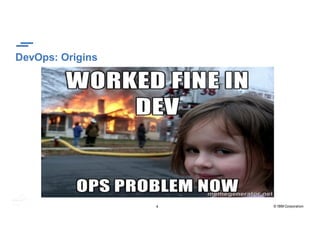
DevOps: Origins
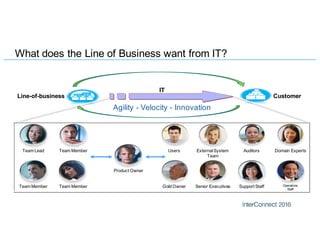
What does the Line of Business want from IT?
Product Owner
Senior Executives
Users Domain ExpertsAuditors
Gold Owner Support Staff
ExternalSystem
Team
Operations
Staff
Team MemberTeam Lead
Team MemberTeam Member
Line-of-business Customer
IT
Agility - Velocity - Innovation
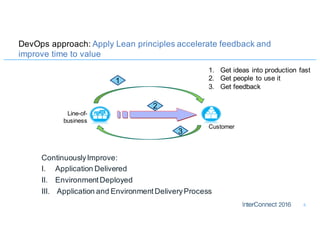
DevOps approach: Apply Lean principles accelerate feedback and
improve time to value
6
People
Process
Line-of-
business
Customer
1
3
2
1. Get ideas into production fast
2. Get people to use it
3. Get feedback
ContinuouslyImprove:
I. Application Delivered
II. EnvironmentDeployed
III. Application and EnvironmentDeliveryProcess
The Real World is Multi-Speed
Adopting DevOps for Multi-Speed IT
8
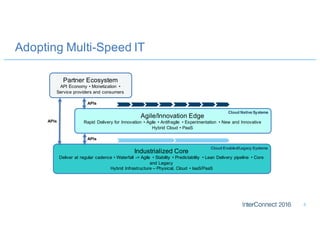
Adopting Multi-Speed IT
Industrialized Core
Deliver at regular cadence • Waterfall -> Agile • Stability • Predictability • Lean Delivery pipeline • Core
and Legacy
Hybrid Infrastructure – Physical, Cloud • IaaS/PaaS
Agile/Innovation Edge
Rapid Delivery for Innovation • Agile • Antifragile • Experimentation • New and Innovative
Hybrid Cloud • PaaS
Partner Ecosystem
API Economy • Monetization •
Service providers and consumers
APIs
APIs
APIs
Cloud Enabled/LegacySystems
Cloud NativeSystems
Evolving to an agile enterprise with Hybrid IT: https://ibm.biz/BdHhdg
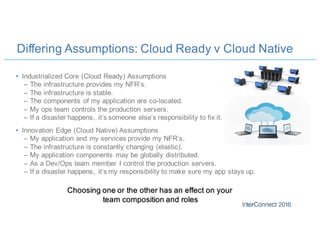
Differing Assumptions: Cloud Ready v Cloud Native
• Industrialized Core (Cloud Ready) Assumptions
– The infrastructure provides my NFR’s.
– The infrastructure is stable.
– The components of my application are co-located.
– My ops team controls the production servers.
– If a disaster happens, it’s someone else’s responsibility to fix it.
• Innovation Edge (Cloud Native) Assumptions
– My application and my services provide my NFR’s.
– The infrastructure is constantly changing (elastic).
– My application components may be globally distributed.
– As a Dev/Ops team member I control the production servers.
– If a disaster happens, it’s my responsibility to make sure my app stays up.
Choosing one or the other has an effect on your
team composition and roles
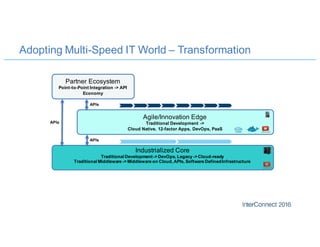
Adopting Multi-Speed IT World – Transformation
Industrialized Core
Traditional Development->DevOps, Legacy ->Cloud-ready
Traditional Middleware ->Middleware on Cloud, APIs, Software DefinedInfrastructure
Agile/Innovation Edge
Traditional Development ->
Cloud Native, 12-factor Apps, DevOps, PaaS
Partner Ecosystem
Point-to-Point Integration -> API
Economy
APIs
APIs
APIs
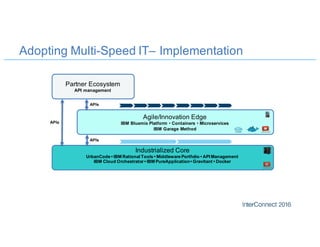
Adopting Multi-Speed IT– Implementation
Industrialized Core
UrbanCode • IBM Rational Tools • Middleware Portfolio • API Management
IBM Cloud Orchestrator • IBM PureApplication• Gravitant • Docker
Agile/Innovation Edge
IBM Bluemix Platform • Containers • Microservices
IBM Garage Method
Partner Ecosystem
API management
APIs
APIs
APIs
Patterns of DevOps Adoption
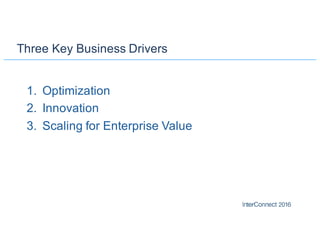
Three Key Business Drivers
1. Optimization
2. Innovation
3. Scaling for Enterprise Value
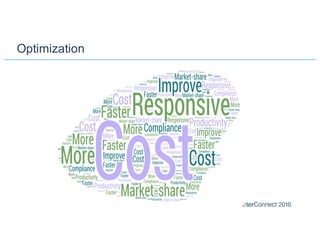
Optimization
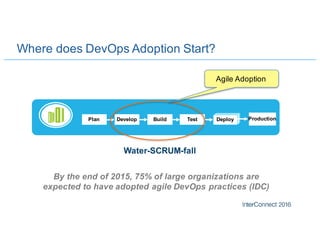
Where does DevOps Adoption Start?
ProductionDevelop Build Test DeployPlan
By the end of 2015, 75% of large organizations are
expected to have adopted agile DevOps practices (IDC)
Agile Adoption
Water-SCRUM-fall
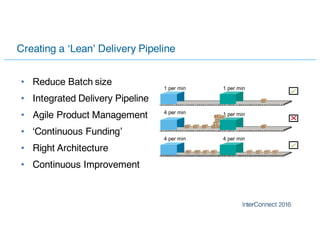
Creating a ‘Lean’ Delivery Pipeline
• Reduce Batch size
• Integrated Delivery Pipeline
• Agile Product Management
• ‘Continuous Funding’
• Right Architecture
• Continuous Improvement
1 per min 1 per min
4 per min 1 per min
4 per min 4 per min
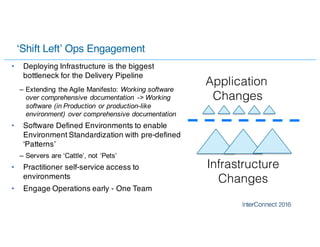
‘Shift Left’ Ops Engagement
• Deploying Infrastructure is the biggest
bottleneck for the Delivery Pipeline
– Extending the Agile Manifesto: Working software
over comprehensive documentation -> Working
software (in Production or production-like
environment) over comprehensive documentation
• Software Defined Environments to enable
Environment Standardization with pre-defined
‘Patterns’
– Servers are ‘Cattle’, not ‘Pets’
• Practitioner self-service access to
environments
• Engage Operations early - One Team
Application
Changes
Infrastructure
Changes
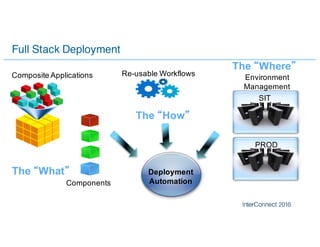
Full Stack Deployment
Composite Applications
Components
Re-usable Workflows Environment
Management
SIT
PROD
The “What”
The “How”
The “Where”
Deployment
Automation
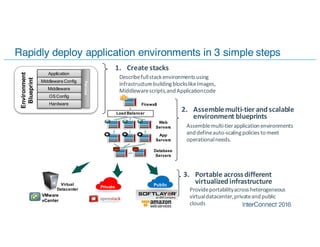
Rapidly deploy application environments in 3 simple steps
Provide	portability	across	heterogeneous	
virtual	datacenter,	private	and	public	
clouds
3. Portable	across	different	
virtualized	infrastructure
Assemble	multi-tier	application	environments	
and	define	auto-scaling	policies	to	meet	
operational	needs.
2. Assemble	multi-tier	and	scalable	
environment	blueprints
1. Create	stacks
Load Balancer
Web
Servers
App
Servers
Database
Servers
Firewall
Describe	full	stack	environments	using	
infrastructure	building	blocks	like	Images,	
Middleware	scripts,	and	Application	code	
VMware
vCenter
Private PublicVirtual
Datacenter
Application
Middleware Config
Middleware
OS Config
Hardware
Environment
Blueprint
Policies
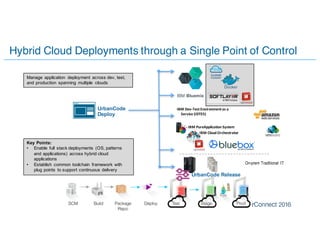
Hybrid Cloud Deployments through a Single Point of Control
IBM Bluemix
On-prem Traditional IT
IBM	Cloud	Orchestrator
IBM	PureApplication	System
Manage application deployment across dev, test,
and production spanning multiple clouds
Key Points:
• Enable full stack deployments (OS, patterns
and applications) across hybrid cloud
applications
• Establish common toolchain framework with
plug points to support continuous delivery
Docker
UrbanCode
Deploy
UrbanCode Release
IBM	Dev-Test	Environment	as	a	
Service	(IDTES)
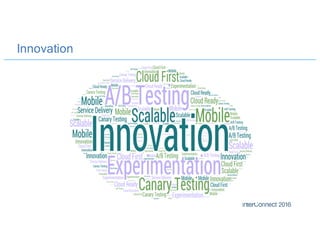
Innovation
The Twelve-Factor App
• A set of best practices for creating applications
– Implementing, deploying, monitoring, and managing
• Typical modern applications
– Deployed in the cloud
– Accessible as web applications that deliver software-as-a-service
• Can be applied to any application
– Implemented in any programming language
– Using any backing services (database, messaging, caching, etc.)
• Addresses common problems
– The dynamics of the organic growth of an app over time
– The dynamics of collaboration between developers
– Avoiding the cost of software erosion
– Systemic problems in modern application development
• Provides a shared vocabulary for addressing these problems
Sources: http://www.12factor.net
http://www.clearlytech.com/2014/01/04/12-factor-apps-plain-english/
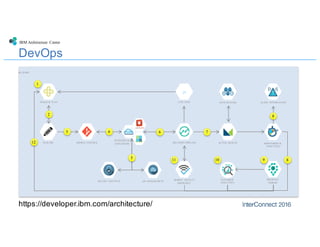
IBM Architecture Center
RUNTIMES &
CONTAINERS
BLUEMIX
DELIVERY PIPELINESOURCE CONTROL
.js
LIVE SYNC
WEB IDE ACTIVE DEPLOY MONITORING &
ANALYTICS
AUTO SCALING ALERT NOTIFICATION
SECURE GATEWAY API MANAGEMENT
TRACK & PLAN
MOBILE QUALITY
ASSURANCE
PRESENCE
INSIGHT
1
2
3 4
5
6 7
8
811 910
12
CUSTOMER
ANALYTICS
DevOps
https://developer.ibm.com/architecture/
Scaling for Enterprise Value
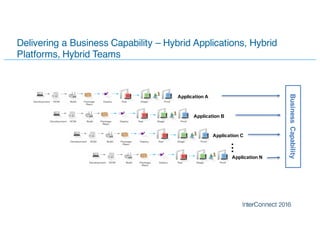
Delivering a Business Capability – Hybrid Applications, Hybrid
Platforms, Hybrid Teams
Application A
Application B
Application C
Application N
BusinessCapability
…
26
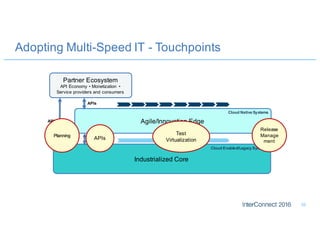
Adopting Multi-Speed IT - Touchpoints
Industrialized Core
Agile/Innovation Edge
Partner Ecosystem
API Economy • Monetization •
Service providers and consumers
APIs
APIs
APIs
Cloud Enabled/LegacySystems
Cloud NativeSystems
Evolving to an agile enterprise with Hybrid IT: https://ibm.biz/BdHhdg
APIs
Test
Virtualization
Release
Manage
ment
Planning
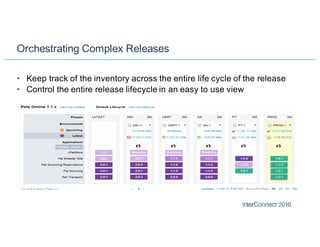
Orchestrating Complex Releases
• Keep track of the inventory across the entire life cycle of the release
• Control the entire release lifecycle in an easy to use view
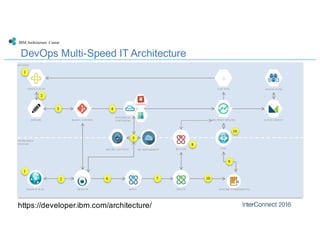
DevOps Multi-Speed IT Architecture
IBM Architecture Center
BLUEMIX
DELIVERY PIPELINESOURCE CONTROL
.js
LIVE SYNC
WEB IDE ACTIVE DEPLOY
AUTO SCALING
SECURE GATEWAY
ON-PREMISES
SYSTEMS
API MANAGEMENT
TRACK & PLAN
TRACK & PLAN DEVELOP BUILD DEPLOY
RELEASE TEST
RUNTIME ENVIRONMENTS
RUNTIMES &
CONTAINERS
1
2
3
6 7
9
10
8
1
2
4
5
10
https://developer.ibm.com/architecture/
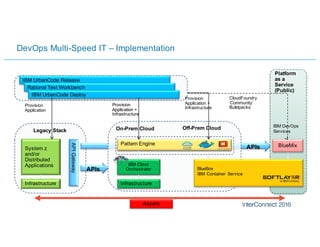
IBM UrbanCode Release
Legacy Stack On-Prem Cloud
Rational Test Workbench
IBM UrbanCode Deploy
Provision
Application
Infrastructure
Private
Cloud
Pattern Engine
Provision
Application +
Infrastructure
Platform
as a
Service
(Public)
BlueMix
Infrastructure
System z
and/or
Distributed
Applications
Provision
Application +
Infrastructure
BlueBox
IBM Container Service
APIGateway
CloudFoundry
‘Community’
Buildpacks
IBM DevOps
Services
APIs
APIs
Off-Prem Cloud
Infrastructure
IBM Cloud
Orchestrator
Pattern Engine
Provision
Application +
Infrastructure
DevOps Multi-Speed IT – Implementation
Aspera
Creating a DevOps Culture
And now for the hard part…
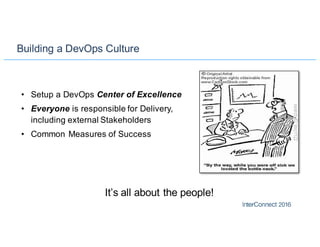
Building a DevOps Culture
• Setup a DevOps Center of Excellence
• Everyone is responsible for Delivery,
including external Stakeholders
• Common Measures of Success
It’s all about the people!
Start Here:
Value Stream Mapping for Identifying and
Addressing bottlenecks
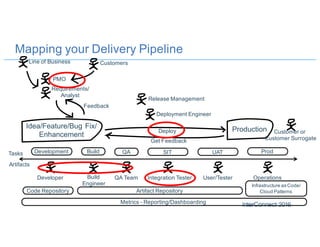
Mapping your Delivery Pipeline
Idea/Feature/Bug Fix/
Enhancement
Production
Development Build QA SIT UAT Prod
PMO
Requirements/
Analyst
Developer
CustomersLine of Business
Build
Engineer
QA Team Integration Tester User/Tester Operations
Artifact Repository
Deployment Engineer
Release Management
Code Repository
Deploy
Get Feedback
Infrastructure as Code/
Cloud Patterns
Feedback
Customer or
Customer Surrogate
Metrics - Reporting/Dashboarding
Tasks
Artifacts
Questions?
34
Notices and Disclaimers
35
Copyright © 2016by International Business Machines Corporation(IBM). No part ofthis document may bereproduced or transmittedin anyform withoutwrittenpermission
from IBM.
U.S. Government UsersRestricted Rights - Use, duplication or disclosure restricted by GSA ADP ScheduleContract with IBM.
Informationin thesepresentations (including informationrelatingto products thathave not yetbeenannounced byIBM) has been reviewedfor accuracy as ofthe dateof
initial publication andcould includeunintentional technical or typographical errors. IBM shall haveno responsibility to update this information.THIS DOCUMENT IS
DISTRIBUTED "ASIS"WITHOUT ANYWARRANTY, EITHER EXPRESSOR IMPLIED. IN NO EVENT SHALLIBM BELIABLEFOR ANY DAMAGEARISING FROM THE
USE OF THIS INFORMATION, INCLUDING BUT NOT LIMITED TO, LOSSOF DATA,BUSINESS INTERRUPTION,LOSS OF PROFIT OR LOSSOF OPPORTUNITY.
IBM products andservicesare warrantedaccording tothe terms andconditions of the agreements under which they areprovided.
Any statements regarding IBM's future direction, intent or product plansaresubject to change or withdrawalwithout notice.
Performancedatacontainedhereinwas generally obtainedin a controlled, isolatedenvironments. Customer examplesare presentedas illustrations of how thosecustomers
have usedIBM products andtheresults theymay have achieved. Actual performance, cost, savingsor other results in other operating environments may vary.
References in this document to IBM products, programs, or services doesnotimply thatIBM intends tomake such products, programs or servicesavailablein all countries in
which IBM operatesor does business.
Workshops, sessions and associatedmaterials may havebeenprepared byindependent sessionspeakers, anddo not necessarily reflect the views of IBM. All materials
and discussionsare provided for informational purposesonly,andare neither intendedto, nor shall constitute legal or other guidanceor adviceto any individual participant or
their specific situation.
It is the customer’s responsibility to insureits own compliancewith legal requirements and toobtainadvice ofcompetent legal counsel as totheidentification and
interpretationof any relevant laws and regulatory requirements that mayaffect the customer’s business andany actions thecustomer may needto taketo comply with such
laws. IBM does not providelegal advice or representor warrantthat its services or products will ensurethat the customer is in compliancewith any law
Notices and Disclaimers Con’t.
36
Informationconcerningnon-IBM productswas obtained from the suppliers of thoseproducts, their publishedannouncementsor other publicly available sources. IBM hasnot
tested thoseproducts in connectionwith this publicationandcannot confirm theaccuracy of performance, compatibility or any other claims related to non-IBM products.
Questionson the capabilities of non-IBM products shouldbe addressedto thesuppliers of thoseproducts.IBM does not warrantthequality of any third-party products, or the
ability of any suchthird-partyproducts to interoperate with IBM’s products. IBM EXPRESSLY DISCLAIMSALL WARRANTIES,EXPRESSED OR IMPLIED, INCLUDINGBUT
NOT LIMITED TO, THE IMPLIED WARRANTIES OF MERCHANTABILITY AND FITNESSFOR A PARTICULAR PURPOSE.
The provision oftheinformation containedh ereinis not intendedto, and does not, grantany right or license under any IBM patents, copyrights, trademarks or other intellectual
property right.
IBM, the IBM logo, ibm.com, Aspera®, Bluemix,BlueworksLive,CICS, Clearcase,Cognos®, DOORS®, Emptoris®, Enterprise Document Management System™, FASP®,
FileNet®, Global BusinessServices ®, Global Technology Services ®, IBM ExperienceOne™,IBM SmartCloud®,IBM Social Business®, Informationon Demand,ILOG,
Maximo®, MQIntegrator®, MQSeries®, Netcool®, OMEGAMON,OpenPower, PureAnalytics™,PureApplication®, pureCluster™, PureCoverage®,PureData®,
PureExperience®, PureFlex®, pureQuery®, pureScale®, PureSystems®,QRadar®, Rational®, Rhapsody®, Smarter Commerce®,SoDA, SPSS, SterlingCommerce®,
StoredIQ,Tealeaf®, Tivoli®, Trusteer®, Unica®, urban{code}®, Watson, WebSphere®,Worklight®, X-Force® and System z® Z/OS, aretrademarks of International Business
Machines Corporation, registeredin many jurisdictions worldwide. Other product andservicenames might betrademarks of IBM or other companies. A current list of IBM
trademarks is availableon the Webat "Copyrightandtrademark information" at: www.ibm.com/legal/copytrade.shtml.
Thank You
Your Feedback is Important!
Access the InterConnect 2016 Conference Attendee
Portal to complete your session surveys from your
smartphone,
laptop or conference kiosk.

A DevOps adoption playbook- achieving business value at scale

  • 1.
    DTA-1460 : ADevOps Adoption Playbook: Achieving Business Value at Scale Sanjeev Sharma CTO, DevOps Technical Sales and Adoption, Distinguished Engineer Lee Reid Executive IT Specialist | IBM Cloud Unit
  • 2.
    Please Note: 1 • IBM’sstatements regarding its plans,directions,and intentare subjectto change or withdrawalwithoutnotice atIBM’s sole discretion. • Information regarding potential future products is intended to outline our general productdirection and itshould notbe relied on in making a purchasing decision. • The information mentioned regarding potential future products is nota commitment, promise,or legal obligation to deliver any material,code or functionality.Information aboutpotentialfuture products may notbe incorporated into any contract. • The development,release,and timing ofany future features or functionality described for our products remains atour sole discretion. • Performance is based on measurements and projections using standard IBM benchmarks in a controlled environment.The actual throughputor performance thatany user will experience willvary depending upon many factors,including considerations such as the amountofmultiprogramming in the user’s job stream,the I/O configuration,the storage configuration,and the workload processed. Therefore,no assurance can be given thatan individual user willachieveresults similar to those stated here.
  • 3.
    Agenda 2 • DevOps refresher •Multi-Speed IT and DevOps • DevOps Adoption Patterns • Culture • Where do I start?
  • 4.
  • 5.
    4 © IBMCorporation DevOps: Origins
  • 6.
    What does theLine of Business want from IT? Product Owner Senior Executives Users Domain ExpertsAuditors Gold Owner Support Staff ExternalSystem Team Operations Staff Team MemberTeam Lead Team MemberTeam Member Line-of-business Customer IT Agility - Velocity - Innovation
  • 7.
    DevOps approach: ApplyLean principles accelerate feedback and improve time to value 6 People Process Line-of- business Customer 1 3 2 1. Get ideas into production fast 2. Get people to use it 3. Get feedback ContinuouslyImprove: I. Application Delivered II. EnvironmentDeployed III. Application and EnvironmentDeliveryProcess
  • 8.
    The Real Worldis Multi-Speed Adopting DevOps for Multi-Speed IT
  • 9.
    8 Adopting Multi-Speed IT IndustrializedCore Deliver at regular cadence • Waterfall -> Agile • Stability • Predictability • Lean Delivery pipeline • Core and Legacy Hybrid Infrastructure – Physical, Cloud • IaaS/PaaS Agile/Innovation Edge Rapid Delivery for Innovation • Agile • Antifragile • Experimentation • New and Innovative Hybrid Cloud • PaaS Partner Ecosystem API Economy • Monetization • Service providers and consumers APIs APIs APIs Cloud Enabled/LegacySystems Cloud NativeSystems Evolving to an agile enterprise with Hybrid IT: https://ibm.biz/BdHhdg
  • 10.
    Differing Assumptions: CloudReady v Cloud Native • Industrialized Core (Cloud Ready) Assumptions – The infrastructure provides my NFR’s. – The infrastructure is stable. – The components of my application are co-located. – My ops team controls the production servers. – If a disaster happens, it’s someone else’s responsibility to fix it. • Innovation Edge (Cloud Native) Assumptions – My application and my services provide my NFR’s. – The infrastructure is constantly changing (elastic). – My application components may be globally distributed. – As a Dev/Ops team member I control the production servers. – If a disaster happens, it’s my responsibility to make sure my app stays up. Choosing one or the other has an effect on your team composition and roles
  • 11.
    Adopting Multi-Speed ITWorld – Transformation Industrialized Core Traditional Development->DevOps, Legacy ->Cloud-ready Traditional Middleware ->Middleware on Cloud, APIs, Software DefinedInfrastructure Agile/Innovation Edge Traditional Development -> Cloud Native, 12-factor Apps, DevOps, PaaS Partner Ecosystem Point-to-Point Integration -> API Economy APIs APIs APIs
  • 12.
    Adopting Multi-Speed IT–Implementation Industrialized Core UrbanCode • IBM Rational Tools • Middleware Portfolio • API Management IBM Cloud Orchestrator • IBM PureApplication• Gravitant • Docker Agile/Innovation Edge IBM Bluemix Platform • Containers • Microservices IBM Garage Method Partner Ecosystem API management APIs APIs APIs
  • 13.
  • 14.
    Three Key BusinessDrivers 1. Optimization 2. Innovation 3. Scaling for Enterprise Value
  • 15.
  • 16.
    Where does DevOpsAdoption Start? ProductionDevelop Build Test DeployPlan By the end of 2015, 75% of large organizations are expected to have adopted agile DevOps practices (IDC) Agile Adoption Water-SCRUM-fall
  • 17.
    Creating a ‘Lean’Delivery Pipeline • Reduce Batch size • Integrated Delivery Pipeline • Agile Product Management • ‘Continuous Funding’ • Right Architecture • Continuous Improvement 1 per min 1 per min 4 per min 1 per min 4 per min 4 per min
  • 18.
    ‘Shift Left’ OpsEngagement • Deploying Infrastructure is the biggest bottleneck for the Delivery Pipeline – Extending the Agile Manifesto: Working software over comprehensive documentation -> Working software (in Production or production-like environment) over comprehensive documentation • Software Defined Environments to enable Environment Standardization with pre-defined ‘Patterns’ – Servers are ‘Cattle’, not ‘Pets’ • Practitioner self-service access to environments • Engage Operations early - One Team Application Changes Infrastructure Changes
  • 19.
    Full Stack Deployment CompositeApplications Components Re-usable Workflows Environment Management SIT PROD The “What” The “How” The “Where” Deployment Automation
  • 20.
    Rapidly deploy applicationenvironments in 3 simple steps Provide portability across heterogeneous virtual datacenter, private and public clouds 3. Portable across different virtualized infrastructure Assemble multi-tier application environments and define auto-scaling policies to meet operational needs. 2. Assemble multi-tier and scalable environment blueprints 1. Create stacks Load Balancer Web Servers App Servers Database Servers Firewall Describe full stack environments using infrastructure building blocks like Images, Middleware scripts, and Application code VMware vCenter Private PublicVirtual Datacenter Application Middleware Config Middleware OS Config Hardware Environment Blueprint Policies
  • 21.
    Hybrid Cloud Deploymentsthrough a Single Point of Control IBM Bluemix On-prem Traditional IT IBM Cloud Orchestrator IBM PureApplication System Manage application deployment across dev, test, and production spanning multiple clouds Key Points: • Enable full stack deployments (OS, patterns and applications) across hybrid cloud applications • Establish common toolchain framework with plug points to support continuous delivery Docker UrbanCode Deploy UrbanCode Release IBM Dev-Test Environment as a Service (IDTES)
  • 22.
  • 23.
    The Twelve-Factor App •A set of best practices for creating applications – Implementing, deploying, monitoring, and managing • Typical modern applications – Deployed in the cloud – Accessible as web applications that deliver software-as-a-service • Can be applied to any application – Implemented in any programming language – Using any backing services (database, messaging, caching, etc.) • Addresses common problems – The dynamics of the organic growth of an app over time – The dynamics of collaboration between developers – Avoiding the cost of software erosion – Systemic problems in modern application development • Provides a shared vocabulary for addressing these problems Sources: http://www.12factor.net http://www.clearlytech.com/2014/01/04/12-factor-apps-plain-english/
  • 24.
    IBM Architecture Center RUNTIMES& CONTAINERS BLUEMIX DELIVERY PIPELINESOURCE CONTROL .js LIVE SYNC WEB IDE ACTIVE DEPLOY MONITORING & ANALYTICS AUTO SCALING ALERT NOTIFICATION SECURE GATEWAY API MANAGEMENT TRACK & PLAN MOBILE QUALITY ASSURANCE PRESENCE INSIGHT 1 2 3 4 5 6 7 8 811 910 12 CUSTOMER ANALYTICS DevOps https://developer.ibm.com/architecture/
  • 25.
  • 26.
    Delivering a BusinessCapability – Hybrid Applications, Hybrid Platforms, Hybrid Teams Application A Application B Application C Application N BusinessCapability …
  • 27.
    26 Adopting Multi-Speed IT- Touchpoints Industrialized Core Agile/Innovation Edge Partner Ecosystem API Economy • Monetization • Service providers and consumers APIs APIs APIs Cloud Enabled/LegacySystems Cloud NativeSystems Evolving to an agile enterprise with Hybrid IT: https://ibm.biz/BdHhdg APIs Test Virtualization Release Manage ment Planning
  • 28.
    Orchestrating Complex Releases •Keep track of the inventory across the entire life cycle of the release • Control the entire release lifecycle in an easy to use view
  • 29.
    DevOps Multi-Speed ITArchitecture IBM Architecture Center BLUEMIX DELIVERY PIPELINESOURCE CONTROL .js LIVE SYNC WEB IDE ACTIVE DEPLOY AUTO SCALING SECURE GATEWAY ON-PREMISES SYSTEMS API MANAGEMENT TRACK & PLAN TRACK & PLAN DEVELOP BUILD DEPLOY RELEASE TEST RUNTIME ENVIRONMENTS RUNTIMES & CONTAINERS 1 2 3 6 7 9 10 8 1 2 4 5 10 https://developer.ibm.com/architecture/
  • 30.
    IBM UrbanCode Release LegacyStack On-Prem Cloud Rational Test Workbench IBM UrbanCode Deploy Provision Application Infrastructure Private Cloud Pattern Engine Provision Application + Infrastructure Platform as a Service (Public) BlueMix Infrastructure System z and/or Distributed Applications Provision Application + Infrastructure BlueBox IBM Container Service APIGateway CloudFoundry ‘Community’ Buildpacks IBM DevOps Services APIs APIs Off-Prem Cloud Infrastructure IBM Cloud Orchestrator Pattern Engine Provision Application + Infrastructure DevOps Multi-Speed IT – Implementation Aspera
  • 31.
    Creating a DevOpsCulture And now for the hard part…
  • 32.
    Building a DevOpsCulture • Setup a DevOps Center of Excellence • Everyone is responsible for Delivery, including external Stakeholders • Common Measures of Success It’s all about the people!
  • 33.
    Start Here: Value StreamMapping for Identifying and Addressing bottlenecks
  • 34.
    Mapping your DeliveryPipeline Idea/Feature/Bug Fix/ Enhancement Production Development Build QA SIT UAT Prod PMO Requirements/ Analyst Developer CustomersLine of Business Build Engineer QA Team Integration Tester User/Tester Operations Artifact Repository Deployment Engineer Release Management Code Repository Deploy Get Feedback Infrastructure as Code/ Cloud Patterns Feedback Customer or Customer Surrogate Metrics - Reporting/Dashboarding Tasks Artifacts
  • 35.
  • 36.
    Notices and Disclaimers 35 Copyright© 2016by International Business Machines Corporation(IBM). No part ofthis document may bereproduced or transmittedin anyform withoutwrittenpermission from IBM. U.S. Government UsersRestricted Rights - Use, duplication or disclosure restricted by GSA ADP ScheduleContract with IBM. Informationin thesepresentations (including informationrelatingto products thathave not yetbeenannounced byIBM) has been reviewedfor accuracy as ofthe dateof initial publication andcould includeunintentional technical or typographical errors. IBM shall haveno responsibility to update this information.THIS DOCUMENT IS DISTRIBUTED "ASIS"WITHOUT ANYWARRANTY, EITHER EXPRESSOR IMPLIED. IN NO EVENT SHALLIBM BELIABLEFOR ANY DAMAGEARISING FROM THE USE OF THIS INFORMATION, INCLUDING BUT NOT LIMITED TO, LOSSOF DATA,BUSINESS INTERRUPTION,LOSS OF PROFIT OR LOSSOF OPPORTUNITY. IBM products andservicesare warrantedaccording tothe terms andconditions of the agreements under which they areprovided. Any statements regarding IBM's future direction, intent or product plansaresubject to change or withdrawalwithout notice. Performancedatacontainedhereinwas generally obtainedin a controlled, isolatedenvironments. Customer examplesare presentedas illustrations of how thosecustomers have usedIBM products andtheresults theymay have achieved. Actual performance, cost, savingsor other results in other operating environments may vary. References in this document to IBM products, programs, or services doesnotimply thatIBM intends tomake such products, programs or servicesavailablein all countries in which IBM operatesor does business. Workshops, sessions and associatedmaterials may havebeenprepared byindependent sessionspeakers, anddo not necessarily reflect the views of IBM. All materials and discussionsare provided for informational purposesonly,andare neither intendedto, nor shall constitute legal or other guidanceor adviceto any individual participant or their specific situation. It is the customer’s responsibility to insureits own compliancewith legal requirements and toobtainadvice ofcompetent legal counsel as totheidentification and interpretationof any relevant laws and regulatory requirements that mayaffect the customer’s business andany actions thecustomer may needto taketo comply with such laws. IBM does not providelegal advice or representor warrantthat its services or products will ensurethat the customer is in compliancewith any law
  • 37.
    Notices and DisclaimersCon’t. 36 Informationconcerningnon-IBM productswas obtained from the suppliers of thoseproducts, their publishedannouncementsor other publicly available sources. IBM hasnot tested thoseproducts in connectionwith this publicationandcannot confirm theaccuracy of performance, compatibility or any other claims related to non-IBM products. Questionson the capabilities of non-IBM products shouldbe addressedto thesuppliers of thoseproducts.IBM does not warrantthequality of any third-party products, or the ability of any suchthird-partyproducts to interoperate with IBM’s products. IBM EXPRESSLY DISCLAIMSALL WARRANTIES,EXPRESSED OR IMPLIED, INCLUDINGBUT NOT LIMITED TO, THE IMPLIED WARRANTIES OF MERCHANTABILITY AND FITNESSFOR A PARTICULAR PURPOSE. The provision oftheinformation containedh ereinis not intendedto, and does not, grantany right or license under any IBM patents, copyrights, trademarks or other intellectual property right. IBM, the IBM logo, ibm.com, Aspera®, Bluemix,BlueworksLive,CICS, Clearcase,Cognos®, DOORS®, Emptoris®, Enterprise Document Management System™, FASP®, FileNet®, Global BusinessServices ®, Global Technology Services ®, IBM ExperienceOne™,IBM SmartCloud®,IBM Social Business®, Informationon Demand,ILOG, Maximo®, MQIntegrator®, MQSeries®, Netcool®, OMEGAMON,OpenPower, PureAnalytics™,PureApplication®, pureCluster™, PureCoverage®,PureData®, PureExperience®, PureFlex®, pureQuery®, pureScale®, PureSystems®,QRadar®, Rational®, Rhapsody®, Smarter Commerce®,SoDA, SPSS, SterlingCommerce®, StoredIQ,Tealeaf®, Tivoli®, Trusteer®, Unica®, urban{code}®, Watson, WebSphere®,Worklight®, X-Force® and System z® Z/OS, aretrademarks of International Business Machines Corporation, registeredin many jurisdictions worldwide. Other product andservicenames might betrademarks of IBM or other companies. A current list of IBM trademarks is availableon the Webat "Copyrightandtrademark information" at: www.ibm.com/legal/copytrade.shtml.
  • 38.
    Thank You Your Feedbackis Important! Access the InterConnect 2016 Conference Attendee Portal to complete your session surveys from your smartphone, laptop or conference kiosk.