Using Lean Thinking to identify and 
address Delivery Pipeline bottlenecks 
Sanjeev Sharma 
IBM WW Lead, DevOps Technical Sales 
@sd_architect 
© 2013 IBM Corporation
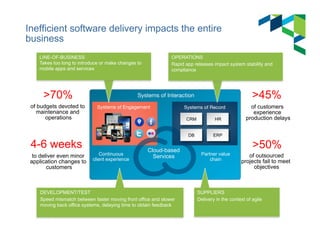
Inefficient software delivery impacts the entire 
business 
OPERATIONS 
Rapid app releases impact system stability and 
compliance 
Systems of Interaction 
Systems of Record 
Systems of Engagement 
Continuous 
client experience 
Partner value 
chain 
Cloud-based 
Services 
>45% 
of customers 
experience 
production delays 
>50% 
of outsourced 
projects fail to meet 
objectives 
>70% 
of budgets devoted to 
maintenance and 
operations 
4-6 weeks 
to deliver even minor 
application changes to 
customers 
DEVELOPMENT/TEST 
Speed mismatch between faster moving front office and slower 
moving back office systems, delaying time to obtain feedback 
SUPPLIERS 
Delivery in the context of agile 
LINE-OF-BUSINESS 
Takes too long to introduce or make changes to 
mobile apps and services 
CRM HR 
DB ERP
3 
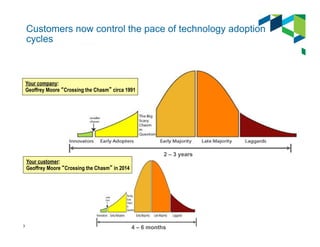
Customers now control the pace of technology adoption 
cycles 
Your company: 
Geoffrey Moore “Crossing the Chasm” circa 1991 
Your customer: 
Geoffrey Moore “Crossing the Chasm” in 2014 
2 – 3 years 
4 – 6 months
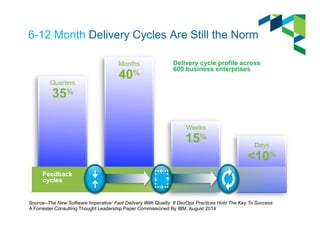
6-12 Month Delivery Cycles Are Still the Norm 
Delivery cycle profile across 
600 business enterprises 
Days 
<10% 
Quarters 
35% 
Months 
40% 
Weeks 
15% 
Feedback 
cycles 
Source--The New Software Imperative: Fast Delivery With Quality: 8 DevOps Practices Hold The Key To Success 
A Forrester Consulting Thought Leadership Paper Commissioned By IBM, August 2014
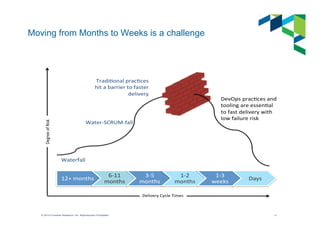
Moving from Months to Weeks is a challenge 
TradiAonal"pracAces" 
hit"a"barrier"to"faster" 
delivery" 
Water,SCRUM,fall" 
Waterfall" 
12+"months" 6,11" 
months" 
3,5" 
months" 
1,2" 
months" 
DevOps"pracAces"and" 
tooling"are"essenAal" 
to"fast"delivery"with" 
low"failure"risk" 
1,3" 
weeks" Days" 
"""Degree"of"Risk"_" 
""Delivery"Cycle"Times_" 
© 2014 Forrester Research, Inc. Reproduction Prohibited 11"
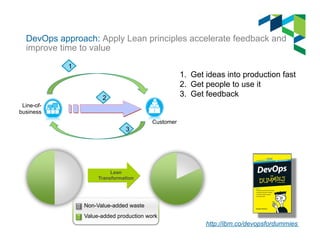
DevOps approach: Apply Lean principles accelerate feedback and 
improve time to value 
Line-of-business 
Customer 
1 
3 
2 
1. Get ideas into production fast 
2. Get people to use it 
3. Get feedback 
Lean 
Transformation 
Non-Value-added waste 
Value-added production work 
http://ibm.co/devopsfordummies
DevOps == Continuous Improvement" 
Leverage feedback across the Delivery Pipeline to 
Continuously Improve: 
I. Application Delivered 
II. Environment Deployed 
III. Application and Environment Delivery Process
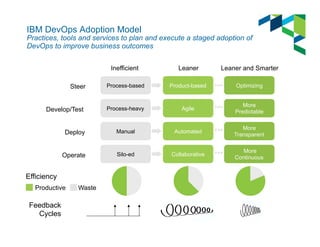
IBM DevOps Adoption Model 
Practices, tools and services to plan and execute a staged adoption of 
DevOps to improve business outcomes 
Efficiency 
Productive Waste 
Feedback 
Cycles 
Steer Product-based 
Agile 
Automated 
Collaborative 
Optimizing 
More 
Predictable 
More 
Transparent 
More 
Continuous 
Process-based 
Process-heavy 
Manual 
Silo-ed 
Develop/Test 
Deploy 
Operate 
Inefficient Leaner Leaner and Smarter
9 
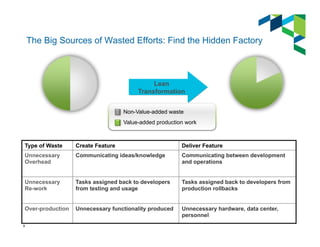
The Big Sources of Wasted Efforts: Find the Hidden Factory 
Non-Value-added waste 
Value-added production work 
Type of Waste Create Feature Deliver Feature 
Unnecessary 
Overhead 
Communicating ideas/knowledge Communicating between development 
and operations 
Unnecessary 
Re-work 
Tasks assigned back to developers 
from testing and usage 
Tasks assigned back to developers from 
production rollbacks 
Over-production 
Unnecessary functionality produced Unnecessary hardware, data center, 
personnel 
Lean 
Transformation
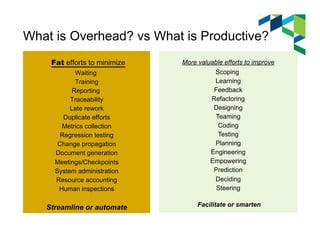
What is Overhead? vs What is Productive? 
Fat efforts to minimize 
Waiting 
Training 
Reporting 
Traceability 
Late rework 
Duplicate efforts 
Metrics collection 
Regression testing 
Change propagation 
Document generation 
Meetings/Checkpoints 
System administration 
Resource accounting 
Human inspections 
Streamline or automate 
More valuable efforts to improve 
Scoping 
Learning 
Feedback 
Refactoring 
Designing 
Teaming 
Coding 
Testing 
Planning 
Engineering 
Empowering 
Prediction 
Deciding 
Steering 
Facilitate or smarten
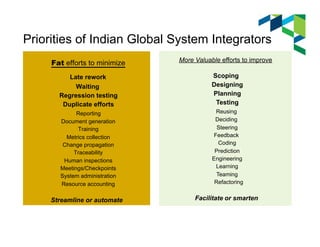
Priorities of Indian Global System Integrators 
Fat efforts to minimize 
Late rework 
Waiting 
Regression testing 
Duplicate efforts 
Reporting 
Document generation 
Training 
Metrics collection 
Change propagation 
Traceability 
Human inspections 
Meetings/Checkpoints 
System administration 
Resource accounting 
Streamline or automate 
More Valuable efforts to improve 
Scoping 
Designing 
Planning 
Testing 
Reusing 
Deciding 
Steering 
Feedback 
Coding 
Prediction 
Engineering 
Learning 
Teaming 
Refactoring 
Facilitate or smarten
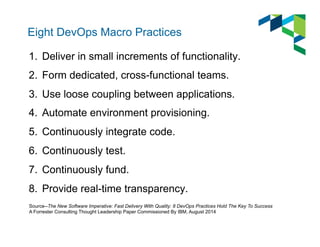
Eight DevOps Macro Practices 
1. Deliver in small increments of functionality. 
2. Form dedicated, cross-functional teams. 
3. Use loose coupling between applications. 
4. Automate environment provisioning. 
5. Continuously integrate code. 
6. Continuously test. 
7. Continuously fund. 
8. Provide real-time transparency. 
Source--The New Software Imperative: Fast Delivery With Quality: 8 DevOps Practices Hold The Key To Success 
A Forrester Consulting Thought Leadership Paper Commissioned By IBM, August 2014
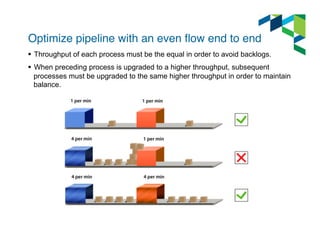
Optimize pipeline with an even flow end to end" 
§ Throughput of each process must be the equal in order to avoid backlogs. 
§ When preceding process is upgraded to a higher throughput, subsequent 
processes must be upgraded to the same higher throughput in order to maintain 
balance.
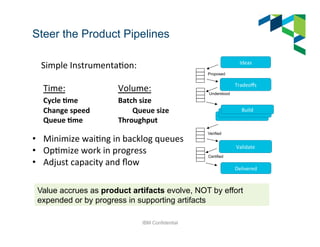
Steer the Product Pipelines 
Build 
Value accrues as product artifacts evolve, NOT by effort 
expended or by progress in supporting artifacts 
IBM Confidential 
Ideas 
Tradeoffs 
Delivered 
Simple 
Instrumenta5on: 
Time: 
Volume: 
Cycle 
'me 
Batch 
size 
Change 
speed 
Queue 
size 
Queue 
'me 
Throughput 
• Minimize 
wai5ng 
in 
backlog 
queues 
• Op5mize 
work 
in 
progress 
• Adjust 
capacity 
and 
flow 
Validate 
Proposed 
Understood 
Verified 
Certified
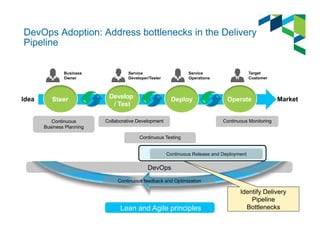
DevOps Adoption: Address bottlenecks in the Delivery 
Pipeline 
Develop 
/ Test 
Steer Deploy Operate 
Collaborative Development 
Continuous Testing 
Continuous Release and Deployment 
Business 
Owner 
Service 
Developer/Tester 
Service 
Operations 
Target 
Customer 
Idea Market 
DevOps 
Continuous 
Business Planning 
Continuous Monitoring 
Continuous feedback and Optimization 
Lean and Agile principles 
Identify Delivery 
Pipeline 
Bottlenecks
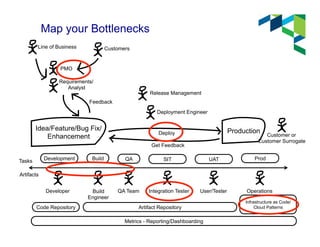
Map your Bottlenecks 
Line of Business Customers 
PMO 
Requirements/ 
Analyst 
Idea/Feature/Bug Fix/ 
Enhancement 
Production 
Release Management 
Deployment Engineer 
Development Build QA SIT UAT Prod 
Developer 
Build 
Engineer 
QA Team Integration Tester User/Tester Operations 
Artifact Repository 
Code Repository 
Deploy 
Get Feedback 
Infrastructure as Code/ 
Cloud Patterns 
Feedback 
Customer or 
Customer Surrogate 
Metrics - Reporting/Dashboarding 
Tasks 
Artifacts
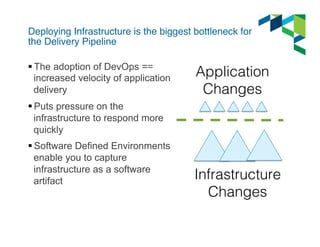
Deploying Infrastructure is the biggest bottleneck for 
the Delivery Pipeline " 
§ The adoption of DevOps == 
increased velocity of application 
delivery 
§ Puts pressure on the 
infrastructure to respond more 
quickly 
§ Software Defined Environments 
enable you to capture 
infrastructure as a software 
artifact 
Application ! 
Changes! 
Infrastructure! 
Changes!
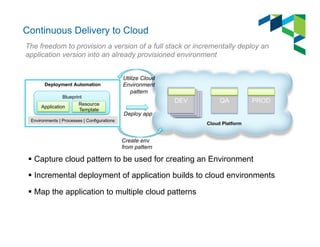
Continuous Delivery to Cloud 
The freedom to provision a version of a full stack or incrementally deploy an 
application version into an already provisioned environment 
Deployment Automation 
Blueprint 
Application Resource 
Template 
Environments | Processes | Configurations 
Utilize Cloud 
Environment 
pattern 
Deploy app 
Create env 
from pattern 
DDEDEDVEVE V V QA PROD 
Cloud Platform 
§ Capture cloud pattern to be used for creating an Environment 
§ Incremental deployment of application builds to cloud environments 
§ Map the application to multiple cloud patterns
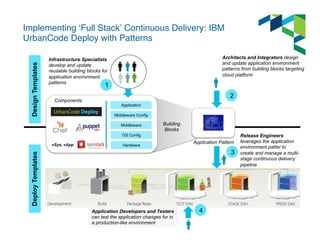
Implementing ‘Full Stack’ Continuous Delivery: IBM 
UrbanCode Deploy with Patterns" 
Infrastructure Specialists 
develop and update 
reusable building blocks for 
application environment 
patterns 1 
Components 
Architects and Integrators design 
and update application environment 
patterns from building blocks targeting 
cloud platform 
2 
Application Pattern 
Building 
Blocks 
3 
Release Engineers 
leverages the application 
environment patter to 
create and manage a multi-stage 
continuous delivery 
pipeline 
Application Developers and Testers 4 
can test the application changes for in 
a production-like environment 
Deploy Templates Design Templates 
vSys, vApp 
Application 
Middleware Config 
Middleware 
OS Config 
Hardware
20 
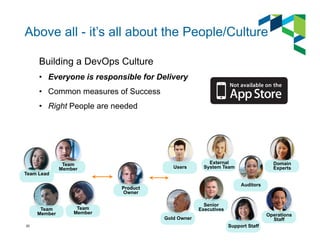
Building a DevOps Culture 
• Everyone is responsible for Delivery 
• Common measures of Success 
• Right People are needed 
Product 
Owner 
Team 
Member 
Team Lead 
Team 
Member 
Team 
Member 
External 
System Team 
Senior 
Executives 
Users 
Domain 
Experts 
Auditors 
Gold Owner 
Support Staff 
Operations 
Staff 
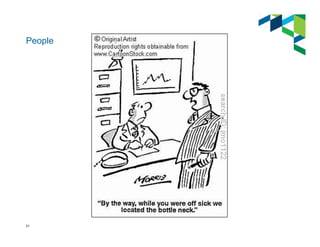
Above all - it’s all about the People/Culture
People 
21
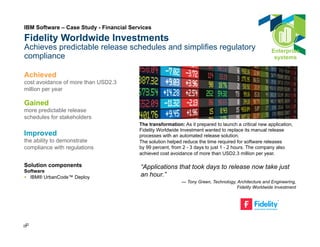
Fidelity Worldwide Investments 
Achieves predictable release schedules and simplifies regulatory 
compliance 
Achieved 
cost avoidance of more than USD2.3 
million per year 
Gained 
more predictable release 
schedules for stakeholders 
Improved 
the ability to demonstrate 
compliance with regulations 
Solution components 
Software 
§ IBM® UrbanCode™ Deploy 
222 2 
The transformation: As it prepared to launch a critical new application, 
Fidelity Worldwide Investment wanted to replace its manual release 
processes with an automated release solution. 
The solution helped reduce the time required for software releases 
by 99 percent, from 2 - 3 days to just 1 - 2 hours. The company also 
achieved cost avoidance of more than USD2.3 million per year. 
“Applications that took days to release now take just 
an hour.” 
— Tony Green, Technology, Architecture and Engineering, 
Fidelity Worldwide Investment 
IBM Software – Case Study - Financial Services 
Enterprise 
systems
Sandhata accelerates software delivery and improves 
competitiveness with continuous testing 
Adoption path: Develop/Test 
100% increase in team productivity 
Doubled the division’s project delivery 
capacity from 40 to 
80 projects 
88% reduction in production 
incidents 
Identified and resolved defects 
earlier in the release cycle 
Tens of millions in new revenue 
generated 
Increased agility to seize new 
market opportunities 
23 
Continuous 
Testing 
“IBM’s service virtualization and test automation 
solutions enabled our banking client to embrace 
an agile, DevOps approach and perform 
integration testing continuously throughout the 
development process. They recouped their IBM 
investment in less than three months.” 
— Gary Thornhill, 
Delivery Director Sandhata Technologies Ltd
DevOps approach speeds IBM Watson solutions to 
market 
Adoption path: Develop/Test 
Reduced delivery cycles 
from nine weeks to three weeks 
Compact releases 
better matched to customer 
expectations 
Zero maintenance window 
downtime through continuous 
availability 
24 
Collaborative 
Development 
“DevOps helps us achieve continuous delivery and 
deliver continuous value.” 
— Carl Kraenzel, Director of the Watson 
Managed services group, IBM Distinguished Engineer, IBM
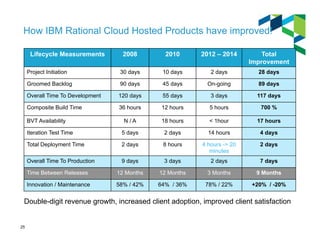
How IBM Rational Cloud Hosted Products have improved! 
Lifecycle Measurements 2008 2010 2012 – 2014 Total 
Improvement 
Project Initiation 30 days 10 days 2 days 28 days 
Groomed Backlog 90 days 45 days On-going 89 days 
Overall Time To Development 120 days 55 days 3 days 117 days 
Composite Build Time 36 hours 12 hours 5 hours 700 % 
BVT Availability N / A 18 hours < 1hour 17 hours 
Iteration Test Time 5 days 2 days 14 hours 4 days 
Total Deployment Time 2 days 8 hours 4 hours -> 20 
minutes 
2 days 
Overall Time To Production 9 days 3 days 2 days 7 days 
Time Between Releases 12 Months 12 Months 3 Months 9 Months 
Innovation / Maintenance 58% / 42% 64% / 36% 78% / 22% +20% / -20% 
Double-digit revenue growth, increased client adoption, improved client satisfaction 
25

Using Lean Thinking to identify and address Delivery Pipeline bottlenecks

  • 1.
    Using Lean Thinkingto identify and address Delivery Pipeline bottlenecks Sanjeev Sharma IBM WW Lead, DevOps Technical Sales @sd_architect © 2013 IBM Corporation
  • 2.
    Inefficient software deliveryimpacts the entire business OPERATIONS Rapid app releases impact system stability and compliance Systems of Interaction Systems of Record Systems of Engagement Continuous client experience Partner value chain Cloud-based Services >45% of customers experience production delays >50% of outsourced projects fail to meet objectives >70% of budgets devoted to maintenance and operations 4-6 weeks to deliver even minor application changes to customers DEVELOPMENT/TEST Speed mismatch between faster moving front office and slower moving back office systems, delaying time to obtain feedback SUPPLIERS Delivery in the context of agile LINE-OF-BUSINESS Takes too long to introduce or make changes to mobile apps and services CRM HR DB ERP
  • 3.
    3 Customers nowcontrol the pace of technology adoption cycles Your company: Geoffrey Moore “Crossing the Chasm” circa 1991 Your customer: Geoffrey Moore “Crossing the Chasm” in 2014 2 – 3 years 4 – 6 months
  • 4.
    6-12 Month DeliveryCycles Are Still the Norm Delivery cycle profile across 600 business enterprises Days <10% Quarters 35% Months 40% Weeks 15% Feedback cycles Source--The New Software Imperative: Fast Delivery With Quality: 8 DevOps Practices Hold The Key To Success A Forrester Consulting Thought Leadership Paper Commissioned By IBM, August 2014
  • 5.
    Moving from Monthsto Weeks is a challenge TradiAonal"pracAces" hit"a"barrier"to"faster" delivery" Water,SCRUM,fall" Waterfall" 12+"months" 6,11" months" 3,5" months" 1,2" months" DevOps"pracAces"and" tooling"are"essenAal" to"fast"delivery"with" low"failure"risk" 1,3" weeks" Days" """Degree"of"Risk"_" ""Delivery"Cycle"Times_" © 2014 Forrester Research, Inc. Reproduction Prohibited 11"
  • 6.
    DevOps approach: ApplyLean principles accelerate feedback and improve time to value Line-of-business Customer 1 3 2 1. Get ideas into production fast 2. Get people to use it 3. Get feedback Lean Transformation Non-Value-added waste Value-added production work http://ibm.co/devopsfordummies
  • 7.
    DevOps == ContinuousImprovement" Leverage feedback across the Delivery Pipeline to Continuously Improve: I. Application Delivered II. Environment Deployed III. Application and Environment Delivery Process
  • 8.
    IBM DevOps AdoptionModel Practices, tools and services to plan and execute a staged adoption of DevOps to improve business outcomes Efficiency Productive Waste Feedback Cycles Steer Product-based Agile Automated Collaborative Optimizing More Predictable More Transparent More Continuous Process-based Process-heavy Manual Silo-ed Develop/Test Deploy Operate Inefficient Leaner Leaner and Smarter
  • 9.
    9 The BigSources of Wasted Efforts: Find the Hidden Factory Non-Value-added waste Value-added production work Type of Waste Create Feature Deliver Feature Unnecessary Overhead Communicating ideas/knowledge Communicating between development and operations Unnecessary Re-work Tasks assigned back to developers from testing and usage Tasks assigned back to developers from production rollbacks Over-production Unnecessary functionality produced Unnecessary hardware, data center, personnel Lean Transformation
  • 10.
    What is Overhead?vs What is Productive? Fat efforts to minimize Waiting Training Reporting Traceability Late rework Duplicate efforts Metrics collection Regression testing Change propagation Document generation Meetings/Checkpoints System administration Resource accounting Human inspections Streamline or automate More valuable efforts to improve Scoping Learning Feedback Refactoring Designing Teaming Coding Testing Planning Engineering Empowering Prediction Deciding Steering Facilitate or smarten
  • 11.
    Priorities of IndianGlobal System Integrators Fat efforts to minimize Late rework Waiting Regression testing Duplicate efforts Reporting Document generation Training Metrics collection Change propagation Traceability Human inspections Meetings/Checkpoints System administration Resource accounting Streamline or automate More Valuable efforts to improve Scoping Designing Planning Testing Reusing Deciding Steering Feedback Coding Prediction Engineering Learning Teaming Refactoring Facilitate or smarten
  • 12.
    Eight DevOps MacroPractices 1. Deliver in small increments of functionality. 2. Form dedicated, cross-functional teams. 3. Use loose coupling between applications. 4. Automate environment provisioning. 5. Continuously integrate code. 6. Continuously test. 7. Continuously fund. 8. Provide real-time transparency. Source--The New Software Imperative: Fast Delivery With Quality: 8 DevOps Practices Hold The Key To Success A Forrester Consulting Thought Leadership Paper Commissioned By IBM, August 2014
  • 13.
    Optimize pipeline withan even flow end to end" § Throughput of each process must be the equal in order to avoid backlogs. § When preceding process is upgraded to a higher throughput, subsequent processes must be upgraded to the same higher throughput in order to maintain balance.
  • 14.
    Steer the ProductPipelines Build Value accrues as product artifacts evolve, NOT by effort expended or by progress in supporting artifacts IBM Confidential Ideas Tradeoffs Delivered Simple Instrumenta5on: Time: Volume: Cycle 'me Batch size Change speed Queue size Queue 'me Throughput • Minimize wai5ng in backlog queues • Op5mize work in progress • Adjust capacity and flow Validate Proposed Understood Verified Certified
  • 15.
    DevOps Adoption: Addressbottlenecks in the Delivery Pipeline Develop / Test Steer Deploy Operate Collaborative Development Continuous Testing Continuous Release and Deployment Business Owner Service Developer/Tester Service Operations Target Customer Idea Market DevOps Continuous Business Planning Continuous Monitoring Continuous feedback and Optimization Lean and Agile principles Identify Delivery Pipeline Bottlenecks
  • 16.
    Map your Bottlenecks Line of Business Customers PMO Requirements/ Analyst Idea/Feature/Bug Fix/ Enhancement Production Release Management Deployment Engineer Development Build QA SIT UAT Prod Developer Build Engineer QA Team Integration Tester User/Tester Operations Artifact Repository Code Repository Deploy Get Feedback Infrastructure as Code/ Cloud Patterns Feedback Customer or Customer Surrogate Metrics - Reporting/Dashboarding Tasks Artifacts
  • 17.
    Deploying Infrastructure isthe biggest bottleneck for the Delivery Pipeline " § The adoption of DevOps == increased velocity of application delivery § Puts pressure on the infrastructure to respond more quickly § Software Defined Environments enable you to capture infrastructure as a software artifact Application ! Changes! Infrastructure! Changes!
  • 18.
    Continuous Delivery toCloud The freedom to provision a version of a full stack or incrementally deploy an application version into an already provisioned environment Deployment Automation Blueprint Application Resource Template Environments | Processes | Configurations Utilize Cloud Environment pattern Deploy app Create env from pattern DDEDEDVEVE V V QA PROD Cloud Platform § Capture cloud pattern to be used for creating an Environment § Incremental deployment of application builds to cloud environments § Map the application to multiple cloud patterns
  • 19.
    Implementing ‘Full Stack’Continuous Delivery: IBM UrbanCode Deploy with Patterns" Infrastructure Specialists develop and update reusable building blocks for application environment patterns 1 Components Architects and Integrators design and update application environment patterns from building blocks targeting cloud platform 2 Application Pattern Building Blocks 3 Release Engineers leverages the application environment patter to create and manage a multi-stage continuous delivery pipeline Application Developers and Testers 4 can test the application changes for in a production-like environment Deploy Templates Design Templates vSys, vApp Application Middleware Config Middleware OS Config Hardware
  • 20.
    20 Building aDevOps Culture • Everyone is responsible for Delivery • Common measures of Success • Right People are needed Product Owner Team Member Team Lead Team Member Team Member External System Team Senior Executives Users Domain Experts Auditors Gold Owner Support Staff Operations Staff Above all - it’s all about the People/Culture
  • 21.
  • 22.
    Fidelity Worldwide Investments Achieves predictable release schedules and simplifies regulatory compliance Achieved cost avoidance of more than USD2.3 million per year Gained more predictable release schedules for stakeholders Improved the ability to demonstrate compliance with regulations Solution components Software § IBM® UrbanCode™ Deploy 222 2 The transformation: As it prepared to launch a critical new application, Fidelity Worldwide Investment wanted to replace its manual release processes with an automated release solution. The solution helped reduce the time required for software releases by 99 percent, from 2 - 3 days to just 1 - 2 hours. The company also achieved cost avoidance of more than USD2.3 million per year. “Applications that took days to release now take just an hour.” — Tony Green, Technology, Architecture and Engineering, Fidelity Worldwide Investment IBM Software – Case Study - Financial Services Enterprise systems
  • 23.
    Sandhata accelerates softwaredelivery and improves competitiveness with continuous testing Adoption path: Develop/Test 100% increase in team productivity Doubled the division’s project delivery capacity from 40 to 80 projects 88% reduction in production incidents Identified and resolved defects earlier in the release cycle Tens of millions in new revenue generated Increased agility to seize new market opportunities 23 Continuous Testing “IBM’s service virtualization and test automation solutions enabled our banking client to embrace an agile, DevOps approach and perform integration testing continuously throughout the development process. They recouped their IBM investment in less than three months.” — Gary Thornhill, Delivery Director Sandhata Technologies Ltd
  • 24.
    DevOps approach speedsIBM Watson solutions to market Adoption path: Develop/Test Reduced delivery cycles from nine weeks to three weeks Compact releases better matched to customer expectations Zero maintenance window downtime through continuous availability 24 Collaborative Development “DevOps helps us achieve continuous delivery and deliver continuous value.” — Carl Kraenzel, Director of the Watson Managed services group, IBM Distinguished Engineer, IBM
  • 25.
    How IBM RationalCloud Hosted Products have improved! Lifecycle Measurements 2008 2010 2012 – 2014 Total Improvement Project Initiation 30 days 10 days 2 days 28 days Groomed Backlog 90 days 45 days On-going 89 days Overall Time To Development 120 days 55 days 3 days 117 days Composite Build Time 36 hours 12 hours 5 hours 700 % BVT Availability N / A 18 hours < 1hour 17 hours Iteration Test Time 5 days 2 days 14 hours 4 days Total Deployment Time 2 days 8 hours 4 hours -> 20 minutes 2 days Overall Time To Production 9 days 3 days 2 days 7 days Time Between Releases 12 Months 12 Months 3 Months 9 Months Innovation / Maintenance 58% / 42% 64% / 36% 78% / 22% +20% / -20% Double-digit revenue growth, increased client adoption, improved client satisfaction 25