Diving Into Docker
What It Means for Your
Enterprise DevOps Strategy
March 3rd, 2016
2
Housekeeping
▪  This webinar is being recorded
▪  Links to the slides and the recording
will be made available after the
presentation
▪  You can post questions via the
GoToWebinar Control Panel, or…
▪  Join the conversation live on twitter
using #DockerDive!
3
Meet Your Presenter
Andrew Phillips
VP of DevOps Strategy, XebiaLabs
▪  Lots of Enterprise Software Development on High-Performance Systems
▪  Been on Both Sides of the “Dev…Ops” Fence
▪  Active Open Source Contributor and Committer
4
Agenda
•  Setting the stage
•  Docker and microservices lightning intro
•  What do these mean for the enterprise?
•  Recommendations
•  Q&A
	
4
5
§  Continuous Delivery and
DevOps pioneer, authority
and technology leader
§  Global team in US,
Europe & APAC
§  Consistently recognized by
leading industry analysts
Connecting the dots for
Continuous Delivery
at enterprise scale
About XebiaLabs
VISIBILITY
AUTOMATION
CONTROL
6
Visibility and control across the
Software Delivery Process
Integrates the tools you already have
without customization
Fortune 100 proven, enterprise-
grade technology
Scalable and fast to adopt
XebiaLabs: Proven software solutions for
Continuous Delivery at Enterprise Scale
“IT organizations that have
tried to custom adjust current
tools to meet DevOps practices
have a failure rate of 80%” 	
1
2
3
4
Setting the stage
And how do we relate to this topic?
8
Setting the stage
This is not going to be a technical deep-dive into
Docker, Kubernetes, microservices, etc.	
We’ll be talking about:
▪  …what these technologies are
▪  …how they relate to all the existing technology
and process you already have
▪  …what you need to bear in mind if you’re considering adoption
9
Award-winning tools, recognized by
leading industry analysts
Orchestrate, automate and get visibility
into release pipelines
Automate and standardize complex
application deployments
Analyze test results across
multiple test tools
XebiaLabs Solutions:
Connecting the dots for Continuous Delivery at enterprise scale
10
Provision
Plan Code Build Test Release Operate		
Dev Test Prod
mainframe
Orchestrate	the	en8re	delivery	process
11
Provision
Plan Code Build Test Release Operate		
Dev Test Prod
mainframe
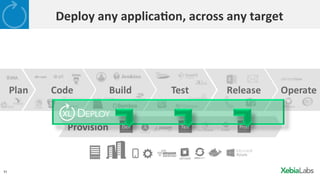
Deploy	any	applica8on,	across	any	target
12
Provision
Plan Code Build Test Release Operate		
Dev Test Prod
mainframe
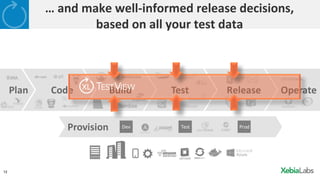
…	and	make	well-informed	release	decisions,	
based	on	all	your	test	data
What is Docker?
What are microservices?
Lightning introductions
14
What is Docker?
▪  Docker is a format for lightweight virtual machines that are easy
to share between teams and companies, and easy to run identically
anywhere from a developer’s laptop to a production environment
▪  Hype aside, teams (esp. developers) are looking at Docker because
−  It’s a much more lightweight and easy-to-use format than other VMs
−  Docker containers are convenient for local test environments,
especially if you’re developing microservices
−  Docker containers can easily be shared
and extended, so promise a degree of
reusability that other formats do not
−  The promise is that containers can be run much more
resource-efficiently than existing virtual machines
15
What do people often mean by “Docker”?
▪  A “new paradigm” whereby all applications should be delivered
as versioned containers by development teams
−  New version of the app = new version of the (set of) containers
−  Often also assuming that apps will be built as microservices
▪  The expanding ecosystem of container tools
that enable this
−  Multi-container frameworks
−  Container runtime platforms
−  Container delivery pipeline tools
16
What are “microservices”
▪  A microservice architecture is one in which a business application/
service is built by composing multiple small, independent elements
(the “microservices”) that each perform a single business function
▪  “Moving to microservices” generally means not just
architecting new applications in this way, but also converting
existing (monolithic) applications to a microservice
architecture by “splitting off” more and more functionality of the
monolith into separate applications
What does this mean for you?
18
What changes with Docker?
Docker will impact:
▪  Development and delivery teams, as they will be
shipping “different stuff”
▪  Operations, as they will need to build out
the runtime environment (including networking,
monitoring etc. etc.)for containers
▪  Security, as they will need to develop new
security policies for containers
19
What changes with microservices?
Microservices will impact:
▪  Architects, since a microservices transition is fundamentally an
application re-architecture
▪  Development teams and/or external development partners,
since they will have to write applications differently
▪  Testing/QA, since they will have to change the way they test
▪  Release/delivery teams, as they will need to handle
many more moving parts
▪  Operations, as they will need better visualization and monitoring
to understand what’s running at any given point in time
20
What does not change?
▪  Your delivery process does not magically become less complicated:
many different tests, sign-offs etc. are still required
▪  Your cross-cutting concerns do not change: security/access control,
auditability etc. all still need to be handled…and now with more
technologies in the mix!
▪  Your existing applications and runtimes will still be around
for a looooong time, even if you get started with
Docker and microservices tomorrow
21
In brief
▪  Microservices especially will be a pretty disruptive change,
Docker somewhat less
▪  Add to that the fact that the technology and best practices in
this area are still very, very new and changing all the time
▪  As with most “new waves” of technology, there is
very little effort being put into supporting
a hybrid setup
▪  …and yet, that will be the reality for the vast
majority of enterprises that adopt Docker and
microservices for a loooong time
22
In brief
▪  That does not mean that you should not consider containers and
microservices!
▪  Both Docker and microservices are incredibly promising and
have the potential to make a significant impact
−  …although, unlike virtualization, not so much from a
cost savings perspective
▪  Key point: identify what the business benefit will be for you
▪  Unlikely to be cost, but could be acceleration, reduction in errors,
employee satisfaction etc. etc.
Recommendations
24
What should you do now?
Investigate Docker and related technology:
Evaluate multi-container orchestration frameworks
Evaluate container runtime platforms
Understand how you will handle networking
and storage
Understand how you will handle cross-
cutting concerns: monitoring, access control, auditing etc.
1
2
3
4
25
What should you do now?
Understand how you will handle containers in your delivery
pipeline/release process
Understand how you will deliver and run a hybrid setup
−  …where some components of an application are
in containers, and others are not
−  …where a fully-containerized application needs to
talk to other non-containerized services
5
6
26
What should you do now?
Investigate microservices:
Identify candidate applications that would benefit from
a transition to microservices
Determine whether these smaller applications can be delivered
as containers, or not
Understand how your delivery/release process will work
when you are no longer delivering one monolithic applications,
but many different microservices
1
2
3
27
What should you do now?
Understand how your delivery/release process will handle
releases of “in transition” applications, where changes
to the microservices that have been “split off” may be fast,
but changes to the monolith very slow
Understand how you will track and visualize dependencies
between the different microservices
Understand how you will monitor business transactions
that may now span many different services
5
6
4
28
What should you do now?
Quantify the business benefit:
§  What would the benefits of containerization be? Are they
sufficient to outweigh the risk of adopting new technology very
early in the cycle?
§  What would the benefits of moving to microservices? For new
applications, are they sufficient to outweigh the complexity of having
many more moving parts? For existing applications to be migrated,
do they outweigh the cost of migration?
§  Microservices and containers do not have to go together –
you may find that you can justify one, but not the other
What is XebiaLabs doing?
30
How	can	XebiaLabs	help?	
We’re	doing	a	whole	bunch	of	things	to	help	you		be	
ready	for	this	transi7on,	should	you	decide	to	go	down	
this	path:	
▪  Automa8on:	support	for	common	container	
pla;orms	and	frameworks	in	our	release	and	
deployment	tools	
−  provides	consistency,	supports	standardiza7on	and	
takes	care	of	cross-cu@ng	concerns	such	as	access	
control,	audi7ng	etc.	in	a	hybrid	environment
31
How	can	XebiaLabs	help?	
▪  Visibility:	Support	for	dependency	management	in	our	
deployment	tools	
−  helps	you	handle	the	increased	complexity	of	the	many	moving	parts	
in	a	microservice	environment	
−  gives	you	insight	into	the	state	of	your	delivery	pipelines	at	all	7mes	
−  captures		metrics	to	help	you	iden7fy	boDlenecks	and	guide	
improvements
32
How	can	XebiaLabs	help?	
▪  Control:	support	for	advanced	delivery	paDerns	in	our	release	
tool	
−  release	trains	allow	individual	teams	to	iterate	quickly	as	they	break	
away	from	the	monolith,	while	s7ll	providing	an	aggregate	overview	
for	the	release	team,	project	managers	etc.	
−  handle	requirements	around	compliance,	audit,	repor7ng,	process	
enforcement	etc.
33
How	can	XebiaLabs	help?	
▪  Scale:	a	single,	simple	interface	and	integra7on	approach	
across	teams	and	applica7ons	
−  reduce	the	learning	curve	for	onboarding	of	new	teams	and	provide	a	
consistent	interface	for	Opera7ons	to	support	both	containers	and	
exis7ng	applica7ons	in	a	hybrid	environment	
▪  Guidance	and	advice	
−  This	is	a	very	fast-moving	space,	and	most	of	our	users	have	too	much	
going	on	already	to	dive	into	yet	another	new	topic	in	much	detail.	
We’re	here	to	help	you	understand	how	containers	and	microservices	
could	fit	into	your	landscape
34
Continuing Education
Check Out Our Many Other Microservices and Docker
Resources…
▪  xebialabs.com/solutions/microservices/
▪  xebialabs.com/solutions/docker/
35
Other Great Resources
▪  Get Started with XebiaLabs for Free Today!
www.xebialabs.com/products
▪  Download The IT Manager’s Guide to Continuous Delivery
xebialabs.com/resources/whitepapers/the-it-managers-guide-to-
continuous-delivery/
	
	 	 		
blog.xebialabs.com
@xebialabs
youtube.com/xebialabs
36
§  Continuous Delivery and
DevOps pioneer, authority
and technology leader
§  Global team in US,
Europe & APAC
§  Consistently recognized
by leading industry
analystsVISIBILITY
AUTOMATION
CONTROL
37
Questions?	
VISIBILITY
AUTOMATION
CONTROL
Thank you!

Diving Into Docker

  • 1.
    Diving Into Docker WhatIt Means for Your Enterprise DevOps Strategy March 3rd, 2016
  • 2.
    2 Housekeeping ▪  This webinaris being recorded ▪  Links to the slides and the recording will be made available after the presentation ▪  You can post questions via the GoToWebinar Control Panel, or… ▪  Join the conversation live on twitter using #DockerDive!
  • 3.
    3 Meet Your Presenter AndrewPhillips VP of DevOps Strategy, XebiaLabs ▪  Lots of Enterprise Software Development on High-Performance Systems ▪  Been on Both Sides of the “Dev…Ops” Fence ▪  Active Open Source Contributor and Committer
  • 4.
    4 Agenda •  Setting thestage •  Docker and microservices lightning intro •  What do these mean for the enterprise? •  Recommendations •  Q&A 4
  • 5.
    5 §  Continuous Deliveryand DevOps pioneer, authority and technology leader §  Global team in US, Europe & APAC §  Consistently recognized by leading industry analysts Connecting the dots for Continuous Delivery at enterprise scale About XebiaLabs VISIBILITY AUTOMATION CONTROL
  • 6.
    6 Visibility and controlacross the Software Delivery Process Integrates the tools you already have without customization Fortune 100 proven, enterprise- grade technology Scalable and fast to adopt XebiaLabs: Proven software solutions for Continuous Delivery at Enterprise Scale “IT organizations that have tried to custom adjust current tools to meet DevOps practices have a failure rate of 80%” 1 2 3 4
  • 7.
    Setting the stage Andhow do we relate to this topic?
  • 8.
    8 Setting the stage Thisis not going to be a technical deep-dive into Docker, Kubernetes, microservices, etc. We’ll be talking about: ▪  …what these technologies are ▪  …how they relate to all the existing technology and process you already have ▪  …what you need to bear in mind if you’re considering adoption
  • 9.
    9 Award-winning tools, recognizedby leading industry analysts Orchestrate, automate and get visibility into release pipelines Automate and standardize complex application deployments Analyze test results across multiple test tools XebiaLabs Solutions: Connecting the dots for Continuous Delivery at enterprise scale
  • 10.
    10 Provision Plan Code BuildTest Release Operate Dev Test Prod mainframe Orchestrate the en8re delivery process
  • 11.
    11 Provision Plan Code BuildTest Release Operate Dev Test Prod mainframe Deploy any applica8on, across any target
  • 12.
    12 Provision Plan Code BuildTest Release Operate Dev Test Prod mainframe … and make well-informed release decisions, based on all your test data
  • 13.
    What is Docker? Whatare microservices? Lightning introductions
  • 14.
    14 What is Docker? ▪ Docker is a format for lightweight virtual machines that are easy to share between teams and companies, and easy to run identically anywhere from a developer’s laptop to a production environment ▪  Hype aside, teams (esp. developers) are looking at Docker because −  It’s a much more lightweight and easy-to-use format than other VMs −  Docker containers are convenient for local test environments, especially if you’re developing microservices −  Docker containers can easily be shared and extended, so promise a degree of reusability that other formats do not −  The promise is that containers can be run much more resource-efficiently than existing virtual machines
  • 15.
    15 What do peopleoften mean by “Docker”? ▪  A “new paradigm” whereby all applications should be delivered as versioned containers by development teams −  New version of the app = new version of the (set of) containers −  Often also assuming that apps will be built as microservices ▪  The expanding ecosystem of container tools that enable this −  Multi-container frameworks −  Container runtime platforms −  Container delivery pipeline tools
  • 16.
    16 What are “microservices” ▪ A microservice architecture is one in which a business application/ service is built by composing multiple small, independent elements (the “microservices”) that each perform a single business function ▪  “Moving to microservices” generally means not just architecting new applications in this way, but also converting existing (monolithic) applications to a microservice architecture by “splitting off” more and more functionality of the monolith into separate applications
  • 17.
    What does thismean for you?
  • 18.
    18 What changes withDocker? Docker will impact: ▪  Development and delivery teams, as they will be shipping “different stuff” ▪  Operations, as they will need to build out the runtime environment (including networking, monitoring etc. etc.)for containers ▪  Security, as they will need to develop new security policies for containers
  • 19.
    19 What changes withmicroservices? Microservices will impact: ▪  Architects, since a microservices transition is fundamentally an application re-architecture ▪  Development teams and/or external development partners, since they will have to write applications differently ▪  Testing/QA, since they will have to change the way they test ▪  Release/delivery teams, as they will need to handle many more moving parts ▪  Operations, as they will need better visualization and monitoring to understand what’s running at any given point in time
  • 20.
    20 What does notchange? ▪  Your delivery process does not magically become less complicated: many different tests, sign-offs etc. are still required ▪  Your cross-cutting concerns do not change: security/access control, auditability etc. all still need to be handled…and now with more technologies in the mix! ▪  Your existing applications and runtimes will still be around for a looooong time, even if you get started with Docker and microservices tomorrow
  • 21.
    21 In brief ▪  Microservicesespecially will be a pretty disruptive change, Docker somewhat less ▪  Add to that the fact that the technology and best practices in this area are still very, very new and changing all the time ▪  As with most “new waves” of technology, there is very little effort being put into supporting a hybrid setup ▪  …and yet, that will be the reality for the vast majority of enterprises that adopt Docker and microservices for a loooong time
  • 22.
    22 In brief ▪  Thatdoes not mean that you should not consider containers and microservices! ▪  Both Docker and microservices are incredibly promising and have the potential to make a significant impact −  …although, unlike virtualization, not so much from a cost savings perspective ▪  Key point: identify what the business benefit will be for you ▪  Unlikely to be cost, but could be acceleration, reduction in errors, employee satisfaction etc. etc.
  • 23.
  • 24.
    24 What should youdo now? Investigate Docker and related technology: Evaluate multi-container orchestration frameworks Evaluate container runtime platforms Understand how you will handle networking and storage Understand how you will handle cross- cutting concerns: monitoring, access control, auditing etc. 1 2 3 4
  • 25.
    25 What should youdo now? Understand how you will handle containers in your delivery pipeline/release process Understand how you will deliver and run a hybrid setup −  …where some components of an application are in containers, and others are not −  …where a fully-containerized application needs to talk to other non-containerized services 5 6
  • 26.
    26 What should youdo now? Investigate microservices: Identify candidate applications that would benefit from a transition to microservices Determine whether these smaller applications can be delivered as containers, or not Understand how your delivery/release process will work when you are no longer delivering one monolithic applications, but many different microservices 1 2 3
  • 27.
    27 What should youdo now? Understand how your delivery/release process will handle releases of “in transition” applications, where changes to the microservices that have been “split off” may be fast, but changes to the monolith very slow Understand how you will track and visualize dependencies between the different microservices Understand how you will monitor business transactions that may now span many different services 5 6 4
  • 28.
    28 What should youdo now? Quantify the business benefit: §  What would the benefits of containerization be? Are they sufficient to outweigh the risk of adopting new technology very early in the cycle? §  What would the benefits of moving to microservices? For new applications, are they sufficient to outweigh the complexity of having many more moving parts? For existing applications to be migrated, do they outweigh the cost of migration? §  Microservices and containers do not have to go together – you may find that you can justify one, but not the other
  • 29.
  • 30.
  • 31.
    31 How can XebiaLabs help? ▪  Visibility: Support for dependency management in our deployment tools −  helps you handle the increased complexity of the many moving parts in a microservice environment − gives you insight into the state of your delivery pipelines at all 7mes −  captures metrics to help you iden7fy boDlenecks and guide improvements
  • 32.
  • 33.
    33 How can XebiaLabs help? ▪  Scale: a single, simple interface and integra7on approach across teams and applica7ons −  reduce the learning curve for onboarding of new teams and provide a consistent interface for Opera7ons to support both containers and exis7ng applica7ons in a hybrid environment ▪ Guidance and advice −  This is a very fast-moving space, and most of our users have too much going on already to dive into yet another new topic in much detail. We’re here to help you understand how containers and microservices could fit into your landscape
  • 34.
    34 Continuing Education Check OutOur Many Other Microservices and Docker Resources… ▪  xebialabs.com/solutions/microservices/ ▪  xebialabs.com/solutions/docker/
  • 35.
    35 Other Great Resources ▪ Get Started with XebiaLabs for Free Today! www.xebialabs.com/products ▪  Download The IT Manager’s Guide to Continuous Delivery xebialabs.com/resources/whitepapers/the-it-managers-guide-to- continuous-delivery/ blog.xebialabs.com @xebialabs youtube.com/xebialabs
  • 36.
    36 §  Continuous Deliveryand DevOps pioneer, authority and technology leader §  Global team in US, Europe & APAC §  Consistently recognized by leading industry analystsVISIBILITY AUTOMATION CONTROL
  • 37.
  • 38.