Department of Mechanical & Manufacturing Engineering, MIT, Manipal 1 of 79
THERMODYNAMICS - I
Chapter 5
PURE SUBSTANCE
Department of Mechanical & Manufacturing Engineering, MIT, Manipal 2 of 79
THERMODYNAMICS - I
• A substance may exist in solid, liquid, or gaseous
phase
• A pure substance is one, which is homogenous and
invariable in chemical aggregation.
• It may exist in one or more phases, but chemical
composition remains same in all phases.
Department of Mechanical & Manufacturing Engineering, MIT, Manipal 3 of 79
THERMODYNAMICS - I
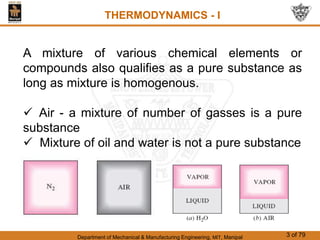
A mixture of various chemical elements or
compounds also qualifies as a pure substance as
long as mixture is homogenous.
 Air - a mixture of number of gasses is a pure
substance
 Mixture of oil and water is not a pure substance
Department of Mechanical & Manufacturing Engineering, MIT, Manipal 4 of 79
THERMODYNAMICS - I
Equation of State: The relation between the
primary properties, P, v, and T.
Two property rule: The state of a pure substance
of given mass can be fixed by specifying two
properties provide that
(i) The system is in equilibrium.
(ii) Gravity, motion, electricity and magnetism
are without significant effect.
Department of Mechanical & Manufacturing Engineering, MIT, Manipal 5 of 79
THERMODYNAMICS - I
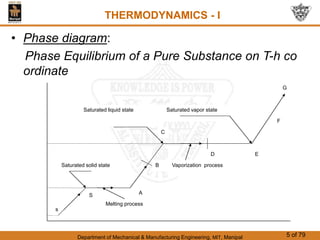
• Phase diagram:
Phase Equilibrium of a Pure Substance on T-h co
ordinate
Saturated solid state
Saturated liquid state
Melting process
Saturated vapor state
s
B
S A
C
D E
F
G
Vaporization process
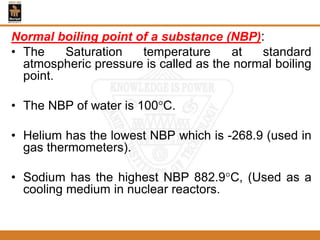
Normal boiling point of a substance (NBP):
• The Saturation temperature at standard
atmospheric pressure is called as the normal boiling
point.
• The NBP of water is 100C.
• Helium has the lowest NBP which is -268.9 (used in
gas thermometers).
• Sodium has the highest NBP 882.9C, (Used as a
cooling medium in nuclear reactors.
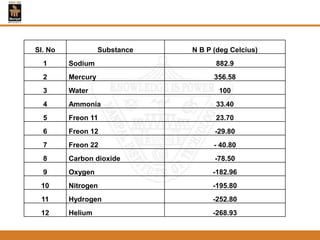
Sl. No Substance N B P (deg Celcius)
1 Sodium 882.9
2 Mercury 356.58
3 Water 100
4 Ammonia 33.40
5 Freon 11 23.70
6 Freon 12 -29.80
7 Freon 22 - 40.80
8 Carbon dioxide -78.50
9 Oxygen -182.96
10 Nitrogen -195.80
11 Hydrogen -252.80
12 Helium -268.93
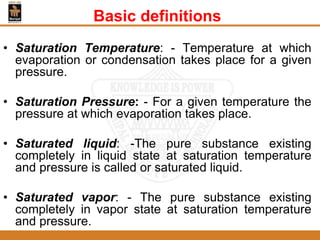
Basic definitions
• Saturation Temperature: - Temperature at which
evaporation or condensation takes place for a given
pressure.
• Saturation Pressure: - For a given temperature the
pressure at which evaporation takes place.
• Saturated liquid: -The pure substance existing
completely in liquid state at saturation temperature
and pressure is called or saturated liquid.
• Saturated vapor: - The pure substance existing
completely in vapor state at saturation temperature
and pressure.
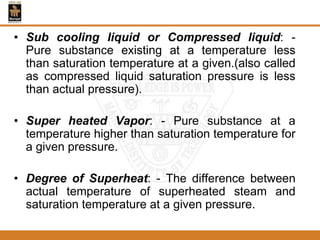
• Sub cooling liquid or Compressed liquid: -
Pure substance existing at a temperature less
than saturation temperature at a given.(also called
as compressed liquid saturation pressure is less
than actual pressure).
• Super heated Vapor: - Pure substance at a
temperature higher than saturation temperature for
a given pressure.
• Degree of Superheat: - The difference between
actual temperature of superheated steam and
saturation temperature at a given pressure.
PVT surface for pure substances
The three dimensional diagram which shows the
relationship between pressure, specific volume and
temperature is called as P-v-t surface.
There are two types-
 P-v-T surface for a substance like water that
expands upon freezing (contract upon melting).
 P-v-T surface for substances other than water
which contract upon freezing ( expand upon
melting).
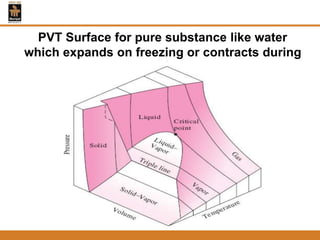
PVT Surface for pure substance like water
which expands on freezing or contracts during
melting
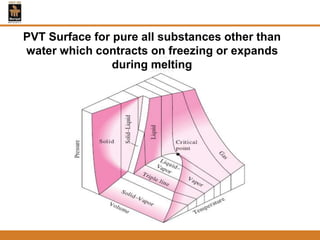
PVT Surface for pure all substances other than
water which contracts on freezing or expands
during melting
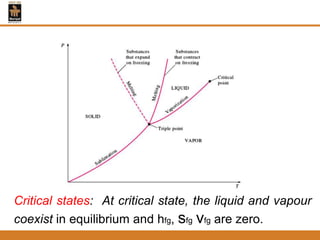
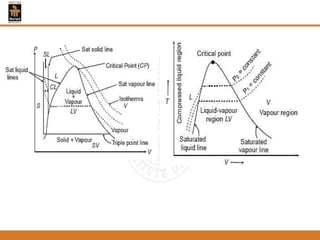
Critical states: At critical state, the liquid and vapour
coexist in equilibrium and hfg, sfg vfg are zero.
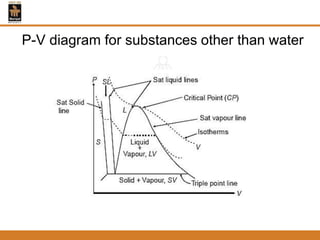
P-V diagram for substances other than water
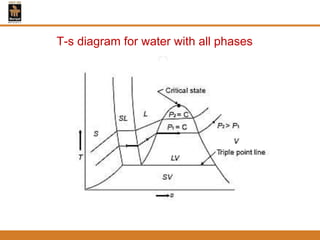
T-s diagram for water with all phases
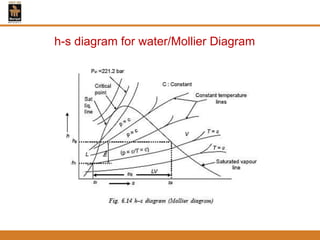
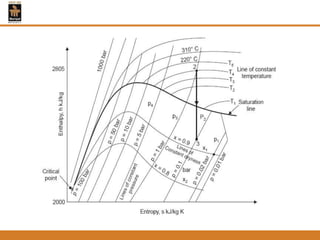
h-s diagram for water/Mollier Diagram
Determination of dryness fraction:
There are different methods available to determine
the dryness fraction of the steam.
(i) Using separating calorimeter.
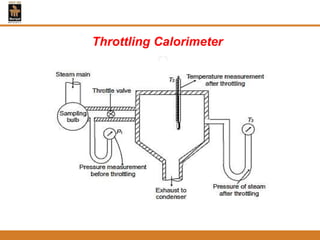
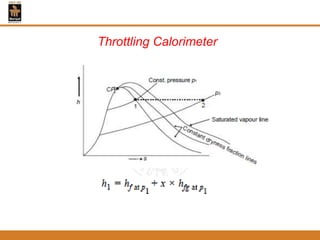
(ii) Using throttling calorimeter.
(iii) Using separating and throttling calorimeter
Throttling Calorimeter
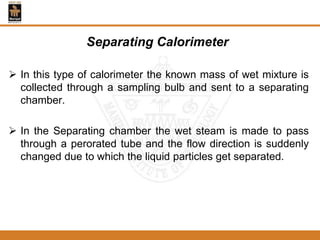
Separating Calorimeter
 In this type of calorimeter the known mass of wet mixture is
collected through a sampling bulb and sent to a separating
chamber.
 In the Separating chamber the wet steam is made to pass
through a perorated tube and the flow direction is suddenly
changed due to which the liquid particles get separated.
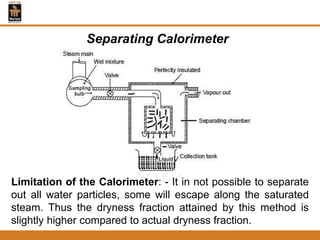
Limitation of the Calorimeter: - It in not possible to separate
out all water particles, some will escape along the saturated
steam. Thus the dryness fraction attained by this method is
slightly higher compared to actual dryness fraction.
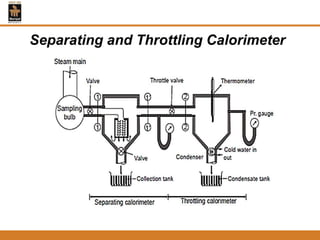
Separating Calorimeter
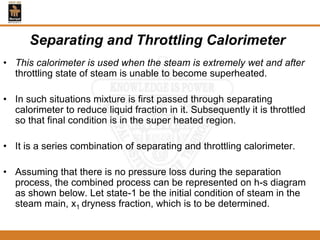
Separating and Throttling Calorimeter
• This calorimeter is used when the steam is extremely wet and after
throttling state of steam is unable to become superheated.
• In such situations mixture is first passed through separating
calorimeter to reduce liquid fraction in it. Subsequently it is throttled
so that final condition is in the super heated region.
• It is a series combination of separating and throttling calorimeter.
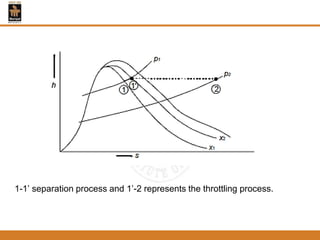
• Assuming that there is no pressure loss during the separation
process, the combined process can be represented on h-s diagram
as shown below. Let state-1 be the initial condition of steam in the
steam main, x1 dryness fraction, which is to be determined.
Separating and Throttling Calorimeter
1-1’ separation process and 1’-2 represents the throttling process.

Pure Substances.potx .

  • 1.
    Department of Mechanical& Manufacturing Engineering, MIT, Manipal 1 of 79 THERMODYNAMICS - I Chapter 5 PURE SUBSTANCE
  • 2.
    Department of Mechanical& Manufacturing Engineering, MIT, Manipal 2 of 79 THERMODYNAMICS - I • A substance may exist in solid, liquid, or gaseous phase • A pure substance is one, which is homogenous and invariable in chemical aggregation. • It may exist in one or more phases, but chemical composition remains same in all phases.
  • 3.
    Department of Mechanical& Manufacturing Engineering, MIT, Manipal 3 of 79 THERMODYNAMICS - I A mixture of various chemical elements or compounds also qualifies as a pure substance as long as mixture is homogenous.  Air - a mixture of number of gasses is a pure substance  Mixture of oil and water is not a pure substance
  • 4.
    Department of Mechanical& Manufacturing Engineering, MIT, Manipal 4 of 79 THERMODYNAMICS - I Equation of State: The relation between the primary properties, P, v, and T. Two property rule: The state of a pure substance of given mass can be fixed by specifying two properties provide that (i) The system is in equilibrium. (ii) Gravity, motion, electricity and magnetism are without significant effect.
  • 5.
    Department of Mechanical& Manufacturing Engineering, MIT, Manipal 5 of 79 THERMODYNAMICS - I • Phase diagram: Phase Equilibrium of a Pure Substance on T-h co ordinate Saturated solid state Saturated liquid state Melting process Saturated vapor state s B S A C D E F G Vaporization process
  • 6.
    Normal boiling pointof a substance (NBP): • The Saturation temperature at standard atmospheric pressure is called as the normal boiling point. • The NBP of water is 100C. • Helium has the lowest NBP which is -268.9 (used in gas thermometers). • Sodium has the highest NBP 882.9C, (Used as a cooling medium in nuclear reactors.
  • 7.
    Sl. No SubstanceN B P (deg Celcius) 1 Sodium 882.9 2 Mercury 356.58 3 Water 100 4 Ammonia 33.40 5 Freon 11 23.70 6 Freon 12 -29.80 7 Freon 22 - 40.80 8 Carbon dioxide -78.50 9 Oxygen -182.96 10 Nitrogen -195.80 11 Hydrogen -252.80 12 Helium -268.93
  • 8.
    Basic definitions • SaturationTemperature: - Temperature at which evaporation or condensation takes place for a given pressure. • Saturation Pressure: - For a given temperature the pressure at which evaporation takes place. • Saturated liquid: -The pure substance existing completely in liquid state at saturation temperature and pressure is called or saturated liquid. • Saturated vapor: - The pure substance existing completely in vapor state at saturation temperature and pressure.
  • 9.
    • Sub coolingliquid or Compressed liquid: - Pure substance existing at a temperature less than saturation temperature at a given.(also called as compressed liquid saturation pressure is less than actual pressure). • Super heated Vapor: - Pure substance at a temperature higher than saturation temperature for a given pressure. • Degree of Superheat: - The difference between actual temperature of superheated steam and saturation temperature at a given pressure.
  • 10.
    PVT surface forpure substances The three dimensional diagram which shows the relationship between pressure, specific volume and temperature is called as P-v-t surface. There are two types-  P-v-T surface for a substance like water that expands upon freezing (contract upon melting).  P-v-T surface for substances other than water which contract upon freezing ( expand upon melting).
  • 11.
    PVT Surface forpure substance like water which expands on freezing or contracts during melting
  • 12.
    PVT Surface forpure all substances other than water which contracts on freezing or expands during melting
  • 13.
    Critical states: Atcritical state, the liquid and vapour coexist in equilibrium and hfg, sfg vfg are zero.
  • 15.
    P-V diagram forsubstances other than water
  • 16.
    T-s diagram forwater with all phases
  • 17.
    h-s diagram forwater/Mollier Diagram
  • 19.
    Determination of drynessfraction: There are different methods available to determine the dryness fraction of the steam. (i) Using separating calorimeter. (ii) Using throttling calorimeter. (iii) Using separating and throttling calorimeter
  • 20.
  • 21.
  • 22.
    Separating Calorimeter  Inthis type of calorimeter the known mass of wet mixture is collected through a sampling bulb and sent to a separating chamber.  In the Separating chamber the wet steam is made to pass through a perorated tube and the flow direction is suddenly changed due to which the liquid particles get separated.
  • 23.
    Limitation of theCalorimeter: - It in not possible to separate out all water particles, some will escape along the saturated steam. Thus the dryness fraction attained by this method is slightly higher compared to actual dryness fraction. Separating Calorimeter
  • 24.
    Separating and ThrottlingCalorimeter • This calorimeter is used when the steam is extremely wet and after throttling state of steam is unable to become superheated. • In such situations mixture is first passed through separating calorimeter to reduce liquid fraction in it. Subsequently it is throttled so that final condition is in the super heated region. • It is a series combination of separating and throttling calorimeter. • Assuming that there is no pressure loss during the separation process, the combined process can be represented on h-s diagram as shown below. Let state-1 be the initial condition of steam in the steam main, x1 dryness fraction, which is to be determined.
  • 25.
  • 26.
    1-1’ separation processand 1’-2 represents the throttling process.