88 – SUZIE SEQUEIRA
89- JEFFLON SEQUEIRA
90- SAMEER SHARIF
91- KARISHMA SHARMA
SYBMS (B)
Purchase is main activity
in area of material
management , it is the
most imp function in any
organisation.
This is the place where
money is spent out of the
organisation.
Thus, it decides the
profitability of the
company.
 The PURCHASING ORGANIZATION is an organizational
unit within Logistics. Almost all business transactions
related to procurement are carried out in a purchasing
organization.
 A foundation of any business, the purchasing department
is responsible for everything related to ordering
materials and dealing with vendors.
 A good purchasing department will minimize costs of
purchased goods, screen vendors for quality and track
orders from initiation to reception.
 The quality of the purchasing department can have a
significant impact on a business's profit margins.
 The Director of Materials Management & CPO has
responsibility for the procurement of all goods and service.
 The purchasing department is responsible for all review
and approval of all vendors.
 The Purchasing Department is responsible for initiating
and maintaining effective and professional relationships
with suppliers, actual and potential.
 Purchasing personnel are to seek to obtain and purchase all
goods and services at the lowest possible total end cost,
considering the guidelines of prices, service, quality,
delivery and reliability.
 The Purchasing Department is responsible for questioning
requests that are beyond the University's "generally
accepted" terms and conditions and for consulting with the
Office of General Counsel on these issues
PREVENT SHORTAGE :
 The purchasing department is responsible for
acquiring materials necessary for manufacturing and
running your business. To guarantee that material
shortages do not impact productivity, purchasing
departments use techniques such as multiple sourcing.
MINIMIZE EXPENSES :
 The purchasing department plays an important role in
maximizing your business's profits. It compares prices
and negotiates with suppliers to get your business the
best price possible on necessary goods.
 PRE APPROVE VENDORS :
 The purchasing department evaluates vendors in terms of
price, quality, customer reviews and time to fill orders, and
produces a list of approved vendors.
 TRACK ORDERS :
• Orders are documented through purchase order forms, which
specify important identifying information about materials
ordered as well as the quantity ordered.
 CHECK INVOICES :
 The purchasing department checks invoices when they
arrive for accuracy, before passing them on to accounting.
It compares the invoice to the purchase order form and
goods actually received.
 Material requirement review.
 Make or buy analysis.
 Material standardization.
 Determination of quality.
 Supplier selection.
 Price forecasting.
 Value analysis.
 Market analysis.
 Productivity / cost improvements.
 Long -range purchasing policy.
It can also be called as “7r’s “
 Buying the material at the right price.
 Buying material of right quality.
 In the right quantity
 At the right time
 From the right source
 At the right place.
 With the right mode of transport.
 To obtain the specific materials and supplies of quality.
 To procure the material and supplies in time and at the
proper place.
 To procure them at lowest possible ultimate cost.
 To maintain good vendor relationship.
 To implement activities such as make-or-buy analysis,
cost analysis and value analysis to reduce cost.
 To keep top management informed about the latest
developments.
 To keep the expenses incurred as low as possible.
 To ensure continuity in supply of raw material.
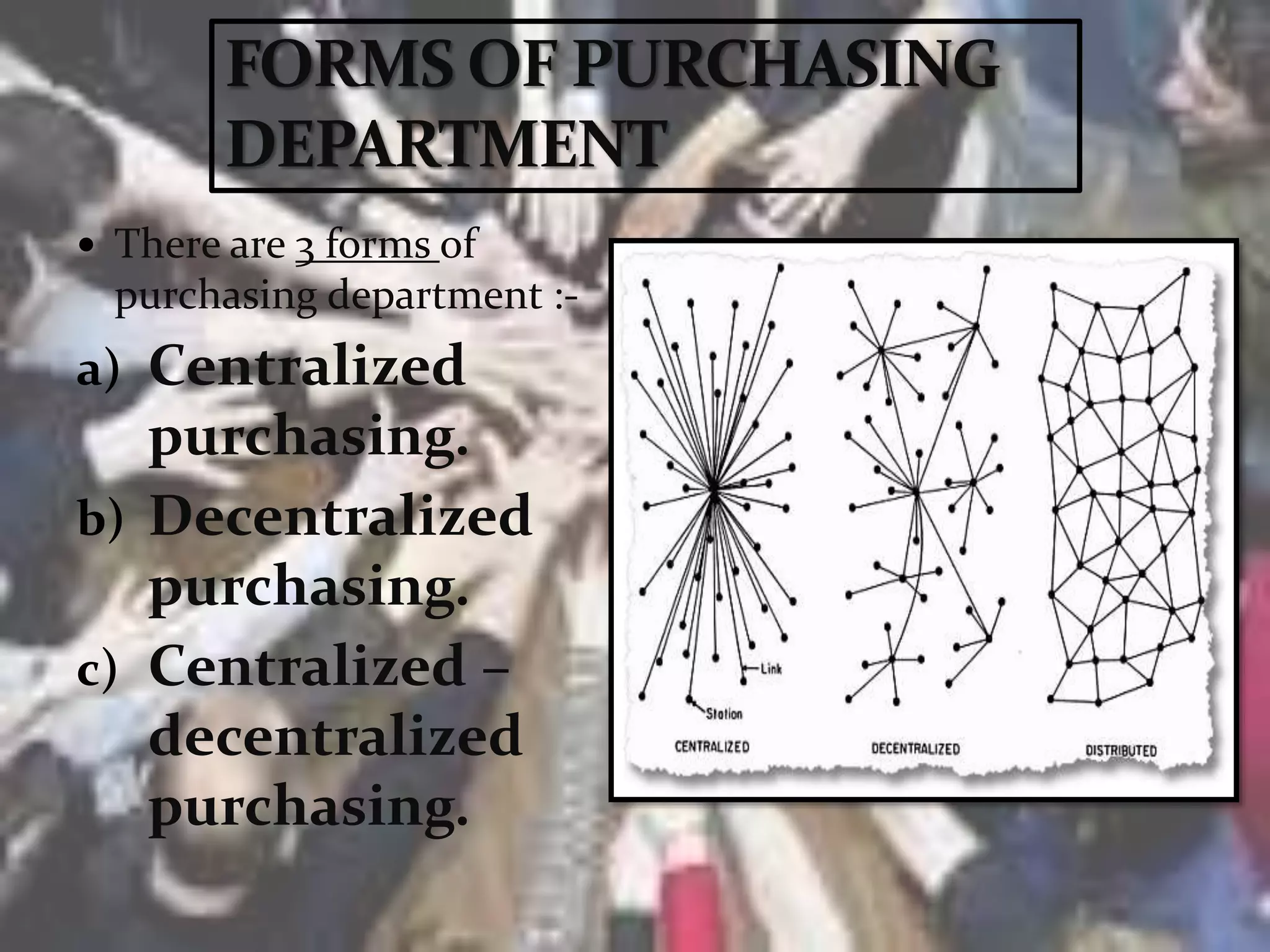
 There are 3 forms of
purchasing department :-
a) Centralized
purchasing.
b) Decentralized
purchasing.
c) Centralized –
decentralized
purchasing.
 With centralized purchasing , all records are kept at
one place & under one supervision and control.
 Thus, it is more effective for taking action to meet the
changing market needs.
 Centralization aids in the standardization of
specifications and tends towards lower inventory
investments.
 Usually, any organisation having a single location must
adopt centralized purchasing as a rule.
 When manufacturing plants are widely dispersed
geographically and manufacture different products
having materials decentralized purchasing is better.
 In such a case each manufacturing unit will have their
own purchasing department.
 The individual purchasing department of each plants
will have functional relationship with the corporate
director.
 The director will enforce general purchasing policies
for all purchase department of their organization.
 Many firms operating several plants whose
geographical locations may not be too widely
scattered & whose products & material
requirements may cover a large number of similar
parts & materials used in common & in large
quantities, may adopt centralized-decentralized
purchasing approach.
 It is a primary function, directly influencing the major
cost of operating a business.
 Discovering new material which may be used to
advantage as substitutes for materials in use.
 Identifying possible new line of products to added.
 Building up goodwill in business world.
 See changes in trends, either in price or other factors,
that will affect the sales of the company.
 Its knowledge of vendors, and the manufacturing and
marketing policies of other industries.
1) Recognition of need.
2) Description of specifications & requirements.
3) Check on suppliers, price & specifications.
4) Determination of price and availability of
materials.
5) Preparation of purchase orders.
6) Suppliers acceptance of purchase orders .
7) Follow up of supplier.
8) Receiving and inspection of materials.
9) Checking the invoices and authorizing payments
of bills .
10) Closing the order.
 SUPPLIER OPTIMIZATION
 The company chooses an optimum mix of vendors who can provide the
best prices and terms. This process usually means that the less able
suppliers who cannot provide a quality service at the terms and prices
required are discarded. This is by far the most common of the various
purchasing strategies.
 TQM
 Total Quality Methods, requires the vendors to provide an ever
increasing quality service with zero errors. The supplier ensures
purchasing best practices using a number of tools such as six sigma.
 RISK MANAGEMENT
 As more companies obtain their supplies from countries such as China
and India, they are more concerned with the risk management of this
supply chain. Whilst these countries can supply products at very
advantageous prices, these advantages can be soon negated by a natural
or human disaster.
 Pune civic body to purchase 5 ambulances:-The pune
civic body’s purchasing department will be purchasing 5
ambulances for public welfare that can be used it times of
emergency.
 BSP- warns about another food grain scam to come up:-
there are chances of food grain scam to come up like
2003-04 worth rs.500cr. The investigation is undertaken
by the CBI and all the purchase departments for the same
is to be investigated.
 Soon health department to issue fresh drug purchase
tenders:- The health and family welfare department has
planned to float fresh tender for procurement of
medicine.
E-PROCUREMENT STRATEGY FOR A LEADING
INTEGRATED STEEL AND POWER COMPANY
BASED IN CENTRAL INDIA.
 The client is a leading manufacturer of sponge iron
and long steel products (wire rods). They also have a
captive power plant fulfilling their requirement for
internal use as well as selling it in the market.
 There is a lack of transparency in the sourcing process.
Also, on-the-table negotiation skills are not utilized
properly due to lack of time as well as capability.
BACKGROUND
 All commodities irrespective of their strategic nature,
spend, frequency of consumption, etc. are purchased on
“as and when the request comes” basis. As a result, the
purchase department functions perpetually on fire-
fighting mode.
 Since the purchase is flooded with requests, a lot of
maverick buying happens without putting any thought,
constituting heavy losses to the client annually.
 Due to inefficiencies, entire atmosphere in the
organization is vitiated with blame-game, political
bickering, no-accountability scenarios, and hence high
attrition rate of good employees.
 The client approached us with a mandate to make the
sourcing process transparent to all stakeholders.
 To adopted a systematic and methodical approach to
address the opportunity:
1. Separated the sourcing function with the daily ongoing
procurement activities.
2. Created an e-procurement cell to address sourcing needs,
identified right skill set of people to fill-in, detailed out
entire process, assigned ownerships, defined timelines
for each activity, to all for effective functioning
3. Evaluated and finalized technology partner for e-
sourcing needs.
4. Conducted first few e-sourcing events as POC, monitored
the subsequent ones, and finally handed full
responsibilities to the e-procurement cell.
Purchase organisation

Purchase organisation

  • 2.
    88 – SUZIESEQUEIRA 89- JEFFLON SEQUEIRA 90- SAMEER SHARIF 91- KARISHMA SHARMA SYBMS (B)
  • 3.
    Purchase is mainactivity in area of material management , it is the most imp function in any organisation. This is the place where money is spent out of the organisation. Thus, it decides the profitability of the company.
  • 4.
     The PURCHASINGORGANIZATION is an organizational unit within Logistics. Almost all business transactions related to procurement are carried out in a purchasing organization.  A foundation of any business, the purchasing department is responsible for everything related to ordering materials and dealing with vendors.  A good purchasing department will minimize costs of purchased goods, screen vendors for quality and track orders from initiation to reception.  The quality of the purchasing department can have a significant impact on a business's profit margins.
  • 5.
     The Directorof Materials Management & CPO has responsibility for the procurement of all goods and service.  The purchasing department is responsible for all review and approval of all vendors.  The Purchasing Department is responsible for initiating and maintaining effective and professional relationships with suppliers, actual and potential.  Purchasing personnel are to seek to obtain and purchase all goods and services at the lowest possible total end cost, considering the guidelines of prices, service, quality, delivery and reliability.  The Purchasing Department is responsible for questioning requests that are beyond the University's "generally accepted" terms and conditions and for consulting with the Office of General Counsel on these issues
  • 7.
    PREVENT SHORTAGE : The purchasing department is responsible for acquiring materials necessary for manufacturing and running your business. To guarantee that material shortages do not impact productivity, purchasing departments use techniques such as multiple sourcing. MINIMIZE EXPENSES :  The purchasing department plays an important role in maximizing your business's profits. It compares prices and negotiates with suppliers to get your business the best price possible on necessary goods.
  • 8.
     PRE APPROVEVENDORS :  The purchasing department evaluates vendors in terms of price, quality, customer reviews and time to fill orders, and produces a list of approved vendors.  TRACK ORDERS : • Orders are documented through purchase order forms, which specify important identifying information about materials ordered as well as the quantity ordered.  CHECK INVOICES :  The purchasing department checks invoices when they arrive for accuracy, before passing them on to accounting. It compares the invoice to the purchase order form and goods actually received.
  • 9.
     Material requirementreview.  Make or buy analysis.  Material standardization.  Determination of quality.  Supplier selection.  Price forecasting.  Value analysis.  Market analysis.  Productivity / cost improvements.  Long -range purchasing policy.
  • 10.
    It can alsobe called as “7r’s “  Buying the material at the right price.  Buying material of right quality.  In the right quantity  At the right time  From the right source  At the right place.  With the right mode of transport.
  • 11.
     To obtainthe specific materials and supplies of quality.  To procure the material and supplies in time and at the proper place.  To procure them at lowest possible ultimate cost.  To maintain good vendor relationship.  To implement activities such as make-or-buy analysis, cost analysis and value analysis to reduce cost.  To keep top management informed about the latest developments.  To keep the expenses incurred as low as possible.  To ensure continuity in supply of raw material.
  • 12.
     There are3 forms of purchasing department :- a) Centralized purchasing. b) Decentralized purchasing. c) Centralized – decentralized purchasing.
  • 13.
     With centralizedpurchasing , all records are kept at one place & under one supervision and control.  Thus, it is more effective for taking action to meet the changing market needs.  Centralization aids in the standardization of specifications and tends towards lower inventory investments.  Usually, any organisation having a single location must adopt centralized purchasing as a rule.
  • 14.
     When manufacturingplants are widely dispersed geographically and manufacture different products having materials decentralized purchasing is better.  In such a case each manufacturing unit will have their own purchasing department.  The individual purchasing department of each plants will have functional relationship with the corporate director.  The director will enforce general purchasing policies for all purchase department of their organization.
  • 15.
     Many firmsoperating several plants whose geographical locations may not be too widely scattered & whose products & material requirements may cover a large number of similar parts & materials used in common & in large quantities, may adopt centralized-decentralized purchasing approach.
  • 16.
     It isa primary function, directly influencing the major cost of operating a business.  Discovering new material which may be used to advantage as substitutes for materials in use.  Identifying possible new line of products to added.  Building up goodwill in business world.  See changes in trends, either in price or other factors, that will affect the sales of the company.  Its knowledge of vendors, and the manufacturing and marketing policies of other industries.
  • 18.
    1) Recognition ofneed. 2) Description of specifications & requirements. 3) Check on suppliers, price & specifications. 4) Determination of price and availability of materials. 5) Preparation of purchase orders. 6) Suppliers acceptance of purchase orders . 7) Follow up of supplier. 8) Receiving and inspection of materials. 9) Checking the invoices and authorizing payments of bills . 10) Closing the order.
  • 19.
     SUPPLIER OPTIMIZATION The company chooses an optimum mix of vendors who can provide the best prices and terms. This process usually means that the less able suppliers who cannot provide a quality service at the terms and prices required are discarded. This is by far the most common of the various purchasing strategies.  TQM  Total Quality Methods, requires the vendors to provide an ever increasing quality service with zero errors. The supplier ensures purchasing best practices using a number of tools such as six sigma.  RISK MANAGEMENT  As more companies obtain their supplies from countries such as China and India, they are more concerned with the risk management of this supply chain. Whilst these countries can supply products at very advantageous prices, these advantages can be soon negated by a natural or human disaster.
  • 20.
     Pune civicbody to purchase 5 ambulances:-The pune civic body’s purchasing department will be purchasing 5 ambulances for public welfare that can be used it times of emergency.  BSP- warns about another food grain scam to come up:- there are chances of food grain scam to come up like 2003-04 worth rs.500cr. The investigation is undertaken by the CBI and all the purchase departments for the same is to be investigated.  Soon health department to issue fresh drug purchase tenders:- The health and family welfare department has planned to float fresh tender for procurement of medicine.
  • 21.
    E-PROCUREMENT STRATEGY FORA LEADING INTEGRATED STEEL AND POWER COMPANY BASED IN CENTRAL INDIA.  The client is a leading manufacturer of sponge iron and long steel products (wire rods). They also have a captive power plant fulfilling their requirement for internal use as well as selling it in the market.  There is a lack of transparency in the sourcing process. Also, on-the-table negotiation skills are not utilized properly due to lack of time as well as capability. BACKGROUND
  • 22.
     All commoditiesirrespective of their strategic nature, spend, frequency of consumption, etc. are purchased on “as and when the request comes” basis. As a result, the purchase department functions perpetually on fire- fighting mode.  Since the purchase is flooded with requests, a lot of maverick buying happens without putting any thought, constituting heavy losses to the client annually.  Due to inefficiencies, entire atmosphere in the organization is vitiated with blame-game, political bickering, no-accountability scenarios, and hence high attrition rate of good employees.  The client approached us with a mandate to make the sourcing process transparent to all stakeholders.
  • 23.
     To adopteda systematic and methodical approach to address the opportunity: 1. Separated the sourcing function with the daily ongoing procurement activities. 2. Created an e-procurement cell to address sourcing needs, identified right skill set of people to fill-in, detailed out entire process, assigned ownerships, defined timelines for each activity, to all for effective functioning 3. Evaluated and finalized technology partner for e- sourcing needs. 4. Conducted first few e-sourcing events as POC, monitored the subsequent ones, and finally handed full responsibilities to the e-procurement cell.