PUNIA & THE SHARKS

      HWST 104
ADDITIONAL RESOURCES
• The book Place Names of Hawai`i can
  help provide insight into the location
  of places mentioned in these stories as
  well as the meaning of the place name.
  This text may be accessed through
  ulukau.org on Resources.
• The Hawaiian Dictionary can also
  help provide insight into the meanings
  of names and other terms found in
  stories. This text may be accessed
  through ulukau.org on Resources or by
  going directly to www.wehewehe.org
• The book ‘Ōlelo No`eau contains
  Hawaiian proverbs & poetical sayings
  and more.
NĀ INOA (NAMES)
• As is typical in Hawaiian myths and legends,
  names provide insight into the characters’
  attributes, personality, and the story itself.
• In the same regards, place names can also
  provide insight into the plot of the story.
MAIN CHARACTERS –
   DEFINITIONS OF NAMES
• PUNIA
  – “to gain control of, to
    overcome”
  – To be fond of, desire, covet
  – Deceive, deluded

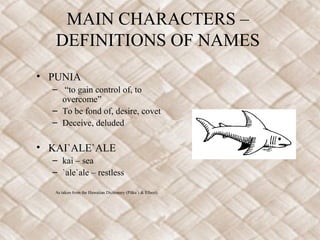
• KAI`ALE`ALE
  – kai – sea
  – `ale`ale – restless

   As taken from the Hawaiian Dictionary (Pūku`i & Elbert).
BIG ISLAND OF HAWAI`I
PLACE NAMES

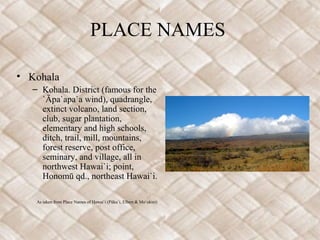
• Kohala
  – Kohala. District (famous for the
    `Āpa`apa`a wind), quadrangle,
    extinct volcano, land section,
    club, sugar plantation,
    elementary and high schools,
    ditch, trail, mill, mountains,
    forest reserve, post office,
    seminary, and village, all in
    northwest Hawai`i; point,
    Honomū qd., northeast Hawai`i.

   As taken from Place Names of Hawai`i (Püku`i, Elbert & Mo`okini)
PLACE NAMES CONT.

• Kona
  – Kona. Leeward districts on
    Hawai`i, Kaua`i, Moloka`i,
    Ni`ihau, and O`ahu. Poetic
    (Hawai`i); kai mā`oki`oki; kai
    ʻōpua i ka la`i; kai hā-
    wanawana, streaked sea; clouds
    [over the] sea in the calm;
    whispering sea. (See Appendix
    9.) Lit., leeward.
  As taken from Place Names of Hawai`i (Püku`i, Elbert & Mo`okini)
PLACE NAMES CONT.
• Alula
    – Alula. Bay, Kai-lua qd., North
      Kona, Hawai`i.
• Hi`iakanoholae
    – Hi`iaka-noho-lae. A rock beyond
      the seawall (between the Kona
      Inn and the end of the wall) at
      Kai-lua Village, Kona, Hawai`i.
      (For. Sel. 14-15.) Lit., Hi`iaka
      living [at] point. (One of Pele's
      Hi`iaka sisters lived here. In one
      legend the stone is the shark
      form of a priest turned to stone
      in response to an enemy's prayer                     Alula Beach
      to Pele. See Ka-iwi.)
  As taken from Place Names of Hawai`i (Püku`i, Elbert &
                         Mo`okini)
PLACE NAMES CONT.

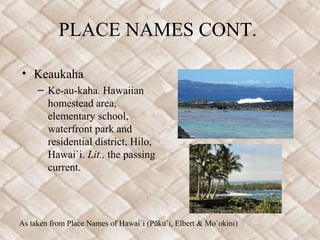
• Keaukaha
     – Ke-au-kaha. Hawaiian
       homestead area,
       elementary school,
       waterfront park and
       residential district, Hilo,
       Hawai`i. Lit., the passing
       current.


As taken from Place Names of Hawai`i (Pūku`i, Elbert & Mo`okini)
OLI
• MELE OLI
   – Mele oli, or simply oli, are chants that are not danced to and are generally
     unaccompanied by any musical instrument.
   – Because the Hawaiian people had no written language until the arrival of the
     missionaries, they relied heavily on oli to preserve history, genealogy,
     traditions, beliefs, and much more.
   – There are many different kind of oli, both formal and informal for specific
     occasions including mele ko`ihonua (recounts a person’s genealogy), mele
     inoa (name chant in honor of an individual), and mele he`enalu (surfing
     chant).
   – The mana (power) of a chant, lies in its hidden meanings, or kaona. Hidden
     meanings, such as rain as a metaphor for love or the use of a certain place
     name, could evoke different feelings, depending on who heard and
     understood the chant.
• In his oli (chant) on p.14-15, Punia mentions 3 fishes: the kala, uhu
  & palani.
KALA
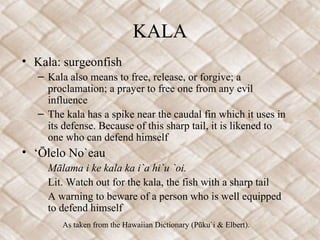
• Kala: surgeonfish
   – Kala also means to free, release, or forgive; a
     proclamation; a prayer to free one from any evil
     influence
   – The kala has a spike near the caudal fin which it uses in
     its defense. Because of this sharp tail, it is likened to
     one who can defend himself
• ‘Ōlelo No`eau
     Mālama i ke kala ka i`a hi`u `oi.
     Lit. Watch out for the kala, the fish with a sharp tail
     A warning to beware of a person who is well equipped
     to defend himself
        As taken from the Hawaiian Dictionary (Pūku`i & Elbert).
UHU

• Uhu: wrasse-fish
  – Uhu also means to strain, chafe under restraint; willful,
    headstrong
  – Uhu are plant eaters, the teeth are strong and beaklike.
    The uhu is a beautiful, bright-colored fish.
• ‘Ōlelo No`eau
    `A`ohe e loa`a, he uhu pakelo
    Lit. He will not be caught, for he is an uhu, slippery
    with slime
    Said of a person too wily and wise to be caught
PALANI
• Palani: surgeonfish
  – The palani is famous for its strong odor. As such,
    it is likened to a detested person
• ‘Ōlelo No`eau
    Hauna ke kai o ka palani.
    Lit. The palani makes a strong-smelling soup
    A person of unsavory reputation imparts it to all he
    does.
PUNIA & THE SHARKS

• There are at least 2 other documented
  versions of this myth.
• The main storyline, theme, and overall
  outcome of each version are the same.
• However, there are subtle differences in
  each.
• The ending in each version varies.
• The differences are noted in the following
  slides.
Legends of Hawai`i (Colum, 1937)
• In Colum’s version, Punia’s father was killed by the
  king of sharks, Kai`ale`ale.
• In this version, Punia came out of Kai`ale`ale when
  he reached the shore. He cried out to the people that
  their enemy, Kai`ale`ale, had come for a visit. The
  people of Kohala came down to shore with their
  knives and spears, killing him.
Pikoi & Other legends of the island of
        Hawai`i (Pūku`i & Curtis, 1949)

• In this version, Punia asked his mother to make him
  a small, closely-plaited mat which he took with him
  along with his sticks for lighting fire and charcoal.
• In this version, Punia was about to crawl out when
  they reached shore, but heard voices outside. The
  men tried to kill Kai`ale`ale by cutting him open.
  Punia shouted “Oh be careful, lest you cut the man
  inside.”
Pikoi & Other legends of the island of
    Hawai`i continued (Pūku`i & Curtis, 1949)
• Believing the shark to be inhabited by an evil spirit,
  the people were frightened away.
• He was about to crawl out again, but saw more people
  coming with knives and adzes.
• Since he was not sure of his whereabouts, he feared
  that the people would kill him.
• Thus, he drew back and shouted once more,
  frightening them away as well.
Pikoi & Other legends of the island of
    Hawai`i continued (Pūku`i & Curtis, 1949)

• This continued until darkness fell.
• Although there were still some people around,
  he crawled out and ran into the forest.
• He was relieved to see Mauna Kea and
  returned home.
Punia+ +the+sharks

Punia+ +the+sharks

  • 1.
    PUNIA & THESHARKS HWST 104
  • 2.
    ADDITIONAL RESOURCES • Thebook Place Names of Hawai`i can help provide insight into the location of places mentioned in these stories as well as the meaning of the place name. This text may be accessed through ulukau.org on Resources. • The Hawaiian Dictionary can also help provide insight into the meanings of names and other terms found in stories. This text may be accessed through ulukau.org on Resources or by going directly to www.wehewehe.org • The book ‘Ōlelo No`eau contains Hawaiian proverbs & poetical sayings and more.
  • 3.
    NĀ INOA (NAMES) •As is typical in Hawaiian myths and legends, names provide insight into the characters’ attributes, personality, and the story itself. • In the same regards, place names can also provide insight into the plot of the story.
  • 4.
    MAIN CHARACTERS – DEFINITIONS OF NAMES • PUNIA – “to gain control of, to overcome” – To be fond of, desire, covet – Deceive, deluded • KAI`ALE`ALE – kai – sea – `ale`ale – restless As taken from the Hawaiian Dictionary (Pūku`i & Elbert).
  • 5.
  • 6.
    PLACE NAMES • Kohala – Kohala. District (famous for the `Āpa`apa`a wind), quadrangle, extinct volcano, land section, club, sugar plantation, elementary and high schools, ditch, trail, mill, mountains, forest reserve, post office, seminary, and village, all in northwest Hawai`i; point, Honomū qd., northeast Hawai`i. As taken from Place Names of Hawai`i (Püku`i, Elbert & Mo`okini)
  • 7.
    PLACE NAMES CONT. •Kona – Kona. Leeward districts on Hawai`i, Kaua`i, Moloka`i, Ni`ihau, and O`ahu. Poetic (Hawai`i); kai mā`oki`oki; kai ʻōpua i ka la`i; kai hā- wanawana, streaked sea; clouds [over the] sea in the calm; whispering sea. (See Appendix 9.) Lit., leeward. As taken from Place Names of Hawai`i (Püku`i, Elbert & Mo`okini)
  • 8.
    PLACE NAMES CONT. •Alula – Alula. Bay, Kai-lua qd., North Kona, Hawai`i. • Hi`iakanoholae – Hi`iaka-noho-lae. A rock beyond the seawall (between the Kona Inn and the end of the wall) at Kai-lua Village, Kona, Hawai`i. (For. Sel. 14-15.) Lit., Hi`iaka living [at] point. (One of Pele's Hi`iaka sisters lived here. In one legend the stone is the shark form of a priest turned to stone in response to an enemy's prayer Alula Beach to Pele. See Ka-iwi.) As taken from Place Names of Hawai`i (Püku`i, Elbert & Mo`okini)
  • 9.
    PLACE NAMES CONT. •Keaukaha – Ke-au-kaha. Hawaiian homestead area, elementary school, waterfront park and residential district, Hilo, Hawai`i. Lit., the passing current. As taken from Place Names of Hawai`i (Pūku`i, Elbert & Mo`okini)
  • 10.
    OLI • MELE OLI – Mele oli, or simply oli, are chants that are not danced to and are generally unaccompanied by any musical instrument. – Because the Hawaiian people had no written language until the arrival of the missionaries, they relied heavily on oli to preserve history, genealogy, traditions, beliefs, and much more. – There are many different kind of oli, both formal and informal for specific occasions including mele ko`ihonua (recounts a person’s genealogy), mele inoa (name chant in honor of an individual), and mele he`enalu (surfing chant). – The mana (power) of a chant, lies in its hidden meanings, or kaona. Hidden meanings, such as rain as a metaphor for love or the use of a certain place name, could evoke different feelings, depending on who heard and understood the chant. • In his oli (chant) on p.14-15, Punia mentions 3 fishes: the kala, uhu & palani.
  • 11.
    KALA • Kala: surgeonfish – Kala also means to free, release, or forgive; a proclamation; a prayer to free one from any evil influence – The kala has a spike near the caudal fin which it uses in its defense. Because of this sharp tail, it is likened to one who can defend himself • ‘Ōlelo No`eau Mālama i ke kala ka i`a hi`u `oi. Lit. Watch out for the kala, the fish with a sharp tail A warning to beware of a person who is well equipped to defend himself As taken from the Hawaiian Dictionary (Pūku`i & Elbert).
  • 12.
    UHU • Uhu: wrasse-fish – Uhu also means to strain, chafe under restraint; willful, headstrong – Uhu are plant eaters, the teeth are strong and beaklike. The uhu is a beautiful, bright-colored fish. • ‘Ōlelo No`eau `A`ohe e loa`a, he uhu pakelo Lit. He will not be caught, for he is an uhu, slippery with slime Said of a person too wily and wise to be caught
  • 13.
    PALANI • Palani: surgeonfish – The palani is famous for its strong odor. As such, it is likened to a detested person • ‘Ōlelo No`eau Hauna ke kai o ka palani. Lit. The palani makes a strong-smelling soup A person of unsavory reputation imparts it to all he does.
  • 14.
    PUNIA & THESHARKS • There are at least 2 other documented versions of this myth. • The main storyline, theme, and overall outcome of each version are the same. • However, there are subtle differences in each. • The ending in each version varies. • The differences are noted in the following slides.
  • 15.
    Legends of Hawai`i(Colum, 1937) • In Colum’s version, Punia’s father was killed by the king of sharks, Kai`ale`ale. • In this version, Punia came out of Kai`ale`ale when he reached the shore. He cried out to the people that their enemy, Kai`ale`ale, had come for a visit. The people of Kohala came down to shore with their knives and spears, killing him.
  • 16.
    Pikoi & Otherlegends of the island of Hawai`i (Pūku`i & Curtis, 1949) • In this version, Punia asked his mother to make him a small, closely-plaited mat which he took with him along with his sticks for lighting fire and charcoal. • In this version, Punia was about to crawl out when they reached shore, but heard voices outside. The men tried to kill Kai`ale`ale by cutting him open. Punia shouted “Oh be careful, lest you cut the man inside.”
  • 17.
    Pikoi & Otherlegends of the island of Hawai`i continued (Pūku`i & Curtis, 1949) • Believing the shark to be inhabited by an evil spirit, the people were frightened away. • He was about to crawl out again, but saw more people coming with knives and adzes. • Since he was not sure of his whereabouts, he feared that the people would kill him. • Thus, he drew back and shouted once more, frightening them away as well.
  • 18.
    Pikoi & Otherlegends of the island of Hawai`i continued (Pūku`i & Curtis, 1949) • This continued until darkness fell. • Although there were still some people around, he crawled out and ran into the forest. • He was relieved to see Mauna Kea and returned home.