LEGEND OF KAWELO:
MOKUNA II
HWST 104
CHARACTERS
 Kalanikilo
 One of Kawelo’s gods
 Used as a metaphor (kilo – look into clouds to tell the
future)
 Kalaumeki
 Warrior that goes with Kawelo to Kaua`i
 Lit., a kind of barbed spear; to recede, ebb, as the tide or
flood waters; to wilt, as plants without water
 Kauluiki
 Warrior tht goes with Kawelo to Kaua`i
 Lit., to grow, increase, spread; to protect
CHARACTERS
 Kou
 Second wife of Kawelo’s
 Kaneikapualena
 Kawelo’s other god
 Left behind because he didn’t respond
 Kulanihehu
 War god
 Given to Kawelo from his father’s side
 Passed down to him because of the h `ailona at birthō
 Brought from Kaua`i with uncles
CHARACTERS
Kaehuikiawakea
Kawelo’s cousin
Aikanaka’s runner
Kuahulu
One of Aikanaka’s chief officers
Onionikaua
One of Aikanaka’s chief officers
Lit., let us contest or to have war continuously
until it becomes a weary thing
IMPT. NOTES
 Kuika`a – name of Kawelo’s club; Lit., to swing and
hit, as with a war club
 Wahieloa – name of stroke requested by Kawelo;
Lit., the best stroke in spear or club fighting
 Ke lewa – morning star when traveling from O`ahuō
to Kaua`i. Lit., the light (of the) atmosphere
 In traditional art, when you beat the instructor, he
says that you have nothing more to learn
KAUHALE (Dwellings)
 Kauhale: Group of houses compromising a Hawaiian
home, formerly consisting of men’s eating house,
women’s eating house, sleeping house, cooking house,
canoe house, etc.
 Mua (men’s eating house): The place where men and older
boys ate their meals and where the head of the family offered
daily offerings of `awa to the family `aumakua. Women were
excluded because they were periodically considered “unclean”
due to menstruation.
 Hale `aina (women’s eating house): The place where women,
girls and small boys ate together.
 Hale noa (sleeping house): Literally means “house free of
kapu.” This house was for sleeping and no eating was
permitted there.
MARRIAGE
 Ho` o is the traditional term for marriage. Lit: Toā
stay until daylight. It refers to the night of the day
called Huna, the 11th night of the month when the
nuptials took place.
 Punalua - Formerly, spouses sharing a spouse, as two
husbands of a wife, or two wives of a husband.
OLI (CHANTS)
 Chant on p. 56
 Kalonaikahailaau insults
Kawelo
 K lea (plover): migratory birdō
with slim legs; a figurative
reference to one who claims
friendship or kinship that does
not exist
 ` lili (sandpiper): regularŪ
winter migrant bird to Hawai`i
that runs about the beach; a
metaphor for a weakling who
cannot fight
K lea (above) and ` lili (below)ō Ū
OLI (CHANTS)
Chant on p. 56
continued
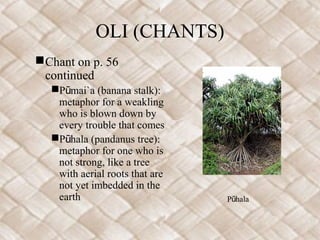
P mai`a (banana stalk):ū
metaphor for a weakling
who is blown down by
every trouble that comes
P hala (pandanus tree):ū
metaphor for one who is
not strong, like a tree
with aerial roots that are
not yet imbedded in the
earth P halaū
OLI (CHANTS)
 Chant on p. 56
 Kalonaikahailaau compares
himself to an `a`ali`i tree
 `A`ali`i: a native hardwood
shrub/tree whose clusters
are made into lei; a
metaphor for a strong
person. The `a`ali`i bush
can withstand the worst of
gales, twisting and
bending, but seldom
breaking off or falling over
`A`ali`i
OLI (CHANTS)
 Chant on p. 58
 Kalonaikahailaau insults Kawelo again
 “gets food belonging to others” is an analogy for how rats
survive (stealing)
 ` lelo No`eauŌ
`A`ohe m lama pau i ka `ioleā
Lit. No one who takes care of his possessions has ever
found them eaten by rats
When one takes care of his goods, he will not suffer
losses
OLI (CHANTS)
Line #3 on pg. 62
Kuika`a – the name of Kawelo’s club
Ho`oka`a, Ka`akua, Ka`aalo are names for strokes of club
3rd
chant on pg. 66
Kawelo is telling Kamalama to get everyone ready for
battle
2nd
chant on pg. 68
Kaehuikiawakea is telling Kamalama that they don’t have
enough men
OLI (CHANTS)
1st Chant on p. 72
1st
2 lines: Kawelo is comparing the people moving
on sand to waves
Kahinali`i – 1st
flood that all native people have in
their records
Line 9: “lehua” figurative for soldiers, especially if
they will be taken down/defeated
2nd
chant on p. 72
Kawelo is saying that all men can be reached by
Kuika`a (his club)
PLACE NAMES
 Ko`olau
 Windward mountain
range, O`ahu.
 Where Kalonaikahailaau
lived
 Lit., windward
As taken from Place Names of Hawai`i (1974) by P ku`i, Elbertū
& Mo`okini
PLACE NAMES
 Nu`uanu
 Valley, stream, pali
(cliff), Honolulu.
 Lit., cool height
As taken from Place Names of Hawai`i (1974) by P ku`i, Elbertū
& Mo`okini
Top: Nu`uanu Stream
Bottom: Nu`uani Pali
Not all characters and place names are listed in this
presentation. As a reminder, you may access the
Hawaiian Dictionary and Place Names of Hawai`i (and
many other books) for free online via a link on the
Resources page.

Kawelo (Ch 2)

  • 1.
  • 2.
    CHARACTERS  Kalanikilo  Oneof Kawelo’s gods  Used as a metaphor (kilo – look into clouds to tell the future)  Kalaumeki  Warrior that goes with Kawelo to Kaua`i  Lit., a kind of barbed spear; to recede, ebb, as the tide or flood waters; to wilt, as plants without water  Kauluiki  Warrior tht goes with Kawelo to Kaua`i  Lit., to grow, increase, spread; to protect
  • 3.
    CHARACTERS  Kou  Secondwife of Kawelo’s  Kaneikapualena  Kawelo’s other god  Left behind because he didn’t respond  Kulanihehu  War god  Given to Kawelo from his father’s side  Passed down to him because of the h `ailona at birthō  Brought from Kaua`i with uncles
  • 4.
    CHARACTERS Kaehuikiawakea Kawelo’s cousin Aikanaka’s runner Kuahulu Oneof Aikanaka’s chief officers Onionikaua One of Aikanaka’s chief officers Lit., let us contest or to have war continuously until it becomes a weary thing
  • 5.
    IMPT. NOTES  Kuika`a– name of Kawelo’s club; Lit., to swing and hit, as with a war club  Wahieloa – name of stroke requested by Kawelo; Lit., the best stroke in spear or club fighting  Ke lewa – morning star when traveling from O`ahuō to Kaua`i. Lit., the light (of the) atmosphere  In traditional art, when you beat the instructor, he says that you have nothing more to learn
  • 6.
    KAUHALE (Dwellings)  Kauhale:Group of houses compromising a Hawaiian home, formerly consisting of men’s eating house, women’s eating house, sleeping house, cooking house, canoe house, etc.  Mua (men’s eating house): The place where men and older boys ate their meals and where the head of the family offered daily offerings of `awa to the family `aumakua. Women were excluded because they were periodically considered “unclean” due to menstruation.  Hale `aina (women’s eating house): The place where women, girls and small boys ate together.  Hale noa (sleeping house): Literally means “house free of kapu.” This house was for sleeping and no eating was permitted there.
  • 7.
    MARRIAGE  Ho` ois the traditional term for marriage. Lit: Toā stay until daylight. It refers to the night of the day called Huna, the 11th night of the month when the nuptials took place.  Punalua - Formerly, spouses sharing a spouse, as two husbands of a wife, or two wives of a husband.
  • 8.
    OLI (CHANTS)  Chanton p. 56  Kalonaikahailaau insults Kawelo  K lea (plover): migratory birdō with slim legs; a figurative reference to one who claims friendship or kinship that does not exist  ` lili (sandpiper): regularŪ winter migrant bird to Hawai`i that runs about the beach; a metaphor for a weakling who cannot fight K lea (above) and ` lili (below)ō Ū
  • 9.
    OLI (CHANTS) Chant onp. 56 continued P mai`a (banana stalk):ū metaphor for a weakling who is blown down by every trouble that comes P hala (pandanus tree):ū metaphor for one who is not strong, like a tree with aerial roots that are not yet imbedded in the earth P halaū
  • 10.
    OLI (CHANTS)  Chanton p. 56  Kalonaikahailaau compares himself to an `a`ali`i tree  `A`ali`i: a native hardwood shrub/tree whose clusters are made into lei; a metaphor for a strong person. The `a`ali`i bush can withstand the worst of gales, twisting and bending, but seldom breaking off or falling over `A`ali`i
  • 11.
    OLI (CHANTS)  Chanton p. 58  Kalonaikahailaau insults Kawelo again  “gets food belonging to others” is an analogy for how rats survive (stealing)  ` lelo No`eauŌ `A`ohe m lama pau i ka `ioleā Lit. No one who takes care of his possessions has ever found them eaten by rats When one takes care of his goods, he will not suffer losses
  • 12.
    OLI (CHANTS) Line #3on pg. 62 Kuika`a – the name of Kawelo’s club Ho`oka`a, Ka`akua, Ka`aalo are names for strokes of club 3rd chant on pg. 66 Kawelo is telling Kamalama to get everyone ready for battle 2nd chant on pg. 68 Kaehuikiawakea is telling Kamalama that they don’t have enough men
  • 13.
    OLI (CHANTS) 1st Chanton p. 72 1st 2 lines: Kawelo is comparing the people moving on sand to waves Kahinali`i – 1st flood that all native people have in their records Line 9: “lehua” figurative for soldiers, especially if they will be taken down/defeated 2nd chant on p. 72 Kawelo is saying that all men can be reached by Kuika`a (his club)
  • 14.
    PLACE NAMES  Ko`olau Windward mountain range, O`ahu.  Where Kalonaikahailaau lived  Lit., windward As taken from Place Names of Hawai`i (1974) by P ku`i, Elbertū & Mo`okini
  • 15.
    PLACE NAMES  Nu`uanu Valley, stream, pali (cliff), Honolulu.  Lit., cool height As taken from Place Names of Hawai`i (1974) by P ku`i, Elbertū & Mo`okini Top: Nu`uanu Stream Bottom: Nu`uani Pali
  • 16.
    Not all charactersand place names are listed in this presentation. As a reminder, you may access the Hawaiian Dictionary and Place Names of Hawai`i (and many other books) for free online via a link on the Resources page.