LEGEND OF KAWELO:
MOKUNA I
HWST 104
CHARACTERS
• Kaweloleimakua
– Ka – the
– Welo - To flutter, float or stream, as in the wind; to set, of
the sun; progeny, ancestry, breed, family trait or strain,
group custom, heritage characteristic
– Lei – figuratively represents a beloved child
– Makua – parent
• Maihuna
– Kawelo’s father
• Malaiakalani
– Kawelo’s mother
CHARACTERS
• Aikanaka
– Son of King of Kaua`i
– Kawelo’s cousin
• Kauahoa
– Of Hanalei
– Brought up with Kawelo
– ` lelo No`eau:Ō
He hoa `ai wai paha no Kauahoaū
Lit: Perhaps he shared the breast with Kauahoa
A play on uahoa (hard) in Kauahoa, a warrior of
Kaua`i
– Uahoa: hard, severe, harsh, indifferent to the distress of others
CHARACTERS
• K kuhihewaā
– King of O`ahu
– Famous wrestler
– ` lelo No`eauŌ
E `ike ana `oe i ke li`i nui o O`ahu, `o K kuhihewaā
Lit: You will meet with the great chief of O`ahu, K kuhihewaā
You shall find out how wrong you are. A play on kuhihewa
(erroneous)
– Kuhihewa: To suppose wrongly, err in judgment, give
wrong directions; to mistake a person for someone else
CHARACTERS
• Kanewahineikiaoha
– Becomes Kawelo’s wife in Waik kī ī
– Her forte is the pïkoi (club with string)
• Kalonaikahailaau
– Kawelo’s father-in-law
– Teaches Kawelo martial arts
• Maakuakeke
– Of Waialae
– Kawelo’s fishing instructor
CHARACTERS
• Kalohipikonui & Kalohipikoikip wa`awa`aū
– Lohi: slow, tardy, late, retarded, backward
– P wa`awa`a: stupidū
– From the meaning of their names, we can
foreshadow their actions/characteristics in this
mo`olelo
H NAIĀ
• The Hawaiian word for adoption is h nai, itsā
derivation meaning to feed or nourish.
• H nai, as it was traditionally practiced inā
Hawaiian culture, referred to the situation
where a child was taken permanently to be
reared, educated, and loved by someone
other than their natural parents. The tradition
of h nai is still practiced to this day.ā
• Sometimes a child was asked for by a friend
or relative before it was born, but not the
eldest.
• The eldest belonged to the grandparents; a
boy to his paternal grandparents and a girl to
her maternal grandparents
NOTES
• The chiefs were surrounded by a throng of attendants,
who were generally kaukauali`i (class of chiefs of
lesser rank than the high chief) ie: the father is a high
chief and the mother of lower rank, but not a
commoner. These attendants included a steward.
• ` ` pu`upu`uā ī
– The steward of a person of high rank, deputed to care and
care for the chief’s food
– Steward, butler, said to be so called because the chief’s
steward got calluses (pu`upu`u) on his shoulders from
carrying food
WARFARE
• In ancient Hawai`i, chiefs would attack rival islands or battle
factions on their own island. This would require months of careful
preparation. A chief would consult advisors as well as kahuna
(priests) and then drew his army from lesser ranked chiefs and well-
trained warriors.
• Lua
– A type of dangerous hand-to-hand fighting in which the fighters broke
bones, dislocated bones at the joints, and inflicted severe pain by
pressing on nerve centers. Many of the techniques were secret; lua
experts were bodyguards to chiefs.
• Some of the weaponry mentioned in this mo`olelo are described in the following slides. Please note that the list
included here is not all-inclusive as there are many other forms of traditional Hawaiian weapons.
WEAPONS
• Clubs
– Clubs are the weapon of choice for men
– Clubs were carved from wood or made of a shaped stone lashed to a
wooden handle.
• Ihe: Spears
– Spears had barbed edges or straight point
– Warriors used short and long spears for thrusting and throwing.
– Women were generally not allowed to use spears in warfare
– Some women had spears, but they were short (8 ft).
WEAPONS
• Ma`a: Sling
– The ma`a was designed to fling
different types and sizes of rocks
– A bigger stone was flung higher
into the air onto the top of the
enemy; smaller stones were flung
directly into the face or forehead
of the attackers
– Women were allowed to use
slings
WEAPONS
• P hoa: Daggerā
– The p hoa can be used for blocking, spearing,ā
clubbing, and strangling
WEAPONS
• P koiī
– This weapon has a cord that is at least
10-15 feet long. At the end there is a
rock or a piece of wood (such as the one
shown).
– A warrior would hold onto one end of
the cord and whip it around.
– It would tangle the enemy, causing him
to trip or allowing the warrior to pull his
opponent down.
– This was the forte of Kawelo’s wife
KUKUI
• Candlenut tree
• The tree is a symbol for
enlightenment
• The nuts were chewed and spat into
the sea by men fishing with nets in
order to calm the sea
• The nuts were used for lights;
cooked for a relish (`inamona); or
polished and strung into lei
• The leaves and small white flowers
are also used in leis
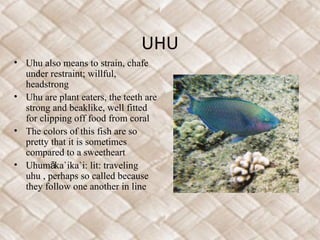
UHU
• Uhu also means to strain, chafe
under restraint; willful,
headstrong
• Uhu are plant eaters, the teeth are
strong and beaklike, well fitted
for clipping off food from coral
• The colors of this fish are so
pretty that it is sometimes
compared to a sweetheart
• Uhum ka`ika`i: lit: travelingā
uhu , perhaps so called because
they follow one another in line
OLI (CHANTS)
• Used as a form of communication; form of prayer; informs
us of social protocol
• As noted in previous lecture notes, in the Hawaiian
culture, there is much power in words. This is
demonstrated through Kawelo’s oli in which he kills
Uhum ka`ika`i through his prayer.ā
• The words of an oli were chosen very carefully because of
its double meanings, metaphorical references, etc.
• ` lelo No`eauŌ
I ka ` lelo n ke ola, i ka ` lelo n ka makeō ō ō ō
Lit: Life is in speech; death is in speech
Words can heal; words can destroy
OLI
• Often contains h `ailona (signs, omens,ō
premonitions)
– Kilo (to look at clouds to tell omens) – oli on pg.
40
– Kawelo tells Kamalama that the small pointed
clouds denote oppression
– He then goes on to chant about Kaua`i and lists
different place names of Kaua`i, indicating the
place of oppression
OLI (CHANTS)
• Adds to imagery as it often contains metaphors
– Pg. 38 “the eyes of H loa” is a metaphor for the sunā
– Lines #2-4 of oli on pg. 40 strengthen the action of imagery
(what Kawelo’s wife is doing)
• Halahola – the character in which the mat is spread out
• Kaukekeha – the character in which the head is tilted on the pillow
• Maakuiaikalani – the character in which the kapa envelopes the
wearer
• Lines #3-8 of oli on pg. 48/49 are martial holds in lua
(Hawaiian martial art of self-defense)
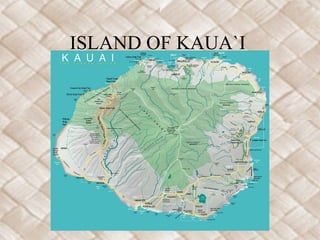
ISLAND OF KAUA`I
ISLAND OF O`AHU
PLACE NAMES
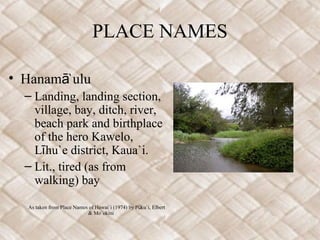
• Hanam `uluā
– Landing, landing section,
village, bay, ditch, river,
beach park and birthplace
of the hero Kawelo,
L hu`e district, Kaua`i.ī
– Lit., tired (as from
walking) bay
As taken from Place Names of Hawai`i (1974) by P ku`i, Elbertū
& Mo`okini
PLACE NAMES
• Wailua
– Land division,
river, falls, valley,
town, L hu`e qd.,ī
Kaua`i.
– Lit., two waters
As taken from Place Names of Hawai`i (1974) by
P kuū i, Elbert & Mo`okini
PLACE NAMES
• Kaho`olein pe`aā
– Land division near K loa,ō
Kaua`i.
– Lit., the flying (of) the kites
– The kite of the Kaua`i hero
Kawelo was entangled here
with that of his rival cousin.
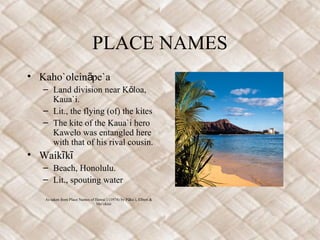
• Waik kī ī
– Beach, Honolulu.
– Lit., spouting water
As taken from Place Names of Hawai`i (1974) by P ku`i, Elbert &ū
Mo`okini
PLACE NAMES
• Kalehuawehe
– Name for an ancient surfing area
at Waik k ; now called Castle’sī ī
– Lit., the removed lehua lei; take
off the lehua
– ` lelo No`eauŌ
Ka nalu ha`i o Kalehuawehe
The rolling surf of
Kalehuawehe
Kalehuawehe was Waik k ’sī ī
most famous surf. IT was so
named when a legendary hero
took off his lei of lehua blossoms
and gave it to the wife of the
ruling chief, with whom he was
surfing.
As taken from Place Names of Hawai`i (1974) by P ku`i, Elbert & Mo`okiniū
PLACE NAMES
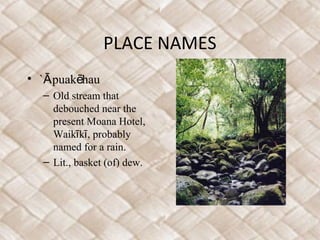
• ` puak hauĀ ē
– Old stream that
debouched near the
present Moana Hotel,
Waik k , probablyī ī
named for a rain.
– Lit., basket (of) dew.
PLACE NAMES
• Wai`alae
– Mountain, section, avenue
in Honolulu said to be
named for a spring
– Lit., mudhen water
• Wai`anae
– Quadrangle, mountain
range, land division, town,
valley on O`ahu.
– Lit., mullet water
As taken from Place Names of Hawai`i (1974) by P ku`i, Elbert &ū
Mo`okini
Wai`anae Coast
PLACE NAMES
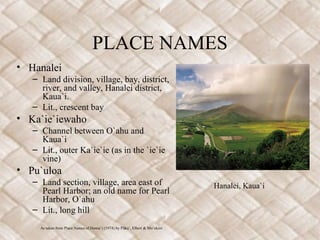
• Hanalei
– Land division, village, bay, district,
river, and valley, Hanalei district,
Kaua`i.
– Lit., crescent bay
• Ka`ie`iewaho
– Channel between O`ahu and
Kaua`i
– Lit., outer Ka`ie`ie (as in the `ie`ie
vine)
• Pu`uloa
– Land section, village, area east of
Pearl Harbor; an old name for Pearl
Harbor, O`ahu
– Lit., long hill
As taken from Place Names of Hawai`i (1974) by P ku`, Elbert & Mo`okiniū
Hanalei, Kaua`i
Not all characters and place names are listed in this
presentation. As a reminder, you may access the
Hawaiian Dictionary and Place Names of Hawai`i (and
many other books) for free online via a link on the
Resources page.

Kawelo (Ch 1)

  • 1.
  • 2.
    CHARACTERS • Kaweloleimakua – Ka– the – Welo - To flutter, float or stream, as in the wind; to set, of the sun; progeny, ancestry, breed, family trait or strain, group custom, heritage characteristic – Lei – figuratively represents a beloved child – Makua – parent • Maihuna – Kawelo’s father • Malaiakalani – Kawelo’s mother
  • 3.
    CHARACTERS • Aikanaka – Sonof King of Kaua`i – Kawelo’s cousin • Kauahoa – Of Hanalei – Brought up with Kawelo – ` lelo No`eau:Ō He hoa `ai wai paha no Kauahoaū Lit: Perhaps he shared the breast with Kauahoa A play on uahoa (hard) in Kauahoa, a warrior of Kaua`i – Uahoa: hard, severe, harsh, indifferent to the distress of others
  • 4.
    CHARACTERS • K kuhihewaā –King of O`ahu – Famous wrestler – ` lelo No`eauŌ E `ike ana `oe i ke li`i nui o O`ahu, `o K kuhihewaā Lit: You will meet with the great chief of O`ahu, K kuhihewaā You shall find out how wrong you are. A play on kuhihewa (erroneous) – Kuhihewa: To suppose wrongly, err in judgment, give wrong directions; to mistake a person for someone else
  • 5.
    CHARACTERS • Kanewahineikiaoha – BecomesKawelo’s wife in Waik kī ī – Her forte is the pïkoi (club with string) • Kalonaikahailaau – Kawelo’s father-in-law – Teaches Kawelo martial arts • Maakuakeke – Of Waialae – Kawelo’s fishing instructor
  • 6.
    CHARACTERS • Kalohipikonui &Kalohipikoikip wa`awa`aū – Lohi: slow, tardy, late, retarded, backward – P wa`awa`a: stupidū – From the meaning of their names, we can foreshadow their actions/characteristics in this mo`olelo
  • 7.
    H NAIĀ • TheHawaiian word for adoption is h nai, itsā derivation meaning to feed or nourish. • H nai, as it was traditionally practiced inā Hawaiian culture, referred to the situation where a child was taken permanently to be reared, educated, and loved by someone other than their natural parents. The tradition of h nai is still practiced to this day.ā • Sometimes a child was asked for by a friend or relative before it was born, but not the eldest. • The eldest belonged to the grandparents; a boy to his paternal grandparents and a girl to her maternal grandparents
  • 8.
    NOTES • The chiefswere surrounded by a throng of attendants, who were generally kaukauali`i (class of chiefs of lesser rank than the high chief) ie: the father is a high chief and the mother of lower rank, but not a commoner. These attendants included a steward. • ` ` pu`upu`uā ī – The steward of a person of high rank, deputed to care and care for the chief’s food – Steward, butler, said to be so called because the chief’s steward got calluses (pu`upu`u) on his shoulders from carrying food
  • 9.
    WARFARE • In ancientHawai`i, chiefs would attack rival islands or battle factions on their own island. This would require months of careful preparation. A chief would consult advisors as well as kahuna (priests) and then drew his army from lesser ranked chiefs and well- trained warriors. • Lua – A type of dangerous hand-to-hand fighting in which the fighters broke bones, dislocated bones at the joints, and inflicted severe pain by pressing on nerve centers. Many of the techniques were secret; lua experts were bodyguards to chiefs. • Some of the weaponry mentioned in this mo`olelo are described in the following slides. Please note that the list included here is not all-inclusive as there are many other forms of traditional Hawaiian weapons.
  • 10.
    WEAPONS • Clubs – Clubsare the weapon of choice for men – Clubs were carved from wood or made of a shaped stone lashed to a wooden handle. • Ihe: Spears – Spears had barbed edges or straight point – Warriors used short and long spears for thrusting and throwing. – Women were generally not allowed to use spears in warfare – Some women had spears, but they were short (8 ft).
  • 11.
    WEAPONS • Ma`a: Sling –The ma`a was designed to fling different types and sizes of rocks – A bigger stone was flung higher into the air onto the top of the enemy; smaller stones were flung directly into the face or forehead of the attackers – Women were allowed to use slings
  • 12.
    WEAPONS • P hoa:Daggerā – The p hoa can be used for blocking, spearing,ā clubbing, and strangling
  • 13.
    WEAPONS • P koiī –This weapon has a cord that is at least 10-15 feet long. At the end there is a rock or a piece of wood (such as the one shown). – A warrior would hold onto one end of the cord and whip it around. – It would tangle the enemy, causing him to trip or allowing the warrior to pull his opponent down. – This was the forte of Kawelo’s wife
  • 14.
    KUKUI • Candlenut tree •The tree is a symbol for enlightenment • The nuts were chewed and spat into the sea by men fishing with nets in order to calm the sea • The nuts were used for lights; cooked for a relish (`inamona); or polished and strung into lei • The leaves and small white flowers are also used in leis
  • 15.
    UHU • Uhu alsomeans to strain, chafe under restraint; willful, headstrong • Uhu are plant eaters, the teeth are strong and beaklike, well fitted for clipping off food from coral • The colors of this fish are so pretty that it is sometimes compared to a sweetheart • Uhum ka`ika`i: lit: travelingā uhu , perhaps so called because they follow one another in line
  • 16.
    OLI (CHANTS) • Usedas a form of communication; form of prayer; informs us of social protocol • As noted in previous lecture notes, in the Hawaiian culture, there is much power in words. This is demonstrated through Kawelo’s oli in which he kills Uhum ka`ika`i through his prayer.ā • The words of an oli were chosen very carefully because of its double meanings, metaphorical references, etc. • ` lelo No`eauŌ I ka ` lelo n ke ola, i ka ` lelo n ka makeō ō ō ō Lit: Life is in speech; death is in speech Words can heal; words can destroy
  • 17.
    OLI • Often containsh `ailona (signs, omens,ō premonitions) – Kilo (to look at clouds to tell omens) – oli on pg. 40 – Kawelo tells Kamalama that the small pointed clouds denote oppression – He then goes on to chant about Kaua`i and lists different place names of Kaua`i, indicating the place of oppression
  • 18.
    OLI (CHANTS) • Addsto imagery as it often contains metaphors – Pg. 38 “the eyes of H loa” is a metaphor for the sunā – Lines #2-4 of oli on pg. 40 strengthen the action of imagery (what Kawelo’s wife is doing) • Halahola – the character in which the mat is spread out • Kaukekeha – the character in which the head is tilted on the pillow • Maakuiaikalani – the character in which the kapa envelopes the wearer • Lines #3-8 of oli on pg. 48/49 are martial holds in lua (Hawaiian martial art of self-defense)
  • 19.
  • 20.
  • 21.
    PLACE NAMES • Hanam`uluā – Landing, landing section, village, bay, ditch, river, beach park and birthplace of the hero Kawelo, L hu`e district, Kaua`i.ī – Lit., tired (as from walking) bay As taken from Place Names of Hawai`i (1974) by P ku`i, Elbertū & Mo`okini
  • 22.
    PLACE NAMES • Wailua –Land division, river, falls, valley, town, L hu`e qd.,ī Kaua`i. – Lit., two waters As taken from Place Names of Hawai`i (1974) by P kuū i, Elbert & Mo`okini
  • 23.
    PLACE NAMES • Kaho`oleinpe`aā – Land division near K loa,ō Kaua`i. – Lit., the flying (of) the kites – The kite of the Kaua`i hero Kawelo was entangled here with that of his rival cousin. • Waik kī ī – Beach, Honolulu. – Lit., spouting water As taken from Place Names of Hawai`i (1974) by P ku`i, Elbert &ū Mo`okini
  • 24.
    PLACE NAMES • Kalehuawehe –Name for an ancient surfing area at Waik k ; now called Castle’sī ī – Lit., the removed lehua lei; take off the lehua – ` lelo No`eauŌ Ka nalu ha`i o Kalehuawehe The rolling surf of Kalehuawehe Kalehuawehe was Waik k ’sī ī most famous surf. IT was so named when a legendary hero took off his lei of lehua blossoms and gave it to the wife of the ruling chief, with whom he was surfing. As taken from Place Names of Hawai`i (1974) by P ku`i, Elbert & Mo`okiniū
  • 25.
    PLACE NAMES • `puak hauĀ ē – Old stream that debouched near the present Moana Hotel, Waik k , probablyī ī named for a rain. – Lit., basket (of) dew.
  • 26.
    PLACE NAMES • Wai`alae –Mountain, section, avenue in Honolulu said to be named for a spring – Lit., mudhen water • Wai`anae – Quadrangle, mountain range, land division, town, valley on O`ahu. – Lit., mullet water As taken from Place Names of Hawai`i (1974) by P ku`i, Elbert &ū Mo`okini Wai`anae Coast
  • 27.
    PLACE NAMES • Hanalei –Land division, village, bay, district, river, and valley, Hanalei district, Kaua`i. – Lit., crescent bay • Ka`ie`iewaho – Channel between O`ahu and Kaua`i – Lit., outer Ka`ie`ie (as in the `ie`ie vine) • Pu`uloa – Land section, village, area east of Pearl Harbor; an old name for Pearl Harbor, O`ahu – Lit., long hill As taken from Place Names of Hawai`i (1974) by P ku`, Elbert & Mo`okiniū Hanalei, Kaua`i
  • 28.
    Not all charactersand place names are listed in this presentation. As a reminder, you may access the Hawaiian Dictionary and Place Names of Hawai`i (and many other books) for free online via a link on the Resources page.