OTHER FOOD
  PLANTS
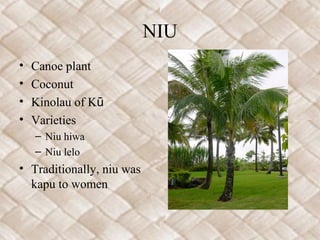
NIU
•   Canoe plant
•   Coconut
•   Kinolau of Kū
•   Varieties
    – Niu hiwa
    – Niu lelo
• Traditionally, niu was
  kapu to women
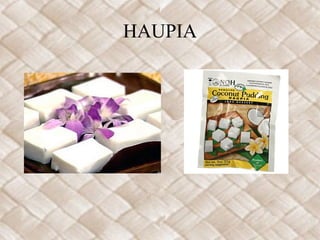
HAUPIA
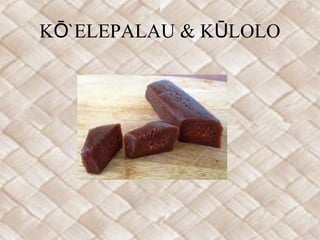
KŌ`ELEPALAU & KŪLOLO
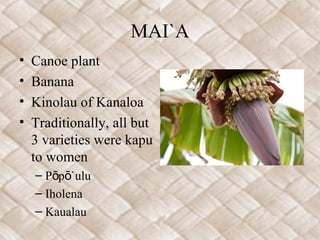
MAI`A
•   Canoe plant
•   Banana
•   Kinolau of Kanaloa
•   Traditionally, all but
    3 varieties were kapu
    to women
    – Pōpō`ulu
    – Iholena
    – Kaualau
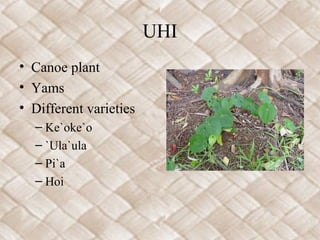
UHI
• Canoe plant
• Yams
• Different varieties
  – Ke`oke`o
  – `Ula`ula
  – Pi`a
  – Hoi
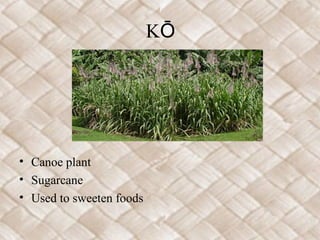
KŌ


• Canoe plant
• Sugarcane
• Used to sweeten foods
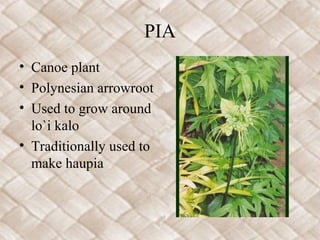
PIA
• Canoe plant
• Polynesian arrowroot
• Used to grow around
  lo`i kalo
• Traditionally used to
  make haupia
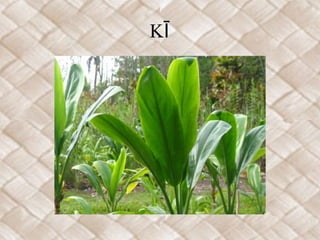
KĪ
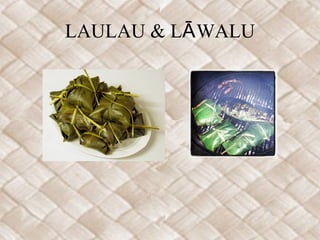
LAULAU & LĀ WALU
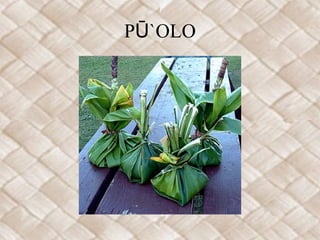
PŪ`OLO
If you have any
questions, please
 ask them on the
Discussion Board.
     Mahalo!

Other food plants

Editor's Notes

  • #3 Niu is considered to be a kinolau of Kū. Thus, planting the kumu niu was men’s work, and with few exceptions, trees and their fruits were kapu to women. There were two varieties of niu that were well used in Hawai`i – niu hiwa and niu lelo Niu hiwa has a dark green husk and a black shell when mature The niu hiwa, which was used for ceremonial and medicinal purposes as well as for food, was kapu to women in its entirety. The niu lelo has a reddish, yellow exterior and a yellowish shell when mature The niu lelo was forbidden to women as food, but its fronds and trunk were free for other uses Women, who were expert cordage makers, were not permitted to make `aha from niu husk; all such cordage was manufactured by men Grated coconut meet was used for food in two ways, either as an ingredient in cooked dishes or to make the sweet, milky liquid commonly known as “coconut cream.”
  • #4 pudding of coconut cream thickened with pia. Today, sugar is added Please note that there is no early documentation on haupia or kō`elepalau and kūlolo, but they are presumed to have originated in ancient times and if so, would have been consumed only by men, since there was a kapu on niu as a food for women
  • #5 Kō`elepalau – pudding made of cooked sweet potatoes, peeled and mashed, to which coconut cream was added Kūlolo – made from grated raw taro corms and coconut milk. Today brown sugar or honey are added for a modern touch.
  • #6 Mai`a is a kinolau of the Kanaloa – god of the ocean There are many different varieties of mai`a, but traditionally women were only allowed to eat three – pōpō`ulu, iholena and kaualau. Otherwise, all other varieties were forbidden to them It is believed to be bad luck to dream of bananas, to meet someone who carries them, or to bring them on a fishing trip The Hawaiian's used the Maia Leaves and trunks for cooking. Mai`a offered in heiau In planting mai`a, the kanaka maoli followed the lunar calendar carefully. Certain phases of the moon were regarded as ideal for planting mai`a, increasing the chances that a plant would bear large clusters of well shaped fruit
  • #7 Uhi tubers are steamed and eaten in chunks, but not sticky enough to be suitable for mashing into poi Ke`oke`o – white both outside and inside. Used only for food `Ula`ula – tubers have white flesh but red skin. Used for food and medicine Pi`a – leaves with 5 lobes. Tubers vary from bulbous, somewhat turnip shaped to more elongate Hoi – bears small, aerial tubers adjacent to its leaves that can fall to the ground and root themselves
  • #8 Planted along the embankments of lo`i and by plots of `uala or dryland kalo Eaten by simply chewing and sucking upon the stems or juice extracted by pounding the pulp Sugar cane stalks or stems are carried on journeys and chewed for quick energy Also chewed throughout the year by adults and children as one of the few sweet foods The fibers cleanse the teeth and strengthen the gums Used to sweeten foods such as haupia and kūlolo
  • #9 Cultivated for its starchy tubers Grated the tubers, soaked it repeatedly in fresh water until it was no longer bitter Filtered, shaped into cakes and dried in the sun The dried starch was moistened when needed, placed in lā`ī and baked in an imu, plain or mixed with coconut cream. The dessert we know today as haupia is a variation of this preparation. Today, it is usually made with cornstarch rather than with pia
  • #10 Raw foods are wrapped in lā`ī – laulau – and cooked in the imu – kālua – or broiled over coals – lāwalu Food is wrapped in lā`ī and stored or transported in bundles – pū`olo