HIKI
HAW 102
• Hiki sentences express the idea of “can” and
“cannot.” Last week, we learned the difference
between hamani, hehele and a ano type words. Itʻ ʻ
is important to remember the differences in each
when using this pattern.
• Hamani words are words that describe an action,
sense, or emotion towards another thing or person (ie:
aloha, inu, lawe, heluhelu, etc.).
• Hehele words are words that describe the creation of a
movement, position, or sound within oneself (ie:
hiamoe, u , lele, etc.).ē
• ‘A ano words are stative verbs that describe aʻ
condition, trait or state of being of someone or
something (ie: melemele, wela, molo , u i, etc.).ā ʻ
HIKI I ka i + meme aʻ ʻ KE verb (hamani/hehele)
*The ka/ke rule does not apply to the “ke”
before the verb. The pattern always calls
for “ke.”
HIKI USING KA`I + MEME`A &
HAMANI/HEHELE TYPE WORDS
N LA`ANAĀ
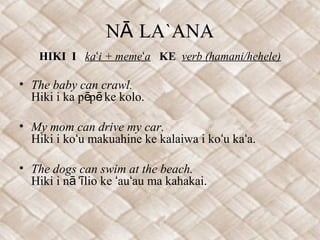
HIKI I ka i + meme aʻ ʻ KE verb (hamani/hehele)
• The baby can crawl.
Hiki i ka p p ke kolo.ē ē
• My mom can drive my car.
Hiki i ko u makuahine ke kalaiwa i ko u ka a.ʻ ʻ ʻ
• The dogs can swim at the beach.
Hiki i n lio ke au au ma kahakai.āʻī ʻ ʻ
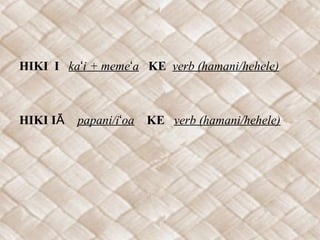
HIKI I ka i + meme aʻ ʻ KE verb (hamani/hehele)
HIKI IĀ papani/i oaʻ KE verb (hamani/hehele)
N LA`ANAĀ
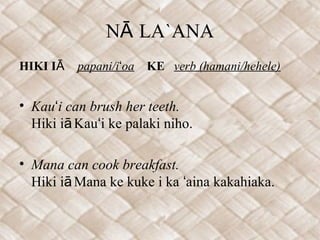
HIKI IĀ papani/i oaʻ KE verb (hamani/hehele)
• Kau i can brush her teeth.ʻ
Hiki i Kau i ke palaki niho.ā ʻ
• Mana can cook breakfast.
Hiki i Mana ke kuke i ka aina kakahiaka.ā ʻ
N LA`ANAĀ
HIKI IĀ papani/i oaʻ KE verb (hamani/hehele)
• They (2) can play the guitar.
Hiki i l ua ke ho okani i ke k k .ā ā ʻ ī ā
• You can sit down now.
Hiki i oe ke noho i k ia manawa.āʻ ē
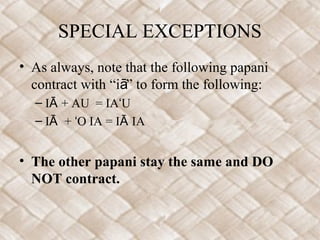
SPECIAL EXCEPTIONS
• As always, note that the following papani
contract with “i ” to form the following:ā
– I + AU = IA UĀ ʻ
– I + O IA = I IAĀ ʻ Ā
• The other papani stay the same and DO
NOT contract.
N LA`ANAĀ
I + AU = IA UĀ ʻ
• I can drive the truck.
Hiki ia`u ke kalaiwa i ke kalaka.
I + O IA = I IAĀ ʻ Ā
• He can sleep on my bed.
Hiki i ia ke hiamoe ma ko`u pela moe.ā
QUESTION?
• Note that to make the sentence into a question,
you should simply add a question mark to the end.
• Can I go to the movies?
Hiki ia u ke hele i ke ki i oni oni?ʻ ʻ ʻ ʻ
• Can we go to McDonald’s?
Hiki i k kou ke hele i McDonald’s?ā ā
• Can I leave the table?
Hiki ia u ke ha alele i ke p kaukau?ʻ ʻ ā
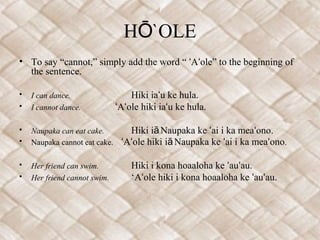
H `OLEŌ
• To say “cannot,” simply add the word “ A ole” to the beginning ofʻ ʻ
the sentence.
• I can dance. Hiki ia u ke hula.ʻ
• I cannot dance. A ole hiki ia u ke hula.ʻ ʻ ʻ
• Naupaka can eat cake. Hiki i Naupaka ke ai i ka mea ono.ā ʻ ʻ
• Naupaka cannot eat cake. A ole hiki i Naupaka ke ai i ka mea onoʻ ʻ ā ʻ ʻ .
• Her friend can swim. Hiki i kona hoaaloha ke au au.ʻ ʻ
• Her friend cannot swim. ‘A ole hiki i kona hoaaloha ke au au.ʻ ʻ ʻ
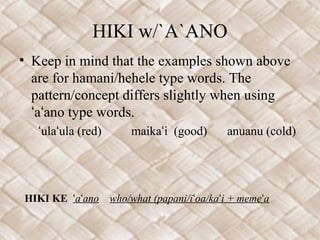
HIKI w/`A`ANO
• Keep in mind that the examples shown above
are for hamani/hehele type words. The
pattern/concept differs slightly when using
a ano type words.ʻ ʻ
ula ula (red)ʻ ʻ maika i (good)ʻ anuanu (cold)
HIKI KE a anoʻ ʻ who/what (papani/i oa/ka i + meme aʻ ʻ ʻ
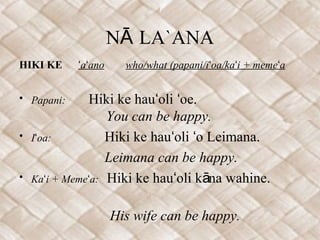
N LA`ANAĀ
HIKI KE a anoʻ ʻ who/what (papani/i oa/ka i + meme aʻ ʻ ʻ
• Papani: Hiki ke hau oli oe.ʻ ʻ
You can be happy.
• I oa:ʻ Hiki ke hau oli o Leimana.ʻ ʻ
Leimana can be happy.
• Ka i + Meme a:ʻ ʻ Hiki ke hau oli k na wahine.ʻ ā
His wife can be happy.
N LA`ANAĀ
HIKI KE a anoʻ ʻ who/what (papani/i oa/ka i + meme aʻ ʻ ʻ
• Papani: Hiki ke hilahila k kou a pau.ā
We can all be embarrassed.
• I oa:ʻ Hiki ke hilahila o Pono.ʻ
Pono can be embarrassed.
• Ka i + Meme a:ʻ ʻ Hiki ke hilahila ke keiki kolohe.
The rascal child can be embarrassed.
Hiki

Hiki

  • 1.
  • 2.
    • Hiki sentencesexpress the idea of “can” and “cannot.” Last week, we learned the difference between hamani, hehele and a ano type words. Itʻ ʻ is important to remember the differences in each when using this pattern. • Hamani words are words that describe an action, sense, or emotion towards another thing or person (ie: aloha, inu, lawe, heluhelu, etc.). • Hehele words are words that describe the creation of a movement, position, or sound within oneself (ie: hiamoe, u , lele, etc.).ē • ‘A ano words are stative verbs that describe aʻ condition, trait or state of being of someone or something (ie: melemele, wela, molo , u i, etc.).ā ʻ
  • 3.
    HIKI I kai + meme aʻ ʻ KE verb (hamani/hehele) *The ka/ke rule does not apply to the “ke” before the verb. The pattern always calls for “ke.” HIKI USING KA`I + MEME`A & HAMANI/HEHELE TYPE WORDS
  • 4.
    N LA`ANAĀ HIKI Ika i + meme aʻ ʻ KE verb (hamani/hehele) • The baby can crawl. Hiki i ka p p ke kolo.ē ē • My mom can drive my car. Hiki i ko u makuahine ke kalaiwa i ko u ka a.ʻ ʻ ʻ • The dogs can swim at the beach. Hiki i n lio ke au au ma kahakai.āʻī ʻ ʻ
  • 5.
    HIKI I kai + meme aʻ ʻ KE verb (hamani/hehele) HIKI IĀ papani/i oaʻ KE verb (hamani/hehele)
  • 6.
    N LA`ANAĀ HIKI IĀpapani/i oaʻ KE verb (hamani/hehele) • Kau i can brush her teeth.ʻ Hiki i Kau i ke palaki niho.ā ʻ • Mana can cook breakfast. Hiki i Mana ke kuke i ka aina kakahiaka.ā ʻ
  • 7.
    N LA`ANAĀ HIKI IĀpapani/i oaʻ KE verb (hamani/hehele) • They (2) can play the guitar. Hiki i l ua ke ho okani i ke k k .ā ā ʻ ī ā • You can sit down now. Hiki i oe ke noho i k ia manawa.āʻ ē
  • 8.
    SPECIAL EXCEPTIONS • Asalways, note that the following papani contract with “i ” to form the following:ā – I + AU = IA UĀ ʻ – I + O IA = I IAĀ ʻ Ā • The other papani stay the same and DO NOT contract.
  • 9.
    N LA`ANAĀ I +AU = IA UĀ ʻ • I can drive the truck. Hiki ia`u ke kalaiwa i ke kalaka. I + O IA = I IAĀ ʻ Ā • He can sleep on my bed. Hiki i ia ke hiamoe ma ko`u pela moe.ā
  • 10.
    QUESTION? • Note thatto make the sentence into a question, you should simply add a question mark to the end. • Can I go to the movies? Hiki ia u ke hele i ke ki i oni oni?ʻ ʻ ʻ ʻ • Can we go to McDonald’s? Hiki i k kou ke hele i McDonald’s?ā ā • Can I leave the table? Hiki ia u ke ha alele i ke p kaukau?ʻ ʻ ā
  • 11.
    H `OLEŌ • Tosay “cannot,” simply add the word “ A ole” to the beginning ofʻ ʻ the sentence. • I can dance. Hiki ia u ke hula.ʻ • I cannot dance. A ole hiki ia u ke hula.ʻ ʻ ʻ • Naupaka can eat cake. Hiki i Naupaka ke ai i ka mea ono.ā ʻ ʻ • Naupaka cannot eat cake. A ole hiki i Naupaka ke ai i ka mea onoʻ ʻ ā ʻ ʻ . • Her friend can swim. Hiki i kona hoaaloha ke au au.ʻ ʻ • Her friend cannot swim. ‘A ole hiki i kona hoaaloha ke au au.ʻ ʻ ʻ
  • 12.
    HIKI w/`A`ANO • Keepin mind that the examples shown above are for hamani/hehele type words. The pattern/concept differs slightly when using a ano type words.ʻ ʻ ula ula (red)ʻ ʻ maika i (good)ʻ anuanu (cold) HIKI KE a anoʻ ʻ who/what (papani/i oa/ka i + meme aʻ ʻ ʻ
  • 13.
    N LA`ANAĀ HIKI KEa anoʻ ʻ who/what (papani/i oa/ka i + meme aʻ ʻ ʻ • Papani: Hiki ke hau oli oe.ʻ ʻ You can be happy. • I oa:ʻ Hiki ke hau oli o Leimana.ʻ ʻ Leimana can be happy. • Ka i + Meme a:ʻ ʻ Hiki ke hau oli k na wahine.ʻ ā His wife can be happy.
  • 14.
    N LA`ANAĀ HIKI KEa anoʻ ʻ who/what (papani/i oa/ka i + meme aʻ ʻ ʻ • Papani: Hiki ke hilahila k kou a pau.ā We can all be embarrassed. • I oa:ʻ Hiki ke hilahila o Pono.ʻ Pono can be embarrassed. • Ka i + Meme a:ʻ ʻ Hiki ke hilahila ke keiki kolohe. The rascal child can be embarrassed.