KAWELO
MOKUNA IV - X
HWST 104
IMPT. NOTES
 Milu
 The underworld; ruler of the underworld
 Like purgatory
 Not a place for being punished for being there
 P.88 The “cold that has entered” Aikanaka is a
metaphor for fear
 P. 88 Kawelo’s chant to Kahakaloa
 Kawelo makes fun of Kahakaloa
 Pun on the word “haka,” meaning long shelf; vacant,
empty, open space, hole, breach
OLI
 P. 92 Kahakaloa’s maiming
 A king’s pig was marked for sacrifice by cutting off a part of
his ear
 P. 94 Kawelo’s chant to Kauahoa
 Line 9 – Kawelo is trying to butter up Kauahoa
 Lines 10-14 – Kawelo is naming the warriors that are with
him and where they’re from
 Lines 15-22 – Offers a proposition of postponement even
though he knows it’s inevitable
 Lines 21-22 – Kawelo mentiones what they did for ‘Aikanaka
(string lehua blossoms)
 P. 94 – Kawelo’s chant (3 lines)
 Kawelo is psyching himself up for the fight
OLI
 P. 100
 ` lelo No`eauŌ
He ali`i ka moa
Lit. The rooster is a chief
The rooster sleeps on a high perch. His feathers
are used in k hili, which are the symbols ofā chiefs.
HEIAU
 A pre-Christian place of worship; some heiau were
elaborately constructed stone platforms, others simple
earth terraces
 From the heiau, the kahuna (priest) communicated
with the gods and advised the ali`i (chief)
 At least 9 types of heiau existed including the
following:
 Luakini: Large heiau where ruling chiefs prayed and
human sacrifices were offered; often referred to as “war
temples”
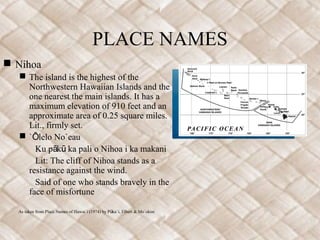
PLACE NAMES
 Nihoa
 The island is the highest of the
Northwestern Hawaiian Islands and the
one nearest the main islands. It has a
maximum elevation of 910 feet and an
approximate area of 0.25 square miles.
Lit., firmly set.
 ` lelo No`eauŌ
Ku p k ka pali o Nihoa i ka makaniā ū
Lit: The cliff of Nihoa stands as a
resistance against the wind.
Said of one who stands bravely in the
face of misfortune
As taken from Place Names of Hawai`i (1974) by P ku`i, Elbert & Mo`okiniū
PLACE NAMES Lehua
 Island (291 acres, maximum
elevation 710 feet) west of
Ni`ihau, the westernmost
island of the main Hawaiian
chain (not including the
Northwestern Hawaiian
Islands) Lit., lehua flower
 ` lelo No`eauŌ
Aia i ka mole o Lehua
Lit: At the taproot of Lehua
Said of one who is out of
sight for a long time, neither
seen nor heard of
As taken from Place Names of Hawai`i (1974) by
P ku`i, Elbert & Mo`okiniū
PLACE NAMES
 Kualoa
 Land division, point, Waik neā
qd., O`ahu, an area anciently
considered one of the most
sacred places on the island. A
place of refuge was here. Lit.,
long back.
 `Ewa
 Plantation, quadrangle west of
Pearl Harbor, O`ahu. Lit.,
crooked.
 Honokoa
 Place, Wai`alae, Honolulu.
Lit., brave bay
As taken from Place Names of Hawai`i (1974) by P ku`i, Elbert &ū
Mo`okini
Kualoa
PLACE NAMES M malahoaā
 Peak, Hanalei district, Kaua`i.
 Stream, K ne`ohe; place,ā
Nu`uanu, O`ahu.
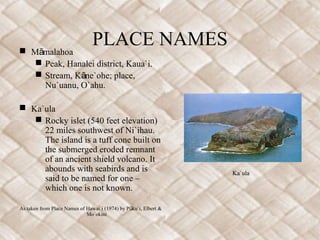
 Ka`ula
 Rocky islet (540 feet elevation)
22 miles southwest of Ni`ihau.
The island is a tuff cone built on
the submerged eroded remnant
of an ancient shield volcano. It
abounds with seabirds and is
said to be named for one –
which one is not known.
As taken from Place Names of Hawai`i (1974) by P ku`i, Elbert &ū
Mo`okini
Ka`ulaKa`ula
PLACE NAMES
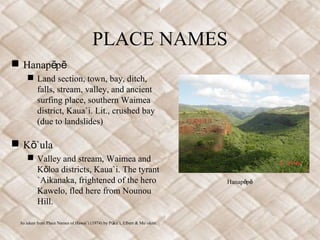
 Hanap pē ē
 Land section, town, bay, ditch,
falls, stream, valley, and ancient
surfing place, southern Waimea
district, Kaua`i. Lit., crushed bay
(due to landslides)
 K `ulaō
 Valley and stream, Waimea and
K loa districts, Kaua`i. The tyrantō
`Aikanaka, frightened of the hero
Kawelo, fled here from Nounou
Hill.
As taken from Place Names of Hawai`i (1974) by P ku`i, Elbert & Mo`okiniū
Hanap pē ē
PLACE NAMES
 Polihale
 State park, beach, ridge,
heiau, and land division,
Waimea district, Kaua`i,
famous for its seaweed
(pahapaha) used in leis, a
practice said to have been
introduced by Pele’s older
sister, N makaokaha`i. Lit.,ā
house bosom
As taken from Place Names of Hawai`i (1974) by P ku`i, Elbert &ū
Mo`okini
PLACE NAMES
K loaō
Town, park, land division, district, southeast
Kaua`i. According to one account, the
district was named for a steep rock called
Paliok loa. The first successful sugarō
plantation in the islands was started here in
1835.
As taken from Place Names of Hawai`i (1974) by P ku`i, Elbert & Mo`okiniū
PLACE NAMES
Wahiawa
Stream and heiau, K loa district, Kaua`i. Lit.,ō
milkfish place.
Luakaha
Street and land section, upper Nu`uanu, Honolulu,
and the site of and name of the country home of
Kamehameha III. Lit., place for relaxation.
As taken from Place Names of Hawai`i (1974) by P ku`i, Elbert & Mo`okiniū
Not all characters and place names are listed in this
presentation. As a reminder, you may access the
Hawaiian Dictionary and Place Names of Hawai`i (and
many other books) for free online via a link on the
Resources page.

Kawelo Ch 4-10

  • 1.
  • 2.
    IMPT. NOTES  Milu The underworld; ruler of the underworld  Like purgatory  Not a place for being punished for being there  P.88 The “cold that has entered” Aikanaka is a metaphor for fear  P. 88 Kawelo’s chant to Kahakaloa  Kawelo makes fun of Kahakaloa  Pun on the word “haka,” meaning long shelf; vacant, empty, open space, hole, breach
  • 3.
    OLI  P. 92Kahakaloa’s maiming  A king’s pig was marked for sacrifice by cutting off a part of his ear  P. 94 Kawelo’s chant to Kauahoa  Line 9 – Kawelo is trying to butter up Kauahoa  Lines 10-14 – Kawelo is naming the warriors that are with him and where they’re from  Lines 15-22 – Offers a proposition of postponement even though he knows it’s inevitable  Lines 21-22 – Kawelo mentiones what they did for ‘Aikanaka (string lehua blossoms)  P. 94 – Kawelo’s chant (3 lines)  Kawelo is psyching himself up for the fight
  • 4.
    OLI  P. 100 ` lelo No`eauŌ He ali`i ka moa Lit. The rooster is a chief The rooster sleeps on a high perch. His feathers are used in k hili, which are the symbols ofā chiefs.
  • 5.
    HEIAU  A pre-Christianplace of worship; some heiau were elaborately constructed stone platforms, others simple earth terraces  From the heiau, the kahuna (priest) communicated with the gods and advised the ali`i (chief)  At least 9 types of heiau existed including the following:  Luakini: Large heiau where ruling chiefs prayed and human sacrifices were offered; often referred to as “war temples”
  • 6.
    PLACE NAMES  Nihoa The island is the highest of the Northwestern Hawaiian Islands and the one nearest the main islands. It has a maximum elevation of 910 feet and an approximate area of 0.25 square miles. Lit., firmly set.  ` lelo No`eauŌ Ku p k ka pali o Nihoa i ka makaniā ū Lit: The cliff of Nihoa stands as a resistance against the wind. Said of one who stands bravely in the face of misfortune As taken from Place Names of Hawai`i (1974) by P ku`i, Elbert & Mo`okiniū
  • 7.
    PLACE NAMES Lehua Island (291 acres, maximum elevation 710 feet) west of Ni`ihau, the westernmost island of the main Hawaiian chain (not including the Northwestern Hawaiian Islands) Lit., lehua flower  ` lelo No`eauŌ Aia i ka mole o Lehua Lit: At the taproot of Lehua Said of one who is out of sight for a long time, neither seen nor heard of As taken from Place Names of Hawai`i (1974) by P ku`i, Elbert & Mo`okiniū
  • 8.
    PLACE NAMES  Kualoa Land division, point, Waik neā qd., O`ahu, an area anciently considered one of the most sacred places on the island. A place of refuge was here. Lit., long back.  `Ewa  Plantation, quadrangle west of Pearl Harbor, O`ahu. Lit., crooked.  Honokoa  Place, Wai`alae, Honolulu. Lit., brave bay As taken from Place Names of Hawai`i (1974) by P ku`i, Elbert &ū Mo`okini Kualoa
  • 9.
    PLACE NAMES Mmalahoaā  Peak, Hanalei district, Kaua`i.  Stream, K ne`ohe; place,ā Nu`uanu, O`ahu.  Ka`ula  Rocky islet (540 feet elevation) 22 miles southwest of Ni`ihau. The island is a tuff cone built on the submerged eroded remnant of an ancient shield volcano. It abounds with seabirds and is said to be named for one – which one is not known. As taken from Place Names of Hawai`i (1974) by P ku`i, Elbert &ū Mo`okini Ka`ulaKa`ula
  • 10.
    PLACE NAMES  Hanappē ē  Land section, town, bay, ditch, falls, stream, valley, and ancient surfing place, southern Waimea district, Kaua`i. Lit., crushed bay (due to landslides)  K `ulaō  Valley and stream, Waimea and K loa districts, Kaua`i. The tyrantō `Aikanaka, frightened of the hero Kawelo, fled here from Nounou Hill. As taken from Place Names of Hawai`i (1974) by P ku`i, Elbert & Mo`okiniū Hanap pē ē
  • 11.
    PLACE NAMES  Polihale State park, beach, ridge, heiau, and land division, Waimea district, Kaua`i, famous for its seaweed (pahapaha) used in leis, a practice said to have been introduced by Pele’s older sister, N makaokaha`i. Lit.,ā house bosom As taken from Place Names of Hawai`i (1974) by P ku`i, Elbert &ū Mo`okini
  • 12.
    PLACE NAMES K loaō Town,park, land division, district, southeast Kaua`i. According to one account, the district was named for a steep rock called Paliok loa. The first successful sugarō plantation in the islands was started here in 1835. As taken from Place Names of Hawai`i (1974) by P ku`i, Elbert & Mo`okiniū
  • 13.
    PLACE NAMES Wahiawa Stream andheiau, K loa district, Kaua`i. Lit.,ō milkfish place. Luakaha Street and land section, upper Nu`uanu, Honolulu, and the site of and name of the country home of Kamehameha III. Lit., place for relaxation. As taken from Place Names of Hawai`i (1974) by P ku`i, Elbert & Mo`okiniū
  • 14.
    Not all charactersand place names are listed in this presentation. As a reminder, you may access the Hawaiian Dictionary and Place Names of Hawai`i (and many other books) for free online via a link on the Resources page.