NĀ`ANA:  PEPEKE PAINU HAW 102
PEPEKE PAINU W/KA`I QUALITY/TRAIT   KA`I   PERSON/PLACE/THING. ka`i   person/place/thing   is  quality/trait The water is cold. Cold the water.   Anuanu ka wai.  The ball is big. Big the ball.   Nui ke kinipōpō. Her hair is long. Long her hair.   Lō`ihi kona lauoho. That dog is black. Black that dog.   `Ele`ele kēlā `īlio. My friend is smart. Smart my friend.   Akamai ko`u hoaaloha. Your car is old. Old your car.   Kahiko kou ka`a. His pencil is short. Short his pencil.   Pōkole kāna penikala
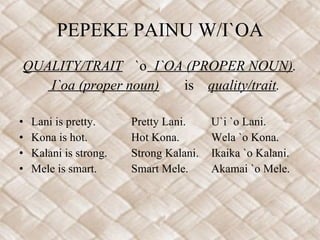
PEPEKE PAINU W/I`OA QUALITY/TRAIT  `o   I`OA (PROPER NOUN) . I`oa (proper noun)   is  quality/trait . Lani is pretty. Pretty Lani. U`i `o Lani. Kona is hot. Hot Kona. Wela `o Kona. Kalani is strong. Strong Kalani. Ikaika `o Kalani. Mele is smart. Smart Mele. Akamai `o Mele.
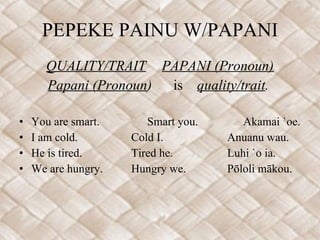
PEPEKE PAINU W/PAPANI QUALITY/TRAIT   PAPANI (Pronoun) Papani (Pronoun )   is  quality/trait .   You are smart. Smart you. Akamai `oe. I am cold. Cold I. Anuanu wau. He is tired. Tired he. Luhi `o ia. We are hungry. Hungry we. Pōloli mākou.
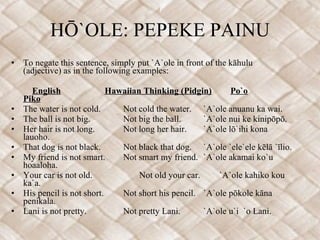
HŌ`OLE: PEPEKE PAINU To negate this sentence, simply put `A`ole in front of the kāhulu (adjective) as in the following examples:     English   Hawaiian Thinking (Pidgin)   Po`o   Piko The water is not cold. Not cold the water. `A`ole anuanu ka wai.  The ball is not big. Not big the ball. `A`ole nui ke kinipōpō. Her hair is not long. Not long her hair. `A`ole lō`ihi kona lauoho. That dog is not black. Not black that dog. `A`ole `ele`ele kēlā `īlio. My friend is not smart. Not smart my friend. `A`ole akamai ko`u hoaaloha. Your car is not old. Not old your car. `A`ole kahiko kou ka`a. His pencil is not short. Not short his pencil. `A`ole pōkole kāna penikala. Lani is not pretty. Not pretty Lani. `A`ole u`i  `o Lani.
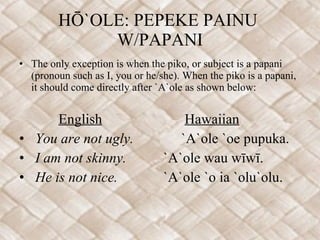
HŌ`OLE: PEPEKE PAINU  W/PAPANI The only exception is when the piko, or subject is a papani (pronoun such as I, you or he/she). When the piko is a papani, it should come directly after `A`ole as shown below: English   Hawaiian You are not ugly.   `A`ole `oe pupuka. I am not skinny. `A`ole wau wīwī. He is not nice. `A`ole `o ia `olu`olu.
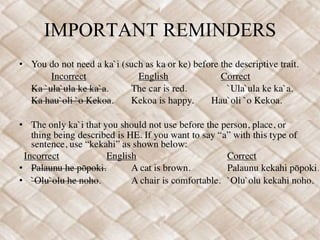
IMPORTANT REMINDERS
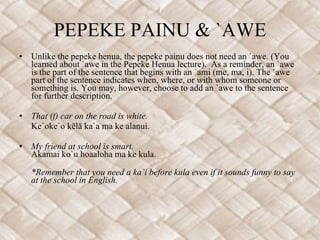
PEPEKE PAINU & `AWE Unlike the pepeke henua, the pepeke painu does not need an `awe. (You learned about `awe in the Pepeke Henua lecture).  As a reminder, an `awe is the part of the sentence that begins with an `ami (me, ma, i). The `awe part of the sentence indicates when, where, or with whom someone or something is. You may, however, choose to add an `awe to the sentence for further description. That (f) car on the road is white. Ke`oke`o kēlā ka`a ma ke alanui. My friend at school is smart. Akamai ko`u hoaaloha ma ke kula. *Remember that you need a ka`i before kula even if it sounds funny to say at the school in English.
`O REMINDERS
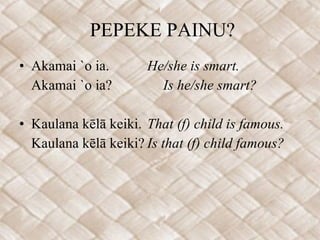
PEPEKE PAINU? Akamai `o ia. He/she is smart. Akamai `o ia?  Is he/she smart? Kaulana kēlā keiki. That (f) child is famous. Kaulana kēlā keiki? Is that (f) child famous?  
PEPEKE PAINU W/KĀHULU You may add a kāhulu (adjective) to the po`o of the sentence as shown below: U`i loa kēlā wahine. That (f) woman is very beautiful. Lō`ihi loa ka`u keiki. My child is very tall. `Ano pōkole kēia mo`olelo. This story is kind of short.
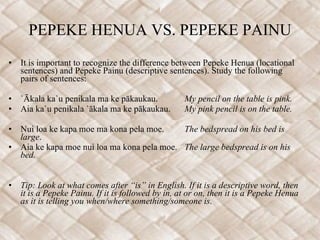
PEPEKE HENUA VS. PEPEKE PAINU It is important to recognize the difference between Pepeke Henua (locational sentences) and Pepeke Painu (descriptive sentences). Study the following pairs of sentences: `Ākala ka`u penikala ma ke pākaukau. My pencil on the table is pink. Aia ka`u penikala `ākala ma ke pākaukau. My pink pencil is on the table.    Nui loa ke kapa moe ma kona pela moe. The bedspread on his bed is large . Aia ke kapa moe nui loa ma kona pela moe. The large bedspread is on his bed.   Tip: Look at what comes after “is” in English. If it is a descriptive word, then it is a Pepeke Painu. If it is followed by in, at or on, then it is a Pepeke Henua as it is telling you when/where something/someone is.
 

Pepeke painu

  • 1.
    NĀ`ANA: PEPEKEPAINU HAW 102
  • 2.
    PEPEKE PAINU W/KA`IQUALITY/TRAIT KA`I PERSON/PLACE/THING. ka`i person/place/thing is quality/trait The water is cold. Cold the water. Anuanu ka wai. The ball is big. Big the ball. Nui ke kinipōpō. Her hair is long. Long her hair. Lō`ihi kona lauoho. That dog is black. Black that dog. `Ele`ele kēlā `īlio. My friend is smart. Smart my friend. Akamai ko`u hoaaloha. Your car is old. Old your car. Kahiko kou ka`a. His pencil is short. Short his pencil. Pōkole kāna penikala
  • 3.
    PEPEKE PAINU W/I`OAQUALITY/TRAIT `o I`OA (PROPER NOUN) . I`oa (proper noun) is quality/trait . Lani is pretty. Pretty Lani. U`i `o Lani. Kona is hot. Hot Kona. Wela `o Kona. Kalani is strong. Strong Kalani. Ikaika `o Kalani. Mele is smart. Smart Mele. Akamai `o Mele.
  • 4.
    PEPEKE PAINU W/PAPANIQUALITY/TRAIT PAPANI (Pronoun) Papani (Pronoun ) is quality/trait . You are smart. Smart you. Akamai `oe. I am cold. Cold I. Anuanu wau. He is tired. Tired he. Luhi `o ia. We are hungry. Hungry we. Pōloli mākou.
  • 5.
    HŌ`OLE: PEPEKE PAINUTo negate this sentence, simply put `A`ole in front of the kāhulu (adjective) as in the following examples:   English Hawaiian Thinking (Pidgin) Po`o Piko The water is not cold. Not cold the water. `A`ole anuanu ka wai. The ball is not big. Not big the ball. `A`ole nui ke kinipōpō. Her hair is not long. Not long her hair. `A`ole lō`ihi kona lauoho. That dog is not black. Not black that dog. `A`ole `ele`ele kēlā `īlio. My friend is not smart. Not smart my friend. `A`ole akamai ko`u hoaaloha. Your car is not old. Not old your car. `A`ole kahiko kou ka`a. His pencil is not short. Not short his pencil. `A`ole pōkole kāna penikala. Lani is not pretty. Not pretty Lani. `A`ole u`i `o Lani.
  • 6.
    HŌ`OLE: PEPEKE PAINU W/PAPANI The only exception is when the piko, or subject is a papani (pronoun such as I, you or he/she). When the piko is a papani, it should come directly after `A`ole as shown below: English Hawaiian You are not ugly. `A`ole `oe pupuka. I am not skinny. `A`ole wau wīwī. He is not nice. `A`ole `o ia `olu`olu.
  • 7.
  • 8.
    PEPEKE PAINU &`AWE Unlike the pepeke henua, the pepeke painu does not need an `awe. (You learned about `awe in the Pepeke Henua lecture). As a reminder, an `awe is the part of the sentence that begins with an `ami (me, ma, i). The `awe part of the sentence indicates when, where, or with whom someone or something is. You may, however, choose to add an `awe to the sentence for further description. That (f) car on the road is white. Ke`oke`o kēlā ka`a ma ke alanui. My friend at school is smart. Akamai ko`u hoaaloha ma ke kula. *Remember that you need a ka`i before kula even if it sounds funny to say at the school in English.
  • 9.
  • 10.
    PEPEKE PAINU? Akamai`o ia. He/she is smart. Akamai `o ia? Is he/she smart? Kaulana kēlā keiki. That (f) child is famous. Kaulana kēlā keiki? Is that (f) child famous?  
  • 11.
    PEPEKE PAINU W/KĀHULUYou may add a kāhulu (adjective) to the po`o of the sentence as shown below: U`i loa kēlā wahine. That (f) woman is very beautiful. Lō`ihi loa ka`u keiki. My child is very tall. `Ano pōkole kēia mo`olelo. This story is kind of short.
  • 12.
    PEPEKE HENUA VS.PEPEKE PAINU It is important to recognize the difference between Pepeke Henua (locational sentences) and Pepeke Painu (descriptive sentences). Study the following pairs of sentences: `Ākala ka`u penikala ma ke pākaukau. My pencil on the table is pink. Aia ka`u penikala `ākala ma ke pākaukau. My pink pencil is on the table.   Nui loa ke kapa moe ma kona pela moe. The bedspread on his bed is large . Aia ke kapa moe nui loa ma kona pela moe. The large bedspread is on his bed.   Tip: Look at what comes after “is” in English. If it is a descriptive word, then it is a Pepeke Painu. If it is followed by in, at or on, then it is a Pepeke Henua as it is telling you when/where something/someone is.
  • 13.