PEPEKE `AIKE: Equational Sentences HAW 101
PEPEKE `AIKE HE   Po`o   Piko HE  (MAU)  object   +  subject   As we have already learned, “he” is a kaʻi that is usually translated as “a” or “an” in English. The pepeke ʻaike he is used to express sentences with the word “a” in it, such as ____ is/was a ____ and  ___ am a ____. For example, “She is a teacher,” and “I am a student.”
LA`ANA HE  (MAU)  object  +  subject   He pōpoki kēlā. That (f) is a cat. He pōpoki `ele`ele kēlā. That (f) is a black cat. He pōpoki `ele`ele kēlā ma ke alanui. That (f) is  a black cat on the road.
LA`ANA HE  (MAU)  object  +  subject   He mau pōpoki kēlā. Those (f) are cats. He mau pōpoki `ele`ele kēlā. Those (f) are black cats. He mau pōpoki `ele`ele kēlā ma ke alanui. Those (f) are black cats on the road.
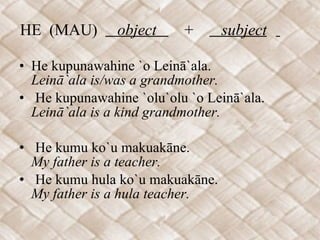
HE  (MAU)  object  +  subject   He kupunawahine `o Leinā`ala. Leinā`ala is/was a grandmother. He kupunawahine `olu`olu `o Leinā`ala. Leinā`ala is a kind grandmother.   He kumu ko`u makuakāne. My father is a teacher. He kumu hula ko`u makuakāne. My father is a hula teacher.
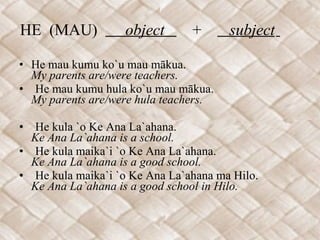
HE  (MAU)  object  +  subject   He mau kumu ko`u mau mākua. My parents are/were teachers. He mau kumu hula ko`u mau mākua. My parents are/were hula teachers.    He kula `o Ke Ana La`ahana. Ke Ana La`ahana is a school. He kula maika`i `o Ke Ana La`ahana. Ke Ana La`ahana is a good school. He kula maika`i `o Ke Ana La`ahana ma Hilo. Ke Ana La`ahana is a good school in Hilo.
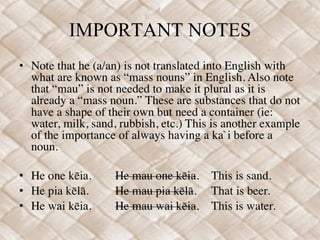
IMPORTANT NOTES
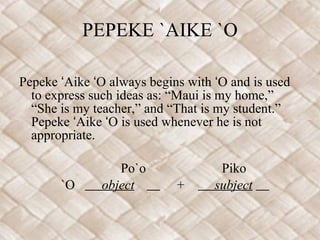
PEPEKE `AIKE `O Pepeke ʻAike ʻO always begins with ʻO and is used to express such ideas as: “Maui is my home,” “She is my teacher,” and “That is my student.” Pepeke ʻAike ʻO is used whenever he is not appropriate.  Po`o   Piko `O  object   +  subject
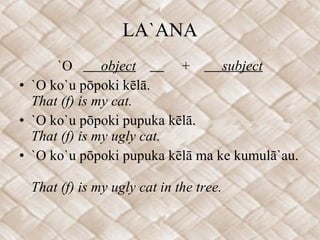
LA`ANA `O  object   +  subject   `O ko`u pōpoki kēlā. That (f) is my cat. `O ko`u pōpoki pupuka kēlā. That (f) is my ugly cat. `O ko`u pōpoki pupuka kēlā ma ke kumulā`au. That (f) is my ugly cat in the tree.
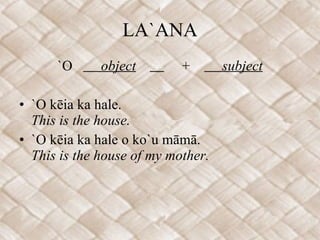
LA`ANA `O  object   +  subject   `O kēia ka hale. This is the house. `O kēia ka hale o ko`u māmā. This is the house of my mother.
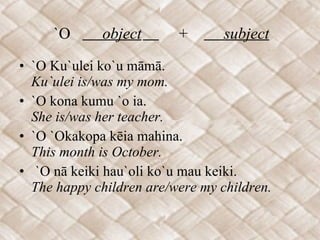
`O  object   +  subject   `O Ku`ulei ko`u māmā. Ku`ulei is/was my mom. `O kona kumu `o ia. She is/was her teacher. `O `Okakopa kēia mahina. This month is October. `O nā keiki hau`oli ko`u mau keiki. The happy children are/were my children.
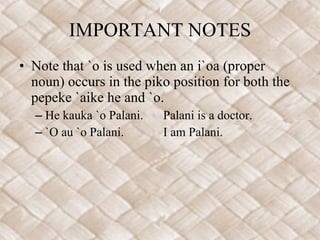
IMPORTANT NOTES Note that `o is used when an i`oa (proper noun) occurs in the piko position for both the pepeke `aike he and `o. He kauka `o Palani. Palani is a doctor. `O au `o Palani. I am Palani.
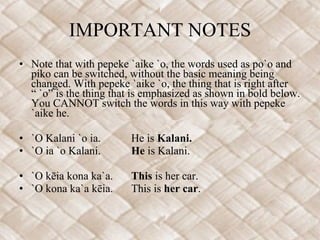
IMPORTANT NOTES Note that with pepeke `aike `o, the words used as po`o and piko can be switched, without the basic meaning being changed. With pepeke `aike `o, the thing that is right after  “ `o” is the thing that is emphasized as shown in bold below. You CANNOT switch the words in this way with pepeke `aike he.    `O Kalani `o ia. He is  Kalani. `O ia `o Kalani. He  is Kalani.    `O kēia kona ka`a. This  is her car. `O kona ka`a kēia. This is  her car .
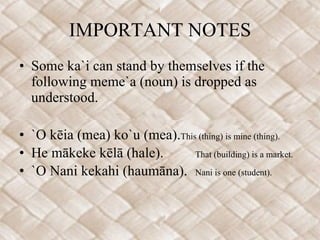
IMPORTANT NOTES Some ka`i can stand by themselves if the following meme`a (noun) is dropped as understood.   `O kēia (mea) ko`u (mea). This (thing) is mine (thing). He mākeke kēlā (hale). That (building) is a market. `O Nani kekahi (haumāna). Nani is one (student).
HE AHA vs. `O WAI Note that “he aha” means “what” and “ ‘o wai” means “who.” Although in English you ask, “What is your name?” in Hawaiian you ask, “Who is your name?” as in “ `O wai kou inoa?” To say “He aha kou inoa?” means something quite different as shown in the following example:   `O wai kou inoa? What is your name? (Keoki? Sean? Pua? Lynn?) He aha kou inoa? What is your name? (a Chinese name? a Japanese name? an old family    name? a name from the Bible?)
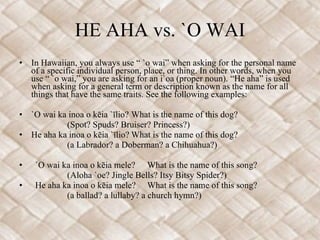
HE AHA vs. `O WAI In Hawaiian, you always use “ `o wai” when asking for the personal name of a specific individual person, place, or thing. In other words, when you use “ `o wai,” you are asking for an i`oa (proper noun). “He aha” is used when asking for a general term or description known as the name for all things that have the same traits. See the following examples:   `O wai ka inoa o kēia `īlio? What is the name of this dog? (Spot? Spuds? Bruiser? Princess?) He aha ka inoa o kēia `īlio? What is the name of this dog? (a Labrador? a Doberman? a Chihuahua?)   `O wai ka inoa o kēia mele? What is the name of this song? (Aloha `oe? Jingle Bells? Itsy Bitsy Spider?) He aha ka inoa o kēia mele? What is the name of this song? (a ballad? a lullaby? a church hymn?)
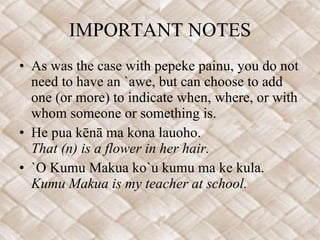
IMPORTANT NOTES As was the case with pepeke painu, you do not need to have an `awe, but can choose to add one (or more) to indicate when, where, or with whom someone or something is.   He pua kēnā ma kona lauoho.   That (n) is a flower in her hair. `O Kumu Makua ko`u kumu ma ke kula.   Kumu Makua is my teacher at school.
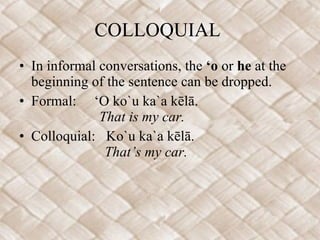
COLLOQUIAL  In informal conversations, the  ‘o  or  he  at the beginning of the sentence can be dropped. Formal:  ‘O ko`u ka`a kēlā.     That is my car. Colloquial:  Ko`u ka`a kēlā.       That’s my car.
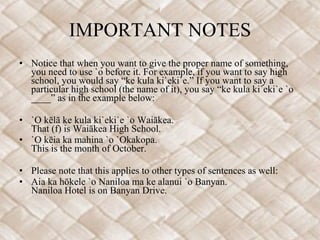
IMPORTANT NOTES Notice that when you want to give the proper name of something, you need to use `o before it. For example, if you want to say high school, you would say “ke kula ki`eki`e.” If you want to say a particular high school (the name of it), you say “ke kula ki`eki`e `o ____” as in the example below:   `O kēlā ke kula ki`eki`e `o Waiākea. That (f) is Waiākea High School. `O kēia ka mahina `o `Okakopa. This is the month of October.    Please note that this applies to other types of sentences as well: Aia ka hōkele `o Naniloa ma ke alanui `o Banyan.  Naniloa Hotel is on Banyan Drive.
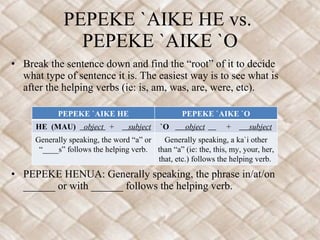
PEPEKE `AIKE HE vs.  PEPEKE `AIKE `O Break the sentence down and find the “root” of it to decide what type of sentence it is. The easiest way is to see what is after the helping verbs (ie: is, am, was, are, were, etc). PEPEKE HENUA: Generally speaking, the phrase in/at/on ______ or with ______ follows the helping verb. PEPEKE `AIKE HE PEPEKE `AIKE `O HE  (MAU)   object  +  subject `O  object   +  subject Generally speaking, the word “a” or “____s” follows the helping verb. Generally speaking, a ka`i other than “a” (ie: the, this, my, your, her, that, etc.) follows the helping verb.
 

Aike 101

  • 1.
    PEPEKE `AIKE: EquationalSentences HAW 101
  • 2.
    PEPEKE `AIKE HE Po`o Piko HE (MAU) object + subject As we have already learned, “he” is a kaʻi that is usually translated as “a” or “an” in English. The pepeke ʻaike he is used to express sentences with the word “a” in it, such as ____ is/was a ____ and ___ am a ____. For example, “She is a teacher,” and “I am a student.”
  • 3.
    LA`ANA HE (MAU) object + subject He pōpoki kēlā. That (f) is a cat. He pōpoki `ele`ele kēlā. That (f) is a black cat. He pōpoki `ele`ele kēlā ma ke alanui. That (f) is a black cat on the road.
  • 4.
    LA`ANA HE (MAU) object + subject He mau pōpoki kēlā. Those (f) are cats. He mau pōpoki `ele`ele kēlā. Those (f) are black cats. He mau pōpoki `ele`ele kēlā ma ke alanui. Those (f) are black cats on the road.
  • 5.
    HE (MAU) object + subject He kupunawahine `o Leinā`ala. Leinā`ala is/was a grandmother. He kupunawahine `olu`olu `o Leinā`ala. Leinā`ala is a kind grandmother.   He kumu ko`u makuakāne. My father is a teacher. He kumu hula ko`u makuakāne. My father is a hula teacher.
  • 6.
    HE (MAU) object + subject He mau kumu ko`u mau mākua. My parents are/were teachers. He mau kumu hula ko`u mau mākua. My parents are/were hula teachers.   He kula `o Ke Ana La`ahana. Ke Ana La`ahana is a school. He kula maika`i `o Ke Ana La`ahana. Ke Ana La`ahana is a good school. He kula maika`i `o Ke Ana La`ahana ma Hilo. Ke Ana La`ahana is a good school in Hilo.
  • 7.
  • 8.
    PEPEKE `AIKE `OPepeke ʻAike ʻO always begins with ʻO and is used to express such ideas as: “Maui is my home,” “She is my teacher,” and “That is my student.” Pepeke ʻAike ʻO is used whenever he is not appropriate. Po`o Piko `O object + subject
  • 9.
    LA`ANA `O object + subject `O ko`u pōpoki kēlā. That (f) is my cat. `O ko`u pōpoki pupuka kēlā. That (f) is my ugly cat. `O ko`u pōpoki pupuka kēlā ma ke kumulā`au. That (f) is my ugly cat in the tree.
  • 10.
    LA`ANA `O object + subject `O kēia ka hale. This is the house. `O kēia ka hale o ko`u māmā. This is the house of my mother.
  • 11.
    `O object + subject `O Ku`ulei ko`u māmā. Ku`ulei is/was my mom. `O kona kumu `o ia. She is/was her teacher. `O `Okakopa kēia mahina. This month is October. `O nā keiki hau`oli ko`u mau keiki. The happy children are/were my children.
  • 12.
    IMPORTANT NOTES Notethat `o is used when an i`oa (proper noun) occurs in the piko position for both the pepeke `aike he and `o. He kauka `o Palani. Palani is a doctor. `O au `o Palani. I am Palani.
  • 13.
    IMPORTANT NOTES Notethat with pepeke `aike `o, the words used as po`o and piko can be switched, without the basic meaning being changed. With pepeke `aike `o, the thing that is right after “ `o” is the thing that is emphasized as shown in bold below. You CANNOT switch the words in this way with pepeke `aike he.   `O Kalani `o ia. He is Kalani. `O ia `o Kalani. He is Kalani.   `O kēia kona ka`a. This is her car. `O kona ka`a kēia. This is her car .
  • 14.
    IMPORTANT NOTES Someka`i can stand by themselves if the following meme`a (noun) is dropped as understood.   `O kēia (mea) ko`u (mea). This (thing) is mine (thing). He mākeke kēlā (hale). That (building) is a market. `O Nani kekahi (haumāna). Nani is one (student).
  • 15.
    HE AHA vs.`O WAI Note that “he aha” means “what” and “ ‘o wai” means “who.” Although in English you ask, “What is your name?” in Hawaiian you ask, “Who is your name?” as in “ `O wai kou inoa?” To say “He aha kou inoa?” means something quite different as shown in the following example:   `O wai kou inoa? What is your name? (Keoki? Sean? Pua? Lynn?) He aha kou inoa? What is your name? (a Chinese name? a Japanese name? an old family name? a name from the Bible?)
  • 16.
    HE AHA vs.`O WAI In Hawaiian, you always use “ `o wai” when asking for the personal name of a specific individual person, place, or thing. In other words, when you use “ `o wai,” you are asking for an i`oa (proper noun). “He aha” is used when asking for a general term or description known as the name for all things that have the same traits. See the following examples:   `O wai ka inoa o kēia `īlio? What is the name of this dog? (Spot? Spuds? Bruiser? Princess?) He aha ka inoa o kēia `īlio? What is the name of this dog? (a Labrador? a Doberman? a Chihuahua?)   `O wai ka inoa o kēia mele? What is the name of this song? (Aloha `oe? Jingle Bells? Itsy Bitsy Spider?) He aha ka inoa o kēia mele? What is the name of this song? (a ballad? a lullaby? a church hymn?)
  • 17.
    IMPORTANT NOTES Aswas the case with pepeke painu, you do not need to have an `awe, but can choose to add one (or more) to indicate when, where, or with whom someone or something is.   He pua kēnā ma kona lauoho. That (n) is a flower in her hair. `O Kumu Makua ko`u kumu ma ke kula. Kumu Makua is my teacher at school.
  • 18.
    COLLOQUIAL Ininformal conversations, the ‘o or he at the beginning of the sentence can be dropped. Formal: ‘O ko`u ka`a kēlā. That is my car. Colloquial: Ko`u ka`a kēlā. That’s my car.
  • 19.
    IMPORTANT NOTES Noticethat when you want to give the proper name of something, you need to use `o before it. For example, if you want to say high school, you would say “ke kula ki`eki`e.” If you want to say a particular high school (the name of it), you say “ke kula ki`eki`e `o ____” as in the example below:   `O kēlā ke kula ki`eki`e `o Waiākea. That (f) is Waiākea High School. `O kēia ka mahina `o `Okakopa. This is the month of October.   Please note that this applies to other types of sentences as well: Aia ka hōkele `o Naniloa ma ke alanui `o Banyan. Naniloa Hotel is on Banyan Drive.
  • 20.
    PEPEKE `AIKE HEvs. PEPEKE `AIKE `O Break the sentence down and find the “root” of it to decide what type of sentence it is. The easiest way is to see what is after the helping verbs (ie: is, am, was, are, were, etc). PEPEKE HENUA: Generally speaking, the phrase in/at/on ______ or with ______ follows the helping verb. PEPEKE `AIKE HE PEPEKE `AIKE `O HE (MAU) object + subject `O object + subject Generally speaking, the word “a” or “____s” follows the helping verb. Generally speaking, a ka`i other than “a” (ie: the, this, my, your, her, that, etc.) follows the helping verb.
  • 21.