NATIVE
HAWAIIAN
BELIEFS &
PRACTICES
  TODAY
`AI KAPU
• 1819
  – Kamehameha I died
  – End of `ai kapu by
    Liholiho (Kamehameha
    II) & Ka`ahumanu
LOSS OF THE
        LUNAR CALENDAR
• The rhythms of the
  moon dictated
  when planting,
  harvesting and
  fishing activities
  should occur
`ILIAHI
• `Iliahi –
  sandalwood
• First commercial
  venture with the
  West
CHRISTIANITY
• Missionaries
  arrived in 1820
• Moku`aikaua
  Church in Kailua-
  Kona was the first
  church
  established
EDUCATION
• Written language
  developed
• Western schools
  created
• `Ōlelo Hawai`i
  banned in schools
THE GREAT MĀ HELE
• 1848 – 1855
• Kauikeaouli
  (Kamehameha III)
• Introduced the
  concept of “land
  ownership”
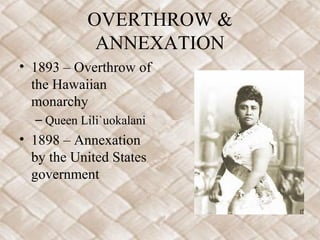
OVERTHROW &
            ANNEXATION
• 1893 – Overthrow of
  the Hawaiian
  monarchy
  – Queen Lili`uokalani
• 1898 – Annexation
  by the United States
  government
HULA
• 1830 – Hula was
  banned from being
  performed
  publicly
• 1859 – Required
  to obtain a license
  for hula
  performances
• 1870 – Law
  restricting public
BELIEFS & PRACTICES TODAY
If you have any
questions, please
 ask them on the
Discussion Board.
     Mahalo!

Beliefs today

  • 1.
  • 2.
    `AI KAPU • 1819 – Kamehameha I died – End of `ai kapu by Liholiho (Kamehameha II) & Ka`ahumanu
  • 3.
    LOSS OF THE LUNAR CALENDAR • The rhythms of the moon dictated when planting, harvesting and fishing activities should occur
  • 4.
    `ILIAHI • `Iliahi – sandalwood • First commercial venture with the West
  • 5.
    CHRISTIANITY • Missionaries arrived in 1820 • Moku`aikaua Church in Kailua- Kona was the first church established
  • 6.
    EDUCATION • Written language developed • Western schools created • `Ōlelo Hawai`i banned in schools
  • 7.
    THE GREAT MĀHELE • 1848 – 1855 • Kauikeaouli (Kamehameha III) • Introduced the concept of “land ownership”
  • 8.
    OVERTHROW & ANNEXATION • 1893 – Overthrow of the Hawaiian monarchy – Queen Lili`uokalani • 1898 – Annexation by the United States government
  • 9.
    HULA • 1830 –Hula was banned from being performed publicly • 1859 – Required to obtain a license for hula performances • 1870 – Law restricting public
  • 10.
  • 11.
    If you haveany questions, please ask them on the Discussion Board. Mahalo!

Editor's Notes

  • #3 Kamehameha I died in 1819 By that time, foreigners' influence had profoundly eroded many traditional religious and social customs Within a few months of Kamehameha’s death, his wife Ka`ahumanu who was serving as kuhina nui (regent administrator) and his young son and successor, Liholiho (Kamehameha II) overturned the kapu system by violating the `ai kapu which required men and women to eat separately. As a result, the destruction of heiau (temples) and ki`i (images) were triggered. It also resulted in the discontinuation of formal religious services in heiau and of Makahiki celebrations
  • #4 As a result, the ali`i were no longer seen as representatives of the gods, but rather as authority figures Farming and fishing were affected as well Without Makahiki, there was no period of rest from work, no fixed season when fishing was prohibited, no fallow time mandated for the land The lunar calendar was no longer observed which provided logic and ethic for planting
  • #5 In the same year, whaling vessels began arriving in the islands `Iliahi or sandalwood was a hot commodity. Enormous quantities of the fragrant wood was being cut down to be shipped elsewhere Because so much time was devoted to cutting down forests of `iliahi for profit, farmers couldn’t work the land and the `iliahi supply quickly dwindled This was the kanaka maoli’s introduction to a market economy. These traders, accustomed to owning land, pressured the King (Kamehameha III) to change the ahupua`a system of land tenure and permit private ownership of the land.
  • #6 The religious and governmental system was full of turmoil due to `ai noa Brought with them a single “god” Set up a governmental system of laws to get the people back in order and to take the place of the kapu that had been broken Instated religious holidays, a daily and monthly calendar and different concept of time One of the things that changed was that the missionaries put a stop to inter-family marriage that was done to keep the ali`i bloodline pure Women and men were made to dress according to European and American standards rather than their malo and other traditional wear
  • #7 To aid in converting a society with an oral tradition to Christianity, the missionaries developed a written alphabet for the Hawaiian language They wanted to convert all Hawaiians to Christianity, so they needed to learn the language so they could publish a Hawaiian Bible and preach in Hawaiian. Taught the kanaka maoli to read and write the language Published various educational materials in Hawaiian and eventually finished translating the Bible In less than 20 years, the missionaries had established a school system that reflected Western society and the Protestant religion. In 1885, banned talking Hawaiian in schools For this and a variety of other reasons, the number of mānaleo diminished from 37,000 to 1,000 by the early 1900’s. With this came the decline of the language, and cultural practices
  • #8 The concept of land ownership was foreign to ancient Hawaiians. Under their holistic view of the world that incorporated all things from the ocean to the sea, no one owned the land. Instead, the land was divided into ahupua`a or land sections that typically extended from the mountain down to the sea. The ali`i were stewards of the land and granted the maka`āinana living in the ahupua`a use of the lands’s bounty for their livelihood In 1820, the first company of American missionaries came to Hawai`i, initiating yet another wave of changes The missionaries preached the Western concepts of law, property and government to the ali`i who ruled the islands They lobbied the ali`i hard for the institution of private property – a foreign concept to the kanaka maoli Eventually, the ali`i caved from the constant pressure and The Great Māhele was enacted in 1848 and lasted until 1855 The Great Māhele was a process of dividing the land and awarding private title to it In the end, Kauikeaouli (Kamehameha III) held 984,000 acres as crown lands. Government land amounted to another 1,495,000 acres. Konohiki land, awarded to 245 chiefs and their families totaled 1,619,000 acres. Kuleana or small parcels of land for maka`āinana and other individuals came to 28,000 acres for 9.337 people, about 1/15 of the population. Of this number, only 6 percent was Hawaiian or part-Hawaiian.
  • #9 The overthrow of the Hawaiian monarchy by American business interests in 1893 resulted in annexation 5 years later by the U.S. Within a century of Western contact, the kanaka maoli had lost their land, their power and their very way of life Thus, it is hardly surprising that some of the traditions that we learned about throughout the semester were swept away by these changes Of course, not all has been lost. Many families continue to pass traditions on throughout the years Others have gained interest in certain aspects of the culture and traditions and have been able to revive some of those traditions
  • #10 Many other practices have been nurtured over the years or have been revived as discussed throughout the semester – kapa making, lā`au lapa`au, lauhala weaving and much more. Among the most prominent sources of promoting this reawakening is hula. Hula has had its own struggle for survival since coming under missionary fire. Formal restrictions on hula began as early as 1830, when Ka`ahumanu banned hula and its accompanying chants to be performed. Hula was practiced openly after Ka`ahumanu’s death in 1832, but the missionaries continued to push for it to be banned. By 1859, licensing for hula performances was required and a $500 fine or 6 month prison term was instituted for violators. The law restricting public hula was repealed in 1870. Public displays of hula were further revived during the reign of Hawai`i’s last king, Kalākaua. The hula renaissance has promoted awareness of the native flora and helped to rejuvenate traditional forms of lei and instrument making.
  • #11 The Hawaiian culture, like all cultures, is constantly evolving. Awareness of various traditions is an important part of preserving and protecting them for future generations Recreating the past is impossible, but it is within our reach to stem the loss of cultural information to promote continuity of the ways of old Hawai`i.