Punctuating Dialogue
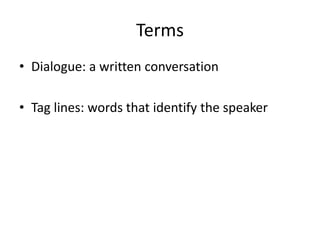
Terms
• Dialogue: a written conversation

• Tag lines: words that identify the speaker
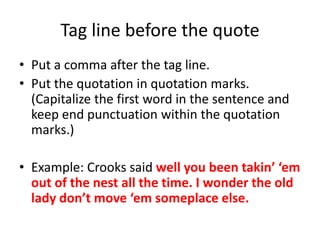
Tag line before the quote
• Put a comma after the tag line.
• Put the quotation in quotation marks.
  (Capitalize the first word in the sentence and
  keep end punctuation within the quotation
  marks.)

• Example: Crooks said well you been takin’ ‘em
  out of the nest all the time. I wonder the old
  lady don’t move ‘em someplace else.
Example
• Crooks said, “Well you been takin’ ‘em out of
  the nest all the time. I wonder the old lady
  don’t move ‘em someplace else.”
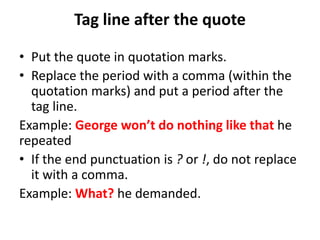
Tag line after the quote

• Put the quote in quotation marks.
• Replace the period with a comma (within the
  quotation marks) and put a period after the
  tag line.
Example: George won’t do nothing like that he
repeated
• If the end punctuation is ? or !, do not replace
  it with a comma.
Example: What? he demanded.
Examples
• “George won’t do nothing like that,” he
  repeated

• “What?” he demanded.
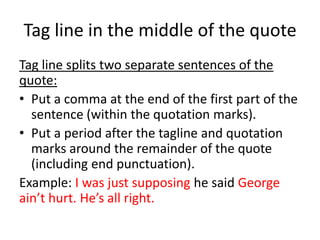
Tag line in the middle of the quote
Tag line splits two separate sentences of the
quote:
• Put a comma at the end of the first part of the
  sentence (within the quotation marks).
• Put a period after the tagline and quotation
  marks around the remainder of the quote
  (including end punctuation).
Example: I was just supposing he said George
ain’t hurt. He’s all right.
Example
• “I was just supposing,” he said. “George ain’t
  hurt. He’s all right.”
Tag line in the middle of the quote
Tag line splits one sentence of the quote:
• Put a comma at the end of the first part
  (within the quotation marks).
• Put a comma after the tagline and quotation
  marks around the rest of the quote (including
  the end punctuation).
Example: Well said George we’ll have a big
vegetable garden and a rabbit hutch and
chickens.
Example
• “Well,” said George, “we’ll have a big
  vegetable garden and a rabbit hutch and
  chickens.”
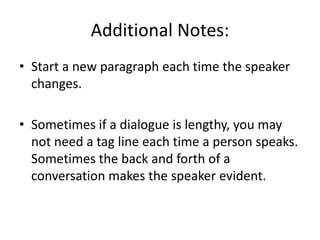
Additional Notes:
• Start a new paragraph each time the speaker
  changes.

• Sometimes if a dialogue is lengthy, you may
  not need a tag line each time a person speaks.
  Sometimes the back and forth of a
  conversation makes the speaker evident.

Punctuating dialogue

  • 1.
  • 2.
    Terms • Dialogue: awritten conversation • Tag lines: words that identify the speaker
  • 3.
    Tag line beforethe quote • Put a comma after the tag line. • Put the quotation in quotation marks. (Capitalize the first word in the sentence and keep end punctuation within the quotation marks.) • Example: Crooks said well you been takin’ ‘em out of the nest all the time. I wonder the old lady don’t move ‘em someplace else.
  • 4.
    Example • Crooks said,“Well you been takin’ ‘em out of the nest all the time. I wonder the old lady don’t move ‘em someplace else.”
  • 5.
    Tag line afterthe quote • Put the quote in quotation marks. • Replace the period with a comma (within the quotation marks) and put a period after the tag line. Example: George won’t do nothing like that he repeated • If the end punctuation is ? or !, do not replace it with a comma. Example: What? he demanded.
  • 6.
    Examples • “George won’tdo nothing like that,” he repeated • “What?” he demanded.
  • 7.
    Tag line inthe middle of the quote Tag line splits two separate sentences of the quote: • Put a comma at the end of the first part of the sentence (within the quotation marks). • Put a period after the tagline and quotation marks around the remainder of the quote (including end punctuation). Example: I was just supposing he said George ain’t hurt. He’s all right.
  • 8.
    Example • “I wasjust supposing,” he said. “George ain’t hurt. He’s all right.”
  • 9.
    Tag line inthe middle of the quote Tag line splits one sentence of the quote: • Put a comma at the end of the first part (within the quotation marks). • Put a comma after the tagline and quotation marks around the rest of the quote (including the end punctuation). Example: Well said George we’ll have a big vegetable garden and a rabbit hutch and chickens.
  • 10.
    Example • “Well,” saidGeorge, “we’ll have a big vegetable garden and a rabbit hutch and chickens.”
  • 11.
    Additional Notes: • Starta new paragraph each time the speaker changes. • Sometimes if a dialogue is lengthy, you may not need a tag line each time a person speaks. Sometimes the back and forth of a conversation makes the speaker evident.