Punctuation is the set of marks
used to regulate texts and clarify their
meanings, principally by separating or
linking words, phrases, and clauses.
Punctuation Marks
Why do we need punctuation?
 Punctuation allows the authors writing to be easy
to read and understandable for the reader.
Types of Punctuation
Period Comma Colon
Question
Mark
Quotation
Marks
Exclamation
Point
Parenthesis Apostrophe
Period
 Rule: Use at the end of a complete sentence.
 Example: I went to the store for groceries.
 Rule: Use at the end of an indirect question.
 Example: Could you tell me where the milk is.
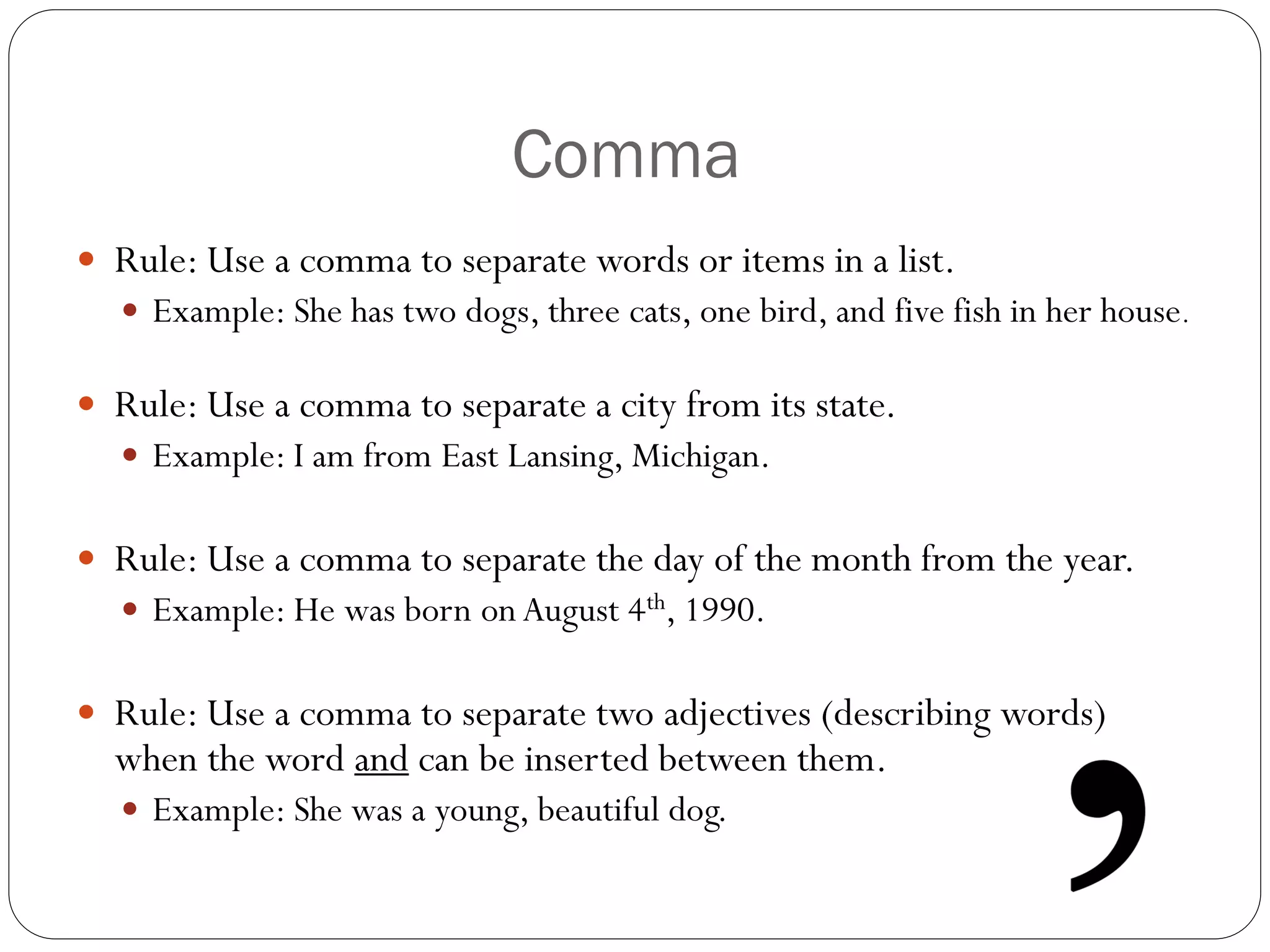
Comma
 Rule: Use a comma to separate words or items in a list.
 Example: She has two dogs, three cats, one bird, and five fish in her house.
 Rule: Use a comma to separate a city from its state.
 Example: I am from East Lansing, Michigan.
 Rule: Use a comma to separate the day of the month from the year.
 Example: He was born on August 4th, 1990.
 Rule: Use a comma to separate two adjectives (describing words)
when the word and can be inserted between them.
 Example: She was a young, beautiful dog.
Colon
 Rule: Use the colon after a complete sentence to introduce a list of
items.
 Example: On my trip I will bring: clothes, a pillow, a sleeping bag, a toothbrush,
and my teddy bear.
 Rule: Use the colon after the greeting of the person’s name in a
business letter.
 Example: Dear Mr. Smith:
 within time expressions.
Within time, it is used to separate out the hour and minute: 12 : 15 p.m.
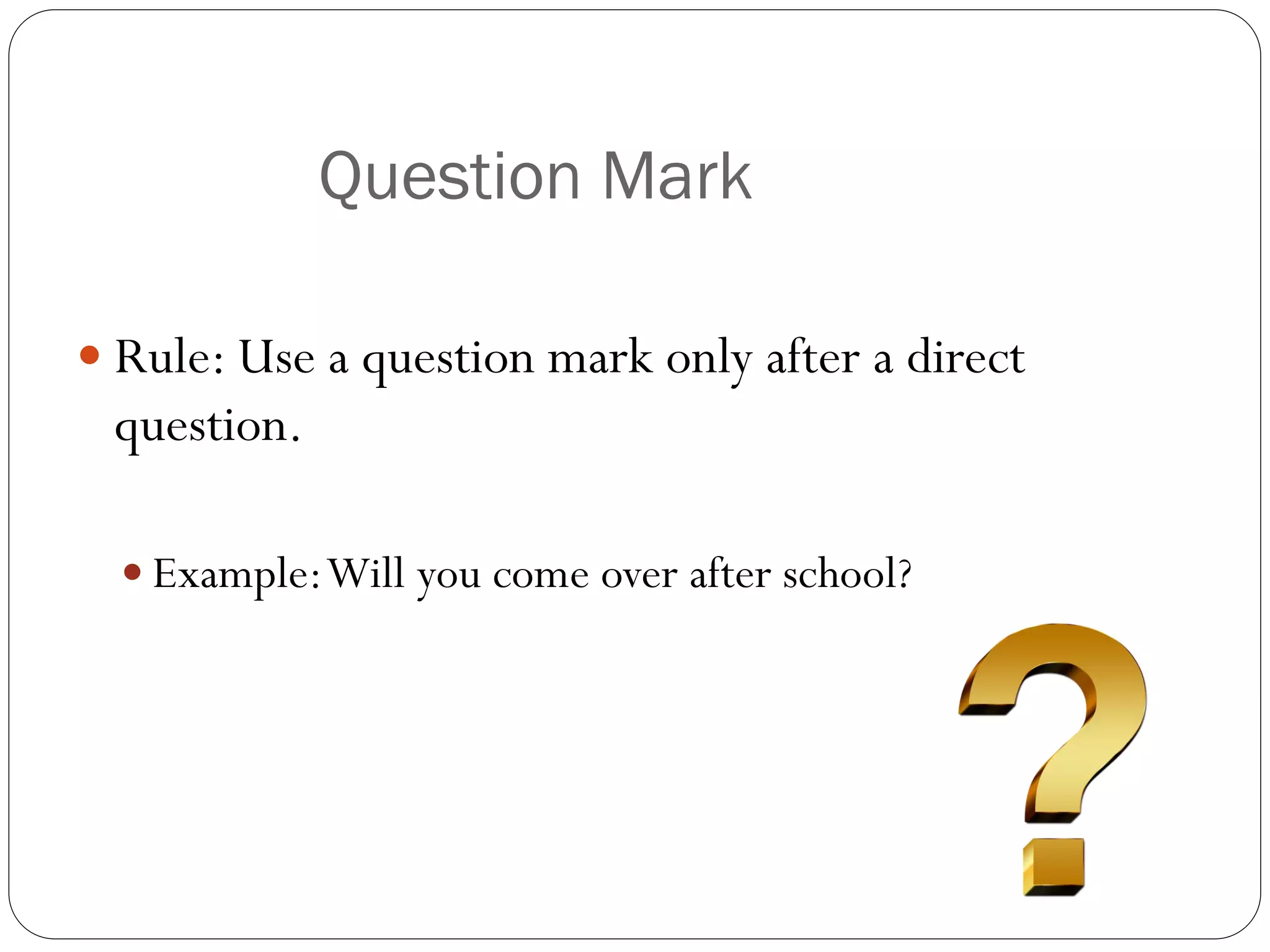
Question Mark
 Rule: Use a question mark only after a direct
question.
 Example:Will you come over after school?
Quotation Marks
 Rule: Use quotation marks to set off a direct quotation.
 Example:“What is your favorite color?” she asked.
 Rule: Periods and commas always go inside quotation marks.
 Example:“I don’t want to go to school today,”Alan said.
Exclamation Point
 Rule: Use the exclamation point to show
emphasis or excitement.
Summer is in three months!
Parenthesis
 Rule: Use parenthesis to enclose words or figures that clarify
or are used as an aside.
 Example: He received one hundred and fifty points (150)on his math
project.
 John and Jane ( who were actually half brother and sister ) both have
red hair.
Apostrophe
 Rule: Use the apostrophe when combining two words. It is always
placed in the spot where the letter(s) have been removed.
 Example: She’s (she is) only allowed candy on Friday.
 Rule: Use the apostrophe to show possession. Place the
apostrophe before the s.
 Example:They found Ms. Connor’s gloves.
 Plural for numbers: Sixteen people were born on dates with 7 '
s in them.

Punctuation marks

  • 1.
    Punctuation is theset of marks used to regulate texts and clarify their meanings, principally by separating or linking words, phrases, and clauses. Punctuation Marks
  • 2.
    Why do weneed punctuation?  Punctuation allows the authors writing to be easy to read and understandable for the reader.
  • 3.
    Types of Punctuation PeriodComma Colon Question Mark Quotation Marks Exclamation Point Parenthesis Apostrophe
  • 4.
    Period  Rule: Useat the end of a complete sentence.  Example: I went to the store for groceries.  Rule: Use at the end of an indirect question.  Example: Could you tell me where the milk is.
  • 5.
    Comma  Rule: Usea comma to separate words or items in a list.  Example: She has two dogs, three cats, one bird, and five fish in her house.  Rule: Use a comma to separate a city from its state.  Example: I am from East Lansing, Michigan.  Rule: Use a comma to separate the day of the month from the year.  Example: He was born on August 4th, 1990.  Rule: Use a comma to separate two adjectives (describing words) when the word and can be inserted between them.  Example: She was a young, beautiful dog.
  • 6.
    Colon  Rule: Usethe colon after a complete sentence to introduce a list of items.  Example: On my trip I will bring: clothes, a pillow, a sleeping bag, a toothbrush, and my teddy bear.  Rule: Use the colon after the greeting of the person’s name in a business letter.  Example: Dear Mr. Smith:  within time expressions. Within time, it is used to separate out the hour and minute: 12 : 15 p.m.
  • 7.
    Question Mark  Rule:Use a question mark only after a direct question.  Example:Will you come over after school?
  • 8.
    Quotation Marks  Rule:Use quotation marks to set off a direct quotation.  Example:“What is your favorite color?” she asked.  Rule: Periods and commas always go inside quotation marks.  Example:“I don’t want to go to school today,”Alan said.
  • 9.
    Exclamation Point  Rule:Use the exclamation point to show emphasis or excitement. Summer is in three months!
  • 10.
    Parenthesis  Rule: Useparenthesis to enclose words or figures that clarify or are used as an aside.  Example: He received one hundred and fifty points (150)on his math project.  John and Jane ( who were actually half brother and sister ) both have red hair.
  • 11.
    Apostrophe  Rule: Usethe apostrophe when combining two words. It is always placed in the spot where the letter(s) have been removed.  Example: She’s (she is) only allowed candy on Friday.  Rule: Use the apostrophe to show possession. Place the apostrophe before the s.  Example:They found Ms. Connor’s gloves.  Plural for numbers: Sixteen people were born on dates with 7 ' s in them.