With Our Cat Flossie and
      Call Me Gorgeous!
 What?
We will be looking at character development:
How text is used to describe a character and
how images are used to show a characters’
appearance.

 Why?
So we can ‘…create a text using writing and
images to express and develop experiences,
events, information, ideas and characters.’
(ACARA year 3 achievement standard)
   How?

 Language
Exploring action/saying and sensing verbs in narrative
texts to show how they give information about what
characters do and say and allow readers to know what a
character thinks and feels. (acela1482)

 Literature
Drawing on literary texts read, viewed and listened to
for inspiration and ideas, appropriating language to
create mood and characterisation. (aclet1601)

 Literacy
Use software including word processing programs with
growing speed efficiency to construct and edit texts
featuring visual, print and audio elements. (acely 1685)
The Year 3 Students will have prior knowledge from
Year 2 where they were required to know and
understand that;

   Language for interaction – evaluative language: how
    language is used to express opinions, and make
    evaluative judgements about people, places, things
    and texts.

 Expressing and developing ideas – visual language:
  how images work in texts to communicate meanings
  especially in conjunction with other elements such as
  print and sound – identify visual representations of
  characters’ actions, reactions, speech and thought
  processes in narratives, and consider how these
  images add to or contradict or multiply the meaning
  of accompanying words.
(ACARA, scope and sequence, Year 2)
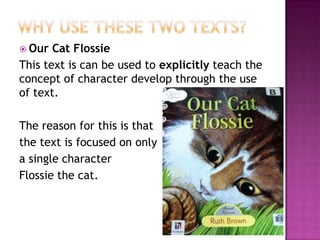
 Our  Cat Flossie
This text is can be used to explicitly teach the
concept of character develop through the use
of text.

The reason for this is that
the text is focused on only
a single character
Flossie the cat.
 Each page contains only a single new piece
 of textual information about Flossie the cat.


 Eachpage has a single image that
 corresponds to the textual information.
 Call Me Gorgeous!
This text also can be used to explicitly teach
the concept of character develop through the
use of images.

Again this text is
focused on only a single
character of an
unknown type.
Each page contains only a single new piece of
textual and imagery information about an
unknown creature.
 Both of these texts allows Learners to focus on
  the idea of learning about only the main
  character of the text and how that character is
  developed without being distracted by other
  images or textual information.
(ACARA links - acela1482 & aclet1601)
   KWHL chart can be made for the students to
    reference their understanding and learning of
    this topic before and then after the topic has
    been completed. (Eric Frangenheim, 2005, p61)

   The picture books Our Cat Flossie by Ruth Brown
    and Call Me Gorgeous! By Giles and Alexandra
    Milton can be introduced and read to students.

   Have the Learners compare the final image in
    the book to their mental imagery of the
    creature. Look at the impact of character
    development in imagery. Discussions on the
    differences will utilise Bloom’s Taxonomy of
    hierarchal thinking.
   Questioning of the Learners – ‘effective
    questioning is a key teaching strategy, aimed at
    finding out what students know and prompting
    them to think through ideas, combine pieces of
    information and explore ideas.’ (Gordon
    Winch, 2011, p58)

   The Learners through class discussions can look
    at how both text and images can be used
    individually/together to help a reader to learn
    about and understand a character in a text.
    Personality and appearance will have to be
    explored and considered. This relates to DoL
    2, declarative knowledge, no. 6 - create
    opportunities for students to discover or figure
    out information for themselves. (Marzano &
    Pickering, 1997, p56)
   Interactive Excel Book

   Using the continuum teaching method – I, We,
    You - the students will be guided through each
    page and the processes they will use to
    manipulate the information there to suit their
    choices. The interactive excel book allows the
    Students to experience an Office document
    maker in way it is not usually used. This activity
    requires them to interpret text and decide on an
    image to go with it.
 Interactive   Multimodal Power Point

 Using
      the continuum teaching method – I,
 We, You - the Learners will be guided
 through the use of Power Point to make a
 book.

 Thisactivity focuses on pieces of images
 similar to Call Me Gorgeous and will allow
 the Students to start compiling ideas about
 their own character they are to develop.
   Using excel and PowerPoint to engage the Learners is
    an effective way to ‘develop a clearer understanding
    and awareness of the basic structure of written and
    visual texts.’

   ‘provides a high quality of presentation that can
    motivate students who find manual writing difficult
    or messy.’

 and ‘students can learn in a more holistic,
  multimodal way when text is accompanied by audio
  and visual content.’
(Gordon Winch, 2011, p400 - 406)
(ACARA link - acely 1685)
 Use   Power Point in a new way!!

 Download   Mischief Mouse – IT’S FREE

 Make   a slide show that is interactive.

 Engage   students.

 Make   a hands on text interactive.

Character development

  • 1.
    With Our CatFlossie and Call Me Gorgeous!
  • 2.
     What? We willbe looking at character development: How text is used to describe a character and how images are used to show a characters’ appearance.  Why? So we can ‘…create a text using writing and images to express and develop experiences, events, information, ideas and characters.’ (ACARA year 3 achievement standard)
  • 3.
    How?  Language Exploring action/saying and sensing verbs in narrative texts to show how they give information about what characters do and say and allow readers to know what a character thinks and feels. (acela1482)  Literature Drawing on literary texts read, viewed and listened to for inspiration and ideas, appropriating language to create mood and characterisation. (aclet1601)  Literacy Use software including word processing programs with growing speed efficiency to construct and edit texts featuring visual, print and audio elements. (acely 1685)
  • 4.
    The Year 3Students will have prior knowledge from Year 2 where they were required to know and understand that;  Language for interaction – evaluative language: how language is used to express opinions, and make evaluative judgements about people, places, things and texts.  Expressing and developing ideas – visual language: how images work in texts to communicate meanings especially in conjunction with other elements such as print and sound – identify visual representations of characters’ actions, reactions, speech and thought processes in narratives, and consider how these images add to or contradict or multiply the meaning of accompanying words. (ACARA, scope and sequence, Year 2)
  • 5.
     Our Cat Flossie This text is can be used to explicitly teach the concept of character develop through the use of text. The reason for this is that the text is focused on only a single character Flossie the cat.
  • 6.
     Each pagecontains only a single new piece of textual information about Flossie the cat.  Eachpage has a single image that corresponds to the textual information.
  • 7.
     Call MeGorgeous! This text also can be used to explicitly teach the concept of character develop through the use of images. Again this text is focused on only a single character of an unknown type.
  • 8.
    Each page containsonly a single new piece of textual and imagery information about an unknown creature.
  • 9.
     Both ofthese texts allows Learners to focus on the idea of learning about only the main character of the text and how that character is developed without being distracted by other images or textual information. (ACARA links - acela1482 & aclet1601)
  • 10.
    KWHL chart can be made for the students to reference their understanding and learning of this topic before and then after the topic has been completed. (Eric Frangenheim, 2005, p61)  The picture books Our Cat Flossie by Ruth Brown and Call Me Gorgeous! By Giles and Alexandra Milton can be introduced and read to students.  Have the Learners compare the final image in the book to their mental imagery of the creature. Look at the impact of character development in imagery. Discussions on the differences will utilise Bloom’s Taxonomy of hierarchal thinking.
  • 11.
    Questioning of the Learners – ‘effective questioning is a key teaching strategy, aimed at finding out what students know and prompting them to think through ideas, combine pieces of information and explore ideas.’ (Gordon Winch, 2011, p58)  The Learners through class discussions can look at how both text and images can be used individually/together to help a reader to learn about and understand a character in a text. Personality and appearance will have to be explored and considered. This relates to DoL 2, declarative knowledge, no. 6 - create opportunities for students to discover or figure out information for themselves. (Marzano & Pickering, 1997, p56)
  • 12.
    Interactive Excel Book  Using the continuum teaching method – I, We, You - the students will be guided through each page and the processes they will use to manipulate the information there to suit their choices. The interactive excel book allows the Students to experience an Office document maker in way it is not usually used. This activity requires them to interpret text and decide on an image to go with it.
  • 13.
     Interactive Multimodal Power Point  Using the continuum teaching method – I, We, You - the Learners will be guided through the use of Power Point to make a book.  Thisactivity focuses on pieces of images similar to Call Me Gorgeous and will allow the Students to start compiling ideas about their own character they are to develop.
  • 14.
    Using excel and PowerPoint to engage the Learners is an effective way to ‘develop a clearer understanding and awareness of the basic structure of written and visual texts.’  ‘provides a high quality of presentation that can motivate students who find manual writing difficult or messy.’  and ‘students can learn in a more holistic, multimodal way when text is accompanied by audio and visual content.’ (Gordon Winch, 2011, p400 - 406) (ACARA link - acely 1685)
  • 15.
     Use Power Point in a new way!!  Download Mischief Mouse – IT’S FREE  Make a slide show that is interactive.  Engage students.  Make a hands on text interactive.