Pulpotomy
DR. SYED SAROSH HUSSAIN
HOUSE OFFICER HUDH
Contents
• Definition
• Indication
• Contraindication
• Classification
• Treatment objective
• Partial Pulpotomy
• NonVital Pulpotomy
• Selection Criteria
Definition
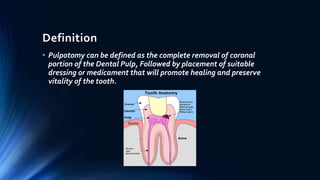
• Pulpotomy can be defined as the complete removal of coronal
portion of the Dental Pulp, Followed by placement of suitable
dressing or medicament that will promote healing and preserve
vitality of the tooth.
Indication
• Cariously exposed primary teeth, when their retention is more
advantageous than extraction.
• Vital tooth with healthy periodontium.
• Pain, if present not spontaneous nor persists after removal of the
stimulus.
• Tooth which is restorable,Tooth with-2/3rd root length.
• Hemorrhage from the amputation site is pale red & easy to control.
• In mixed dentition stage primary tooth is preferable to a space
maintainer.
Contraindication
• Evidence of internal resorption.
• Presence of inter radicular bone loss.
• Abscess , fistula in relation to teeth.
• Radiographic sign of calcific globules in pulp chamber.
• Caries penetrating the floor of pulp chamber.
• Tooth close to natural exfoliation.
Classification
1. Vital Pulpotomy techniques
• Devitalization
• Preservation
• Regeneration
2. Non-Vital Pulpotomy techniques
• Beechwood cresol
• Formocresol
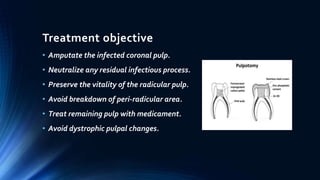
Treatment objective
• Amputate the infected coronal pulp.
• Neutralize any residual infectious process.
• Preserve the vitality of the radicular pulp.
• Avoid breakdown of peri-radicular area.
• Treat remaining pulp with medicament.
• Avoid dystrophic pulpal changes.
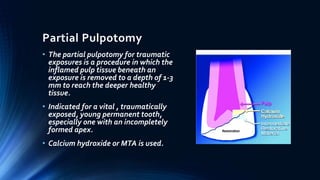
Partial Pulpotomy
• The partial pulpotomy for traumatic
exposures is a procedure in which the
inflamed pulp tissue beneath an
exposure is removed to a depth of 1-3
mm to reach the deeper healthy
tissue.
• Indicated for a vital , traumatically
exposed, young permanent tooth,
especially one with an incompletely
formed apex.
• Calcium hydroxide or MTA is used.
Non Vital Pulpotomy
• Ideally, a non-vital tooth should b treated by pulpectomy or root
canal filling.
• However, pulpectomy of a primary molar may sometime be
impracticable due to non-negotiable root canals and also due to
limited patient co-operation.
• Hence, a two-stage pulpotomy technique is advocated.
Selection Criteria
• History of spontaneous pain.
• Swelling ,redness or soreness of mucosa.
• Tooth mobility.
• Tenderness to percussion.
• Radiographic evidence of root resorption.
THANK
YOU

Pulpotomy

  • 1.
    Pulpotomy DR. SYED SAROSHHUSSAIN HOUSE OFFICER HUDH
  • 2.
    Contents • Definition • Indication •Contraindication • Classification • Treatment objective • Partial Pulpotomy • NonVital Pulpotomy • Selection Criteria
  • 3.
    Definition • Pulpotomy canbe defined as the complete removal of coronal portion of the Dental Pulp, Followed by placement of suitable dressing or medicament that will promote healing and preserve vitality of the tooth.
  • 4.
    Indication • Cariously exposedprimary teeth, when their retention is more advantageous than extraction. • Vital tooth with healthy periodontium. • Pain, if present not spontaneous nor persists after removal of the stimulus. • Tooth which is restorable,Tooth with-2/3rd root length. • Hemorrhage from the amputation site is pale red & easy to control. • In mixed dentition stage primary tooth is preferable to a space maintainer.
  • 5.
    Contraindication • Evidence ofinternal resorption. • Presence of inter radicular bone loss. • Abscess , fistula in relation to teeth. • Radiographic sign of calcific globules in pulp chamber. • Caries penetrating the floor of pulp chamber. • Tooth close to natural exfoliation.
  • 6.
    Classification 1. Vital Pulpotomytechniques • Devitalization • Preservation • Regeneration 2. Non-Vital Pulpotomy techniques • Beechwood cresol • Formocresol
  • 7.
    Treatment objective • Amputatethe infected coronal pulp. • Neutralize any residual infectious process. • Preserve the vitality of the radicular pulp. • Avoid breakdown of peri-radicular area. • Treat remaining pulp with medicament. • Avoid dystrophic pulpal changes.
  • 8.
    Partial Pulpotomy • Thepartial pulpotomy for traumatic exposures is a procedure in which the inflamed pulp tissue beneath an exposure is removed to a depth of 1-3 mm to reach the deeper healthy tissue. • Indicated for a vital , traumatically exposed, young permanent tooth, especially one with an incompletely formed apex. • Calcium hydroxide or MTA is used.
  • 9.
    Non Vital Pulpotomy •Ideally, a non-vital tooth should b treated by pulpectomy or root canal filling. • However, pulpectomy of a primary molar may sometime be impracticable due to non-negotiable root canals and also due to limited patient co-operation. • Hence, a two-stage pulpotomy technique is advocated.
  • 10.
    Selection Criteria • Historyof spontaneous pain. • Swelling ,redness or soreness of mucosa. • Tooth mobility. • Tenderness to percussion. • Radiographic evidence of root resorption.
  • 11.