OPEN BITE
Dr. Syed Sarosh Hussain
House Officer HUDH
Content
 Definition
 Classification
 Causes
 Diagnosis
 Treatment
Definition
 Malocclusion in vertical plane.
 A deviation in the vertical relationship of the maxillary and
mandibular dental arches characterized by a definite lack
of contact between opposing segments of teeth.” (Daniel
Subtelny, 1964).
 “Localized absence of occlusion while the remaining teeth
are in occlusion” (Moyer’s).
Classification
 According to location:
1. Anterior Open Bite.
2. Posterior Open Bite.
 According to cause:
1. Dental or Simple Open Bite.
2. Skeletal or Complex Open Bite.
According to location
1. Anterior Open Bite
“Absence of contact between the
maxillary and mandibular incisors at
centric relation (Worms 1971).” Absence
of vertical overlap of incisors.
2. Posterior Open Bite
“Lack of contact between the posterior
teeth when the teeth are in centric
occlusion.”
Causes
1. Dental or Simple Open Bite.
When the basal skeleton is normal and the open bite is confined
to the teeth and alveolar processes.
2. Skeletal or Complex Open Bite.
Results from skeletal dysplasia, so severe that the alveolar
processes cannot cope to maintain occlusal stops.
Causes
1. Dental or Simple Open Bite
Heredity
Environmental
Mouth Breathing
Thumb Sucking
Tongue Thrusting
Iatrogenic
Causes
2. Skeletal or Complex Open Bite
Jaw rotation during growth.
Trauma.
Diagnosis
1. Extraoral
2. Intraoral
3. Cephalogram
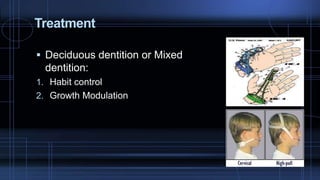
Treatment
 Deciduous dentition or Mixed
dentition:
1. Habit control
2. Growth Modulation
Treatment
 Skeletal or Complex Open
Bite
1. Surgical Orthodontics
2. Orthognathic Surgery
THANK YOU

Open bite

  • 1.
    OPEN BITE Dr. SyedSarosh Hussain House Officer HUDH
  • 2.
    Content  Definition  Classification Causes  Diagnosis  Treatment
  • 3.
    Definition  Malocclusion invertical plane.  A deviation in the vertical relationship of the maxillary and mandibular dental arches characterized by a definite lack of contact between opposing segments of teeth.” (Daniel Subtelny, 1964).  “Localized absence of occlusion while the remaining teeth are in occlusion” (Moyer’s).
  • 4.
    Classification  According tolocation: 1. Anterior Open Bite. 2. Posterior Open Bite.  According to cause: 1. Dental or Simple Open Bite. 2. Skeletal or Complex Open Bite.
  • 5.
    According to location 1.Anterior Open Bite “Absence of contact between the maxillary and mandibular incisors at centric relation (Worms 1971).” Absence of vertical overlap of incisors. 2. Posterior Open Bite “Lack of contact between the posterior teeth when the teeth are in centric occlusion.”
  • 6.
    Causes 1. Dental orSimple Open Bite. When the basal skeleton is normal and the open bite is confined to the teeth and alveolar processes. 2. Skeletal or Complex Open Bite. Results from skeletal dysplasia, so severe that the alveolar processes cannot cope to maintain occlusal stops.
  • 7.
    Causes 1. Dental orSimple Open Bite Heredity Environmental Mouth Breathing Thumb Sucking Tongue Thrusting Iatrogenic
  • 8.
    Causes 2. Skeletal orComplex Open Bite Jaw rotation during growth. Trauma.
  • 9.
  • 10.
    Treatment  Deciduous dentitionor Mixed dentition: 1. Habit control 2. Growth Modulation
  • 11.
    Treatment  Skeletal orComplex Open Bite 1. Surgical Orthodontics 2. Orthognathic Surgery
  • 12.