Dr Fariya Ashraf
PG 1st year
 INTRODUCTION
 HISTORY
 PREVALANCE
 CLASSIFICATION
 COMPOSITION
 ATTACHMENT TO TOOTH
SURFACE
 FORMATION
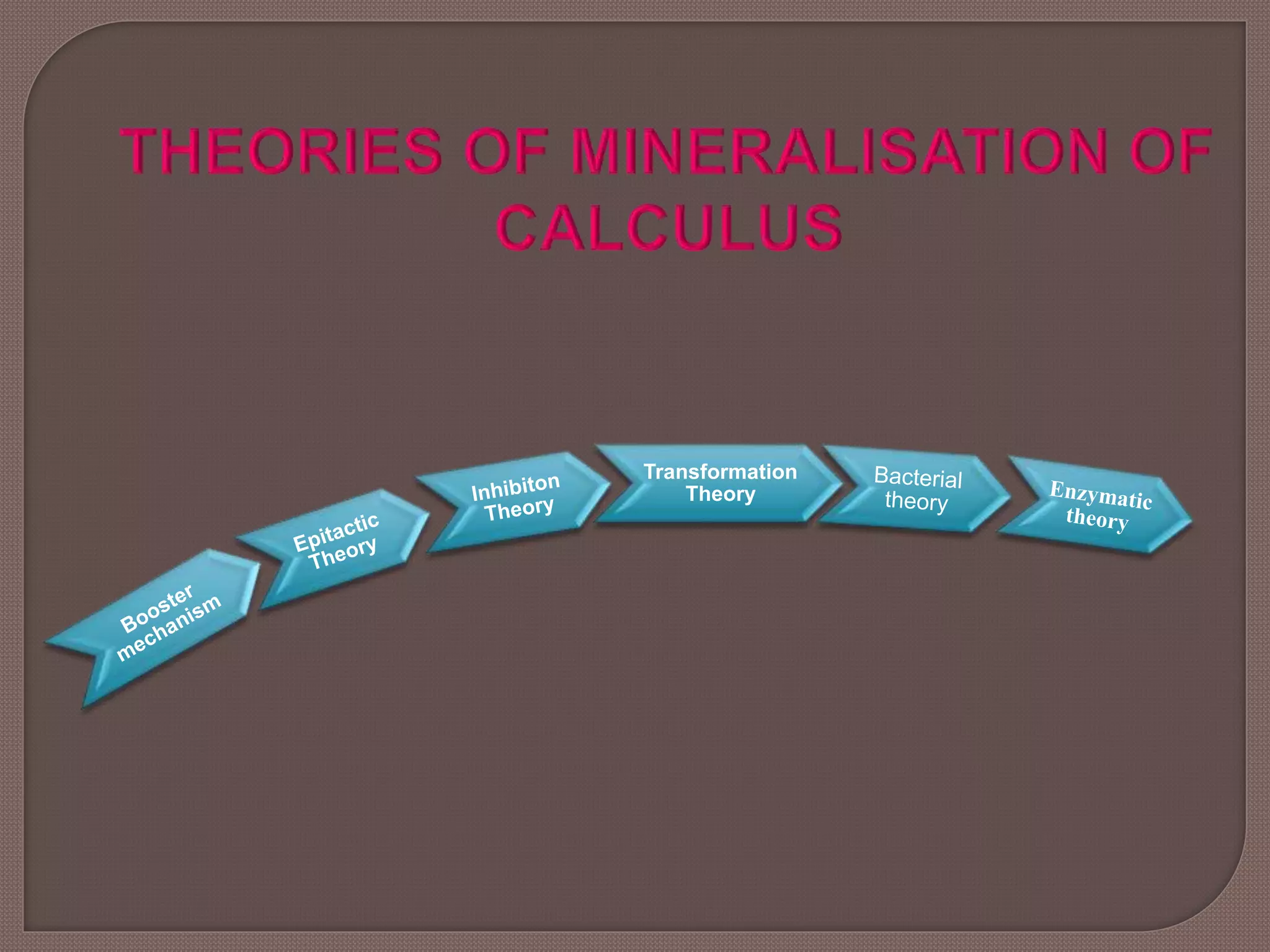
 THEORIES OF
MINERALIZATION OF
CALCULUS
 ETIOLOGIC SIGNIFICANCE
 DETECTION OF CALCULUS
 PREVENTIVE ASPECTS
 CLINICAL MEASUREMENT
 REFERENCES
INTRODUCTION
• Once a tooth erupts, various materials gather on its surface , these substances
are frequently called as tooth accumulated materials/ deposits.
They are classified as –
 Soft deposit
 Hard deposit
SOFT DEPOSIT
 Acquired pellicle
 Material Alba
 Microbial plaque
 Food Debris
HARD DEPOSIT
 Calculus
 Stains
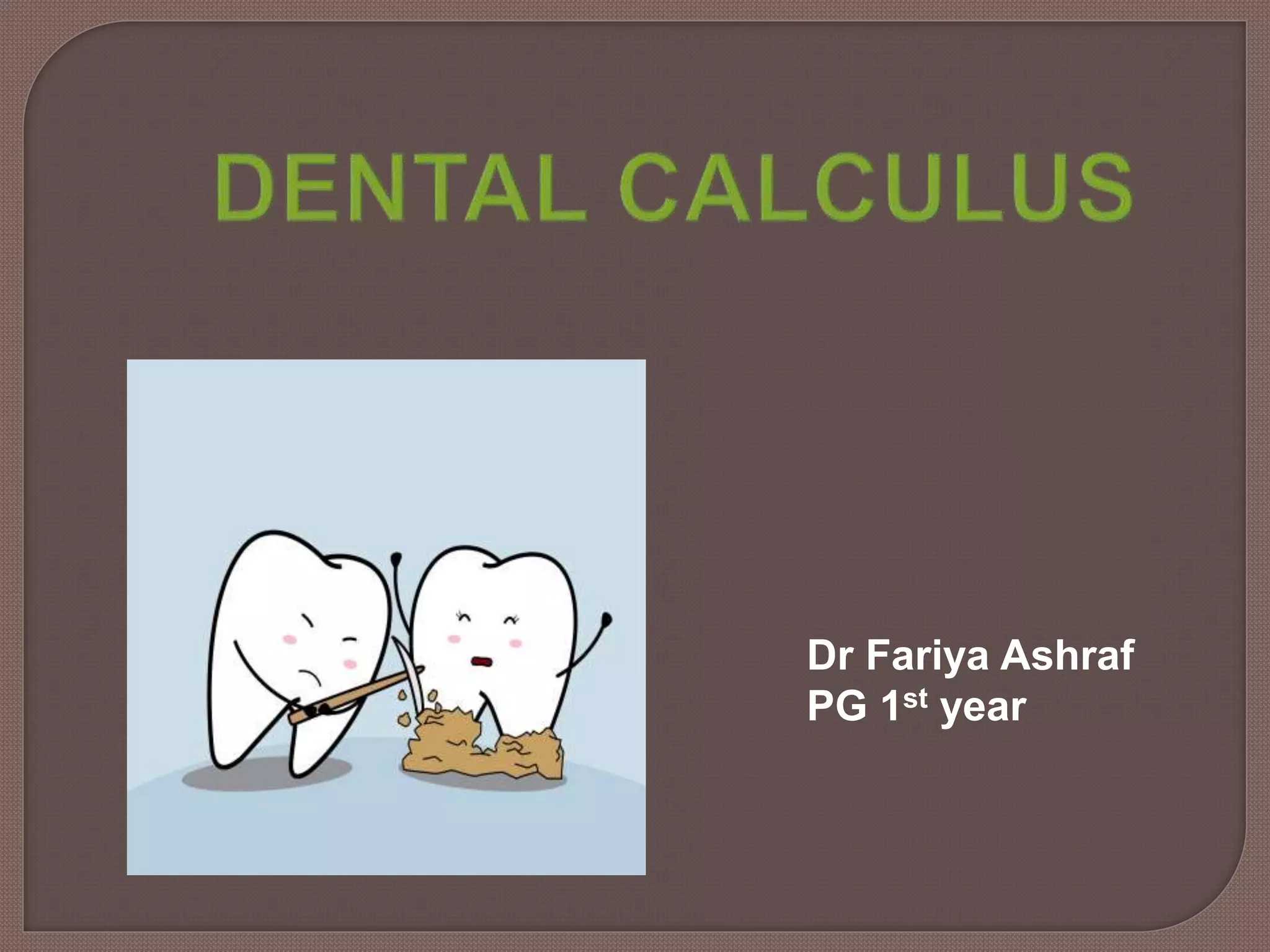
Dental Calculus consists of mineralized bacterial plaque that forms on the
surfaces of natural teeth and dental prosthesis. [Carranza ]
A hard deposit that forms by mineralization of dental plaque and is generally
covered by a layer of unmineralized plaque (Lindhe)
A deposit of inorganic salts composed primarily of calcium carbonate and
phosphate mixed with food debris bacteria and desquamated epithelial cells.
(Greene 1967)
 Calculus is derived from Greek words Calcis-lime stone, Tartar- white
encrustation inside casks.
Hippocrates
(460-377 BC)
Albucasis
(936-1013)
Paracelsus 1535
• In 1683, van leeuwenhoek described microorganism in
tartar, he called them “ANIMALCULES”
• Fauchard, in 1728, termed it tartar or slime, and
referred to it as “a substance which accumulates on
the surface of the teeth and which becomes, when left
there, a stony crust of more or less considerable
volume
1970's, the first studies of ancient dental
calculus took place on archaeological
samples of cattle, sheep, and horse teeth
(Armitage, 1975) and revealed the
presence of numerous oral phytoliths
(silica content of some plant cells)
Many studies have been
conducted on the
prevalence of calculus and
these surveys revealed a
high prevalence(70-100%)
of calculus in virtually every
population studied.
Longitudinal study was
done by Anerud and
coworkers (1991) among
Srilankan tea laborers and
Norwegian academicians
for 15 years and all
periodontal parameters
were recorded
Two national surveys by O’Brien(1993) and Bhat M.(1991) have provided data on
the prevalence of calculus.
National Health and Nutrition Examination Survey
(NHANES ΙΙΙ)
They evaluated 9689 adults in United States between
1988 and 1994 out of which
91.8 % of subjects had detectable calculus
55.1% had subgingival calculus.
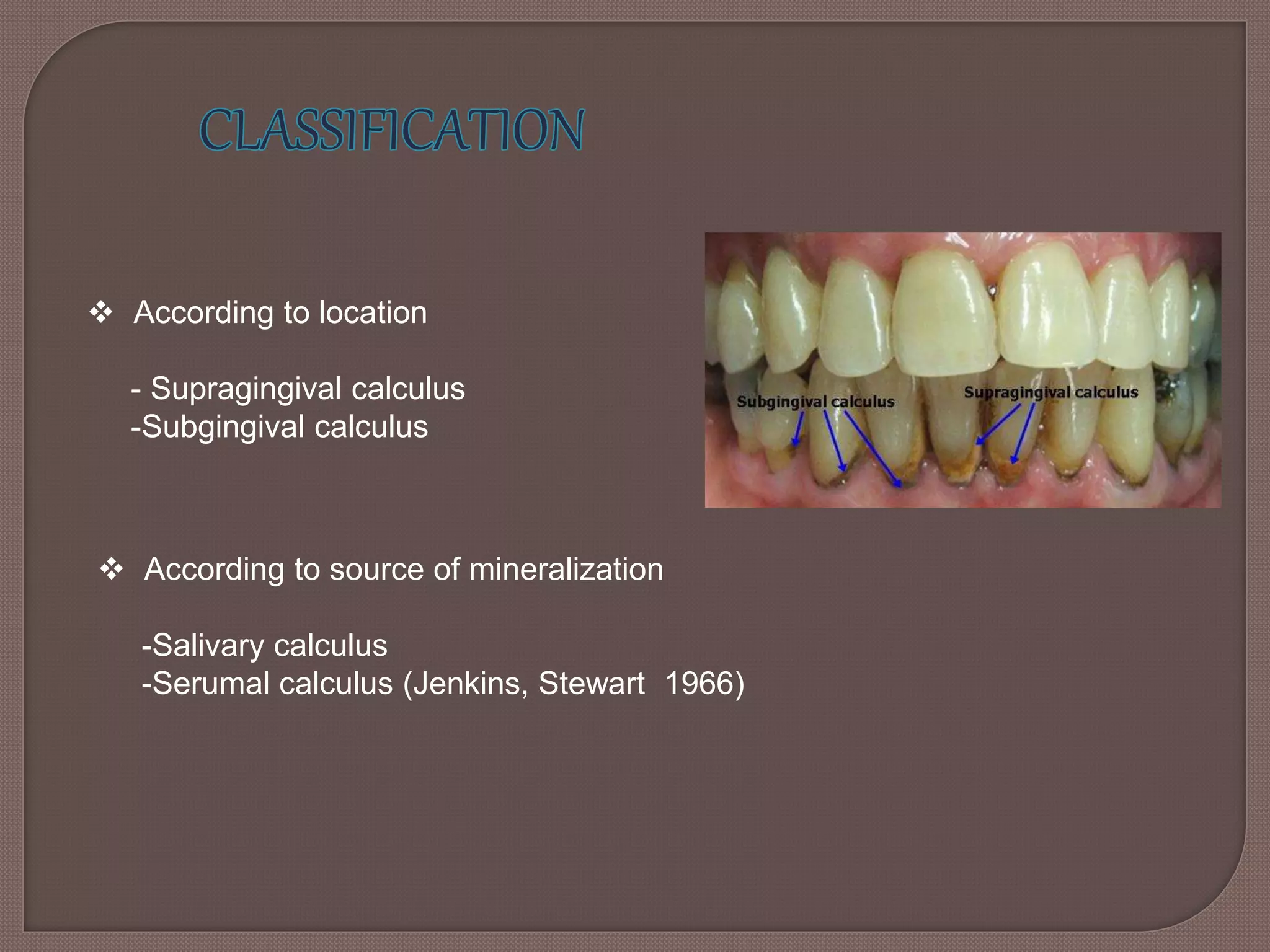
 According to location
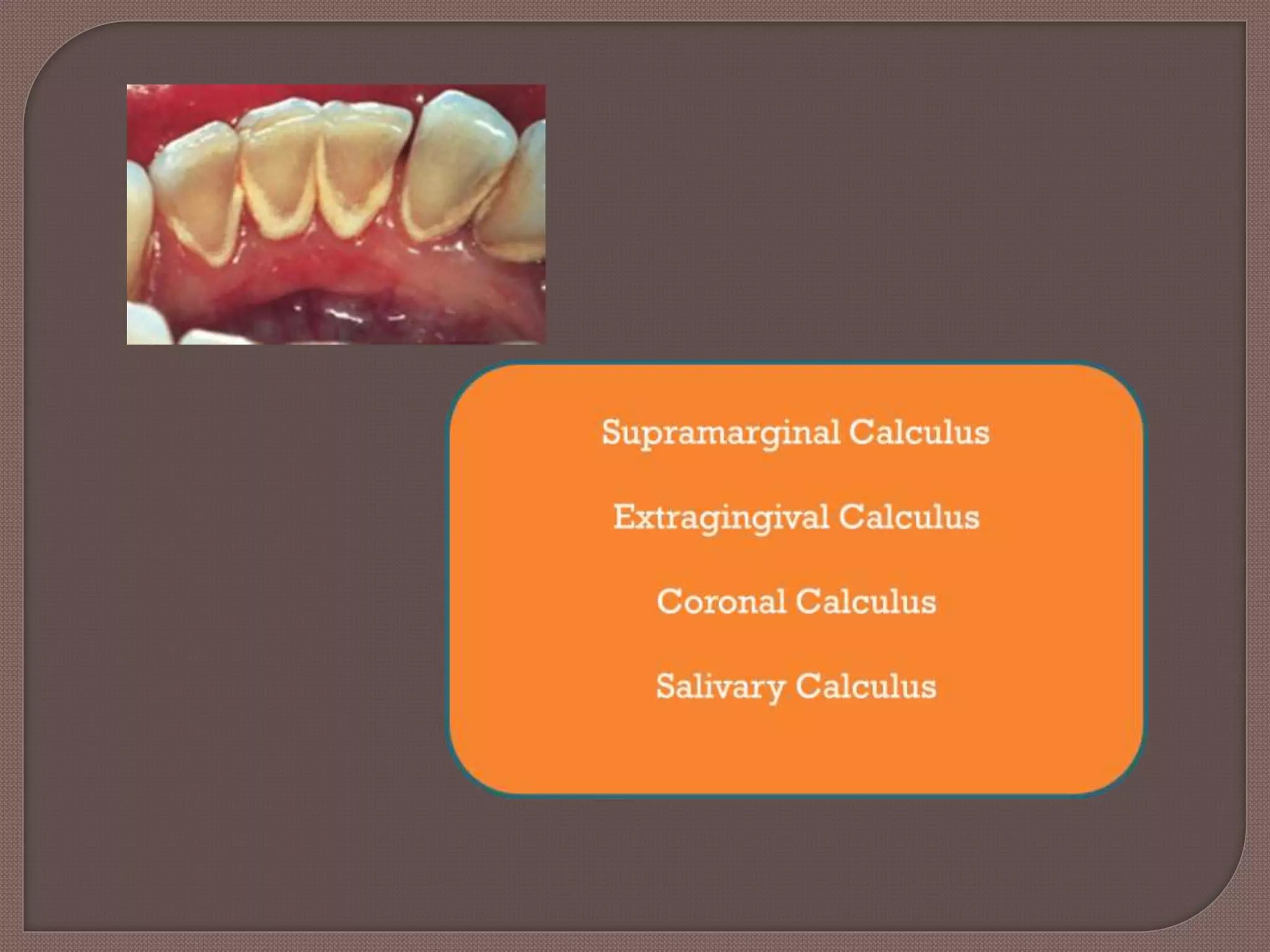
- Supragingival calculus
-Subgingival calculus
 According to source of mineralization
-Salivary calculus
-Serumal calculus (Jenkins, Stewart 1966)
 According to surface
-Exogenous
-Endogenous (Melz 1950)
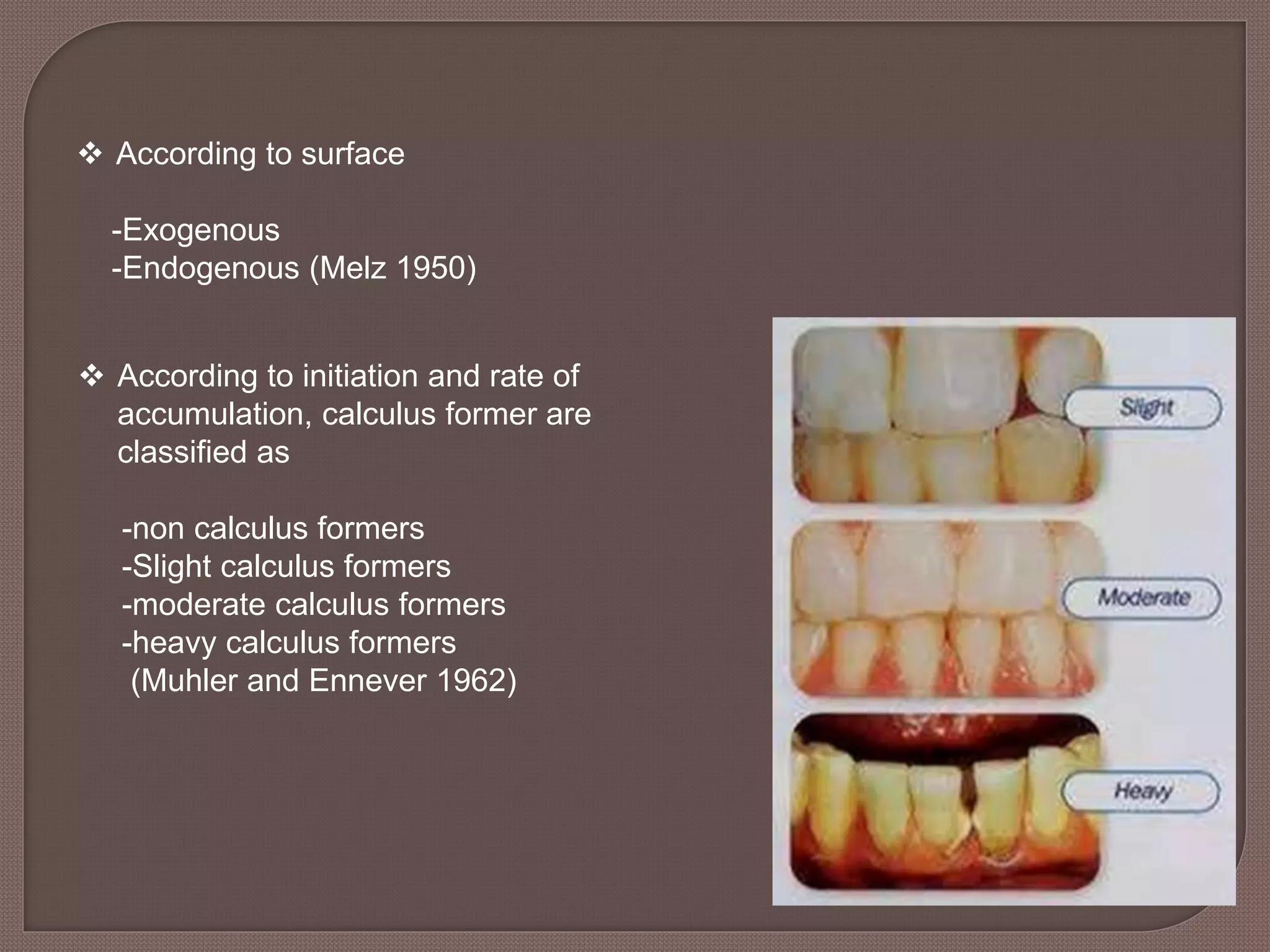
 According to initiation and rate of
accumulation, calculus former are
classified as
-non calculus formers
-Slight calculus formers
-moderate calculus formers
-heavy calculus formers
(Muhler and Ennever 1962)
 In extreme cases calculus may form a bridge-like structure along adjacent teeth
or cover the occlusal surface of teeth without functional antagonist.
 Found nearly 100% in mandibular anterior teeth, decreasing posteriorly to 20%
of the third molars. In maxilla, 10% of the anterior teeth and 60% of first molars
had supragingival calculus.
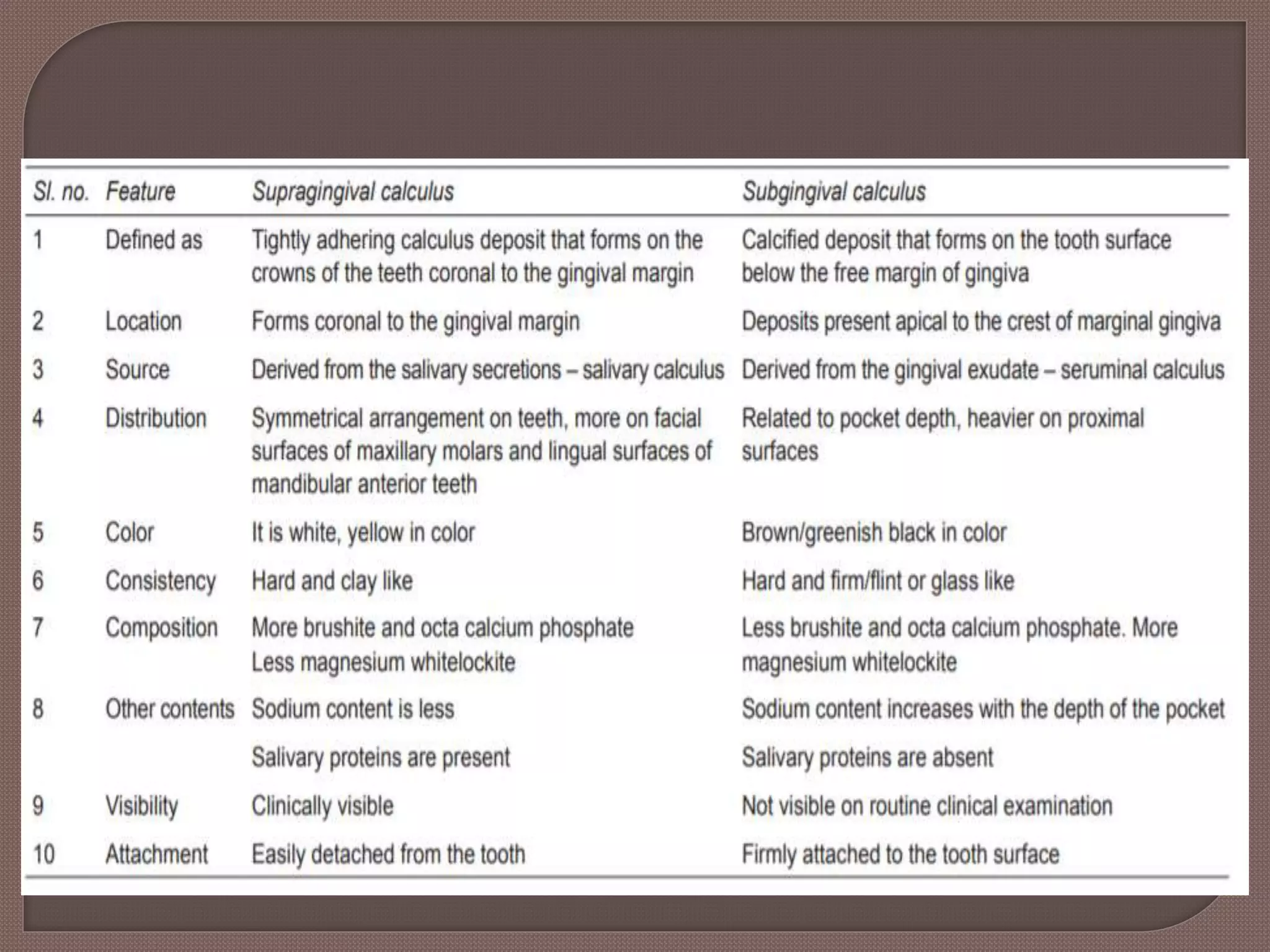
Location–
 On the clinical crown coronal to the margin of the gingiva and visible in the oral
cavity.
Distribution–
 Most frequent sites are on the lingual surfaces of the mandibular anterior teeth
opposite Warton’s duct and on the buccal surfaces of the maxillary molars opposite
Stenson’s duct.
 Crowns of teeth out of occlusion; non-functional; or teeth that are neglected during
daily plaque removal.
 Surfaces of dentures and dental prosthesis.
Location
 On the clinical crown apical to the margin of the gingiva, usually in
periodontal pockets, not visible upon oral examination.
 Extents to bottom of the pocket and follows contour of soft tissue attachment.
Distribution
 May be generalized or localized on single teeth or a group of teeth.
 Proximal surfaces have heaviest deposits, lightest deposits on facial
surfaces.(Lovdal et al.1958)
 Occurs with or without associated supragingival deposits.
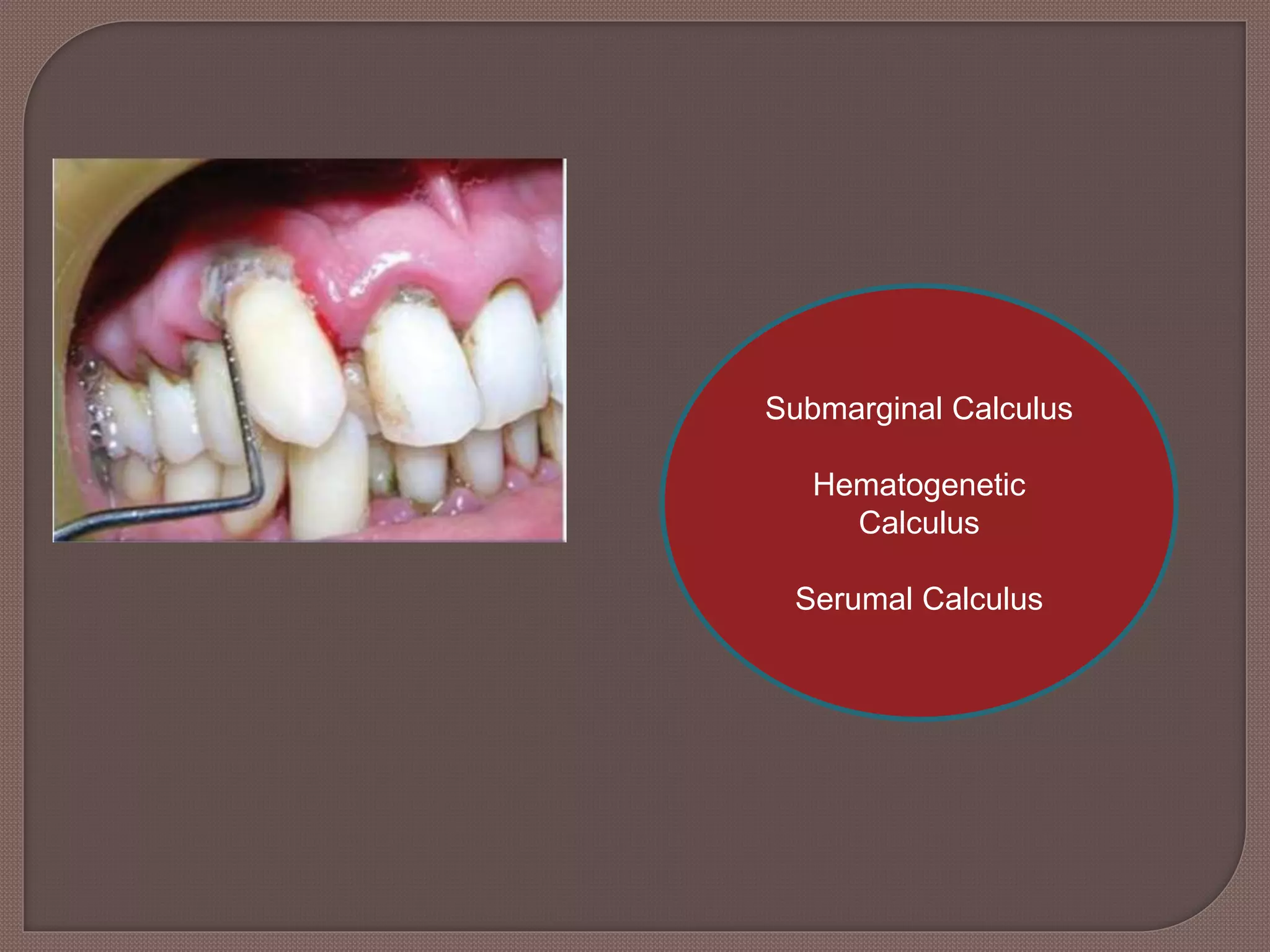
Submarginal Calculus
Hematogenetic
Calculus
Serumal Calculus
COMPOSIT
ION
Supragingival calculus consists of:
 inorganic (70 to 90 per cent) and
 organic components (20 to 30%)
Inorganic portion consist of:
• 76% calcium phosphate
• 3% calcium carbonate
• 4% magnesium phosphate
• 2% carbon dioxide
• Traces of other metals
Trace elements –
sodium tungsten
zinc gold
strontium aluminium
bromine silicon
copper iron
manganese fluorine
INORGANIC CONTENT
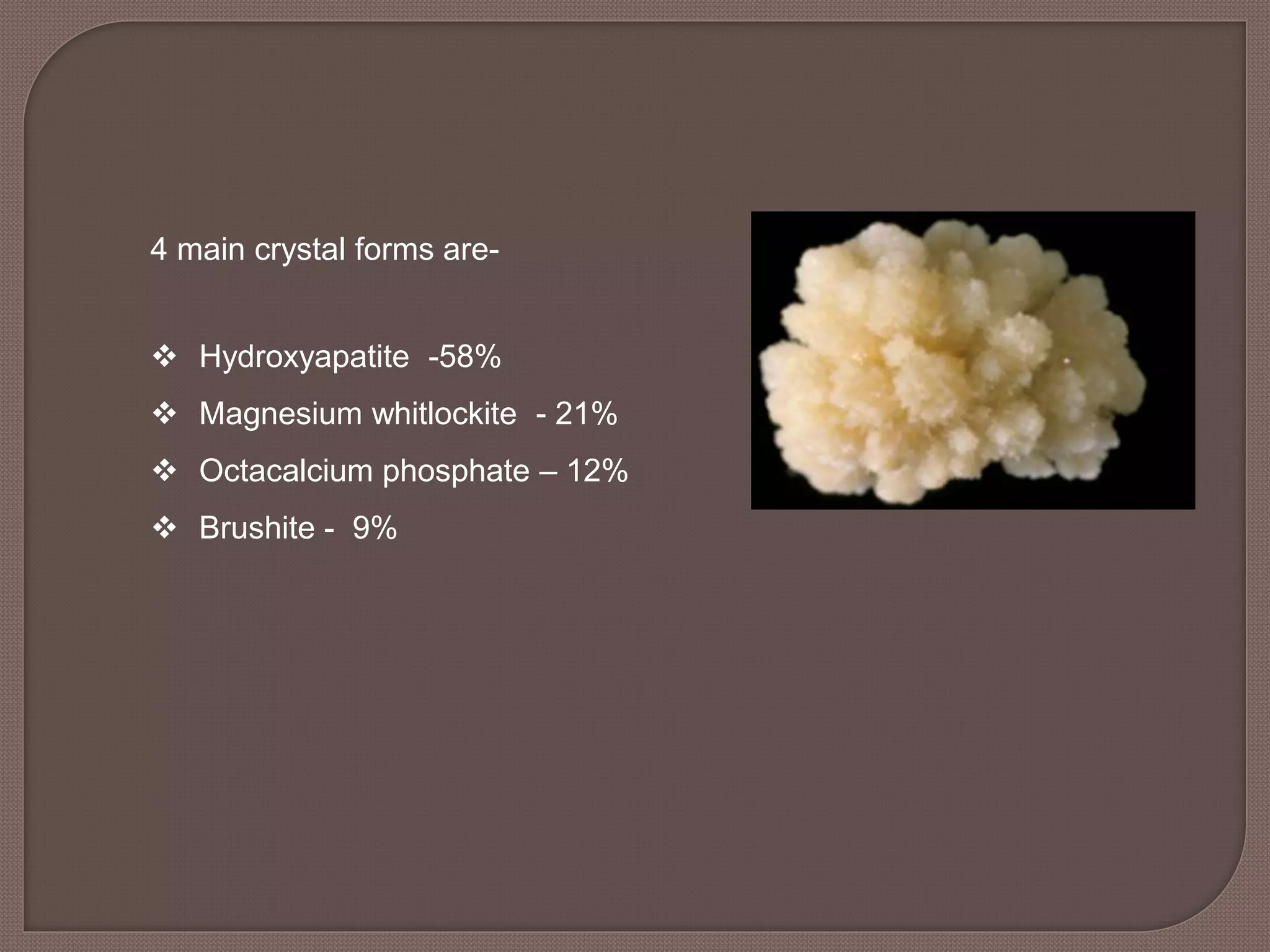
4 main crystal forms are-
 Hydroxyapatite -58%
 Magnesium whitlockite - 21%
 Octacalcium phosphate – 12%
 Brushite - 9%
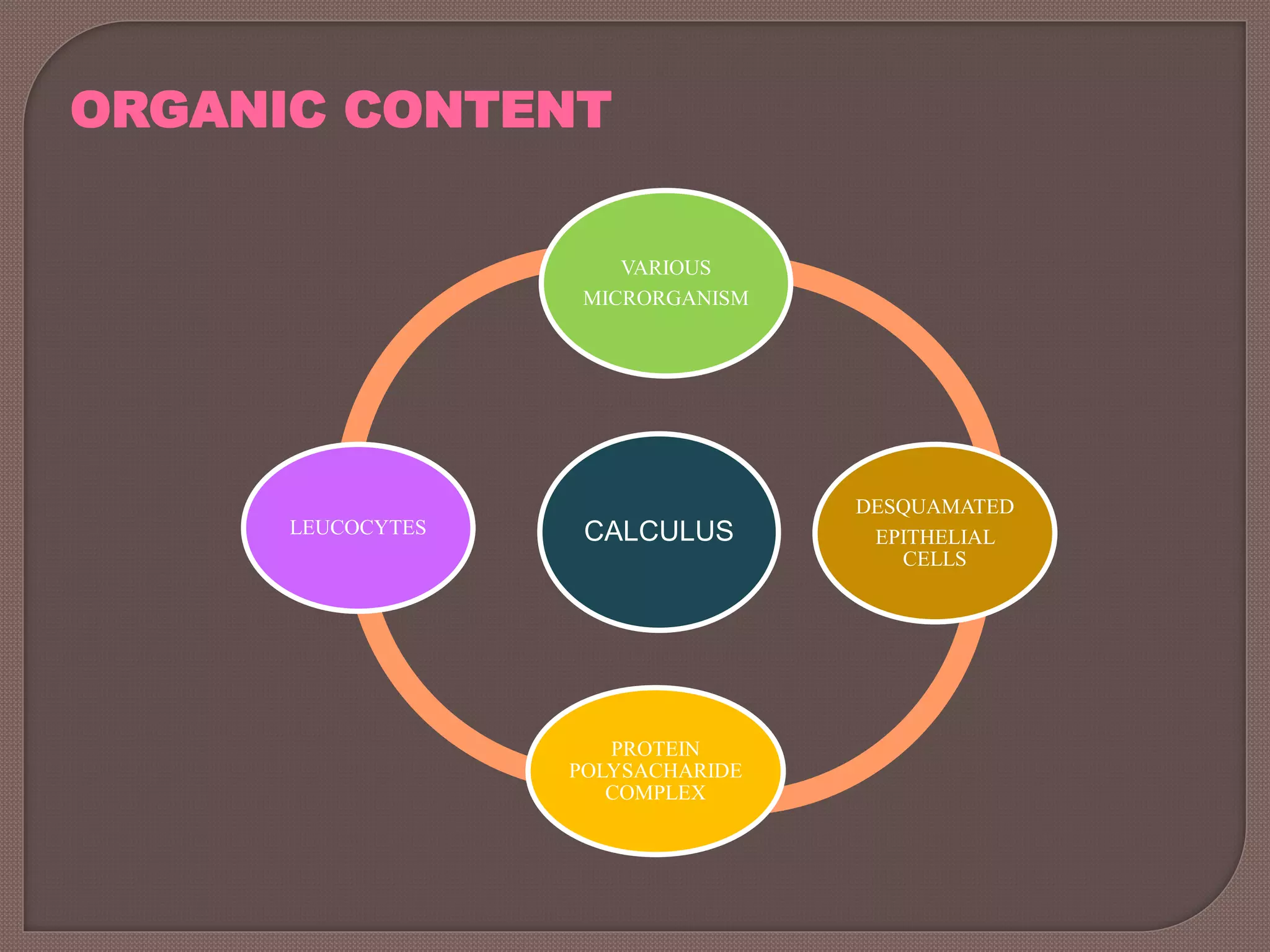
ORGANIC CONTENT
CALCULUS
VARIOUS
MICRORGANISM
DESQUAMATED
EPITHELIAL
CELLS
PROTEIN
POLYSACHARIDE
COMPLEX
LEUCOCYTES
 Carbohydrate – 1.9% and 9.1% of organic component, consist
of :
• Galactose sometimes:
arabinose
• Glucose galacturonic acid
• Mannose glucosamine
• Glucuronic acid
• Galactosamine
 Salivary proteins 5.9% to 8.2% of organic component
 Lipids 0.2% of organic component
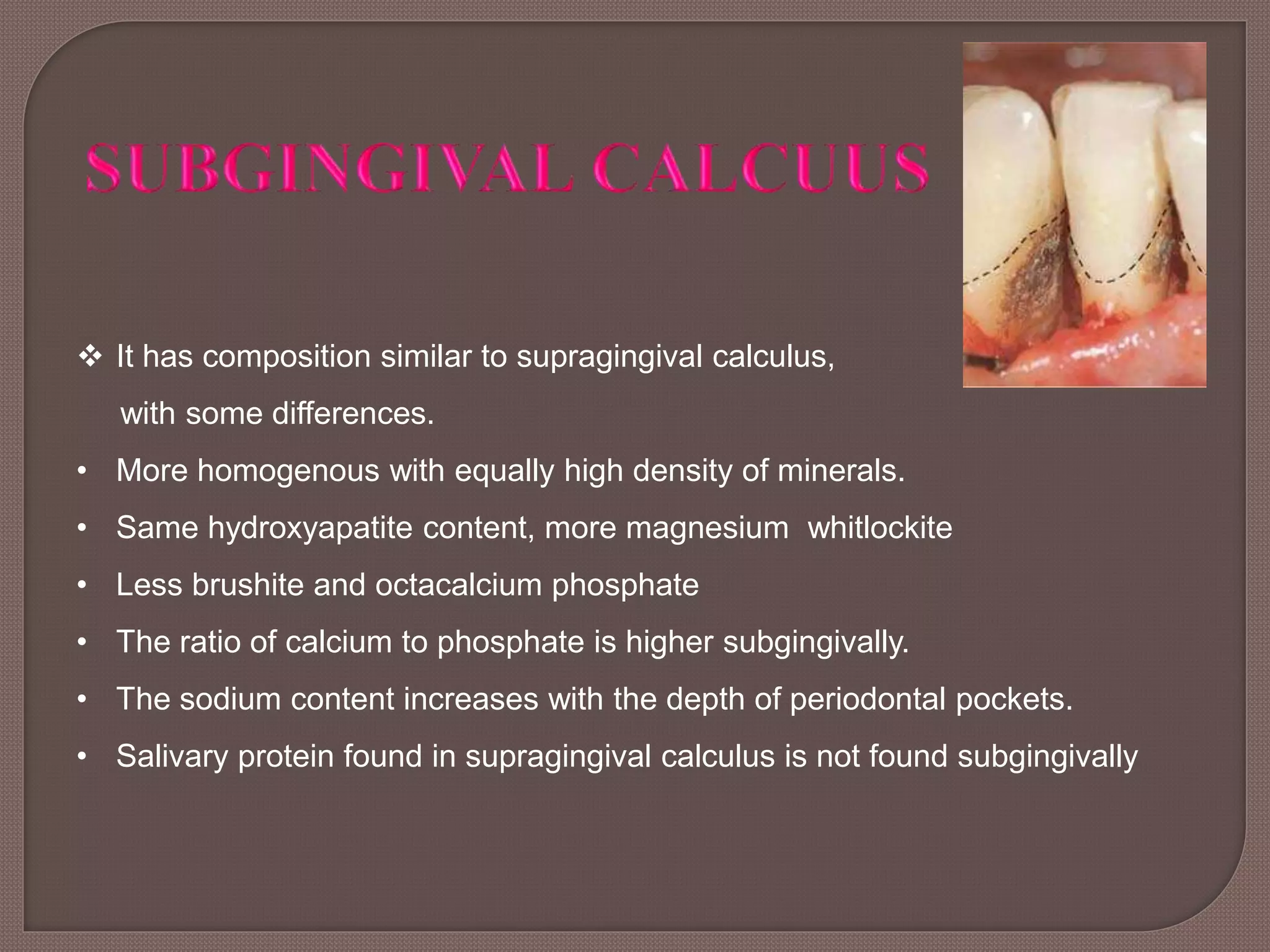
 It has composition similar to supragingival calculus,
with some differences.
• More homogenous with equally high density of minerals.
• Same hydroxyapatite content, more magnesium whitlockite
• Less brushite and octacalcium phosphate
• The ratio of calcium to phosphate is higher subgingivally.
• The sodium content increases with the depth of periodontal pockets.
• Salivary protein found in supragingival calculus is not found subgingivally
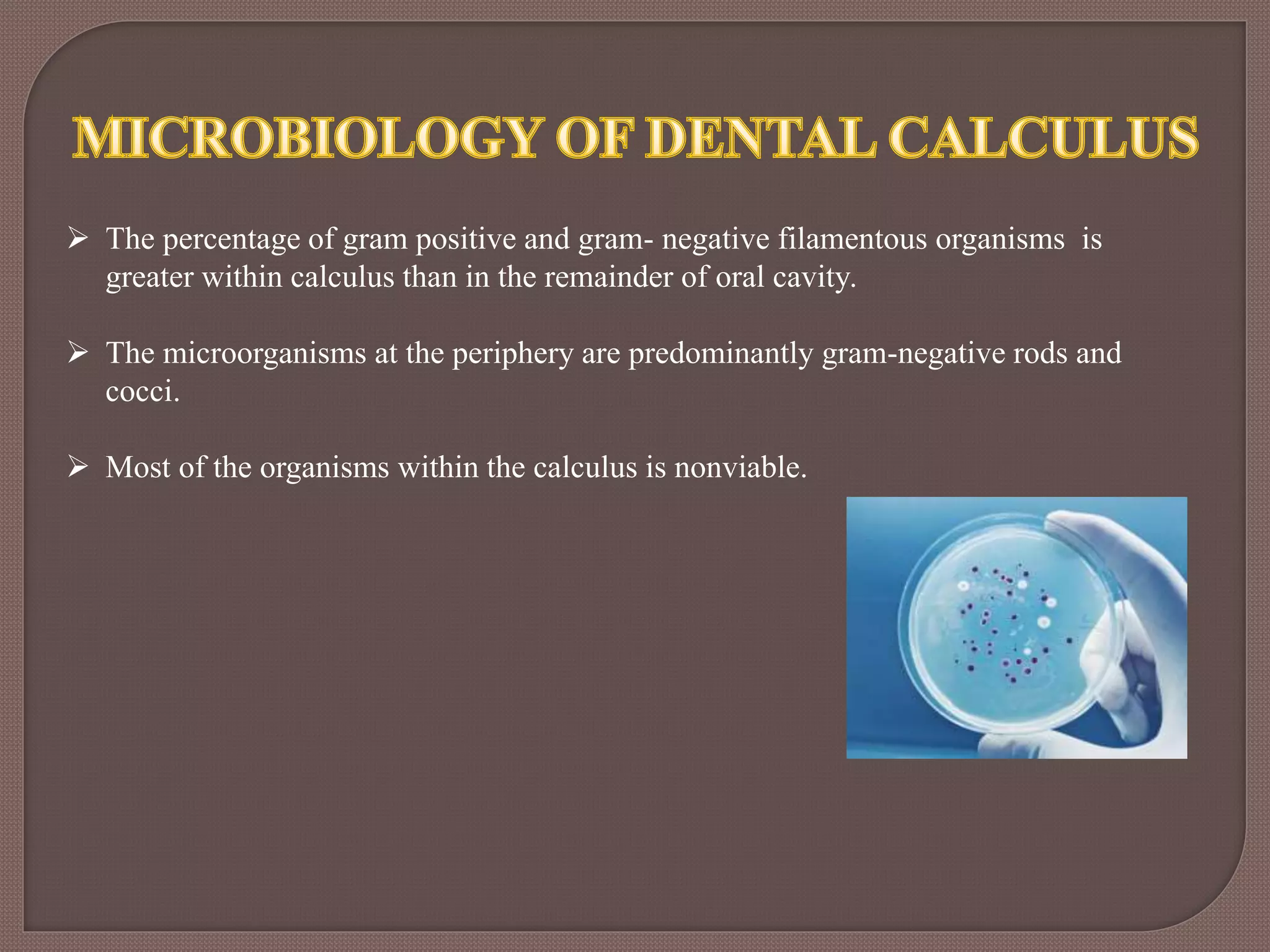
 The percentage of gram positive and gram- negative filamentous organisms is
greater within calculus than in the remainder of oral cavity.
 The microorganisms at the periphery are predominantly gram-negative rods and
cocci.
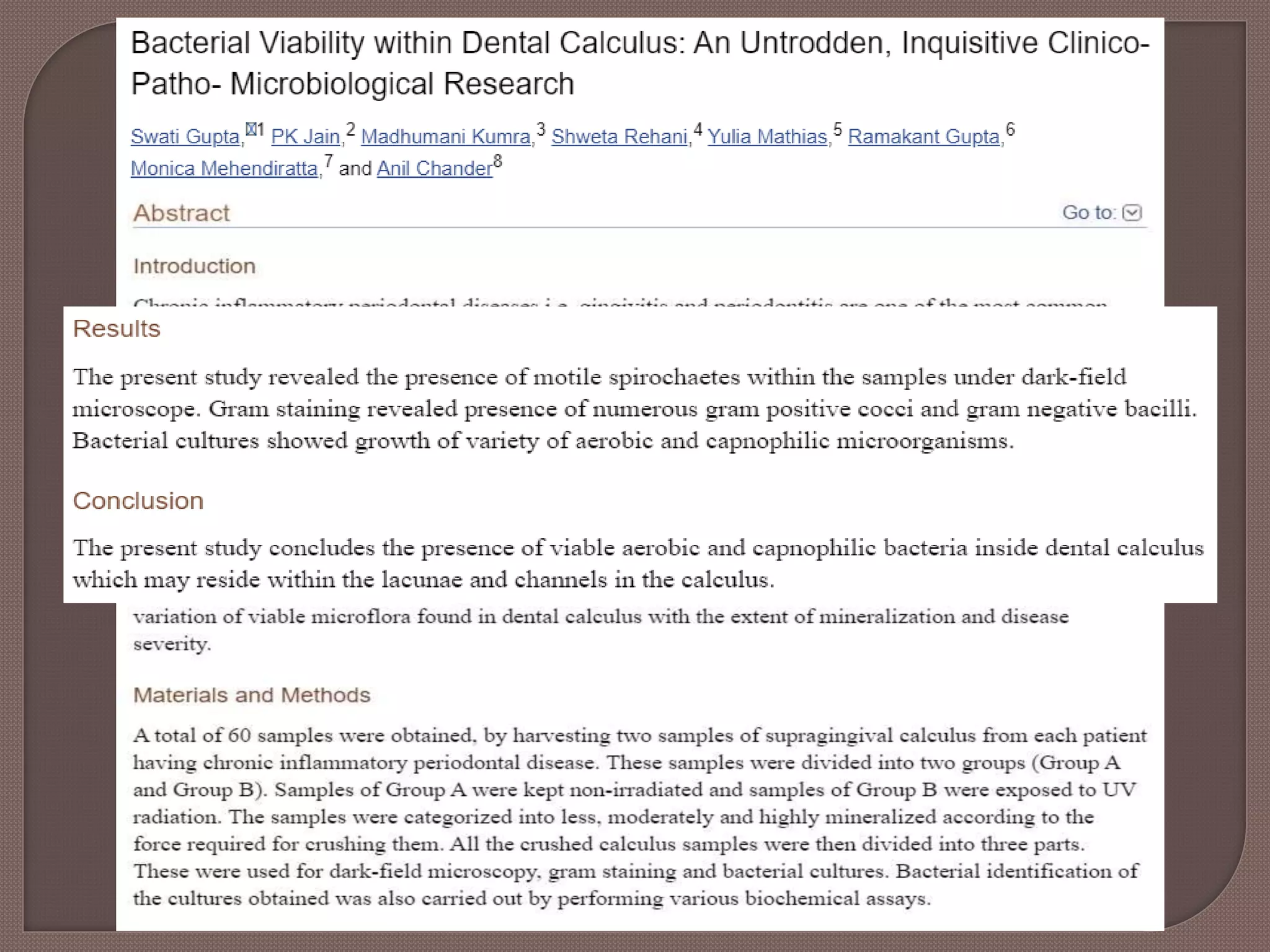
 Most of the organisms within the calculus is nonviable.
 Friskopp & Hammarstrom (1980) With TEM & SEM found differences in the
nature of the microbial coverings.
On supragingival calculus filamentous organisms,oriented at right angles to
the surface dominated,
Subgingival calculus was covered by cocci, rods and filaments with no
distinct pattern of orientation.
Pathogens like
A.actenomycetecomitans, P.gingivalis,
T.denticola have found within the
lacunae Of both supragingival and
subgingival calculus
Plaque bacteria have been proposed to actively participate in the
mineralization of calculus by forming phosphatases, changing the plaque pH
inducing mineralization (Emper et al, 1962)
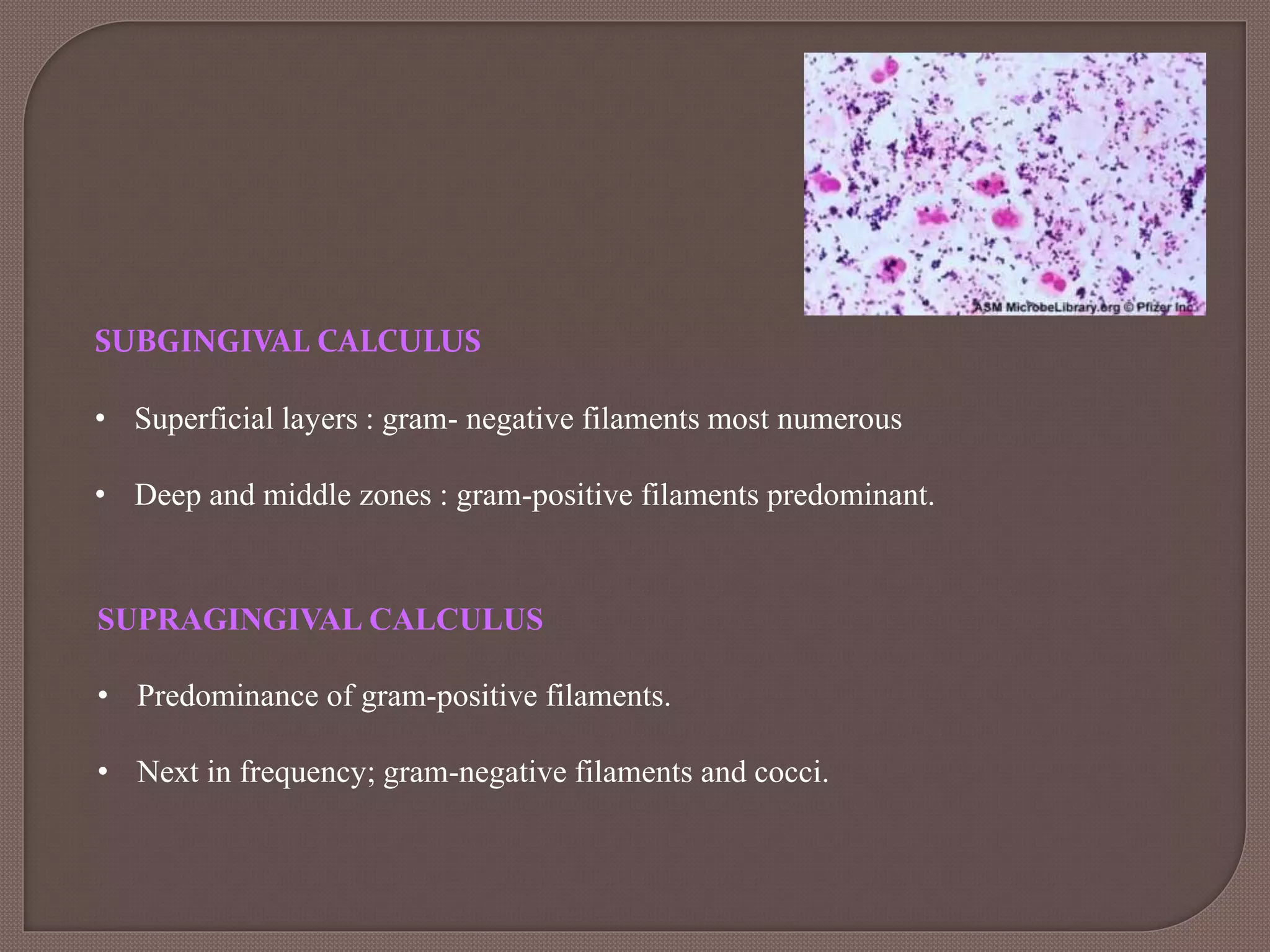
SUBGINGIVAL CALCULUS
• Superficial layers : gram- negative filaments most numerous
• Deep and middle zones : gram-positive filaments predominant.
SUPRAGINGIVAL CALCULUS
• Predominance of gram-positive filaments.
• Next in frequency; gram-negative filaments and cocci.
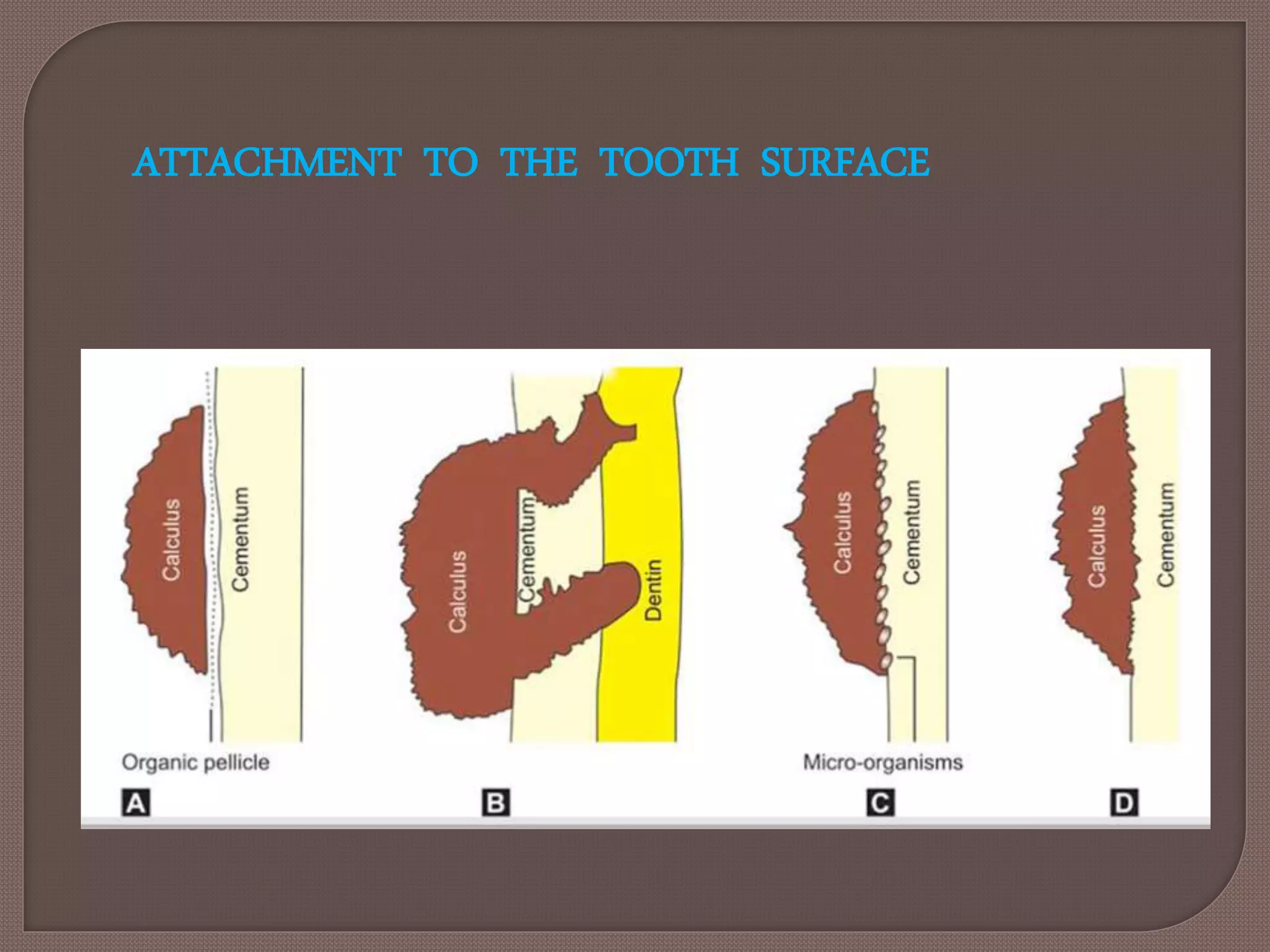
ATTACHMENT TO THE TOOTH SURFACE
Calculus embedded deeply in cementum
may appear morphologically similar to
cementum and thus has been termed
calculocementum
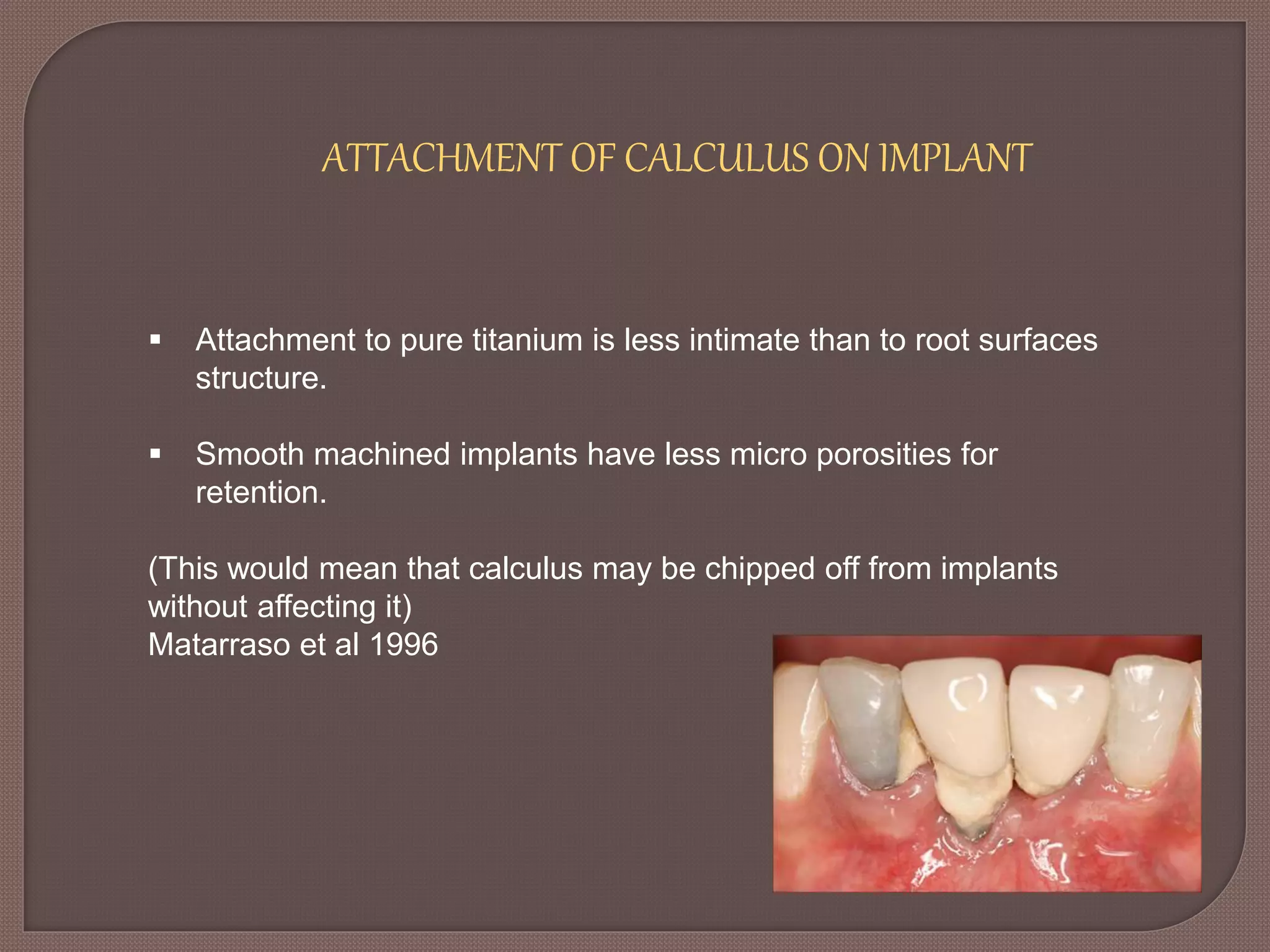
ATTACHMENT OF CALCULUS ON IMPLANT
 Attachment to pure titanium is less intimate than to root surfaces
structure.
 Smooth machined implants have less micro porosities for
retention.
(This would mean that calculus may be chipped off from implants
without affecting it)
Matarraso et al 1996
PELLICLE
FORMATION
PLAQUE
FORMATION
MINERALIZATION
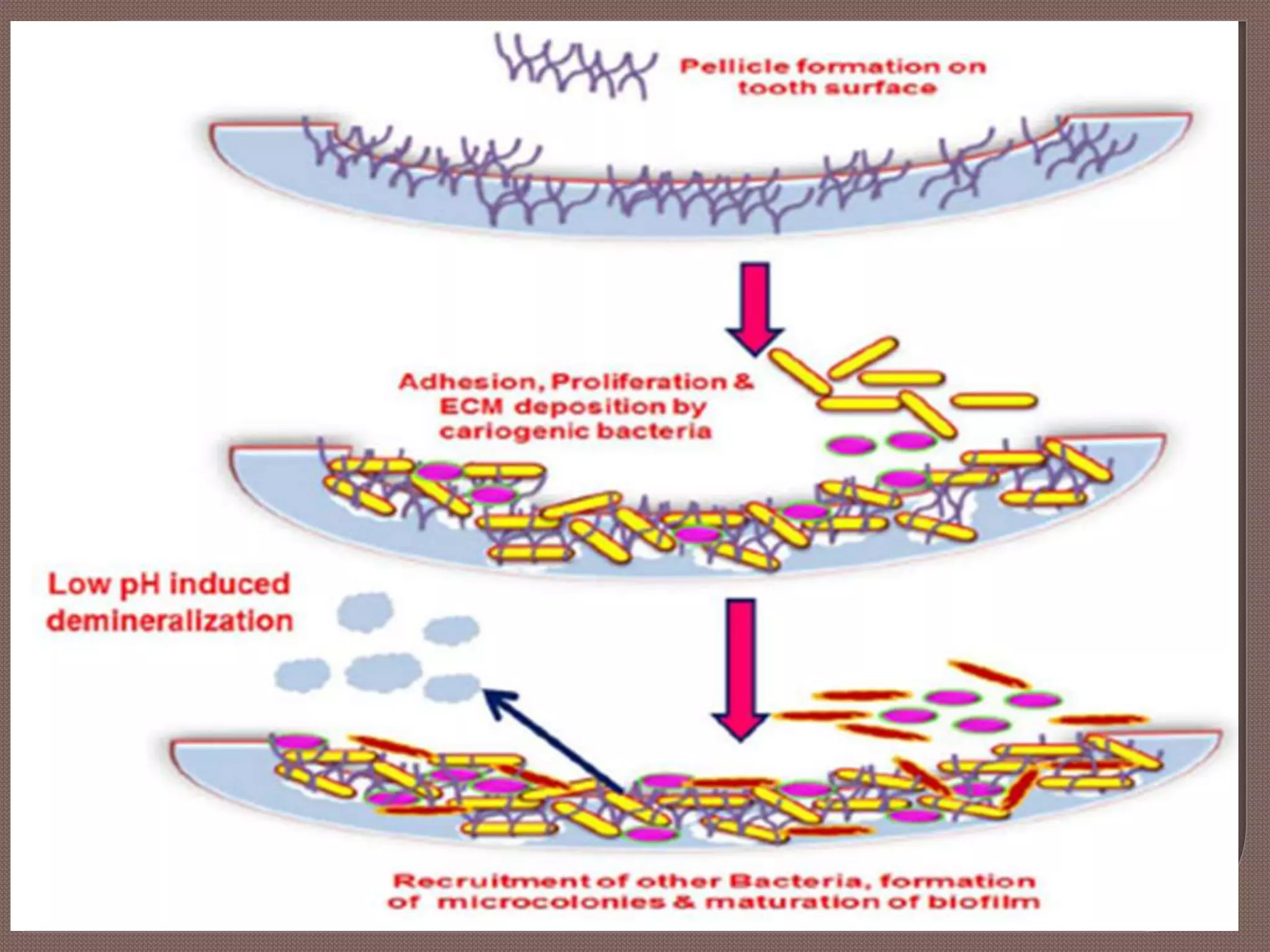
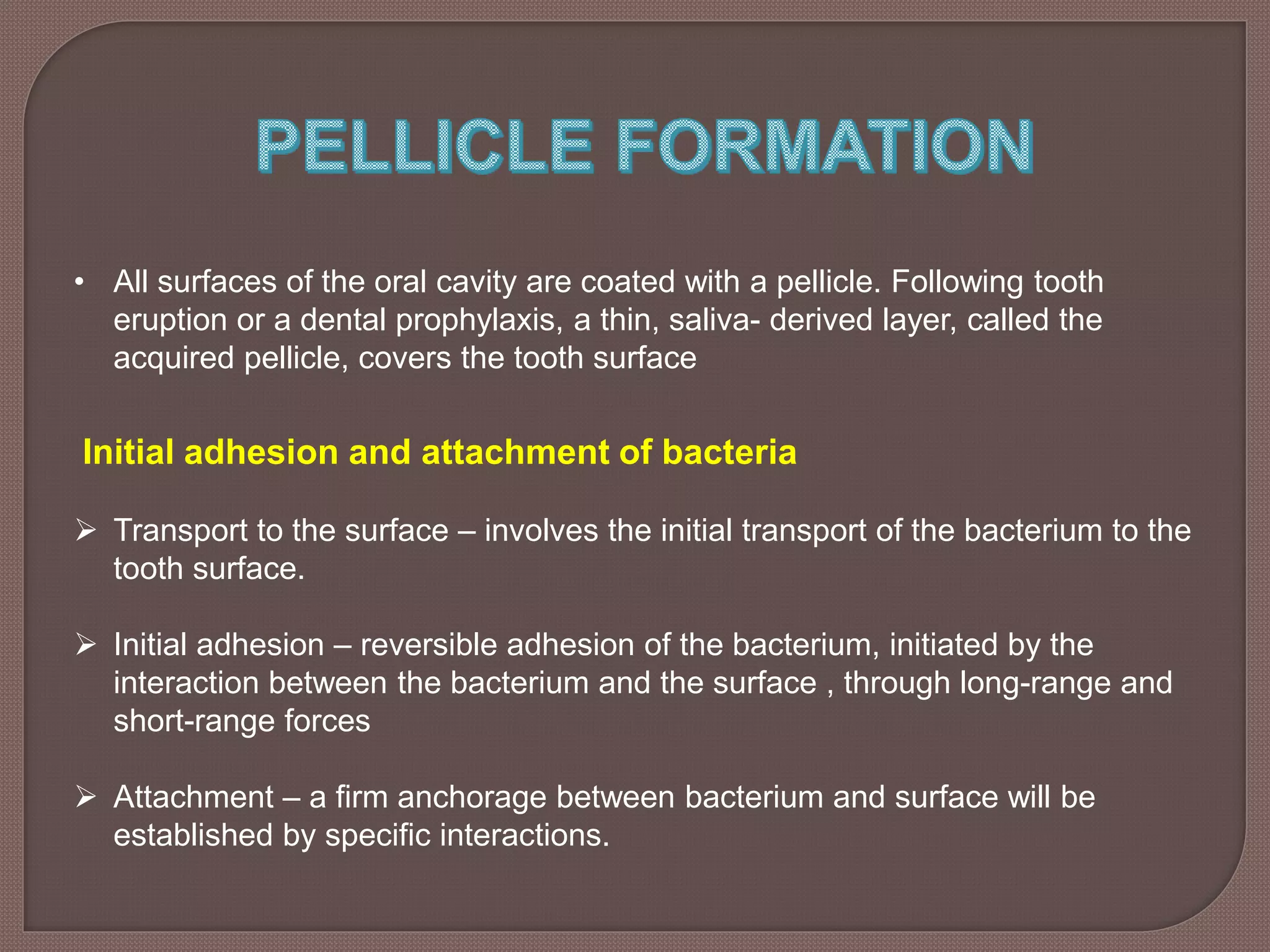
• All surfaces of the oral cavity are coated with a pellicle. Following tooth
eruption or a dental prophylaxis, a thin, saliva- derived layer, called the
acquired pellicle, covers the tooth surface
Initial adhesion and attachment of bacteria
 Transport to the surface – involves the initial transport of the bacterium to the
tooth surface.
 Initial adhesion – reversible adhesion of the bacterium, initiated by the
interaction between the bacterium and the surface , through long-range and
short-range forces
 Attachment – a firm anchorage between bacterium and surface will be
established by specific interactions.
• When the firmly attached microorganisms start growing and the newly
formed bacterial clusters remain attached, microcolonies or a biofilm can
develop.
• Gram- positive coccoidal organisms are the first settlers to adhere to the
formed enamel pellicle, and subsequently, filamentous bacteria gradually
dominate the maturing plaque biofilm (Scheie, 1994).
Colonization and Plaque Maturation
Rate of formation and accumulation
• Formation of plaque consist of amorphous and/ or finely granular organic
matrix containing mass of variety of gram positive and gram negative coccoid
bacteria and filamentous form.
• The matrix is a form of mucopolysaccride derived from either saliva or
bacteria or both.
MINERALIZATION
Soft plaque is hardened by precipitation of
mineral salts which usually starts between the
first and the fourteen day of plaque formation.
Calcification has been reported to occur as
soon as 4 to 8 hours.
Calcifying plaque may become 50% mineralized
within 2 days and 60% to 90% mineralized in 12
days.
Early plaque contains a small amount of
inorganic material which increases as a plaque
develops into calculus.
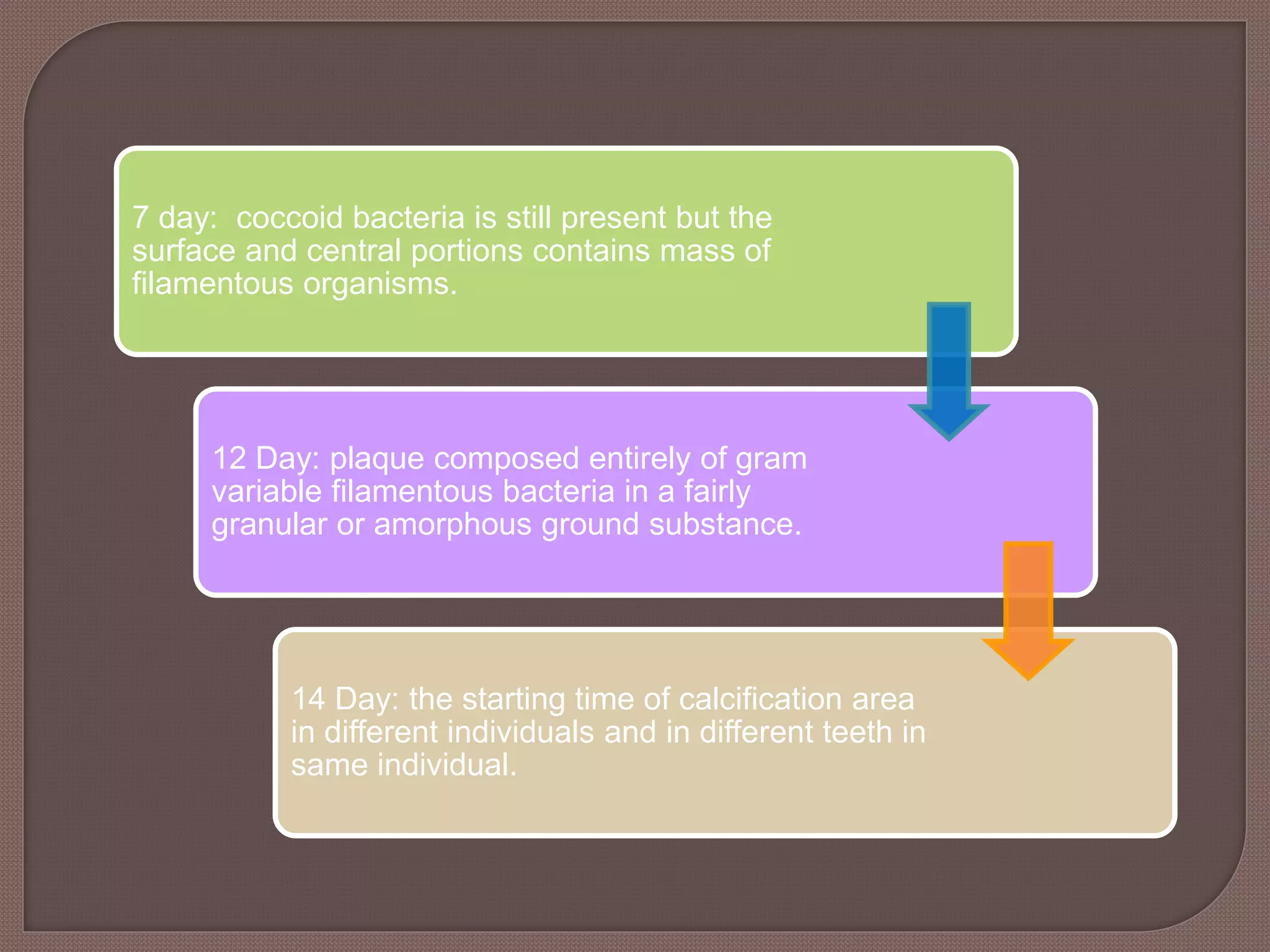
7 day: coccoid bacteria is still present but the
surface and central portions contains mass of
filamentous organisms.
12 Day: plaque composed entirely of gram
variable filamentous bacteria in a fairly
granular or amorphous ground substance.
14 Day: the starting time of calcification area
in different individuals and in different teeth in
same individual.
CALCIUM
IONS
CARBOHYDRAT
E PROTEIN
COMPLEX
CRYSTALLINE
CALCIUM
PHOSPHATE
SALT
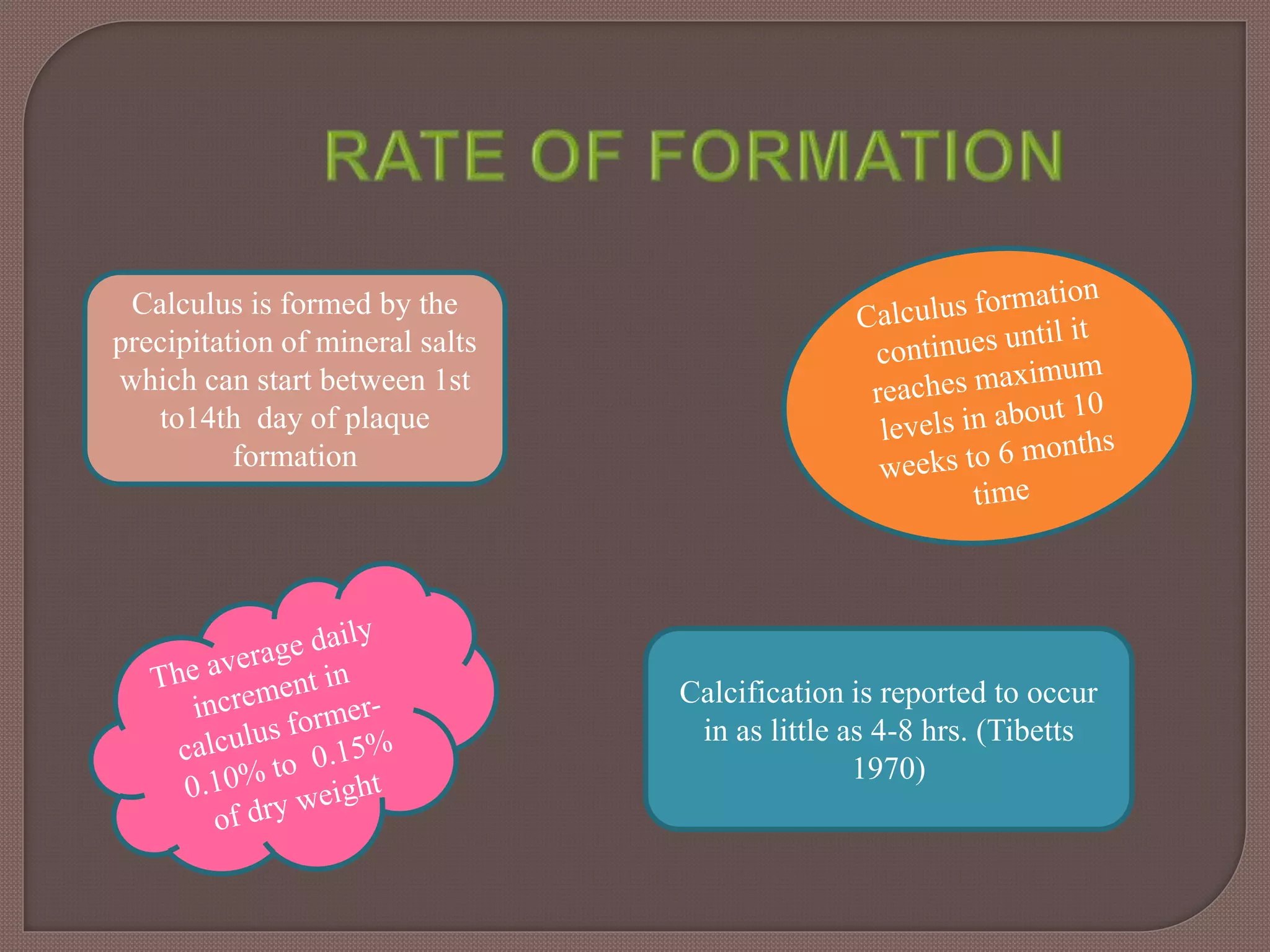
Calculus is formed by the
precipitation of mineral salts
which can start between 1st
to14th day of plaque
formation
Calcification is reported to occur
in as little as 4-8 hrs. (Tibetts
1970)
Transformation
Theory
• Mineral precipitation results from a local rise in the degree of saturation of calcium and
phosphate ions
• A rise in the pH of the saliva causes the precipitation of calcium phosphate salts by lowering
the precipitation constant
• Colloidal proteins in saliva bind calcium and phosphate ions and maintain a supersaturated
solution with respect to calcium phosphate salts.
• Phosphatase liberated from dental plaque, desquamated epithelial cells, or bacteria precipitates
calcium phosphate by hydrolyzing organic phosphates in saliva, thereby increasing the
concentration of free phosphate ions.
EPITACTIC CONCEPT / SEEDING
THEORY/HETEROGENOUS NUCLEATION
(Mandel 1957)
According to this concept, seeding agents induce small foci of calcification,
which enlarge and coalesce to form a calcified mass.
The seeding agent in calculus formation are not known, but it is
suspected that the intercellular marix of plaque plays an active role.
The carbohydrate protein complexes may initiate calcification by removing
calcium from the saliva(chelation) and binding with it to form nuclei that
induce subsequent deposition of minerals.
 Calcification at specific sites - because of inhibiting mechanism at non-
calcifying sites.
 The site where calcification occur ,the inhibitor is apparently altered or
Removed.
 Alkaline pyrophosphatase enzyme involved in controlling mechanism----
hydrolyzes pyrophosphate to phosphate (Russell and Fleisch 1970).
 Pyrophosphate inhibits calcification - prevents the initial nucleus from
growing, possibly by poisoning the growth centers of thecrystals
• Hypothesis - hydroxyapatite need not arise exclusively via epitaxis or nucleation.
• Amorphous non-crystalline deposits and brushite Transformed into
octacalcium phosphate and then to hydroxyapatite (Eanes et al 1970).
• Controlling mechanism in transformation mechanism can be pyrophosphate
(Fleisch et al 1968).
BACTERIOLOGICAL THEORY
• Oral microorganisms are the primary cause of calculus formaton
• Involved in the attachment to the tooth surface.
• Leptotrichia and Actinomyces have been considered most often as the causative
microorganism.
ENZYMATIC THEORY
Calculus formation
Action of phosphatases derived from either oral tissues
or oral microorganism on some salivary phosphate
complex (phosphoric ester of hexophosphoric group)
ROLE OF MICRORGANISM IN THE
MINERALIZATION OF CALCULUS
• Mineralisation of plaque generally starts extracellularly around both
gram positive and gram negative organism, but it may also start
intracellularly.
• Mineralisation spreads until the matrix and bacteria are calcified.
• Bacterial plaque may actively participate in the mineralizaion of calculus
by forming phosphatases, which change the pH of plaque and induce
mineralization.
The incidence of calculus, gingival inflammation
and periodontal disease increases with age.(Greene
et al, 1963; Gregory et al, 1965)
Calculus does not contribute directly to gingival
inflammation, but it provides a fixed nidus for the
continued accumulation of of plaque and its
retentionin close proximity to the gingiva
ENZER reported that only 11%. of examined tooth surfaces
containing calculus (supragingival or subgingival) exhibited
gingivitis, while 75% of the surfaces harbouring plaque exhibited
gingival inflammation
FRENCKEN et al. (59), in a
longitudinal study of Morogoro
school children from 1984-1988
in Tanzania, observed that
dental calculus increased with
increasing age while gingival
bleeding remained the same,
suggestive of no correlation
between calculus and gingival
condition.
DETECTION OF CALCULUS
(A) VISUAL
 Transillumination
 Airblast
 Color change
(B) Tactile
 Probe
 explorer
(C) Radiographs
LATEST METHOD OF DETECTION OF
CALCULUS
• Fiberooptic endoscopy-based
technology
• Spectro- optical technology
• Auto fluorescence based
technology
• Ultrasonic oscillating
system
• Laser based technology
DETECTION ONLY
COMBINED CALCULUS
DETECTION AND REMOVAL
FIBEROOPTIC BASED TECHNOLOGY
• Perioscopy involves a modified medical
endoscope exclusively for periodontal
purpose.
• Fiberoptic system permits visualization
of the subgingival root surface, tooth
structure and calculus in real time on a
display monitor.
SPECTRO OPTICAL BASED
TECHNOLOGY
• Uses a light emitting diode and fiberoptic
technology.
• The characteristic spectral signature of
subgingival calculus which is caused by
absorption, reflection and diffraction when
irradiated by red light is sensed by an optical
fiber and converted into an electrical signal
that is analysed by a computer processed
algorithm
AUTO FLUORESCENCE BASED
TECHNOLOGY
• The ability of calculus to emit light
following irradication with light of certain
wavelength enables the detection of
calculus.
ULTRASONIC TECHNOLOGY
• Ultrasonic calculus detection technology
is based on a conventional piezo –
driven ultrasonic scaleand is similar to
the way one might tr ap on the rim of a
glass with a spoon to identify cracks
acoustically.
• The ultrasonic device currently available
(Perioscan) provides a detection mode
to discriminate between calculus
deposits and clean roots, along with a
treatment mode that allows conventional
ultrasonic treatment at different power
levels.
LASERBASEDTECHNOLOGY
 Key laser 3 combines calculus detection and
treatment in a feedback controlled manner
for selective removal calculus.
 The device is based on a 655 nm InGaAs
diode laser for autoflourescence based
calculus detection whereas a 2940 nm
ER:YAG LASER is used for treatment.
Significance of removal of calculus
MOMBELLI et al showed that pocket depth reduction w/o calculus
removal altered clinical course of periodontitis
BIAGINI et al demonstrated growth of periodontal ligament
fibroblast on cementum that had attached calculus.
LISTGARTEN and ELLGARD as early as 1973 noted gingival
epithelial reattachment to calculus depoisits sterlized by 2%
chlorhexidine
• There are several methods for coping with the problem of calculus. The
patient must understand the importance of individual daily removal & how
professional maintenance appointments on a regular basis can supplement
the personal care.
Removal of plaque
appropriately by selected
brushing, flossing and
various supplementary
methods is major factor
in the control of dental
calculus formation
ANTI CALCULUS AGENT
CLINICAL MEASUREMENT
 Oral calculus index (Greene and Vermilion 1964)
 Calculus Index ( Ramfjord, 1959)
 Calculus surface severity index(Ennener et al 1961)
 Calculus rating (Volpe and Manhold, 1962)
 Marginal line calculus index (Muhlanann and Villa1967)
MARGINAL LINE CALCULUS INDEX (MUHLANANN ND VILLA, 1967)
CODE CRITERIA
0 no calculus present
1 calculus observable, but less than 0.5mm in width/thickness
2 calculus not exceeding 1.0mm in width & / or thickness
3 exceeding 1.00 mm in width
ORAL CALCULUS INDEX (GREENE AND VERMILION 1964)
CONCLUSION
• Calculus plays an important role in maintaining and
accentuating periodontal disease by keeping plaque in close
contact with the gingival tissues and creating areas where
plaque removal is impossible.
• Therefore the clinician must not only possess the clinical
skills to remove the calculus and other irritants that attach to
teeth .
REFERENCES
• Periodontology 2000; volume 55
• Mandel ID, Gaffar A. Calculus revisited- A review. J Clin Periodontol1986;13: 249-
257
• Newmann, Takei, Klokkevold, Carranza: Clinical periodontology. 10th Edition.
Noida: Elsevier; 2009.
• Glossary of periodontal terms (2001). 4th edn. Chicago: The American academy of
periodontology.
• Greene JC. The Oral Hygiene Index—Development and uses. Journal of
Periodontology. 1967;38(Suppl):37.
Dental Calculus ppt

Dental Calculus ppt

  • 1.
  • 2.
     INTRODUCTION  HISTORY PREVALANCE  CLASSIFICATION  COMPOSITION  ATTACHMENT TO TOOTH SURFACE  FORMATION  THEORIES OF MINERALIZATION OF CALCULUS  ETIOLOGIC SIGNIFICANCE  DETECTION OF CALCULUS  PREVENTIVE ASPECTS  CLINICAL MEASUREMENT  REFERENCES
  • 3.
    INTRODUCTION • Once atooth erupts, various materials gather on its surface , these substances are frequently called as tooth accumulated materials/ deposits. They are classified as –  Soft deposit  Hard deposit SOFT DEPOSIT  Acquired pellicle  Material Alba  Microbial plaque  Food Debris HARD DEPOSIT  Calculus  Stains
  • 4.
    Dental Calculus consistsof mineralized bacterial plaque that forms on the surfaces of natural teeth and dental prosthesis. [Carranza ] A hard deposit that forms by mineralization of dental plaque and is generally covered by a layer of unmineralized plaque (Lindhe) A deposit of inorganic salts composed primarily of calcium carbonate and phosphate mixed with food debris bacteria and desquamated epithelial cells. (Greene 1967)  Calculus is derived from Greek words Calcis-lime stone, Tartar- white encrustation inside casks.
  • 5.
  • 6.
    • In 1683,van leeuwenhoek described microorganism in tartar, he called them “ANIMALCULES” • Fauchard, in 1728, termed it tartar or slime, and referred to it as “a substance which accumulates on the surface of the teeth and which becomes, when left there, a stony crust of more or less considerable volume 1970's, the first studies of ancient dental calculus took place on archaeological samples of cattle, sheep, and horse teeth (Armitage, 1975) and revealed the presence of numerous oral phytoliths (silica content of some plant cells)
  • 7.
    Many studies havebeen conducted on the prevalence of calculus and these surveys revealed a high prevalence(70-100%) of calculus in virtually every population studied. Longitudinal study was done by Anerud and coworkers (1991) among Srilankan tea laborers and Norwegian academicians for 15 years and all periodontal parameters were recorded Two national surveys by O’Brien(1993) and Bhat M.(1991) have provided data on the prevalence of calculus.
  • 8.
    National Health andNutrition Examination Survey (NHANES ΙΙΙ) They evaluated 9689 adults in United States between 1988 and 1994 out of which 91.8 % of subjects had detectable calculus 55.1% had subgingival calculus.
  • 11.
     According tolocation - Supragingival calculus -Subgingival calculus  According to source of mineralization -Salivary calculus -Serumal calculus (Jenkins, Stewart 1966)
  • 12.
     According tosurface -Exogenous -Endogenous (Melz 1950)  According to initiation and rate of accumulation, calculus former are classified as -non calculus formers -Slight calculus formers -moderate calculus formers -heavy calculus formers (Muhler and Ennever 1962)
  • 13.
     In extremecases calculus may form a bridge-like structure along adjacent teeth or cover the occlusal surface of teeth without functional antagonist.  Found nearly 100% in mandibular anterior teeth, decreasing posteriorly to 20% of the third molars. In maxilla, 10% of the anterior teeth and 60% of first molars had supragingival calculus.
  • 14.
    Location–  On theclinical crown coronal to the margin of the gingiva and visible in the oral cavity. Distribution–  Most frequent sites are on the lingual surfaces of the mandibular anterior teeth opposite Warton’s duct and on the buccal surfaces of the maxillary molars opposite Stenson’s duct.  Crowns of teeth out of occlusion; non-functional; or teeth that are neglected during daily plaque removal.  Surfaces of dentures and dental prosthesis.
  • 16.
    Location  On theclinical crown apical to the margin of the gingiva, usually in periodontal pockets, not visible upon oral examination.  Extents to bottom of the pocket and follows contour of soft tissue attachment. Distribution  May be generalized or localized on single teeth or a group of teeth.  Proximal surfaces have heaviest deposits, lightest deposits on facial surfaces.(Lovdal et al.1958)  Occurs with or without associated supragingival deposits.
  • 17.
  • 19.
    COMPOSIT ION Supragingival calculus consistsof:  inorganic (70 to 90 per cent) and  organic components (20 to 30%)
  • 20.
    Inorganic portion consistof: • 76% calcium phosphate • 3% calcium carbonate • 4% magnesium phosphate • 2% carbon dioxide • Traces of other metals Trace elements – sodium tungsten zinc gold strontium aluminium bromine silicon copper iron manganese fluorine INORGANIC CONTENT
  • 21.
    4 main crystalforms are-  Hydroxyapatite -58%  Magnesium whitlockite - 21%  Octacalcium phosphate – 12%  Brushite - 9%
  • 22.
  • 23.
     Carbohydrate –1.9% and 9.1% of organic component, consist of : • Galactose sometimes: arabinose • Glucose galacturonic acid • Mannose glucosamine • Glucuronic acid • Galactosamine  Salivary proteins 5.9% to 8.2% of organic component  Lipids 0.2% of organic component
  • 24.
     It hascomposition similar to supragingival calculus, with some differences. • More homogenous with equally high density of minerals. • Same hydroxyapatite content, more magnesium whitlockite • Less brushite and octacalcium phosphate • The ratio of calcium to phosphate is higher subgingivally. • The sodium content increases with the depth of periodontal pockets. • Salivary protein found in supragingival calculus is not found subgingivally
  • 25.
     The percentageof gram positive and gram- negative filamentous organisms is greater within calculus than in the remainder of oral cavity.  The microorganisms at the periphery are predominantly gram-negative rods and cocci.  Most of the organisms within the calculus is nonviable.
  • 26.
     Friskopp &Hammarstrom (1980) With TEM & SEM found differences in the nature of the microbial coverings. On supragingival calculus filamentous organisms,oriented at right angles to the surface dominated, Subgingival calculus was covered by cocci, rods and filaments with no distinct pattern of orientation.
  • 27.
    Pathogens like A.actenomycetecomitans, P.gingivalis, T.denticolahave found within the lacunae Of both supragingival and subgingival calculus Plaque bacteria have been proposed to actively participate in the mineralization of calculus by forming phosphatases, changing the plaque pH inducing mineralization (Emper et al, 1962)
  • 28.
    SUBGINGIVAL CALCULUS • Superficiallayers : gram- negative filaments most numerous • Deep and middle zones : gram-positive filaments predominant. SUPRAGINGIVAL CALCULUS • Predominance of gram-positive filaments. • Next in frequency; gram-negative filaments and cocci.
  • 30.
    ATTACHMENT TO THETOOTH SURFACE
  • 31.
    Calculus embedded deeplyin cementum may appear morphologically similar to cementum and thus has been termed calculocementum
  • 32.
    ATTACHMENT OF CALCULUSON IMPLANT  Attachment to pure titanium is less intimate than to root surfaces structure.  Smooth machined implants have less micro porosities for retention. (This would mean that calculus may be chipped off from implants without affecting it) Matarraso et al 1996
  • 33.
  • 35.
    • All surfacesof the oral cavity are coated with a pellicle. Following tooth eruption or a dental prophylaxis, a thin, saliva- derived layer, called the acquired pellicle, covers the tooth surface Initial adhesion and attachment of bacteria  Transport to the surface – involves the initial transport of the bacterium to the tooth surface.  Initial adhesion – reversible adhesion of the bacterium, initiated by the interaction between the bacterium and the surface , through long-range and short-range forces  Attachment – a firm anchorage between bacterium and surface will be established by specific interactions.
  • 36.
    • When thefirmly attached microorganisms start growing and the newly formed bacterial clusters remain attached, microcolonies or a biofilm can develop. • Gram- positive coccoidal organisms are the first settlers to adhere to the formed enamel pellicle, and subsequently, filamentous bacteria gradually dominate the maturing plaque biofilm (Scheie, 1994). Colonization and Plaque Maturation
  • 37.
    Rate of formationand accumulation • Formation of plaque consist of amorphous and/ or finely granular organic matrix containing mass of variety of gram positive and gram negative coccoid bacteria and filamentous form. • The matrix is a form of mucopolysaccride derived from either saliva or bacteria or both. MINERALIZATION
  • 38.
    Soft plaque ishardened by precipitation of mineral salts which usually starts between the first and the fourteen day of plaque formation. Calcification has been reported to occur as soon as 4 to 8 hours. Calcifying plaque may become 50% mineralized within 2 days and 60% to 90% mineralized in 12 days. Early plaque contains a small amount of inorganic material which increases as a plaque develops into calculus.
  • 39.
    7 day: coccoidbacteria is still present but the surface and central portions contains mass of filamentous organisms. 12 Day: plaque composed entirely of gram variable filamentous bacteria in a fairly granular or amorphous ground substance. 14 Day: the starting time of calcification area in different individuals and in different teeth in same individual.
  • 40.
  • 41.
    Calculus is formedby the precipitation of mineral salts which can start between 1st to14th day of plaque formation Calcification is reported to occur in as little as 4-8 hrs. (Tibetts 1970)
  • 42.
  • 43.
    • Mineral precipitationresults from a local rise in the degree of saturation of calcium and phosphate ions • A rise in the pH of the saliva causes the precipitation of calcium phosphate salts by lowering the precipitation constant • Colloidal proteins in saliva bind calcium and phosphate ions and maintain a supersaturated solution with respect to calcium phosphate salts. • Phosphatase liberated from dental plaque, desquamated epithelial cells, or bacteria precipitates calcium phosphate by hydrolyzing organic phosphates in saliva, thereby increasing the concentration of free phosphate ions.
  • 44.
    EPITACTIC CONCEPT /SEEDING THEORY/HETEROGENOUS NUCLEATION (Mandel 1957) According to this concept, seeding agents induce small foci of calcification, which enlarge and coalesce to form a calcified mass. The seeding agent in calculus formation are not known, but it is suspected that the intercellular marix of plaque plays an active role. The carbohydrate protein complexes may initiate calcification by removing calcium from the saliva(chelation) and binding with it to form nuclei that induce subsequent deposition of minerals.
  • 45.
     Calcification atspecific sites - because of inhibiting mechanism at non- calcifying sites.  The site where calcification occur ,the inhibitor is apparently altered or Removed.  Alkaline pyrophosphatase enzyme involved in controlling mechanism---- hydrolyzes pyrophosphate to phosphate (Russell and Fleisch 1970).  Pyrophosphate inhibits calcification - prevents the initial nucleus from growing, possibly by poisoning the growth centers of thecrystals
  • 46.
    • Hypothesis -hydroxyapatite need not arise exclusively via epitaxis or nucleation. • Amorphous non-crystalline deposits and brushite Transformed into octacalcium phosphate and then to hydroxyapatite (Eanes et al 1970). • Controlling mechanism in transformation mechanism can be pyrophosphate (Fleisch et al 1968).
  • 47.
    BACTERIOLOGICAL THEORY • Oralmicroorganisms are the primary cause of calculus formaton • Involved in the attachment to the tooth surface. • Leptotrichia and Actinomyces have been considered most often as the causative microorganism.
  • 48.
    ENZYMATIC THEORY Calculus formation Actionof phosphatases derived from either oral tissues or oral microorganism on some salivary phosphate complex (phosphoric ester of hexophosphoric group)
  • 49.
    ROLE OF MICRORGANISMIN THE MINERALIZATION OF CALCULUS • Mineralisation of plaque generally starts extracellularly around both gram positive and gram negative organism, but it may also start intracellularly. • Mineralisation spreads until the matrix and bacteria are calcified. • Bacterial plaque may actively participate in the mineralizaion of calculus by forming phosphatases, which change the pH of plaque and induce mineralization.
  • 50.
    The incidence ofcalculus, gingival inflammation and periodontal disease increases with age.(Greene et al, 1963; Gregory et al, 1965) Calculus does not contribute directly to gingival inflammation, but it provides a fixed nidus for the continued accumulation of of plaque and its retentionin close proximity to the gingiva ENZER reported that only 11%. of examined tooth surfaces containing calculus (supragingival or subgingival) exhibited gingivitis, while 75% of the surfaces harbouring plaque exhibited gingival inflammation FRENCKEN et al. (59), in a longitudinal study of Morogoro school children from 1984-1988 in Tanzania, observed that dental calculus increased with increasing age while gingival bleeding remained the same, suggestive of no correlation between calculus and gingival condition.
  • 51.
    DETECTION OF CALCULUS (A)VISUAL  Transillumination  Airblast  Color change
  • 52.
    (B) Tactile  Probe explorer (C) Radiographs
  • 53.
    LATEST METHOD OFDETECTION OF CALCULUS • Fiberooptic endoscopy-based technology • Spectro- optical technology • Auto fluorescence based technology • Ultrasonic oscillating system • Laser based technology DETECTION ONLY COMBINED CALCULUS DETECTION AND REMOVAL
  • 54.
    FIBEROOPTIC BASED TECHNOLOGY •Perioscopy involves a modified medical endoscope exclusively for periodontal purpose. • Fiberoptic system permits visualization of the subgingival root surface, tooth structure and calculus in real time on a display monitor.
  • 55.
    SPECTRO OPTICAL BASED TECHNOLOGY •Uses a light emitting diode and fiberoptic technology. • The characteristic spectral signature of subgingival calculus which is caused by absorption, reflection and diffraction when irradiated by red light is sensed by an optical fiber and converted into an electrical signal that is analysed by a computer processed algorithm
  • 56.
    AUTO FLUORESCENCE BASED TECHNOLOGY •The ability of calculus to emit light following irradication with light of certain wavelength enables the detection of calculus.
  • 57.
    ULTRASONIC TECHNOLOGY • Ultrasoniccalculus detection technology is based on a conventional piezo – driven ultrasonic scaleand is similar to the way one might tr ap on the rim of a glass with a spoon to identify cracks acoustically. • The ultrasonic device currently available (Perioscan) provides a detection mode to discriminate between calculus deposits and clean roots, along with a treatment mode that allows conventional ultrasonic treatment at different power levels.
  • 58.
    LASERBASEDTECHNOLOGY  Key laser3 combines calculus detection and treatment in a feedback controlled manner for selective removal calculus.  The device is based on a 655 nm InGaAs diode laser for autoflourescence based calculus detection whereas a 2940 nm ER:YAG LASER is used for treatment.
  • 59.
    Significance of removalof calculus MOMBELLI et al showed that pocket depth reduction w/o calculus removal altered clinical course of periodontitis BIAGINI et al demonstrated growth of periodontal ligament fibroblast on cementum that had attached calculus. LISTGARTEN and ELLGARD as early as 1973 noted gingival epithelial reattachment to calculus depoisits sterlized by 2% chlorhexidine
  • 60.
    • There areseveral methods for coping with the problem of calculus. The patient must understand the importance of individual daily removal & how professional maintenance appointments on a regular basis can supplement the personal care.
  • 61.
    Removal of plaque appropriatelyby selected brushing, flossing and various supplementary methods is major factor in the control of dental calculus formation
  • 62.
  • 68.
    CLINICAL MEASUREMENT  Oralcalculus index (Greene and Vermilion 1964)  Calculus Index ( Ramfjord, 1959)  Calculus surface severity index(Ennener et al 1961)  Calculus rating (Volpe and Manhold, 1962)  Marginal line calculus index (Muhlanann and Villa1967)
  • 69.
    MARGINAL LINE CALCULUSINDEX (MUHLANANN ND VILLA, 1967) CODE CRITERIA 0 no calculus present 1 calculus observable, but less than 0.5mm in width/thickness 2 calculus not exceeding 1.0mm in width & / or thickness 3 exceeding 1.00 mm in width ORAL CALCULUS INDEX (GREENE AND VERMILION 1964)
  • 70.
    CONCLUSION • Calculus playsan important role in maintaining and accentuating periodontal disease by keeping plaque in close contact with the gingival tissues and creating areas where plaque removal is impossible. • Therefore the clinician must not only possess the clinical skills to remove the calculus and other irritants that attach to teeth .
  • 71.
    REFERENCES • Periodontology 2000;volume 55 • Mandel ID, Gaffar A. Calculus revisited- A review. J Clin Periodontol1986;13: 249- 257 • Newmann, Takei, Klokkevold, Carranza: Clinical periodontology. 10th Edition. Noida: Elsevier; 2009. • Glossary of periodontal terms (2001). 4th edn. Chicago: The American academy of periodontology. • Greene JC. The Oral Hygiene Index—Development and uses. Journal of Periodontology. 1967;38(Suppl):37.

Editor's Notes

  • #8 Calculus is prevalent in populations throughout the world. Two national surveys by O’Brien(1993) and Bhat M.(1991) have provided data on the prevalence of calculus. The prevalence of supragingival calculus only and the mean proportion of teeth affected did not increase with age. In contrast, the prevalence of subgingival calculus, with or without supragingival calculus, showed a slight but consistent increase with age for both sexes. In all age groups males had approximately twice as many teeth with supragingival and subgingival calculus as females.
  • #24 Neutral fats Free fatty acids Cholesterol Cholesterol esters Phospholipids
  • #31 1.Attachment by means of organic pellicle on cementum and enamel 2.Mechanical locking on the surface irregularity such as caries lesion or resorption lacunae 3. Close adaptation of calculus undersurface depressions to gently sloping mounds on the unaltered cementum surface. 4. Penetration of calculus bacteria in cementum. (But this mode of attachment was Not Acknowledged)
  • #35 Salivary proteins will be primarily adsorbed at the enamel surface due to electrostatic interactions between the ionic double layer (calcium and phosphate ions) on one hand and correspondingly charged groups of the proteins on the other. Specific interactions between microbial cell surface “adhesin” molecules and receptors in the salivary pellicle determine whether a bacterial cell will remain associated with the surface. Primary colonizers provide new binding sites for adhesion by other oral bacteria
  • #41 It occurs by binding of calcium to carbohydrate – protein complexes of organic matrix. This leads to precipitation of crystalline calcium phosphate salts. Crystals form initially in the intercellular matrix and on the bacterial surfaces and finally within the bacteria. Calcification begins along the inner surface of supragingival plaque in separate foci that increased in size and coalesce to form solid masses of calculus. With occurrence of calcification, filamentous bacteria increase in number Calculus is formed in layers, which are often separated by a thin cuticle that becomes embedded in calculus as calcification progresses. Plaque has the ability to concentrate calcium at 2 to 20 times its level in saliva.
  • #55  magnifications of 24–48x
  • #56 The DetecTar device comes as a portable cordless handpiece with a curved periodontal probe that has millimeter markings to measure pocket depths. Without any tactile pressure, the subgingival root surface can be scanned by the instrument. As soon as calculus is detected, the operator receives the information on calculus localization by audible and luminous signals.
  • #57  Oral microorganisms and their metabolites (metal-free porphyrins, metalloporphyrins and other chromatophores) are assumed to contain the fluorophores that are emitted from dental calculus and from carious lesions. Oral microorganisms and their metabolites (metal-free porphyrins, metalloporphyrins and other chromatophores) are assumed to contain the fluorophores that are emitted from dental calculus and from carious lesions The device was further refined to enable calculus detection. The fluorescence intensities are measured, transformed and shown on a digital display as relative calculus-detection values from 0-99
  • #58  An insert at a conventional dental ultrasound scaler receives short, weak impulses with a frequency of about 50 Hz, which make the inserts distal tip oscillate at a frequency that is dependent upon the surface characteristics. The oscillations are conducted into the piezo-ceramic discs, which transform the oscillations into voltage. The overall signal, consisting of both the impulse stimulus and the impulse response, is evaluated using a computerized system, thereby generating information about a given surface characteristic. When the ultrasonic tip touches the tooth surface, the detection results are indicated by a light signal integrated both in the handpiece and in a display of the table unit (green indicates cementum and blue indicates calculus). When calculus is detected, an additional acoustic signal sounds. The detection mode is only activated when no scaling treatment is performed
  • #59  The Er:YAG laser is only activated to emit light if a preselected autofluorescence threshold value for the diagnostic laser on a scale of 0–99 is exceeded. As soon as the value falls below the threshold, the Er:YAG laser turns off. This combination of a diagnostic and a therapeutic laser was designed to optimize calculus removal while minimizing the undesired side effects of the Er:YAG laser.
  • #63  (i) dissolve or soften the mature deposit by removing the inorganic portion; (ii) affect the calculus matrix, i.e., to change the ‘skeleton’ around which calculus is deposited; (iii) alter the attachment of the calculus to the tooth surface; (iv) prevent plaque from forming; (v) inhibit crystal growth and there by prevent the development of mineralised plaque.
  • #64 `