Introduction
Embryology
Structures and functions
Nerves in the pulp
Conclusion
References
Transition
headline
1
“
The Pulp is a small tissue with big issue
Uniqueness
▹ Sensory fibres
▹ Exquisitely responsive system
▹ Neurovascular interactions
Purpose!!!
Embryology
Development – fifth week
Mineralization – 14th week
Primary teeth – 6 months
Permanent teeth – 5-6years
Third molars
Principal cells
“
▹Stages in the early tooth development
CAP STAGE
BELL STAGE
STRUCTURES AND FUNCTIONS
DENTAL PULP COMPLEX
White
Is the color of milk and
fresh snow, the color
produced by the
combination of all the
colors of the visible
spectrum.
DENTINE
STRUCTURE
Black
Is the color of coal,
ebony, and of outer
space. It is the darkest
color, the result of the
absence of or complete
absorption of light.
White
Is the color of milk and
fresh snow, the color
produced by the
combination of all the
colors of the visible
spectrum.
DENTINE
STRUCTURE Black
Is the color of coal,
ebony, and of outer
space. It is the darkest
color, the result of the
absence of or complete
absorption of light.
Dentin
permeability
Dentin
permeability • Increasing depth
• Dentin expose
• Increased permeability
• Increases chemical or
bacterial irritation
Clinical implications
Dentin
permeability
▹1. DECREASE IN
MICRO HARDNESS
TOWARDS PULP
▹FACILITATES CANAL
ENLARGEMENTS
Dentin
permeability
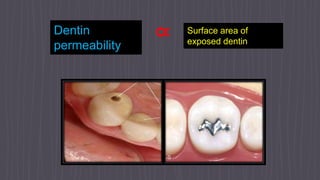
Surface area of
exposed dentin
ᴕ
Dentin
permeability
▹10 to 20 times less in
root
▹Lack of pulpal reaction
Dentin
permeability The character of dentin surface can also modify dentin
permeability
Smear layer
Slows bacterial
penetration
Permits wide range of
molecules
DEBRIS
Small- faster
Large- slower
Often dissolved
Debate: whether to remove smear layer
Removal may increase:
Quality of the seal
Bond strength of resin post
What happens when permeating substances reach pulp chamber??????
Pulpal blood flow – normal
Blood – 7%
Blood volume : 5-14 times/minute
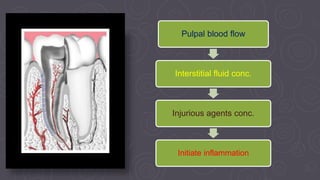
Pulpal blood flow
Interstitial fluid conc.
Injurious agents conc.
Initiate inflammation
DENTIN SENSITIVITY
DENTAL
PULP
DENTAL
PULP
DIFFERENT LAYERS
ODONTOBLAST LAYER CAPILLARIES, NERVE
FIBRES, DENDRITIC
CELLS
CELL FREE ZONE PLEXUS OF
RASCHOW,
CAPILLARIES,
FIBROBLASTIC
PROCESSES
CELL RICH ZONE HIGH DENSITY OF
FIBROBLAST,
UNDIFFERENTIATED
MESENCHYMAL CELLS
PULP PROPER BLOOD VESSELS,
NERVE FIBRES,
FIBROBLAST,
UNDIFFERENTIATED
MESENCHYMAL
CELLS,
IMMUNOCOMPETENT
CELLS, FIBERS AND
GROUND
SUBSTANCES.
INTERSTITIAL FLUID Rigid encasement – blood and IF constant
ECF – 63%
Low compliance
Increase in pulpal volume
Blood or IF
Hydrostatic pressure
No noxious stimuli – pressure transitory
INTERSTITIAL FLUID Similar to blood plasma
Acts as a middleman between cells
and blood
Substances transported - diffusion
Capillaries are widely distributed
CELLULAR
STRUCTURES
FIBROBLAST
ODONTOBLAST
IMMUNO
COMPETENT
CELLS
FIBROBLAST
ODONTOBLAST
ODONTOBLAST
ODONTOBLAST
Class II major
histocompatability complex
molecules
Dendritic cells
T- lymphocytes
B- lymphocytes and mast cells
not clearly demonstrated
FIBERS
GROUND
SUBSTANCE
MICRO
VASCULATURE
Collagen – major organic component
Secreted by odontoblast and fibroblast
Several fibres aggregate – collagen bundle
Inelastic, great tensile strength
Fibronectin – mediator for adhesion
GROUND SUBSTANCES
Structure less mass, gel-like in
consistency, makes the bulk of the
pulp organ
Complexes of carbohydrates,
proteins and water
Surrounds and supports
PULPAL MICROVASCULATURE
ARTERIO VENOUS ANASTAMOSIS AND “U” TURN LOOPS
Before the arterioles break up into capillary beds, (AVA) often arise to
connect the arteriole directly to a venule.
 Relatively small vessels - diameter -10 µm.
Their presence is more frequent in the radicular area of the pulp.
The functional role -not completely known
ARTERIO VENOUS ANASTAMOSIS AND “U” TURN LOOPS
Capillary density is highest in
the sub odontoblastic region
with loops passing between
odontoblasts
ARTERIO VENOUS ANASTAMOSIS AND “U” TURN LOOPS
Capillaries empty into small venules
Successively larger venules
Exit the pulp
Vessels that drain PDL and alv.bone
REGULATION OF PULPAL BLOOD FLOW
1. sympathetic α-adrenergic
vasoconstriction
2. β-adrenergic vasodilation,
3. sympathetic cholinergic
vasoactive system
4. an antidromic vasodilation
THE STEALING THEORY Place your screenshot here
clinical treatment causing vasodilatation in adjacent
tissues may decrease the circulation to the dental pulp.
LOW- COMPLIENCE SYSTEM THEORY Place your screenshot here
In this system, any increase in blood flow or
vasodilation has a limit depending on the degree of
increase in tissue pressure.
TRANS CAPILLARY FLUID FLOW Place your screenshot here
The hydrostatic pressure outside the vessels is
normally considerably lower than the blood pressure
inside the capillaries
LYMPH
VESSELS
Removal of proteins and macromolecules
Recovery of inflammation
Reversible pulpitis depends
Most lymphatic's – root pulp
Peripheral pulp zone
Larger collecting vessels
Larger lymphatic vessels
Apex
The fact that materials placed
on pulps can migrate to
lymph nodes indicates the
possibility of the spread of
bacteria or bacterial products
from the pulp.
Clinicians should remember this when performing
dental procedures since their placement of materials on
dentin or the pulp may result in widespread
distribution of that material or medicament.
Nerves in the pulp
Nerves in the pulp
NEURO
PEPTIDES
In addition to their vasoactive
functions, stimulated sensory and
autonomic nerves release biologically
active peptides, known as
neuropeptides, that influence neural
activity and functioning.
Synthesized – ribosomes
Processed – ER & GC
Released – nerve terminals
DISTRIBUTION
CGRP-IR
CGRP-IR close proximity to immunocompetent cells in the pulp
DISTRIBUTION
FUNCTION
neuropeptide
CGRP
This presentations uses the following typographies and colors:
▹ Titles: Playfair display
▹ Body copy: Tinos
You can download the fonts on this page:
https://www.google.com/fonts/#UsePlace:use/Collection:Playfair+Display:400,70
0,400italic,700italic|Tinos:400,700,400italic,700italic
Click on the “arrow button” that appears on the top right
▹ Pink #ecc1c8
▹ Dark gray #4d4a56
RECEPTORS
Preservation of healthy dentin pulp complex
Successful management in cases of disease
Thorough knowledge
Proper understanding
Preservation
Successful management
REFERENCES
Ingle’s
ENDODONTICS
6TH EDITION
Cohen:
Pathways of the
Pulp, 9th ed.
Orban’s oral
histology and
embryology 13th
edition
Pashley DH, Kehl T,
Pashley E, Palmer P.
Comparison of in vitro
and in vivo dog dentin
permeability. J Dent Res
1981;60:763.
Rowe NH, editor.
Hypersensitive dentin:
origin and management.
Ann Arbor, MI:
University of Michigan;
Bletsa A, Berggreen E,
Fristad I, et al. Cytokine
signalling in rat pulp
interstitial fluid and
transcapillary fluid
exchange during
lipopolysaccharide-
induced acute
inflammation. J Physiol
2006;573:225–36.
THANK YOU

PULP DENTIN COMPLEX

Editor's Notes

  • #14 In bud stage oral epithelium invaginates to form tooth bud
  • #15 In cap stage neural crest cells initiate the formation of dental lamina, from dental lamina enamel organ develops under which the dental papilla is present, dp is basically an ectomesen.. Of mandible and gives rise to dentin and pulp. Dp is sorrounded by df, the dp&df together called as dental sac, ds and enam organ is called as tooth germ
  • #16 Ectomesnchyme of dp gives rise to odontoblasts,which form dentin, inner enamel epithelium which consists of ameloblasts gives rise to enamel
  • #54 Using the laser Doppler technique to study pulpal blood flow in dogs, Sasano et al. suggested that an increase or a decrease in pulpal blood flow is more dependent on systemic blood pressure than on local vasoconstriction or vasodilation.
  • #55 changes in circulation in the neighboring adjacent tissues, such as the gingiva, alveolar bone, and PDL, will change the blood flow to the pulp because it will affect the feeding pulpal arterial blood pressure
  • #56 The dental pulp is encased in rigid structures, namely dentin, enamel, and cementum, creating a low-compliance system
  • #57 The dental pulp is encased in rigid structures, namely dentin, enamel, and cementum, creating a low-compliance system
  • #61 The relationship of teeth to the cardiovascular and lymphatic systems is intimate and absolute.