Pulmonary Hypertension
Dr. Vineet Gupta
Guide : Dr. P.P. Joshi
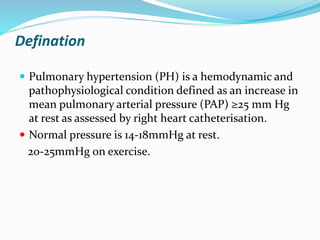
Defination
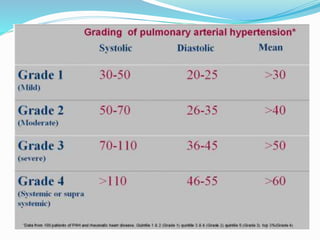
 Pulmonary hypertension (PH) is a hemodynamic and
pathophysiological condition defined as an increase in
mean pulmonary arterial pressure (PAP) ≥25 mm Hg
at rest as assessed by right heart catheterisation.
 Normal pressure is 14-18mmHg at rest.
20-25mmHg on exercise.
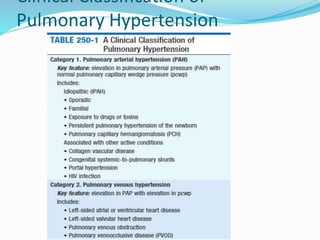
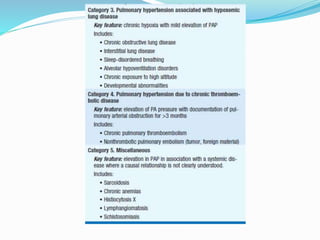
Clinical Classification of
Pulmonary Hypertension
Idiopathic pulmonary hypertension
(IPAH)
 Epidemiology
Annual incidence of about 2-6 cases per million
population
More common in females
fourth to fifth decade of life
Familail IPAH accounts for 20% of IPAH
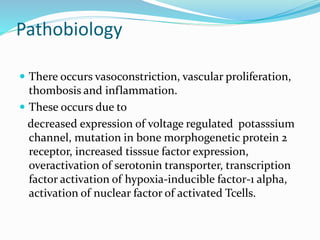
Pathobiology
 There occurs vasoconstriction, vascular proliferation,
thombosis and inflammation.
 These occurs due to
decreased expression of voltage regulated potasssium
channel, mutation in bone morphogenetic protein 2
receptor, increased tisssue factor expression,
overactivation of serotonin transporter, transcription
factor activation of hypoxia-inducible factor-1 alpha,
activation of nuclear factor of activated Tcells.
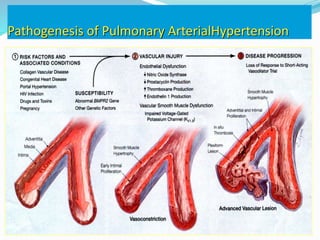
Pathogenesis of Pulmonary ArterialHypertension
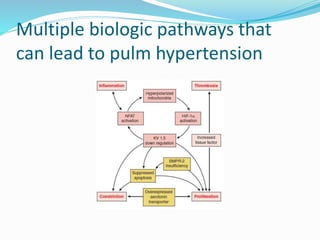
Multiple biologic pathways that
can lead to pulm hypertension
Presentation
 Symptoms:
Very insidious onset
Dyspnoea.
Generalised weakness and tiredness.
Recurrent syncope or presyncope, often related to
exertion.
Chest pain
Palpitation
Lower limb edema
 Signs:
Right ventricular (parasternal) heave may be
visible/palpable.
JVP may be elevated with prominent a and v waves.
Loud pulmonary component of second heart sound.
May be fixed or paradoxical splitting of second heart
sound.
Murmur of pulmonary regurgitation - Graham Steell
murmur.
Tricuspid regurgitation murmur - if significant right
ventricular hypertrophy and dilatation are present.
If significant associated tricuspid regurgitation -
enlarged pulsatile liver with exaggerated hepato-
jugular reflux.
Ascites and peripheral oedema - if there is significant
right ventricular failure.
Lung fields are usually clear.
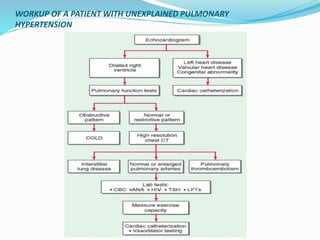
WORKUP OF A PATIENT WITH UNEXPLAINED PULMONARY
HYPERTENSION
Investigations
 Routine biochemistry screen including LFTs
 Thyroid function test.
 Autoimmune screening
 ECG :
Right axis deviation
An R wave/S wave ratio greater than one in lead V1
Incomplete or complete right bundle branch block
Increased P wave amplitude in lead II (P pulmonale) due to
right atrial enlargement
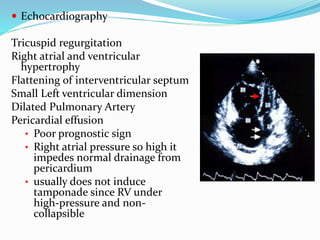
 Echocardiography
Tricuspid regurgitation
Right atrial and ventricular
hypertrophy
Flattening of interventricular septum
Small Left ventricular dimension
Dilated Pulmonary Artery
Pericardial effusion
• Poor prognostic sign
• Right atrial pressure so high it
impedes normal drainage from
pericardium
• usually does not induce
tamponade since RV under
high-pressure and non-
collapsible
 Pulmonary function tests.
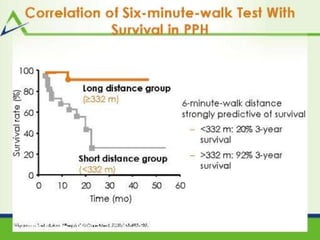
 Exercise testing: a six-minute walk is often used to
test for aerobic capacity and severity of PH but it
lacks specificity.
 High-resolution CT of the thorax to investigate other
possible causes of PH.
 Ventilation/perfusion scanning to exclude
thromboembolic cause of pulmonary arterial
occlusion.
 Pulmonary angiography and/or cardiac
catheterisation
 Lung biopsy may be needed to exclude interstitial
lung disease.
 Polysomnography may be used to exclude obstructive
sleep apnoea.
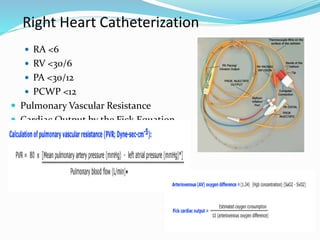
Right Heart Catheterization
 RA <6
 RV <30/6
 PA <30/12
 PCWP <12
 Pulmonary Vascular Resistance
 Cardiac Output by the Fick Equation
 Mean PAP pressure
 At rest: >25mmHg
 With exercise: >30mmHg
 Wedge Pressure: <15mmHg
 Pulmonary Vascular Resistance: > 240 dynes-cm-
sec-5
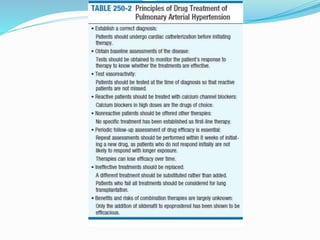
Vasoreactivity Testing During RHC
 Inhaled Nitric Oxide (NO) is a preferential
pulmonary arterial vasodilator
 Positive if:
 Mean PAP decreases at least 10 mmHg and to a value
less than 40 mmHg
 Associated increased or unchanged cardiac output
 Minimally reduced or unchanged systemic blood
pressure
 Only patients with Positive Vasoreactivity are
given treatment trials with Calcium Channel
Blockers!
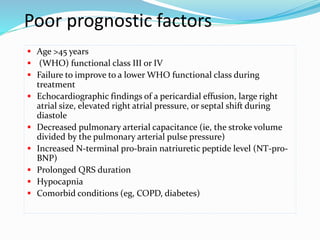
Poor prognostic factors
 Age >45 years
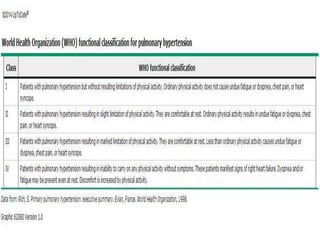
 (WHO) functional class III or IV
 Failure to improve to a lower WHO functional class during
treatment
 Echocardiographic findings of a pericardial effusion, large right
atrial size, elevated right atrial pressure, or septal shift during
diastole
 Decreased pulmonary arterial capacitance (ie, the stroke volume
divided by the pulmonary arterial pulse pressure)
 Increased N-terminal pro-brain natriuretic peptide level (NT-pro-
BNP)
 Prolonged QRS duration
 Hypocapnia
 Comorbid conditions (eg, COPD, diabetes)
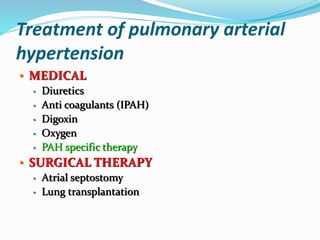
Treatment of pulmonary arterial
hypertension
• MEDICAL
• Diuretics
• Anti coagulants (IPAH)
• Digoxin
• Oxygen
• PAH specific therapy
• SURGICAL THERAPY
• Atrial septostomy
• Lung transplantation
Diuretics
 Principally to treat edema from right heart failure
 May need to combine classes
• -Thiazide and loop diuretics
 Careful to avoid too much pre-load reduction
 Patients often require large doses of diuretics
Anticoagulants
 Studies only show benefit in IPAH patients,
based on improved survival.
 Other PAH groups not as clear, use in them
considered expert opinion.
 Generally, keep INR 2.0-2.5.
 Thought to lessen in-situ thrombosis
 warfarin is generally most commonly use.
Oxygen
 Formal assessment of nocturnal and exertional
oxygenation needs.
 Minimize added insult of hypoxic vasoconstriction
 Keep oxygen saturation ≥90%
• May be impossible with large right to left shunt
 Exclude nocturnal desaturation
• Overnight oximetry
 Rule out concomitant obstructive sleep apnea and
hypoventilation syndromes
PAH-Specific Therapies
1) Calcium channel blockers
2) Endothelin receptor antagonists (ERAs)—
Bosentan, Sitaxsentan, Ambrisentan
3) Phosphodiesterase (type 5) inhibitors (PDE 5-
I)—Sildenafil, Tadalafil, Vardenafil.
4) Prostanoids—Epoprostenol, Treprostinil, Iloprost
5) Guanylate cyclase stimulant- Riociguat
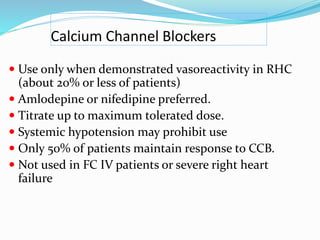
Calcium Channel Blockers
 Use only when demonstrated vasoreactivity in RHC
(about 20% or less of patients)
 Amlodepine or nifedipine preferred.
 Titrate up to maximum tolerated dose.
 Systemic hypotension may prohibit use
 Only 50% of patients maintain response to CCB.
 Not used in FC IV patients or severe right heart
failure
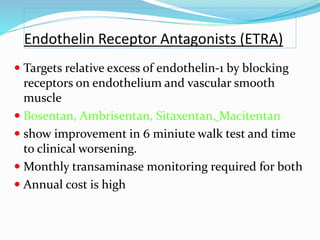
Endothelin Receptor Antagonists (ETRA)
 Targets relative excess of endothelin-1 by blocking
receptors on endothelium and vascular smooth
muscle
 Bosentan, Ambrisentan, Sitaxentan, Macitentan
 show improvement in 6 miniute walk test and time
to clinical worsening.
 Monthly transaminase monitoring required for both
 Annual cost is high
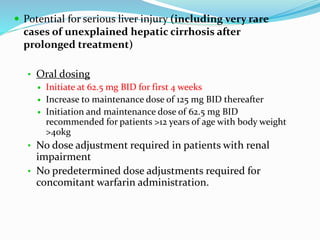
 Potential for serious liver injury (including very rare
cases of unexplained hepatic cirrhosis after
prolonged treatment)
• Oral dosing
 Initiate at 62.5 mg BID for first 4 weeks
 Increase to maintenance dose of 125 mg BID thereafter
 Initiation and maintenance dose of 62.5 mg BID
recommended for patients >12 years of age with body weight
>40kg
• No dose adjustment required in patients with renal
impairment
• No predetermined dose adjustments required for
concomitant warfarin administration.
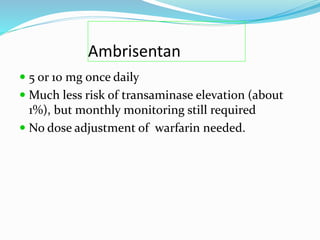
Ambrisentan
 5 or 10 mg once daily
 Much less risk of transaminase elevation (about
1%), but monthly monitoring still required
 No dose adjustment of warfarin needed.
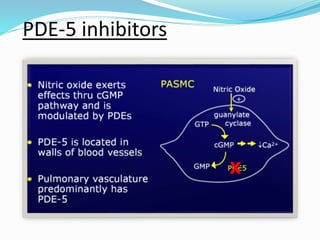
PDE-5 inhibitors
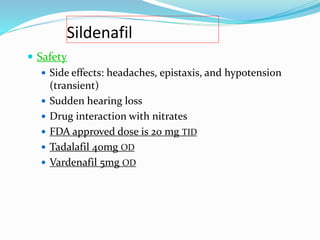
Sildenafil
 Safety
 Side effects: headaches, epistaxis, and hypotension
(transient)
 Sudden hearing loss
 Drug interaction with nitrates
 FDA approved dose is 20 mg TID
 Tadalafil 40mg OD
 Vardenafil 5mg OD
Prostacyclin analogues
 Epoprostenol, treprostinil, iloprost
 Benefits
 Vasodilation
 Platelet inhibition
 Anti-proliferative effects
 Inotropic effects
Epoprostenol
 First PAH specific therapy available in the mid
1990’s
 Lack of acute vasodilator response does not
correlate well with epoprostenol
unresponsiveness.
 Very short half life = 2 minutes
 Delivered via continuous infusion
 Cost about $100,000/year
Epoprostenol
 Side effects: headache, jaw pain, flushing, diarrhea, nausea and
vomiting, flu-like symptoms, and anxiety/nervousness
 Complex daily preparation
 Individualized dosing
 Catheter complications
 Dislodgement/malfunction
 Catastrophic deterioration
 Embolization
 Infection (3% deaths)
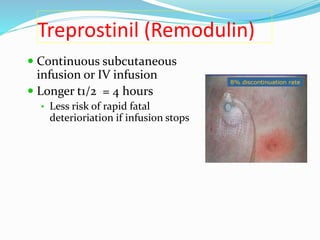
Treprostinil (Remodulin)
 Continuous subcutaneous
infusion or IV infusion
 Longer t1/2 = 4 hours
• Less risk of rapid fatal
deterioriation if infusion stops
Treprostinil
 Intravenous treprostinil
 Hemodynamic improvements and 6MWD
improvements
 No site pain
 Risk of catheter related bloodstream infection and
embolic phenomenon
 Recent concerns about increased gram-negative
bloodstream infections.
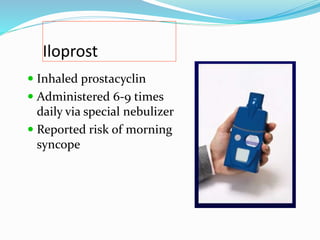
Iloprost
 Inhaled prostacyclin
 Administered 6-9 times
daily via special nebulizer
 Reported risk of morning
syncope
Iloprost
 Improvements in 6 miniute walk test, functional class
and hemodynamics observed
 Safety and side effects
 Potential for increased hypotensive effect
with antihypertensives
 Increased risk of bleeding, especially with
co-administration of anticoagulants
 Flushing, increased cough, headache, insomnia
 Nausea, vomiting, flu-like syndrome
 Increased liver enzymes
Guanylate cyclase stimulant
 Stimulators of the nitric oxide receptor.
 Dual mode of action.
 They increase the sensitivity of sGC to endogenous
nitric oxide (NO)
 Directly stimulate the receptor to mimic the action of
NO.
 Riociguat is an oral sGC stimulant that has reported
benefit in patients with inoperable and persistent
chronic thromboembolic pulmonary hypertension
(CTEPH)
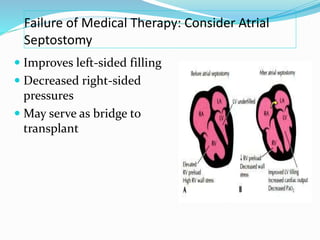
Failure of Medical Therapy: Consider Atrial
Septostomy
 Improves left-sided filling
 Decreased right-sided
pressures
 May serve as bridge to
transplant
Failure of Medical Therapy: Indications for
Lung Transplant
 New York Heart Association
(NYHA) functional class III or IV
 Mean right atrial pressure >10
mmHg
 Mean pulmonary arterial pressure
>50 mmHg
 Failure to improve functionally
despite medical therapy
 Rapidly progressive disease
Following Response to Therapy
 Six minute walk test
 Echocardiogram
 Right heart catheterization
 BNP
 Functional class
THANK YOU

Pulmonary hypertension

  • 1.
    Pulmonary Hypertension Dr. VineetGupta Guide : Dr. P.P. Joshi
  • 2.
    Defination  Pulmonary hypertension(PH) is a hemodynamic and pathophysiological condition defined as an increase in mean pulmonary arterial pressure (PAP) ≥25 mm Hg at rest as assessed by right heart catheterisation.  Normal pressure is 14-18mmHg at rest. 20-25mmHg on exercise.
  • 3.
  • 5.
    Idiopathic pulmonary hypertension (IPAH) Epidemiology Annual incidence of about 2-6 cases per million population More common in females fourth to fifth decade of life Familail IPAH accounts for 20% of IPAH
  • 6.
    Pathobiology  There occursvasoconstriction, vascular proliferation, thombosis and inflammation.  These occurs due to decreased expression of voltage regulated potasssium channel, mutation in bone morphogenetic protein 2 receptor, increased tisssue factor expression, overactivation of serotonin transporter, transcription factor activation of hypoxia-inducible factor-1 alpha, activation of nuclear factor of activated Tcells.
  • 7.
    Pathogenesis of PulmonaryArterialHypertension
  • 8.
    Multiple biologic pathwaysthat can lead to pulm hypertension
  • 9.
    Presentation  Symptoms: Very insidiousonset Dyspnoea. Generalised weakness and tiredness. Recurrent syncope or presyncope, often related to exertion. Chest pain Palpitation Lower limb edema
  • 10.
     Signs: Right ventricular(parasternal) heave may be visible/palpable. JVP may be elevated with prominent a and v waves. Loud pulmonary component of second heart sound. May be fixed or paradoxical splitting of second heart sound. Murmur of pulmonary regurgitation - Graham Steell murmur. Tricuspid regurgitation murmur - if significant right ventricular hypertrophy and dilatation are present. If significant associated tricuspid regurgitation - enlarged pulsatile liver with exaggerated hepato- jugular reflux. Ascites and peripheral oedema - if there is significant right ventricular failure. Lung fields are usually clear.
  • 11.
    WORKUP OF APATIENT WITH UNEXPLAINED PULMONARY HYPERTENSION
  • 12.
    Investigations  Routine biochemistryscreen including LFTs  Thyroid function test.  Autoimmune screening  ECG : Right axis deviation An R wave/S wave ratio greater than one in lead V1 Incomplete or complete right bundle branch block Increased P wave amplitude in lead II (P pulmonale) due to right atrial enlargement
  • 13.
     Echocardiography Tricuspid regurgitation Rightatrial and ventricular hypertrophy Flattening of interventricular septum Small Left ventricular dimension Dilated Pulmonary Artery Pericardial effusion • Poor prognostic sign • Right atrial pressure so high it impedes normal drainage from pericardium • usually does not induce tamponade since RV under high-pressure and non- collapsible
  • 14.
     Pulmonary functiontests.  Exercise testing: a six-minute walk is often used to test for aerobic capacity and severity of PH but it lacks specificity.  High-resolution CT of the thorax to investigate other possible causes of PH.  Ventilation/perfusion scanning to exclude thromboembolic cause of pulmonary arterial occlusion.  Pulmonary angiography and/or cardiac catheterisation  Lung biopsy may be needed to exclude interstitial lung disease.  Polysomnography may be used to exclude obstructive sleep apnoea.
  • 16.
    Right Heart Catheterization RA <6  RV <30/6  PA <30/12  PCWP <12  Pulmonary Vascular Resistance  Cardiac Output by the Fick Equation
  • 17.
     Mean PAPpressure  At rest: >25mmHg  With exercise: >30mmHg  Wedge Pressure: <15mmHg  Pulmonary Vascular Resistance: > 240 dynes-cm- sec-5
  • 18.
    Vasoreactivity Testing DuringRHC  Inhaled Nitric Oxide (NO) is a preferential pulmonary arterial vasodilator  Positive if:  Mean PAP decreases at least 10 mmHg and to a value less than 40 mmHg  Associated increased or unchanged cardiac output  Minimally reduced or unchanged systemic blood pressure  Only patients with Positive Vasoreactivity are given treatment trials with Calcium Channel Blockers!
  • 21.
    Poor prognostic factors Age >45 years  (WHO) functional class III or IV  Failure to improve to a lower WHO functional class during treatment  Echocardiographic findings of a pericardial effusion, large right atrial size, elevated right atrial pressure, or septal shift during diastole  Decreased pulmonary arterial capacitance (ie, the stroke volume divided by the pulmonary arterial pulse pressure)  Increased N-terminal pro-brain natriuretic peptide level (NT-pro- BNP)  Prolonged QRS duration  Hypocapnia  Comorbid conditions (eg, COPD, diabetes)
  • 23.
    Treatment of pulmonaryarterial hypertension • MEDICAL • Diuretics • Anti coagulants (IPAH) • Digoxin • Oxygen • PAH specific therapy • SURGICAL THERAPY • Atrial septostomy • Lung transplantation
  • 25.
    Diuretics  Principally totreat edema from right heart failure  May need to combine classes • -Thiazide and loop diuretics  Careful to avoid too much pre-load reduction  Patients often require large doses of diuretics
  • 26.
    Anticoagulants  Studies onlyshow benefit in IPAH patients, based on improved survival.  Other PAH groups not as clear, use in them considered expert opinion.  Generally, keep INR 2.0-2.5.  Thought to lessen in-situ thrombosis  warfarin is generally most commonly use.
  • 27.
    Oxygen  Formal assessmentof nocturnal and exertional oxygenation needs.  Minimize added insult of hypoxic vasoconstriction  Keep oxygen saturation ≥90% • May be impossible with large right to left shunt  Exclude nocturnal desaturation • Overnight oximetry  Rule out concomitant obstructive sleep apnea and hypoventilation syndromes
  • 28.
    PAH-Specific Therapies 1) Calciumchannel blockers 2) Endothelin receptor antagonists (ERAs)— Bosentan, Sitaxsentan, Ambrisentan 3) Phosphodiesterase (type 5) inhibitors (PDE 5- I)—Sildenafil, Tadalafil, Vardenafil. 4) Prostanoids—Epoprostenol, Treprostinil, Iloprost 5) Guanylate cyclase stimulant- Riociguat
  • 29.
    Calcium Channel Blockers Use only when demonstrated vasoreactivity in RHC (about 20% or less of patients)  Amlodepine or nifedipine preferred.  Titrate up to maximum tolerated dose.  Systemic hypotension may prohibit use  Only 50% of patients maintain response to CCB.  Not used in FC IV patients or severe right heart failure
  • 30.
    Endothelin Receptor Antagonists(ETRA)  Targets relative excess of endothelin-1 by blocking receptors on endothelium and vascular smooth muscle  Bosentan, Ambrisentan, Sitaxentan, Macitentan  show improvement in 6 miniute walk test and time to clinical worsening.  Monthly transaminase monitoring required for both  Annual cost is high
  • 31.
     Potential forserious liver injury (including very rare cases of unexplained hepatic cirrhosis after prolonged treatment) • Oral dosing  Initiate at 62.5 mg BID for first 4 weeks  Increase to maintenance dose of 125 mg BID thereafter  Initiation and maintenance dose of 62.5 mg BID recommended for patients >12 years of age with body weight >40kg • No dose adjustment required in patients with renal impairment • No predetermined dose adjustments required for concomitant warfarin administration.
  • 32.
    Ambrisentan  5 or10 mg once daily  Much less risk of transaminase elevation (about 1%), but monthly monitoring still required  No dose adjustment of warfarin needed.
  • 33.
  • 34.
    Sildenafil  Safety  Sideeffects: headaches, epistaxis, and hypotension (transient)  Sudden hearing loss  Drug interaction with nitrates  FDA approved dose is 20 mg TID  Tadalafil 40mg OD  Vardenafil 5mg OD
  • 35.
    Prostacyclin analogues  Epoprostenol,treprostinil, iloprost  Benefits  Vasodilation  Platelet inhibition  Anti-proliferative effects  Inotropic effects
  • 36.
    Epoprostenol  First PAHspecific therapy available in the mid 1990’s  Lack of acute vasodilator response does not correlate well with epoprostenol unresponsiveness.  Very short half life = 2 minutes  Delivered via continuous infusion  Cost about $100,000/year
  • 37.
    Epoprostenol  Side effects:headache, jaw pain, flushing, diarrhea, nausea and vomiting, flu-like symptoms, and anxiety/nervousness  Complex daily preparation  Individualized dosing  Catheter complications  Dislodgement/malfunction  Catastrophic deterioration  Embolization  Infection (3% deaths)
  • 38.
    Treprostinil (Remodulin)  Continuoussubcutaneous infusion or IV infusion  Longer t1/2 = 4 hours • Less risk of rapid fatal deterioriation if infusion stops
  • 39.
    Treprostinil  Intravenous treprostinil Hemodynamic improvements and 6MWD improvements  No site pain  Risk of catheter related bloodstream infection and embolic phenomenon  Recent concerns about increased gram-negative bloodstream infections.
  • 40.
    Iloprost  Inhaled prostacyclin Administered 6-9 times daily via special nebulizer  Reported risk of morning syncope
  • 41.
    Iloprost  Improvements in6 miniute walk test, functional class and hemodynamics observed  Safety and side effects  Potential for increased hypotensive effect with antihypertensives  Increased risk of bleeding, especially with co-administration of anticoagulants  Flushing, increased cough, headache, insomnia  Nausea, vomiting, flu-like syndrome  Increased liver enzymes
  • 42.
    Guanylate cyclase stimulant Stimulators of the nitric oxide receptor.  Dual mode of action.  They increase the sensitivity of sGC to endogenous nitric oxide (NO)  Directly stimulate the receptor to mimic the action of NO.  Riociguat is an oral sGC stimulant that has reported benefit in patients with inoperable and persistent chronic thromboembolic pulmonary hypertension (CTEPH)
  • 43.
    Failure of MedicalTherapy: Consider Atrial Septostomy  Improves left-sided filling  Decreased right-sided pressures  May serve as bridge to transplant
  • 44.
    Failure of MedicalTherapy: Indications for Lung Transplant  New York Heart Association (NYHA) functional class III or IV  Mean right atrial pressure >10 mmHg  Mean pulmonary arterial pressure >50 mmHg  Failure to improve functionally despite medical therapy  Rapidly progressive disease
  • 45.
    Following Response toTherapy  Six minute walk test  Echocardiogram  Right heart catheterization  BNP  Functional class
  • 46.