Publishing for impact


Elements for a publication strategy

Wouter Gerritsma, Wageningen UR Library
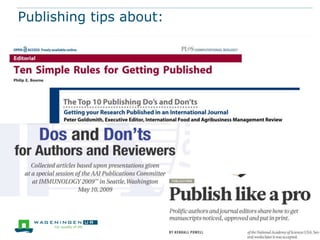
Publishing tips about:
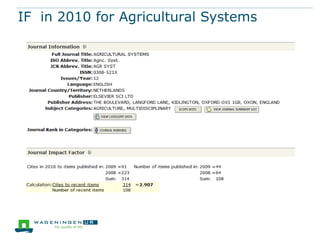
IF in 2010 for Agricultural Systems
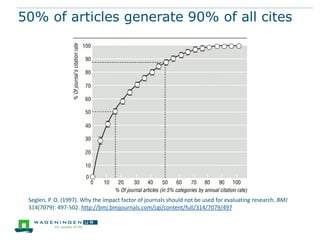
50% of articles generate 90% of all cites


 Seglen, P. O. (1997). Why the impact factor of journals should not be used for evaluating research. BMJ
 314(7079): 497-502. http://bmj.bmjjournals.com/cgi/content/full/314/7079/497
Full screen image with title
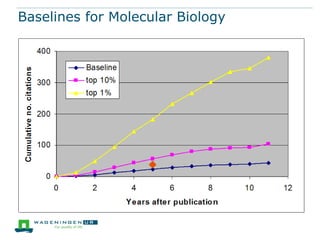
How are we able to compare numbers?


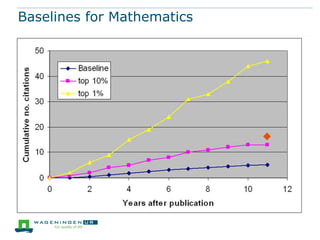
 Scientist Z. Math has a publication from 2001 with 17 citations
 Scientist M. Biology has a publication from 2007 with 32 citations
Baselines for Mathematics
Baselines for Molecular Biology
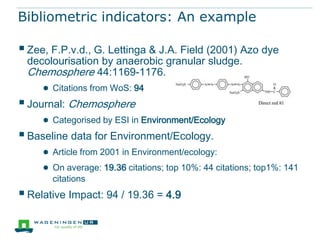
Bibliometric indicators: An example

 Zee, F.P.v.d., G. Lettinga & J.A. Field (2001) Azo dye
 decolourisation by anaerobic granular sludge.
 Chemosphere 44:1169-1176.
    ● Citations from WoS: 94
 Journal: Chemosphere
     ● Categorised by ESI in Environment/Ecology
 Baseline data for Environment/Ecology.
     ● Article from 2001 in Environment/ecology:
     ● On average: 19.36 citations; top 10%: 44 citations; top1%: 141
       citations
 Relative Impact: 94 / 19.36 = 4.9
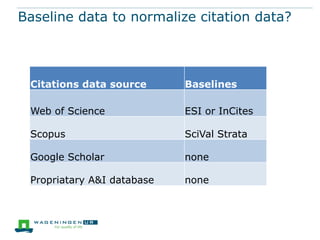
Baseline data to normalize citation data?


 Citations data source      Baselines

 Web of Science             ESI or InCites

 Scopus                     SciVal Strata

 Google Scholar             none

 Propriatary A&I database   none
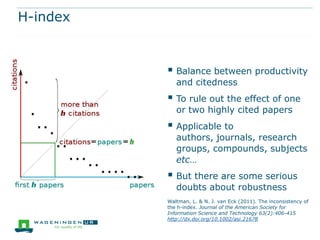
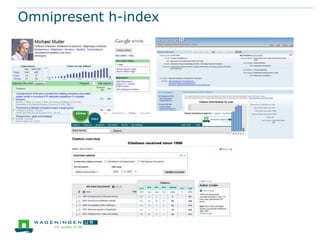
H-index


           Balance between productivity
             and citedness
           To rule out the effect of one
             or two highly cited papers
           Applicable to
             authors, journals, research
             groups, compounds, subjects
             etc…
           But there are some serious
             doubts about robustness
          Waltman, L. & N. J. van Eck (2011). The inconsistency of
          the h-index. Journal of the American Society for
          Information Science and Technology 63(2):406-415
          http://dx.doi.org/10.1002/asi.21678
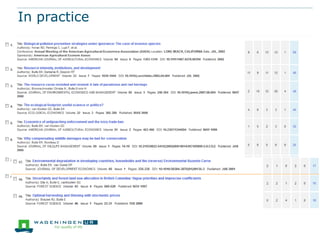
In practice
Omnipresent h-index
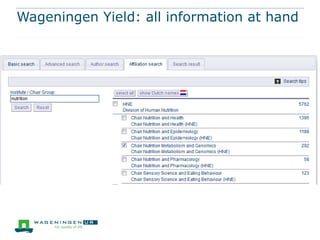
Wageningen Yield: all information at hand
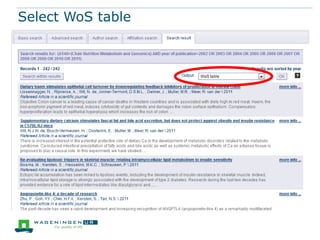
Select WoS table
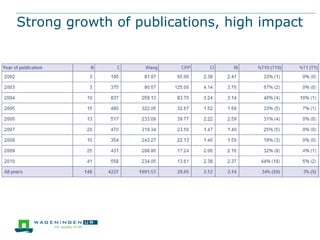
Strong growth of publications, high impact
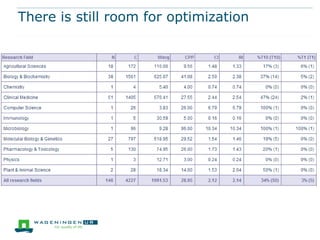
There is still room for optimization
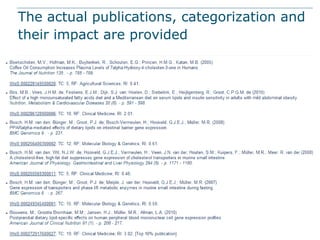
The actual publications, categorization and
their impact are provided
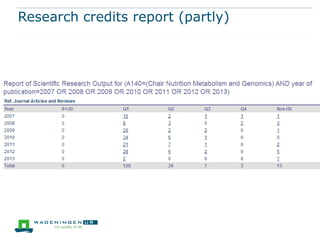
Research credits report (partly)
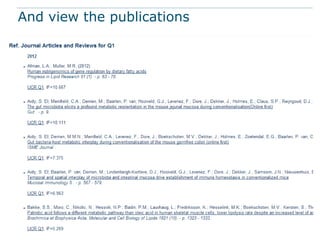
And view the publications
After excellent research,
where should you publish?
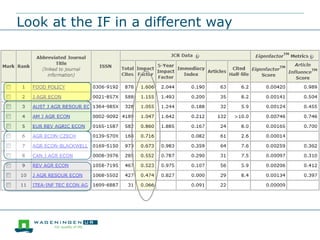
Look at the IF in a different way
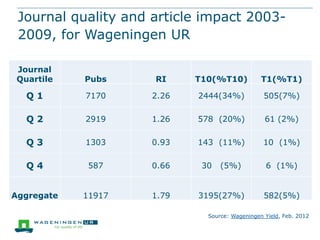
Journal quality and article impact 2003-
 2009, for Wageningen UR

Journal
Quartile    Pubs     RI     T10(%T10)           T1(%T1)

  Q1        7170     2.26   2444(34%)            505(7%)

  Q2        2919     1.26   578 (20%)            61 (2%)

  Q3        1303     0.93   143 (11%)            10 (1%)

  Q4        587      0.66    30   (5%)            6 (1%)


Aggregate   11917    1.79   3195(27%)            582(5%)

                              Source: Wageningen Yield, Feb. 2012
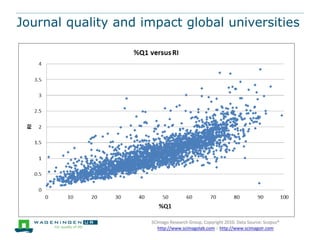
Journal quality and impact global universities
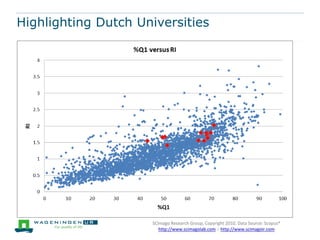
Highlighting Dutch Universities
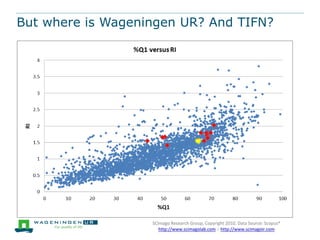
But where is Wageningen UR? And TIFN?
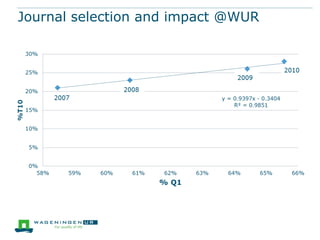
Journal selection and impact @WUR
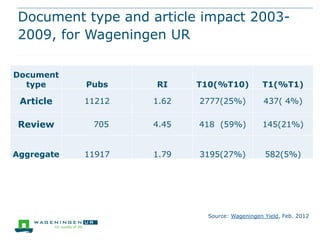
Document type and article impact 2003-
2009, for Wageningen UR

Document
  type      Pubs    RI     T10(%T10)           T1(%T1)

 Article    11212   1.62   2777(25%)            437( 4%)

Review       705    4.45   418 (59%)           145(21%)


Aggregate   11917   1.79   3195(27%)            582(5%)


                             Source: Wageningen Yield, Feb. 2012
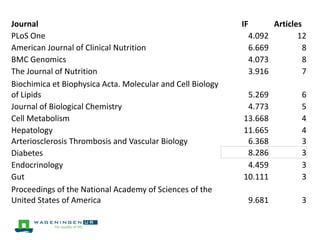
Journal                                                     IF           Articles
PLoS One                                                         4.092          12
American Journal of Clinical Nutrition                           6.669            8
BMC Genomics                                                     4.073            8
The Journal of Nutrition                                         3.916            7
Biochimica et Biophysica Acta. Molecular and Cell Biology
of Lipids                                                    5.269               6
Journal of Biological Chemistry                              4.773               5
Cell Metabolism                                             13.668               4
Hepatology                                                  11.665               4
Arteriosclerosis Thrombosis and Vascular Biology             6.368               3
Diabetes                                                     8.286               3
Endocrinology                                                4.459               3
Gut                                                         10.111               3
Proceedings of the National Academy of Sciences of the
United States of America                                         9.681           3
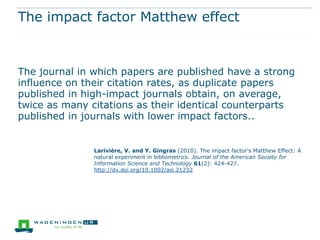
The impact factor Matthew effect


The journal in which papers are published have a strong
influence on their citation rates, as duplicate papers
published in high-impact journals obtain, on average,
twice as many citations as their identical counterparts
published in journals with lower impact factors..


               Larivière, V. and Y. Gingras (2010). The impact factor's Matthew Effect: A
               natural experiment in bibliometrics. Journal of the American Society for
               Information Science and Technology 61(2): 424-427.
               http://dx.doi.org/10.1002/asi.21232
Final word on journal quality


It is better to publish one paper in a quality journal than
multiple papers in lesser journals. [...]. Try to publish in
journals that have high impact factors; chances are your
paper will have high impact, too, if accepted.


                            Bourne, P. E. (2005). Ten Simple Rules for Getting
                            Published. PLoS Computational Biology 1(5): e57.
                            http://dx.doi.org/10.1371/journal.pcbi.0010057
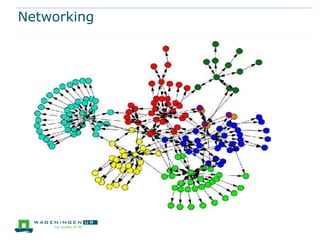
Networking
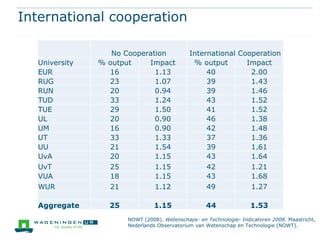
International cooperation

                  No Cooperation             International Cooperation
  University   % output    Impact             % output       Impact
  EUR            16          1.13                 40          2.00
  RUG            23          1.07                 39          1.43
  RUN            20          0.94                 39          1.46
  TUD            33          1.24                 43          1.52
  TUE            29          1.50                 41          1.52
  UL             20          0.90                 46          1.38
  UM             16          0.90                 42          1.48
  UT             33          1.33                 37          1.36
  UU             21          1.54                 39          1.61
  UvA            20          1.15                 43          1.64
  UvT            25          1.15                 42          1.21
  VUA            18          1.15                 43          1.68
  WUR            21          1.12                 49          1.27

  Aggregate      25            1.15                44               1.53
                      NOWT (2008). Wetenschaps- en Technologie- Indicatoren 2008. Maastricht,
                      Nederlands Observatorium van Wetenschap en Technologie (NOWT).
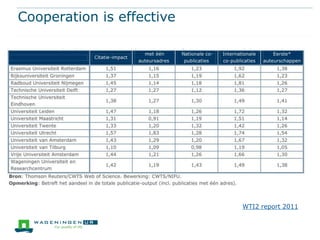
Cooperation is effective


                           WTI2 report 2011
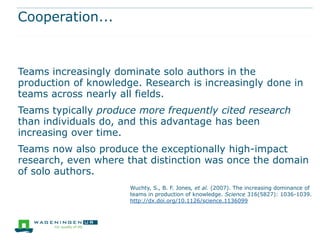
Cooperation...


Teams increasingly dominate solo authors in the
production of knowledge. Research is increasingly done in
teams across nearly all fields.
Teams typically produce more frequently cited research
than individuals do, and this advantage has been
increasing over time.
Teams now also produce the exceptionally high-impact
research, even where that distinction was once the domain
of solo authors.
                      Wuchty, S., B. F. Jones, et al. (2007). The increasing dominance of
                      teams in production of knowledge. Science 316(5827): 1036-1039.
                      http://dx.doi.org/10.1126/science.1136099
Networking is important


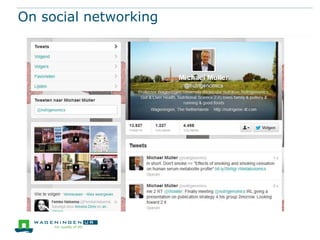
 Start early, make use of Social Networking tools
    ● Facebook
    ● LinkedIn
    ● Social networks for scientists
          ● Academia.edu, Researchgate.net
On social networking
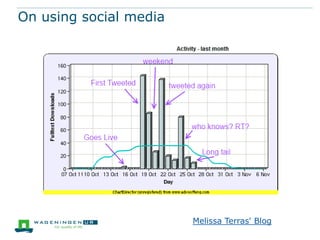
On using social media


                        Melissa Terras' Blog
Consider the Wikipedia


 For better or worse, people are guided to Wikipedia
 when searching the Web for biomedical information. So
 there is an increasing need for the scientific community
 to engage with Wikipedia to ensure that the information
 it contains is accurate and current.

         Logan, D.W., M. Sandal, P.P. Gardner, M. Manske & A. Bateman
         (2010). Ten Simple Rules for Editing Wikipedia. PLoS Comput
         Biol, 6(9): e1000941 http://dx.doi.org/10.1371/journal.pcbi.1000941
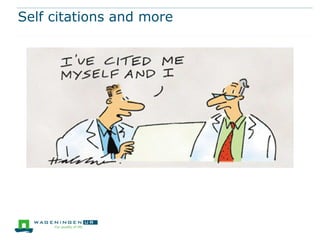
Self citations and more
Self citations


 The model [...] implies that external citations are
 enhanced by self-citations, so that we have the
 “chain reaction:” Larger size leads to more self-
 citations, which lead to more external citations.


   van Raan, A. F. J. (2008). Self-citation as an impact-reinforcing mechanism in the
   science system. Journal of the American Society for Information Science and
   Technology 59(10): 1631-1643.


                                                                                 11/28
More on references


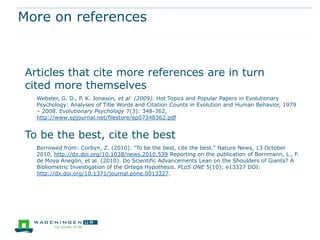
Articles that cite more references are in turn
cited more themselves
  Webster, G. D., P. K. Jonason, et al. (2009). Hot Topics and Popular Papers in Evolutionary
  Psychology: Analyses of Title Words and Citation Counts in Evolution and Human Behavior, 1979
  – 2008. Evolutionary Psychology 7(3): 348-362.
  http://www.epjournal.net/filestore/ep07348362.pdf


To be the best, cite the best
  Borrowed from: Corbyn, Z. (2010). "To be the best, cite the best." Nature News, 13 October
  2010, http://dx.doi.org/10.1038/news.2010.539 Reporting on the publication of Bornmann, L., F.
  de Moya Anegón, et al. (2010). Do Scientific Advancements Lean on the Shoulders of Giants? A
  Bibliometric Investigation of the Ortega Hypothesis. PLoS ONE 5(10): e13327 DOI:
  http://dx.doi.org/10.1371/journal.pone.0013327.
More articles per research project?


 Publishing more articles results in higher citation counts
 if the articles provide sufficient substantive content to
 other researchers.
     ● Beware of the ethical standards
     ● Bornmann looked at total citations, not to relative
       impact


                Bornmann, L. & H.-D. Daniel (2007). Multiple publication on a single research study:
                Does it pay? The influence of number of research articles on total citation counts in
                biomedicine. Journal of the American Society for Information Science and
                Technology, 58(8): 1100-1107 http://dx.doi.org/10.1002/asi.20531
Journal selection and referencing with
multidisciplinary research

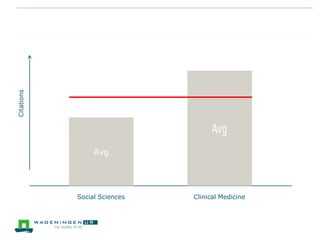
 Higher citations are linked to the citation-intensive
 disciplines.
 Articles citing citation-intensive disciplines are more
 likely to be cited by those disciplines and, hence, obtain
 higher citation scores than would articles citing non-
 citation-intensive disciplines.
         Larivière, V. & Y. Gingras (2010). On the relationship between interdisciplinarity and scientific
         impact. Journal of the American Society for Information Science and Technology, 61(1): 126-131
         http://dx.doi.org/10.1002/asi.21226


 Larivière looked at citations per article but not relative to
 the field
Citations


                 Avg


            Social Sciences   Clinical Medicine
Consider Open Access publishing

 Be aware of your copyrights when publishing
 Golden Road
    ● PloS Journals, BMC, etc.
 Green Road
    ● Self archived copies (final author’s version)
    ● Wageningen Yield, PMC, etc.
 Open Choice
    ● Hybrid system, author pays and library pays
    ● Sage model (only 10% of standard fees)
Other useful information - WaY


 http://library.wur.nl/way/ - Information for authors
 Publishing dissertations
      ● http://library.wur.nl/way/authors/dissertations.html
 Copyright Information (copyright transfer – license to publish)
      ● http://library.wur.nl/way/authors/policies.html
 Open Access
      ● http://library.wur.nl/way/authors/open_access.html
Is there a citation advantage for OA?


 Evidence is mounting
    ● There is certainly no dis-advantange
    ● Van Raan has started to self archive his preprints
    ● Publishers allow self archiving of the final peer
      reviewed authors version
    ● Open Citation Project

 OA is important for developing countries
    Evans, J.A., Reimer, J., 2009. Open access and global participation in
    science. Science. 323, 1025. http://dx.doi.org/10.1126/science.1154562
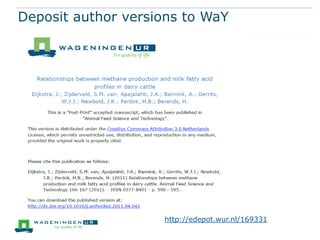
Deposit author versions to WaY


                    http://edepot.wur.nl/169331
Publish your data!


 Henneken et al. (2011) "articles with links to data result
    in higher citation rates than articles without such links"
       http://arxiv.org/abs/1111.3618
 Piwowar et al. (2007) "Sharing detailed research data is
    associated with increased citation rate
       http://dx.doi.org/10.1371/journal.pone.0000308
 Also relevant in the view of the latest developments
       (KNAW)
   Library assists in curating datasets
       ● mailto:data.library@wur.nl
What is in a name?
Claim your publications


 ResearcherID (Web of Science)
 Scopus Author ID (Scopus)
 Google Scholar Citations
 AuthorClaim
 Mendeley
Enserink, M. (2009). Scientific Publishing: Are You Ready to Become a Number? Science,
323(5922): 1662-1664 http://dx.doi.org/10.1126/science.323.5922.1662


 ORCID
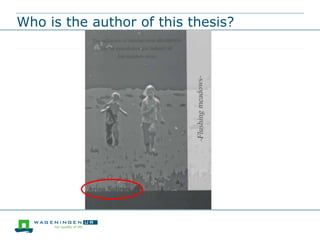
Who is the author of this thesis?
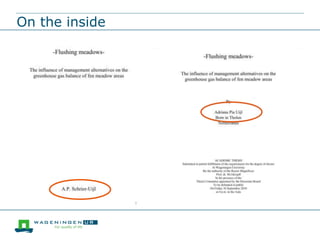
On the inside
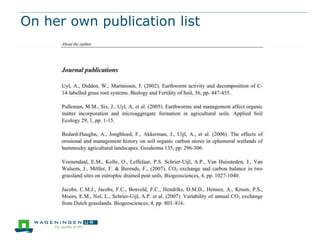
On her own publication list
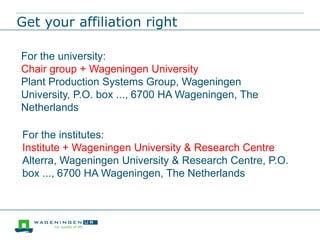
Get your affiliation right

For the university:
Chair group + Wageningen University
Plant Production Systems Group, Wageningen
University, P.O. box ..., 6700 HA Wageningen, The
Netherlands

For the institutes:
Institute + Wageningen University & Research Centre
Alterra, Wageningen University & Research Centre, P.O.
box ..., 6700 HA Wageningen, The Netherlands
Thank you!


 http://tinyurl.com/7r67fmm

http://viaf.org/viaf/285392263/
http://orcid.org/0000-0001-7274-0698
http://wu.academia.edu/WouterGerritsma
http://www.researcherid.com/rid/A-4161-2008
http://www.mendeley.com/profiles/wouter-gerritsma
http://www.researchgate.net/profile/Wouter_Gerritsma
http://scholar.google.com/citations?user=3iDBE-MAAAAJ
http://academic.research.microsoft.com/Author/34373815
http://www.narcis.nl/person/info:eu-repo/dai/nl/33714253X

Publishing for impact elements for a publication strategy for nutrigenomics

  • 1.
    Publishing for impact Elementsfor a publication strategy Wouter Gerritsma, Wageningen UR Library
  • 2.
  • 3.
    IF in 2010for Agricultural Systems
  • 4.
    50% of articlesgenerate 90% of all cites Seglen, P. O. (1997). Why the impact factor of journals should not be used for evaluating research. BMJ 314(7079): 497-502. http://bmj.bmjjournals.com/cgi/content/full/314/7079/497
  • 5.
  • 6.
    How are weable to compare numbers?  Scientist Z. Math has a publication from 2001 with 17 citations  Scientist M. Biology has a publication from 2007 with 32 citations
  • 7.
  • 8.
  • 9.
    Bibliometric indicators: Anexample  Zee, F.P.v.d., G. Lettinga & J.A. Field (2001) Azo dye decolourisation by anaerobic granular sludge. Chemosphere 44:1169-1176. ● Citations from WoS: 94  Journal: Chemosphere ● Categorised by ESI in Environment/Ecology  Baseline data for Environment/Ecology. ● Article from 2001 in Environment/ecology: ● On average: 19.36 citations; top 10%: 44 citations; top1%: 141 citations  Relative Impact: 94 / 19.36 = 4.9
  • 10.
    Baseline data tonormalize citation data? Citations data source Baselines Web of Science ESI or InCites Scopus SciVal Strata Google Scholar none Propriatary A&I database none
  • 11.
    H-index  Balance between productivity and citedness  To rule out the effect of one or two highly cited papers  Applicable to authors, journals, research groups, compounds, subjects etc…  But there are some serious doubts about robustness Waltman, L. & N. J. van Eck (2011). The inconsistency of the h-index. Journal of the American Society for Information Science and Technology 63(2):406-415 http://dx.doi.org/10.1002/asi.21678
  • 12.
  • 13.
  • 14.
    Wageningen Yield: allinformation at hand
  • 15.
  • 16.
    Strong growth ofpublications, high impact
  • 17.
    There is stillroom for optimization
  • 18.
    The actual publications,categorization and their impact are provided
  • 19.
  • 20.
    And view thepublications
  • 21.
  • 22.
    Look at theIF in a different way
  • 23.
    Journal quality andarticle impact 2003- 2009, for Wageningen UR Journal Quartile Pubs RI T10(%T10) T1(%T1) Q1 7170 2.26 2444(34%) 505(7%) Q2 2919 1.26 578 (20%) 61 (2%) Q3 1303 0.93 143 (11%) 10 (1%) Q4 587 0.66 30 (5%) 6 (1%) Aggregate 11917 1.79 3195(27%) 582(5%) Source: Wageningen Yield, Feb. 2012
  • 24.
    Journal quality andimpact global universities
  • 25.
  • 26.
    But where isWageningen UR? And TIFN?
  • 27.
  • 28.
    Document type andarticle impact 2003- 2009, for Wageningen UR Document type Pubs RI T10(%T10) T1(%T1) Article 11212 1.62 2777(25%) 437( 4%) Review 705 4.45 418 (59%) 145(21%) Aggregate 11917 1.79 3195(27%) 582(5%) Source: Wageningen Yield, Feb. 2012
  • 29.
    Journal IF Articles PLoS One 4.092 12 American Journal of Clinical Nutrition 6.669 8 BMC Genomics 4.073 8 The Journal of Nutrition 3.916 7 Biochimica et Biophysica Acta. Molecular and Cell Biology of Lipids 5.269 6 Journal of Biological Chemistry 4.773 5 Cell Metabolism 13.668 4 Hepatology 11.665 4 Arteriosclerosis Thrombosis and Vascular Biology 6.368 3 Diabetes 8.286 3 Endocrinology 4.459 3 Gut 10.111 3 Proceedings of the National Academy of Sciences of the United States of America 9.681 3
  • 30.
    The impact factorMatthew effect The journal in which papers are published have a strong influence on their citation rates, as duplicate papers published in high-impact journals obtain, on average, twice as many citations as their identical counterparts published in journals with lower impact factors.. Larivière, V. and Y. Gingras (2010). The impact factor's Matthew Effect: A natural experiment in bibliometrics. Journal of the American Society for Information Science and Technology 61(2): 424-427. http://dx.doi.org/10.1002/asi.21232
  • 31.
    Final word onjournal quality It is better to publish one paper in a quality journal than multiple papers in lesser journals. [...]. Try to publish in journals that have high impact factors; chances are your paper will have high impact, too, if accepted. Bourne, P. E. (2005). Ten Simple Rules for Getting Published. PLoS Computational Biology 1(5): e57. http://dx.doi.org/10.1371/journal.pcbi.0010057
  • 32.
  • 33.
    International cooperation No Cooperation International Cooperation University % output Impact % output Impact EUR 16 1.13 40 2.00 RUG 23 1.07 39 1.43 RUN 20 0.94 39 1.46 TUD 33 1.24 43 1.52 TUE 29 1.50 41 1.52 UL 20 0.90 46 1.38 UM 16 0.90 42 1.48 UT 33 1.33 37 1.36 UU 21 1.54 39 1.61 UvA 20 1.15 43 1.64 UvT 25 1.15 42 1.21 VUA 18 1.15 43 1.68 WUR 21 1.12 49 1.27 Aggregate 25 1.15 44 1.53 NOWT (2008). Wetenschaps- en Technologie- Indicatoren 2008. Maastricht, Nederlands Observatorium van Wetenschap en Technologie (NOWT).
  • 34.
    Cooperation is effective WTI2 report 2011
  • 35.
    Cooperation... Teams increasingly dominatesolo authors in the production of knowledge. Research is increasingly done in teams across nearly all fields. Teams typically produce more frequently cited research than individuals do, and this advantage has been increasing over time. Teams now also produce the exceptionally high-impact research, even where that distinction was once the domain of solo authors. Wuchty, S., B. F. Jones, et al. (2007). The increasing dominance of teams in production of knowledge. Science 316(5827): 1036-1039. http://dx.doi.org/10.1126/science.1136099
  • 36.
    Networking is important Start early, make use of Social Networking tools ● Facebook ● LinkedIn ● Social networks for scientists ● Academia.edu, Researchgate.net
  • 37.
  • 38.
    On using socialmedia Melissa Terras' Blog
  • 39.
    Consider the Wikipedia For better or worse, people are guided to Wikipedia when searching the Web for biomedical information. So there is an increasing need for the scientific community to engage with Wikipedia to ensure that the information it contains is accurate and current. Logan, D.W., M. Sandal, P.P. Gardner, M. Manske & A. Bateman (2010). Ten Simple Rules for Editing Wikipedia. PLoS Comput Biol, 6(9): e1000941 http://dx.doi.org/10.1371/journal.pcbi.1000941
  • 40.
  • 41.
    Self citations Themodel [...] implies that external citations are enhanced by self-citations, so that we have the “chain reaction:” Larger size leads to more self- citations, which lead to more external citations. van Raan, A. F. J. (2008). Self-citation as an impact-reinforcing mechanism in the science system. Journal of the American Society for Information Science and Technology 59(10): 1631-1643. 11/28
  • 42.
    More on references Articlesthat cite more references are in turn cited more themselves Webster, G. D., P. K. Jonason, et al. (2009). Hot Topics and Popular Papers in Evolutionary Psychology: Analyses of Title Words and Citation Counts in Evolution and Human Behavior, 1979 – 2008. Evolutionary Psychology 7(3): 348-362. http://www.epjournal.net/filestore/ep07348362.pdf To be the best, cite the best Borrowed from: Corbyn, Z. (2010). "To be the best, cite the best." Nature News, 13 October 2010, http://dx.doi.org/10.1038/news.2010.539 Reporting on the publication of Bornmann, L., F. de Moya Anegón, et al. (2010). Do Scientific Advancements Lean on the Shoulders of Giants? A Bibliometric Investigation of the Ortega Hypothesis. PLoS ONE 5(10): e13327 DOI: http://dx.doi.org/10.1371/journal.pone.0013327.
  • 44.
    More articles perresearch project?  Publishing more articles results in higher citation counts if the articles provide sufficient substantive content to other researchers. ● Beware of the ethical standards ● Bornmann looked at total citations, not to relative impact Bornmann, L. & H.-D. Daniel (2007). Multiple publication on a single research study: Does it pay? The influence of number of research articles on total citation counts in biomedicine. Journal of the American Society for Information Science and Technology, 58(8): 1100-1107 http://dx.doi.org/10.1002/asi.20531
  • 45.
    Journal selection andreferencing with multidisciplinary research  Higher citations are linked to the citation-intensive disciplines.  Articles citing citation-intensive disciplines are more likely to be cited by those disciplines and, hence, obtain higher citation scores than would articles citing non- citation-intensive disciplines. Larivière, V. & Y. Gingras (2010). On the relationship between interdisciplinarity and scientific impact. Journal of the American Society for Information Science and Technology, 61(1): 126-131 http://dx.doi.org/10.1002/asi.21226  Larivière looked at citations per article but not relative to the field
  • 46.
    Citations Avg Social Sciences Clinical Medicine
  • 47.
    Consider Open Accesspublishing  Be aware of your copyrights when publishing  Golden Road ● PloS Journals, BMC, etc.  Green Road ● Self archived copies (final author’s version) ● Wageningen Yield, PMC, etc.  Open Choice ● Hybrid system, author pays and library pays ● Sage model (only 10% of standard fees)
  • 48.
    Other useful information- WaY  http://library.wur.nl/way/ - Information for authors  Publishing dissertations ● http://library.wur.nl/way/authors/dissertations.html  Copyright Information (copyright transfer – license to publish) ● http://library.wur.nl/way/authors/policies.html  Open Access ● http://library.wur.nl/way/authors/open_access.html
  • 49.
    Is there acitation advantage for OA?  Evidence is mounting ● There is certainly no dis-advantange ● Van Raan has started to self archive his preprints ● Publishers allow self archiving of the final peer reviewed authors version ● Open Citation Project  OA is important for developing countries Evans, J.A., Reimer, J., 2009. Open access and global participation in science. Science. 323, 1025. http://dx.doi.org/10.1126/science.1154562
  • 50.
    Deposit author versionsto WaY http://edepot.wur.nl/169331
  • 51.
    Publish your data! Henneken et al. (2011) "articles with links to data result in higher citation rates than articles without such links" http://arxiv.org/abs/1111.3618  Piwowar et al. (2007) "Sharing detailed research data is associated with increased citation rate http://dx.doi.org/10.1371/journal.pone.0000308  Also relevant in the view of the latest developments (KNAW)  Library assists in curating datasets ● mailto:data.library@wur.nl
  • 52.
    What is ina name?
  • 53.
    Claim your publications ResearcherID (Web of Science)  Scopus Author ID (Scopus)  Google Scholar Citations  AuthorClaim  Mendeley Enserink, M. (2009). Scientific Publishing: Are You Ready to Become a Number? Science, 323(5922): 1662-1664 http://dx.doi.org/10.1126/science.323.5922.1662  ORCID
  • 54.
    Who is theauthor of this thesis?
  • 55.
  • 56.
    On her ownpublication list
  • 57.
    Get your affiliationright For the university: Chair group + Wageningen University Plant Production Systems Group, Wageningen University, P.O. box ..., 6700 HA Wageningen, The Netherlands For the institutes: Institute + Wageningen University & Research Centre Alterra, Wageningen University & Research Centre, P.O. box ..., 6700 HA Wageningen, The Netherlands
  • 58.