Scott Edmunds, GigaScience/BGI Hong Kong
ICG7, Hong Kong, 1st December 2012


           www.gigasciencejournal.com
The challenges integrating papers + data:
Technical issues:
•Data volumes: (1.2 zettabytes generated globally each year)

•>Exponential growth of genomics data

•Technical challenges (VMs/cloud, compression)


Cultural issues:
•Lack of incentives (Data DOIs)

•Data licensing (CC-BY, CC0)

•Journal/funder policies
 Source: 1. Mervis J. U.S. science policy. Agencies rally to tackle big data. Science. 2012 Apr 6;336(6077):22.
The challenges integrating papers + data:
Technical issues:
•Data volumes: (1.2 zettabytes generated globally each year)

•>Exponential growth of genomics data

•Technical challenges (VMs/cloud, compression)


Cultural issues:
•Lack of incentives (Data DOIs)

•Data licensing (CC-BY, CC0)

•Journal/funder policies
 Source: 1. Mervis J. U.S. science policy. Agencies rally to tackle big data. Science. 2012 Apr 6;336(6077):22.
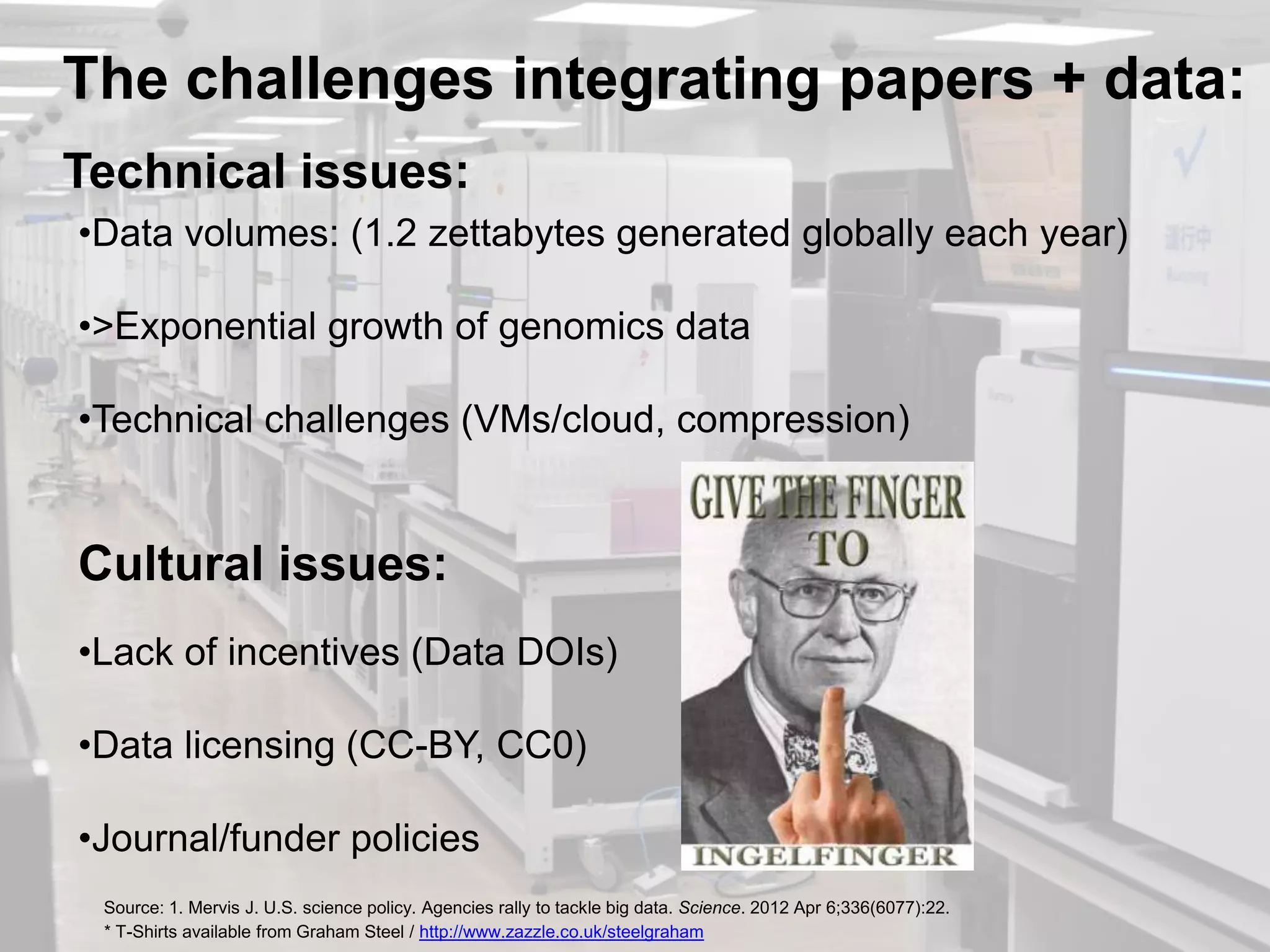
 * T-Shirts available from Graham Steel / http://www.zazzle.co.uk/steelgraham
Why is this important?
                                                                                 • Transparency
                                                                                 • Reproducibility
                                                                                 • Re-use


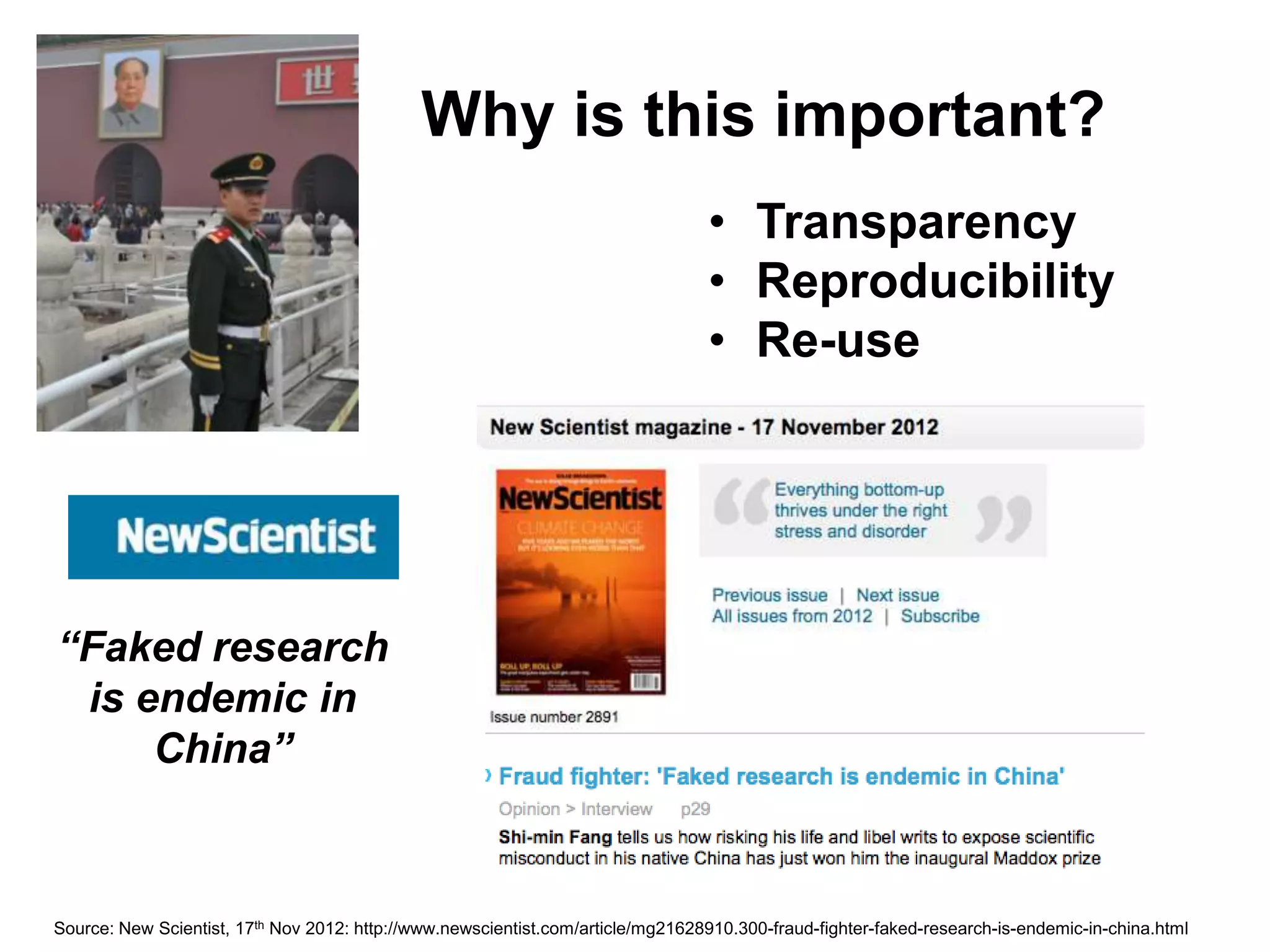
“Faked research
 is endemic in
     China”


Source: New Scientist, 17th Nov 2012: http://www.newscientist.com/article/mg21628910.300-fraud-fighter-faked-research-is-endemic-in-china.html
Why is this important?

                                          475, 267 (2011)


―Wide distribution of information is key to scientific progress,
yet traditionally, Chinese scientists have not systematically
released data or research findings, even after publication.―

―There have been widespread complaints from scientists
inside and outside China about this lack of transparency. ‖

―Usually incomplete and unsystematic, [what little supporting
data released] are of little value to researchers and there is
evidence that this drives down a paper's citation numbers.‖
Source: Nature 475, 267 (2011) http://www.nature.com/news/2011/110720/full/475267a.html?
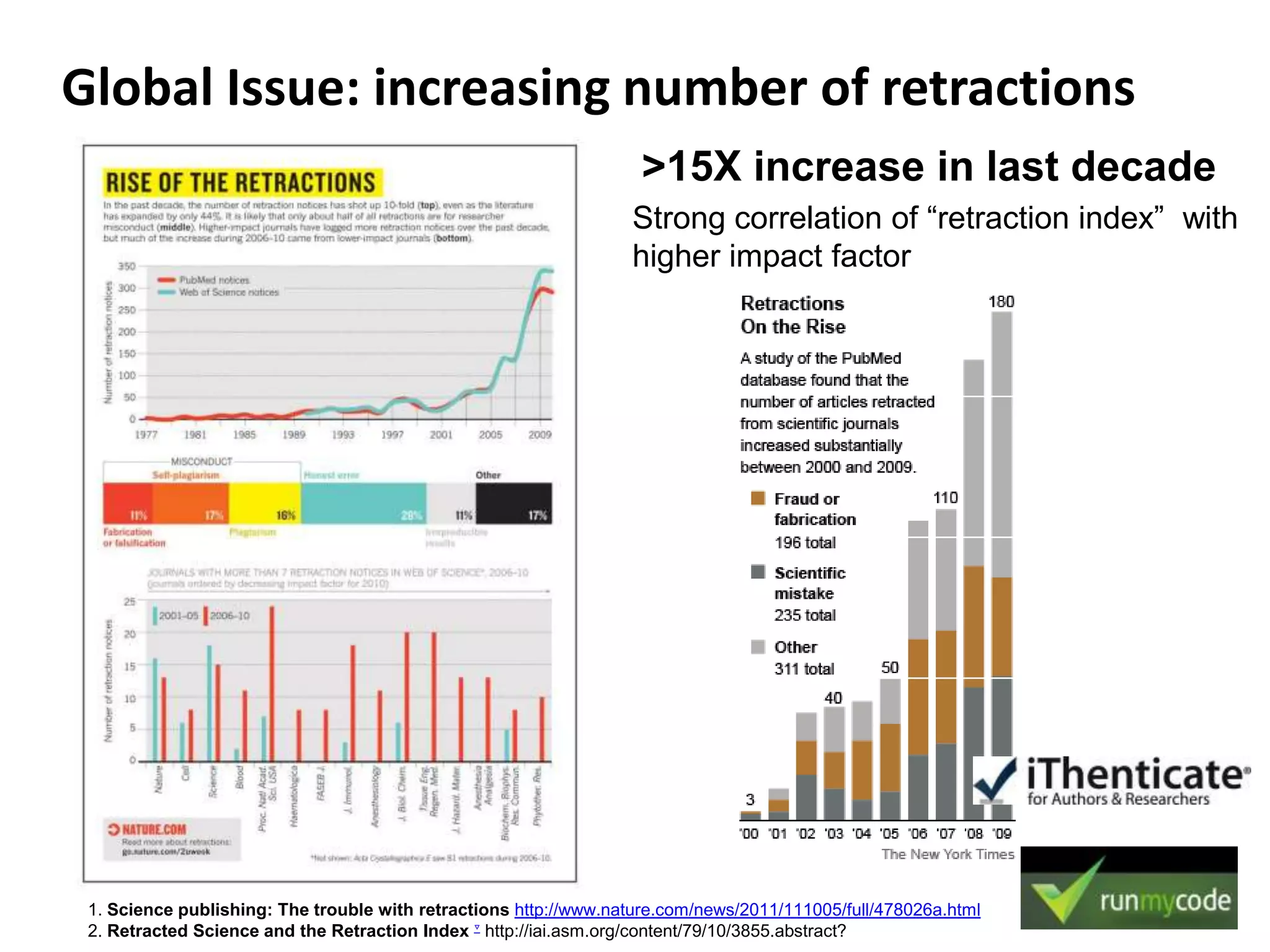
Global Issue: increasing number of retractions
                                                                   >15X increase in last decade
                                                                  Strong correlation of ―retraction index‖ with
                                                                  higher impact factor


 1. Science publishing: The trouble with retractions http://www.nature.com/news/2011/111005/full/478026a.html
 2. Retracted Science and the Retraction Index ▿ http://iai.asm.org/content/79/10/3855.abstract?
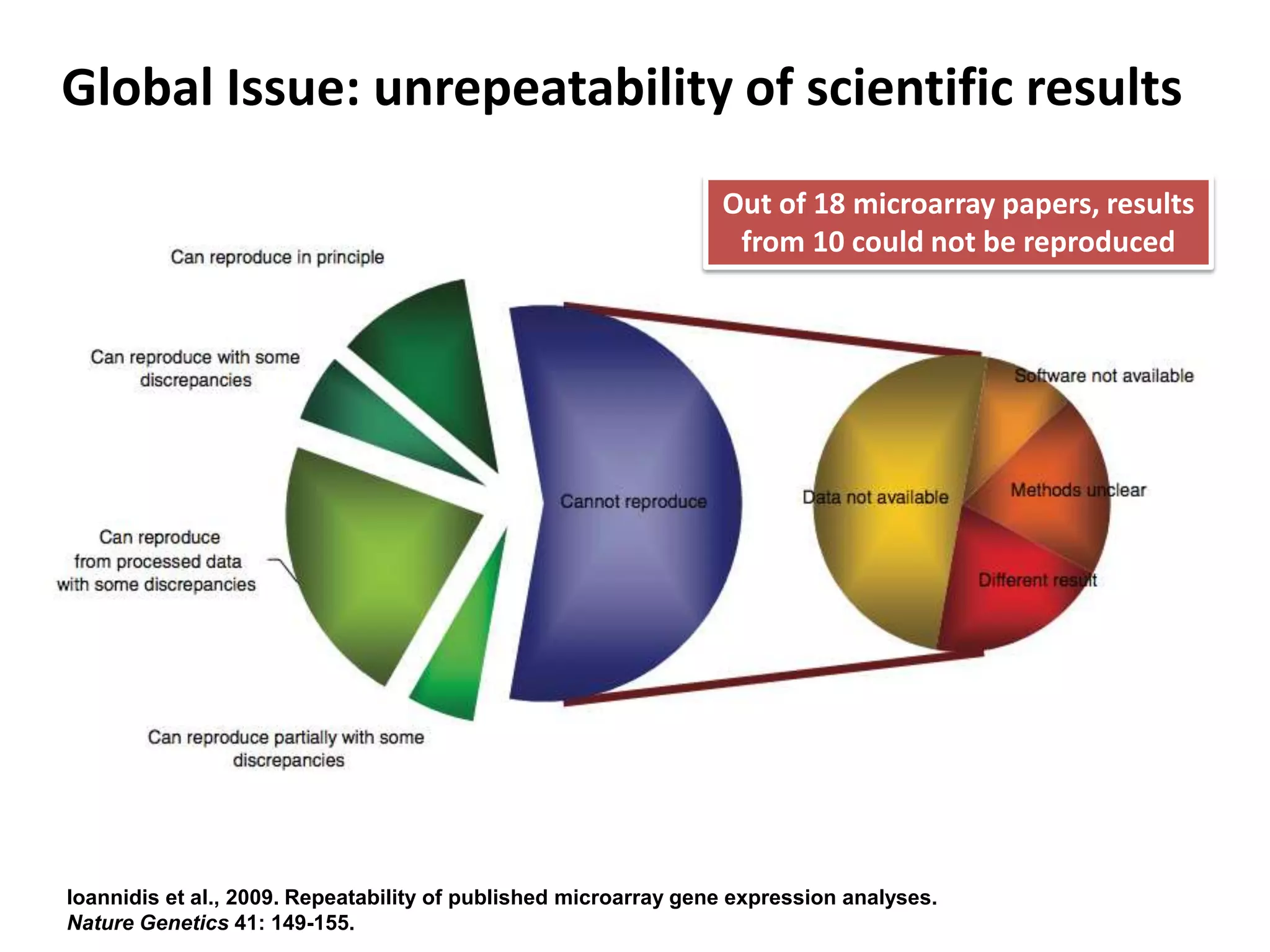
Global Issue: unrepeatability of scientific results
                                                                 Out of 18 microarray papers, results
                                                                  from 10 could not be reproduced


Ioannidis et al., 2009. Repeatability of published microarray gene expression analyses.
Nature Genetics 41: 149-155.
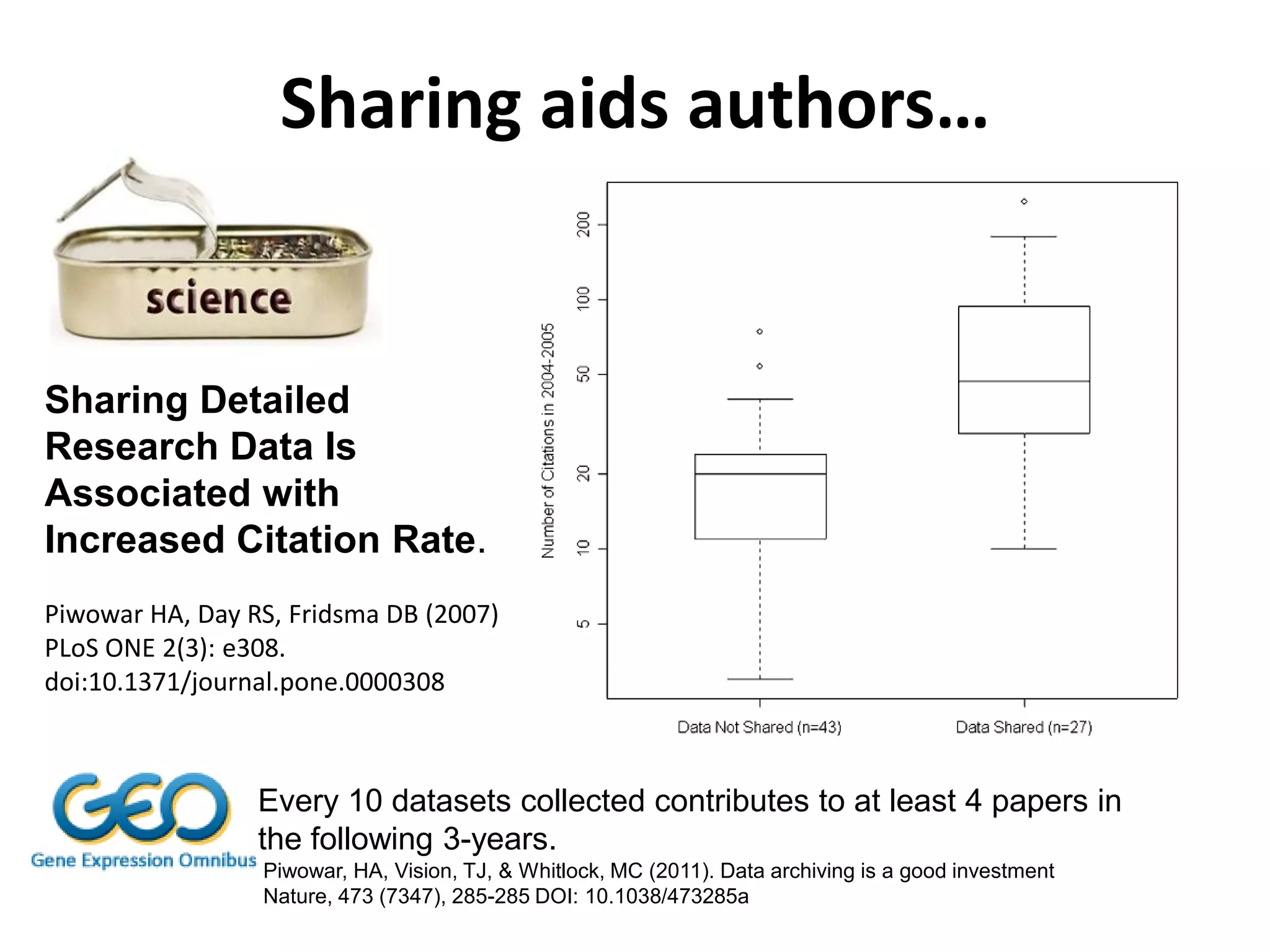
Sharing aids authors…


Sharing Detailed
Research Data Is
Associated with
Increased Citation Rate.
Piwowar HA, Day RS, Fridsma DB (2007)
PLoS ONE 2(3): e308.
doi:10.1371/journal.pone.0000308


                 Every 10 datasets collected contributes to at least 4 papers in
                 the following 3-years.
                 Piwowar, HA, Vision, TJ, & Whitlock, MC (2011). Data archiving is a good investment
                 Nature, 473 (7347), 285-285 DOI: 10.1038/473285a
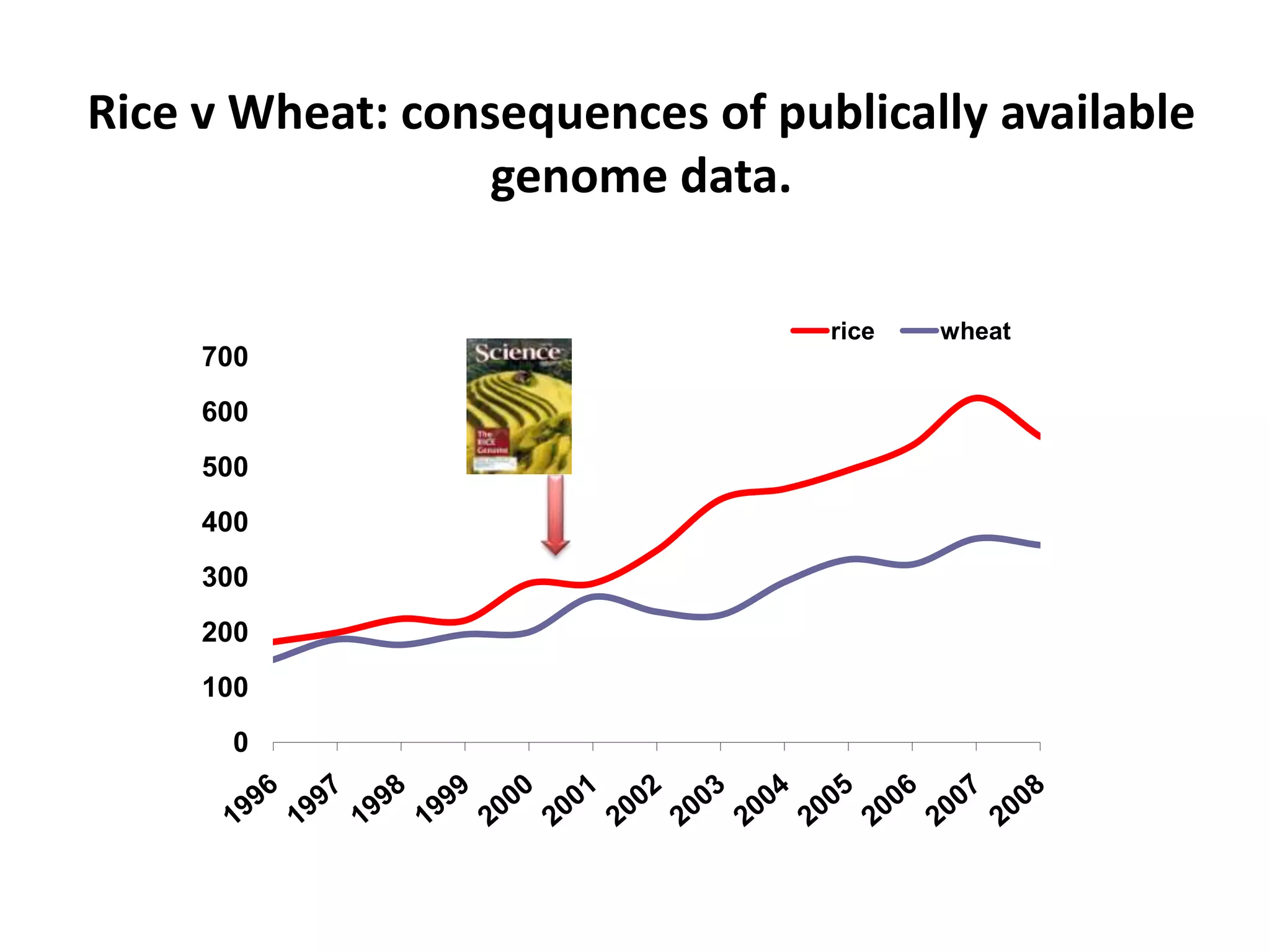
Rice v Wheat: consequences of publically available
                  genome data.

                                 rice   wheat
     700
     600
     500
     400
     300
     200
     100
       0
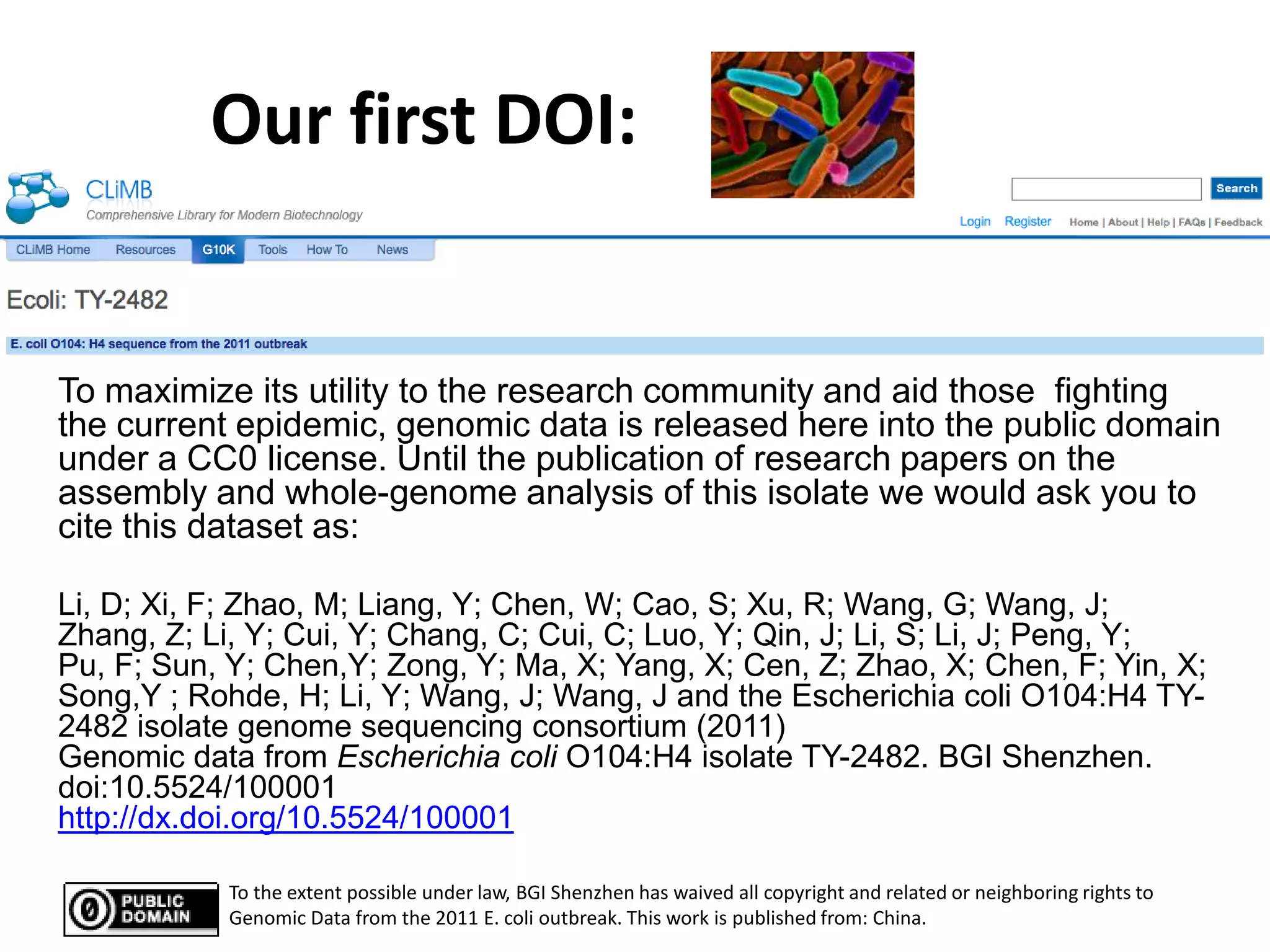
Our first DOI:


To maximize its utility to the research community and aid those fighting
the current epidemic, genomic data is released here into the public domain
under a CC0 license. Until the publication of research papers on the
assembly and whole-genome analysis of this isolate we would ask you to
cite this dataset as:

Li, D; Xi, F; Zhao, M; Liang, Y; Chen, W; Cao, S; Xu, R; Wang, G; Wang, J;
Zhang, Z; Li, Y; Cui, Y; Chang, C; Cui, C; Luo, Y; Qin, J; Li, S; Li, J; Peng, Y;
Pu, F; Sun, Y; Chen,Y; Zong, Y; Ma, X; Yang, X; Cen, Z; Zhao, X; Chen, F; Yin, X;
Song,Y ; Rohde, H; Li, Y; Wang, J; Wang, J and the Escherichia coli O104:H4 TY-
2482 isolate genome sequencing consortium (2011)
Genomic data from Escherichia coli O104:H4 isolate TY-2482. BGI Shenzhen.
doi:10.5524/100001
http://dx.doi.org/10.5524/100001

            To the extent possible under law, BGI Shenzhen has waived all copyright and related or neighboring rights to
            Genomic Data from the 2011 E. coli outbreak. This work is published from: China.
Downstream consequences:

1. Citations (~100)        2. Therapeutics (primers, antimicrobials) 3. Platform Comparisons
4. Example for faster & more open science


  ―Last summer, biologist Andrew Kasarskis was eager to help decipher the genetic origin of the
  Escherichia coli strain that infected roughly 4,000 people in Germany between May and July. But he knew
  it that might take days for the lawyers at his company — Pacific Biosciences — to parse the agreements
  governing how his team could use data collected on the strain. Luckily, one team had released its data
  under a Creative Commons licence that allowed free use of the data, allowing Kasarskis and his
  colleagues to join the international research effort and publish their work without wasting time on
  legal wrangling.‖
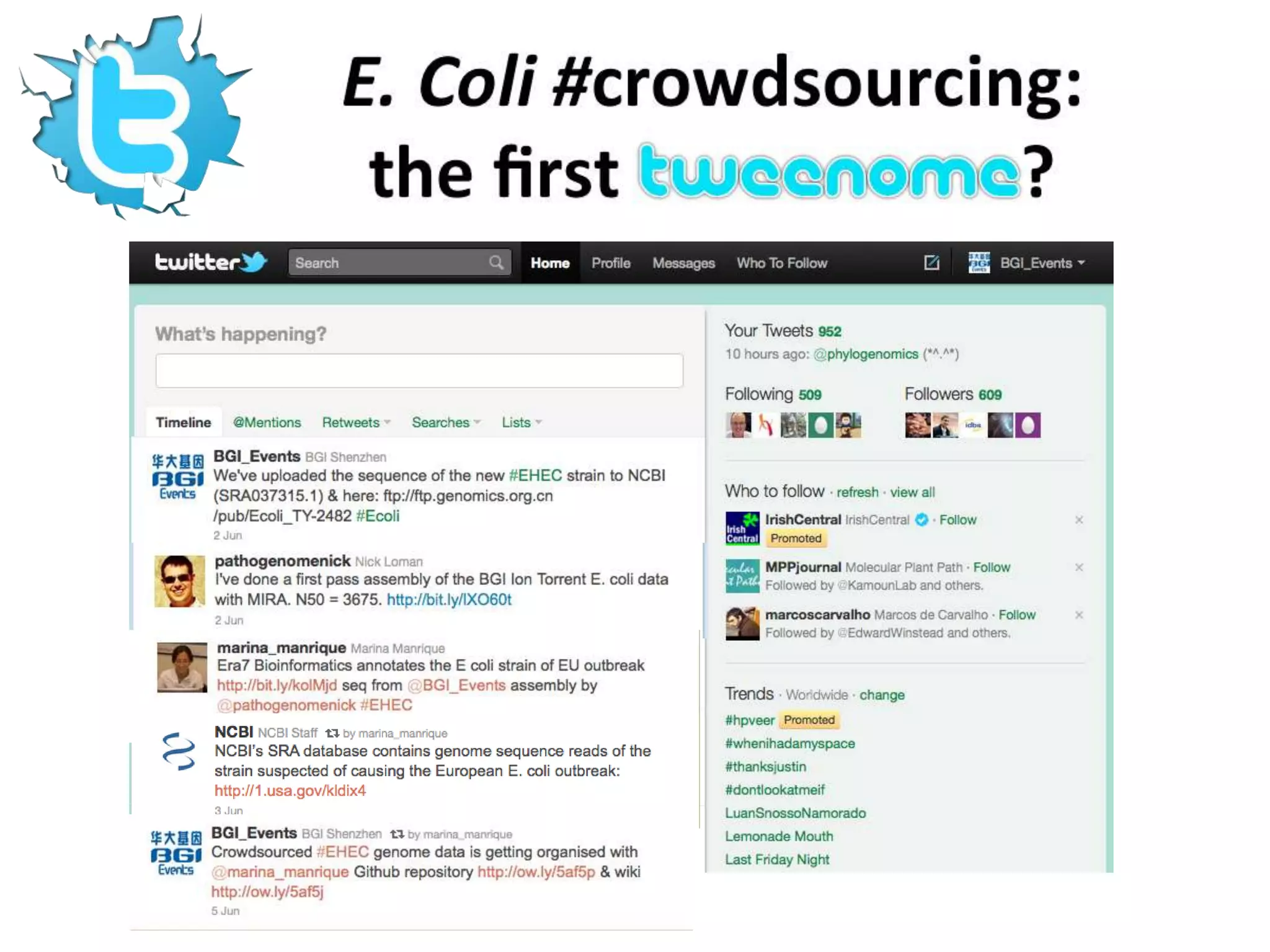
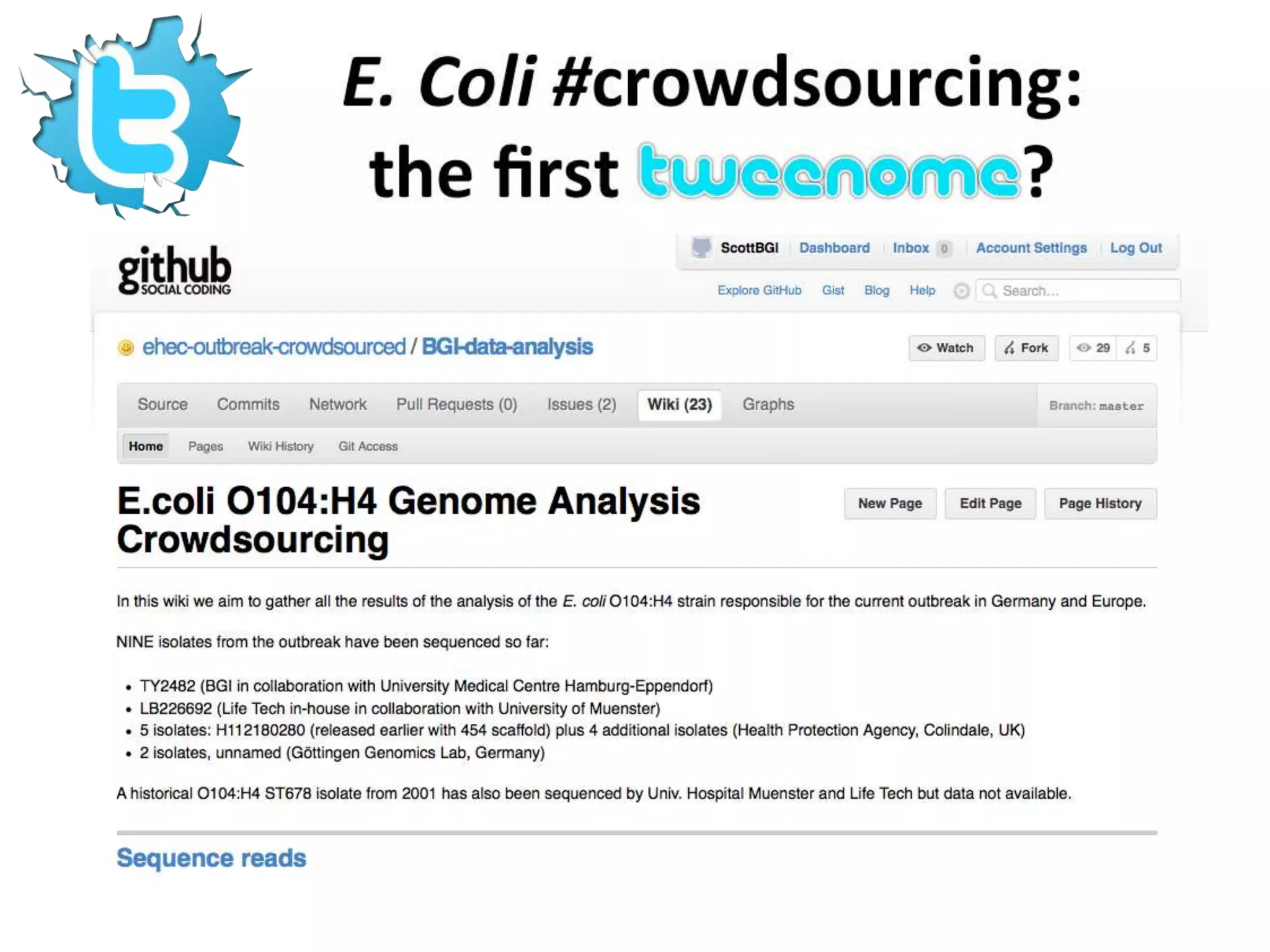
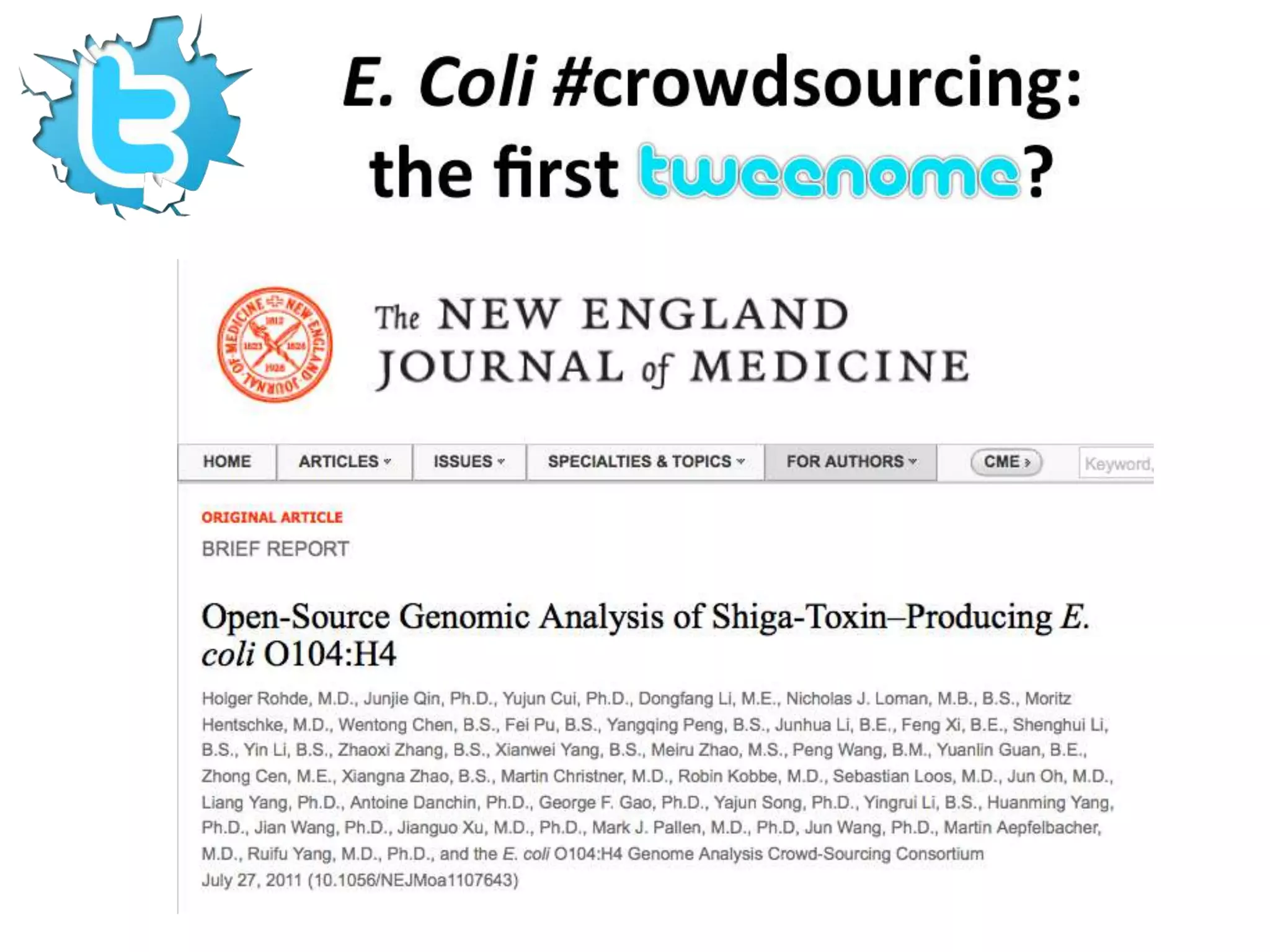
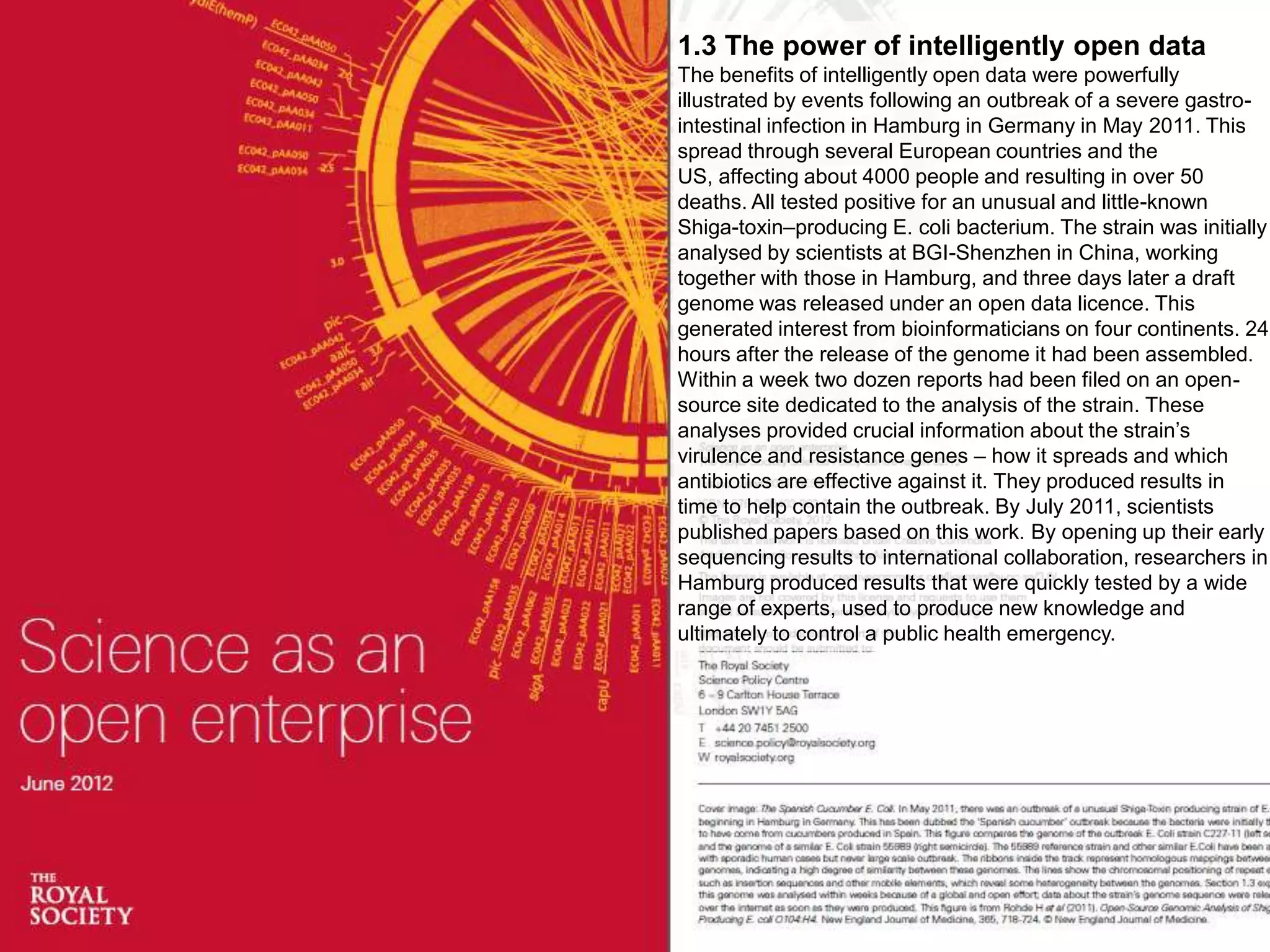
1.3 The power of intelligently open data
The benefits of intelligently open data were powerfully
illustrated by events following an outbreak of a severe gastro-
intestinal infection in Hamburg in Germany in May 2011. This
spread through several European countries and the
US, affecting about 4000 people and resulting in over 50
deaths. All tested positive for an unusual and little-known
Shiga-toxin–producing E. coli bacterium. The strain was initially
analysed by scientists at BGI-Shenzhen in China, working
together with those in Hamburg, and three days later a draft
genome was released under an open data licence. This
generated interest from bioinformaticians on four continents. 24
hours after the release of the genome it had been assembled.
Within a week two dozen reports had been filed on an open-
source site dedicated to the analysis of the strain. These
analyses provided crucial information about the strain’s
virulence and resistance genes – how it spreads and which
antibiotics are effective against it. They produced results in
time to help contain the outbreak. By July 2011, scientists
published papers based on this work. By opening up their early
sequencing results to international collaboration, researchers in
Hamburg produced results that were quickly tested by a wide
range of experts, used to produce new knowledge and
ultimately to control a public health emergency.
Not just (data) quantity, but quality
1. Lack of sufficient metadata

2. Lack of interoperability

1. Long tail of curation (“Democratization” of “Big-Data”)
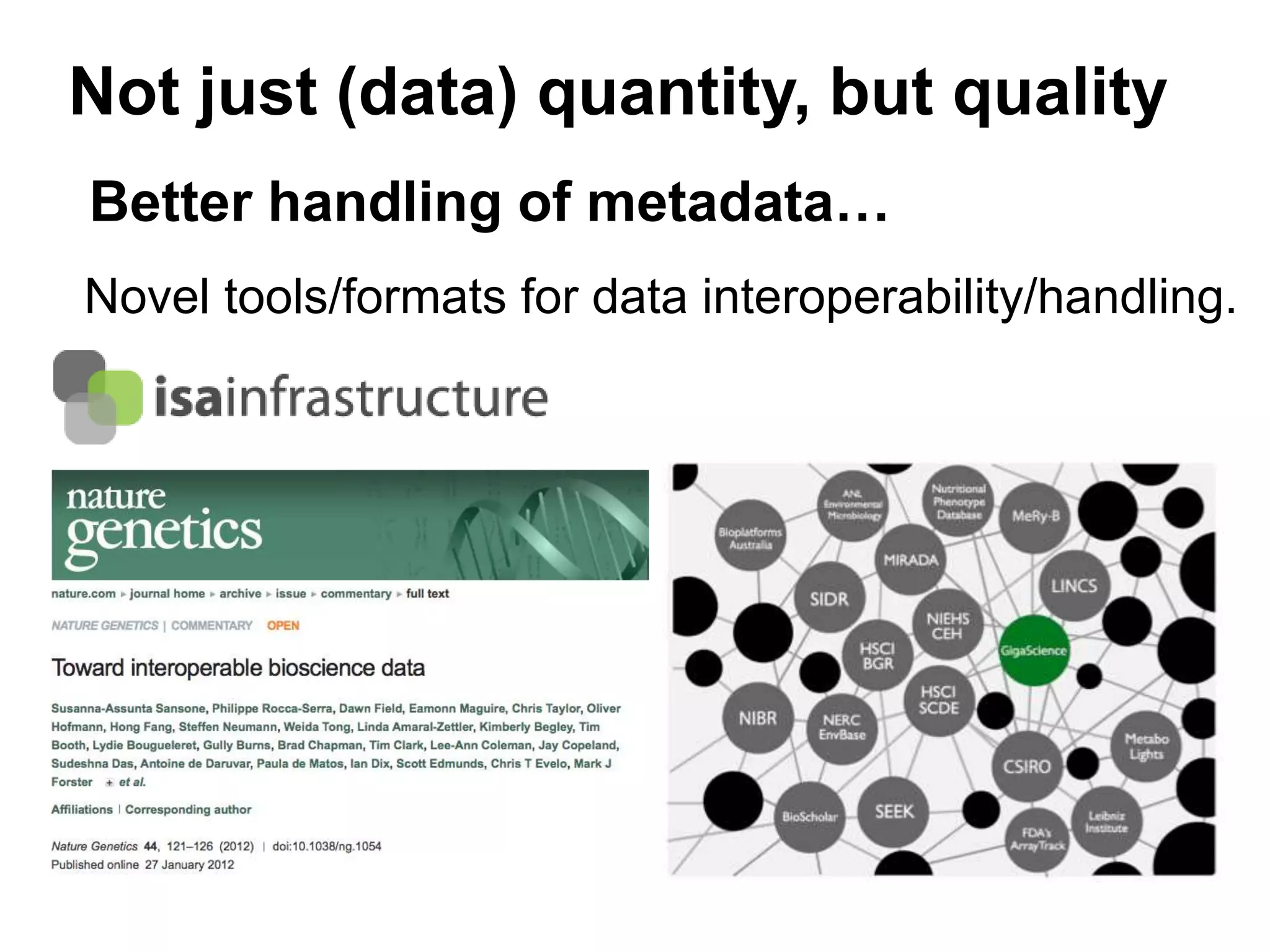
Not just (data) quantity, but quality
Better handling of metadata…
Novel tools/formats for data interoperability/handling.
      Cloud
    solutions?
Not just (data) quantity, but quality

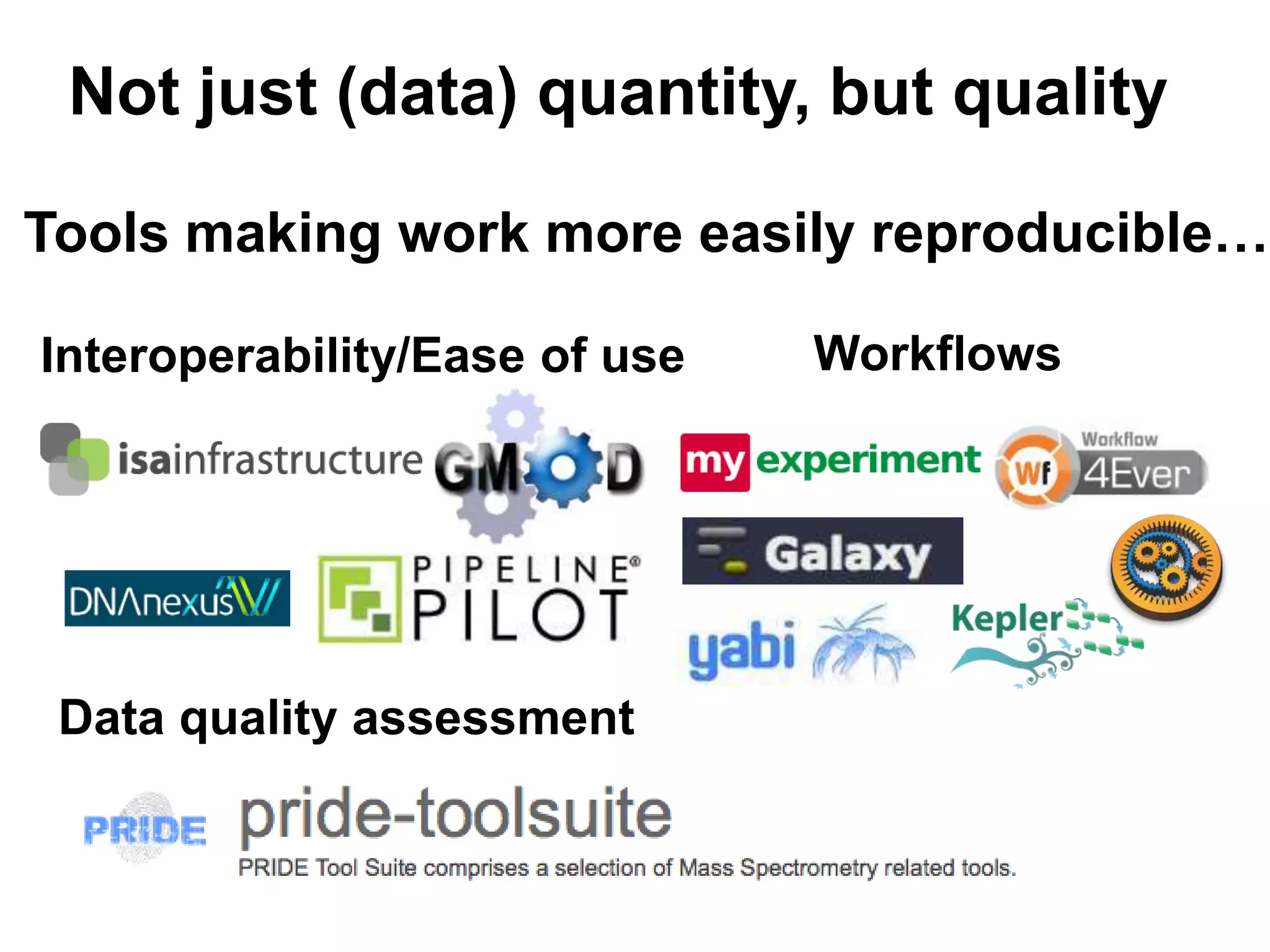
Tools making work more easily reproducible…

Interoperability/Ease of use   Workflows


 Data quality assessment
Large-Scale Data
      Journal/Database
    In conjunction with:

Editor-in-Chief: Laurie Goodman, PhD
Editor: Scott Edmunds, PhD
Commisioning Editor: Nicole Nogoy, PhD
Lead Curator: Tam Sneddon D.Phil
Data Platform: Peter Li, PhD
  www.gigasciencejournal.com
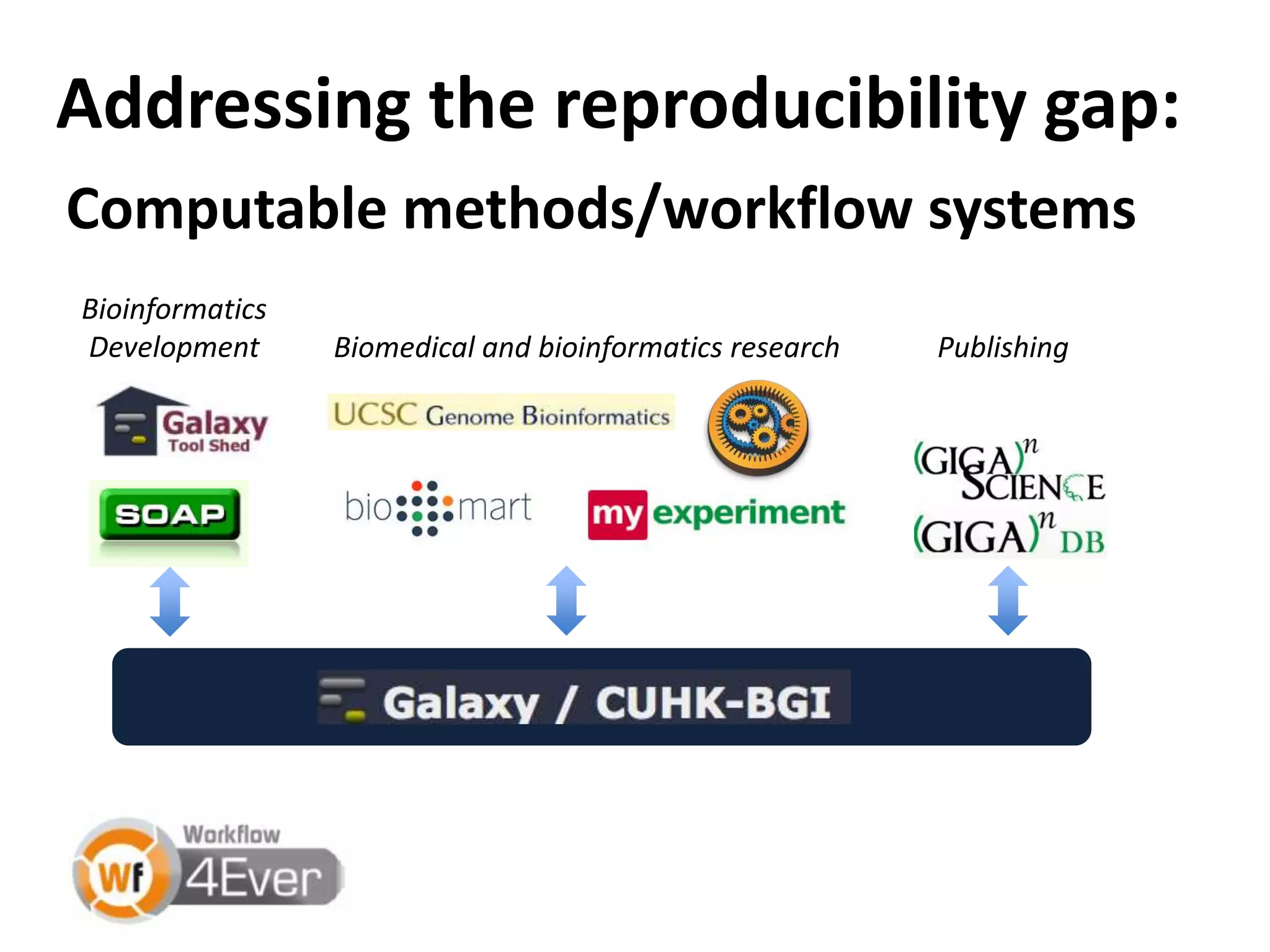
Addressing the reproducibility gap:
Computable methods/workflow systems
Bioinformatics
Development      Biomedical and bioinformatics research   Publishing
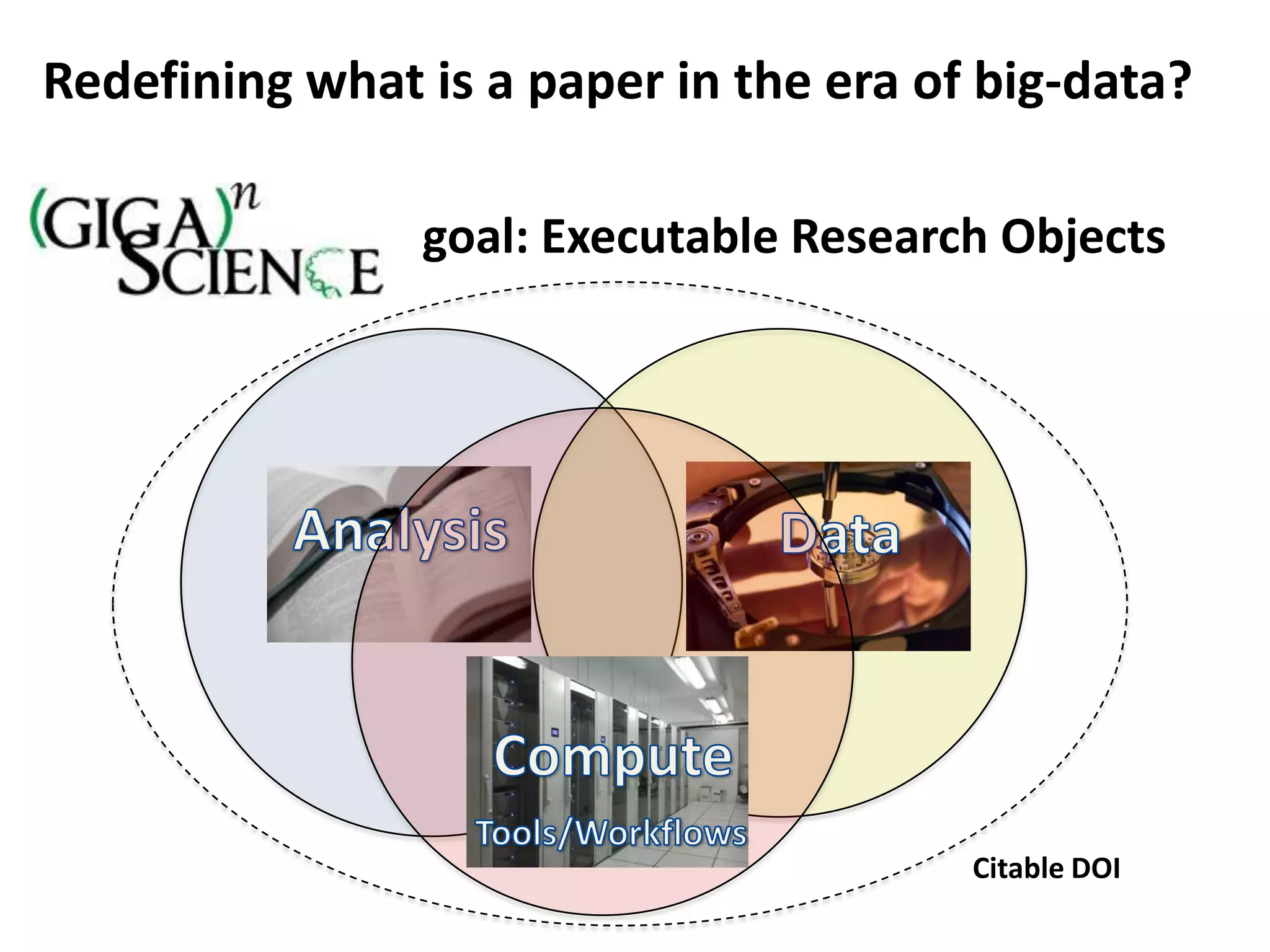
Redefining what is a paper in the era of big-data?

                goal: Executable Research Objects


                                        Citable DOI
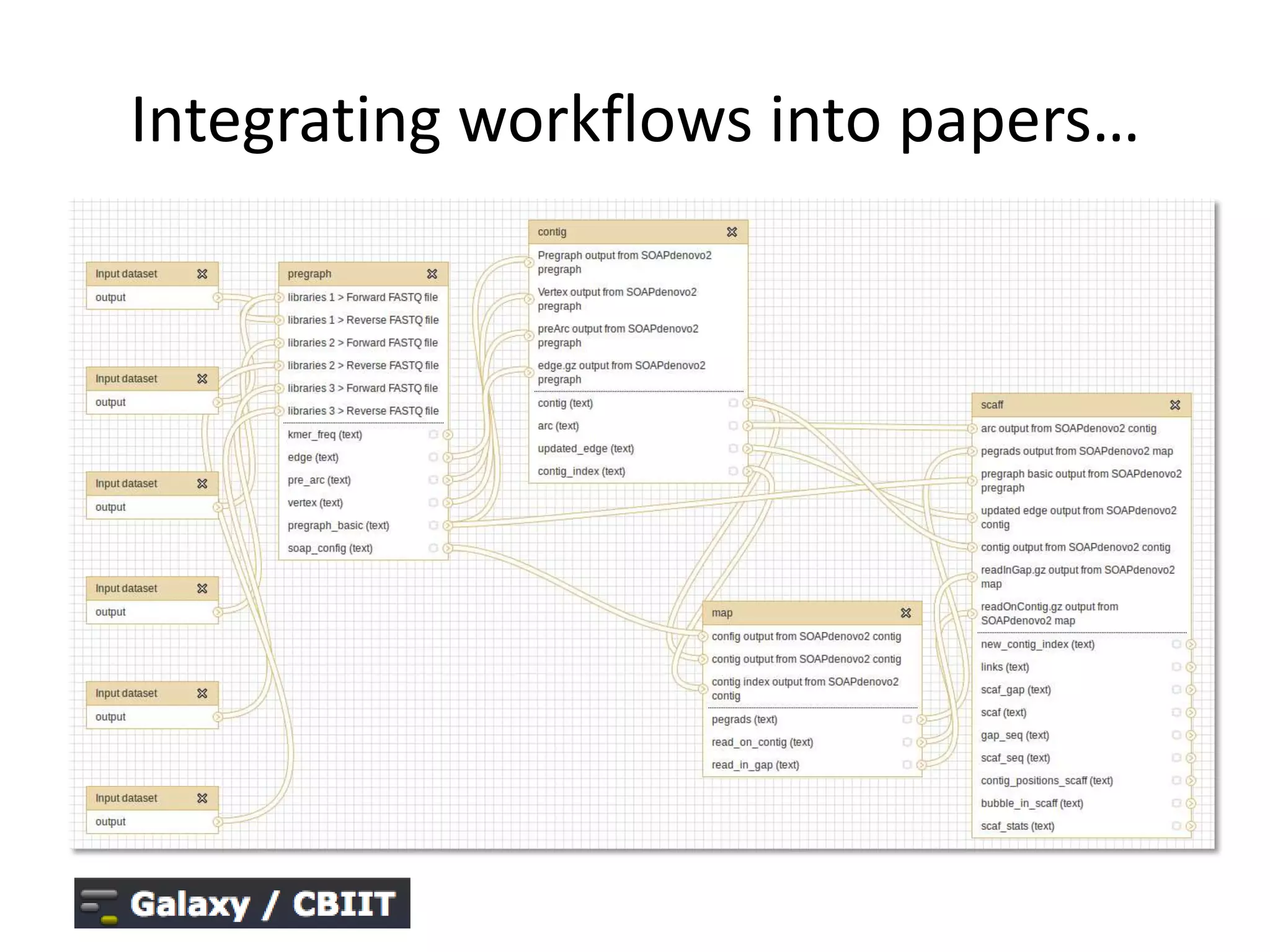
Integrating workflows into papers…
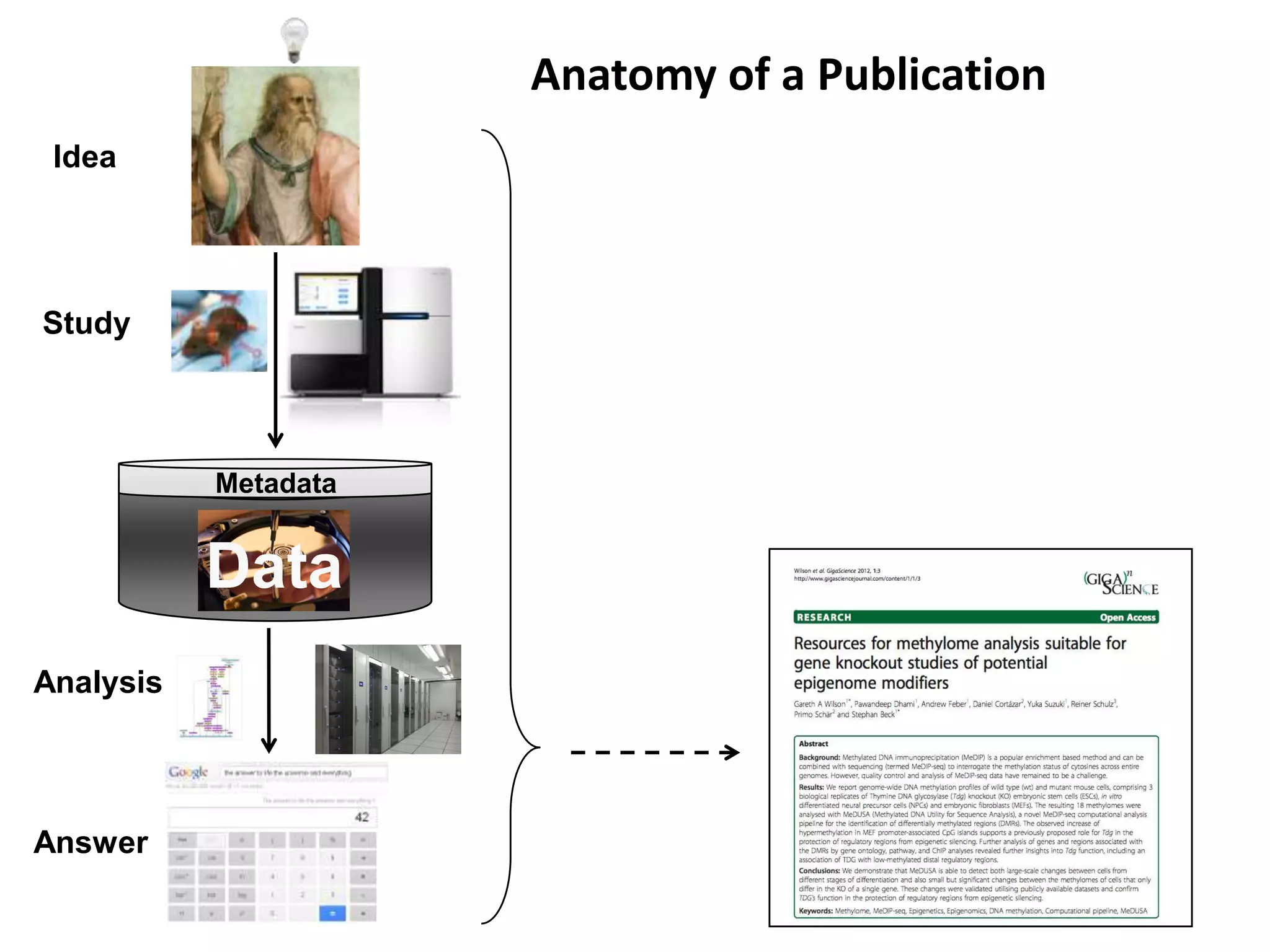
Anatomy of a Publication
 Idea


Study


           Metadata


           Data
Analysis


Answer
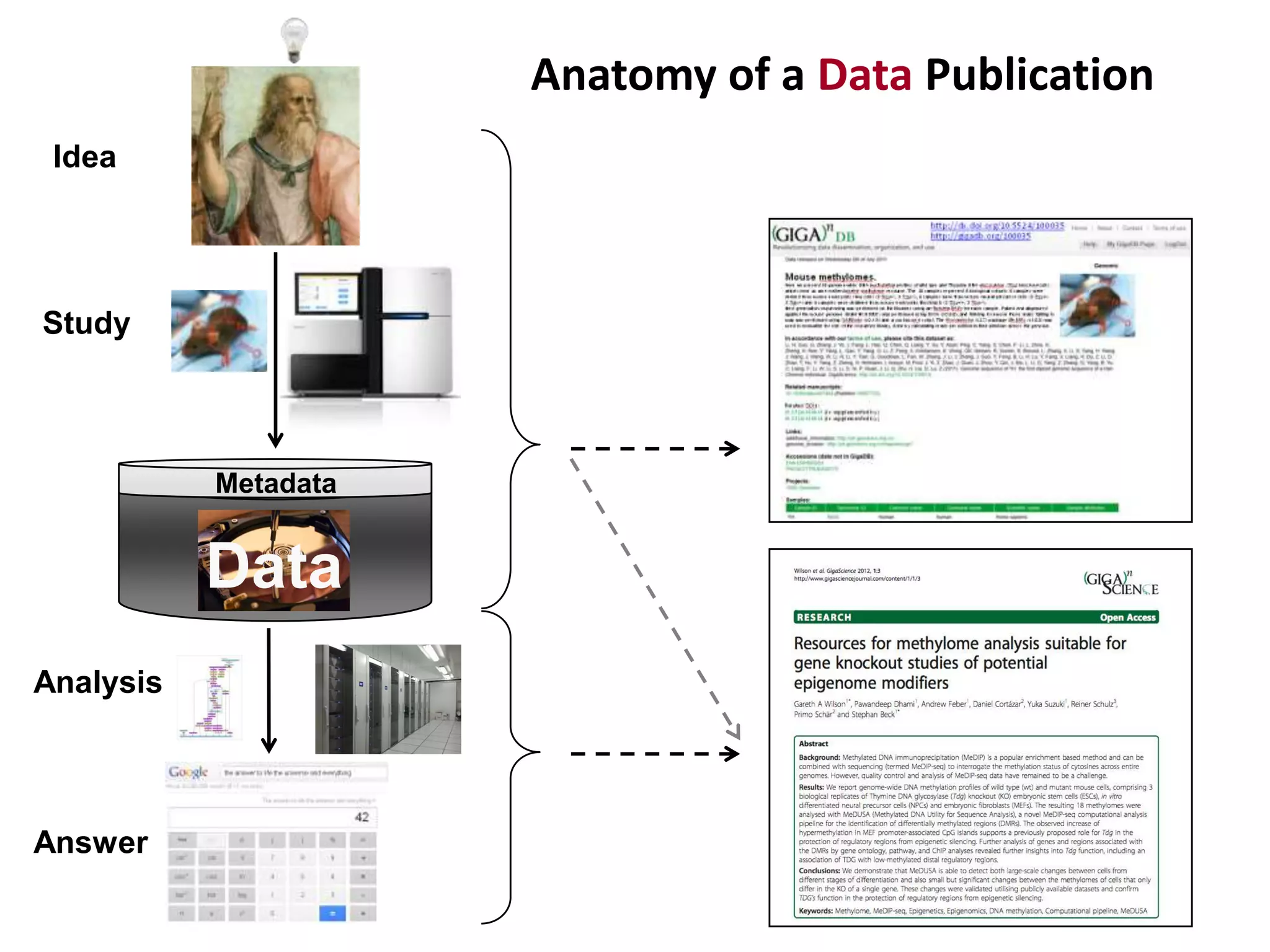
Anatomy of a Data Publication
 Idea


Study


           Metadata


           Data
Analysis


Answer
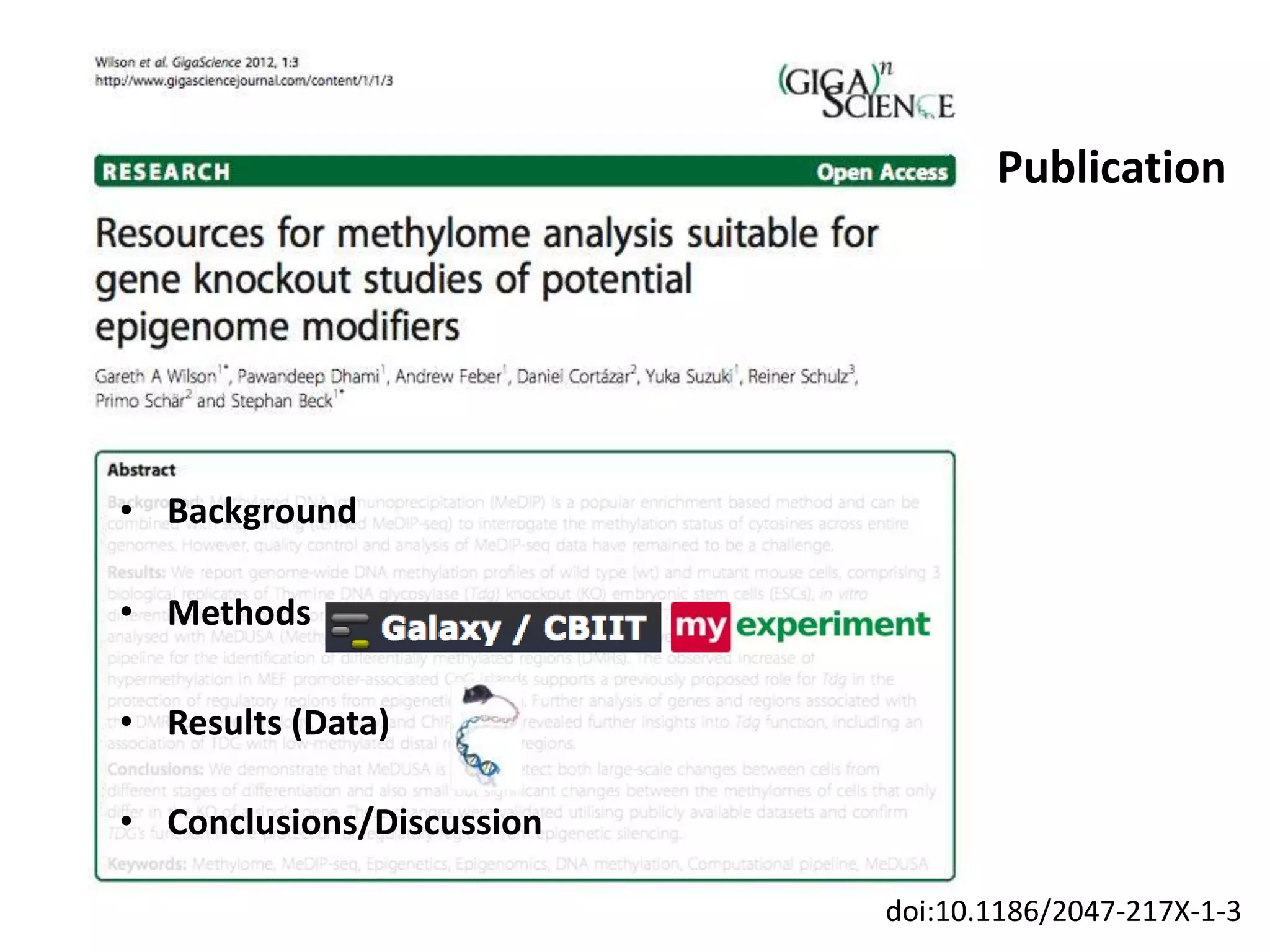
Publication


• Background

• Methods

• Results (Data)

• Conclusions/Discussion

                           doi:10.1186/2047-217X-1-3
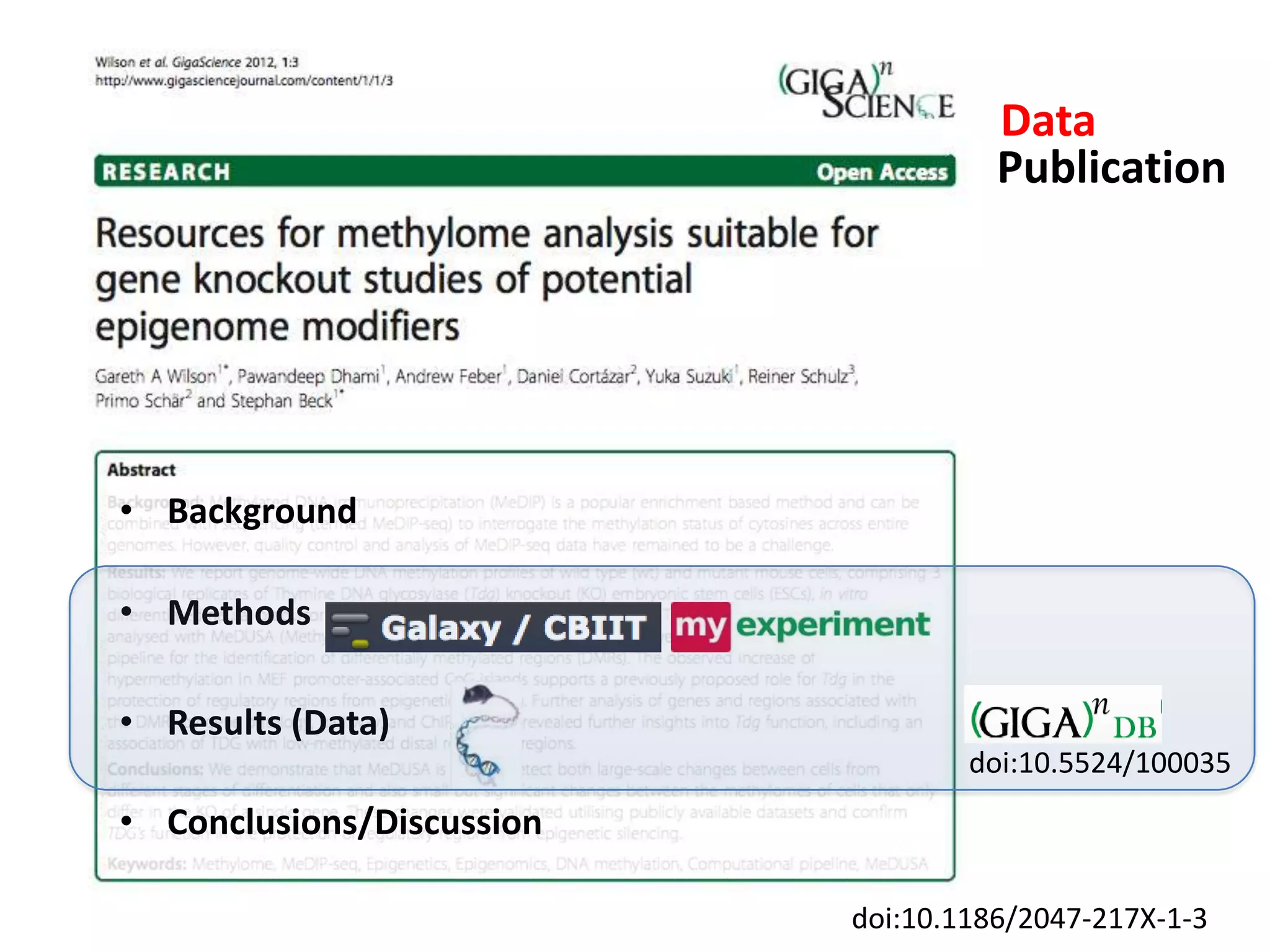
Data
                                     Publication


• Background

• Methods

• Results (Data)
                                   doi:10.5524/100035
• Conclusions/Discussion

                           doi:10.1186/2047-217X-1-3
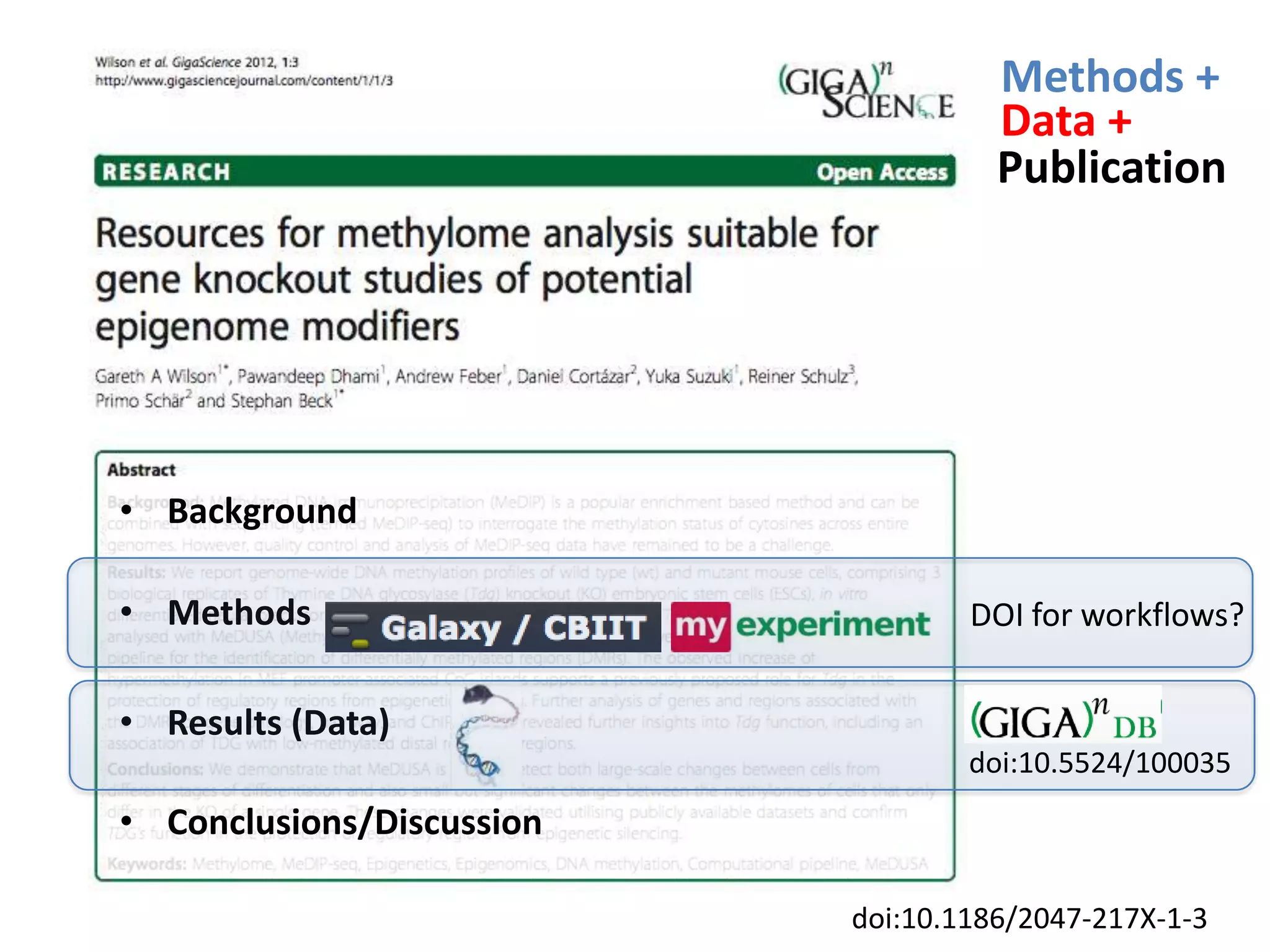
Methods +
                                     Data +
                                     Publication


• Background

• Methods                          DOI for workflows?


• Results (Data)
                                   doi:10.5524/100035
• Conclusions/Discussion

                           doi:10.1186/2047-217X-1-3
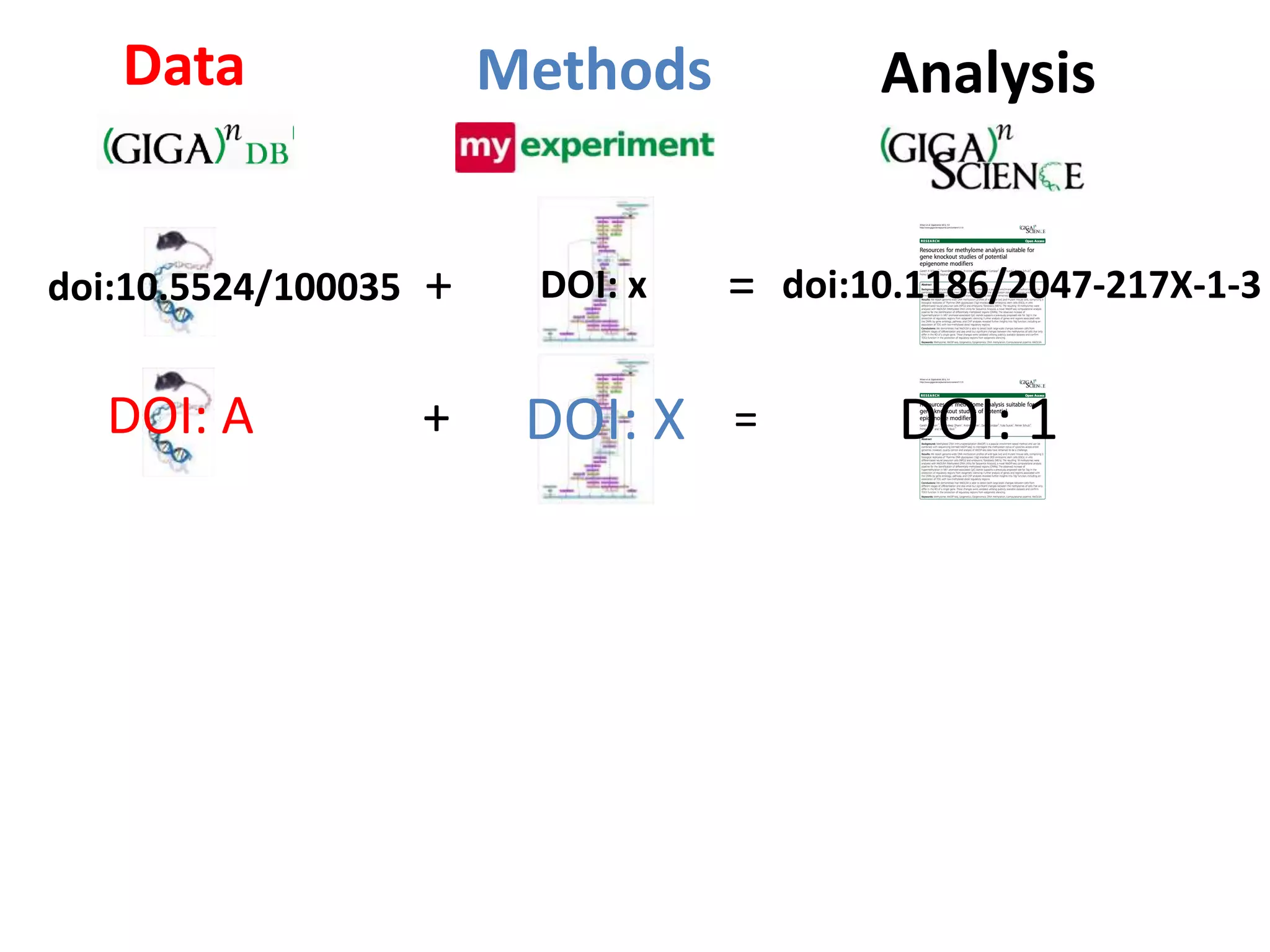
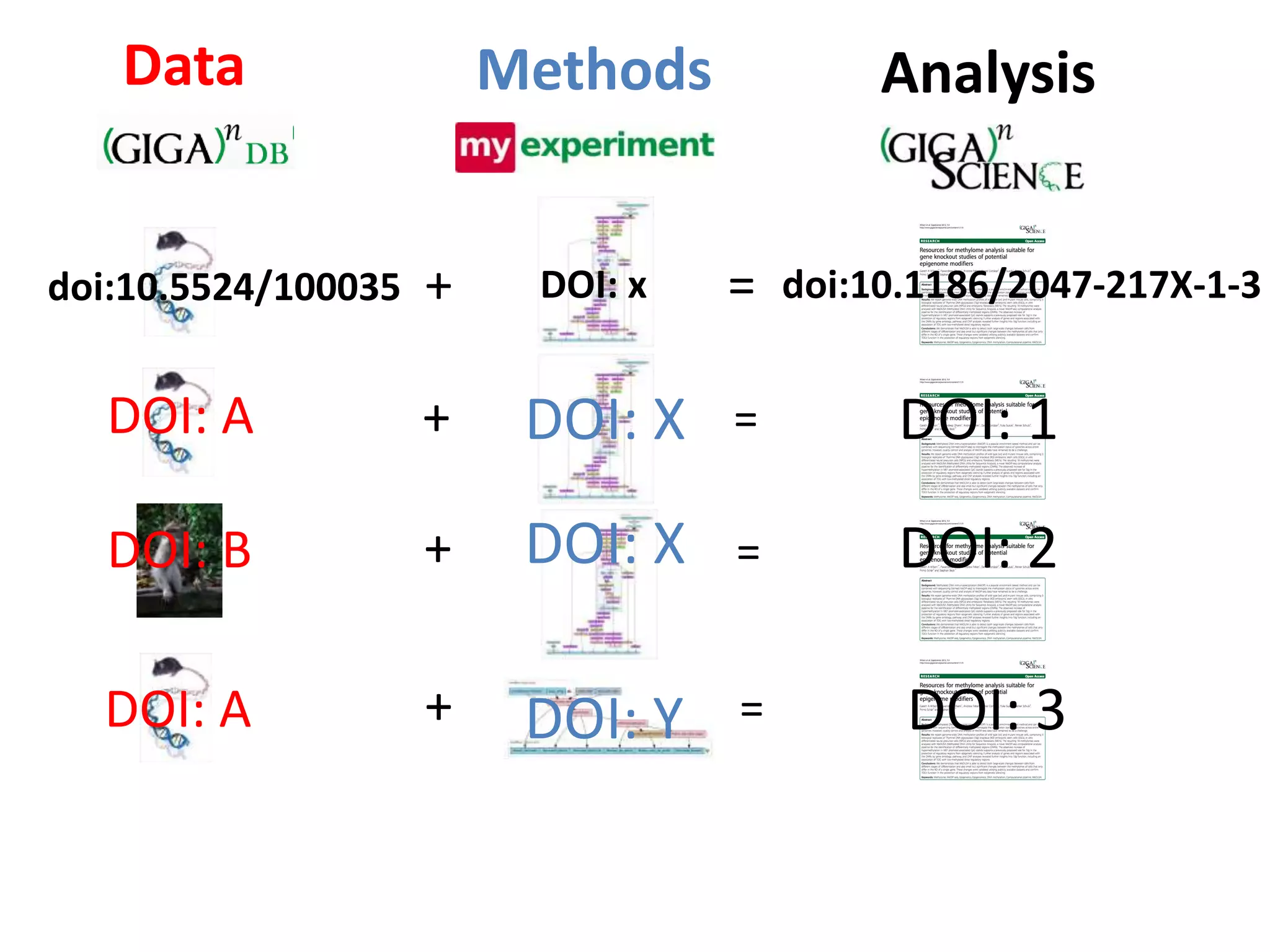
Data                  Methods            Analysis


doi:10.5524/100035   +    DOI: x   =   doi:10.1186/2047-217X-1-3


   DOI: A            +    DOI: X   =         DOI: 1
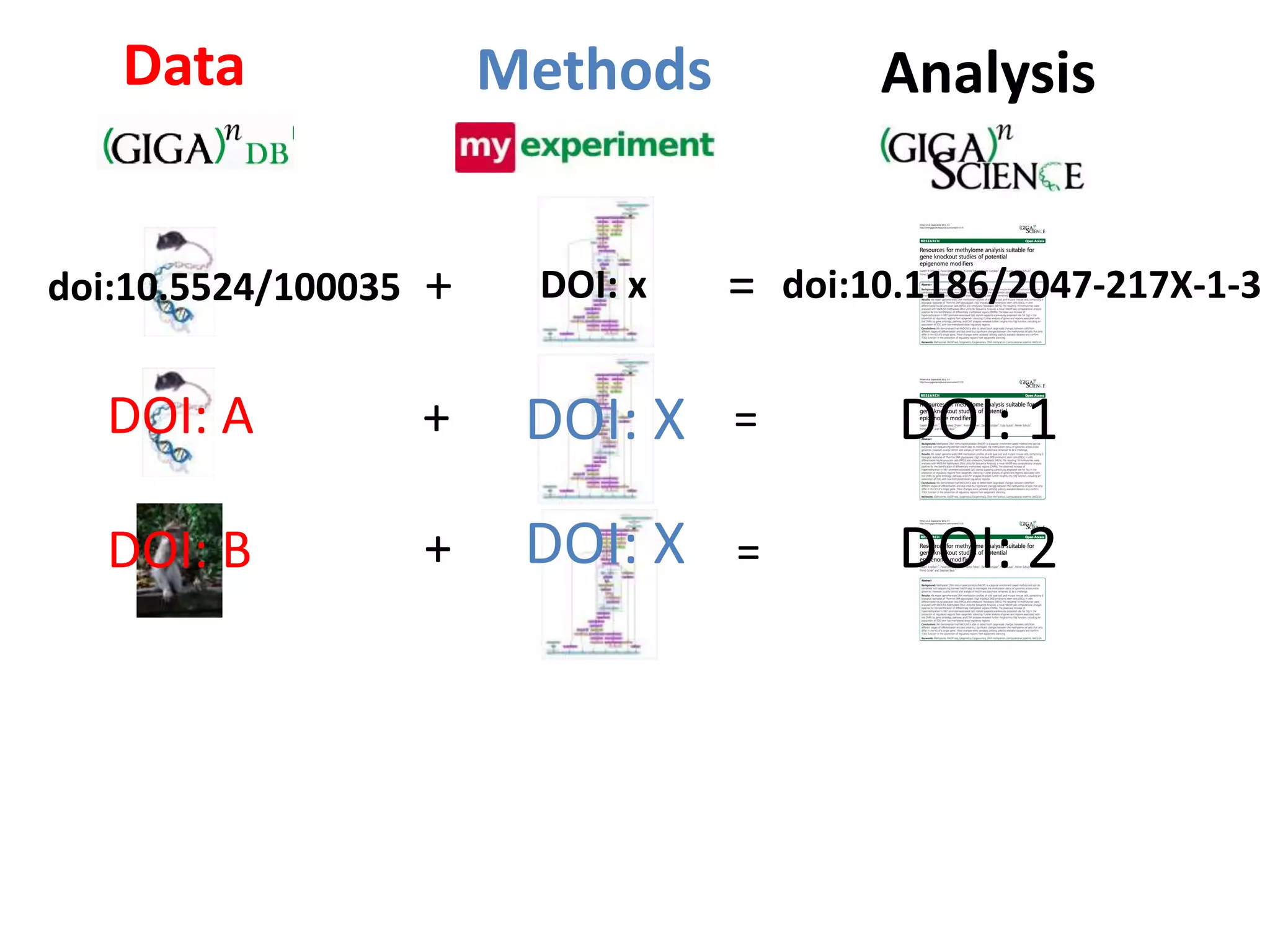
Data                  Methods            Analysis


doi:10.5524/100035   +    DOI: x   =   doi:10.1186/2047-217X-1-3


   DOI: A            +    DOI: X   =         DOI: 1

   DOI: B            +    DOI: X   =         DOI: 2
Data                  Methods            Analysis


doi:10.5524/100035   +    DOI: x   =   doi:10.1186/2047-217X-1-3


   DOI: A            +    DOI: X   =         DOI: 1

   DOI: B            +    DOI: X   =         DOI: 2

  DOI: A             +    DOI: Y   =         DOI: 3
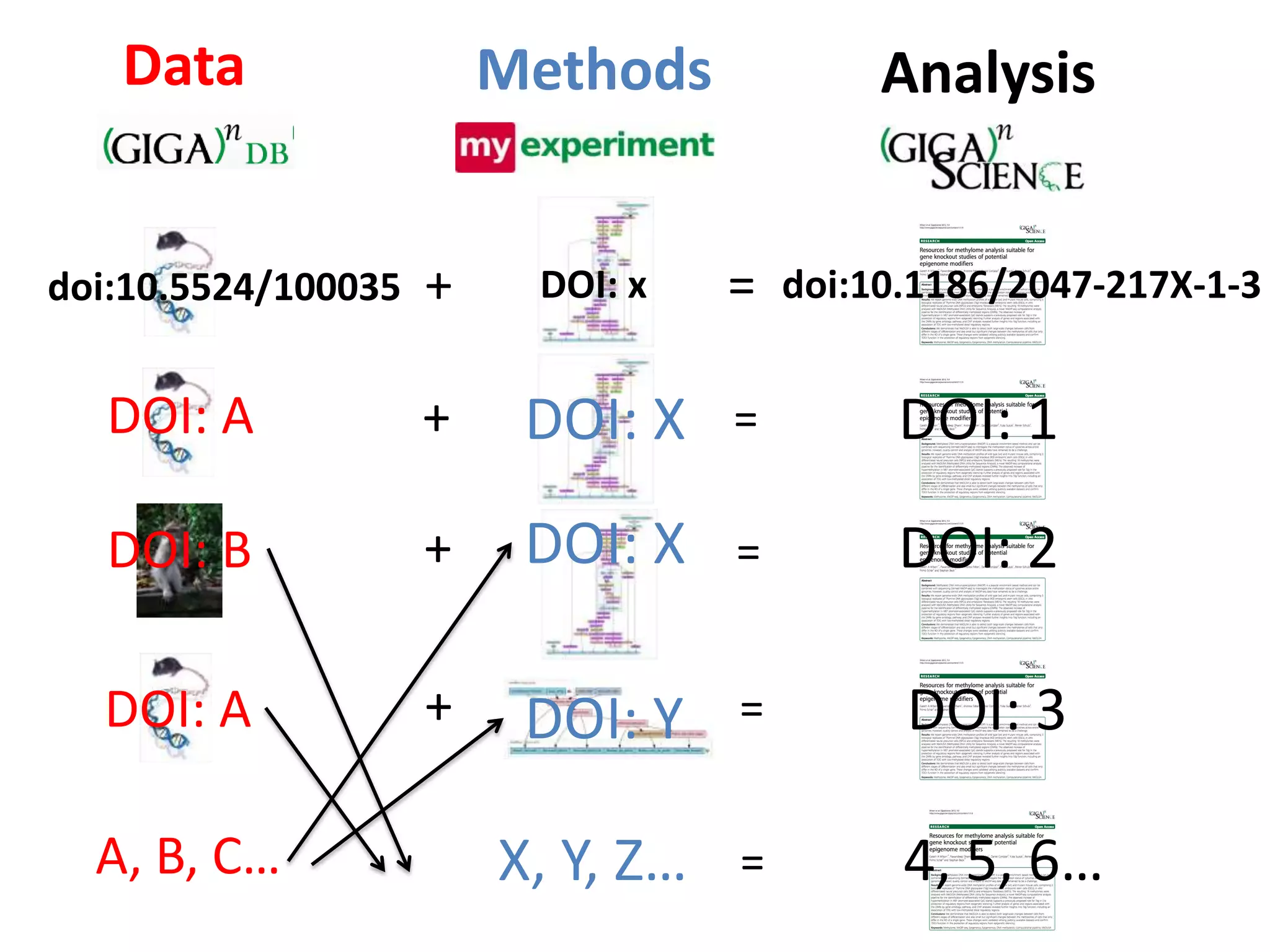
Data                  Methods             Analysis


doi:10.5524/100035   +    DOI: x    =   doi:10.1186/2047-217X-1-3


   DOI: A            +    DOI: X    =         DOI: 1

   DOI: B            +    DOI: X    =         DOI: 2

  DOI: A             +    DOI: Y    =         DOI: 3

  A, B, C…               X, Y, Z…   =         4, 5, 6…
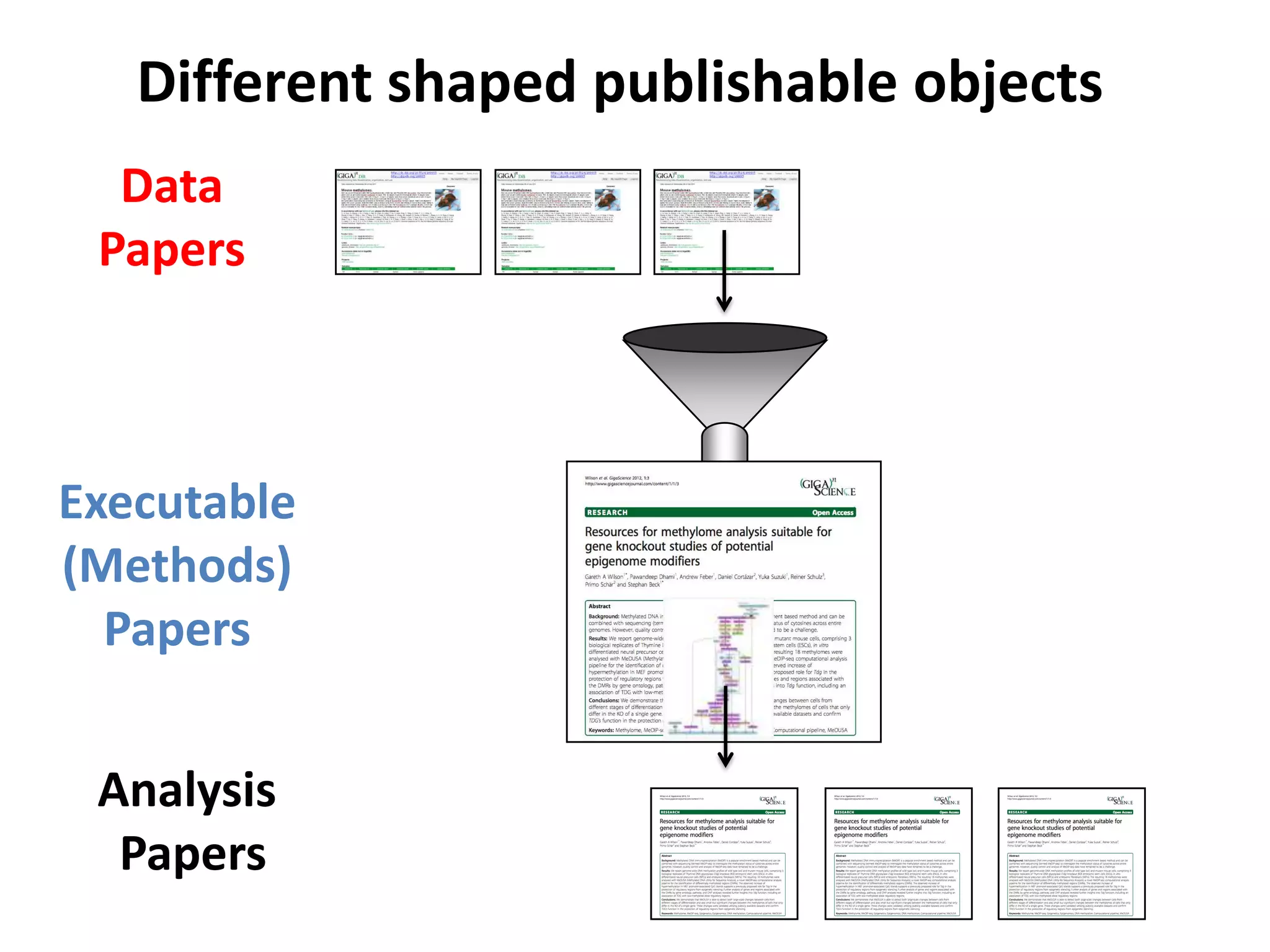
Different shaped publishable objects
  Data
 Papers


Executable
(Methods)
  Papers


 Analysis
  Papers
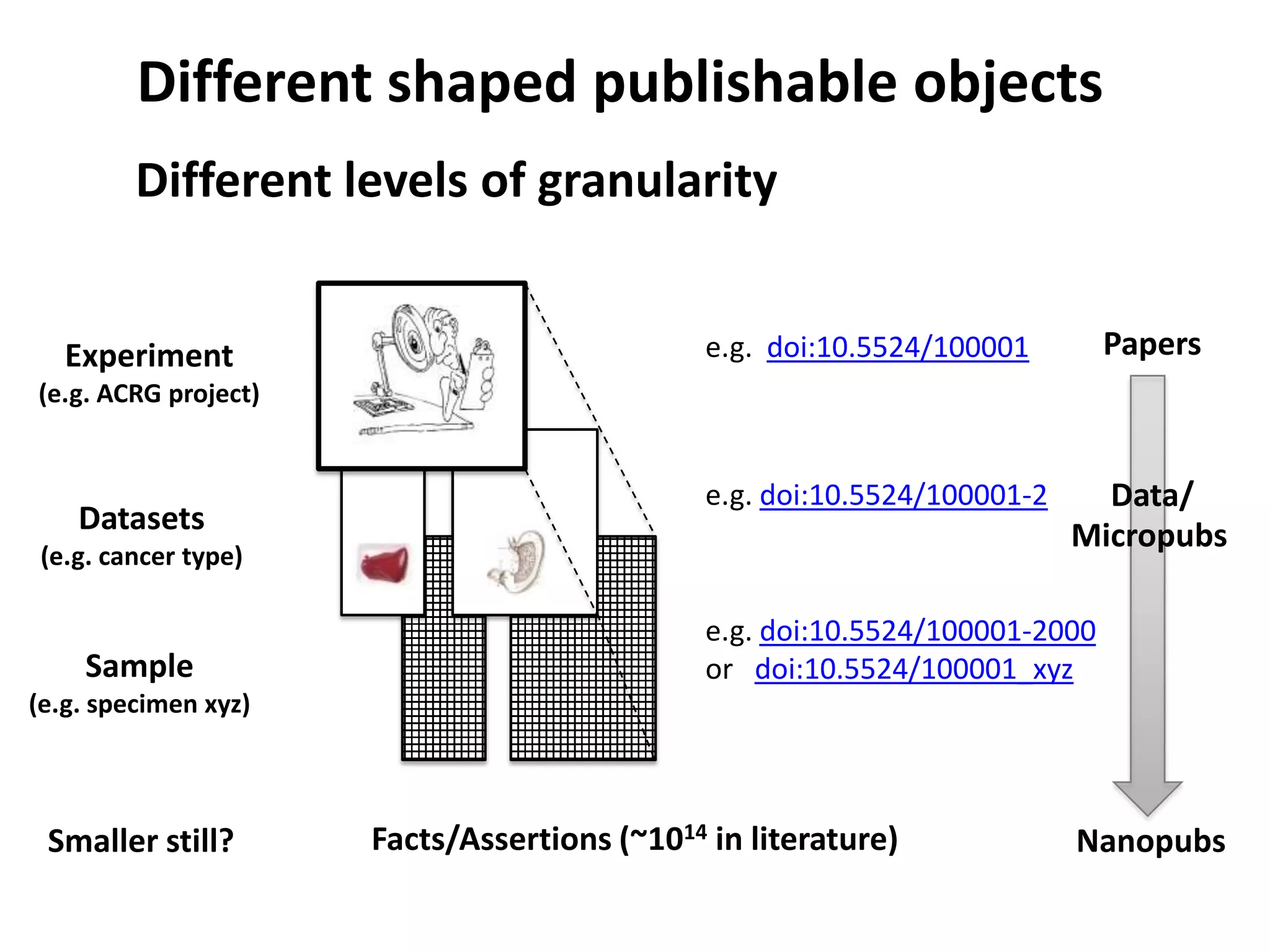
Different shaped publishable objects
         Different levels of granularity


   Experiment                                 e.g. doi:10.5524/100001        Papers
(e.g. ACRG project)


                                              e.g. doi:10.5524/100001-2     Data/
    Datasets                                                              Micropubs
 (e.g. cancer type)

                                              e.g. doi:10.5524/100001-2000
    Sample                                    or doi:10.5524/100001_xyz
(e.g. specimen xyz)


 Smaller still?       Facts/Assertions (~1014 in literature)              Nanopubs
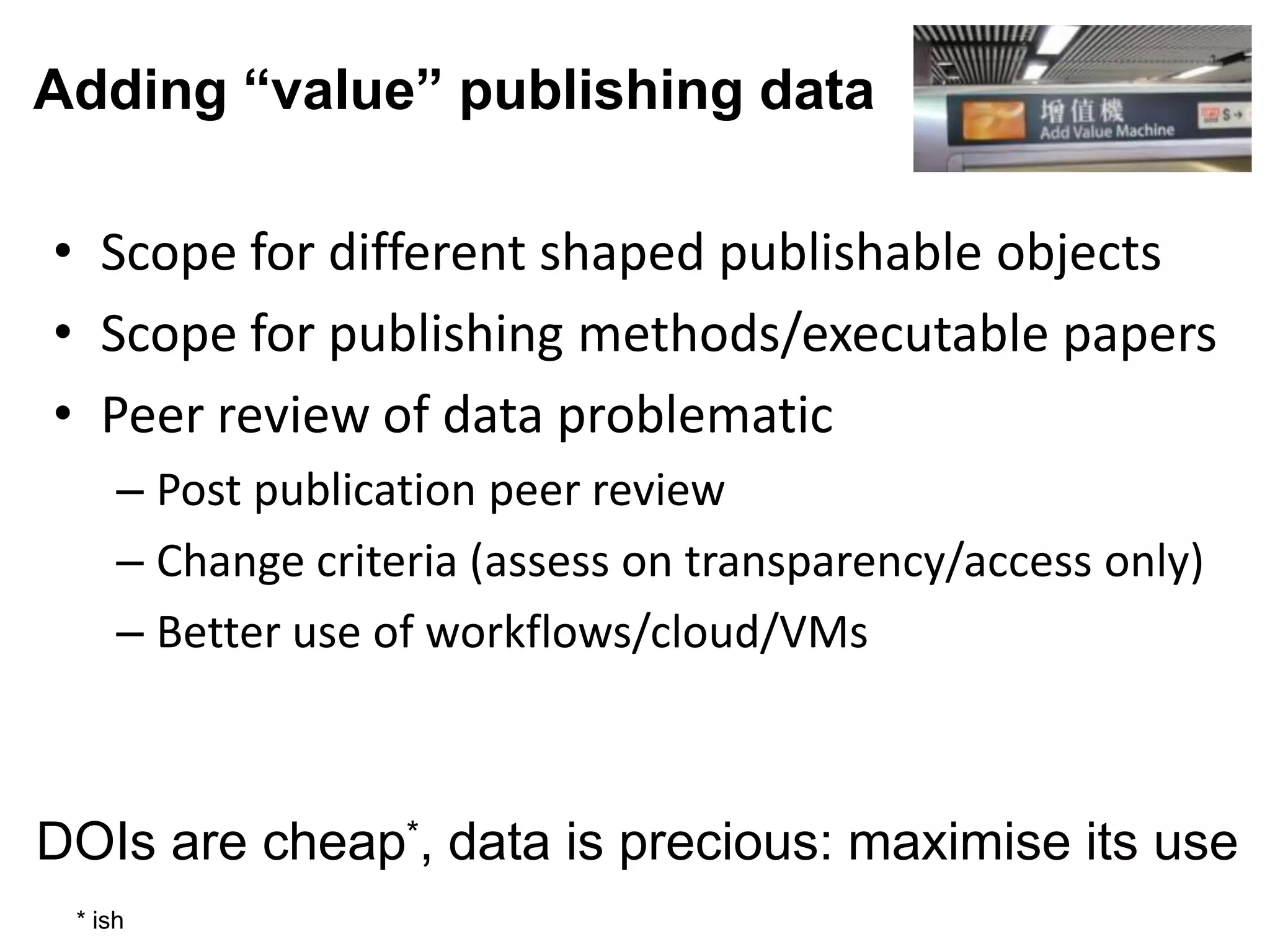
Adding “value” publishing data

• Scope for different shaped publishable objects
• Scope for publishing methods/executable papers
• Peer review of data problematic
     – Post publication peer review
     – Change criteria (assess on transparency/access only)
     – Better use of workflows/cloud/VMs


DOIs are cheap*, data is precious: maximise its use
 * ish
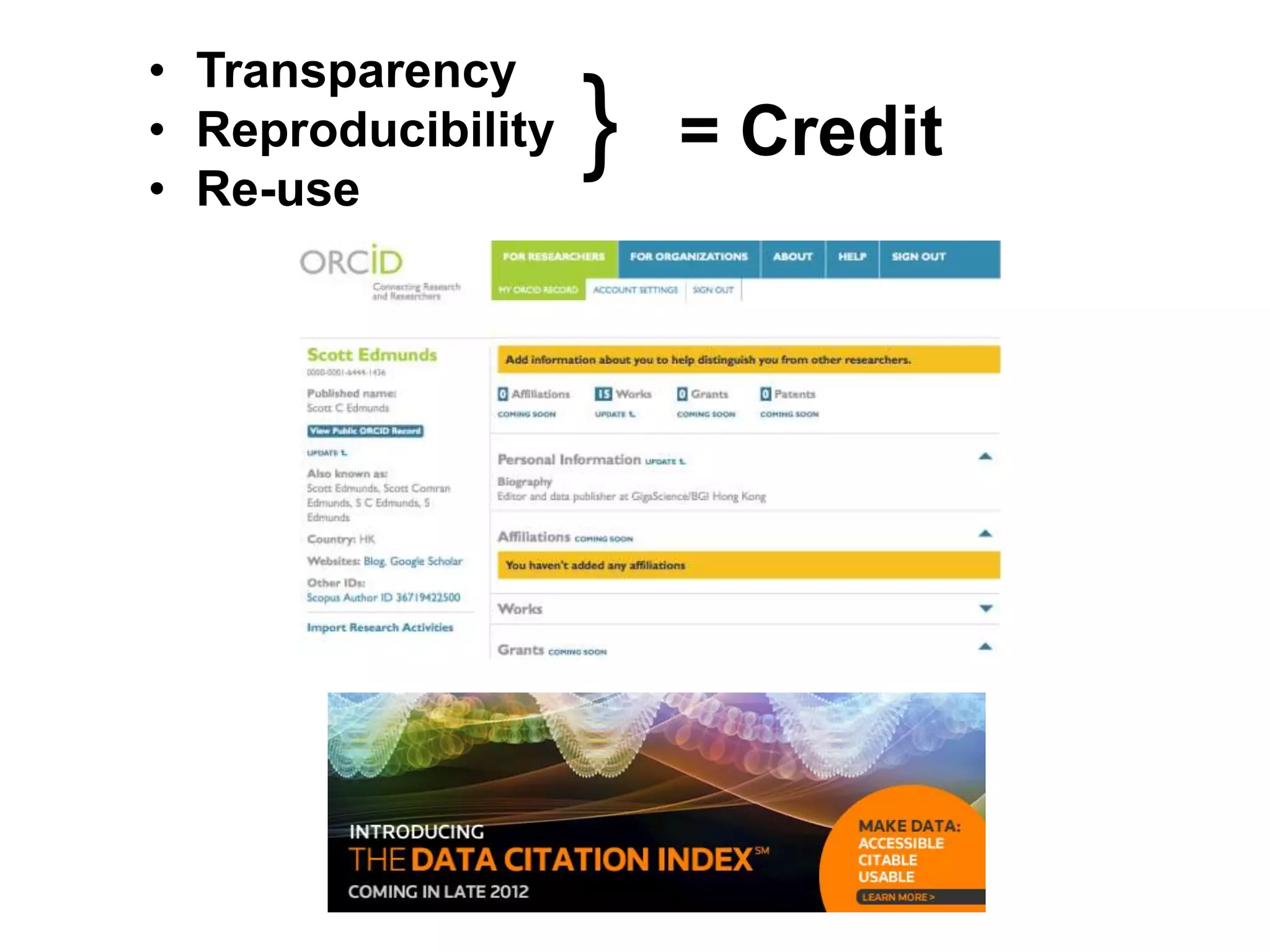
• Transparency
• Reproducibility
• Re-use
                    }   = Credit
Thanks to:               Shaoguang Liang (BGI-SZ)
Laurie Goodman           Tin-Lap Lee (CUHK)
Tam Sneddon              Huayen Gao (CUHK)
Nicole Nogoy             Qiong Luo (HKUST)
Alexandra Basford        Senghong Wang (HKUST)
Peter Li                 Yan Zhou (HKUST)
Jesse Si Zhe             Cogini
                           editorial@gigasciencejournal.com
Contact us:                database@gigasciencejournal.com

                            @gigascience

 Follow us:                 facebook.com/GigaScience

                            blogs.openaccesscentral.com/blogs/gigablog/

                   www.gigadb.org
              www.gigasciencejournal.com

Scott Edmunds: Channeling the Deluge: Reproducibility & Data Dissemination in the “Big-Data” Era

  • 1.
    Scott Edmunds, GigaScience/BGIHong Kong ICG7, Hong Kong, 1st December 2012 www.gigasciencejournal.com
  • 2.
    The challenges integratingpapers + data: Technical issues: •Data volumes: (1.2 zettabytes generated globally each year) •>Exponential growth of genomics data •Technical challenges (VMs/cloud, compression) Cultural issues: •Lack of incentives (Data DOIs) •Data licensing (CC-BY, CC0) •Journal/funder policies Source: 1. Mervis J. U.S. science policy. Agencies rally to tackle big data. Science. 2012 Apr 6;336(6077):22.
  • 3.
    The challenges integratingpapers + data: Technical issues: •Data volumes: (1.2 zettabytes generated globally each year) •>Exponential growth of genomics data •Technical challenges (VMs/cloud, compression) Cultural issues: •Lack of incentives (Data DOIs) •Data licensing (CC-BY, CC0) •Journal/funder policies Source: 1. Mervis J. U.S. science policy. Agencies rally to tackle big data. Science. 2012 Apr 6;336(6077):22. * T-Shirts available from Graham Steel / http://www.zazzle.co.uk/steelgraham
  • 4.
    Why is thisimportant? • Transparency • Reproducibility • Re-use “Faked research is endemic in China” Source: New Scientist, 17th Nov 2012: http://www.newscientist.com/article/mg21628910.300-fraud-fighter-faked-research-is-endemic-in-china.html
  • 5.
    Why is thisimportant? 475, 267 (2011) ―Wide distribution of information is key to scientific progress, yet traditionally, Chinese scientists have not systematically released data or research findings, even after publication.― ―There have been widespread complaints from scientists inside and outside China about this lack of transparency. ‖ ―Usually incomplete and unsystematic, [what little supporting data released] are of little value to researchers and there is evidence that this drives down a paper's citation numbers.‖ Source: Nature 475, 267 (2011) http://www.nature.com/news/2011/110720/full/475267a.html?
  • 6.
    Global Issue: increasingnumber of retractions >15X increase in last decade Strong correlation of ―retraction index‖ with higher impact factor 1. Science publishing: The trouble with retractions http://www.nature.com/news/2011/111005/full/478026a.html 2. Retracted Science and the Retraction Index ▿ http://iai.asm.org/content/79/10/3855.abstract?
  • 7.
    Global Issue: unrepeatabilityof scientific results Out of 18 microarray papers, results from 10 could not be reproduced Ioannidis et al., 2009. Repeatability of published microarray gene expression analyses. Nature Genetics 41: 149-155.
  • 8.
    Sharing aids authors… SharingDetailed Research Data Is Associated with Increased Citation Rate. Piwowar HA, Day RS, Fridsma DB (2007) PLoS ONE 2(3): e308. doi:10.1371/journal.pone.0000308 Every 10 datasets collected contributes to at least 4 papers in the following 3-years. Piwowar, HA, Vision, TJ, & Whitlock, MC (2011). Data archiving is a good investment Nature, 473 (7347), 285-285 DOI: 10.1038/473285a
  • 9.
    Rice v Wheat:consequences of publically available genome data. rice wheat 700 600 500 400 300 200 100 0
  • 10.
    Our first DOI: Tomaximize its utility to the research community and aid those fighting the current epidemic, genomic data is released here into the public domain under a CC0 license. Until the publication of research papers on the assembly and whole-genome analysis of this isolate we would ask you to cite this dataset as: Li, D; Xi, F; Zhao, M; Liang, Y; Chen, W; Cao, S; Xu, R; Wang, G; Wang, J; Zhang, Z; Li, Y; Cui, Y; Chang, C; Cui, C; Luo, Y; Qin, J; Li, S; Li, J; Peng, Y; Pu, F; Sun, Y; Chen,Y; Zong, Y; Ma, X; Yang, X; Cen, Z; Zhao, X; Chen, F; Yin, X; Song,Y ; Rohde, H; Li, Y; Wang, J; Wang, J and the Escherichia coli O104:H4 TY- 2482 isolate genome sequencing consortium (2011) Genomic data from Escherichia coli O104:H4 isolate TY-2482. BGI Shenzhen. doi:10.5524/100001 http://dx.doi.org/10.5524/100001 To the extent possible under law, BGI Shenzhen has waived all copyright and related or neighboring rights to Genomic Data from the 2011 E. coli outbreak. This work is published from: China.
  • 14.
    Downstream consequences: 1. Citations(~100) 2. Therapeutics (primers, antimicrobials) 3. Platform Comparisons 4. Example for faster & more open science ―Last summer, biologist Andrew Kasarskis was eager to help decipher the genetic origin of the Escherichia coli strain that infected roughly 4,000 people in Germany between May and July. But he knew it that might take days for the lawyers at his company — Pacific Biosciences — to parse the agreements governing how his team could use data collected on the strain. Luckily, one team had released its data under a Creative Commons licence that allowed free use of the data, allowing Kasarskis and his colleagues to join the international research effort and publish their work without wasting time on legal wrangling.‖
  • 15.
    1.3 The powerof intelligently open data The benefits of intelligently open data were powerfully illustrated by events following an outbreak of a severe gastro- intestinal infection in Hamburg in Germany in May 2011. This spread through several European countries and the US, affecting about 4000 people and resulting in over 50 deaths. All tested positive for an unusual and little-known Shiga-toxin–producing E. coli bacterium. The strain was initially analysed by scientists at BGI-Shenzhen in China, working together with those in Hamburg, and three days later a draft genome was released under an open data licence. This generated interest from bioinformaticians on four continents. 24 hours after the release of the genome it had been assembled. Within a week two dozen reports had been filed on an open- source site dedicated to the analysis of the strain. These analyses provided crucial information about the strain’s virulence and resistance genes – how it spreads and which antibiotics are effective against it. They produced results in time to help contain the outbreak. By July 2011, scientists published papers based on this work. By opening up their early sequencing results to international collaboration, researchers in Hamburg produced results that were quickly tested by a wide range of experts, used to produce new knowledge and ultimately to control a public health emergency.
  • 16.
    Not just (data)quantity, but quality 1. Lack of sufficient metadata 2. Lack of interoperability 1. Long tail of curation (“Democratization” of “Big-Data”)
  • 17.
    Not just (data)quantity, but quality Better handling of metadata… Novel tools/formats for data interoperability/handling. Cloud solutions?
  • 18.
    Not just (data)quantity, but quality Tools making work more easily reproducible… Interoperability/Ease of use Workflows Data quality assessment
  • 19.
    Large-Scale Data Journal/Database In conjunction with: Editor-in-Chief: Laurie Goodman, PhD Editor: Scott Edmunds, PhD Commisioning Editor: Nicole Nogoy, PhD Lead Curator: Tam Sneddon D.Phil Data Platform: Peter Li, PhD www.gigasciencejournal.com
  • 20.
    Addressing the reproducibilitygap: Computable methods/workflow systems Bioinformatics Development Biomedical and bioinformatics research Publishing
  • 21.
    Redefining what isa paper in the era of big-data? goal: Executable Research Objects Citable DOI
  • 22.
  • 23.
    Anatomy of aPublication Idea Study Metadata Data Analysis Answer
  • 24.
    Anatomy of aData Publication Idea Study Metadata Data Analysis Answer
  • 25.
    Publication • Background • Methods •Results (Data) • Conclusions/Discussion doi:10.1186/2047-217X-1-3
  • 26.
    Data Publication • Background • Methods • Results (Data) doi:10.5524/100035 • Conclusions/Discussion doi:10.1186/2047-217X-1-3
  • 27.
    Methods + Data + Publication • Background • Methods DOI for workflows? • Results (Data) doi:10.5524/100035 • Conclusions/Discussion doi:10.1186/2047-217X-1-3
  • 28.
    Data Methods Analysis doi:10.5524/100035 + DOI: x = doi:10.1186/2047-217X-1-3 DOI: A + DOI: X = DOI: 1
  • 29.
    Data Methods Analysis doi:10.5524/100035 + DOI: x = doi:10.1186/2047-217X-1-3 DOI: A + DOI: X = DOI: 1 DOI: B + DOI: X = DOI: 2
  • 30.
    Data Methods Analysis doi:10.5524/100035 + DOI: x = doi:10.1186/2047-217X-1-3 DOI: A + DOI: X = DOI: 1 DOI: B + DOI: X = DOI: 2 DOI: A + DOI: Y = DOI: 3
  • 31.
    Data Methods Analysis doi:10.5524/100035 + DOI: x = doi:10.1186/2047-217X-1-3 DOI: A + DOI: X = DOI: 1 DOI: B + DOI: X = DOI: 2 DOI: A + DOI: Y = DOI: 3 A, B, C… X, Y, Z… = 4, 5, 6…
  • 32.
    Different shaped publishableobjects Data Papers Executable (Methods) Papers Analysis Papers
  • 33.
    Different shaped publishableobjects Different levels of granularity Experiment e.g. doi:10.5524/100001 Papers (e.g. ACRG project) e.g. doi:10.5524/100001-2 Data/ Datasets Micropubs (e.g. cancer type) e.g. doi:10.5524/100001-2000 Sample or doi:10.5524/100001_xyz (e.g. specimen xyz) Smaller still? Facts/Assertions (~1014 in literature) Nanopubs
  • 34.
    Adding “value” publishingdata • Scope for different shaped publishable objects • Scope for publishing methods/executable papers • Peer review of data problematic – Post publication peer review – Change criteria (assess on transparency/access only) – Better use of workflows/cloud/VMs DOIs are cheap*, data is precious: maximise its use * ish
  • 35.
  • 36.
    Thanks to: Shaoguang Liang (BGI-SZ) Laurie Goodman Tin-Lap Lee (CUHK) Tam Sneddon Huayen Gao (CUHK) Nicole Nogoy Qiong Luo (HKUST) Alexandra Basford Senghong Wang (HKUST) Peter Li Yan Zhou (HKUST) Jesse Si Zhe Cogini editorial@gigasciencejournal.com Contact us: database@gigasciencejournal.com @gigascience Follow us: facebook.com/GigaScience blogs.openaccesscentral.com/blogs/gigablog/ www.gigadb.org www.gigasciencejournal.com

Editor's Notes

  • #21 Leading on from that, current and future plans include collaborating with Tin-Lap Lee at the Chinese University of Hong Kong to integrate an instance of the Galaxy bioinformatics platform with GigaDB so users can make full use of the data in GigaDB by linking it to other resources and we can incorporate fully executable papers. One such submission is a new SOAPdenovo pipeline. The SOAP tools have been wrapped in Galaxy, the workflow defined in MyExperiment and the data will be issued with a DOI and accessible via GigaDB. Utilizing the BGI cloud if necessary, users will then be able to reproduce all the steps described in the GigaScience paper to test, reanalyze, compare results etc.Since we would like GigaDB to be a host for data types that have no other home, such as imaging data, we are investigating adding other tools such as an image viewer and the like to support accessibility to and usability of the data. So, if you have a large-scale biological or biomedical dataset and/or a pipeline or software that you would like to submit to GigaScience we would love to hear from you so please come and talk to Scott or myself.
  • #37 That just leaves me to thank the GigaScience team: Laurie, Scott, Alexandra, Peter and Jesse, BGI for their support - specifically Shaoguang for IT and bioinformatics support – our collaborators on the database, website and tools: Tin-Lap, Qiong, Senhong, Yan, the Cogini web design team, Datacite for providing the DOI service and the isacommons team for their support and advocacy for best practice use of metadata reporting and sharing.Thank you for listening.