P U B L I C S P E A K I N G
“ A L L E Y E S O N M E ”
By André Harrell
P U B L I C
S P E A K I N G
• 1993 study done bypolling firm Bruskin-
Goldring, 45% of those surveyed said they
feared public speaking, 30% said they feared
death.
• In a study of 3,000 Americans published in
the Book of Lists (David Wallenchinsky, Little,
and Brown, 1995), the number one fear
cited by 41% of those studied wasspeaking
to an audience.
• Astudy by Ronald Seifert of the Behavioral
Institute of Atlanta indicated that as many as
40 million Americans hate speaking so much,
they’d do almost anything to avoid it.
P U B L I C
S P E A K I N G
( W O R K S H O P
G O A L )
To help the participant remove
apprehension and gain confidence
and sense of self that will help not
only the ability to speak in front of an
audience…but the assuredness that
her/his presence in any situation has
impact.
A G E N D A
• Day 1: Introduction Day
• Day 2: “What Makes A Good Speaker”
• Day 3: Mechanics Of Public Speaking
• Day 4: Preparing For Your Presentation
• Day 5: Practice Presentation Day
• Day 6: Official Presentation Day
• Day 7: Official Presentation Day cont.
• Day 8: Graduation Day
I N T R O D U C T I O N
( “ W H Y I S I T I M P O R T A N T ” )
• Important Form Of
Communication
• “First Impressions”
• Career/Occupation
• Self-Confidence!!
Q U E S T I O N ?
• What do you find especially
challenging about “Public Speaking”?
• What do you want to get out of this
course?
E X E R C I S E
“I Like Me Because”
D A Y 2
“ W H A T M A K E S A
G O O D P U B L I C
S P E A K E R ”
D A Y 2
What Makes A Good Public
Speaker?
G R E A T
P U B L I C
S P E A K I N G
R U L E S
• Knowledge (Knowledge Of Subject)
• Self-Confidence
• Enthusiasm
• Preparation
• Message
• Listening Skills
3 K I N D S O F
P U B L I C
S P E A K I N G
• Informing
• Persuading
• Entertaining
E X E R C I S E
“Getting To Know You”
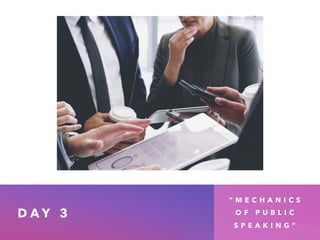
D A Y 3
“ M E C H A N I C S
O F P U B L I C
S P E A K I N G ”
D A Y 3
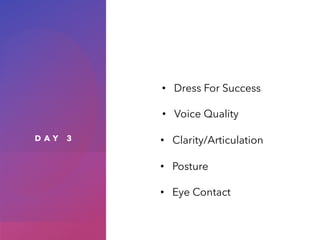
• Dress For Success
• Voice Quality
• Clarity/Articulation
• Posture
• Eye Contact
M E C H A N I C S
O F P U B L I C
S P E A K I N G
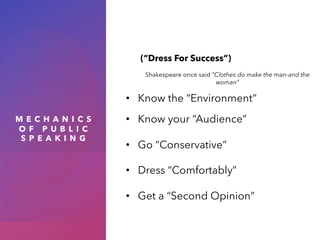
(“Dress For Success”)
Shakespeare once said “Clothes do make the man-and the
woman”
• Know the “Environment”
• Know your “Audience”
• Go “Conservative”
• Dress “Comfortably”
• Get a “Second Opinion”
V O I C E
Q U A L I T Y
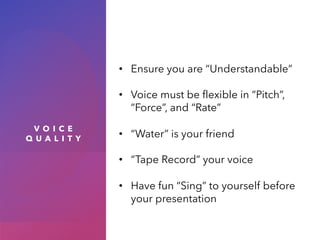
• Ensure you are “Understandable”
• Voice must be flexible in “Pitch”,
“Force”, and “Rate”
• “Water” is your friend
• “Tape Record” your voice
• Have fun “Sing” to yourself before
your presentation
C L A R I T Y &
A R T I C U L A T I O N
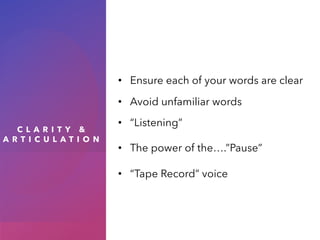
• Ensure each of your words are clear
• Avoid unfamiliar words
• “Listening”
• The power of the….”Pause”
• “Tape Record” voice
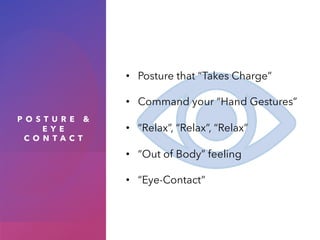
P O S T U R E &
E Y E
C O N T A C T
• Posture that “Takes Charge”
• Command your “Hand Gestures”
• “Relax”, “Relax”, “Relax”
• “Out of Body” feeling
• “Eye-Contact”
E X E R C I S E
“Table Topics”
D A Y 4
“ P R E P A R I N G
Y O U R
P R E S E N T A T I O N ”
D A Y 4
(“Preparing Your Presentation”)
• Know the room
• Know your audience
• Know the subject
• Visualize Your Presentation
• Create Your Presentation Outline
P R E S E N T A T I O N
O U T L I N E
(“Completing Presentation Outline”)
Reasons for the Outline:
• Builds the structure of your
presentation
• Helps to arrange your ideas
• Provides succinctness to your
thought process
• Helps to memorize the presentation
• Helps to prepare your presentation
E X E R C I S E
Presentation Structure For Next Class:
• 5-minute presentations
• Any topic you would like to discuss
• You can use cue cards (do not read off
them)
• We’ll choose a timer, “umms” counter,
presentation evaluator
• Cell phones off
• No sidebars
(“Practice Presentation Day”)
W E L C O M E
D A Y 5
“ P R A C T I C E
P R E S E N T A T I O N
D A Y ”
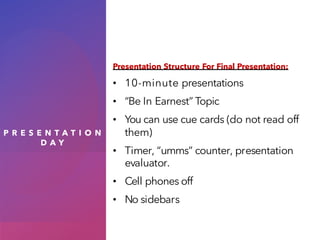
P R E S E N T A T I O N
D A Y
Presentation Structure For Final Presentation:
• 10-minute presentations
• “Be In Earnest” Topic
• You can use cue cards (do not read off
them)
• Timer, “umms” counter, presentation
evaluator.
• Cell phones off
• No sidebars
T H A N K
Y O U !
A N D R É H A R R E L L

PUBLIC SPEAKING WORKSHOP

  • 1.
    P U BL I C S P E A K I N G “ A L L E Y E S O N M E ” By André Harrell
  • 2.
    P U BL I C S P E A K I N G • 1993 study done bypolling firm Bruskin- Goldring, 45% of those surveyed said they feared public speaking, 30% said they feared death. • In a study of 3,000 Americans published in the Book of Lists (David Wallenchinsky, Little, and Brown, 1995), the number one fear cited by 41% of those studied wasspeaking to an audience. • Astudy by Ronald Seifert of the Behavioral Institute of Atlanta indicated that as many as 40 million Americans hate speaking so much, they’d do almost anything to avoid it.
  • 3.
    P U BL I C S P E A K I N G ( W O R K S H O P G O A L ) To help the participant remove apprehension and gain confidence and sense of self that will help not only the ability to speak in front of an audience…but the assuredness that her/his presence in any situation has impact.
  • 4.
    A G EN D A • Day 1: Introduction Day • Day 2: “What Makes A Good Speaker” • Day 3: Mechanics Of Public Speaking • Day 4: Preparing For Your Presentation • Day 5: Practice Presentation Day • Day 6: Official Presentation Day • Day 7: Official Presentation Day cont. • Day 8: Graduation Day
  • 5.
    I N TR O D U C T I O N ( “ W H Y I S I T I M P O R T A N T ” ) • Important Form Of Communication • “First Impressions” • Career/Occupation • Self-Confidence!!
  • 6.
    Q U ES T I O N ? • What do you find especially challenging about “Public Speaking”? • What do you want to get out of this course?
  • 7.
    E X ER C I S E “I Like Me Because”
  • 8.
    D A Y2 “ W H A T M A K E S A G O O D P U B L I C S P E A K E R ”
  • 9.
    D A Y2 What Makes A Good Public Speaker?
  • 10.
    G R EA T P U B L I C S P E A K I N G R U L E S • Knowledge (Knowledge Of Subject) • Self-Confidence • Enthusiasm • Preparation • Message • Listening Skills
  • 11.
    3 K IN D S O F P U B L I C S P E A K I N G • Informing • Persuading • Entertaining
  • 12.
    E X ER C I S E “Getting To Know You”
  • 13.
    D A Y3 “ M E C H A N I C S O F P U B L I C S P E A K I N G ”
  • 14.
    D A Y3 • Dress For Success • Voice Quality • Clarity/Articulation • Posture • Eye Contact
  • 15.
    M E CH A N I C S O F P U B L I C S P E A K I N G (“Dress For Success”) Shakespeare once said “Clothes do make the man-and the woman” • Know the “Environment” • Know your “Audience” • Go “Conservative” • Dress “Comfortably” • Get a “Second Opinion”
  • 16.
    V O IC E Q U A L I T Y • Ensure you are “Understandable” • Voice must be flexible in “Pitch”, “Force”, and “Rate” • “Water” is your friend • “Tape Record” your voice • Have fun “Sing” to yourself before your presentation
  • 17.
    C L AR I T Y & A R T I C U L A T I O N • Ensure each of your words are clear • Avoid unfamiliar words • “Listening” • The power of the….”Pause” • “Tape Record” voice
  • 18.
    P O ST U R E & E Y E C O N T A C T • Posture that “Takes Charge” • Command your “Hand Gestures” • “Relax”, “Relax”, “Relax” • “Out of Body” feeling • “Eye-Contact”
  • 19.
    E X ER C I S E “Table Topics”
  • 20.
    D A Y4 “ P R E P A R I N G Y O U R P R E S E N T A T I O N ”
  • 21.
    D A Y4 (“Preparing Your Presentation”) • Know the room • Know your audience • Know the subject • Visualize Your Presentation • Create Your Presentation Outline
  • 22.
    P R ES E N T A T I O N O U T L I N E (“Completing Presentation Outline”) Reasons for the Outline: • Builds the structure of your presentation • Helps to arrange your ideas • Provides succinctness to your thought process • Helps to memorize the presentation • Helps to prepare your presentation
  • 23.
    E X ER C I S E Presentation Structure For Next Class: • 5-minute presentations • Any topic you would like to discuss • You can use cue cards (do not read off them) • We’ll choose a timer, “umms” counter, presentation evaluator • Cell phones off • No sidebars (“Practice Presentation Day”)
  • 24.
    W E LC O M E D A Y 5 “ P R A C T I C E P R E S E N T A T I O N D A Y ”
  • 25.
    P R ES E N T A T I O N D A Y Presentation Structure For Final Presentation: • 10-minute presentations • “Be In Earnest” Topic • You can use cue cards (do not read off them) • Timer, “umms” counter, presentation evaluator. • Cell phones off • No sidebars
  • 26.
    T H AN K Y O U ! A N D R É H A R R E L L