Creating Customer Value
Workshops Book Prepared By André Harrell
The following workshop activities are unbranded and
designed to demonstrate AH2 Management
capability to tailor selling skill workshops that meet
your needs. Our organization prides itself on its
ability to be flexible and nimble to your specified
needs. The listed activities are just examples and
again can be constructed to meet your organization
and industry needs.
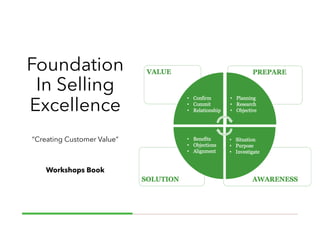
Foundation
In Selling
Excellence
“Creating Customer Value”
Workshops Book
Workshop#1
Sales Profession-Your View
Workshop #1
(Sales Profession-Your View)
Throughout all the modules, we will
review the fundamentals of “Creating
Customer Value” Selling Excellence.
Although every step of the sales model
will be studied in detail, we will
concentrate on building knowledge,
relationships, focusing on customer
needs, having empathy, and working
toward a Win/Win.
Workshop #1 (Sales Profession-Your View)
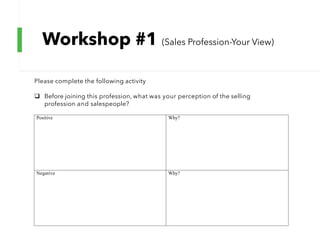
Please complete the following activity
q Before joining this profession, what was your perception of the selling
profession and salespeople?
Positive Why?
Negative Why?
Workshop #1 (Sales Profession-Your View)
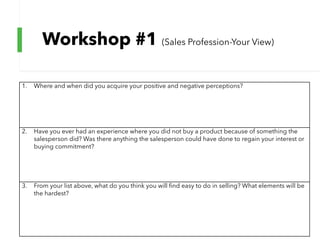
1. Where and when did you acquire your positive and negative perceptions?
2. Have you ever had an experience where you did not buy a product because of something the
salesperson did? Was there anything the salesperson could have done to regain your interest or
buying commitment?
3. From your list above, what do you think you will find easy to do in selling? What elements will be
the hardest?
Workshop #1 (Sales Profession-Your View)
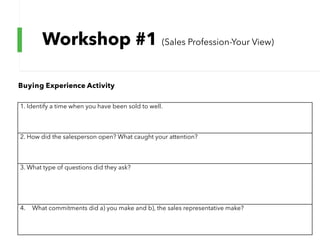
1. Identify a time when you have been sold to well.
2. How did the salesperson open? What caught your attention?
3. What type of questions did they ask?
4. What commitments did a) you make and b), the sales representative make?
Buying Experience Activity
Workshop#2
”Deeply understanding your
customer’s business”
Workshop #2
(Market & Customer
Knowledge)
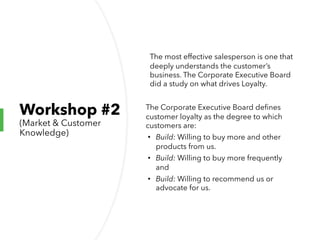
The most effective salesperson is one that
deeply understands the customer’s
business. The Corporate Executive Board
did a study on what drives Loyalty.
The Corporate Executive Board defines
customer loyalty as the degree to which
customers are:
• Build: Willing to buy more and other
products from us.
• Build: Willing to buy more frequently
and
• Build: Willing to recommend us or
advocate for us.
Workshop #2 (Market & Customer Knowledge)
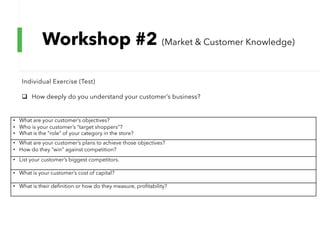
Individual Exercise (Test)
q How deeply do you understand your customer’s business?
• What are your customer’s objectives?
• Who is your customer’s “target shoppers”?
• What is the “role” of your category in the store?
• What are your customer’s plans to achieve those objectives?
• How do they “win” against competition?
• List your customer’s biggest competitors.
• What is your customer’s cost of capital?
• What is their definition or how do they measure, profitability?
Workshop #2 (Market & Customer Knowledge)
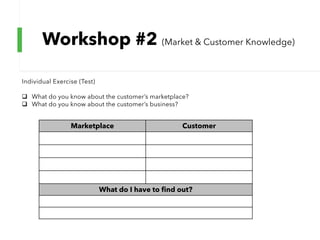
Individual Exercise (Test)
q What do you know about the customer’s marketplace?
q What do you know about the customer’s business?
Marketplace Customer
What do I have to find out?
Workshop #2 (Market & Customer Knowledge)
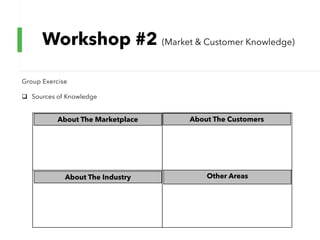
Group Exercise
q Sources of Knowledge
About The Marketplace
About The Industry
About The Customers
Other Areas
Workshop #2 (Market & Customer Knowledge)
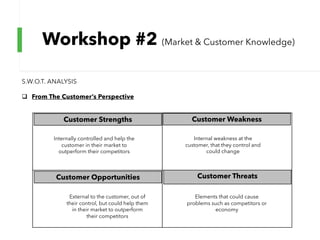
S.W.O.T. ANALYSIS
q From The Customer’s Perspective
Customer Strengths
Customer Opportunities
Customer Weakness
Customer Threats
Internally controlled and help the
customer in their market to
outperform their competitors
Internal weakness at the
customer, that they control and
could change
Elements that could cause
problems such as competitors or
economy
External to the customer, out of
their control, but could help them
in their market to outperform
their competitors
Workshop#3
”Identifying Your Value
Elements”
Workshop #3
(Identifying your Value
Elements)
Once you know your customer….
You can identify Value Elements that can
differentiate you from your competition….
• We’re moving from building a deep
customer understanding to how we use
that customer understanding to identify
value elements that differentiates us
from our competition.
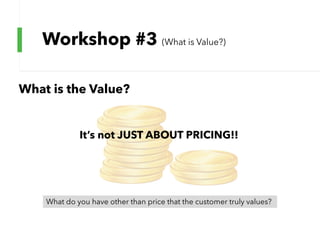
Workshop #3 (What is Value?)
What is the Value?
It’s not JUST ABOUT PRICING!!
What do you have other than price that the customer truly values?
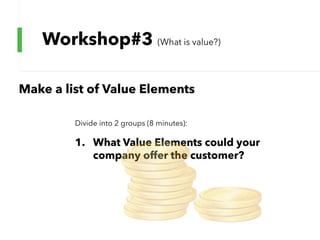
Workshop#3 (What is value?)
Make a list of Value Elements
Divide into 2 groups (8 minutes):
1. What Value Elements could your
company offer the customer?
Workshop#4
”Monetizing Value”
Workshop#4 (Monetizing Value)
Our next step is to monetize the value of the high priority value elements.
“Value is often in the eye of the beholder”
• How does value differ across customers?
• How does value differ inside the customer from level to level such as
procurement all the way up to the Chief Executive Officer?
• How does value differ over time (for example. A water bottle at a meeting versus
a water bottle in a very dry desert)?
Workshop#4 (Monetizing Value)
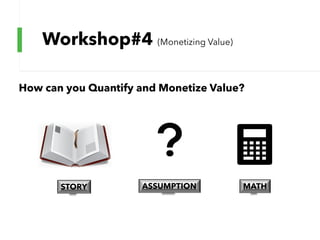
How can you Quantify and Monetize Value?
STORY ASSUMPTION MATH
Workshop#4 (Monetizing Value)
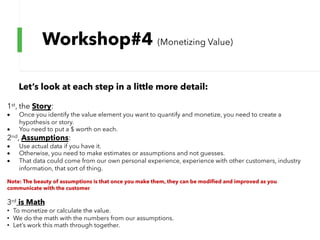
Let’s look at each step in a little more detail:
1st, the Story:
• Once you identify the value element you want to quantify and monetize, you need to create a
hypothesis or story.
• You need to put a $ worth on each.
2nd, Assumptions:
• Use actual data if you have it.
• Otherwise, you need to make estimates or assumptions and not guesses.
• That data could come from our own personal experience, experience with other customers, industry
information, that sort of thing.
Note: The beauty of assumptions is that once you make them, they can be modified and improved as you
communicate with the customer
3rd is Math
• To monetize or calculate the value.
• We do the math with the numbers from our assumptions.
• Let’s work this math through together.
Workshop#4 (Monetizing Value)
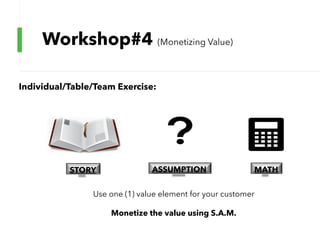
Individual/Table/Team Exercise:
STORY ASSUMPTION MATH
Use one (1) value element for your customer
Monetize the value using S.A.M.
Workshop#5
”How do we determine what
we will sell?”
Workshop#5 (How do we determine what we sell?)
We can determine what we must sell from a variety of sources:
1. For example, we ask ourselves “What does our company expect me to deliver?”
2. Another way is to think about it is what does the customer need? What are their
pain points? What are other opportunities or threats that they face, and we can
uniquely meet?
3. What’s important to my buyer? And how can I capitalize on what that buyer, or
the customer, might value?
4. What’s my plan?
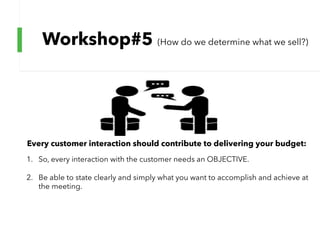
Workshop#5 (How do we determine what we sell?)
Every customer interaction should contribute to delivering your budget:
1. So, every interaction with the customer needs an OBJECTIVE.
2. Be able to state clearly and simply what you want to accomplish and achieve at
the meeting.
Workshop#5 (How do we determine what we sell?)
Individual/Table/Team Exercise:
Using your own customer:
Consider: your customer knowledge, value,
and your annual budget.
Prepare: a selling objective that you will be
developing (what do you want to
accomplish).
Share: with the team.
THANK YOU!
André Harrell
AH2 MANAGEMENT

CCV ACTIVITY WORKSHOP BOOK

  • 1.
    Creating Customer Value WorkshopsBook Prepared By André Harrell
  • 2.
    The following workshopactivities are unbranded and designed to demonstrate AH2 Management capability to tailor selling skill workshops that meet your needs. Our organization prides itself on its ability to be flexible and nimble to your specified needs. The listed activities are just examples and again can be constructed to meet your organization and industry needs.
  • 3.
  • 4.
  • 5.
    Workshop #1 (Sales Profession-YourView) Throughout all the modules, we will review the fundamentals of “Creating Customer Value” Selling Excellence. Although every step of the sales model will be studied in detail, we will concentrate on building knowledge, relationships, focusing on customer needs, having empathy, and working toward a Win/Win.
  • 6.
    Workshop #1 (SalesProfession-Your View) Please complete the following activity q Before joining this profession, what was your perception of the selling profession and salespeople? Positive Why? Negative Why?
  • 7.
    Workshop #1 (SalesProfession-Your View) 1. Where and when did you acquire your positive and negative perceptions? 2. Have you ever had an experience where you did not buy a product because of something the salesperson did? Was there anything the salesperson could have done to regain your interest or buying commitment? 3. From your list above, what do you think you will find easy to do in selling? What elements will be the hardest?
  • 8.
    Workshop #1 (SalesProfession-Your View) 1. Identify a time when you have been sold to well. 2. How did the salesperson open? What caught your attention? 3. What type of questions did they ask? 4. What commitments did a) you make and b), the sales representative make? Buying Experience Activity
  • 9.
  • 10.
    Workshop #2 (Market &Customer Knowledge) The most effective salesperson is one that deeply understands the customer’s business. The Corporate Executive Board did a study on what drives Loyalty. The Corporate Executive Board defines customer loyalty as the degree to which customers are: • Build: Willing to buy more and other products from us. • Build: Willing to buy more frequently and • Build: Willing to recommend us or advocate for us.
  • 11.
    Workshop #2 (Market& Customer Knowledge) Individual Exercise (Test) q How deeply do you understand your customer’s business? • What are your customer’s objectives? • Who is your customer’s “target shoppers”? • What is the “role” of your category in the store? • What are your customer’s plans to achieve those objectives? • How do they “win” against competition? • List your customer’s biggest competitors. • What is your customer’s cost of capital? • What is their definition or how do they measure, profitability?
  • 12.
    Workshop #2 (Market& Customer Knowledge) Individual Exercise (Test) q What do you know about the customer’s marketplace? q What do you know about the customer’s business? Marketplace Customer What do I have to find out?
  • 13.
    Workshop #2 (Market& Customer Knowledge) Group Exercise q Sources of Knowledge About The Marketplace About The Industry About The Customers Other Areas
  • 14.
    Workshop #2 (Market& Customer Knowledge) S.W.O.T. ANALYSIS q From The Customer’s Perspective Customer Strengths Customer Opportunities Customer Weakness Customer Threats Internally controlled and help the customer in their market to outperform their competitors Internal weakness at the customer, that they control and could change Elements that could cause problems such as competitors or economy External to the customer, out of their control, but could help them in their market to outperform their competitors
  • 15.
  • 16.
    Workshop #3 (Identifying yourValue Elements) Once you know your customer…. You can identify Value Elements that can differentiate you from your competition…. • We’re moving from building a deep customer understanding to how we use that customer understanding to identify value elements that differentiates us from our competition.
  • 17.
    Workshop #3 (Whatis Value?) What is the Value? It’s not JUST ABOUT PRICING!! What do you have other than price that the customer truly values?
  • 18.
    Workshop#3 (What isvalue?) Make a list of Value Elements Divide into 2 groups (8 minutes): 1. What Value Elements could your company offer the customer?
  • 19.
  • 20.
    Workshop#4 (Monetizing Value) Ournext step is to monetize the value of the high priority value elements. “Value is often in the eye of the beholder” • How does value differ across customers? • How does value differ inside the customer from level to level such as procurement all the way up to the Chief Executive Officer? • How does value differ over time (for example. A water bottle at a meeting versus a water bottle in a very dry desert)?
  • 21.
    Workshop#4 (Monetizing Value) Howcan you Quantify and Monetize Value? STORY ASSUMPTION MATH
  • 22.
    Workshop#4 (Monetizing Value) Let’slook at each step in a little more detail: 1st, the Story: • Once you identify the value element you want to quantify and monetize, you need to create a hypothesis or story. • You need to put a $ worth on each. 2nd, Assumptions: • Use actual data if you have it. • Otherwise, you need to make estimates or assumptions and not guesses. • That data could come from our own personal experience, experience with other customers, industry information, that sort of thing. Note: The beauty of assumptions is that once you make them, they can be modified and improved as you communicate with the customer 3rd is Math • To monetize or calculate the value. • We do the math with the numbers from our assumptions. • Let’s work this math through together.
  • 23.
    Workshop#4 (Monetizing Value) Individual/Table/TeamExercise: STORY ASSUMPTION MATH Use one (1) value element for your customer Monetize the value using S.A.M.
  • 24.
    Workshop#5 ”How do wedetermine what we will sell?”
  • 25.
    Workshop#5 (How dowe determine what we sell?) We can determine what we must sell from a variety of sources: 1. For example, we ask ourselves “What does our company expect me to deliver?” 2. Another way is to think about it is what does the customer need? What are their pain points? What are other opportunities or threats that they face, and we can uniquely meet? 3. What’s important to my buyer? And how can I capitalize on what that buyer, or the customer, might value? 4. What’s my plan?
  • 26.
    Workshop#5 (How dowe determine what we sell?) Every customer interaction should contribute to delivering your budget: 1. So, every interaction with the customer needs an OBJECTIVE. 2. Be able to state clearly and simply what you want to accomplish and achieve at the meeting.
  • 27.
    Workshop#5 (How dowe determine what we sell?) Individual/Table/Team Exercise: Using your own customer: Consider: your customer knowledge, value, and your annual budget. Prepare: a selling objective that you will be developing (what do you want to accomplish). Share: with the team.
  • 28.