Dott.ssa Giorgia Pizzuti︎
www.formazionedivina.it︎
“THE PURPOSE OF A SPEECH IS TO MAKE YOUR AUDIENCE
SEE WHAT YOU SAW, HEAR WHAT YOU HEARD,
FEEL WHAT YOU FELT” (D. Carnegie)
That means we know “why-how-what” moves people!


  jojopjopjoj	


  jojopjopjoj	


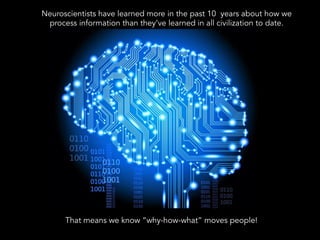
Neuroscientists have learned more in the past 10 years about how we
process information than they’ve learned in all civilization to date.
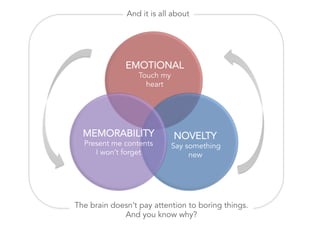
EMOTIONAL
Touch my
heart
NOVELTY
Say something
new
MEMORABILITY
Present me contents
I won’t forget
The brain doesn’t pay attention to boring things.
And you know why?
And it is all about
What we should know about how the brain
works so to be a successfull speaker
STIMULUS
THALAMUS
AMYGDALA
HIPPOCAMPUS
DELIBERATE/INTENTIONAL
REACTION
NEOCORTEX
PERCEPTION
ATTENTION
CNV - VC
AUTOMATIC REACTION
[EMOTIONS – BODY
MOVEMENTS]
ATTENTION	
  
[SRA]	
  
PERCEPTION	
  
MEMORY	
  
Memorizing	
  
Recalling	
  
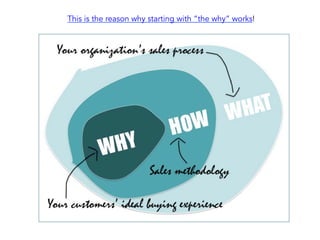
This is the reason why starting with “the why” works!
So how we work on the
“why-how-what” of a
presentation to make it
successfull?
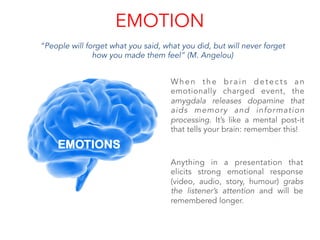
EMOTION
“People will forget what you said, what you did, but will never forget
how you made them feel” (M. Angelou)
When the brain detects an
emotionally charged event, the
amygdala releases dopamine that
aids memory and information
processing. It’s like a mental post-it
that tells your brain: remember this!
Anything in a presentation that
elicits strong emotional response
(video, audio, story, humour) grabs
the listener’s attention and will be
remembered longer.
EMOTIONS


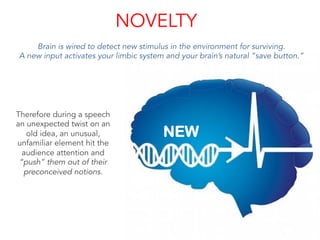
NOVELTY
Therefore during a speech
an unexpected twist on an
old idea, an unusual,
unfamiliar element hit the
audience attention and
“push” them out of their
preconceived notions.
Brain is wired to detect new stimulus in the environment for surviving.
A new input activates your limbic system and your brain’s natural “save button.”
NEW
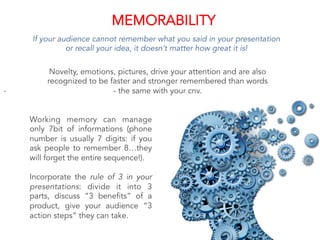
MEMORABILITY
.
If your audience cannot remember what you said in your presentation
or recall your idea, it doesn’t matter how great it is! 	
  
Novelty, emotions, pictures, drive your attention and are also
recognized to be faster and stronger remembered than words
- the same with your cnv.
Working memory can manage
only 7bit of informations (phone
number is usually 7 digits: if you
ask people to remember 8…they
will forget the entire sequence!).
Incorporate the rule of 3 in your
presentations: divide it into 3
parts, discuss “3 benefits” of a
product, give your audience “3
action steps” they can take.
According to what we have seen so far,
what are the best practices for a successfull presentation?
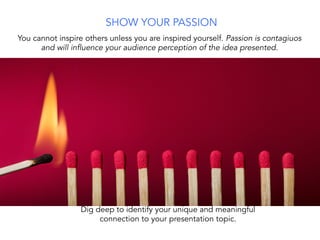
You cannot inspire others unless you are inspired yourself. Passion is contagiuos
and will influence your audience perception of the idea presented.
Dig deep to identify your unique and meaningful
connection to your presentation topic.
SHOW YOUR PASSION
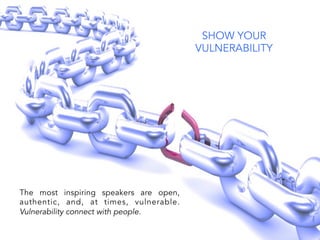
SHOW YOUR
VULNERABILITY
The most inspiring speakers are open,
authentic, and, at times, vulnerable.
Vulnerability connect with people.
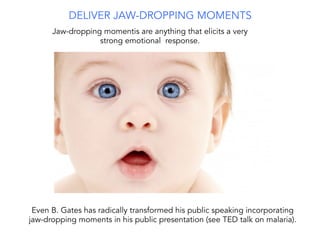
Jaw-dropping momentis are anything that elicits a very
strong emotional response.
DELIVER JAW-DROPPING MOMENTS
Even B. Gates has radically transformed his public speaking incorporating
jaw-dropping moments in his public presentation (see TED talk on malaria).
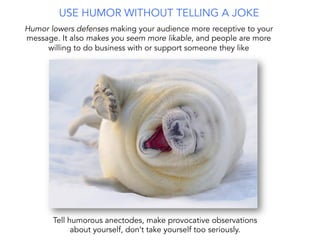
USE HUMOR WITHOUT TELLING A JOKE
Humor lowers defenses making your audience more receptive to your
message. It also makes you seem more likable, and people are more
willing to do business with or support someone they like
Tell humorous anectodes, make provocative observations
about yourself, don’t take yourself too seriously.
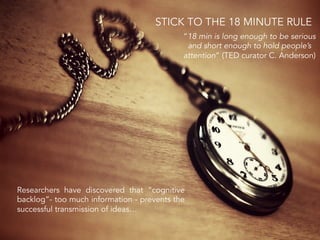
Researchers have discovered that “cognitive
backlog”- too much information - prevents the
successful transmission of ideas…
“18 min is long enough to be serious
and short enough to hold people’s
attention” (TED curator C. Anderson)
STICK TO THE 18 MINUTE RULE
..it makes the mental load on your audience heavier and
heavier…until they forget everything you said.
Whenever you “feel” it is
n e e d e d . C h e c k y o u r
audience body languagge to
get when it’s the right time!
HAVE A BREAK
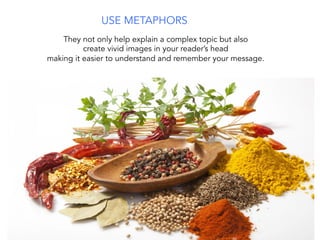
USE METAPHORS
They not only help explain a complex topic but also
create vivid images in your reader’s head
making it easier to understand and remember your message.
Metaphors engage the right brain by-passing rationality and
lowering defenses – just like stories…
“Wine is the poetry of the earth”
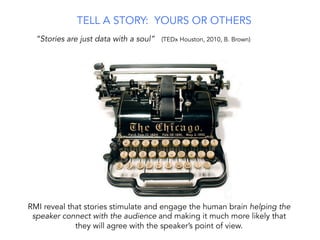
RMI reveal that stories stimulate and engage the human brain helping the
speaker connect with the audience and making it much more likely that
they will agree with the speaker’s point of view.
“Stories are just data with a soul” (TEDx Houston, 2010, B. Brown)
TELL A STORY: YOURS OR OTHERS
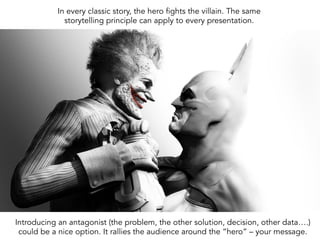
In every classic story, the hero fights the villain. The same
storytelling principle can apply to every presentation.
Introducing an antagonist (the problem, the other solution, decision, other data….)
could be a nice option. It rallies the audience around the “hero” – your message.
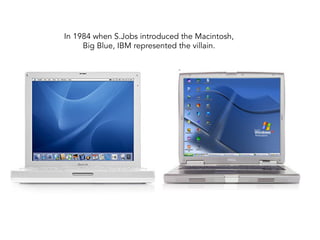
In 1984 when S.Jobs introduced the Macintosh,
Big Blue, IBM represented the villain.
“Best speakers give you the impression
to ad lib their speeches…
…as a matter of fact they set up everything
in detail” (J.F. Kennedy)
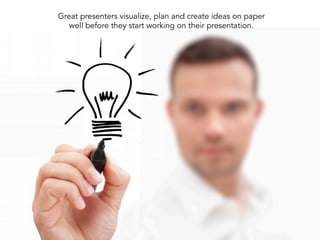
Great presenters visualize, plan and create ideas on paper
well before they start working on their presentation.
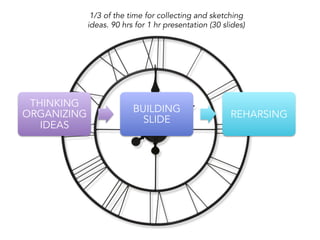
THINKING
ORGANIZING
IDEAS
BUILDING
SLIDE
REHARSING
1/3 of the time for collecting and sketching
ideas. 90 hrs for 1 hr presentation (30 slides)
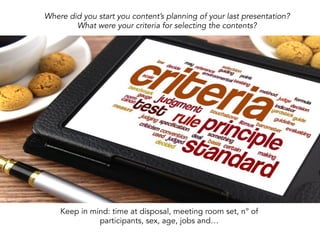
Where did you start you content’s planning of your last presentation?
What were your criteria for selecting the contents?
Keep in mind: time at disposal, meeting room set, n° of
participants, sex, age, jobs and…
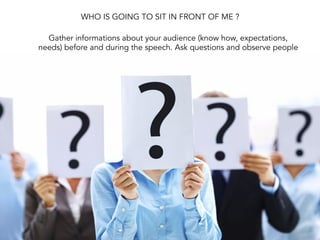
Gather informations about your audience (know how, expectations,
needs) before and during the speech. Ask questions and observe people
WHO IS GOING TO SIT IN FRONT OF ME ?
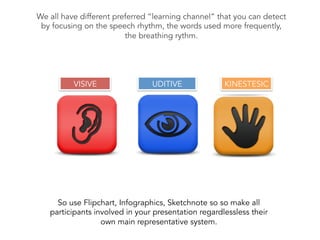
UDITIVEVISIVE KINESTESIC
We all have different preferred “learning channel” that you can detect
by focusing on the speech rhythm, the words used more frequently,
the breathing rythm.
So use Flipchart, Infographics, Sketchnote so so make all
participants involved in your presentation regardlessless their
own main representative system.
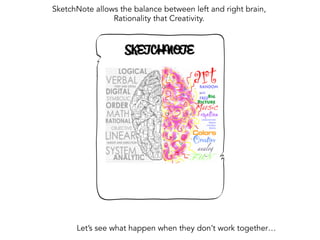
SketchNote allows the balance between left and right brain,
Rationality that Creativity.
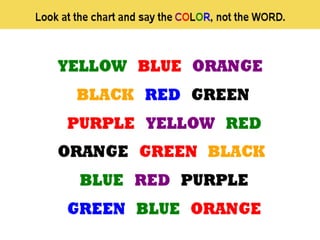
Let’s see what happen when they don’t work together…
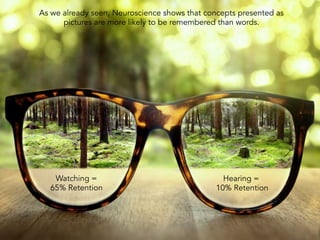
As we already seen, Neuroscience shows that concepts presented as
pictures are more likely to be remembered than words.
Hearing =
10% Retention
Watching =
65% Retention
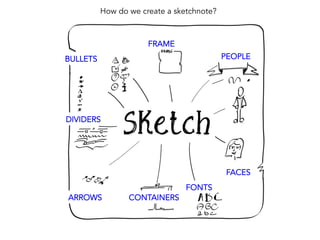
ARROWS
FONTS
FRAME
PEOPLE
FACES
BULLETS
DIVIDERS
CONTAINERS
How do we create a sketchnote?
BUILDING SLIDES: BEST PRACTICES
Create visually intriguing slides. Open up your creativity. Dare!
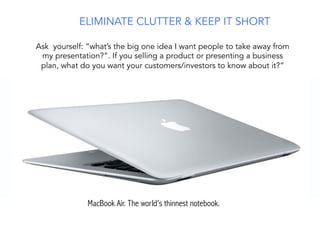
MacBook Air. The world’s thinnest notebook.
ELIMINATE CLUTTER & KEEP IT SHORT
Ask yourself: “what’s the big one idea I want people to take away from
my presentation?”. If you selling a product or presenting a business
plan, what do you want your customers/investors to know about it?”
If you can express it in 140 characther or less, you’ll help your audience
make sense of your presentation and how it will benefit them
THINK LIKE
Challenge yourself to use fewer words and more visuals.
It does take more thought…but it’s much more effective!
CREATE TWITTER-LIKE HEADLINES
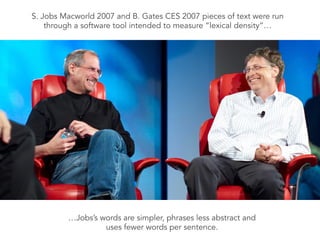
S. Jobs Macworld 2007 and B. Gates CES 2007 pieces of text were run
through a software tool intended to measure “lexical density”…
…Jobs’s words are simpler, phrases less abstract and
uses fewer words per sentence.
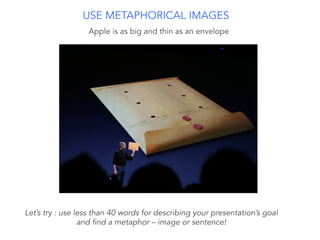
Apple is as big and thin as an envelope
USE METAPHORICAL IMAGES
Let’s try : use less than 40 words for describing your presentation’s goal
and find a metaphor – image or sentence!
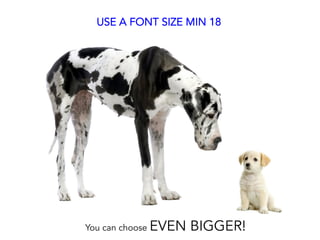
USE A FONT SIZE MIN 18
You can choose EVEN BIGGER!
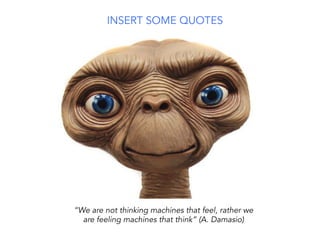
INSERT SOME QUOTES
“We are not thinking machines that feel, rather we
are feeling machines that think” (A. Damasio)
ADD A VIDEO (max 3-4’)	
  
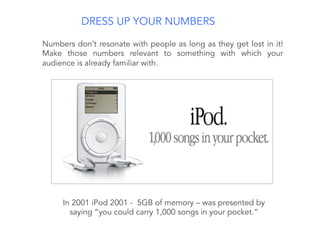
DRESS UP YOUR NUMBERS
Numbers don’t resonate with people as long as they get lost in it!
Make those numbers relevant to something with which your
audience is already familiar with.
In 2001 iPod 2001 - 5GB of memory – was presented by
saying “you could carry 1,000 songs in your pocket.”
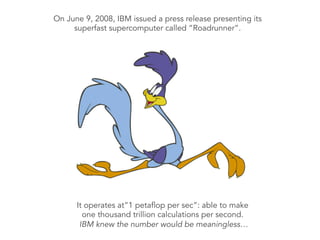
On June 9, 2008, IBM issued a press release presenting its
superfast supercomputer called “Roadrunner”.


It operates at”1 petaflop per sec”: able to make
one thousand trillion calculations per second.
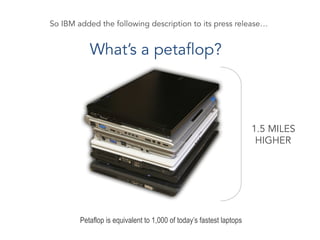
IBM knew the number would be meaningless…	
  
Petaflop is equivalent to 1,000 of today’s fastest laptops
1.5 MILES
HIGHER
So IBM added the following description to its press release…
What’s a petaflop?
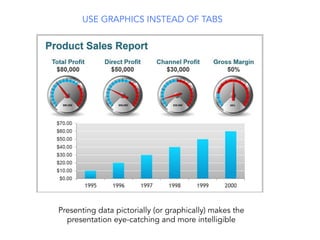
Presenting data pictorially (or graphically) makes the
presentation eye-catching and more intelligible
USE GRAPHICS INSTEAD OF TABS
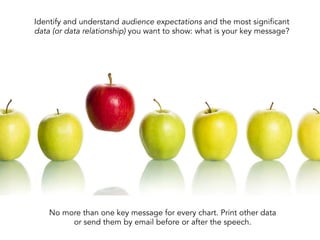
Identify and understand audience expectations and the most significant
data (or data relationship) you want to show: what is your key message?
	
  
No more than one key message for every chart. Print other data
or send them by email before or after the speech.
A lot of free creative software to make graphs available here!
http://www.creativebloq.com/design-tools/data-
visualization-712402
§  Keep in mind color resonance and use distinct but soft colors
§  Don’t use high contrast color combinations such as red/green
§  Keep it simple: don’t add unnecessary ornaments Use less than 6
colors in a single layout. The fewer the number of colours you use,
the better your chart becomes
§  Put a chart title that helps the reader to faster and better
understanding it
§  Do not use a legend when you have only one data series
§  When making pie charts, put the series name with the data labels
outside the pie itself. Do not create a legend. When using line
graphs, label the line graphs instead of putting a legend.
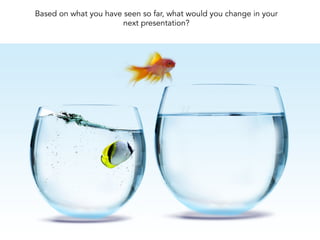
Based on what you have seen so far, what would you change in your
next presentation?
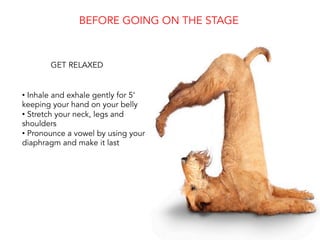
• Inhale and exhale gently for 5’
keeping your hand on your belly
• Stretch your neck, legs and
shoulders
• Pronounce a vowel by using your
diaphragm and make it last
BEFORE GOING ON THE STAGE
GET RELAXED
GET FOCUSED
• Remember your last successfull speech
• Immagine yourself well performing in next speech
• Listen to the music
Neuroscientists believe that 10,000 hours of practice is
required to become world class at a particular skill - whether
it’s surgery, shooting baskets or public speaking.
PRACTICE RESTLESSNLY 	
  
In front of a mirror or audio/video record it and watch it!
S.Jobs used to practice for 2 days before a presentation, asking for feedback.
“His sense of informality comes after grueling hours of practice.” Business week
Cdcs	


He wasn’t born a public speaker. In1984 launched the first Mactintosh and gave a
good presentation. But his style was stiff compared to that of 2007 when he
introduced the iPhone. We can say the same about B.Gates…and M.Renzi!
When is the last time you devoted hours of practice to a presentation?
THE OPENING
Now that you know how the brain works, you can easily
understand why it’s so difficult to change the first
impression you give the audience!
Why is it so important? Think about
watching a movie or reading a book…
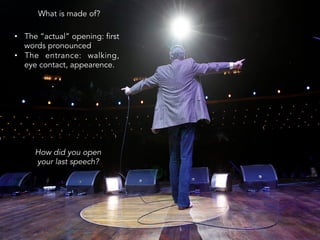
What is made of?
•  The “actual” opening: first
words pronounced
•  The entrance: walking,
eye contact, appearence.
How did you open
your last speech?
TYPICAL OPENING
“My name is…my job is..topic is”
Think about meeting people in a bar or a party…
…but what happen if he/she says “I have the sense to know you…
have we met before? I think we have a friend in common”
FIND SOMETHING IN COMMON WITH YOUR AUDIENCE
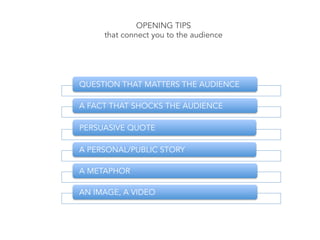
OPENING TIPS
that connect you to the audience
QUESTION THAT MATTERS THE AUDIENCE
A FACT THAT SHOCKS THE AUDIENCE
PERSUASIVE QUOTE
A PERSONAL/PUBLIC STORY
A METAPHOR
AN IMAGE, A VIDEO
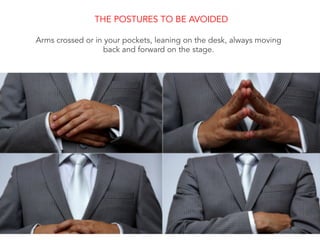
Arms crossed or in your pockets, leaning on the desk, always moving
back and forward on the stage.
THE POSTURES TO BE AVOIDED
HOW TO KEEP AUDIENCE
ATTENTION ALIVE
§ Talk to people using their first name
§ Ask people for personal experience or opinion
§ Tell a story and show your vulnerability
§ Alternate different technical device supports
§ Make an effective use of silence and break
§ Write down/quote audience experiences on a flipchart
NON VERBAL
COMMUNICATION
What does non verbal communication truly convey?
EXTENDS OR CONTRADICTS VERBAL CONTENTS
[SPEAKER TRUSTWORTHINESS]
SPREADS, COMMUNICATES EMOTIONS AND ENERGY
[AUDIENCE ENGAGEMENT, ATTENTION]
SHOWS HOW CONFIDENT WE ARE IN WHAT WE SAY
[PRESTIGE, GOOD STANDING]
GIVES INFO ABOUT THE RELATIONSHIP WITH OTHER
[RELATIONAL MESSAGGES]
INTIMATE	
  
[0-­‐/5	
  cm]	
  
PERSONAL	
  
[0,5/1,2	
  m]	
  
SOCIAL	
  
[1,2/3,5	
  m]	
  
PUBLIC	
  
[>3,5	
  m]	
  
PROXEMICS
Why it is so important?
What is made of?
We all know someone that we consider “intrusive” or “detached”.
We can use the same words to define different speakers depending on the way
they use the space around them during the speech.
§  LEVEL OF INTIMACY
§  HIERARCHY/ROLES
§  COLLABORATION/ANTAGONISM
[Restaurant - Meeting]
•  Use all the space you have at your disposal
•  Dont’ move up and down neither be static
•  Get closer/more distant to people according to their body language
•  If you can, arrange the seats in semicircle
PARAVERBAL
“VOICE” INSTRUMENT	
  
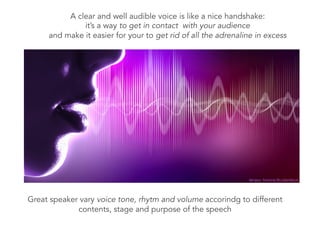
A clear and well audible voice is like a nice handshake:
it’s a way to get in contact with your audience
and make it easier for your to get rid of all the adrenaline in excess
Sdadas	


Great speaker vary voice tone, rhytm and volume accorindg to different
contents, stage and purpose of the speech
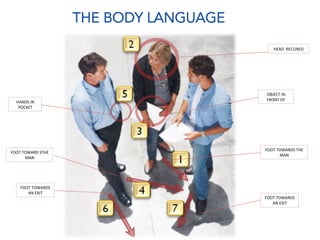
THE BODY LANGUAGE
HEAD	
  	
  RECLINED	
  
OBJECT	
  IN	
  
FRONT	
  OF	
  
FOOT	
  TOWARDS	
  THE	
  
MAN	
  
FOOT	
  TOWARDS	
  
AN	
  EXIT	
  
FOOT	
  TOWARDS	
  
AN	
  EXIT	
  
HANDS	
  IN	
  
POCKET	
  
FOOT	
  TOWARD	
  STHE	
  
MAN	
  
Why it is so important?
§  70/80% of the stimulus reach the brain through the
eyes vs 10/15% thourgh ears
§  As we have already learned, nvc can either amplify or
contraddict your verbal message
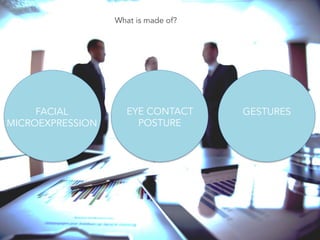
FACIAL
MICROEXPRESSION
EYE CONTACT
POSTURE
GESTURES
What is made of?
GESTURES
What gestures “say” and how to use them persuasively
Convey rhythm to what we say.


REGULATORY
EMBLEMATIC
Have a cultural shared meaning and replace verbal
communication [ok, shut up, back off etc.]
ILLUSTRATIVE Illustrate, clarify , or contraddict verbal contents.
[Self, Other, Objects]
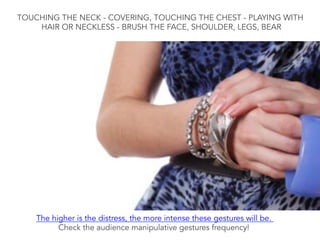
MANIPULATIVE
Idiosyncratic gestures that express anxiety,
discomfort, lack of self confidence, boredom
(audience attention index).
TOUCHING THE NECK - COVERING, TOUCHING THE CHEST - PLAYING WITH
HAIR OR NECKLESS - BRUSH THE FACE, SHOULDER, LEGS, BEAR
The higher is the distress, the more intense these gestures will be.
Check the audience manipulative gestures frequency!
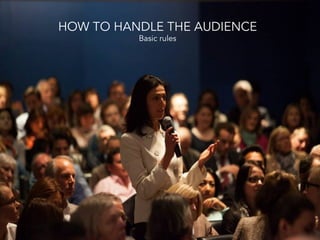
HOW TO HANDLE THE AUDIENCE
Basic rules
THE SILENT GUY
Try to engage him: “What do you think
about…? What is your opinion”
THE CHATTY GUY
Try to engage him in the discussion; Call for a break or
gently express your discomfort in a one-to-one chat
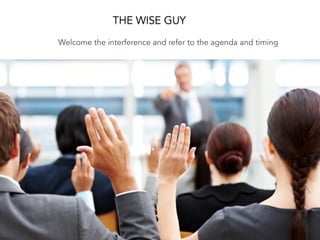
THE WISE GUY
Welcome the interference and refer to the agenda and timing
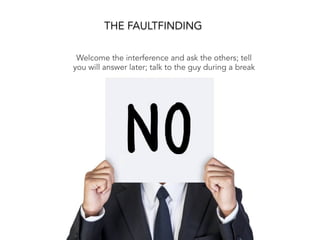
THE FAULTFINDING
Welcome the interference and ask the others; tell
you will answer later; talk to the guy during a break
ENDING A PRESENTATION
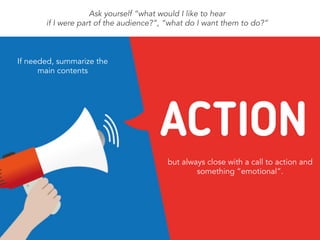
Ask yourself “what would I like to hear
if I were part of the audience?”, “what do I want them to do?”
If needed, summarize the
main contents
but always close with a call to action and
something “emotional”.
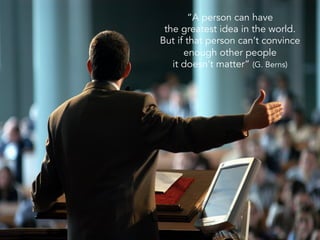
“A person can have
the greatest idea in the world.
But if that person can’t convince
enough other people
it doesn’t matter” (G. Berns)
IT.LINKEDIN/GIORGIAPIZZUTI
GIORGIAPIZZUTIBLOG.WORDPRESS.COM
WWW.FORMAZIONEDIVINA.IT

Public speaking English slideshare

  • 1.
  • 2.
    “THE PURPOSE OFA SPEECH IS TO MAKE YOUR AUDIENCE SEE WHAT YOU SAW, HEAR WHAT YOU HEARD, FEEL WHAT YOU FELT” (D. Carnegie)
  • 3.
    That means weknow “why-how-what” moves people!        jojopjopjoj            jojopjopjoj               Neuroscientists have learned more in the past 10 years about how we process information than they’ve learned in all civilization to date.
  • 4.
    EMOTIONAL Touch my heart NOVELTY Say something new MEMORABILITY Presentme contents I won’t forget The brain doesn’t pay attention to boring things. And you know why? And it is all about
  • 5.
    What we shouldknow about how the brain works so to be a successfull speaker
  • 6.
  • 7.
    ATTENTION   [SRA]   PERCEPTION   MEMORY   Memorizing   Recalling  
  • 8.
    This is thereason why starting with “the why” works!
  • 9.
    So how wework on the “why-how-what” of a presentation to make it successfull?
  • 10.
    EMOTION “People will forgetwhat you said, what you did, but will never forget how you made them feel” (M. Angelou) When the brain detects an emotionally charged event, the amygdala releases dopamine that aids memory and information processing. It’s like a mental post-it that tells your brain: remember this! Anything in a presentation that elicits strong emotional response (video, audio, story, humour) grabs the listener’s attention and will be remembered longer. EMOTIONS          
  • 11.
    NOVELTY Therefore during aspeech an unexpected twist on an old idea, an unusual, unfamiliar element hit the audience attention and “push” them out of their preconceived notions. Brain is wired to detect new stimulus in the environment for surviving. A new input activates your limbic system and your brain’s natural “save button.” NEW
  • 12.
    MEMORABILITY . If your audiencecannot remember what you said in your presentation or recall your idea, it doesn’t matter how great it is!   Novelty, emotions, pictures, drive your attention and are also recognized to be faster and stronger remembered than words - the same with your cnv. Working memory can manage only 7bit of informations (phone number is usually 7 digits: if you ask people to remember 8…they will forget the entire sequence!). Incorporate the rule of 3 in your presentations: divide it into 3 parts, discuss “3 benefits” of a product, give your audience “3 action steps” they can take.
  • 13.
    According to whatwe have seen so far, what are the best practices for a successfull presentation?
  • 14.
    You cannot inspireothers unless you are inspired yourself. Passion is contagiuos and will influence your audience perception of the idea presented. Dig deep to identify your unique and meaningful connection to your presentation topic. SHOW YOUR PASSION
  • 15.
    SHOW YOUR VULNERABILITY The mostinspiring speakers are open, authentic, and, at times, vulnerable. Vulnerability connect with people.
  • 16.
    Jaw-dropping momentis areanything that elicits a very strong emotional response. DELIVER JAW-DROPPING MOMENTS Even B. Gates has radically transformed his public speaking incorporating jaw-dropping moments in his public presentation (see TED talk on malaria).
  • 17.
    USE HUMOR WITHOUTTELLING A JOKE Humor lowers defenses making your audience more receptive to your message. It also makes you seem more likable, and people are more willing to do business with or support someone they like Tell humorous anectodes, make provocative observations about yourself, don’t take yourself too seriously.
  • 18.
    Researchers have discoveredthat “cognitive backlog”- too much information - prevents the successful transmission of ideas… “18 min is long enough to be serious and short enough to hold people’s attention” (TED curator C. Anderson) STICK TO THE 18 MINUTE RULE
  • 19.
    ..it makes themental load on your audience heavier and heavier…until they forget everything you said. Whenever you “feel” it is n e e d e d . C h e c k y o u r audience body languagge to get when it’s the right time! HAVE A BREAK
  • 20.
    USE METAPHORS They notonly help explain a complex topic but also create vivid images in your reader’s head making it easier to understand and remember your message.
  • 21.
    Metaphors engage theright brain by-passing rationality and lowering defenses – just like stories… “Wine is the poetry of the earth”
  • 22.
    RMI reveal thatstories stimulate and engage the human brain helping the speaker connect with the audience and making it much more likely that they will agree with the speaker’s point of view. “Stories are just data with a soul” (TEDx Houston, 2010, B. Brown) TELL A STORY: YOURS OR OTHERS
  • 23.
    In every classicstory, the hero fights the villain. The same storytelling principle can apply to every presentation. Introducing an antagonist (the problem, the other solution, decision, other data….) could be a nice option. It rallies the audience around the “hero” – your message.
  • 24.
    In 1984 whenS.Jobs introduced the Macintosh, Big Blue, IBM represented the villain.
  • 25.
    “Best speakers giveyou the impression to ad lib their speeches… …as a matter of fact they set up everything in detail” (J.F. Kennedy)
  • 26.
    Great presenters visualize,plan and create ideas on paper well before they start working on their presentation.
  • 27.
    THINKING ORGANIZING IDEAS BUILDING SLIDE REHARSING 1/3 of thetime for collecting and sketching ideas. 90 hrs for 1 hr presentation (30 slides)
  • 28.
    Where did youstart you content’s planning of your last presentation? What were your criteria for selecting the contents? Keep in mind: time at disposal, meeting room set, n° of participants, sex, age, jobs and…
  • 29.
    Gather informations aboutyour audience (know how, expectations, needs) before and during the speech. Ask questions and observe people WHO IS GOING TO SIT IN FRONT OF ME ?
  • 30.
    UDITIVEVISIVE KINESTESIC We allhave different preferred “learning channel” that you can detect by focusing on the speech rhythm, the words used more frequently, the breathing rythm. So use Flipchart, Infographics, Sketchnote so so make all participants involved in your presentation regardlessless their own main representative system.
  • 31.
    SketchNote allows thebalance between left and right brain, Rationality that Creativity. Let’s see what happen when they don’t work together…
  • 33.
    As we alreadyseen, Neuroscience shows that concepts presented as pictures are more likely to be remembered than words. Hearing = 10% Retention Watching = 65% Retention
  • 34.
  • 35.
    BUILDING SLIDES: BESTPRACTICES Create visually intriguing slides. Open up your creativity. Dare!
  • 36.
    MacBook Air. Theworld’s thinnest notebook. ELIMINATE CLUTTER & KEEP IT SHORT Ask yourself: “what’s the big one idea I want people to take away from my presentation?”. If you selling a product or presenting a business plan, what do you want your customers/investors to know about it?”
  • 37.
    If you canexpress it in 140 characther or less, you’ll help your audience make sense of your presentation and how it will benefit them THINK LIKE Challenge yourself to use fewer words and more visuals. It does take more thought…but it’s much more effective! CREATE TWITTER-LIKE HEADLINES
  • 38.
    S. Jobs Macworld2007 and B. Gates CES 2007 pieces of text were run through a software tool intended to measure “lexical density”… …Jobs’s words are simpler, phrases less abstract and uses fewer words per sentence.
  • 39.
    Apple is asbig and thin as an envelope USE METAPHORICAL IMAGES Let’s try : use less than 40 words for describing your presentation’s goal and find a metaphor – image or sentence!
  • 40.
    USE A FONTSIZE MIN 18 You can choose EVEN BIGGER!
  • 41.
    INSERT SOME QUOTES “Weare not thinking machines that feel, rather we are feeling machines that think” (A. Damasio)
  • 42.
    ADD A VIDEO(max 3-4’)  
  • 43.
    DRESS UP YOURNUMBERS Numbers don’t resonate with people as long as they get lost in it! Make those numbers relevant to something with which your audience is already familiar with. In 2001 iPod 2001 - 5GB of memory – was presented by saying “you could carry 1,000 songs in your pocket.”
  • 44.
    On June 9,2008, IBM issued a press release presenting its superfast supercomputer called “Roadrunner”.             It operates at”1 petaflop per sec”: able to make one thousand trillion calculations per second. IBM knew the number would be meaningless…  
  • 45.
    Petaflop is equivalentto 1,000 of today’s fastest laptops 1.5 MILES HIGHER So IBM added the following description to its press release… What’s a petaflop?
  • 48.
    Presenting data pictorially(or graphically) makes the presentation eye-catching and more intelligible USE GRAPHICS INSTEAD OF TABS
  • 49.
    Identify and understandaudience expectations and the most significant data (or data relationship) you want to show: what is your key message?   No more than one key message for every chart. Print other data or send them by email before or after the speech.
  • 50.
    A lot offree creative software to make graphs available here! http://www.creativebloq.com/design-tools/data- visualization-712402 §  Keep in mind color resonance and use distinct but soft colors §  Don’t use high contrast color combinations such as red/green §  Keep it simple: don’t add unnecessary ornaments Use less than 6 colors in a single layout. The fewer the number of colours you use, the better your chart becomes §  Put a chart title that helps the reader to faster and better understanding it §  Do not use a legend when you have only one data series §  When making pie charts, put the series name with the data labels outside the pie itself. Do not create a legend. When using line graphs, label the line graphs instead of putting a legend.
  • 51.
    Based on whatyou have seen so far, what would you change in your next presentation?
  • 52.
    • Inhale and exhalegently for 5’ keeping your hand on your belly • Stretch your neck, legs and shoulders • Pronounce a vowel by using your diaphragm and make it last BEFORE GOING ON THE STAGE GET RELAXED
  • 53.
    GET FOCUSED • Remember yourlast successfull speech • Immagine yourself well performing in next speech • Listen to the music
  • 54.
    Neuroscientists believe that10,000 hours of practice is required to become world class at a particular skill - whether it’s surgery, shooting baskets or public speaking. PRACTICE RESTLESSNLY   In front of a mirror or audio/video record it and watch it!
  • 55.
    S.Jobs used topractice for 2 days before a presentation, asking for feedback. “His sense of informality comes after grueling hours of practice.” Business week Cdcs                     He wasn’t born a public speaker. In1984 launched the first Mactintosh and gave a good presentation. But his style was stiff compared to that of 2007 when he introduced the iPhone. We can say the same about B.Gates…and M.Renzi! When is the last time you devoted hours of practice to a presentation?
  • 56.
  • 57.
    Now that youknow how the brain works, you can easily understand why it’s so difficult to change the first impression you give the audience! Why is it so important? Think about watching a movie or reading a book…
  • 58.
    What is madeof? •  The “actual” opening: first words pronounced •  The entrance: walking, eye contact, appearence. How did you open your last speech?
  • 59.
    TYPICAL OPENING “My nameis…my job is..topic is” Think about meeting people in a bar or a party…
  • 60.
    …but what happenif he/she says “I have the sense to know you… have we met before? I think we have a friend in common” FIND SOMETHING IN COMMON WITH YOUR AUDIENCE
  • 61.
    OPENING TIPS that connectyou to the audience QUESTION THAT MATTERS THE AUDIENCE A FACT THAT SHOCKS THE AUDIENCE PERSUASIVE QUOTE A PERSONAL/PUBLIC STORY A METAPHOR AN IMAGE, A VIDEO
  • 62.
    Arms crossed orin your pockets, leaning on the desk, always moving back and forward on the stage. THE POSTURES TO BE AVOIDED
  • 63.
    HOW TO KEEPAUDIENCE ATTENTION ALIVE
  • 64.
    § Talk to peopleusing their first name § Ask people for personal experience or opinion § Tell a story and show your vulnerability § Alternate different technical device supports § Make an effective use of silence and break § Write down/quote audience experiences on a flipchart
  • 65.
  • 66.
    What does nonverbal communication truly convey? EXTENDS OR CONTRADICTS VERBAL CONTENTS [SPEAKER TRUSTWORTHINESS] SPREADS, COMMUNICATES EMOTIONS AND ENERGY [AUDIENCE ENGAGEMENT, ATTENTION] SHOWS HOW CONFIDENT WE ARE IN WHAT WE SAY [PRESTIGE, GOOD STANDING] GIVES INFO ABOUT THE RELATIONSHIP WITH OTHER [RELATIONAL MESSAGGES]
  • 67.
    INTIMATE   [0-­‐/5  cm]   PERSONAL   [0,5/1,2  m]   SOCIAL   [1,2/3,5  m]   PUBLIC   [>3,5  m]   PROXEMICS Why it is so important? What is made of?
  • 68.
    We all knowsomeone that we consider “intrusive” or “detached”. We can use the same words to define different speakers depending on the way they use the space around them during the speech. §  LEVEL OF INTIMACY §  HIERARCHY/ROLES §  COLLABORATION/ANTAGONISM [Restaurant - Meeting]
  • 69.
    •  Use allthe space you have at your disposal •  Dont’ move up and down neither be static •  Get closer/more distant to people according to their body language •  If you can, arrange the seats in semicircle
  • 70.
  • 71.
    A clear andwell audible voice is like a nice handshake: it’s a way to get in contact with your audience and make it easier for your to get rid of all the adrenaline in excess Sdadas                 Great speaker vary voice tone, rhytm and volume accorindg to different contents, stage and purpose of the speech
  • 72.
    THE BODY LANGUAGE HEAD    RECLINED   OBJECT  IN   FRONT  OF   FOOT  TOWARDS  THE   MAN   FOOT  TOWARDS   AN  EXIT   FOOT  TOWARDS   AN  EXIT   HANDS  IN   POCKET   FOOT  TOWARD  STHE   MAN  
  • 73.
    Why it isso important? §  70/80% of the stimulus reach the brain through the eyes vs 10/15% thourgh ears §  As we have already learned, nvc can either amplify or contraddict your verbal message
  • 74.
  • 75.
    GESTURES What gestures “say”and how to use them persuasively Convey rhythm to what we say.       REGULATORY EMBLEMATIC Have a cultural shared meaning and replace verbal communication [ok, shut up, back off etc.] ILLUSTRATIVE Illustrate, clarify , or contraddict verbal contents.
  • 76.
    [Self, Other, Objects] MANIPULATIVE Idiosyncraticgestures that express anxiety, discomfort, lack of self confidence, boredom (audience attention index).
  • 77.
    TOUCHING THE NECK- COVERING, TOUCHING THE CHEST - PLAYING WITH HAIR OR NECKLESS - BRUSH THE FACE, SHOULDER, LEGS, BEAR The higher is the distress, the more intense these gestures will be. Check the audience manipulative gestures frequency!
  • 78.
    HOW TO HANDLETHE AUDIENCE Basic rules
  • 79.
    THE SILENT GUY Tryto engage him: “What do you think about…? What is your opinion”
  • 80.
    THE CHATTY GUY Tryto engage him in the discussion; Call for a break or gently express your discomfort in a one-to-one chat
  • 81.
    THE WISE GUY Welcomethe interference and refer to the agenda and timing
  • 82.
    THE FAULTFINDING Welcome theinterference and ask the others; tell you will answer later; talk to the guy during a break
  • 83.
  • 84.
    Ask yourself “whatwould I like to hear if I were part of the audience?”, “what do I want them to do?” If needed, summarize the main contents but always close with a call to action and something “emotional”.
  • 85.
    “A person canhave the greatest idea in the world. But if that person can’t convince enough other people it doesn’t matter” (G. Berns)
  • 86.

Editor's Notes

  • #2  EMOTIONS FELT…MANAGED…CONVEYED.. STILL REMEMBER MY FIRTS TIME..WINE PFIZER..NOTHING WENT EXPECTED.. AND EACH TIME IT’S BIT STRESSING CAUSE IT IS A COURSE ON IT!! BEFORE GOING…EXPECTATIONS
  • #4 ALL ARE INTERCONETTED AS WE’LL SEE IN A MOMENT… WHY TALKING ABOUT NEUROSCIENZE?? BECAUSE IT’S ABOUT THE “THE WHY”: FIRST RULE IN EVERY SPEECH! WE ARE TALKING ABOUT EMOTIONAL-MEMORABL-NEW (1) CONTENTS (2) WAY TO PRESENT THEM
  • #7 EFFETTI DELLE EMOZIONI SULL’ATTENZIONE quindi SUL PROCESSO VALUTATIVO-DECISIONALE (PROGETTO O ANCHE COMPETENZE DI UNA PERSONA!) quando siamo ARRABBIATI: ridotta focalizzazione attenzione, meno sangue al cervello, minore percezione rischio.. Un PROGETTO/PROPOSTA/OFFERTA NON VIENE ANALIZZATA SOLO DALLA NOSTRA LOGICA (non esiste calcolo probabilità puro!)…COME ANCHE UNA PERSONA… SIAMO RAZIONALIZZATORI PIU CHE RAZIONALI.. MA CHE UTILITA’ C’E DUNQUE NEL PROVARE LE EMOZIONI SE CI POSSONO PORTARE, SEMREREBBE…, FUORI STRADA?
  • #8 SALSE LEADER START WITH THE WHY with the why question. they spend time understanding what their customers' buying experience can look like… the more likely they will delight them, and ultimately, the more successful they will be from a revenue generation perspective. consideration is put on the buying organization, and where, instead, everything is built from the selling organization's perspective.. IT’S NOT BY CHANCE I HAVE STARTED MY PRESENTATIO WITH NEUROSCIENCE: WHY DO BASIC OF PRESENTATION !
  • #12 THINK ABOUT EXPERIENTIAL-SENRSORIAL MARKETING ! AORMI-OLFATTO RULE OF 3: HOW DO YOU SPELL YOUR CELL PHONE NUMBER??
  • #14 Se non siete voi stessi ne risente il rapporto tra cv e cnv e non sarete considerati ne autorevoli ne affiabili IO QUANDO FACCIO CORSI SU RESILIENCE LO SONO !!
  • #15 Something that is jaw-dropping is extremely surprising, impressive, or shocking. Strabiliante . He made headlines when he released mosquitoes into the audience during a presentation on malaria.
  • #17 Or give one content every 20 minutes and make a break after 1h
  • #18 I AM FORCED TO HAVE COFFE BREAK AFTER 1 HOUR AND A HALF! I GOT FRUSTRATED WHEN I AM HELDING A COURSE AND HOTEL WAITRESS COME IN ASKING AT WHAT TIME WILL I DO THE COFFE BREAK: I DON’T KNOW! AUDIENCE WILL TELL ME WHEN TO STOP!!
  • #19  ALL ADVERTISIMENT IS ABOUT METAOHORS!!
  • #21 U. Hasson - Princeton University – makes research on storytelling by attaching electrodes to people. He finds that when somebody tells a story certain parts of the brain light up and the same regions are stimulated in the brains of those who are listening to the story. He calls it brain to “brain coupling”.
  • #23 Introducing an antagonist (the problem) rallies the audience around the hero.
  • #24 In 1984 when he introduced the Macintosh, Big Blue, IBM represented the villain.
  • #26 Truly great presenters like Steve Jobs visualize, plan and create ideas on paper (or whiteboards) well before they open the presentation software.
  • #27 Design experts recommend that presenters spend the majority of their time thinking, sketching and scripting. Nancy Duarte recommends that a presenter spend 90 hours creating an hour long presentation with 30 slides. But only one third of that time is spent building slides. Another third is rehearsing, but the first third is spent collecting ideas, organizing ideas, and sketching the story.
  • #28 WHAT KIND OF INFO DID YOU GATHERED BEFORE DOING A PRESENTATION? HAVE YOU EVER WRITTEN THEM DOWN?
  • #30 I SEE YOUR POINT OF YOU - IT SOUNDS GOOD – I HAVE THE SENSE THAT.. Chiudete gli occhi e immaginate un oggetto. Riuscite a vederne il colore, la luminosità, la dimensione, la forma, se è in movimento, vicino o lontano a voi, se è in 3D? Ora provate a sentire che suono farebbe se cadesse, che tipo di rumore è, che volume ha, da dove sembra provenire? Ora immaginate di toccarlo: di che materiale è fatto, com’è la superficie, che temperatura ha, quale consistenza? Quale dei 3 esercizi avete svolto con maggior semplicità?
  • #32 THINKING FAST…THINKING SLOW
  • #33 CONFLICT
  • #34 Obviuosly everyone has his own concept of intriguing!!
  • #35 You don’t need any drawing ability!
  • #37 Simplicity CLUTTER=DISORDINE A Steve Jobs presentation is strikingly simple, highly visual and completely devoid of bullet points. Steve Jobs always described his products in one sentence. Even before Twitter existed, Jobs’ product descriptions never exceeded 140 characters. CREATE SLIDES AS JOBS CREATE PRODUCT! HE MADE SIMPLICITY HIS MANTRA
  • #38 Pink about his new book, To Sell is Human. Pink is skilled at public speaking and had years of experience as a political speechwriter before he wrote books. When he prepares for a presentation he asks himself, SOME SAYS Average ppt 40 words
  • #42  LAST CELLPHONE I BOUGHT: 3 GB INTERNET TRAFFIC INCLUDED: MY QUESTION WAS “IS IT ENOUGH FOR ME???”
  • #43 What’s a petaflop? One thousand trillion calculations per second. IBM knew the number would be meaningless. It’s simply too big. So IBM added the following description to its press release:
  • #45  WHAT YOU SHOULD DO IF YOU REALLY NEED TO SHOW A LOT OF NUMBERS??
  • #48 THE POINT IS PRIORITIZING YOUR MESSAGES…AND SELECT THEM..THEN SELECT DATAT TO SHOW ARE YOU WORKING A PRESENTATION: LET’S SEE “WHAT’S THE RELATIONSH YOU WANT TO FOCUS ON?”
  • #50 BILL GATES TED’S TALK COME E’ CAMBIATO: SI PUO IMPARARE! USO HUMOR PRESENTAZIONE DATI E SLIDE BODY LANGUAGE
  • #53 LET’S PRACTICE !! I DO FOCUS ON MY BREATHING..LISTEN TO MUSIC…
  • #56 CAMMINATA BUSH-PUTIN
  • #59 Every 2 minutes the energy provided by the sun is equivalent to the whole usage of humanity in whole history THINK ABOUT PEOPLE U REMEMEBR AT A PARTY!! REISLIENZA, VINO!! SIA USO VIDEO CHE IMAGE
  • #62  WE HAVE ALREADLY IMPLCITILY SEEN: CAUSE ALL THINGS THAT ARE EASILY REMEMEBRES…HIT ATTENTION!!
  • #66  CHECK WELL PEOPLE REACTIONS TO YOUR APPROACHING !! IT ACTIVATES AMIGDALA…
  • #69  FEEDBACK UMBERTO SU MIO TONO QUANDO STRESSED OUT !! DO U KNOW DIFFERENCE BETWEEN VOLUME E TONO? WHICH YOU VARY EASILY MOST? WHAT WOULD YOU DEVEOP?
  • #72  THERE CULTURAL DIFFERENCES!!!
  • #76  IT ALWAYS HAS TO DO WITH --- WHAT HAPPEND DURING THE SPEECH ----- AUDIENCE REPONSES AND CHARACHTERISTICS ----- YOUR GOAL
  • #78 I WAS ABOUT TO DO A MARATHON…AND EVERYONE SHOCKED ABOUT RUNNING 42 KM
  • #79 I believe he improved substantially as a speaker every ten years. In 1974, Steve Jobs and his friend, Steve Wozniak would attend meetings of the Homebrew club, a computer hobbyist club in Silicon Valley. Together they started sharing their ideas and Apple was soon formed.
  • #80  MY GOAL WAS TO LEAVE YOU WITH SOMETHING: WHAT YOU TAKE BACK HOME? WHAT YOU LEAVE HERE?