


REVIEW OF POSTTRAUMATIC
STRESS DISORDER
DAVID EISENMAN, MD MSHS
UCLA SCHOOL OF MEDICINE
GRAND ROUNDS
PROVIDENCE HOLY CROSS
MEDICAL CENTER
SEPTEMBER 17, 2013
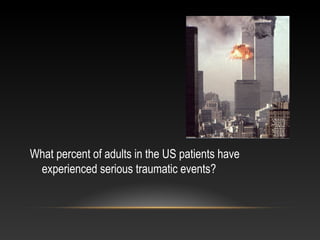
What percent of adults in the US patients have
experienced serious traumatic events?
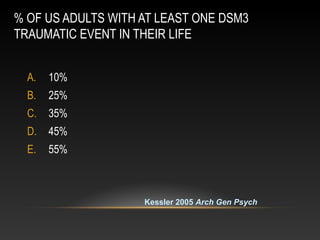
% OF US ADULTS WITH AT LEAST ONE DSM3
TRAUMATIC EVENT IN THEIR LIFE
A.

10%

B.

25%

C.

35%

D.

45%

E.

55%

Kessler 2005 Arch Gen Psych
IF YOU GUESSED

E. 55%
YOU’RE RIGHT!
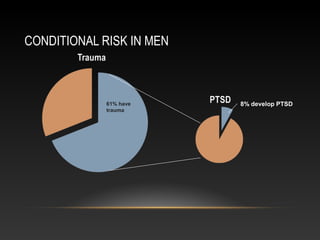
CONDITIONAL RISK IN MEN

61% have
trauma

8% develop PTSD
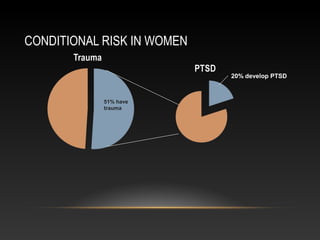
CONDITIONAL RISK IN WOMEN
20% develop PTSD

51% have
trauma
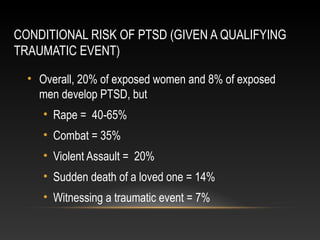
CONDITIONAL RISK OF PTSD (GIVEN A QUALIFYING
TRAUMATIC EVENT)
• Overall, 20% of exposed women and 8% of exposed
men develop PTSD, but
• Rape = 40-65%
• Combat = 35%
• Violent Assault = 20%
• Sudden death of a loved one = 14%
• Witnessing a traumatic event = 7%
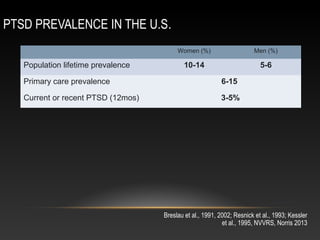
PTSD PREVALENCE IN THE U.S.
Women (%)

Population lifetime prevalence

Men (%)

10-14

5-6

Primary care prevalence

6-15

Current or recent PTSD (12mos)

3-5%

Breslau et al., 1991, 2002; Resnick et al., 1993; Kessler
et al., 1995, NVVRS, Norris 2013
EPIDEMIOLOGY TAKE HOMES….
• Exposure to potentially traumatic events is exceedingly
common
• Only a fraction of people exposed to a trauma develop
PTSD
• PTSD is a civilian disease
• Non-assaultive trauma is a common and real stressor in
the genesis of PTSD
PTSD CHANGES IN DSM 5
• Stressor criteria includes sexual assault and recurring
exposures to details
• Intense fear, helplessness or horror deleted
• 4 clusters instead of 3
DSM 5 POSTTRAUMATIC STRESS DISORDER
•
•
•
•
•
•
•

Stressor criterion
Intrusion symptoms
Hyperarousal symptoms
Avoidance
Cognition & mood
Duration criterion
Clinically significant impairment/distress

American Psychiatric Association (2013). Diagnostic and
Statistical Manual of Mental Disorders, 5th ed.
PTSD: STRESSOR CRITERION
• The person witnessed, experienced, or learned about a
traumatic event or events that involved actual or
threatened death or serious injury, or a threat to the
physical integrity of self or others
PTSD CRITERION: INTRUSION SYMPTOMS
• Trauma is persistently experienced in the following
ways (needs only 1):
• Recurrent, involuntary, intrusive memories
• Traumatic nightmares
• Flashbacks
• Intense distress after reminders
• Physiological reactivity on exposure to internal or
external cues that symbolize or resemble an aspect
of the traumatic event
PTSD CRITERION: AVOIDANCE SYMPTOMS
Persistent avoidance of stimuli associated with
the trauma (needs only 1):
Efforts to avoid thoughts, feelings, or conversations
associated with the trauma
Efforts to avoid activities, places, or people that arouse
recollections of the trauma
PTSD CRITERION: NEGATIVE ALTERATIONS IN
COGNITIONS AND MOOD (NEEDS 2)
• Unable to recall key features of trauma (not due to head
injury, alcohol or drugs)
• Negative beliefs about oneself or world
(distorted/persistent)
• Blame of self or others
• Negative trauma related emotions (anger, shame)
• Diminished interest in activities
• Alienated from others
• Constricted affect
PTSD CRITERION: HYPERAROUSAL SYMPTOMS
Increased arousal (needs 2):
1. Sleep disturbance
2. Irritability or aggressive behavior
3. Self-destructive/reckless behavior
4. Difficulty concentrating
5. Exaggerated startle response
6. Exaggerated startle response
PTSD: ADDITIONAL CRITERIA
• Duration of the disturbance is more than one month.
• The disturbance causes clinically significant distress or
impairment in social, occupational, or other important
areas of functioning.
PHYSICAL EXAM
• Evaluate possible medical sequelae of the trauma

• 10-15% of mild TBI develop post-concussive symptoms
(somatic, cognitive, and emotional) that overlap with
PTSD symptoms
• Rule out medical causes of PTSD symptoms
• No medical illnesses can produce all 4 types of PTSD
symptoms simultaneously; Focus the medical H&P on
the dominant PTSD symptom, e.g. sympathetic
hyperactivity
LABORATORY STUDIES
• TSH: Consider for all patients. Restlessness, insomnia,
and autonomic hyperactivity are common to both PTSD
and hyperthyroid states.
• T3 and T4 levels have been found to be elevated in
patients with PTSD. TSH levels are unaffected.
• Drug Screen: Consider for all patients. Substancerelated disorders are highly comorbid with PTSD.
LABORATORY STUDIES
• CT/MRI of head: Consider for patients with cognitive
deficits.
• Sleep Studies: Consider for patients with sleep symptoms
predating trauma exposure and patients with other
symptoms suggesting a primary sleep disorder (e.g., loud
snoring, excessive daytime sleepiness)
PATIENTS WHO HAVE EXPERIENCED A TRAUMA AND
HAVE SUFFICIENT SYMPTOMS ARE LIKELY TO HAVE
PTSD
• Exposure: “have you had any experience that was so frightening or
upsetting that it haunts you still?
• Physical reactions, nightmares, unwanted memories—resembles
acute anxiety
• Avoidance—they try not to think about it or go out of their way to
avoid reminders
• Numb or detached feeling—resembles depression
• Constantly on guard, watchful, startled easily—resembles
“paranoia” to the patient

PIER, ACP Online http://pier.acponline.org/physicians/public/d251/tables/d251-thp.html
The most common diagnosis missed is the second
diagnosis.
Sir William Osler
COMORBIDITY OF PTSD
• Majority w/PTSD have other diagnoses:~80-90%
• Depression
• Panic attacks and GAD
• Substance abuse (mostly men)
• Physical symptoms (somatization)

Brown et al., Journal of Abnormal Psychology, 2001
Hamner at al., Journal of Nervous and Mental Disease, 2000
Kessler et al., Archives of General Psychiatry, 1995
DEPRESSION AND PTSD
• Posttraumatic depression may occur without PTSD
• Depression more likely later in the course of PTSD
• Later in the course the patient may no longer meet criteria for
PTSD but may still have major depression
SUBSTANCE ABUSE AND PTSD
• At least 2 possible courses:
• PTSD before the Substance Abuse
• PTSD after the Substance Abuse
• Substance Abuse and PTSD likely to be hospitalized
more than Substance Abuse alone
• In veterans the incidence of concurrent substance
abuse is 60-80%
SUICIDE ASSESSMENT
• Particularly important in older adults, males, and
Veterans

Module 1:
Trauma,
PTSD, and
Health-27
DIAGNOSIS BULLETS
• Consider head trauma
• Consider the second diagnosis
• Ask about suicidal thoughts
IF IT APPEARS THAT A PATIENT DOES HAVE PTSD
•

Let the patient know that your evaluation does not mean that he or she definitely has PTSD,
but that you think further evaluation is needed.

•

Encourage the patient to voice any reservations or concerns he or she might have about
evaluation or treatment. You may be able to facilitate treatment by listening to these
concerns, acknowledging their validity, and addressing some of the patient's questions
about what to expect during mental health evaluation and treatment.

•

Make sure the patient understands that he or she is not crazy.

•

Normalize the idea of treatment. Explain that treatment involves common sense activities
that include learning more about PTSD, finding and practicing ways of coping with traumarelated symptoms and problems, taking steps to improve relationships with family and
friends, and making contact with other patients who experience similar problems.

•

Provide the patient with a written referral to a mental health professional

National Center for PTSD: PTSD Screening and Referral,
http://www.ptsd.va.gov/professional/pages/assessments/assessment.a
sp
TREATMENT CHOICES: MEDICATION,
PSYCHOTHERAPY, OR BOTH
• Initial treatment can be either pharmacotherapy or
psychotherapy
• Both approaches are efficacious, and each has
advantages and disadvantages
PSYCHOTHERAPIES
• Education and supportive
• Privacy, confidentiality
• Distress from traumas can effect the body, health
and mental health
• Caution before eliciting detailed trauma story
• Assess current safety
• Cognitive Processing Therapy
• Exposure-based treatments
• EMDR (eye movement desensitization reprocessing)
Patients with PTSD who are going to be treated with
medication should, with few exceptions, be prescribed
an SSRI or SNRI as their first medication.
SSRI AND SNRI
• SSRIs
• Paroxetine (Paxil), sertraline (Zoloft), fluoxetine (Prozac),
and citalopram (Celexa)
• Effective for comorbid depression, anxiety, insomnia,
social phobias
• SNRIs
• Venlafaxine
• May exacerbate hypertension
• Duloxetine
SSRI
• Some patients may demonstrate an initial worsening when
starting treatment
• In some cases, this may be due to activating/ anxiogenic
effects of the SSRIs (e.g., insomnia, agitation,
gastrointestinal distress)
• In other instances, it may be related to discussion of the
trauma and uncovering heretofore unaddressed feelings
and thoughts
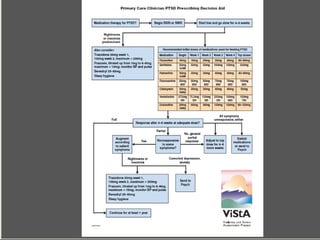
MEDICATION TRIAL
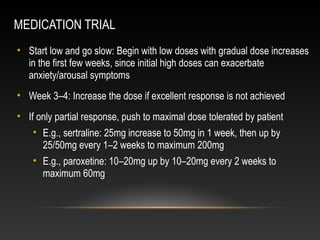
• Start low and go slow: Begin with low doses with gradual dose increases
in the first few weeks, since initial high doses can exacerbate
anxiety/arousal symptoms
• Week 3–4: Increase the dose if excellent response is not achieved
• If only partial response, push to maximal dose tolerated by patient
• E.g., sertraline: 25mg increase to 50mg in 1 week, then up by
25/50mg every 1–2 weeks to maximum 200mg
• E.g., paroxetine: 10–20mg up by 10–20mg every 2 weeks to
maximum 60mg
MEDICATION TRIAL
• Continue at maximal dose for 4–6 more weeks for a total of 8–12
weeks
• Treat for a minimum of one year
• If no response, then try another antidepressant
• If partial response, add other medications
WHAT TO TELL PATIENTS ABOUT ANTIDEPRESSANTS
• They are not like antibiotics
• They are not addictive
• The response is gradual
• Take the medications daily (don’t double up if you miss a day)
• Keep taking the medications even if you feel better
• Keep track of side effects, and discuss these with health care
providers
AVOID BENZODIAZEPINE MONOTHERAPY
• They do not control or eliminate the core features
of PTSD
• They can interfere with the cognitive processing of the trauma necessary for
psychotherapy to be successful
• No demonstrated benefit over placebo for PTSD-related sleep dysfunction
• Can produce dependence in PTSD patients who are prone to addiction
• Withdrawal may exacerbate PTSD symptoms
• Not recommended by VA/DoD Clinical Practice Guideline
Bernardy, N., PTSD Research Quarterly, 2013
MANAGING PTSD-RELATED INSOMNIA
• Sleep hygiene: Decrease caffeine, alcohol, etc.
• Antihistamines: Diphenhydramine (25–50mg)
• Antidepressants: Low dose trazodone 50mg to 100mg
after 1 week, up to 200mg
• Alpha-blocker: Prazosin, titrated up from 1–15mg, may
reduce nightmares and insomnia; monitor BP and pulse
• Non-BZD: Zolpidem
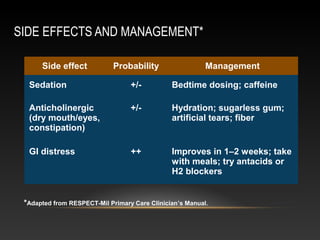
SIDE EFFECTS AND MANAGEMENT*
Side effect

Probability

Management

Sedation

+/-

Bedtime dosing; caffeine

Anticholinergic
(dry mouth/eyes,
constipation)

+/-

Hydration; sugarless gum;
artificial tears; fiber

GI distress

++

Improves in 1–2 weeks; take
with meals; try antacids or
H2 blockers

*Adapted from RESPECT-Mil Primary Care Clinician’s Manual.
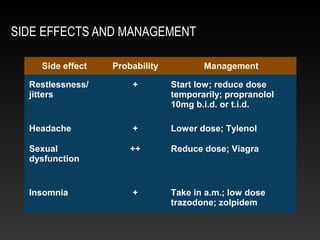
SIDE EFFECTS AND MANAGEMENT
Side effect

Probability

Management

Restlessness/
jitters

+

Start low; reduce dose
temporarily; propranolol
10mg b.i.d. or t.i.d.

Headache

+

Lower dose; Tylenol

Sexual
dysfunction

++

Reduce dose; Viagra

Insomnia

+

Take in a.m.; low dose
trazodone; zolpidem
MANAGEMENT BULLETS
• SSRIs are the first line treatment
• Start low and go slow
• Combine other medications as needed
David Eisenman, MD, MSHS
Director, UCLA Center for Public Health and Disasters
Associate Professor Medicine/Public Health at UCLA
RAND Associate Natural Scientist
Preparedness Science Officer, Los Angeles County
Department of Public Health
deisenman@mednet.ucla.edu
PC-PTSD: 4 ITEM SCREENER USED IN PRIMARY CARE
AND AT THE VA
• In your life, have you had any experience that was so frightening,
horrible, or upsetting that in the past month you:
• Had nightmares about it or thought about it when you didn’t
want to?
• Tried hard not to think about it or went out of your way to
avoid situations that reminded you of it?
• Were constantly on guard, watchful, or easily startled?
• Felt numb or detached from others or activities or
surroundings?
• “Positive” if answers yes to any three.

Prins, Primary Care Psychiatry, 2003

PTSD for Primary Care Providers under the new DSM

  • 1.
    REVIEW OF POSTTRAUMATIC STRESSDISORDER DAVID EISENMAN, MD MSHS UCLA SCHOOL OF MEDICINE GRAND ROUNDS PROVIDENCE HOLY CROSS MEDICAL CENTER SEPTEMBER 17, 2013
  • 2.
    What percent ofadults in the US patients have experienced serious traumatic events?
  • 3.
    % OF USADULTS WITH AT LEAST ONE DSM3 TRAUMATIC EVENT IN THEIR LIFE A. 10% B. 25% C. 35% D. 45% E. 55% Kessler 2005 Arch Gen Psych
  • 4.
  • 5.
  • 6.
    CONDITIONAL RISK INMEN 61% have trauma 8% develop PTSD
  • 7.
    CONDITIONAL RISK INWOMEN 20% develop PTSD 51% have trauma
  • 8.
    CONDITIONAL RISK OFPTSD (GIVEN A QUALIFYING TRAUMATIC EVENT) • Overall, 20% of exposed women and 8% of exposed men develop PTSD, but • Rape = 40-65% • Combat = 35% • Violent Assault = 20% • Sudden death of a loved one = 14% • Witnessing a traumatic event = 7%
  • 9.
    PTSD PREVALENCE INTHE U.S. Women (%) Population lifetime prevalence Men (%) 10-14 5-6 Primary care prevalence 6-15 Current or recent PTSD (12mos) 3-5% Breslau et al., 1991, 2002; Resnick et al., 1993; Kessler et al., 1995, NVVRS, Norris 2013
  • 10.
    EPIDEMIOLOGY TAKE HOMES…. •Exposure to potentially traumatic events is exceedingly common • Only a fraction of people exposed to a trauma develop PTSD • PTSD is a civilian disease • Non-assaultive trauma is a common and real stressor in the genesis of PTSD
  • 11.
    PTSD CHANGES INDSM 5 • Stressor criteria includes sexual assault and recurring exposures to details • Intense fear, helplessness or horror deleted • 4 clusters instead of 3
  • 12.
    DSM 5 POSTTRAUMATICSTRESS DISORDER • • • • • • • Stressor criterion Intrusion symptoms Hyperarousal symptoms Avoidance Cognition & mood Duration criterion Clinically significant impairment/distress American Psychiatric Association (2013). Diagnostic and Statistical Manual of Mental Disorders, 5th ed.
  • 13.
    PTSD: STRESSOR CRITERION •The person witnessed, experienced, or learned about a traumatic event or events that involved actual or threatened death or serious injury, or a threat to the physical integrity of self or others
  • 14.
    PTSD CRITERION: INTRUSIONSYMPTOMS • Trauma is persistently experienced in the following ways (needs only 1): • Recurrent, involuntary, intrusive memories • Traumatic nightmares • Flashbacks • Intense distress after reminders • Physiological reactivity on exposure to internal or external cues that symbolize or resemble an aspect of the traumatic event
  • 15.
    PTSD CRITERION: AVOIDANCESYMPTOMS Persistent avoidance of stimuli associated with the trauma (needs only 1): Efforts to avoid thoughts, feelings, or conversations associated with the trauma Efforts to avoid activities, places, or people that arouse recollections of the trauma
  • 16.
    PTSD CRITERION: NEGATIVEALTERATIONS IN COGNITIONS AND MOOD (NEEDS 2) • Unable to recall key features of trauma (not due to head injury, alcohol or drugs) • Negative beliefs about oneself or world (distorted/persistent) • Blame of self or others • Negative trauma related emotions (anger, shame) • Diminished interest in activities • Alienated from others • Constricted affect
  • 17.
    PTSD CRITERION: HYPERAROUSALSYMPTOMS Increased arousal (needs 2): 1. Sleep disturbance 2. Irritability or aggressive behavior 3. Self-destructive/reckless behavior 4. Difficulty concentrating 5. Exaggerated startle response 6. Exaggerated startle response
  • 18.
    PTSD: ADDITIONAL CRITERIA •Duration of the disturbance is more than one month. • The disturbance causes clinically significant distress or impairment in social, occupational, or other important areas of functioning.
  • 19.
    PHYSICAL EXAM • Evaluatepossible medical sequelae of the trauma • 10-15% of mild TBI develop post-concussive symptoms (somatic, cognitive, and emotional) that overlap with PTSD symptoms • Rule out medical causes of PTSD symptoms • No medical illnesses can produce all 4 types of PTSD symptoms simultaneously; Focus the medical H&P on the dominant PTSD symptom, e.g. sympathetic hyperactivity
  • 20.
    LABORATORY STUDIES • TSH:Consider for all patients. Restlessness, insomnia, and autonomic hyperactivity are common to both PTSD and hyperthyroid states. • T3 and T4 levels have been found to be elevated in patients with PTSD. TSH levels are unaffected. • Drug Screen: Consider for all patients. Substancerelated disorders are highly comorbid with PTSD.
  • 21.
    LABORATORY STUDIES • CT/MRIof head: Consider for patients with cognitive deficits. • Sleep Studies: Consider for patients with sleep symptoms predating trauma exposure and patients with other symptoms suggesting a primary sleep disorder (e.g., loud snoring, excessive daytime sleepiness)
  • 22.
    PATIENTS WHO HAVEEXPERIENCED A TRAUMA AND HAVE SUFFICIENT SYMPTOMS ARE LIKELY TO HAVE PTSD • Exposure: “have you had any experience that was so frightening or upsetting that it haunts you still? • Physical reactions, nightmares, unwanted memories—resembles acute anxiety • Avoidance—they try not to think about it or go out of their way to avoid reminders • Numb or detached feeling—resembles depression • Constantly on guard, watchful, startled easily—resembles “paranoia” to the patient PIER, ACP Online http://pier.acponline.org/physicians/public/d251/tables/d251-thp.html
  • 23.
    The most commondiagnosis missed is the second diagnosis. Sir William Osler
  • 24.
    COMORBIDITY OF PTSD •Majority w/PTSD have other diagnoses:~80-90% • Depression • Panic attacks and GAD • Substance abuse (mostly men) • Physical symptoms (somatization) Brown et al., Journal of Abnormal Psychology, 2001 Hamner at al., Journal of Nervous and Mental Disease, 2000 Kessler et al., Archives of General Psychiatry, 1995
  • 25.
    DEPRESSION AND PTSD •Posttraumatic depression may occur without PTSD • Depression more likely later in the course of PTSD • Later in the course the patient may no longer meet criteria for PTSD but may still have major depression
  • 26.
    SUBSTANCE ABUSE ANDPTSD • At least 2 possible courses: • PTSD before the Substance Abuse • PTSD after the Substance Abuse • Substance Abuse and PTSD likely to be hospitalized more than Substance Abuse alone • In veterans the incidence of concurrent substance abuse is 60-80%
  • 27.
    SUICIDE ASSESSMENT • Particularlyimportant in older adults, males, and Veterans Module 1: Trauma, PTSD, and Health-27
  • 28.
    DIAGNOSIS BULLETS • Considerhead trauma • Consider the second diagnosis • Ask about suicidal thoughts
  • 29.
    IF IT APPEARSTHAT A PATIENT DOES HAVE PTSD • Let the patient know that your evaluation does not mean that he or she definitely has PTSD, but that you think further evaluation is needed. • Encourage the patient to voice any reservations or concerns he or she might have about evaluation or treatment. You may be able to facilitate treatment by listening to these concerns, acknowledging their validity, and addressing some of the patient's questions about what to expect during mental health evaluation and treatment. • Make sure the patient understands that he or she is not crazy. • Normalize the idea of treatment. Explain that treatment involves common sense activities that include learning more about PTSD, finding and practicing ways of coping with traumarelated symptoms and problems, taking steps to improve relationships with family and friends, and making contact with other patients who experience similar problems. • Provide the patient with a written referral to a mental health professional National Center for PTSD: PTSD Screening and Referral, http://www.ptsd.va.gov/professional/pages/assessments/assessment.a sp
  • 30.
    TREATMENT CHOICES: MEDICATION, PSYCHOTHERAPY,OR BOTH • Initial treatment can be either pharmacotherapy or psychotherapy • Both approaches are efficacious, and each has advantages and disadvantages
  • 31.
    PSYCHOTHERAPIES • Education andsupportive • Privacy, confidentiality • Distress from traumas can effect the body, health and mental health • Caution before eliciting detailed trauma story • Assess current safety • Cognitive Processing Therapy • Exposure-based treatments • EMDR (eye movement desensitization reprocessing)
  • 32.
    Patients with PTSDwho are going to be treated with medication should, with few exceptions, be prescribed an SSRI or SNRI as their first medication.
  • 33.
    SSRI AND SNRI •SSRIs • Paroxetine (Paxil), sertraline (Zoloft), fluoxetine (Prozac), and citalopram (Celexa) • Effective for comorbid depression, anxiety, insomnia, social phobias • SNRIs • Venlafaxine • May exacerbate hypertension • Duloxetine
  • 34.
    SSRI • Some patientsmay demonstrate an initial worsening when starting treatment • In some cases, this may be due to activating/ anxiogenic effects of the SSRIs (e.g., insomnia, agitation, gastrointestinal distress) • In other instances, it may be related to discussion of the trauma and uncovering heretofore unaddressed feelings and thoughts
  • 35.
    MEDICATION TRIAL • Startlow and go slow: Begin with low doses with gradual dose increases in the first few weeks, since initial high doses can exacerbate anxiety/arousal symptoms • Week 3–4: Increase the dose if excellent response is not achieved • If only partial response, push to maximal dose tolerated by patient • E.g., sertraline: 25mg increase to 50mg in 1 week, then up by 25/50mg every 1–2 weeks to maximum 200mg • E.g., paroxetine: 10–20mg up by 10–20mg every 2 weeks to maximum 60mg
  • 36.
    MEDICATION TRIAL • Continueat maximal dose for 4–6 more weeks for a total of 8–12 weeks • Treat for a minimum of one year • If no response, then try another antidepressant • If partial response, add other medications
  • 37.
    WHAT TO TELLPATIENTS ABOUT ANTIDEPRESSANTS • They are not like antibiotics • They are not addictive • The response is gradual • Take the medications daily (don’t double up if you miss a day) • Keep taking the medications even if you feel better • Keep track of side effects, and discuss these with health care providers
  • 38.
    AVOID BENZODIAZEPINE MONOTHERAPY •They do not control or eliminate the core features of PTSD • They can interfere with the cognitive processing of the trauma necessary for psychotherapy to be successful • No demonstrated benefit over placebo for PTSD-related sleep dysfunction • Can produce dependence in PTSD patients who are prone to addiction • Withdrawal may exacerbate PTSD symptoms • Not recommended by VA/DoD Clinical Practice Guideline Bernardy, N., PTSD Research Quarterly, 2013
  • 39.
    MANAGING PTSD-RELATED INSOMNIA •Sleep hygiene: Decrease caffeine, alcohol, etc. • Antihistamines: Diphenhydramine (25–50mg) • Antidepressants: Low dose trazodone 50mg to 100mg after 1 week, up to 200mg • Alpha-blocker: Prazosin, titrated up from 1–15mg, may reduce nightmares and insomnia; monitor BP and pulse • Non-BZD: Zolpidem
  • 40.
    SIDE EFFECTS ANDMANAGEMENT* Side effect Probability Management Sedation +/- Bedtime dosing; caffeine Anticholinergic (dry mouth/eyes, constipation) +/- Hydration; sugarless gum; artificial tears; fiber GI distress ++ Improves in 1–2 weeks; take with meals; try antacids or H2 blockers *Adapted from RESPECT-Mil Primary Care Clinician’s Manual.
  • 41.
    SIDE EFFECTS ANDMANAGEMENT Side effect Probability Management Restlessness/ jitters + Start low; reduce dose temporarily; propranolol 10mg b.i.d. or t.i.d. Headache + Lower dose; Tylenol Sexual dysfunction ++ Reduce dose; Viagra Insomnia + Take in a.m.; low dose trazodone; zolpidem
  • 43.
    MANAGEMENT BULLETS • SSRIsare the first line treatment • Start low and go slow • Combine other medications as needed
  • 44.
    David Eisenman, MD,MSHS Director, UCLA Center for Public Health and Disasters Associate Professor Medicine/Public Health at UCLA RAND Associate Natural Scientist Preparedness Science Officer, Los Angeles County Department of Public Health deisenman@mednet.ucla.edu
  • 45.
    PC-PTSD: 4 ITEMSCREENER USED IN PRIMARY CARE AND AT THE VA • In your life, have you had any experience that was so frightening, horrible, or upsetting that in the past month you: • Had nightmares about it or thought about it when you didn’t want to? • Tried hard not to think about it or went out of your way to avoid situations that reminded you of it? • Were constantly on guard, watchful, or easily startled? • Felt numb or detached from others or activities or surroundings? • “Positive” if answers yes to any three. Prins, Primary Care Psychiatry, 2003

Editor's Notes

  • #14 The criterion that The person’s response involved intense fear, helplessness, or horror is gone.
  • #25 Very little study in this area, focus has been “pure” disease. Studies in place now seek to look at this. In to take caution in over generalizing these studies.
  • #31 Patient preference and/or special skills of the clinician may influence this choice. Comorbidity may influence the type of medication or psychotherapy prescribed Comorbidity may influence the choice of whether to use medication or psychotherapy Focus on Medications today: Feasible in primary care Co-occurs with other disorders that respond to medications
  • #37 Antidepressants only work if taken every day. Antidepressants are not addictive. Benefits from medication appear slowly. Continue antidepressants even after you feel better.
  • #39 (They can reduce anxiety and improve sleep, so they may be used for short-term adjunctive therapy)
  • #41 Mild side effects are common and usually improve with time. Wait and support. Some side effects will subside over one to two weeks (e.g., GI distress). Lower the dose temporarily. Treat the side effects (see next slide).