Anxiety Normal human emotion life without anxiety is not possible Exists on a continuum mild to severe
Anxiety  Operational Definition Expectations are held Expectations are not met Anxiety felt Automatic behavior Behavior is rationalized
Stress Resistance Internal locus of control Healthy lifestyle Regular exercise Balanced diet Social support
Symptoms of Anxiety Emotional Irritability Helplessness Social withdrawal Angry outbursts
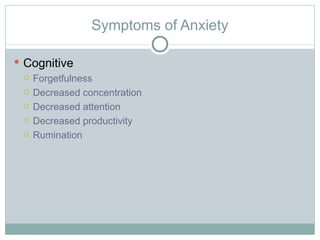
Symptoms of Anxiety Cognitive Forgetfulness Decreased concentration Decreased attention Decreased productivity Rumination
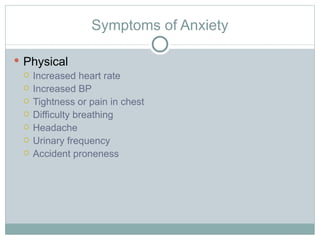
Symptoms of Anxiety Physical Increased heart rate Increased BP Tightness or pain in chest Difficulty breathing Headache Urinary frequency Accident proneness
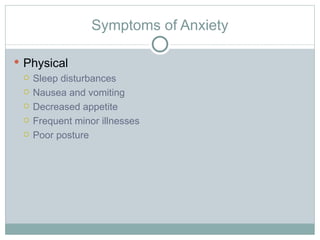
Symptoms of Anxiety Physical Sleep disturbances Nausea and vomiting Decreased appetite Frequent minor illnesses Poor posture
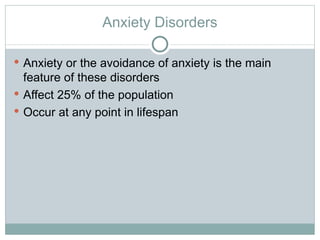
Anxiety Disorders Anxiety or the avoidance of anxiety is the main feature of these disorders Affect 25% of the population Occur at any point in lifespan
Theories Cognitive-Behavioral Excessive anxiety is learned Change thoughts, change anxious behavior  Psychosocial Unconscious conflicts Overactive superego Disturbed self concept
Theories Genetic 20% of first degree relatives with generalized anxiety disorder (GAD) also have GAD Biological Dysfunction of GABA receptors in CNS GABA (natural anti-anxiety substance) is the major inhibitory neurotransmitter
Medications Benzodiazepines Immediate effect Risk of addiction Buspirone Takes 2-4 weeks to affect anxiety No risk of addiction SSRIs
Generalized Anxiety Disorder Affects twice as many women as men Chronic, free-floating anxiety No panic attacks No obsessions/compulsions May abuse substances Culture may influence symptoms May co-exist with depression
Panic Disorder Severe anxiety attacks 16% of adult Americans No stimulus needed Worry  about more attacks or change in behavior due to attacks (avoidance) Cardiac neurosis
Panic Disorder Lactate Hypothesis Respiratory and Carbon Dioxide Hypothesis Norepinephrine Hypothesis Serotonin Hypothesis Adenosine Hypothesis GABA - Benzodiazepine Hypothesis Limbic System Dysfunction
Phobic Disorders Panic response to a specific object, activity, or situation: Agoraphobia (leaving home, crowds) Social phobia (eating, public speaking, walking into a room) Specific phobia (snakes, elevators)
Obsessive-Compulsive Disorder (OCD) Obsessions recurring thoughts which cannot be dismissed from consciousness Compulsion uncontrollable urge to perform certain acts Need to control Self Others  Environment
Obsessive-Compulsive Disorder (OCD) Genetics may play a role Serotonin dysfunction SSRIs  therapeutic Basal ganglia and frontal lobe abnormalities Prognosis 15% show progressive deterioration
Posttraumatic Stress Disorder (PTSD) Experience significant, unusual trauma Recurrent, intrusive, reexperiencing of the trauma Acute (last up to 3 months) Chronic (more than 3 months) Delayed onset (after 6 months) Symtoms of hyperarousal Avoidance behavior: May abuse substances
Dissociative Disorder anxiety & dissociative sx within 1 month of trauma exposure to very threatening event feelings of helplessness, fear, horror dissociative symptoms: feeling detached, cut-off, dream-like state avoidance hyperarousal
Dissociative Disorder Dissociative amnesia difficulty remembering a past period of time Dissociative fugue inability to remember one ’s past or identity Dissociative identity disorder 2 or more distinct personalities Depersonalization disorder episodes of feeling detached or numb
Dissociative Disorder Symptoms Flashbacks Numbing Nightmares Startle response Memory impairment
Nursing Intervention Observe the nonverbal Connect relief behavior with feeling Investigate preceding situation  Help client connect what happened to anxiety Help client state causes & remember similar patterns
Multidisciplinary Interventions Cognitive-Behavior Therapy Cognitive restructuring Relaxation training Exposure therapy: confronting situation with support of therapist Systematic desensitization: gradual exposure Implosive therapy: uses vivid imagery to expose Flooding: exposing to stimulus without relaxation until the anxiety subsides
Multidisciplinary Interventions Paradoxical intention Instruction to hyperventilate and bring on attack
Laboratory Values for Anxiety Disorders Panic disorder  Decreased serum Bicarbonate due to hyperventilation syndrome Increased serum Chloride in hyperventilation syndrome Decreased Fasting blood sugar
Assessment tools for Anxiety Hamilton Rating Scale forAnxiety
Case Study A 26 year old man has started to count in units of 4.  As he walks he counts his steps, one two three, four.  As he shops he counts items on the shelves, one, two, three, four. He has taken to insisting that when his wife and he kiss, that they kiss four times or a multiple of four times.  He and his wife come to visit your for help.  Both of them realize this behavior is irrational.  How do your further this diagnosis?
Case Study A 47 year old female client tells you that as a child she grew up on a farm.  Her father would discipline her by humiliating her by calling her names, such as  “stupid, and lazy”.  For punishment, he would take her outside of the house and threaten her with a gun and then shoot the gun off near her.  She was terrified that one day her could kill her. She has recently married for the second time to a “very nice man”; however, she has many flashbacks to her childhood, nightmares, and is suspicious of her husband.  What is this client’s diagnosis and prognosis?

Anxiety disorders

  • 1.
    Anxiety Normal humanemotion life without anxiety is not possible Exists on a continuum mild to severe
  • 2.
    Anxiety OperationalDefinition Expectations are held Expectations are not met Anxiety felt Automatic behavior Behavior is rationalized
  • 3.
    Stress Resistance Internallocus of control Healthy lifestyle Regular exercise Balanced diet Social support
  • 4.
    Symptoms of AnxietyEmotional Irritability Helplessness Social withdrawal Angry outbursts
  • 5.
    Symptoms of AnxietyCognitive Forgetfulness Decreased concentration Decreased attention Decreased productivity Rumination
  • 6.
    Symptoms of AnxietyPhysical Increased heart rate Increased BP Tightness or pain in chest Difficulty breathing Headache Urinary frequency Accident proneness
  • 7.
    Symptoms of AnxietyPhysical Sleep disturbances Nausea and vomiting Decreased appetite Frequent minor illnesses Poor posture
  • 8.
    Anxiety Disorders Anxietyor the avoidance of anxiety is the main feature of these disorders Affect 25% of the population Occur at any point in lifespan
  • 9.
    Theories Cognitive-Behavioral Excessiveanxiety is learned Change thoughts, change anxious behavior Psychosocial Unconscious conflicts Overactive superego Disturbed self concept
  • 10.
    Theories Genetic 20%of first degree relatives with generalized anxiety disorder (GAD) also have GAD Biological Dysfunction of GABA receptors in CNS GABA (natural anti-anxiety substance) is the major inhibitory neurotransmitter
  • 11.
    Medications Benzodiazepines Immediateeffect Risk of addiction Buspirone Takes 2-4 weeks to affect anxiety No risk of addiction SSRIs
  • 12.
    Generalized Anxiety DisorderAffects twice as many women as men Chronic, free-floating anxiety No panic attacks No obsessions/compulsions May abuse substances Culture may influence symptoms May co-exist with depression
  • 13.
    Panic Disorder Severeanxiety attacks 16% of adult Americans No stimulus needed Worry about more attacks or change in behavior due to attacks (avoidance) Cardiac neurosis
  • 14.
    Panic Disorder LactateHypothesis Respiratory and Carbon Dioxide Hypothesis Norepinephrine Hypothesis Serotonin Hypothesis Adenosine Hypothesis GABA - Benzodiazepine Hypothesis Limbic System Dysfunction
  • 15.
    Phobic Disorders Panicresponse to a specific object, activity, or situation: Agoraphobia (leaving home, crowds) Social phobia (eating, public speaking, walking into a room) Specific phobia (snakes, elevators)
  • 16.
    Obsessive-Compulsive Disorder (OCD)Obsessions recurring thoughts which cannot be dismissed from consciousness Compulsion uncontrollable urge to perform certain acts Need to control Self Others Environment
  • 17.
    Obsessive-Compulsive Disorder (OCD)Genetics may play a role Serotonin dysfunction SSRIs therapeutic Basal ganglia and frontal lobe abnormalities Prognosis 15% show progressive deterioration
  • 18.
    Posttraumatic Stress Disorder(PTSD) Experience significant, unusual trauma Recurrent, intrusive, reexperiencing of the trauma Acute (last up to 3 months) Chronic (more than 3 months) Delayed onset (after 6 months) Symtoms of hyperarousal Avoidance behavior: May abuse substances
  • 19.
    Dissociative Disorder anxiety& dissociative sx within 1 month of trauma exposure to very threatening event feelings of helplessness, fear, horror dissociative symptoms: feeling detached, cut-off, dream-like state avoidance hyperarousal
  • 20.
    Dissociative Disorder Dissociativeamnesia difficulty remembering a past period of time Dissociative fugue inability to remember one ’s past or identity Dissociative identity disorder 2 or more distinct personalities Depersonalization disorder episodes of feeling detached or numb
  • 21.
    Dissociative Disorder SymptomsFlashbacks Numbing Nightmares Startle response Memory impairment
  • 22.
    Nursing Intervention Observethe nonverbal Connect relief behavior with feeling Investigate preceding situation Help client connect what happened to anxiety Help client state causes & remember similar patterns
  • 23.
    Multidisciplinary Interventions Cognitive-BehaviorTherapy Cognitive restructuring Relaxation training Exposure therapy: confronting situation with support of therapist Systematic desensitization: gradual exposure Implosive therapy: uses vivid imagery to expose Flooding: exposing to stimulus without relaxation until the anxiety subsides
  • 24.
    Multidisciplinary Interventions Paradoxicalintention Instruction to hyperventilate and bring on attack
  • 25.
    Laboratory Values forAnxiety Disorders Panic disorder Decreased serum Bicarbonate due to hyperventilation syndrome Increased serum Chloride in hyperventilation syndrome Decreased Fasting blood sugar
  • 26.
    Assessment tools forAnxiety Hamilton Rating Scale forAnxiety
  • 27.
    Case Study A26 year old man has started to count in units of 4. As he walks he counts his steps, one two three, four. As he shops he counts items on the shelves, one, two, three, four. He has taken to insisting that when his wife and he kiss, that they kiss four times or a multiple of four times. He and his wife come to visit your for help. Both of them realize this behavior is irrational. How do your further this diagnosis?
  • 28.
    Case Study A47 year old female client tells you that as a child she grew up on a farm. Her father would discipline her by humiliating her by calling her names, such as “stupid, and lazy”. For punishment, he would take her outside of the house and threaten her with a gun and then shoot the gun off near her. She was terrified that one day her could kill her. She has recently married for the second time to a “very nice man”; however, she has many flashbacks to her childhood, nightmares, and is suspicious of her husband. What is this client’s diagnosis and prognosis?