Evidence-Based Medicine:Evidence-Based Medicine: What it is and what it isn't.What it is and what it isn't.
 EvidenceEvidence in its broadest sense includes anything that is used to determine or demonstrate the
truth of an assertion. Evidence is information, such as facts, coupled with beliefs and
assumptions, that make information relevant to the proof or disproof of a hypothesis. A
person’s assumptions or beliefs about the relationship between alleged facts and a hypothesis
will determine if that person takes the facts as evidence. (which car is better…)
 Scientific evidenceScientific evidence is an evidence which serves to either support or counter a scientific
theory or hypothesis. Such evidence is expected to be empirical and properly documented in
accordance with scientific method.
 Scientific evidence is evidence where the dependence of the evidence on beliefs and
assumptions is not conceded, enabling to examine the background beliefs or assumptions.
Standards for evidence may vary according to whether the field of inquiry is among the
natural sciences or social sciences. (Where is medicine…?)
 Scientist can develop a theory which may be falsified or verified by testing it against evidence
or known facts. Asymmetry exists that evidence can prove a theory wrong, by establishing
facts that are inconsistent with the theory. In contrast, evidence cannot prove a theory
correct because other evidence, yet to be discovered, may exist that is inconsistent with
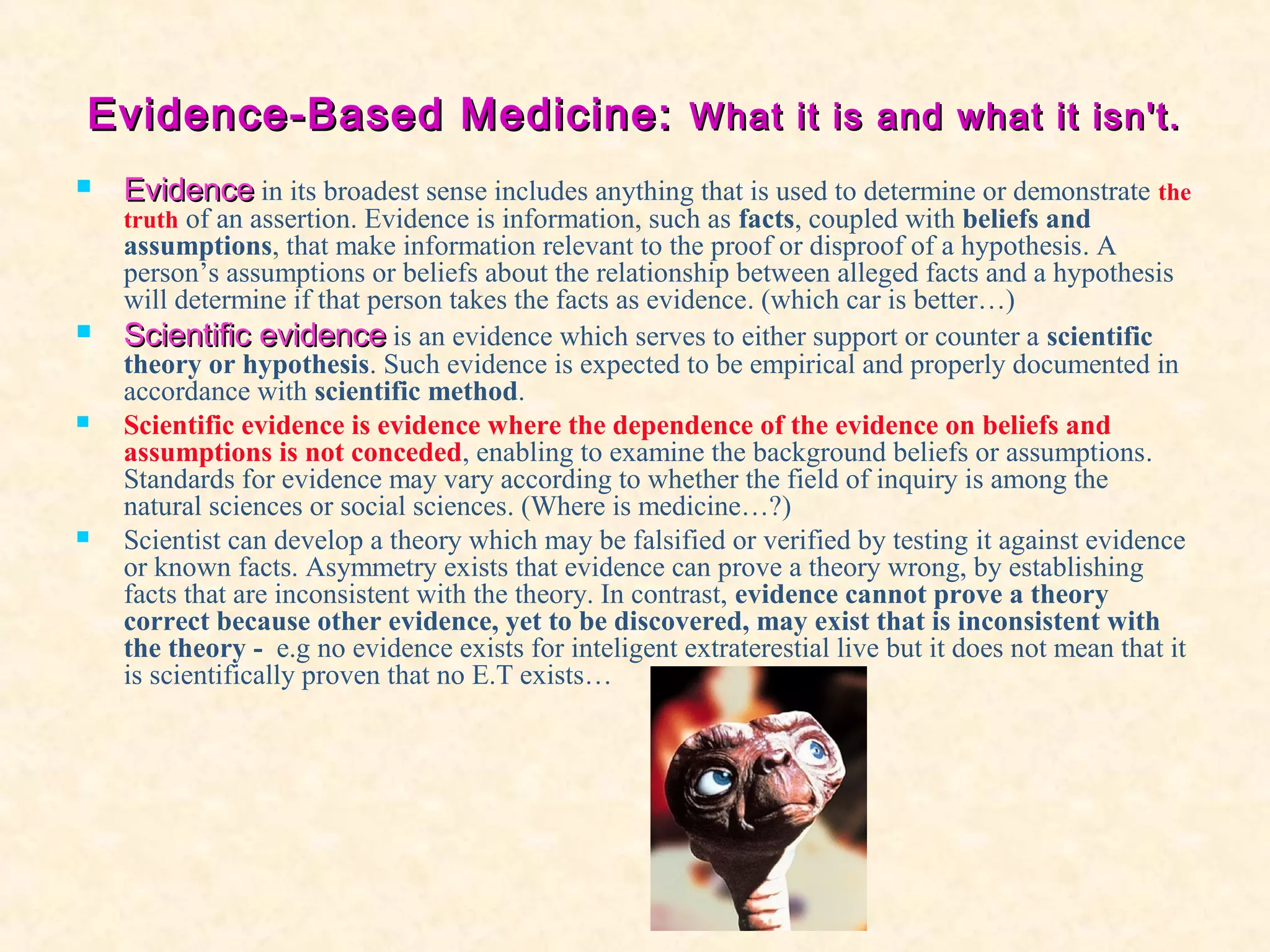
the theory - e.g no evidence exists for inteligent extraterestial live but it does not mean that it
is scientifically proven that no E.T exists…

SScientific theory or hypothesiscientific theory or hypothesis - consists either of a suggested explanation for a
phenomenon or of a reasoned proposal suggesting a possible correlation between observable
events (phenomenon is any occurrence that is observable by senses or by mind). Theory or
hypothesis is a trial solution to a problem - an "educated guess". Experimenters may test and
reject several hypotheses before solving the problem. Researchers weighing up alternative
hypotheses may take into consideration:
 Testability - a hypothesis must be falsifiable, and one cannot regard a proposition or theory
as scientific if it does not admit the possibility of being shown false at least in principle.
 Simplicity - discouraging the postulation of excessive numbers of entities
 Scope - the apparent application of the hypothesis to multiple cases of phenomena
 Fruitfulness - the prospect that a hypothesis may explain further phenomena in the future
 Conservatism - the degree of "fit" with existing recognized knowledge-systems
 Scientific methodScientific method is a body of techniques for investigating phenomena, acquiring new
knowledge, or correcting and integrating previous knowledge. It is based on gathering
observable, empirical and measurable evidence subject to specific principles of
reasoning.
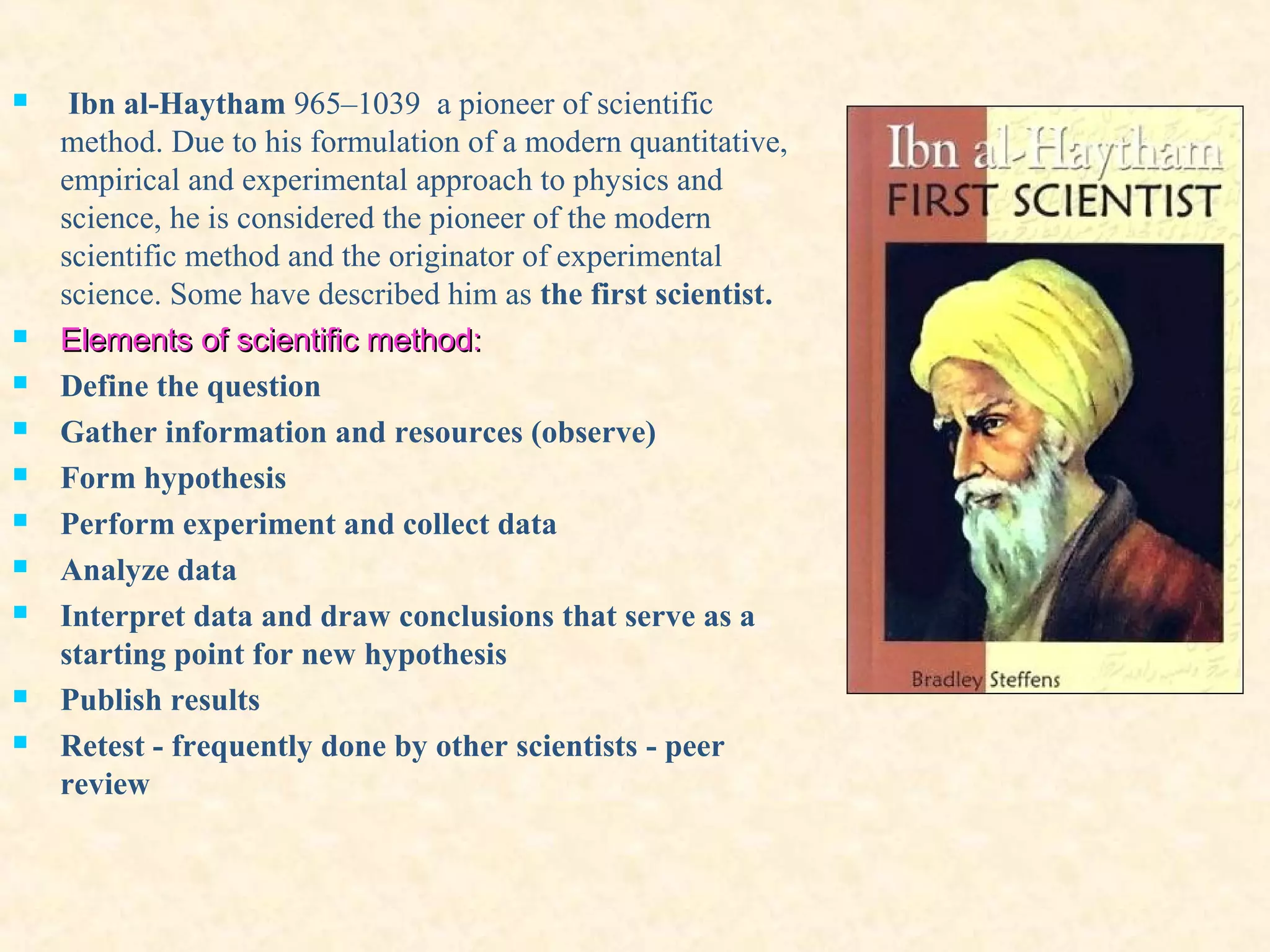
 Ibn al-Haytham 965–1039 a pioneer of scientific
method. Due to his formulation of a modern quantitative,
empirical and experimental approach to physics and
science, he is considered the pioneer of the modern
scientific method and the originator of experimental
science. Some have described him as the first scientist.
 Elements of scientific methodElements of scientific method::
 Define the question
 Gather information and resources (observe)
 Form hypothesis
 Perform experiment and collect data
 Analyze data
 Interpret data and draw conclusions that serve as a
starting point for new hypothesis
 Publish results
 Retest - frequently done by other scientists - peer
review
Is medicine a science?Is medicine a science?
 Medicine is the science and "art" of maintaining and restoring human
health. Our primary goal is to help a patient.
 Science refers to a system of acquiring knowledge and its primary goal is
to find a truth.
 The modern practice of medicine occurs at the many interfaces between the
art of healing and various sciences. Medicine is directly connected to the
health sciences and biomedicine and is using scientific knowledge for the
art of healing.
 Physician is committed to promoting the health of any individual accepted
as a patient’. Medical practice has an inherently moral aspect. Science
is goal-directed, but its end is theoretical, not practical, and science is not
committed to promoting any interest at all.
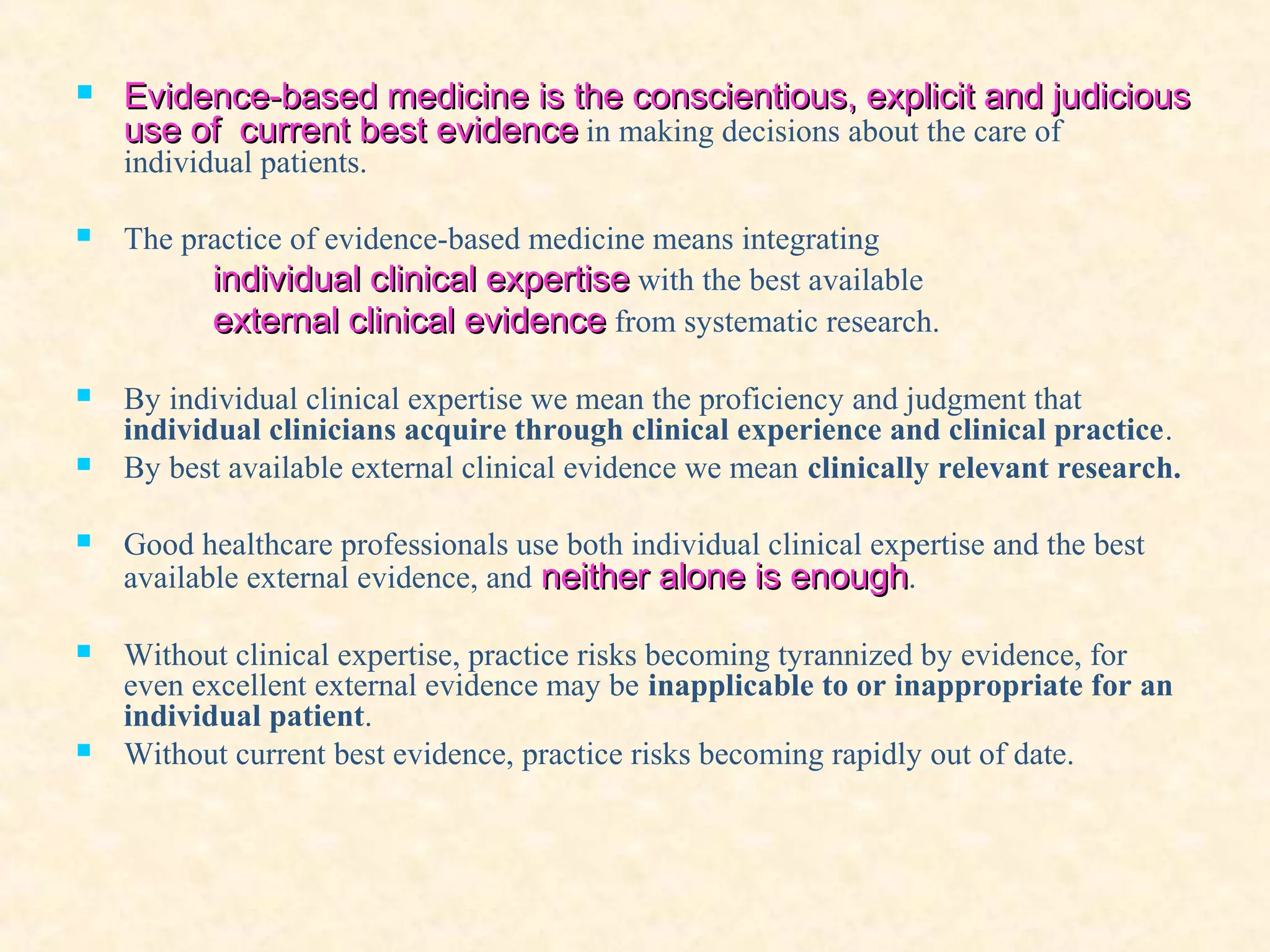
 Evidence-based medicine is the conscientious, explicit and judiciousEvidence-based medicine is the conscientious, explicit and judicious
use of current bestuse of current best evidenceevidence in making decisions about the care of
individual patients.
 The practice of evidence-based medicine means integrating
individual clinical expertiseindividual clinical expertise with the best available
external clinical evidenceexternal clinical evidence from systematic research.
 By individual clinical expertise we mean the proficiency and judgment that
individual clinicians acquire through clinical experience and clinical practice.
 By best available external clinical evidence we mean clinically relevant research.
 Good healthcare professionals use both individual clinical expertise and the best
available external evidence, and neither alone is enoughneither alone is enough.
 Without clinical expertise, practice risks becoming tyrannized by evidence, for
even excellent external evidence may be inapplicable to or inappropriate for an
individual patient.
 Without current best evidence, practice risks becoming rapidly out of date.

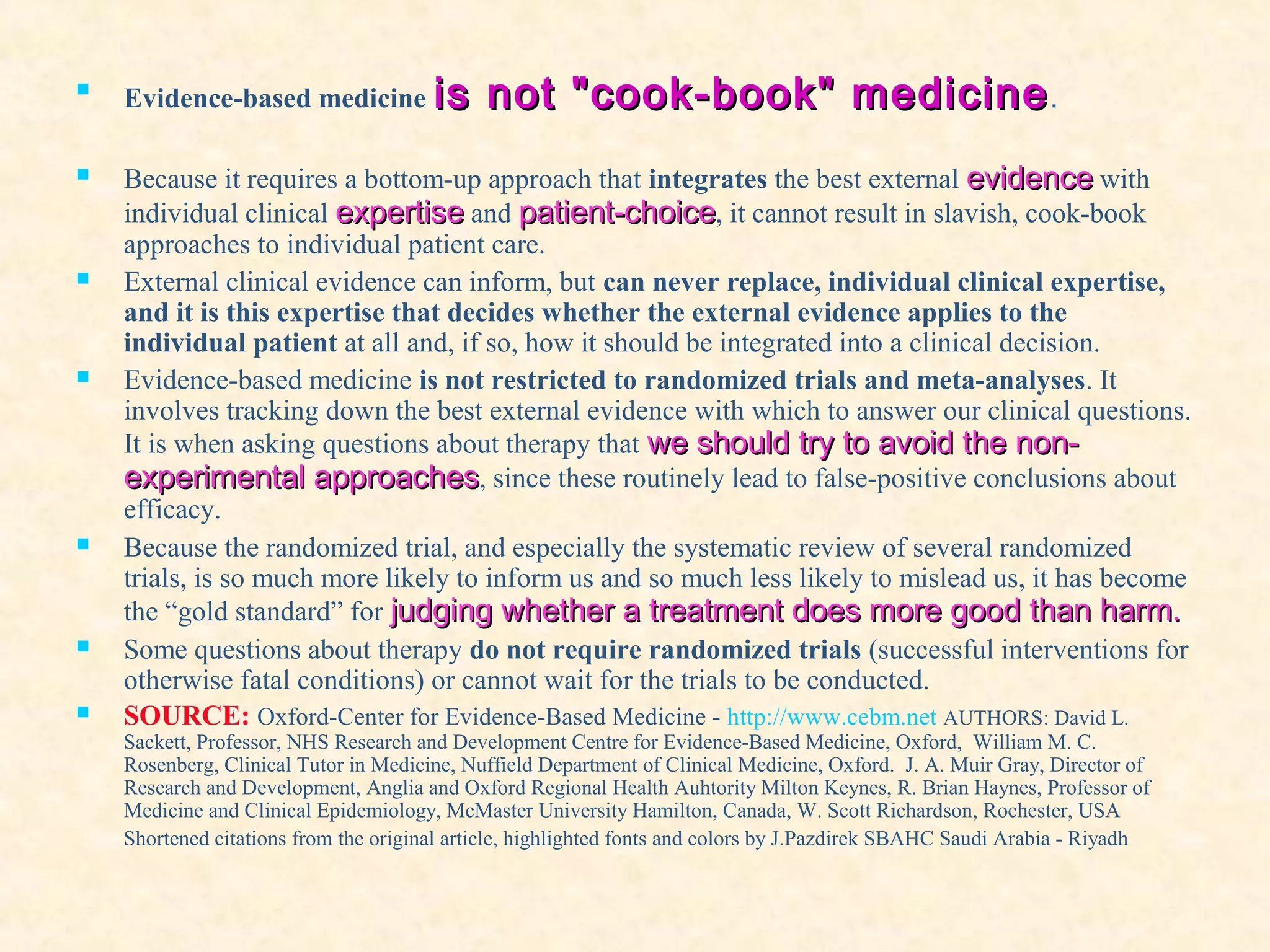
Evidence-based medicine is not "cook-book" medicineis not "cook-book" medicine.
 Because it requires a bottom-up approach that integrates the best external evidenceevidence with
individual clinical expertiseexpertise and patient-choicepatient-choice, it cannot result in slavish, cook-book
approaches to individual patient care.
 External clinical evidence can inform, but can never replace, individual clinical expertise,
and it is this expertise that decides whether the external evidence applies to the
individual patient at all and, if so, how it should be integrated into a clinical decision.
 Evidence-based medicine is not restricted to randomized trials and meta-analyses. It
involves tracking down the best external evidence with which to answer our clinical questions.
It is when asking questions about therapy that we should try to avoid the non-we should try to avoid the non-
experimental approachesexperimental approaches, since these routinely lead to false-positive conclusions about
efficacy.
 Because the randomized trial, and especially the systematic review of several randomized
trials, is so much more likely to inform us and so much less likely to mislead us, it has become
the “gold standard” for judging whether a treatment does more good than harm.judging whether a treatment does more good than harm.
 Some questions about therapy do not require randomized trials (successful interventions for
otherwise fatal conditions) or cannot wait for the trials to be conducted.
 SOURCE: Oxford-Center for Evidence-Based Medicine - http://www.cebm.net AUTHORS: David L.
Sackett, Professor, NHS Research and Development Centre for Evidence-Based Medicine, Oxford, William M. C.
Rosenberg, Clinical Tutor in Medicine, Nuffield Department of Clinical Medicine, Oxford. J. A. Muir Gray, Director of
Research and Development, Anglia and Oxford Regional Health Auhtority Milton Keynes, R. Brian Haynes, Professor of
Medicine and Clinical Epidemiology, McMaster University Hamilton, Canada, W. Scott Richardson, Rochester, USA
Shortened citations from the original article, highlighted fonts and colors by J.Pazdirek SBAHC Saudi Arabia - Riyadh
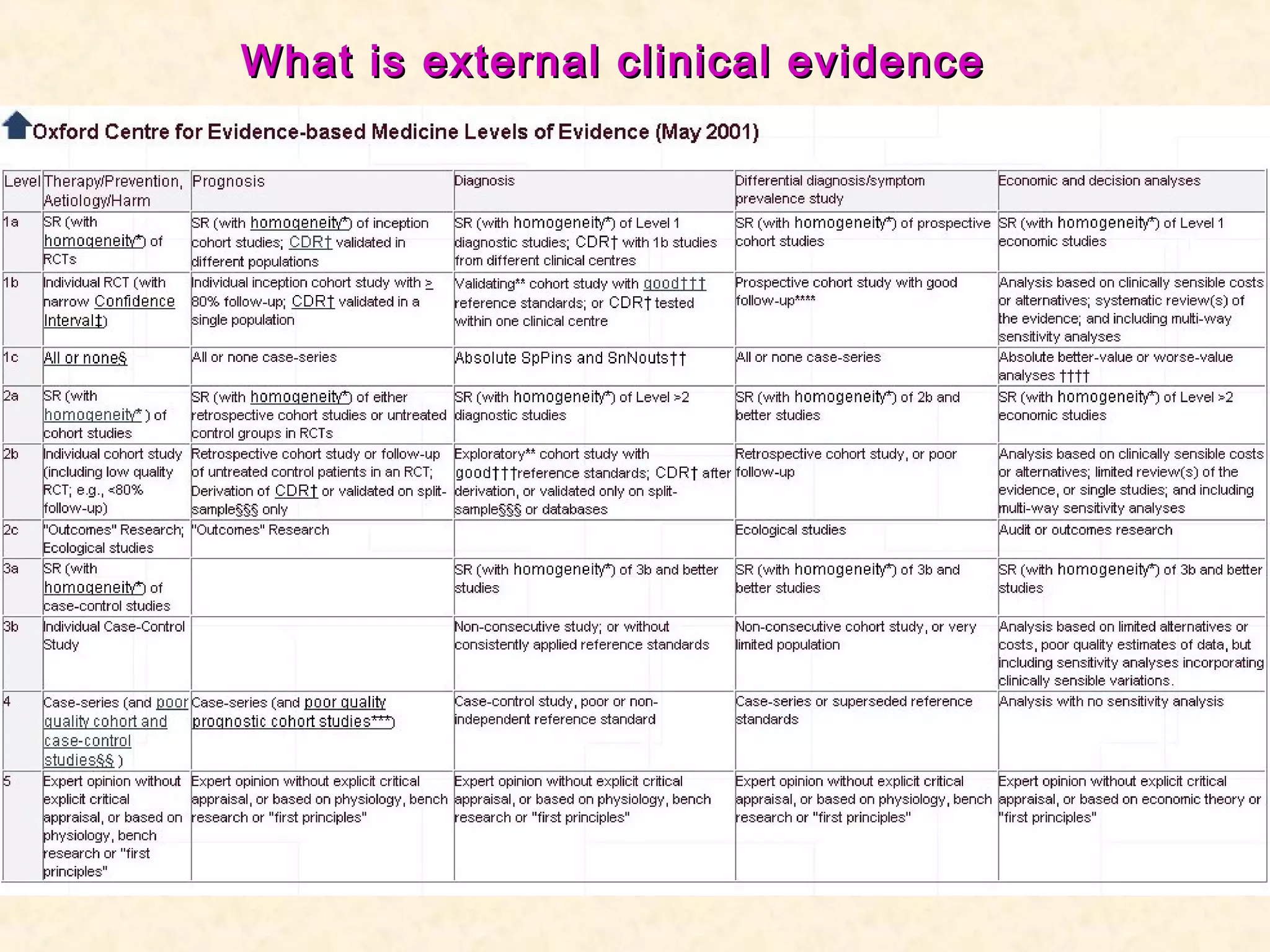
What is external clinical evidenceWhat is external clinical evidence
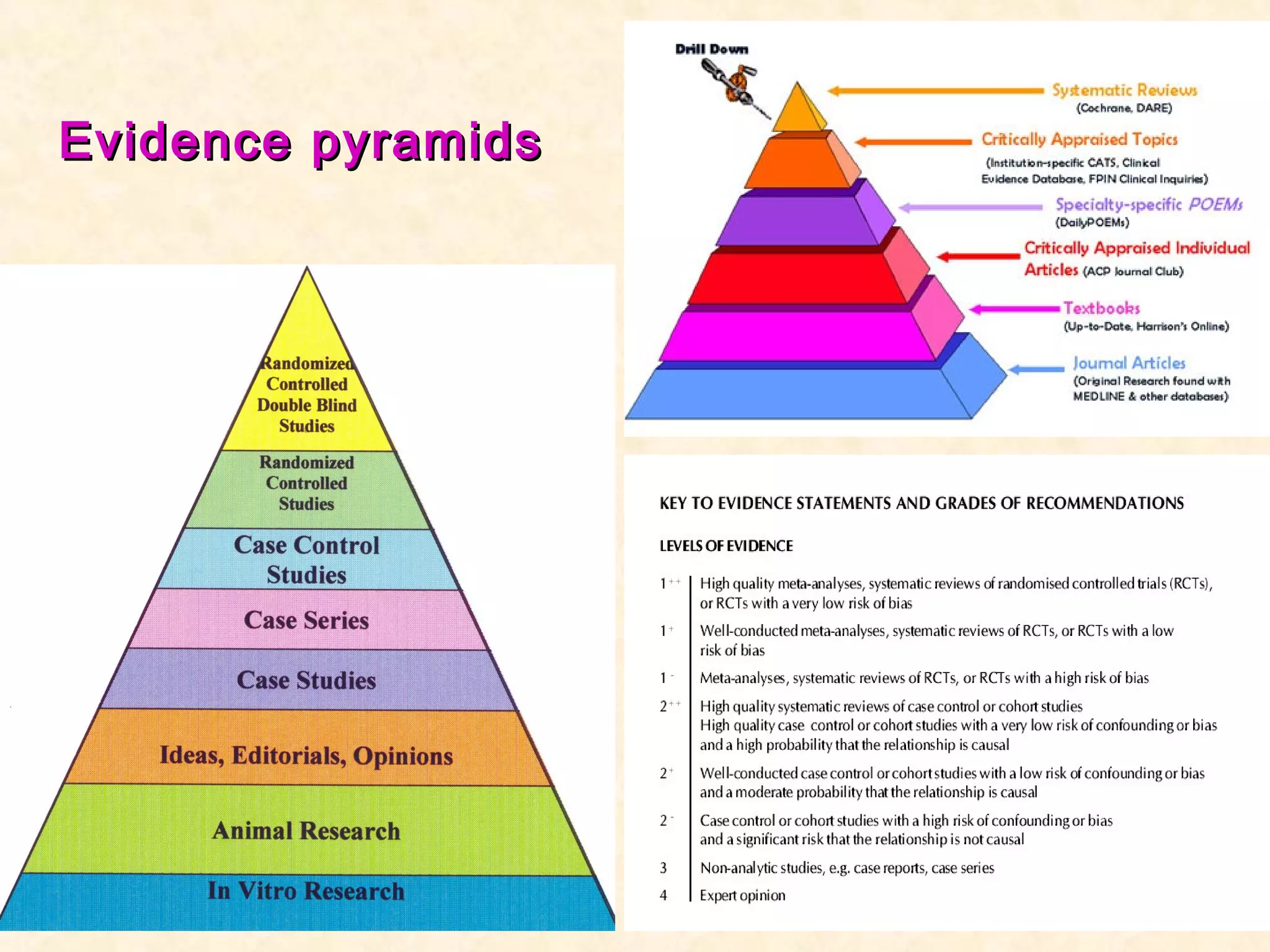
Evidence pyramidsEvidence pyramids
Meta-analysis -Meta-analysis - Analysis of analysisAnalysis of analysis
 In statistics, a meta-analysis combines the results of several studies that address a
set of related research hypotheses.
 Metaanalysis can often be concerned with trying to find the faults in a statistical
study, for instance if an inappropriate statistical test has been used to analyze the
data.
 A meta-analysis can be performed on studies that describe their findings in
correlation coefficients which indicates the strength and direction of a linear
relationship between two variables.
 A weakness of the method is that sources of bias are not controlled by the method
and a good meta-analysis of multiple badly designed studies will still result in bad
statistics
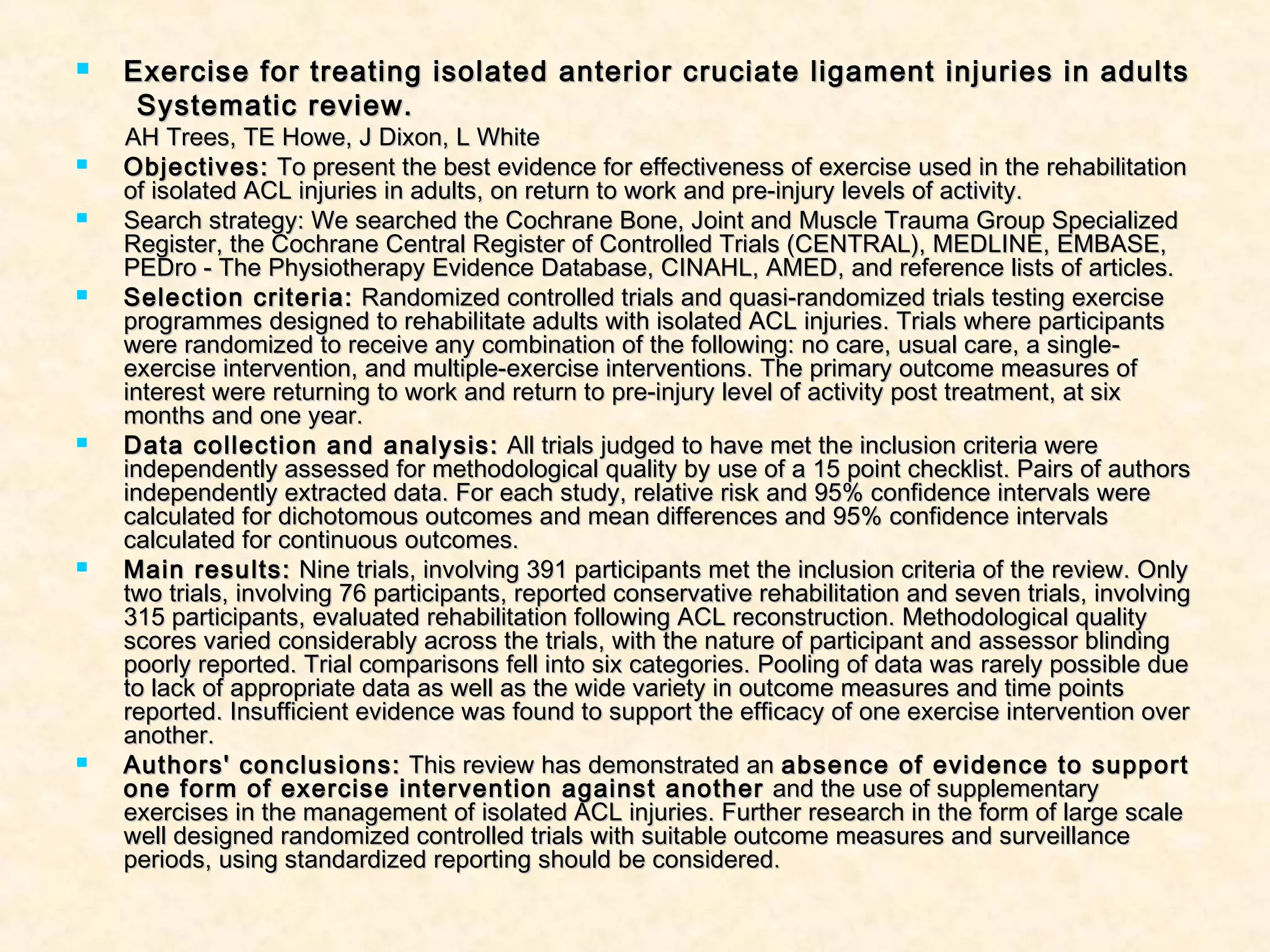
"Don't trust any statistics
you did not fake yourself“
Winston Churchill
 Efficacy of continuous passive motion following total knee arthroplasty:Efficacy of continuous passive motion following total knee arthroplasty:
a metaanalysis.a metaanalysis.
Brosseau L, Milne S, Wells G, Tugwell P, Robinson V, Casimiro L, Pelland L, Noel MJ, Davis J,Brosseau L, Milne S, Wells G, Tugwell P, Robinson V, Casimiro L, Pelland L, Noel MJ, Davis J,
Drouin H.Drouin H.
School of Rehabilitation Sciences, University of Ottawa, Ottawa, Ontario, Canada.School of Rehabilitation Sciences, University of Ottawa, Ottawa, Ontario, Canada.
 OBJECTIVE:OBJECTIVE: The objective of this metaanalysis is to examine the effectiveness of continuousThe objective of this metaanalysis is to examine the effectiveness of continuous
passive motion (CPM) following total knee arthroplasty (TKA).passive motion (CPM) following total knee arthroplasty (TKA).
 METHODS:METHODS: This metaanalysis used the methodology proposed by the Cochrane Collaboration.This metaanalysis used the methodology proposed by the Cochrane Collaboration.
 RESULTS:RESULTS: This review of 14 studies (952 patients) found significant improvements in activeThis review of 14 studies (952 patients) found significant improvements in active
knee flexion and analgesic use 2 weeks postoperatively with the use of CPM and physiotherapyknee flexion and analgesic use 2 weeks postoperatively with the use of CPM and physiotherapy
(PT) compared to PT alone. In addition, length of hospital stay and need for knee manipulations(PT) compared to PT alone. In addition, length of hospital stay and need for knee manipulations
were significantly decreased in the CPM group. Not enough data were available to compare thewere significantly decreased in the CPM group. Not enough data were available to compare the
degree of knee flexion applied or number of hours of application of CPM. However, significantdegree of knee flexion applied or number of hours of application of CPM. However, significant
results were not found for other comparisons such as short term CPM application versusresults were not found for other comparisons such as short term CPM application versus
longterm CPM application and wide treatment range versus small treatment range for thelongterm CPM application and wide treatment range versus small treatment range for the
outcomes of active knee flexion, passive knee flexion and extension, presence of a fixed flexionoutcomes of active knee flexion, passive knee flexion and extension, presence of a fixed flexion
deformity, use of analgesic, or total knee range of motion.deformity, use of analgesic, or total knee range of motion.
 CONCLUSION:CONCLUSION: CPM combined with PT may offer beneficial results for patients post-TKA.CPM combined with PT may offer beneficial results for patients post-TKA.
However, the potential benefits will need to be carefully weighed against the inconvenience andHowever, the potential benefits will need to be carefully weighed against the inconvenience and
expense of CPM. More research is necessary to assess the differences in effectiveness withexpense of CPM. More research is necessary to assess the differences in effectiveness with
different characteristics of application such as total duration of treatment and intensity of CPMdifferent characteristics of application such as total duration of treatment and intensity of CPM
interventions.interventions.
Systematic reviewSystematic review
 Systematic reviews are summarizing research evidence. The explosion in biomedical
publishing perhaps 20,000 journals and upwards of 2 million articles a year makes keeping up
with primary research an impossible feat.
 High-quality systematic reviews take great care to find all relevant studies published and
unpublished, assess each study, synthesize the findings from individual studies in an unbiased
way and present a balanced and impartial summary of the findings with due consideration of
any flaws in the evidence.
 Systematic reviews are needed whenever there is a substantive therapeutic question,
several primary studies – perhaps with disparate findings – and substantial uncertainty.
 Developing a systematic review requires the following steps:
Defining an appropriate therapeutic question.
Searching the literature.
Assessing the studies.
Combining the results.
Placing the findings in context
 The findings from this aggregation of an unbiased selection of studies then need to be
discussed to put them in context. This will address such issues as the quality and
heterogeneity of the included studies, the likely impact of bias and chance and the
applicability of the findings.
 A word of caution, however. Performing a rigorous systematic review is far from easy. It
requires meticulous and laborious searching and considerable attention to methodological
detail before it truly deserves the badge' systematic’. Not all published systematic reviews
have been produced with meticulous care – therefore the findings may sometimes mislead.
 Many high-quality reviews are available from electronic sources such as the Cochrane
Library
 Exercise for treating isolated anterior cruciate ligament injuries in adultsExercise for treating isolated anterior cruciate ligament injuries in adults
Systematic review.Systematic review.
AH Trees, TE Howe, J Dixon, L WhiteAH Trees, TE Howe, J Dixon, L White
 Objectives:Objectives: To present the best evidence for effectiveness of exercise used in the rehabilitationTo present the best evidence for effectiveness of exercise used in the rehabilitation
of isolated ACL injuries in adults, on return to work and pre-injury levels of activity.of isolated ACL injuries in adults, on return to work and pre-injury levels of activity.
 Search strategy: We searched the Cochrane Bone, Joint and Muscle Trauma Group SpecializedSearch strategy: We searched the Cochrane Bone, Joint and Muscle Trauma Group Specialized
Register, the Cochrane Central Register of Controlled Trials (CENTRAL), MEDLINE, EMBASE,Register, the Cochrane Central Register of Controlled Trials (CENTRAL), MEDLINE, EMBASE,
PEDro - The Physiotherapy Evidence Database, CINAHL, AMED, and reference lists of articles.PEDro - The Physiotherapy Evidence Database, CINAHL, AMED, and reference lists of articles.
 Selection criteria:Selection criteria: Randomized controlled trials and quasi-randomized trials testing exerciseRandomized controlled trials and quasi-randomized trials testing exercise
programmes designed to rehabilitate adults with isolated ACL injuries. Trials where participantsprogrammes designed to rehabilitate adults with isolated ACL injuries. Trials where participants
were randomized to receive any combination of the following: no care, usual care, a single-were randomized to receive any combination of the following: no care, usual care, a single-
exercise intervention, and multiple-exercise interventions. The primary outcome measures ofexercise intervention, and multiple-exercise interventions. The primary outcome measures of
interest were returning to work and return to pre-injury level of activity post treatment, at sixinterest were returning to work and return to pre-injury level of activity post treatment, at six
months and one year.months and one year.
 Data collection and analysis:Data collection and analysis: All trials judged to have met the inclusion criteria wereAll trials judged to have met the inclusion criteria were
independently assessed for methodological quality by use of a 15 point checklist. Pairs of authorsindependently assessed for methodological quality by use of a 15 point checklist. Pairs of authors
independently extracted data. For each study, relative risk and 95% confidence intervals wereindependently extracted data. For each study, relative risk and 95% confidence intervals were
calculated for dichotomous outcomes and mean differences and 95% confidence intervalscalculated for dichotomous outcomes and mean differences and 95% confidence intervals
calculated for continuous outcomes.calculated for continuous outcomes.
 Main results:Main results: Nine trials, involving 391 participants met the inclusion criteria of the review. OnlyNine trials, involving 391 participants met the inclusion criteria of the review. Only
two trials, involving 76 participants, reported conservative rehabilitation and seven trials, involvingtwo trials, involving 76 participants, reported conservative rehabilitation and seven trials, involving
315 participants, evaluated rehabilitation following ACL reconstruction. Methodological quality315 participants, evaluated rehabilitation following ACL reconstruction. Methodological quality
scores varied considerably across the trials, with the nature of participant and assessor blindingscores varied considerably across the trials, with the nature of participant and assessor blinding
poorly reported. Trial comparisons fell into six categories. Pooling of data was rarely possible duepoorly reported. Trial comparisons fell into six categories. Pooling of data was rarely possible due
to lack of appropriate data as well as the wide variety in outcome measures and time pointsto lack of appropriate data as well as the wide variety in outcome measures and time points
reported. Insufficient evidence was found to support the efficacy of one exercise intervention overreported. Insufficient evidence was found to support the efficacy of one exercise intervention over
another.another.
 Authors' conclusions:Authors' conclusions: This review has demonstrated anThis review has demonstrated an absence of evidence to supportabsence of evidence to support
one form of exercise intervention against anotherone form of exercise intervention against another and the use of supplementaryand the use of supplementary
exercises in the management of isolated ACL injuries. Further research in the form of large scaleexercises in the management of isolated ACL injuries. Further research in the form of large scale
well designed randomized controlled trials with suitable outcome measures and surveillancewell designed randomized controlled trials with suitable outcome measures and surveillance
periods, using standardized reporting should be considered.periods, using standardized reporting should be considered.
Randomized controlled trialRandomized controlled trial
 Randomized controlled trials is experimental study of population used to compare treatments
between individual subjects. Experimental investigations tend to be time consuming and
expensive. (Who is paying for the study is also an important information).They should not,
therefore, be undertaken without good reason. They do provide the most compelling evidence
of cause and effect. They are often used for comparison of two treatments.
 Criteria for entry to the study sample must be specified (for example, in terms of age, sex,
diagnosis, etc). The subjects studied should be representative of the target population in whom
it is hoped to apply the results. Subjects who satisfy the entry criteria are asked to consent to
participation. As far as possible, the criteria for withdrawing a patient from treatment should
be specified in advance.
 Those subjects who agree to participate are then randomized to the treatments under
comparison. This can be achieved with random numbers generated by computer.
 When outcome is influenced by other aspects of a patient's management, as well as by the
treatments under comparison, it may be desirable for those responsible for management to be
"blinded" to which treatment has been allocated.
 Bias in the evaluation of subjective outcomes can be avoided by blinding the assessor to the
treatment given.
 Similarly, if the end point is a subjective physical sign then the examiner is best kept
ignorant about which patient received which treatment.
 It is important to measure not only the outcomes that the treatments are intended to improve,
but also possible adverse effects.
 The statistical analysis of randomized controlled trials is complex. Whatever analytical
technique is adopted, it is important always to compare subjects according to the treatment
to which they were randomized, even if this treatment was not completed.
 A randomised controlled trial on the efficacy of hydroelectrophoresis inA randomised controlled trial on the efficacy of hydroelectrophoresis in
acute recurrences in chronic low back pain patients.acute recurrences in chronic low back pain patients.
Brizzi A, Giusti A, Giacchetti P, Stefanelli S, Provinciali L, Ceravolo MG.Brizzi A, Giusti A, Giacchetti P, Stefanelli S, Provinciali L, Ceravolo MG.
Department of Neuroscience, Azienda Ospedali Riuniti di Ancona, Polytechnic University ofDepartment of Neuroscience, Azienda Ospedali Riuniti di Ancona, Polytechnic University of
Marche, Italy.Marche, Italy.
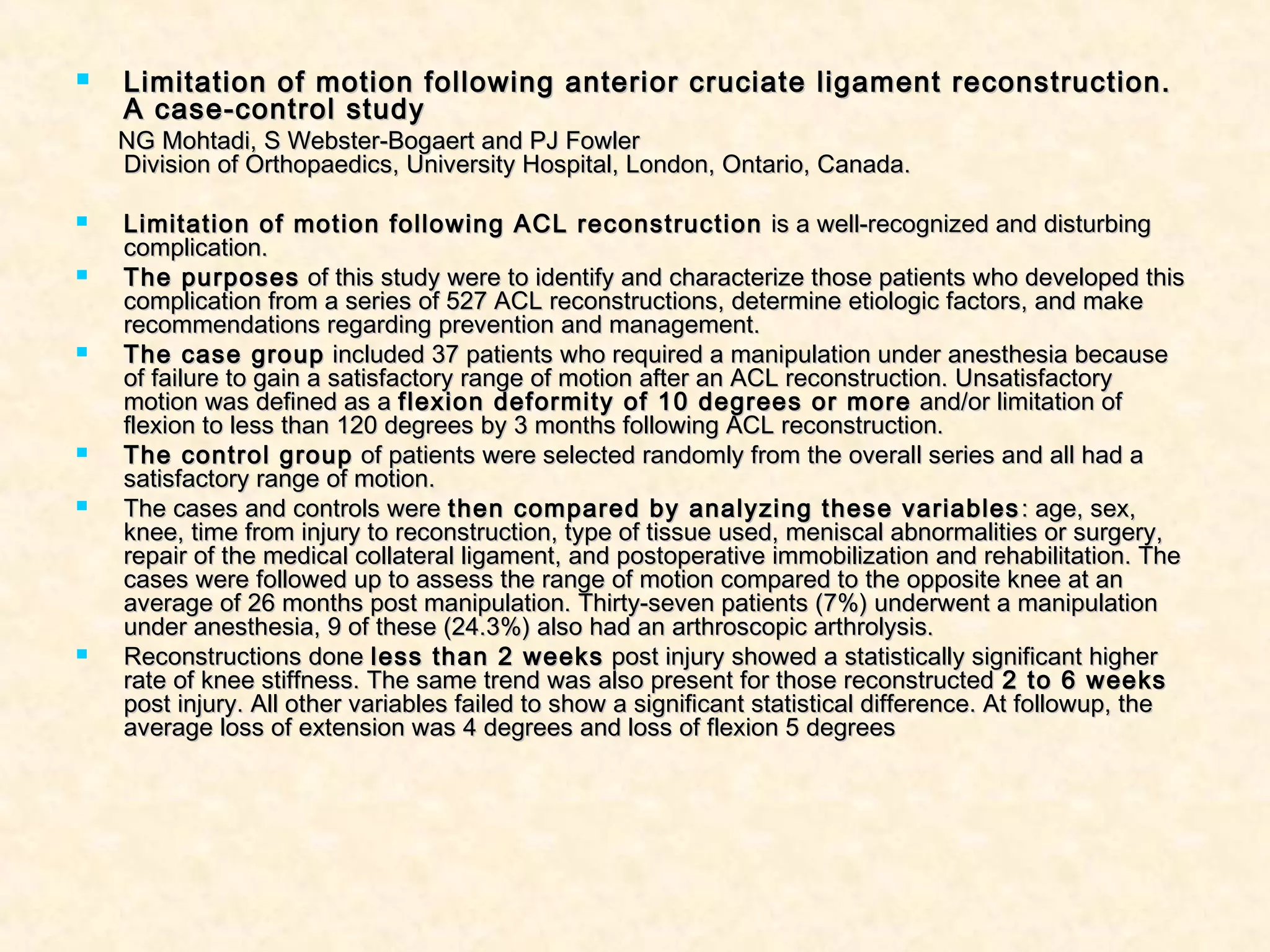
 AIM:AIM: Physical therapy efficacy in the treatment of low back pain (LBP) has been widely debatedPhysical therapy efficacy in the treatment of low back pain (LBP) has been widely debated
and is far from achieving high levels of evidence. Hydroelectrophoresis (Hydrofor) is a noveland is far from achieving high levels of evidence. Hydroelectrophoresis (Hydrofor) is a novel
method of driving drugs through the dermal tissue, which has been proposed for muscle painmethod of driving drugs through the dermal tissue, which has been proposed for muscle pain
treatment. Aim of this randomised placebo-controlled study was to ascertain the efficacy oftreatment. Aim of this randomised placebo-controlled study was to ascertain the efficacy of
Hydrofor treatment on acute relapsing episodes of pain in chronic LBP subjects.Hydrofor treatment on acute relapsing episodes of pain in chronic LBP subjects.
 METHODS:METHODS: Eighteen under-50 adults (M/F: 7/11; age 35+/-8 years) suffering from chronic LBPEighteen under-50 adults (M/F: 7/11; age 35+/-8 years) suffering from chronic LBP
were enrolled within 3 to 4 days of back pain relapse. After a complete clinical and functionalwere enrolled within 3 to 4 days of back pain relapse. After a complete clinical and functional
assessment patients were randomly divided into 2 equal groups. Group A received 3 Hydroforassessment patients were randomly divided into 2 equal groups. Group A received 3 Hydrofor
applications of a mixture containing both NSAIDs and muscle relaxants, whereas Group B receivedapplications of a mixture containing both NSAIDs and muscle relaxants, whereas Group B received
3 Hydrofor applications of a drug-free solution. Afterwards, both groups performed the same3 Hydrofor applications of a drug-free solution. Afterwards, both groups performed the same
rehabilitation treatment consisting of 7 group sessions of standard physiotherapy, includingrehabilitation treatment consisting of 7 group sessions of standard physiotherapy, including
stretching, range of motion and extension exercises. The Oswestry disability index (ODI), thestretching, range of motion and extension exercises. The Oswestry disability index (ODI), the
Million instrument scale and a visual analogue scale (VAS) were chosen as outcome measures andMillion instrument scale and a visual analogue scale (VAS) were chosen as outcome measures and
applied at baseline, after Hydrofor/placebo applications, after completion of rehabilitation sessionsapplied at baseline, after Hydrofor/placebo applications, after completion of rehabilitation sessions
and, at last, 2 months later. The two-way Friedman test was used to analyse within-group (timeand, at last, 2 months later. The two-way Friedman test was used to analyse within-group (time
effect) and between-group (time x group effect) differences.effect) and between-group (time x group effect) differences.
 RESULTS:RESULTS: All subjects declared a significant pain reduction since the first Hydrofor application.All subjects declared a significant pain reduction since the first Hydrofor application.
Pain evolution overlapped in the 2 groups until the 3rd session, after which Group A significantlyPain evolution overlapped in the 2 groups until the 3rd session, after which Group A significantly
diverged from Group B, as they affirmed a greater symptom reduction than controls (time x groupdiverged from Group B, as they affirmed a greater symptom reduction than controls (time x group
effect: VAS: F = 7.4, p <0.01). Such difference disappeared after the physiotherapy sessions aseffect: VAS: F = 7.4, p <0.01). Such difference disappeared after the physiotherapy sessions as
well as 2 months later (time x group effect: VAS: F = 2.1, p =0.08). Pain-related disability showed awell as 2 months later (time x group effect: VAS: F = 2.1, p =0.08). Pain-related disability showed a
greater reduction in Group A than B immediately after Hydrofor application (time x group effect:greater reduction in Group A than B immediately after Hydrofor application (time x group effect:
ODI: F=3.9 p <0.05; Million: F=4.1 p<0.05), but the mean scores almost overlapped at the 2 monthODI: F=3.9 p <0.05; Million: F=4.1 p<0.05), but the mean scores almost overlapped at the 2 month
follow-up (time x group effect: ODI: F=2.3 p =0.08; Million: F=1.3 p=0.26).follow-up (time x group effect: ODI: F=2.3 p =0.08; Million: F=1.3 p=0.26).
 CONCLUSIONS:CONCLUSIONS: Hydrofor treatment relieves relapsing LBP and could be recommended toHydrofor treatment relieves relapsing LBP and could be recommended to
active adults as a safe technique shortening the time needed to achieve functional restoration.active adults as a safe technique shortening the time needed to achieve functional restoration.
Case-control studiesCase-control studies
 Case-control studies often referred to as a Retrospective Studies are less expensive and often
used type of epidemiological studies.
 In a case-control study patients who have developed a disease are identified and their past
exposure to suspected etiological factors is compared with that of controls or referents
who do not have the disease. The great triumph of the case-control study was the discovery of
the link between tobacco smoking and lung cancer.
 Randomized controlled trials cannot be used to evaluate the effects of toxic substances.
 Case definition and selection of cases: The case-control study begins with the identification
by researchers of an outcome or effect and a number of potential causative factors. Using
medical records or interviews researchers record the variables identified as risk factors plus
other non-risk variables which can then be used to select matching controls.
 Selection of controls: A number of Control subjects are then chosen who do not exhibit the
outcome or effect under investigation. These controls should match the cases as closely as
possible.
 Ascertainment of exposure: The case and control groups are then compared on the proposed
causal factors.
 Statistical analysis is used to estimate the strength of association of each factor with the
studied outcome.
 Limitation of motion following anterior cruciate ligament reconstruction.Limitation of motion following anterior cruciate ligament reconstruction.
A case-control studyA case-control study
NG Mohtadi, S Webster-Bogaert and PJ FowlerNG Mohtadi, S Webster-Bogaert and PJ Fowler
Division of Orthopaedics, University Hospital, London, Ontario, Canada.Division of Orthopaedics, University Hospital, London, Ontario, Canada.
 Limitation of motion following ACL reconstructionLimitation of motion following ACL reconstruction is a well-recognized and disturbingis a well-recognized and disturbing
complication.complication.
 The purposesThe purposes of this study were to identify and characterize those patients who developed thisof this study were to identify and characterize those patients who developed this
complication from a series of 527 ACL reconstructions, determine etiologic factors, and makecomplication from a series of 527 ACL reconstructions, determine etiologic factors, and make
recommendations regarding prevention and management.recommendations regarding prevention and management.
 The case groupThe case group included 37 patients who required a manipulation under anesthesia becauseincluded 37 patients who required a manipulation under anesthesia because
of failure to gain a satisfactory range of motion after an ACL reconstruction. Unsatisfactoryof failure to gain a satisfactory range of motion after an ACL reconstruction. Unsatisfactory
motion was defined as amotion was defined as a flexion deformity of 10 degrees or moreflexion deformity of 10 degrees or more and/or limitation ofand/or limitation of
flexion to less than 120 degrees by 3 months following ACL reconstruction.flexion to less than 120 degrees by 3 months following ACL reconstruction.
 The control groupThe control group of patients were selected randomly from the overall series and all had aof patients were selected randomly from the overall series and all had a
satisfactory range of motion.satisfactory range of motion.
 The cases and controls wereThe cases and controls were then compared by analyzing these variablesthen compared by analyzing these variables : age, sex,: age, sex,
knee, time from injury to reconstruction, type of tissue used, meniscal abnormalities or surgery,knee, time from injury to reconstruction, type of tissue used, meniscal abnormalities or surgery,
repair of the medical collateral ligament, and postoperative immobilization and rehabilitation. Therepair of the medical collateral ligament, and postoperative immobilization and rehabilitation. The
cases were followed up to assess the range of motion compared to the opposite knee at ancases were followed up to assess the range of motion compared to the opposite knee at an
average of 26 months post manipulation. Thirty-seven patients (7%) underwent a manipulationaverage of 26 months post manipulation. Thirty-seven patients (7%) underwent a manipulation
under anesthesia, 9 of these (24.3%) also had an arthroscopic arthrolysis.under anesthesia, 9 of these (24.3%) also had an arthroscopic arthrolysis.
 Reconstructions doneReconstructions done less than 2 weeksless than 2 weeks post injury showed a statistically significant higherpost injury showed a statistically significant higher
rate of knee stiffness. The same trend was also present for those reconstructedrate of knee stiffness. The same trend was also present for those reconstructed 2 to 6 weeks2 to 6 weeks
post injury. All other variables failed to show a significant statistical difference. At followup, thepost injury. All other variables failed to show a significant statistical difference. At followup, the
average loss of extension was 4 degrees and loss of flexion 5 degreesaverage loss of extension was 4 degrees and loss of flexion 5 degrees
Longitudinal studiesLongitudinal studies
 In a longitudinal study subjects are followed over time with continuous or repeated
monitoring of risk factors or health outcomes, or both.
 A cohort studyA cohort study is a form of longitudinal study. A cohort is a group of people who
share a common characteristic or experience within a defined time period.
 The main characteristic is that the study proceeds from cause to effect. Some of these studies
have continued for decades.
 The cohorts are identified prior to the appearance of the disease under investigation. The study
groups, so defined, are observed over a period of time to determine the frequency of disease
among them.
 The comparison group may be the general population from which the cohort is drawn, or it
may be another cohort of persons thought to have had little or no exposure to the substance
under investigation, but otherwise similar.
 Clinical follow up studiesClinical follow up studies
 Clinical follow up studies - longitudinal studies in which patients with a disease are
monitored systematically to establish how their illness progresses and what influences the
prognosis. To measure outcome over longer periods, survival rates are used.
Case Report andCase Report and Case SeriesCase Series
 A case report is a descriptive study of a single individual (case report) or small group (case
series) in which the study of an association between an observed effect and a specific
environmental exposure is based on detailed clinical evaluations and histories of the
individual(s). No control group is involved.
 A Case Report tells a clinical story that has unique value to the field of practice.
 In a case report, the clinical case presentation is examined in the context of current scientific
knowledge and is shared for the purpose of educating others or stimulating further scientific
inquiry and the development of a new understanding or knowledge.
 Some cases are published because they support findings of previously published cases or
because they illustrate an important point in the care of a patient.
 Case reports serve as foundational elements for more sophisticated scientific endeavors.
 Following types of cases as worth reporting:
Uncommon observations
A new theory
Questions regarding a new theory
Unusual combination of conditions or events that cause confusion
Adverse responses to therapies
Personal Impact
Unique aspects of the practice
Very common observations or practices that have not been documented previously
Expert opinionExpert opinion
 An expert is someone widely recognized as a reliable source of knowledge, technique, or
skill whose judgment is accorded authority and status by the public or their peers. Experts
have prolonged or intense experience through practice and education in a particular
field.
 In specific fields, the definition of expert is well established by consensus and therefore it is
not necessary for an individual to have a professional or academic qualification for them
to be accepted as an expert. In this respect, a shepherd with 50 years of experience tending
flocks would be widely recognized as having complete expertise in the use and training of
sheep dogs and the care of sheep.
 The term is widely used informally, with people being described as 'experts' in order to bolster
the relative value of their opinion, when no objective criteria for their expertise are
available.
 Academic elitism arises when experts become convinced that only their opinion is useful,
sometimes on matters beyond their personal expertise.
SciencScienc
e ise is
NOTNOT
thethe
onlyonly
wayway
how tohow to
seesee
thethe
realityreality
Evidence based medicine what it is and what it is not

Evidence based medicine what it is and what it is not

  • 1.
    Evidence-Based Medicine:Evidence-Based Medicine:What it is and what it isn't.What it is and what it isn't.  EvidenceEvidence in its broadest sense includes anything that is used to determine or demonstrate the truth of an assertion. Evidence is information, such as facts, coupled with beliefs and assumptions, that make information relevant to the proof or disproof of a hypothesis. A person’s assumptions or beliefs about the relationship between alleged facts and a hypothesis will determine if that person takes the facts as evidence. (which car is better…)  Scientific evidenceScientific evidence is an evidence which serves to either support or counter a scientific theory or hypothesis. Such evidence is expected to be empirical and properly documented in accordance with scientific method.  Scientific evidence is evidence where the dependence of the evidence on beliefs and assumptions is not conceded, enabling to examine the background beliefs or assumptions. Standards for evidence may vary according to whether the field of inquiry is among the natural sciences or social sciences. (Where is medicine…?)  Scientist can develop a theory which may be falsified or verified by testing it against evidence or known facts. Asymmetry exists that evidence can prove a theory wrong, by establishing facts that are inconsistent with the theory. In contrast, evidence cannot prove a theory correct because other evidence, yet to be discovered, may exist that is inconsistent with the theory - e.g no evidence exists for inteligent extraterestial live but it does not mean that it is scientifically proven that no E.T exists…
  • 2.
     SScientific theory orhypothesiscientific theory or hypothesis - consists either of a suggested explanation for a phenomenon or of a reasoned proposal suggesting a possible correlation between observable events (phenomenon is any occurrence that is observable by senses or by mind). Theory or hypothesis is a trial solution to a problem - an "educated guess". Experimenters may test and reject several hypotheses before solving the problem. Researchers weighing up alternative hypotheses may take into consideration:  Testability - a hypothesis must be falsifiable, and one cannot regard a proposition or theory as scientific if it does not admit the possibility of being shown false at least in principle.  Simplicity - discouraging the postulation of excessive numbers of entities  Scope - the apparent application of the hypothesis to multiple cases of phenomena  Fruitfulness - the prospect that a hypothesis may explain further phenomena in the future  Conservatism - the degree of "fit" with existing recognized knowledge-systems  Scientific methodScientific method is a body of techniques for investigating phenomena, acquiring new knowledge, or correcting and integrating previous knowledge. It is based on gathering observable, empirical and measurable evidence subject to specific principles of reasoning.
  • 3.
     Ibn al-Haytham965–1039 a pioneer of scientific method. Due to his formulation of a modern quantitative, empirical and experimental approach to physics and science, he is considered the pioneer of the modern scientific method and the originator of experimental science. Some have described him as the first scientist.  Elements of scientific methodElements of scientific method::  Define the question  Gather information and resources (observe)  Form hypothesis  Perform experiment and collect data  Analyze data  Interpret data and draw conclusions that serve as a starting point for new hypothesis  Publish results  Retest - frequently done by other scientists - peer review
  • 4.
    Is medicine ascience?Is medicine a science?  Medicine is the science and "art" of maintaining and restoring human health. Our primary goal is to help a patient.  Science refers to a system of acquiring knowledge and its primary goal is to find a truth.  The modern practice of medicine occurs at the many interfaces between the art of healing and various sciences. Medicine is directly connected to the health sciences and biomedicine and is using scientific knowledge for the art of healing.  Physician is committed to promoting the health of any individual accepted as a patient’. Medical practice has an inherently moral aspect. Science is goal-directed, but its end is theoretical, not practical, and science is not committed to promoting any interest at all.
  • 5.
     Evidence-based medicineis the conscientious, explicit and judiciousEvidence-based medicine is the conscientious, explicit and judicious use of current bestuse of current best evidenceevidence in making decisions about the care of individual patients.  The practice of evidence-based medicine means integrating individual clinical expertiseindividual clinical expertise with the best available external clinical evidenceexternal clinical evidence from systematic research.  By individual clinical expertise we mean the proficiency and judgment that individual clinicians acquire through clinical experience and clinical practice.  By best available external clinical evidence we mean clinically relevant research.  Good healthcare professionals use both individual clinical expertise and the best available external evidence, and neither alone is enoughneither alone is enough.  Without clinical expertise, practice risks becoming tyrannized by evidence, for even excellent external evidence may be inapplicable to or inappropriate for an individual patient.  Without current best evidence, practice risks becoming rapidly out of date.
  • 6.
     Evidence-based medicine isnot "cook-book" medicineis not "cook-book" medicine.  Because it requires a bottom-up approach that integrates the best external evidenceevidence with individual clinical expertiseexpertise and patient-choicepatient-choice, it cannot result in slavish, cook-book approaches to individual patient care.  External clinical evidence can inform, but can never replace, individual clinical expertise, and it is this expertise that decides whether the external evidence applies to the individual patient at all and, if so, how it should be integrated into a clinical decision.  Evidence-based medicine is not restricted to randomized trials and meta-analyses. It involves tracking down the best external evidence with which to answer our clinical questions. It is when asking questions about therapy that we should try to avoid the non-we should try to avoid the non- experimental approachesexperimental approaches, since these routinely lead to false-positive conclusions about efficacy.  Because the randomized trial, and especially the systematic review of several randomized trials, is so much more likely to inform us and so much less likely to mislead us, it has become the “gold standard” for judging whether a treatment does more good than harm.judging whether a treatment does more good than harm.  Some questions about therapy do not require randomized trials (successful interventions for otherwise fatal conditions) or cannot wait for the trials to be conducted.  SOURCE: Oxford-Center for Evidence-Based Medicine - http://www.cebm.net AUTHORS: David L. Sackett, Professor, NHS Research and Development Centre for Evidence-Based Medicine, Oxford, William M. C. Rosenberg, Clinical Tutor in Medicine, Nuffield Department of Clinical Medicine, Oxford. J. A. Muir Gray, Director of Research and Development, Anglia and Oxford Regional Health Auhtority Milton Keynes, R. Brian Haynes, Professor of Medicine and Clinical Epidemiology, McMaster University Hamilton, Canada, W. Scott Richardson, Rochester, USA Shortened citations from the original article, highlighted fonts and colors by J.Pazdirek SBAHC Saudi Arabia - Riyadh
  • 7.
    What is externalclinical evidenceWhat is external clinical evidence
  • 8.
  • 9.
    Meta-analysis -Meta-analysis -Analysis of analysisAnalysis of analysis  In statistics, a meta-analysis combines the results of several studies that address a set of related research hypotheses.  Metaanalysis can often be concerned with trying to find the faults in a statistical study, for instance if an inappropriate statistical test has been used to analyze the data.  A meta-analysis can be performed on studies that describe their findings in correlation coefficients which indicates the strength and direction of a linear relationship between two variables.  A weakness of the method is that sources of bias are not controlled by the method and a good meta-analysis of multiple badly designed studies will still result in bad statistics "Don't trust any statistics you did not fake yourself“ Winston Churchill
  • 10.
     Efficacy ofcontinuous passive motion following total knee arthroplasty:Efficacy of continuous passive motion following total knee arthroplasty: a metaanalysis.a metaanalysis. Brosseau L, Milne S, Wells G, Tugwell P, Robinson V, Casimiro L, Pelland L, Noel MJ, Davis J,Brosseau L, Milne S, Wells G, Tugwell P, Robinson V, Casimiro L, Pelland L, Noel MJ, Davis J, Drouin H.Drouin H. School of Rehabilitation Sciences, University of Ottawa, Ottawa, Ontario, Canada.School of Rehabilitation Sciences, University of Ottawa, Ottawa, Ontario, Canada.  OBJECTIVE:OBJECTIVE: The objective of this metaanalysis is to examine the effectiveness of continuousThe objective of this metaanalysis is to examine the effectiveness of continuous passive motion (CPM) following total knee arthroplasty (TKA).passive motion (CPM) following total knee arthroplasty (TKA).  METHODS:METHODS: This metaanalysis used the methodology proposed by the Cochrane Collaboration.This metaanalysis used the methodology proposed by the Cochrane Collaboration.  RESULTS:RESULTS: This review of 14 studies (952 patients) found significant improvements in activeThis review of 14 studies (952 patients) found significant improvements in active knee flexion and analgesic use 2 weeks postoperatively with the use of CPM and physiotherapyknee flexion and analgesic use 2 weeks postoperatively with the use of CPM and physiotherapy (PT) compared to PT alone. In addition, length of hospital stay and need for knee manipulations(PT) compared to PT alone. In addition, length of hospital stay and need for knee manipulations were significantly decreased in the CPM group. Not enough data were available to compare thewere significantly decreased in the CPM group. Not enough data were available to compare the degree of knee flexion applied or number of hours of application of CPM. However, significantdegree of knee flexion applied or number of hours of application of CPM. However, significant results were not found for other comparisons such as short term CPM application versusresults were not found for other comparisons such as short term CPM application versus longterm CPM application and wide treatment range versus small treatment range for thelongterm CPM application and wide treatment range versus small treatment range for the outcomes of active knee flexion, passive knee flexion and extension, presence of a fixed flexionoutcomes of active knee flexion, passive knee flexion and extension, presence of a fixed flexion deformity, use of analgesic, or total knee range of motion.deformity, use of analgesic, or total knee range of motion.  CONCLUSION:CONCLUSION: CPM combined with PT may offer beneficial results for patients post-TKA.CPM combined with PT may offer beneficial results for patients post-TKA. However, the potential benefits will need to be carefully weighed against the inconvenience andHowever, the potential benefits will need to be carefully weighed against the inconvenience and expense of CPM. More research is necessary to assess the differences in effectiveness withexpense of CPM. More research is necessary to assess the differences in effectiveness with different characteristics of application such as total duration of treatment and intensity of CPMdifferent characteristics of application such as total duration of treatment and intensity of CPM interventions.interventions.
  • 11.
    Systematic reviewSystematic review Systematic reviews are summarizing research evidence. The explosion in biomedical publishing perhaps 20,000 journals and upwards of 2 million articles a year makes keeping up with primary research an impossible feat.  High-quality systematic reviews take great care to find all relevant studies published and unpublished, assess each study, synthesize the findings from individual studies in an unbiased way and present a balanced and impartial summary of the findings with due consideration of any flaws in the evidence.  Systematic reviews are needed whenever there is a substantive therapeutic question, several primary studies – perhaps with disparate findings – and substantial uncertainty.  Developing a systematic review requires the following steps: Defining an appropriate therapeutic question. Searching the literature. Assessing the studies. Combining the results. Placing the findings in context  The findings from this aggregation of an unbiased selection of studies then need to be discussed to put them in context. This will address such issues as the quality and heterogeneity of the included studies, the likely impact of bias and chance and the applicability of the findings.  A word of caution, however. Performing a rigorous systematic review is far from easy. It requires meticulous and laborious searching and considerable attention to methodological detail before it truly deserves the badge' systematic’. Not all published systematic reviews have been produced with meticulous care – therefore the findings may sometimes mislead.  Many high-quality reviews are available from electronic sources such as the Cochrane Library
  • 12.
     Exercise fortreating isolated anterior cruciate ligament injuries in adultsExercise for treating isolated anterior cruciate ligament injuries in adults Systematic review.Systematic review. AH Trees, TE Howe, J Dixon, L WhiteAH Trees, TE Howe, J Dixon, L White  Objectives:Objectives: To present the best evidence for effectiveness of exercise used in the rehabilitationTo present the best evidence for effectiveness of exercise used in the rehabilitation of isolated ACL injuries in adults, on return to work and pre-injury levels of activity.of isolated ACL injuries in adults, on return to work and pre-injury levels of activity.  Search strategy: We searched the Cochrane Bone, Joint and Muscle Trauma Group SpecializedSearch strategy: We searched the Cochrane Bone, Joint and Muscle Trauma Group Specialized Register, the Cochrane Central Register of Controlled Trials (CENTRAL), MEDLINE, EMBASE,Register, the Cochrane Central Register of Controlled Trials (CENTRAL), MEDLINE, EMBASE, PEDro - The Physiotherapy Evidence Database, CINAHL, AMED, and reference lists of articles.PEDro - The Physiotherapy Evidence Database, CINAHL, AMED, and reference lists of articles.  Selection criteria:Selection criteria: Randomized controlled trials and quasi-randomized trials testing exerciseRandomized controlled trials and quasi-randomized trials testing exercise programmes designed to rehabilitate adults with isolated ACL injuries. Trials where participantsprogrammes designed to rehabilitate adults with isolated ACL injuries. Trials where participants were randomized to receive any combination of the following: no care, usual care, a single-were randomized to receive any combination of the following: no care, usual care, a single- exercise intervention, and multiple-exercise interventions. The primary outcome measures ofexercise intervention, and multiple-exercise interventions. The primary outcome measures of interest were returning to work and return to pre-injury level of activity post treatment, at sixinterest were returning to work and return to pre-injury level of activity post treatment, at six months and one year.months and one year.  Data collection and analysis:Data collection and analysis: All trials judged to have met the inclusion criteria wereAll trials judged to have met the inclusion criteria were independently assessed for methodological quality by use of a 15 point checklist. Pairs of authorsindependently assessed for methodological quality by use of a 15 point checklist. Pairs of authors independently extracted data. For each study, relative risk and 95% confidence intervals wereindependently extracted data. For each study, relative risk and 95% confidence intervals were calculated for dichotomous outcomes and mean differences and 95% confidence intervalscalculated for dichotomous outcomes and mean differences and 95% confidence intervals calculated for continuous outcomes.calculated for continuous outcomes.  Main results:Main results: Nine trials, involving 391 participants met the inclusion criteria of the review. OnlyNine trials, involving 391 participants met the inclusion criteria of the review. Only two trials, involving 76 participants, reported conservative rehabilitation and seven trials, involvingtwo trials, involving 76 participants, reported conservative rehabilitation and seven trials, involving 315 participants, evaluated rehabilitation following ACL reconstruction. Methodological quality315 participants, evaluated rehabilitation following ACL reconstruction. Methodological quality scores varied considerably across the trials, with the nature of participant and assessor blindingscores varied considerably across the trials, with the nature of participant and assessor blinding poorly reported. Trial comparisons fell into six categories. Pooling of data was rarely possible duepoorly reported. Trial comparisons fell into six categories. Pooling of data was rarely possible due to lack of appropriate data as well as the wide variety in outcome measures and time pointsto lack of appropriate data as well as the wide variety in outcome measures and time points reported. Insufficient evidence was found to support the efficacy of one exercise intervention overreported. Insufficient evidence was found to support the efficacy of one exercise intervention over another.another.  Authors' conclusions:Authors' conclusions: This review has demonstrated anThis review has demonstrated an absence of evidence to supportabsence of evidence to support one form of exercise intervention against anotherone form of exercise intervention against another and the use of supplementaryand the use of supplementary exercises in the management of isolated ACL injuries. Further research in the form of large scaleexercises in the management of isolated ACL injuries. Further research in the form of large scale well designed randomized controlled trials with suitable outcome measures and surveillancewell designed randomized controlled trials with suitable outcome measures and surveillance periods, using standardized reporting should be considered.periods, using standardized reporting should be considered.
  • 13.
    Randomized controlled trialRandomizedcontrolled trial  Randomized controlled trials is experimental study of population used to compare treatments between individual subjects. Experimental investigations tend to be time consuming and expensive. (Who is paying for the study is also an important information).They should not, therefore, be undertaken without good reason. They do provide the most compelling evidence of cause and effect. They are often used for comparison of two treatments.  Criteria for entry to the study sample must be specified (for example, in terms of age, sex, diagnosis, etc). The subjects studied should be representative of the target population in whom it is hoped to apply the results. Subjects who satisfy the entry criteria are asked to consent to participation. As far as possible, the criteria for withdrawing a patient from treatment should be specified in advance.  Those subjects who agree to participate are then randomized to the treatments under comparison. This can be achieved with random numbers generated by computer.  When outcome is influenced by other aspects of a patient's management, as well as by the treatments under comparison, it may be desirable for those responsible for management to be "blinded" to which treatment has been allocated.  Bias in the evaluation of subjective outcomes can be avoided by blinding the assessor to the treatment given.  Similarly, if the end point is a subjective physical sign then the examiner is best kept ignorant about which patient received which treatment.  It is important to measure not only the outcomes that the treatments are intended to improve, but also possible adverse effects.  The statistical analysis of randomized controlled trials is complex. Whatever analytical technique is adopted, it is important always to compare subjects according to the treatment to which they were randomized, even if this treatment was not completed.
  • 14.
     A randomisedcontrolled trial on the efficacy of hydroelectrophoresis inA randomised controlled trial on the efficacy of hydroelectrophoresis in acute recurrences in chronic low back pain patients.acute recurrences in chronic low back pain patients. Brizzi A, Giusti A, Giacchetti P, Stefanelli S, Provinciali L, Ceravolo MG.Brizzi A, Giusti A, Giacchetti P, Stefanelli S, Provinciali L, Ceravolo MG. Department of Neuroscience, Azienda Ospedali Riuniti di Ancona, Polytechnic University ofDepartment of Neuroscience, Azienda Ospedali Riuniti di Ancona, Polytechnic University of Marche, Italy.Marche, Italy.  AIM:AIM: Physical therapy efficacy in the treatment of low back pain (LBP) has been widely debatedPhysical therapy efficacy in the treatment of low back pain (LBP) has been widely debated and is far from achieving high levels of evidence. Hydroelectrophoresis (Hydrofor) is a noveland is far from achieving high levels of evidence. Hydroelectrophoresis (Hydrofor) is a novel method of driving drugs through the dermal tissue, which has been proposed for muscle painmethod of driving drugs through the dermal tissue, which has been proposed for muscle pain treatment. Aim of this randomised placebo-controlled study was to ascertain the efficacy oftreatment. Aim of this randomised placebo-controlled study was to ascertain the efficacy of Hydrofor treatment on acute relapsing episodes of pain in chronic LBP subjects.Hydrofor treatment on acute relapsing episodes of pain in chronic LBP subjects.  METHODS:METHODS: Eighteen under-50 adults (M/F: 7/11; age 35+/-8 years) suffering from chronic LBPEighteen under-50 adults (M/F: 7/11; age 35+/-8 years) suffering from chronic LBP were enrolled within 3 to 4 days of back pain relapse. After a complete clinical and functionalwere enrolled within 3 to 4 days of back pain relapse. After a complete clinical and functional assessment patients were randomly divided into 2 equal groups. Group A received 3 Hydroforassessment patients were randomly divided into 2 equal groups. Group A received 3 Hydrofor applications of a mixture containing both NSAIDs and muscle relaxants, whereas Group B receivedapplications of a mixture containing both NSAIDs and muscle relaxants, whereas Group B received 3 Hydrofor applications of a drug-free solution. Afterwards, both groups performed the same3 Hydrofor applications of a drug-free solution. Afterwards, both groups performed the same rehabilitation treatment consisting of 7 group sessions of standard physiotherapy, includingrehabilitation treatment consisting of 7 group sessions of standard physiotherapy, including stretching, range of motion and extension exercises. The Oswestry disability index (ODI), thestretching, range of motion and extension exercises. The Oswestry disability index (ODI), the Million instrument scale and a visual analogue scale (VAS) were chosen as outcome measures andMillion instrument scale and a visual analogue scale (VAS) were chosen as outcome measures and applied at baseline, after Hydrofor/placebo applications, after completion of rehabilitation sessionsapplied at baseline, after Hydrofor/placebo applications, after completion of rehabilitation sessions and, at last, 2 months later. The two-way Friedman test was used to analyse within-group (timeand, at last, 2 months later. The two-way Friedman test was used to analyse within-group (time effect) and between-group (time x group effect) differences.effect) and between-group (time x group effect) differences.  RESULTS:RESULTS: All subjects declared a significant pain reduction since the first Hydrofor application.All subjects declared a significant pain reduction since the first Hydrofor application. Pain evolution overlapped in the 2 groups until the 3rd session, after which Group A significantlyPain evolution overlapped in the 2 groups until the 3rd session, after which Group A significantly diverged from Group B, as they affirmed a greater symptom reduction than controls (time x groupdiverged from Group B, as they affirmed a greater symptom reduction than controls (time x group effect: VAS: F = 7.4, p <0.01). Such difference disappeared after the physiotherapy sessions aseffect: VAS: F = 7.4, p <0.01). Such difference disappeared after the physiotherapy sessions as well as 2 months later (time x group effect: VAS: F = 2.1, p =0.08). Pain-related disability showed awell as 2 months later (time x group effect: VAS: F = 2.1, p =0.08). Pain-related disability showed a greater reduction in Group A than B immediately after Hydrofor application (time x group effect:greater reduction in Group A than B immediately after Hydrofor application (time x group effect: ODI: F=3.9 p <0.05; Million: F=4.1 p<0.05), but the mean scores almost overlapped at the 2 monthODI: F=3.9 p <0.05; Million: F=4.1 p<0.05), but the mean scores almost overlapped at the 2 month follow-up (time x group effect: ODI: F=2.3 p =0.08; Million: F=1.3 p=0.26).follow-up (time x group effect: ODI: F=2.3 p =0.08; Million: F=1.3 p=0.26).  CONCLUSIONS:CONCLUSIONS: Hydrofor treatment relieves relapsing LBP and could be recommended toHydrofor treatment relieves relapsing LBP and could be recommended to active adults as a safe technique shortening the time needed to achieve functional restoration.active adults as a safe technique shortening the time needed to achieve functional restoration.
  • 15.
    Case-control studiesCase-control studies Case-control studies often referred to as a Retrospective Studies are less expensive and often used type of epidemiological studies.  In a case-control study patients who have developed a disease are identified and their past exposure to suspected etiological factors is compared with that of controls or referents who do not have the disease. The great triumph of the case-control study was the discovery of the link between tobacco smoking and lung cancer.  Randomized controlled trials cannot be used to evaluate the effects of toxic substances.  Case definition and selection of cases: The case-control study begins with the identification by researchers of an outcome or effect and a number of potential causative factors. Using medical records or interviews researchers record the variables identified as risk factors plus other non-risk variables which can then be used to select matching controls.  Selection of controls: A number of Control subjects are then chosen who do not exhibit the outcome or effect under investigation. These controls should match the cases as closely as possible.  Ascertainment of exposure: The case and control groups are then compared on the proposed causal factors.  Statistical analysis is used to estimate the strength of association of each factor with the studied outcome.
  • 16.
     Limitation ofmotion following anterior cruciate ligament reconstruction.Limitation of motion following anterior cruciate ligament reconstruction. A case-control studyA case-control study NG Mohtadi, S Webster-Bogaert and PJ FowlerNG Mohtadi, S Webster-Bogaert and PJ Fowler Division of Orthopaedics, University Hospital, London, Ontario, Canada.Division of Orthopaedics, University Hospital, London, Ontario, Canada.  Limitation of motion following ACL reconstructionLimitation of motion following ACL reconstruction is a well-recognized and disturbingis a well-recognized and disturbing complication.complication.  The purposesThe purposes of this study were to identify and characterize those patients who developed thisof this study were to identify and characterize those patients who developed this complication from a series of 527 ACL reconstructions, determine etiologic factors, and makecomplication from a series of 527 ACL reconstructions, determine etiologic factors, and make recommendations regarding prevention and management.recommendations regarding prevention and management.  The case groupThe case group included 37 patients who required a manipulation under anesthesia becauseincluded 37 patients who required a manipulation under anesthesia because of failure to gain a satisfactory range of motion after an ACL reconstruction. Unsatisfactoryof failure to gain a satisfactory range of motion after an ACL reconstruction. Unsatisfactory motion was defined as amotion was defined as a flexion deformity of 10 degrees or moreflexion deformity of 10 degrees or more and/or limitation ofand/or limitation of flexion to less than 120 degrees by 3 months following ACL reconstruction.flexion to less than 120 degrees by 3 months following ACL reconstruction.  The control groupThe control group of patients were selected randomly from the overall series and all had aof patients were selected randomly from the overall series and all had a satisfactory range of motion.satisfactory range of motion.  The cases and controls wereThe cases and controls were then compared by analyzing these variablesthen compared by analyzing these variables : age, sex,: age, sex, knee, time from injury to reconstruction, type of tissue used, meniscal abnormalities or surgery,knee, time from injury to reconstruction, type of tissue used, meniscal abnormalities or surgery, repair of the medical collateral ligament, and postoperative immobilization and rehabilitation. Therepair of the medical collateral ligament, and postoperative immobilization and rehabilitation. The cases were followed up to assess the range of motion compared to the opposite knee at ancases were followed up to assess the range of motion compared to the opposite knee at an average of 26 months post manipulation. Thirty-seven patients (7%) underwent a manipulationaverage of 26 months post manipulation. Thirty-seven patients (7%) underwent a manipulation under anesthesia, 9 of these (24.3%) also had an arthroscopic arthrolysis.under anesthesia, 9 of these (24.3%) also had an arthroscopic arthrolysis.  Reconstructions doneReconstructions done less than 2 weeksless than 2 weeks post injury showed a statistically significant higherpost injury showed a statistically significant higher rate of knee stiffness. The same trend was also present for those reconstructedrate of knee stiffness. The same trend was also present for those reconstructed 2 to 6 weeks2 to 6 weeks post injury. All other variables failed to show a significant statistical difference. At followup, thepost injury. All other variables failed to show a significant statistical difference. At followup, the average loss of extension was 4 degrees and loss of flexion 5 degreesaverage loss of extension was 4 degrees and loss of flexion 5 degrees
  • 17.
    Longitudinal studiesLongitudinal studies In a longitudinal study subjects are followed over time with continuous or repeated monitoring of risk factors or health outcomes, or both.  A cohort studyA cohort study is a form of longitudinal study. A cohort is a group of people who share a common characteristic or experience within a defined time period.  The main characteristic is that the study proceeds from cause to effect. Some of these studies have continued for decades.  The cohorts are identified prior to the appearance of the disease under investigation. The study groups, so defined, are observed over a period of time to determine the frequency of disease among them.  The comparison group may be the general population from which the cohort is drawn, or it may be another cohort of persons thought to have had little or no exposure to the substance under investigation, but otherwise similar.  Clinical follow up studiesClinical follow up studies  Clinical follow up studies - longitudinal studies in which patients with a disease are monitored systematically to establish how their illness progresses and what influences the prognosis. To measure outcome over longer periods, survival rates are used.
  • 18.
    Case Report andCaseReport and Case SeriesCase Series  A case report is a descriptive study of a single individual (case report) or small group (case series) in which the study of an association between an observed effect and a specific environmental exposure is based on detailed clinical evaluations and histories of the individual(s). No control group is involved.  A Case Report tells a clinical story that has unique value to the field of practice.  In a case report, the clinical case presentation is examined in the context of current scientific knowledge and is shared for the purpose of educating others or stimulating further scientific inquiry and the development of a new understanding or knowledge.  Some cases are published because they support findings of previously published cases or because they illustrate an important point in the care of a patient.  Case reports serve as foundational elements for more sophisticated scientific endeavors.  Following types of cases as worth reporting: Uncommon observations A new theory Questions regarding a new theory Unusual combination of conditions or events that cause confusion Adverse responses to therapies Personal Impact Unique aspects of the practice Very common observations or practices that have not been documented previously
  • 19.
    Expert opinionExpert opinion An expert is someone widely recognized as a reliable source of knowledge, technique, or skill whose judgment is accorded authority and status by the public or their peers. Experts have prolonged or intense experience through practice and education in a particular field.  In specific fields, the definition of expert is well established by consensus and therefore it is not necessary for an individual to have a professional or academic qualification for them to be accepted as an expert. In this respect, a shepherd with 50 years of experience tending flocks would be widely recognized as having complete expertise in the use and training of sheep dogs and the care of sheep.  The term is widely used informally, with people being described as 'experts' in order to bolster the relative value of their opinion, when no objective criteria for their expertise are available.  Academic elitism arises when experts become convinced that only their opinion is useful, sometimes on matters beyond their personal expertise.
  • 20.
    SciencScienc e ise is NOTNOT thethe onlyonly wayway howtohow to seesee thethe realityreality