MOTIVATION
Motivation
- is the hypothetical concept that stands
for the underlying force impelling
behavior and giving it direction
Motive
- is something that incites the organisms
to action or that sustains and gives
direction to action once the organism has
been aroused
Need
- is defined as “a lack of something
required for the survival, health or well-
being of the individual”
Drive
- is a state of uncomfortable tension that
spurs activity until a goal or incentive is
reached
Goal
- refers to a substance, object or situation
capable of satisfying a need and toward
which motivated behavior is directed
Classifications of
Motives
A. Physiological
B. Social
C. Ego-integrative
- are those directly related to normal body
functions such as the need for air, food,
water, excretion of wastes, rest, protection
from the extremes of heat and cold, sleep,
and avoidance of pain
1. Hunger
This condition is believed to be caused by rhythmic
contractions of the empty stomach. The strength of
the hunger drive can be measured by discovering
how much resistance a human or an animal will
endure or overcome in order to reach food that will
alleviate the hunger state.
2. Thirst
When deprived of water over a period of hours,
an organism becomes excessively active. A
dryness of the membrane of the mouth results
from a deficiency of water in the tissues and a
decrease in the secretions of the salivary
glands. The thirst drive is satisfied by drinking
water.
3. Recovery from Fatigue
There is strong desire for rest when one is tired.
Hence, the urge to sleep can be very powerful.
The urge to sleep is a sign that the body needs
rest and relaxation. Sleep and rest help to
establish and maintain homeostasis or organic
equilibrium.
4. Maintenance of Temperature Normalcy
A human being is a warm-blooded animal with
the body temperature maintained at 98.6
degrees Fahrenheit. The homeostasis process
by which this occurs is a constant internal
adjustment that must take place if good health
is to be preserved.
5. Maintaining Proper Elimination
The process of elimination of waste matter is
taken care of by the body through the proper
functioning of specialized organs as they are
activated by adequate internal stimuli. When
there is any interruption in the process,
catharsis is sometimes taken to activate the
process.
6. Avoidance of Pain
The need to avoid tissue damage is essential for
the survival of any organism. Any kind of pain
stimulus may dominate other stimuli in
controlling the direction of behavior.
- are that which arise as a result of
interaction with other people
1. Affectional drive
This is the drive to have contact with, or be
near some object or person that provides
comfort and warmth.
2. Need for security and safety
It motivates people to be cooperative and
thereby builds a society that enables
individuals to live together in peace and
harmony.
3. The need for affiliation
This is the desire to connect or associate
oneself with others. The affiliation need
accounts for the high motivation of individuals
to join clubs, organizations, sports, and so on,
and to feel rejected if they are not allowed
entrance to a desired group.
4. Gregariousness
This is the desire to be in the company or in the
presence of other people. We feel lonely when
we are alone. Our tendency is to be near
someone to talk with, especially with a person
who has the same interest.
5. Dependency (or succorance)
It is the need to seek aid, protection, and
sympathy from another, the need to depend on
others, the need to have someone to look up
to and depend on for help.
6. Social approval
It is the desire to behave in accordance
with what society expects of us.
- motives built around the “self”
1. Recognition
It is a motive that let the people
feel the need for frequent tangible
proof of getting ahead.
Prestige Need
-refers to the desire to feel better
than other persons with whom one
compares himself
- is a desire to attain a
personality of a greater status
Status Drive
-refers to the need to have a high rank in
society, to be respected by people we
know and not to be considered inferior,
to be highly regarded by them
2. Power Drive (or dominance)
This is the need to control and
influence others, to seek or compel
the obedience of others, to
determine their fate.
3. Achievement Drive
This is the drive to acccomplish
something in order to have a feeling
of having done something

worthwhile or important.
4. Autonomy
This is the drive for independence;
the need to resist the influence of
others, the need to feel that one had
power over his actions, and has an
area of prime responsibility.
5. Defensiveness Drive
This is the desire of one to defend
oneself from blame, criticism, ridicule,
and censure.
It is the desire to preserve ones
good name; the need to avoid
failure,shame, and humiliation.
THEORIES
OF
MOTIVATION
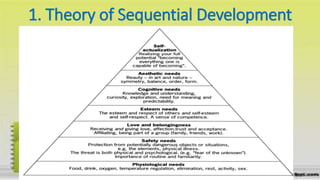
1. Theory of Sequential Development
2. Psychoanalytic Theory
- proposed by Sigmund Freud is known
as the Father of Psychoanalysis
Three Structures of Personality
a.
- the amoral part of personality
Id
- the savage, animalistic nature of
man such as the urge to destroy
b.
- the rational and pragmatic part of
personality
Ego
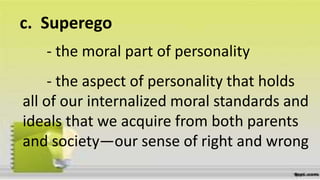
c.
- the moral part of personality
Superego
- the aspect of personality that holds
all of our internalized moral standards and
ideals that we acquire from both parents
and society—our sense of right and wrong
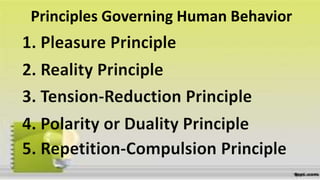
Principles Governing Human Behavior
3. Superiority and Inferiority Theories
- proposed by Alfred Adler, a
disciple of Sigmund Freud
4. Need Theory
- proposed by Henry Murray, an
American who constructed a
projected test known as Thematic
Apperception Test (TAT) to measure
human psychological needs
5. Theory of Functional Autonomy of
Motives
- proposed by Gordon Allport
who states that the motives of a
person develop in his attempt to
satisfy other motives
Psychology_Motivation

Psychology_Motivation

  • 1.
  • 2.
    Motivation - is thehypothetical concept that stands for the underlying force impelling behavior and giving it direction
  • 3.
    Motive - is somethingthat incites the organisms to action or that sustains and gives direction to action once the organism has been aroused
  • 4.
    Need - is definedas “a lack of something required for the survival, health or well- being of the individual”
  • 5.
    Drive - is astate of uncomfortable tension that spurs activity until a goal or incentive is reached
  • 6.
    Goal - refers toa substance, object or situation capable of satisfying a need and toward which motivated behavior is directed
  • 7.
  • 8.
    - are thosedirectly related to normal body functions such as the need for air, food, water, excretion of wastes, rest, protection from the extremes of heat and cold, sleep, and avoidance of pain
  • 9.
    1. Hunger This conditionis believed to be caused by rhythmic contractions of the empty stomach. The strength of the hunger drive can be measured by discovering how much resistance a human or an animal will endure or overcome in order to reach food that will alleviate the hunger state.
  • 10.
    2. Thirst When deprivedof water over a period of hours, an organism becomes excessively active. A dryness of the membrane of the mouth results from a deficiency of water in the tissues and a decrease in the secretions of the salivary glands. The thirst drive is satisfied by drinking water.
  • 11.
    3. Recovery fromFatigue There is strong desire for rest when one is tired. Hence, the urge to sleep can be very powerful. The urge to sleep is a sign that the body needs rest and relaxation. Sleep and rest help to establish and maintain homeostasis or organic equilibrium.
  • 12.
    4. Maintenance ofTemperature Normalcy A human being is a warm-blooded animal with the body temperature maintained at 98.6 degrees Fahrenheit. The homeostasis process by which this occurs is a constant internal adjustment that must take place if good health is to be preserved.
  • 13.
    5. Maintaining ProperElimination The process of elimination of waste matter is taken care of by the body through the proper functioning of specialized organs as they are activated by adequate internal stimuli. When there is any interruption in the process, catharsis is sometimes taken to activate the process.
  • 14.
    6. Avoidance ofPain The need to avoid tissue damage is essential for the survival of any organism. Any kind of pain stimulus may dominate other stimuli in controlling the direction of behavior.
  • 15.
    - are thatwhich arise as a result of interaction with other people
  • 16.
    1. Affectional drive Thisis the drive to have contact with, or be near some object or person that provides comfort and warmth.
  • 17.
    2. Need forsecurity and safety It motivates people to be cooperative and thereby builds a society that enables individuals to live together in peace and harmony.
  • 18.
    3. The needfor affiliation This is the desire to connect or associate oneself with others. The affiliation need accounts for the high motivation of individuals to join clubs, organizations, sports, and so on, and to feel rejected if they are not allowed entrance to a desired group.
  • 19.
    4. Gregariousness This isthe desire to be in the company or in the presence of other people. We feel lonely when we are alone. Our tendency is to be near someone to talk with, especially with a person who has the same interest.
  • 20.
    5. Dependency (orsuccorance) It is the need to seek aid, protection, and sympathy from another, the need to depend on others, the need to have someone to look up to and depend on for help.
  • 21.
    6. Social approval Itis the desire to behave in accordance with what society expects of us.
  • 22.
    - motives builtaround the “self”
  • 23.
    1. Recognition It isa motive that let the people feel the need for frequent tangible proof of getting ahead.
  • 24.
    Prestige Need -refers tothe desire to feel better than other persons with whom one compares himself - is a desire to attain a personality of a greater status
  • 25.
    Status Drive -refers tothe need to have a high rank in society, to be respected by people we know and not to be considered inferior, to be highly regarded by them
  • 26.
    2. Power Drive(or dominance) This is the need to control and influence others, to seek or compel the obedience of others, to determine their fate.
  • 27.
    3. Achievement Drive Thisis the drive to acccomplish something in order to have a feeling of having done something worthwhile or important.
  • 28.
    4. Autonomy This isthe drive for independence; the need to resist the influence of others, the need to feel that one had power over his actions, and has an area of prime responsibility.
  • 29.
    5. Defensiveness Drive Thisis the desire of one to defend oneself from blame, criticism, ridicule, and censure. It is the desire to preserve ones good name; the need to avoid failure,shame, and humiliation.
  • 30.
  • 31.
    1. Theory ofSequential Development
  • 32.
    2. Psychoanalytic Theory -proposed by Sigmund Freud is known as the Father of Psychoanalysis
  • 33.
    Three Structures ofPersonality a. - the amoral part of personality Id - the savage, animalistic nature of man such as the urge to destroy
  • 34.
    b. - the rationaland pragmatic part of personality Ego
  • 35.
    c. - the moralpart of personality Superego - the aspect of personality that holds all of our internalized moral standards and ideals that we acquire from both parents and society—our sense of right and wrong
  • 37.
  • 38.
    3. Superiority andInferiority Theories - proposed by Alfred Adler, a disciple of Sigmund Freud
  • 39.
    4. Need Theory -proposed by Henry Murray, an American who constructed a projected test known as Thematic Apperception Test (TAT) to measure human psychological needs
  • 40.
    5. Theory ofFunctional Autonomy of Motives - proposed by Gordon Allport who states that the motives of a person develop in his attempt to satisfy other motives

Editor's Notes

  • #3 impel- to cause someone to feel a strong need or desire to do something
  • #4 incite- encourage someone to do or achieve something
  • #5 -a bodily deficit like lack of food, or a state of deprivation such as lack of oxygen
  • #6 Drives then are psychological representation of need, i.e., whenever an individual has a need for something, he becomes tensed (pressured, stressed). This tension is often referred to as a drive. spur- stimulate; urge
  • #7 Goal or incentive is the objective (a condition or state) which the motivated organism seeks to attain in order to satisfy some need. The incentive then reduces the drive and satisfies the need and makes the organism less tense. Thus a hungry person will seek food which is the goal.
  • #9 -also referred to as biological, organic, primary, or basic
  • #11 Like the need for food, air, water, etc., thirst can be a powerful factor in controlling the direction of behavior.
  • #12 Need for sleep and rest
  • #13 Organisms respond to stimulation in the environment and from the elements as well as to insure them a regulated amount of temperature. The drive can be represented to be in proportion to the need. People in cold countries bundle themselves in clothing that will keep the body temperature warm.
  • #15 Pain will lead to any behavior that reduces the discomfort- removing one's hand from a hot flat iron, taking off a shoe that causes pain due to a protruding nail in it, taking an analgesic to relieve a headache.
  • #16 The common psychological or social motives that lead us to affiliate and interact with others are the need for security, social approval, affection, sex, and dependence.
  • #17 -Love and affection are very powerful motives. This drive may develop from one or both of these souces: it may be an unlearned drive that emerges in the normal course of maturation; or it may, on the other hand, be learned through experiences with people who satisfy survival needs.
  • #18 -An individual has a strong desire to be secure. The urge for security is one of the most powerful socializing forces. -The individual who feels secure in his home, in his work, in his social relationship, and in his ability to cope with problem situations, develops attitudes of confidence that usually enable him to progress successfully in whatever he undertakes.
  • #19 sense of belongingness
  • #20 gregariousness- association; a state in which you enjoy the company of other people
  • #21 We depend upon our parents for money, for our needs, and for advice.
  • #22 -The desire for group approval is one of the strongest urges of man. -We therefore, tend to avoid doing anything that will meet the disapproval of people around us. We want them to think well of us.
  • #24 - They work hard to gain some measure of success, and if recognition is not forthcoming, they will eventually quit or try some other patter of behavior. - Even a single pat on the back is often enough to reassure subordinate that his performance is appreciated.
  • #25 For example, people in our country know that taking up courses that require passing the board or bar examination , having a big and beautiful house in their community, having a car, piano, and other expensive appliances are symbols of affluence and people having these are better recognized and highly regarded. PRESTIGE - the respect and admiration that someone or something gets for being successful or important
  • #26 Status is shown in the position or rank one has in the institution, agency r company one is connected with.
  • #27 It is similar to prestige, but not the same in the sense that there are people who shun prestige and yet aspire for power.
  • #28 -It also refers to the striving of an individual to succeed in what he undertakes. -In our country, parents want their children to finish their studies and get a good and stable job. Seeing their children successful makes them feel happy for they have ddone something meritorious.
  • #29 It also refers to the desire to do what one feels he is capable of doing.
  • #30 censure- strong criticism
  • #32 Abraham H. Maslow - social anthropologist
  • #34 amoral- having or showing no concern whether behavior is morally right or wrong -driven by pleasure principle, which strives for immediate gratification of all desires, wants, and needs. If these needs are not satisfied immediately, the result is a state of anxiety or tension -rules the infants as it is primitive and unconscious
  • #35 rational- reasonable; justifiable pragmatic- realistic -According to Freud, the ego develops from the id and ensures that the impulses of the id can be expressed in a manner acceptable in the real world. Freud compared the id to a horse and the ego to the horse's rider. The horse provides the power and motion, yet the rider provides the direction and guidance. Without its rider, the horse may simply wander wherever it wished and do whatever it pleased. The rider instead gives the horse directions and commands to guide it in the direction he or she wishes to go. For example, imagine that you are stuck in a long meeting at work. You find yourself growing increasingly hungry as the meeting drags on. While the id might compel you to jump up from your seat and rush to the break room for a snack, the ego guides you to sit quietly and wait for the meeting to end. Instead of acting upon the primal urges of the id, you spend the rest of the meeting imagining yourself eating a cheeseburger. Once the meeting is finally over, you can seek out the object you were imagining and satisfy the demands of the id in a realistic and appropriate manner.
  • #36 internalized- incorporated; made important -corresponds to what is commonly referred to as conscience
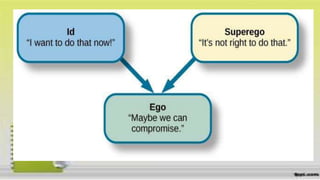
  • #37 compromise- to expose to risk or danger Conflict within the mind: According to Freud, the job of the ego is to balance the aggressive/pleasure-seeking drives of the id with the moral control of the superego.
  • #38 1. man is a pleasure-seeking animal; every act is motivated by the desire for pleasure 2. Man not only seeks pleasure but is likewise bound with the limits of reality which tell him that on certain occasions he must postpone an immediate pleasure in favor of more important future pleasures. 3.
  • #39 Alfred Adler- a disciple of Freud Adler presented 7 principles of human behavior. Superiosity and Inferiority are just few of them.
  • #40 -he was able to identify 20 needs which he believes are present in alry individual although they may vary in strength and intensity. -achievement, affiliation, aggression, autonomy, dependence, dominance, exhibition, avoidance
  • #41 Example: A man whose original motive for working is to earn a living but who may insist on staying on his job even though circumstanceo longer require him to do so. This may be due to the gradual emergence of new motives like the need for recognition and for activity.