ENHANCE YOUR SELF-ESTEEM AND TEACH BETTER Diana Cristina Porto TEACHERS FIRST
What is self-esteem? Briggs: how a person feels about himself, his overall judgment of himself, how much he likes his particular person. James Battle: the perception the individual possesses of his own worth . One’s feelings of self-competence and self-worth
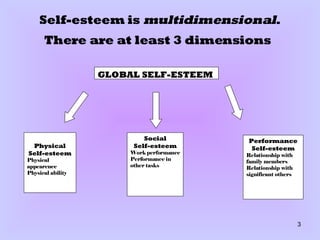
Self-esteem is  multidimensional . There are at least 3 dimensions   Social Self-esteem Work performance Performance in other tasks Physical Self-esteem Physical appearence Physical ability Performance Self-esteem Relationship with family members Relationship with significant others GLOBAL SELF-ESTEEM
Importance of self-esteem The key to success . Productive Behaviour: people perform better when they consider themselves competent . Work Performance: “There’s only one thing that counts in a business: building the self-esteem of your employees. Nothing else matters, because what they feel about themselves is what they give to your customers.” Robert Darvin . Interpersonal Relations: “You will do unto others as you do unto yourself.” D.C.Briggs . Psychological wellbeing: “If I were to search for the central core of difficulty is people as I have come to know them, it is that in the great majority of cases, they despise themselves, regarding themselves as worthless and unlovable.” Carl Rogers
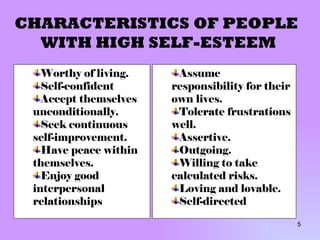
CHARACTERISTICS OF PEOPLE  WITH HIGH SELF-ESTEEM Worthy of living. Self-confident Accept themselves unconditionally. Seek continuous self-improvement. Have peace within themselves. Enjoy good interpersonal   relationships Assume responsibility for their own lives. Tolerate frustrations well. Assertive. Outgoing. Willing to take calculated risks. Loving and lovable. Self-directed
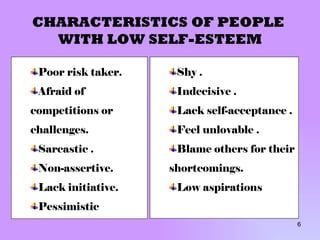
CHARACTERISTICS OF PEOPLE  WITH LOW SELF-ESTEEM Poor risk taker. Afraid of competitions or challenges. Sarcastic . Non-assertive. Lack initiative. Pessimistic  Shy . Indecisive . Lack self-acceptance . Feel unlovable . Blame others for their shortcomings. Low aspirations
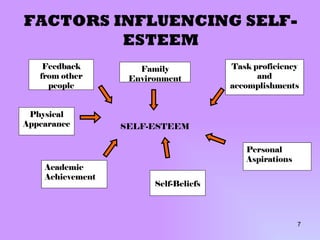
FACTORS INFLUENCING SELF-ESTEEM Personal Aspirations Feedback from other people Self-Beliefs Academic Achievement Physical Appearance SELF-ESTEEM Family Environment Task proficiency and accomplishments
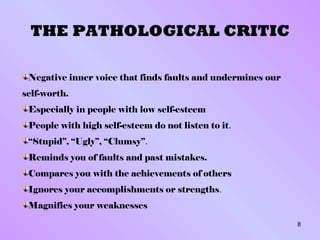
THE PATHOLOGICAL CRITIC Negative inner voice that finds faults and undermines our self-worth. Especially in people with low self-esteem People with high self-esteem do not listen to it . “ Stupid”, “Ugly”, “Clumsy” . Reminds you of faults and past mistakes. Compares you with the achievements of others Ignores your accomplishments or strengths . Magnifies your weaknesses
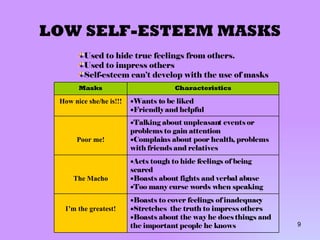
LOW SELF-ESTEEM MASKS Used to hide true feelings from others. Used to impress others Self-esteem can’t develop with the use of masks Boasts to cover feelings of inadequacy Stretches  the truth to impress others Boasts about the way he does things and the important people he knows I’m the greatest! Acts tough to hide feelings of being scared Boasts about fights and verbal abuse Too many curse words when speaking The Macho Talking about unpleasant events or problems to gain attention Complains about poor health, problems with friends and relatives Poor me! Wants to be liked Friendly and helpful How nice she/he is!!! Characteristics Masks
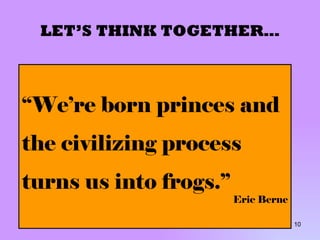
LET’S THINK TOGETHER… “ We’re born princes and the civilizing process turns us into frogs.”  Eric Berne
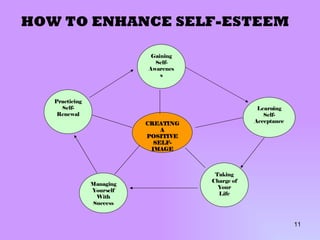
HOW TO ENHANCE SELF-ESTEEM   CREATING A POSITIVE SELF-IMAGE Practicing Self- Renewal Gaining Self- Awareness Learning Self- Acceptance Taking Charge of Your Life Managing Yourself With Success
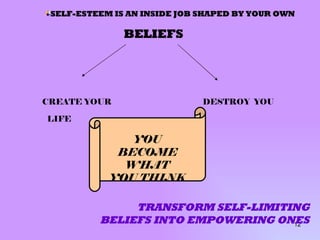
YOU BECOME WHAT YOU THINK SELF-ESTEEM IS AN INSIDE JOB SHAPED BY YOUR OWN BELIEFS   CREATE YOUR  DESTROY  YOU LIFE TRANSFORM SELF-LIMITING BELIEFS INTO EMPOWERING ONES
Let’s share with the person next to you the following basic truths: You are far more competent than you can imagine. You are far more lovable than you think. You are the primary source of your self-esteem. You are the master of your destiny. You choose your thoughts and feelings. You are okay just the way you are. No one is perfect: we have strengths and weaknesses. What makes the difference is who you think you are.
YES I CAN! If you  think  you are beaten, you are, If you  think  you dare not, you don’t. If you’d like to win, but  think  you can’t, It’s almost certain you won’t. If you  think  you’ll lose, you’re lost, For out in the world we find, Success begins with a fellow’s will, It’s all in the state of mind. If you  think  you’re outclassed, you are, You’ve got to  think high  to rise. You’ve got to be sure of yourself before, You can ever win a prize. Life’s battles don’t always go To the stronger or faster man, But sooner or later The person who wins Is the person  who thinks he can! Anonymous
LET’S WORK ON OUR SELF-IMAGES! Self-image: a belief system you have constructed about yourself. Take 5 minutes to answer these questions: What are your dominant negative beliefs? (Example: “I’m unattractive”, “I’m a loser.”) What are the primary sources of these beliefs? Parents, teachers, school mates, etc.? How valid are these beliefs? Are they based on facts? Consider the possibility that they are erroneous or just represent one way of looking at things. Let’s share our findings with the person next to you.
HOW DO YOU SPEAK TO YOURSELF? Avoid toxic self-talk “should”, “ought”, “have to” Use nurturing “prefer”, “want”, “choose”, “desire”. They reflect self-responsibility and free-choice. AFFIRMATIONS: positive statements to boost self-esteem
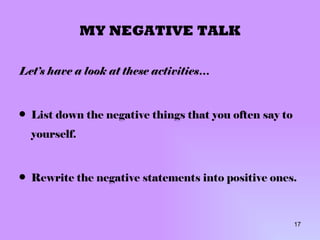
MY NEGATIVE TALK Let’s have a look at these activities… List down the negative things that you often say to yourself. Rewrite the negative statements into positive ones.
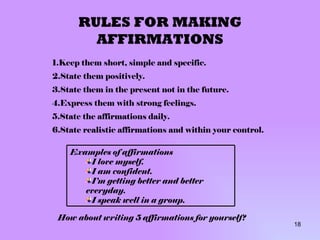
RULES FOR MAKING AFFIRMATIONS Keep them short, simple and specific. State them positively. State them in the present not in the future. Express them with strong feelings. State the affirmations daily. State realistic affirmations and within your control. How about writing 5 affirmations for yourself? Examples of affirmations I love myself. I am confident. I’m getting better and better everyday. I speak well in a group.
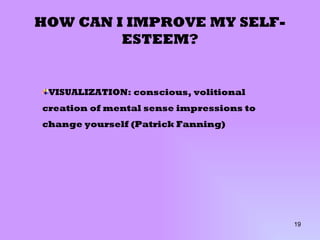
HOW CAN I IMPROVE MY SELF-ESTEEM? VISUALIZATION: conscious, volitional creation of mental sense impressions to change yourself (Patrick Fanning)
[email_address]

Self Esteem

  • 1.
    ENHANCE YOUR SELF-ESTEEMAND TEACH BETTER Diana Cristina Porto TEACHERS FIRST
  • 2.
    What is self-esteem?Briggs: how a person feels about himself, his overall judgment of himself, how much he likes his particular person. James Battle: the perception the individual possesses of his own worth . One’s feelings of self-competence and self-worth
  • 3.
    Self-esteem is multidimensional . There are at least 3 dimensions Social Self-esteem Work performance Performance in other tasks Physical Self-esteem Physical appearence Physical ability Performance Self-esteem Relationship with family members Relationship with significant others GLOBAL SELF-ESTEEM
  • 4.
    Importance of self-esteemThe key to success . Productive Behaviour: people perform better when they consider themselves competent . Work Performance: “There’s only one thing that counts in a business: building the self-esteem of your employees. Nothing else matters, because what they feel about themselves is what they give to your customers.” Robert Darvin . Interpersonal Relations: “You will do unto others as you do unto yourself.” D.C.Briggs . Psychological wellbeing: “If I were to search for the central core of difficulty is people as I have come to know them, it is that in the great majority of cases, they despise themselves, regarding themselves as worthless and unlovable.” Carl Rogers
  • 5.
    CHARACTERISTICS OF PEOPLE WITH HIGH SELF-ESTEEM Worthy of living. Self-confident Accept themselves unconditionally. Seek continuous self-improvement. Have peace within themselves. Enjoy good interpersonal relationships Assume responsibility for their own lives. Tolerate frustrations well. Assertive. Outgoing. Willing to take calculated risks. Loving and lovable. Self-directed
  • 6.
    CHARACTERISTICS OF PEOPLE WITH LOW SELF-ESTEEM Poor risk taker. Afraid of competitions or challenges. Sarcastic . Non-assertive. Lack initiative. Pessimistic Shy . Indecisive . Lack self-acceptance . Feel unlovable . Blame others for their shortcomings. Low aspirations
  • 7.
    FACTORS INFLUENCING SELF-ESTEEMPersonal Aspirations Feedback from other people Self-Beliefs Academic Achievement Physical Appearance SELF-ESTEEM Family Environment Task proficiency and accomplishments
  • 8.
    THE PATHOLOGICAL CRITICNegative inner voice that finds faults and undermines our self-worth. Especially in people with low self-esteem People with high self-esteem do not listen to it . “ Stupid”, “Ugly”, “Clumsy” . Reminds you of faults and past mistakes. Compares you with the achievements of others Ignores your accomplishments or strengths . Magnifies your weaknesses
  • 9.
    LOW SELF-ESTEEM MASKSUsed to hide true feelings from others. Used to impress others Self-esteem can’t develop with the use of masks Boasts to cover feelings of inadequacy Stretches the truth to impress others Boasts about the way he does things and the important people he knows I’m the greatest! Acts tough to hide feelings of being scared Boasts about fights and verbal abuse Too many curse words when speaking The Macho Talking about unpleasant events or problems to gain attention Complains about poor health, problems with friends and relatives Poor me! Wants to be liked Friendly and helpful How nice she/he is!!! Characteristics Masks
  • 10.
    LET’S THINK TOGETHER…“ We’re born princes and the civilizing process turns us into frogs.” Eric Berne
  • 11.
    HOW TO ENHANCESELF-ESTEEM CREATING A POSITIVE SELF-IMAGE Practicing Self- Renewal Gaining Self- Awareness Learning Self- Acceptance Taking Charge of Your Life Managing Yourself With Success
  • 12.
    YOU BECOME WHATYOU THINK SELF-ESTEEM IS AN INSIDE JOB SHAPED BY YOUR OWN BELIEFS CREATE YOUR DESTROY YOU LIFE TRANSFORM SELF-LIMITING BELIEFS INTO EMPOWERING ONES
  • 13.
    Let’s share withthe person next to you the following basic truths: You are far more competent than you can imagine. You are far more lovable than you think. You are the primary source of your self-esteem. You are the master of your destiny. You choose your thoughts and feelings. You are okay just the way you are. No one is perfect: we have strengths and weaknesses. What makes the difference is who you think you are.
  • 14.
    YES I CAN!If you think you are beaten, you are, If you think you dare not, you don’t. If you’d like to win, but think you can’t, It’s almost certain you won’t. If you think you’ll lose, you’re lost, For out in the world we find, Success begins with a fellow’s will, It’s all in the state of mind. If you think you’re outclassed, you are, You’ve got to think high to rise. You’ve got to be sure of yourself before, You can ever win a prize. Life’s battles don’t always go To the stronger or faster man, But sooner or later The person who wins Is the person who thinks he can! Anonymous
  • 15.
    LET’S WORK ONOUR SELF-IMAGES! Self-image: a belief system you have constructed about yourself. Take 5 minutes to answer these questions: What are your dominant negative beliefs? (Example: “I’m unattractive”, “I’m a loser.”) What are the primary sources of these beliefs? Parents, teachers, school mates, etc.? How valid are these beliefs? Are they based on facts? Consider the possibility that they are erroneous or just represent one way of looking at things. Let’s share our findings with the person next to you.
  • 16.
    HOW DO YOUSPEAK TO YOURSELF? Avoid toxic self-talk “should”, “ought”, “have to” Use nurturing “prefer”, “want”, “choose”, “desire”. They reflect self-responsibility and free-choice. AFFIRMATIONS: positive statements to boost self-esteem
  • 17.
    MY NEGATIVE TALKLet’s have a look at these activities… List down the negative things that you often say to yourself. Rewrite the negative statements into positive ones.
  • 18.
    RULES FOR MAKINGAFFIRMATIONS Keep them short, simple and specific. State them positively. State them in the present not in the future. Express them with strong feelings. State the affirmations daily. State realistic affirmations and within your control. How about writing 5 affirmations for yourself? Examples of affirmations I love myself. I am confident. I’m getting better and better everyday. I speak well in a group.
  • 19.
    HOW CAN IIMPROVE MY SELF-ESTEEM? VISUALIZATION: conscious, volitional creation of mental sense impressions to change yourself (Patrick Fanning)
  • 20.