Mrs.Jagadeeswari.J
M.Sc N
INTRODUCTION
The events of pregnancy ,labour
and during delivery together with
the peak experience of giving birth
all contribute to a mixture of
emotional reactions in the mother
during the 1st week of puerperium.
PSYCHOLOGICAL COMPLICATIONS TYPES
There are three distinctive types of
psychological disturbances seen in
the puerperium they are
Postnatal blues
Postpartum depression
Puerperal psychosis
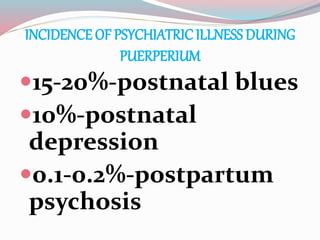
INCIDENCE OF PSYCHIATRICILLNESS DURING
PUERPERIUM
15-20%-postnatal blues
10%-postnatal
depression
0.1-0.2%-postpartum
psychosis
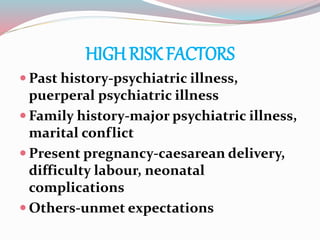
HIGH RISK FACTORS
 Past history-psychiatric illness,
puerperal psychiatric illness
 Family history-major psychiatric illness,
marital conflict
 Present pregnancy-caesarean delivery,
difficulty labour, neonatal
complications
 Others-unmet expectations
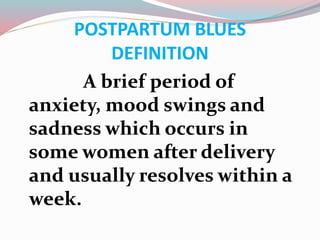
POSTPARTUM BLUES
DEFINITION
A brief period of
anxiety, mood swings and
sadness which occurs in
some women after delivery
and usually resolves within a
week.
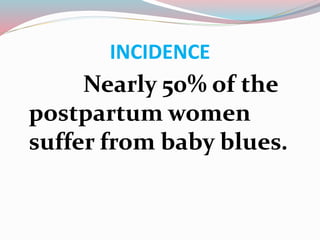
INCIDENCE
Nearly 50% of the
postpartum women
suffer from baby blues.
SYMPTOMS
 Unprovoked weeping
 Spikes of elation
 Irritability
 Anger
 Hostility
 Headache
 Feeling of unreality
 Exhaustion
 Sleep deprivation
 Restlessness
INTERVENTIONS
 Reassurance and psychological support
by family members
 Social interventions-relative baby
sitting so that the mother can get some
sleep or assistance with household
chores or providing instruction on
newborn. Women with previous history
are likely to get in subsequent
pregnancies
POSTPARTUM DEPRESSION
DEFINITION
Post partum depression
/Postnatal depression may seem
like baby blues at first however
symptoms are more intense and
longer lasting eventually
impacting a mothers ability to
care for her baby.
ONSET
Onset can be anytime
one year after delivery and
last more than 2 weeks
INCIDENCE
It is observed in 10-20%
of the postnatal mothers.
Risk of reoccurrence is
high(50-100%) in subsequent
pregnancies
CAUSES
Demand overload
Specific etiology is unknown
CONTRIBUTING FACTORS
 Experiencing stress
 Low self esteem
 Lack of support
 Stress associated with postnatal care
 Severe maternal blues
 Demands of motherhood
 Loss of personal freedom
RISK FACTORS
Problems with baby’s health
Major life changes around time
of delivery
Lack of support or help with
baby
Severe premenstrual syndrome
CLINICAL MANIFESTATIONS
 Loss of energy
 Loss of Appetite
 Insomnia
 Social withdrawal
 Irritability
 Suicidal attitude
 Anxiety
 Excessive guilt
 Depressed mood
 Fatigue
DIAGNOSIS
History collection
Edinburgh postnatal depression
scale
Medical history
Perform physical examination
and lab test
MANAGEMENT
 Early detection and initiation of appropriate
treatment brings best prognosis
 Less severe cases can be treated with mild
sedation or antidepressant
 Counseling
 Involvement of spouse and other family members
 More severe cases admission is necessary
 Fluxetine or paraxetine(serotonin uptake
inhibitors)
 Breast feeding also can be given to baby
POSTPARTUM PSYCHOSIS
Post partum psychosis is a
very serious mental condition that
requires immediate attention.
Postpartum psychosis is also one of
the rarest usually described as a
period when a woman loses touch
with reality the disorder occurs in
women who have recently given
birth.
INCIDENCE
Observed in about 1/500 to
1000 mothers. Commonly
seen in women with past
history of psychosis or with a
positive family history.
ONSET
Onset is relatively sudden
usually within 4 days of delivery
.Risk of reoccurrence in the
subsequent pregnancy is 20-25%
and there is increased risk of
psychiatric illness outside
pregnancy also.
CAUSES
 Lack of social and emotional support
 Low sense of self esteem due to a
woman's postpartum appearance
 Feeling inadequate as a mother
 Feeling isolated and alone
 Financial problems
 Major life changes
SIGNS OF POSTPARTUM
PSYCHOSIS
 Hallucinations
 Delusions
 Illogical thoughts
 Insomnia
 Refusing to eat
 Extreme feeling of anxiety and agitation
 Periods of delirium or mania
 Suicidal or homicidal thoughts
RISK FACTORS
Woman with a personal
history of psychosis, bipolar
disorder or schizophrenia
have a increased risk of
developing postpartum
psychosis
DIFFERTIAL DIAGNOSIS
Postpartum blues
Substance induced mood
disorders, anaesthesia
medication
Psychotic disorders resulting
from a general medical
condition
TREATMENT-PRINCIPLES
 Early identification of psychotic symptoms
 Emergent evaluation
 Hospitalization for safety and acute management
 Pharmacotherapy
 Co ordination of care among clinicians
 Involvement of family and other support system
for the patient and the newborn
 Psycho education for the patient and family
members
TREATMENT
 Active management
 Pharmacotherapy
 Antipsychotic medication
 Other psychotic medications-
Benzodiazepines(lorozepam &
clonazepam)
 ECT-Electroconvulsive therapy
PREVENTION
Women with bipolar disorders
or a history of postpartum
psychosis can be identified
through screening during
prenatal care. They should be
monitored continuously for few
weeks of postpartum.
NURSING MANAGEMENT
1. Listen to the woman regarding her adjustment to
role of mother and observe for any clinical
manifestations suggesting depression.
2. Ask the woman about the infant's behaviour.
Negative statements about the infant may suggest
that the woman is having difficulty coping.
3. Provide support and encourage husband, family
and friends to support and assist with the infant
and mother. Physical support as well as emotional
support may be indicated.
4. Educate the woman that treatment may help
alleviate her symptoms and allow her to better care
for herself and infant.
NURSING DIAGNOSIS
Impaired parenting related to postnatal
depression
Risk for effective ineffective coping
related to depression
Risk for maternal role attainment
related to postnatal psychosis
Psychological disorders during puerperium

Psychological disorders during puerperium

  • 1.
  • 2.
    INTRODUCTION The events ofpregnancy ,labour and during delivery together with the peak experience of giving birth all contribute to a mixture of emotional reactions in the mother during the 1st week of puerperium.
  • 3.
    PSYCHOLOGICAL COMPLICATIONS TYPES Thereare three distinctive types of psychological disturbances seen in the puerperium they are Postnatal blues Postpartum depression Puerperal psychosis
  • 4.
    INCIDENCE OF PSYCHIATRICILLNESSDURING PUERPERIUM 15-20%-postnatal blues 10%-postnatal depression 0.1-0.2%-postpartum psychosis
  • 5.
    HIGH RISK FACTORS Past history-psychiatric illness, puerperal psychiatric illness  Family history-major psychiatric illness, marital conflict  Present pregnancy-caesarean delivery, difficulty labour, neonatal complications  Others-unmet expectations
  • 6.
    POSTPARTUM BLUES DEFINITION A briefperiod of anxiety, mood swings and sadness which occurs in some women after delivery and usually resolves within a week.
  • 7.
    INCIDENCE Nearly 50% ofthe postpartum women suffer from baby blues.
  • 8.
    SYMPTOMS  Unprovoked weeping Spikes of elation  Irritability  Anger  Hostility  Headache  Feeling of unreality  Exhaustion  Sleep deprivation  Restlessness
  • 9.
    INTERVENTIONS  Reassurance andpsychological support by family members  Social interventions-relative baby sitting so that the mother can get some sleep or assistance with household chores or providing instruction on newborn. Women with previous history are likely to get in subsequent pregnancies
  • 10.
    POSTPARTUM DEPRESSION DEFINITION Post partumdepression /Postnatal depression may seem like baby blues at first however symptoms are more intense and longer lasting eventually impacting a mothers ability to care for her baby.
  • 11.
    ONSET Onset can beanytime one year after delivery and last more than 2 weeks
  • 12.
    INCIDENCE It is observedin 10-20% of the postnatal mothers. Risk of reoccurrence is high(50-100%) in subsequent pregnancies
  • 13.
  • 14.
    CONTRIBUTING FACTORS  Experiencingstress  Low self esteem  Lack of support  Stress associated with postnatal care  Severe maternal blues  Demands of motherhood  Loss of personal freedom
  • 15.
    RISK FACTORS Problems withbaby’s health Major life changes around time of delivery Lack of support or help with baby Severe premenstrual syndrome
  • 16.
    CLINICAL MANIFESTATIONS  Lossof energy  Loss of Appetite  Insomnia  Social withdrawal  Irritability  Suicidal attitude  Anxiety  Excessive guilt  Depressed mood  Fatigue
  • 17.
    DIAGNOSIS History collection Edinburgh postnataldepression scale Medical history Perform physical examination and lab test
  • 18.
    MANAGEMENT  Early detectionand initiation of appropriate treatment brings best prognosis  Less severe cases can be treated with mild sedation or antidepressant  Counseling  Involvement of spouse and other family members  More severe cases admission is necessary  Fluxetine or paraxetine(serotonin uptake inhibitors)  Breast feeding also can be given to baby
  • 19.
    POSTPARTUM PSYCHOSIS Post partumpsychosis is a very serious mental condition that requires immediate attention. Postpartum psychosis is also one of the rarest usually described as a period when a woman loses touch with reality the disorder occurs in women who have recently given birth.
  • 20.
    INCIDENCE Observed in about1/500 to 1000 mothers. Commonly seen in women with past history of psychosis or with a positive family history.
  • 21.
    ONSET Onset is relativelysudden usually within 4 days of delivery .Risk of reoccurrence in the subsequent pregnancy is 20-25% and there is increased risk of psychiatric illness outside pregnancy also.
  • 22.
    CAUSES  Lack ofsocial and emotional support  Low sense of self esteem due to a woman's postpartum appearance  Feeling inadequate as a mother  Feeling isolated and alone  Financial problems  Major life changes
  • 23.
    SIGNS OF POSTPARTUM PSYCHOSIS Hallucinations  Delusions  Illogical thoughts  Insomnia  Refusing to eat  Extreme feeling of anxiety and agitation  Periods of delirium or mania  Suicidal or homicidal thoughts
  • 24.
    RISK FACTORS Woman witha personal history of psychosis, bipolar disorder or schizophrenia have a increased risk of developing postpartum psychosis
  • 25.
    DIFFERTIAL DIAGNOSIS Postpartum blues Substanceinduced mood disorders, anaesthesia medication Psychotic disorders resulting from a general medical condition
  • 26.
    TREATMENT-PRINCIPLES  Early identificationof psychotic symptoms  Emergent evaluation  Hospitalization for safety and acute management  Pharmacotherapy  Co ordination of care among clinicians  Involvement of family and other support system for the patient and the newborn  Psycho education for the patient and family members
  • 27.
    TREATMENT  Active management Pharmacotherapy  Antipsychotic medication  Other psychotic medications- Benzodiazepines(lorozepam & clonazepam)  ECT-Electroconvulsive therapy
  • 28.
    PREVENTION Women with bipolardisorders or a history of postpartum psychosis can be identified through screening during prenatal care. They should be monitored continuously for few weeks of postpartum.
  • 29.
    NURSING MANAGEMENT 1. Listento the woman regarding her adjustment to role of mother and observe for any clinical manifestations suggesting depression. 2. Ask the woman about the infant's behaviour. Negative statements about the infant may suggest that the woman is having difficulty coping. 3. Provide support and encourage husband, family and friends to support and assist with the infant and mother. Physical support as well as emotional support may be indicated. 4. Educate the woman that treatment may help alleviate her symptoms and allow her to better care for herself and infant.
  • 30.
    NURSING DIAGNOSIS Impaired parentingrelated to postnatal depression Risk for effective ineffective coping related to depression Risk for maternal role attainment related to postnatal psychosis