Post Partum Disorders
Diagnosis and Treatment Issues
Perinatal Psychiatry
 Perinatal psychiatry deals with mental illness
associated with choldbearing.
 Also concerned with antenatal disorders,
associated psychiatric problems in fathers and the
special needs of parents who are psychiatrically
ill.
 Nosologically, puerperal psychiatric states may
be divided into 3 categories which overlap to
some extent.
Historical Consideration
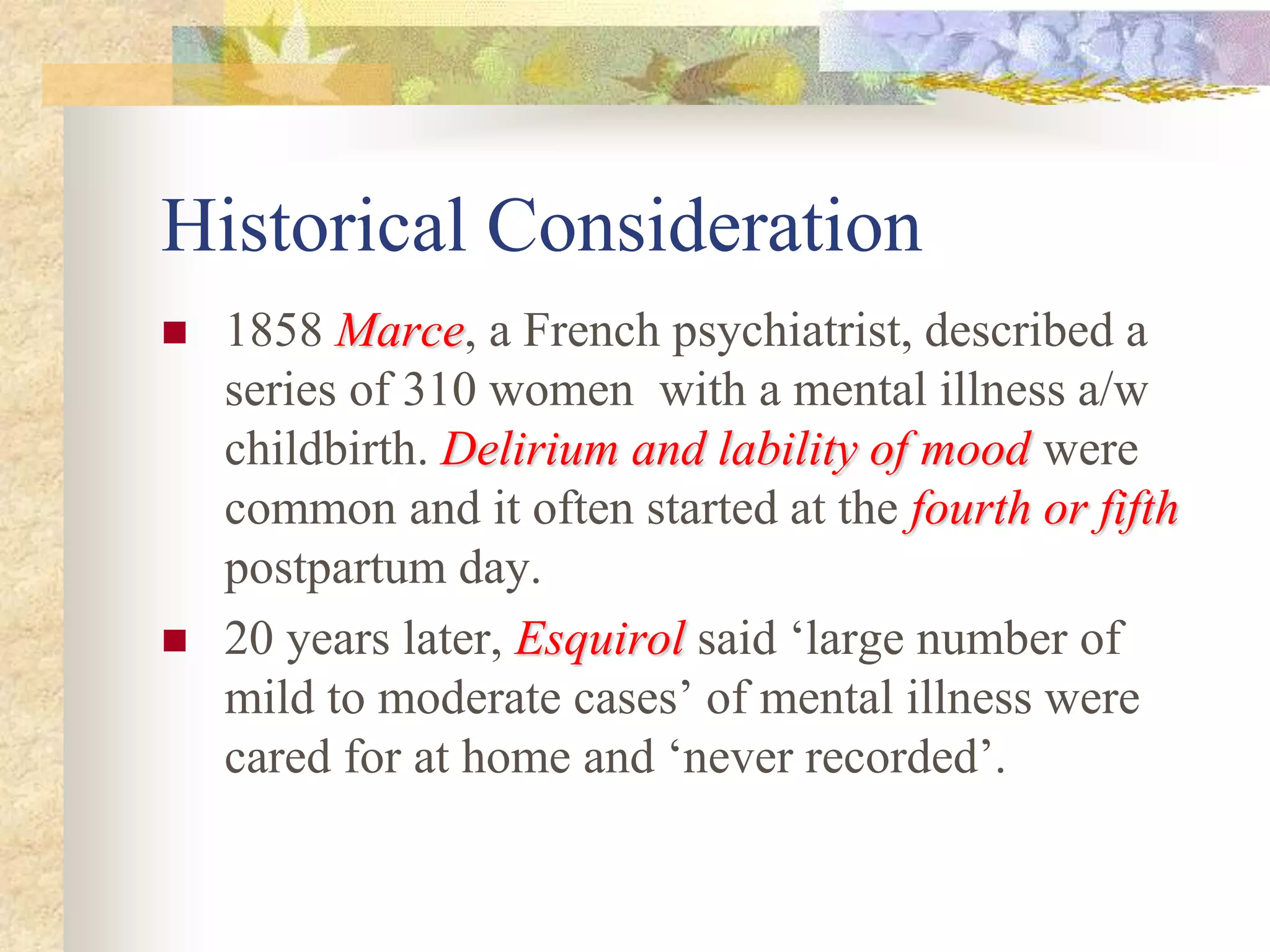
 1858 MarceMarce, a French psychiatrist, described a
series of 310 women with a mental illness a/w
childbirth. Delirium and lability of moodDelirium and lability of mood were
common and it often started at the fourth or fifthfourth or fifth
postpartum day.
 20 years later, EsquirolEsquirol said ‘large number of
mild to moderate cases’ of mental illness were
cared for at home and ‘never recorded’.
Diagnostic Issues
 Are Postpartum disorders distinct entitiesdistinct entities?
 are they different from non-puerperal illness?
 How to differentiate the 3 categories?
 because of their overlappingoverlapping symptoms
 Why are they often undiagnosed?
 they are maskedmasked by constitutional symptoms of
childbirth
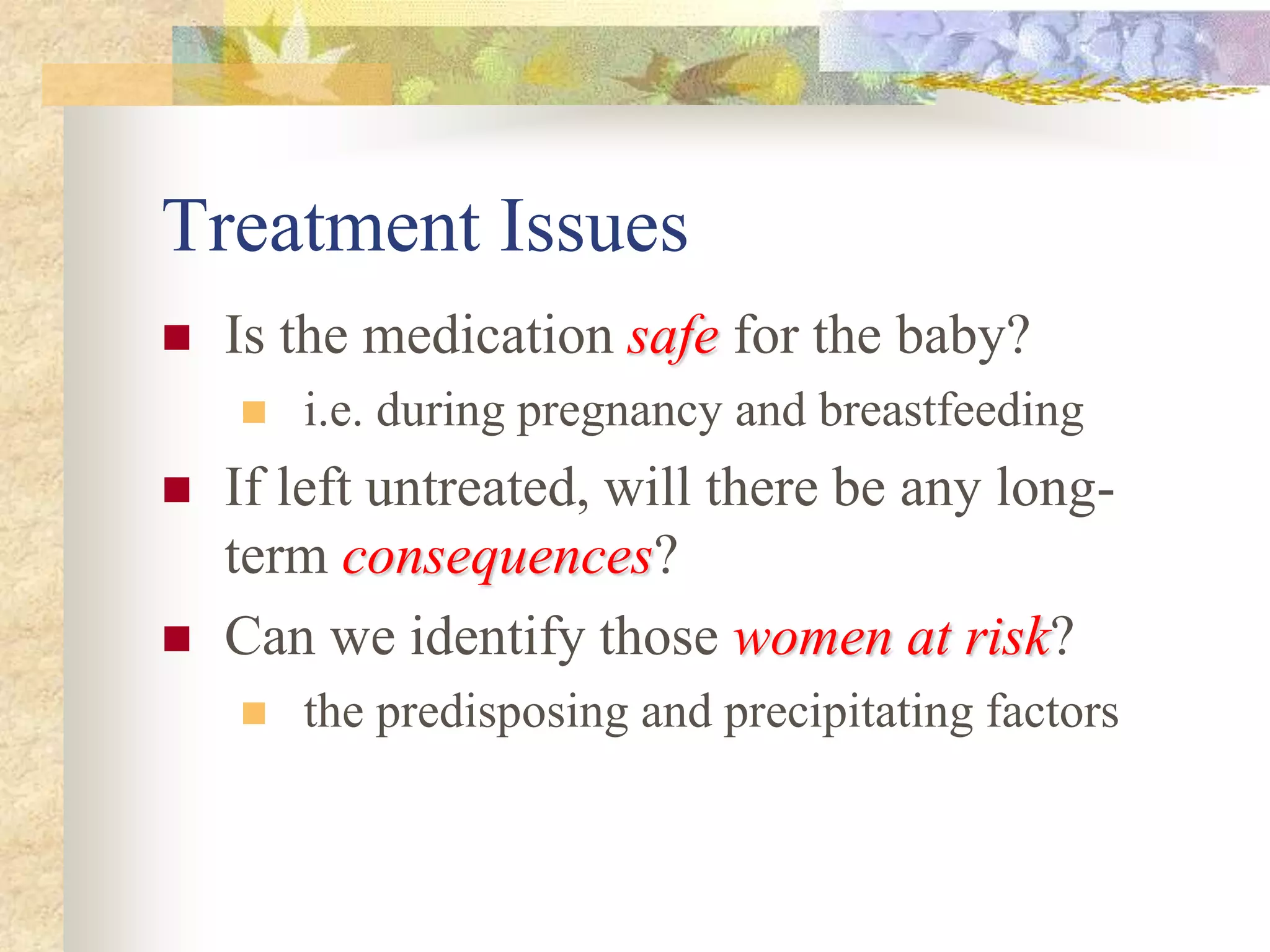
Treatment Issues
 Is the medication safesafe for the baby?
 i.e. during pregnancy and breastfeeding
 If left untreated, will there be any long-
term consequencesconsequences?
 Can we identify those women at riskwomen at risk?
 the predisposing and precipitating factors
Postnatal Blues
Most common postnatal problem, it
requires only education, reassurance and
support
Postnatal Blues
 Also known as baby or maternity blues, or
transitory mood disturbances (Cox 1993)
 In the first few days after childbirth
 In up to 70% of women (most common)
 Anxiety, depression and confusion
 peak at 4th to 5th day
 transient, lasted 2-3 days
Characteristics
 Victoroff (1952) coined the term “maternitymaternity
bluesblues”, seeing it as a similar state to premenstrual
syndrome.
 Prevalence vary 30-70%
 Perhaps a non-specific reaction to hormonalhormonal
changechange following delivery
Characteristics
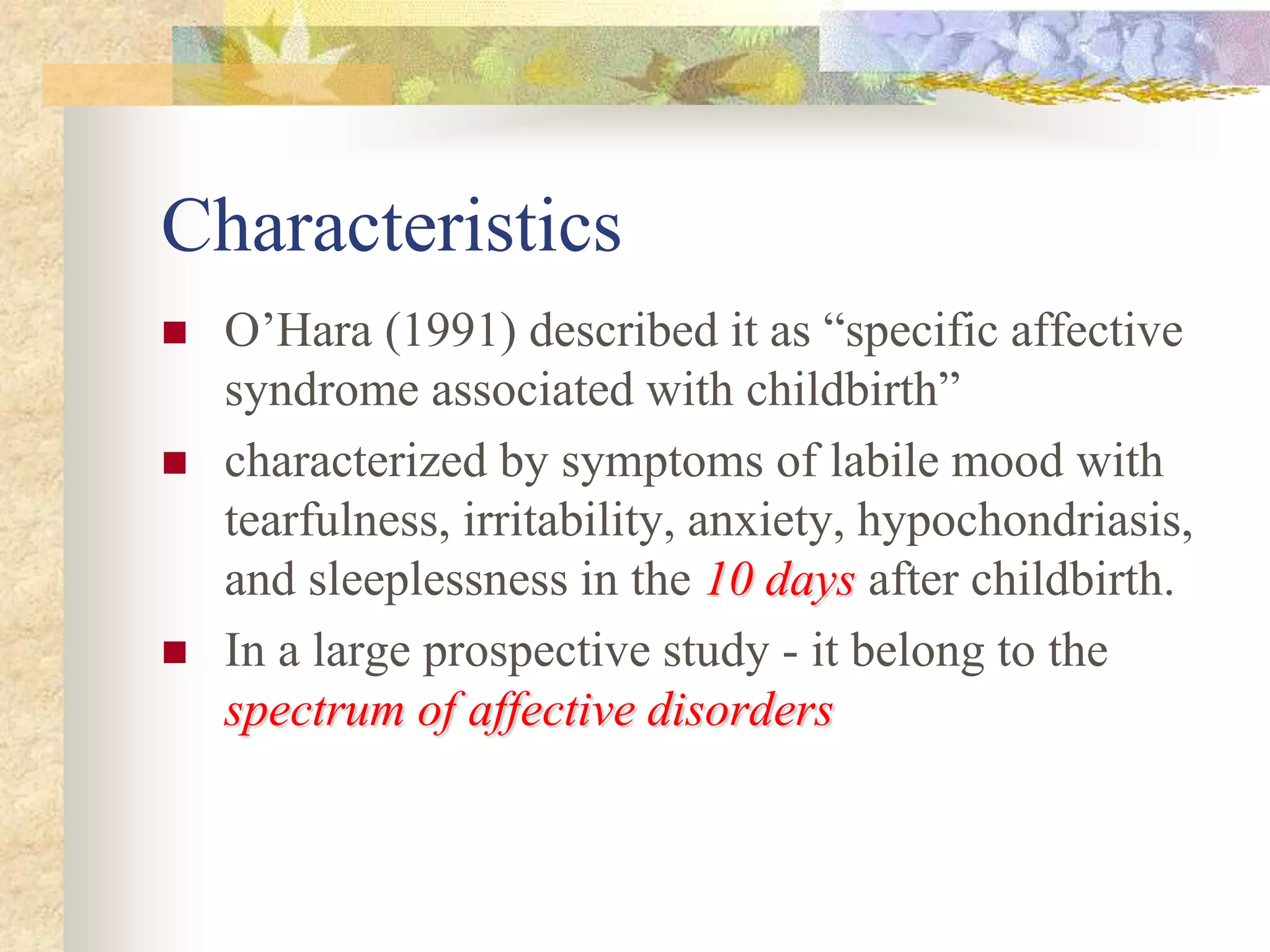
 O’Hara (1991) described it as “specific affective
syndrome associated with childbirth”
 characterized by symptoms of labile mood with
tearfulness, irritability, anxiety, hypochondriasis,
and sleeplessness in the 10 days10 days after childbirth.
 In a large prospective study - it belong to the
spectrum of affective disordersspectrum of affective disorders
Common Psychological Symptoms
 Low mood
 Anxiety
 Tiredness
 Ambivalence about the baby
 Reduced sexual interest
 Anger & bitterness
Etiology
 Harris (1994), found a small but robust associationrobust association
between maternity blues and change in level of
progesterone immediately after birth.
 The higher the antenatal progesterone levelantenatal progesterone level,
 the steeper the gradient of the risegradient of the rise, and
 the bigger the drop in progesterone leveldrop in progesterone level after
delivery, the more severe were the blues.
 blues peaked when progesterone levels at
their lowest
Biological and Social Factors
 Body weight and fluid, and levels of electrolytes
(Stein 1981), monoamines (Treadway 1969),
serum tryptophan (Handley 1980)
 History of premenstrual syndromepremenstrual syndrome, antepartum
depression (O’Hara 1991)
 Poor general social adjustmentgeneral social adjustment during pregnancy,
rather than partnership problems, were the
strongest predictors of the blues (O’Hara 1991)
A Review by Alain Gregoire (2000)
 Biological causes: nature & timing of
blues, h/o PMS
 The only protective social factor is
supportive social relationshipsupportive social relationship
 Social class, chronic stresses and life
events do not seem related
 No evidence for difficult and exhaustive
delivery, being in hospital, and perineal
pain.
Postnatal Depression
Responsible for most postnatal psychiatric
morbidity and suffering in the community and
requires careful planning of services for
prevention, detection and treatment in primary and
secondary care.
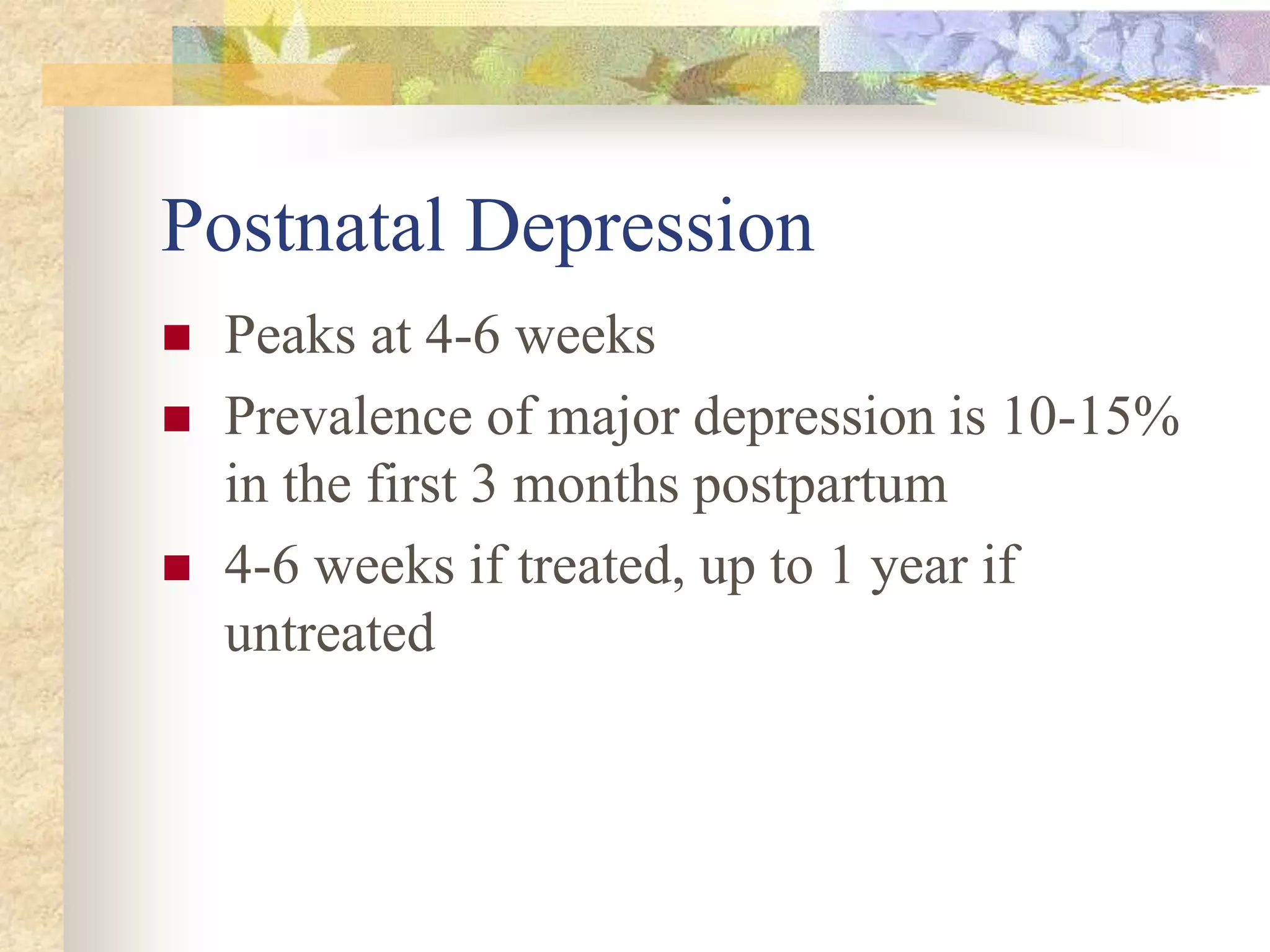
Postnatal Depression
 Peaks at 4-6 weeks
 Prevalence of major depression is 10-15%
in the first 3 months postpartum
 4-6 weeks if treated, up to 1 year if
untreated
Characteristics
 Clasically described as “smiling depressionsmiling depression”
(Dalton 1971) characterized by an outward
display of normality
 The psychic aspects of depression in postpartum
period are probably little different to depressive
episodes at any other time.
 Prevalence: 20% in 6 weeks postpartum had at
least mild depressive episodemild depressive episode (Paykel 1980)
Clinical Features
 Excessive anxiety about her baby’s health that
cannot be diminished by reassurance
 Self-blame: the mother believes she cannot live up to her own
expectations of a ‘good mother’ nor is she competent as her own
mother. She also compare herself unfavorably with others in the
neighbourhood.
 Sleep difficulty due to mood disturbances, but often masked by
the disruption of night feeds or noisy hospital routine
 A complaint of a depressed mood or behaviorally tearful
etc
Clinical Features
 Suicidal thoughts or fear of harming the baby
 Irritability and loss of libido leading to deterioration of
marital relationship
 Worry at her rejection of the baby and a reluctant
to feed or handle it
 A fear that the baby may not be hers, or could be
deformed in some ways
Etiology
 In contrast to maternity blues, postnatal depression has aa
clear setclear set of associated factors.
 Older and younger women (Paykel 1980)
 Unsupportive partners (Watson 1984)
 Twice more life events (Paykel 1980)
 Previous mental illness (Paykel 1980)
 Thyroid dysfunction
Factors for Apparent Neglect
 An assumption that all mood disturbances in the
puerperium are ‘just postnatal blues’just postnatal blues’, i.e. They are not
only common but transitory and therefore of no clinical importance
 Transfer from hospitalTransfer from hospital occur at/about the same
time when the illness begins, so the the likelihood of an
accurate diagnosis being made is diminished
 The health worker and family may be more
concerned with physical health andphysical health and
developmental milestonesdevelopmental milestones of the baby,
Factors for Apparent Neglect
 LimitedLimited psychiatric training of GP, midwives may
delay diagnosis
 The mothers may not report their depressed
mood, because they do not recognize their distress as an illness or
they fear that their guilt and inadequacy will be reinforced
Therefore, early identificationearly identification of postnatal depression is often
difficult
 absence of antenatal predictorsantenatal predictors, other than hereditary
predisposition and previous psychiatric history
 Often develops unexpectedlyunexpectedly ‘out of the blue’
Detection
 Weight loss, menstrual change, low libido,
appetite change, and change of general interest
may be normal postpartum phenomena
 EPDS rates core featurescore features of low mood,
anhedonia, anxiety, and sleep disturbances due to
anxiety.
 EPDS superior than BDI in postpartum period
(self-rated)
 Equal to 17-item Hamilton scale & MADRS
(observer-rated)
Impact on Child Development
(Cooper & Murray 1998)
 Cognitive developmentCognitive development is adversely affected,
especially among male and socioeconomically
disadvantage groups
 The children tend to have insecure attachmentinsecure attachment at
18 months and the boys then show high level of
frank behavioral disturbancesfrank behavioral disturbances at 5 years
 The adverse child outcome is related to the
disturbances in mother-infant interactionsmother-infant interactions
Classification of Postpartum Mental
Illness (Sichel, 1998)
 Postpartum blues
 Pure depression of postpartum onset (no h/o
previous depression)
 Depression of antenatal onset
 Depression with previous h/o non-pueperial
depression
 Depression with comorbid diagnoses
DSM-IV Criteria for Postpartum
Onset Specifier
Specify if
 With Postpartum Onset (can be applied to the
current or most recent Major Depression, Manic,
or Mixed Episode in Major Depressive Disorder,
Bipolar I Disorder, or Bipolar II Disorder; or to
Brief Psychotic Disorder)
 Onset of episode within 4 weeks4 weeks postpartum
ICD-10
F53 Mental and behavioral disorders
associated with the pueperium, not
elsewhere classified
 Commencing within 6 weeks of delivery
 and, either
 insufficient data
 because it is considered that special additional
features are present which make classification
elsewhere inappropriate
ICD-10
 F53.0 Mild Mental and behavioral disorders associated with the
pueperium, not elsewhere classified
 Postnatal depression NOS
 Postpartum depression NOS
 F53.1 Severe Mental and behavioral disorders associated with
the pueperium, not elsewhere classified
 Puerperal psychosis NOS
 F53.8 Other Mental and behavioral disorders associated with the
pueperium, not elsewhere classified
 F53.9 Puerperal mental disorder, unspecified
Treatment
 Based on principles similar to depression at
other time
Puerperal Psychosis
Most severe postnatal disorder, it requires
specialist psychiatric care and usually admission,
preferably to a specialist mother-and-baby service
Puerperal Psychosis
 1-2 per 1000 birth
(0.1-0.2%)
 Usually begins in first
week after delivery
 In most cases,
affective disorder
akin the manic
depressive illness
Characteristics
 One of the most serious psychiatric conditions -
may endanger the livesendanger the lives of both mother and baby
 Prevalence: 1-2 in 1000 births1-2 in 1000 births (Kendel 1987) -
the majority bipolar illness.
 Risk of developing bipolar at postpartum period
is 35 times35 times more than at any other time during a
woman’s life.
Clinical Presentation
 Severe insomnia and early morning waking
 Lability of mood, sudden tearfulness or
inappropriate laughter
 Persistent perplexity, disorientation or
depersonalization
 Unusual behavior such as restlessness,
excitement or sullen withdrawal
Clinical Presentation
 Unexpected rejection of the baby or a
conviction that the baby is deformed or
dead
 Paranoid ideas that may involve hospital
staff or close family relations
 Suicidal or infanticidal threats
 Excessive guilt, depression or anxiety
Etiology
 Puerperal psychosis is associated with (Kendel 1987)
 A family history of bipolar illnessbipolar illness
 A personal history of bipolar illness
 Primiparity
 Perinatal mortality
 Lack of partner support
Etiology
 Puerperal psychosis is related to the vast postnatal
hormonal changeshormonal changes.
 Relapse could be predicted by apomorphine
challenge test in immediate postpartum
period - increase GH secretion (Wieck 1991)
 Not replicated by Mearkin 1995 study
 Efficacy of estrogen treatment (Henderson
1991)
Predisposing and precipitating factors according to
Gregoire review (2000)
 a previous or family history of psychosispsychosis,
particularly pueperal
 first pregnancy
 perinatal death
 alcohol or drug abuse
 poor marital relationship
 poor social support
Treatment
 Usually includes antipsychotic, and possibly
antidepressant medication.
 In breastfeeding women: traditional antipsychotic
is preferable.
 In non breast-feeding women: atypical
antipsychotic
 ECT
 Hospitalization
FDA Rating of Drug
Safety in Pregnancy
 Category A: No fetal risks in controlled human studies
e.g., folic acid, iron.
 Category B: No fetal risk in animal studies but no
controlled human studies OR fetal risk in animals but no risk in
well-controlled human studies e.g., caffeine, nicotine,
acetaminophen.
 Category C: Adverse fetal effect in animals
and no human data available e.g., aspirin,
haloperidolhaloperidol, chlorpromazinechlorpromazine.
FDA Rating of Drug
Safety in Pregnancy
 Category D: Human fetal
risk seen (may be used in
life-threatening situation)
e.g., lithiumlithium, tetracycline,
ethanol.
 Category X: Proved fetal
risk in humans (no indication
for use, even in life-
threatening situations) e.g.,
valproic acidvalproic acid, thalidomide.
Antipsychotic and
Lactation
 Milk-to-plasma ratio: chlorpromazine 0.3:1 and
perphenazine 1:1
 Phenothiazine use in lactating women
 Has not been associated with
serious consequences
 Breast feeding is contraindicatedBreast feeding is contraindicated
Lithium
 Principle indication: prophylaxis of bipolar
illness
 Use in pregnancy:
 avoid if possible in first 10 weeks of pregnancy
(small increased risk of cardiac abnormalities),
 levels need more frequent monitoring,
 dose need to be increased
 Use during breast-feeding: monitor levels and
infant closely
Carbamazepine & Valproate
 Principle indication: prophylaxis of bipolar
illness
 Use in pregnancy:
 avoid if possible ( increased risk of neural tube
defects)
 lithium preferred
 Use during breast-feeding: safe
Benzodiazepines
 Principle indication: brief (max 4 weeks)
treatment of acute anxiety or insomnia
 Use in pregnancy:
 Avoid in first trimester (possible increased risk of
oral cleft)
 short-acting type preferred
 Use during breast-feeding: short-acting type
preferred
Transcultural Issues
 Remarkable similarity in prevalence across
different culture (Kumar 1994)
 Postnatal blues are not generally affected by cultural
factors
 Intercultural differences cannot be shown for
postnatal depression
 Puerperal psychosis is consistent across cultural and
ethnic divides
 Unchanging incidence over the past 150 years
Transcultural Issues
 Howard 1993, stated that puerperal psychosis are
more common in the developing world, which
suggest the importance of organic factor.
 Hypothesis: lack of ‘rites of incorporation’ are
related to postnatal depression (present-day
ambiguity about social norms postpartum)
Thank You
Presenter: Dr. Zahiruddin
Supervisor: Dr. Wan Mohd Rusdi

Post Partum Disorders [2001]

  • 1.
    Post Partum Disorders Diagnosisand Treatment Issues
  • 2.
    Perinatal Psychiatry  Perinatalpsychiatry deals with mental illness associated with choldbearing.  Also concerned with antenatal disorders, associated psychiatric problems in fathers and the special needs of parents who are psychiatrically ill.  Nosologically, puerperal psychiatric states may be divided into 3 categories which overlap to some extent.
  • 3.
    Historical Consideration  1858MarceMarce, a French psychiatrist, described a series of 310 women with a mental illness a/w childbirth. Delirium and lability of moodDelirium and lability of mood were common and it often started at the fourth or fifthfourth or fifth postpartum day.  20 years later, EsquirolEsquirol said ‘large number of mild to moderate cases’ of mental illness were cared for at home and ‘never recorded’.
  • 4.
    Diagnostic Issues  ArePostpartum disorders distinct entitiesdistinct entities?  are they different from non-puerperal illness?  How to differentiate the 3 categories?  because of their overlappingoverlapping symptoms  Why are they often undiagnosed?  they are maskedmasked by constitutional symptoms of childbirth
  • 5.
    Treatment Issues  Isthe medication safesafe for the baby?  i.e. during pregnancy and breastfeeding  If left untreated, will there be any long- term consequencesconsequences?  Can we identify those women at riskwomen at risk?  the predisposing and precipitating factors
  • 6.
    Postnatal Blues Most commonpostnatal problem, it requires only education, reassurance and support
  • 7.
    Postnatal Blues  Alsoknown as baby or maternity blues, or transitory mood disturbances (Cox 1993)  In the first few days after childbirth  In up to 70% of women (most common)  Anxiety, depression and confusion  peak at 4th to 5th day  transient, lasted 2-3 days
  • 8.
    Characteristics  Victoroff (1952)coined the term “maternitymaternity bluesblues”, seeing it as a similar state to premenstrual syndrome.  Prevalence vary 30-70%  Perhaps a non-specific reaction to hormonalhormonal changechange following delivery
  • 9.
    Characteristics  O’Hara (1991)described it as “specific affective syndrome associated with childbirth”  characterized by symptoms of labile mood with tearfulness, irritability, anxiety, hypochondriasis, and sleeplessness in the 10 days10 days after childbirth.  In a large prospective study - it belong to the spectrum of affective disordersspectrum of affective disorders
  • 10.
    Common Psychological Symptoms Low mood  Anxiety  Tiredness  Ambivalence about the baby  Reduced sexual interest  Anger & bitterness
  • 11.
    Etiology  Harris (1994),found a small but robust associationrobust association between maternity blues and change in level of progesterone immediately after birth.  The higher the antenatal progesterone levelantenatal progesterone level,  the steeper the gradient of the risegradient of the rise, and  the bigger the drop in progesterone leveldrop in progesterone level after delivery, the more severe were the blues.  blues peaked when progesterone levels at their lowest
  • 12.
    Biological and SocialFactors  Body weight and fluid, and levels of electrolytes (Stein 1981), monoamines (Treadway 1969), serum tryptophan (Handley 1980)  History of premenstrual syndromepremenstrual syndrome, antepartum depression (O’Hara 1991)  Poor general social adjustmentgeneral social adjustment during pregnancy, rather than partnership problems, were the strongest predictors of the blues (O’Hara 1991)
  • 13.
    A Review byAlain Gregoire (2000)  Biological causes: nature & timing of blues, h/o PMS  The only protective social factor is supportive social relationshipsupportive social relationship  Social class, chronic stresses and life events do not seem related  No evidence for difficult and exhaustive delivery, being in hospital, and perineal pain.
  • 14.
    Postnatal Depression Responsible formost postnatal psychiatric morbidity and suffering in the community and requires careful planning of services for prevention, detection and treatment in primary and secondary care.
  • 15.
    Postnatal Depression  Peaksat 4-6 weeks  Prevalence of major depression is 10-15% in the first 3 months postpartum  4-6 weeks if treated, up to 1 year if untreated
  • 16.
    Characteristics  Clasically describedas “smiling depressionsmiling depression” (Dalton 1971) characterized by an outward display of normality  The psychic aspects of depression in postpartum period are probably little different to depressive episodes at any other time.  Prevalence: 20% in 6 weeks postpartum had at least mild depressive episodemild depressive episode (Paykel 1980)
  • 17.
    Clinical Features  Excessiveanxiety about her baby’s health that cannot be diminished by reassurance  Self-blame: the mother believes she cannot live up to her own expectations of a ‘good mother’ nor is she competent as her own mother. She also compare herself unfavorably with others in the neighbourhood.  Sleep difficulty due to mood disturbances, but often masked by the disruption of night feeds or noisy hospital routine  A complaint of a depressed mood or behaviorally tearful etc
  • 18.
    Clinical Features  Suicidalthoughts or fear of harming the baby  Irritability and loss of libido leading to deterioration of marital relationship  Worry at her rejection of the baby and a reluctant to feed or handle it  A fear that the baby may not be hers, or could be deformed in some ways
  • 19.
    Etiology  In contrastto maternity blues, postnatal depression has aa clear setclear set of associated factors.  Older and younger women (Paykel 1980)  Unsupportive partners (Watson 1984)  Twice more life events (Paykel 1980)  Previous mental illness (Paykel 1980)  Thyroid dysfunction
  • 20.
    Factors for ApparentNeglect  An assumption that all mood disturbances in the puerperium are ‘just postnatal blues’just postnatal blues’, i.e. They are not only common but transitory and therefore of no clinical importance  Transfer from hospitalTransfer from hospital occur at/about the same time when the illness begins, so the the likelihood of an accurate diagnosis being made is diminished  The health worker and family may be more concerned with physical health andphysical health and developmental milestonesdevelopmental milestones of the baby,
  • 21.
    Factors for ApparentNeglect  LimitedLimited psychiatric training of GP, midwives may delay diagnosis  The mothers may not report their depressed mood, because they do not recognize their distress as an illness or they fear that their guilt and inadequacy will be reinforced Therefore, early identificationearly identification of postnatal depression is often difficult  absence of antenatal predictorsantenatal predictors, other than hereditary predisposition and previous psychiatric history  Often develops unexpectedlyunexpectedly ‘out of the blue’
  • 22.
    Detection  Weight loss,menstrual change, low libido, appetite change, and change of general interest may be normal postpartum phenomena  EPDS rates core featurescore features of low mood, anhedonia, anxiety, and sleep disturbances due to anxiety.  EPDS superior than BDI in postpartum period (self-rated)  Equal to 17-item Hamilton scale & MADRS (observer-rated)
  • 23.
    Impact on ChildDevelopment (Cooper & Murray 1998)  Cognitive developmentCognitive development is adversely affected, especially among male and socioeconomically disadvantage groups  The children tend to have insecure attachmentinsecure attachment at 18 months and the boys then show high level of frank behavioral disturbancesfrank behavioral disturbances at 5 years  The adverse child outcome is related to the disturbances in mother-infant interactionsmother-infant interactions
  • 24.
    Classification of PostpartumMental Illness (Sichel, 1998)  Postpartum blues  Pure depression of postpartum onset (no h/o previous depression)  Depression of antenatal onset  Depression with previous h/o non-pueperial depression  Depression with comorbid diagnoses
  • 25.
    DSM-IV Criteria forPostpartum Onset Specifier Specify if  With Postpartum Onset (can be applied to the current or most recent Major Depression, Manic, or Mixed Episode in Major Depressive Disorder, Bipolar I Disorder, or Bipolar II Disorder; or to Brief Psychotic Disorder)  Onset of episode within 4 weeks4 weeks postpartum
  • 26.
    ICD-10 F53 Mental andbehavioral disorders associated with the pueperium, not elsewhere classified  Commencing within 6 weeks of delivery  and, either  insufficient data  because it is considered that special additional features are present which make classification elsewhere inappropriate
  • 27.
    ICD-10  F53.0 MildMental and behavioral disorders associated with the pueperium, not elsewhere classified  Postnatal depression NOS  Postpartum depression NOS  F53.1 Severe Mental and behavioral disorders associated with the pueperium, not elsewhere classified  Puerperal psychosis NOS  F53.8 Other Mental and behavioral disorders associated with the pueperium, not elsewhere classified  F53.9 Puerperal mental disorder, unspecified
  • 28.
    Treatment  Based onprinciples similar to depression at other time
  • 29.
    Puerperal Psychosis Most severepostnatal disorder, it requires specialist psychiatric care and usually admission, preferably to a specialist mother-and-baby service
  • 30.
    Puerperal Psychosis  1-2per 1000 birth (0.1-0.2%)  Usually begins in first week after delivery  In most cases, affective disorder akin the manic depressive illness
  • 31.
    Characteristics  One ofthe most serious psychiatric conditions - may endanger the livesendanger the lives of both mother and baby  Prevalence: 1-2 in 1000 births1-2 in 1000 births (Kendel 1987) - the majority bipolar illness.  Risk of developing bipolar at postpartum period is 35 times35 times more than at any other time during a woman’s life.
  • 32.
    Clinical Presentation  Severeinsomnia and early morning waking  Lability of mood, sudden tearfulness or inappropriate laughter  Persistent perplexity, disorientation or depersonalization  Unusual behavior such as restlessness, excitement or sullen withdrawal
  • 33.
    Clinical Presentation  Unexpectedrejection of the baby or a conviction that the baby is deformed or dead  Paranoid ideas that may involve hospital staff or close family relations  Suicidal or infanticidal threats  Excessive guilt, depression or anxiety
  • 34.
    Etiology  Puerperal psychosisis associated with (Kendel 1987)  A family history of bipolar illnessbipolar illness  A personal history of bipolar illness  Primiparity  Perinatal mortality  Lack of partner support
  • 35.
    Etiology  Puerperal psychosisis related to the vast postnatal hormonal changeshormonal changes.  Relapse could be predicted by apomorphine challenge test in immediate postpartum period - increase GH secretion (Wieck 1991)  Not replicated by Mearkin 1995 study  Efficacy of estrogen treatment (Henderson 1991)
  • 36.
    Predisposing and precipitatingfactors according to Gregoire review (2000)  a previous or family history of psychosispsychosis, particularly pueperal  first pregnancy  perinatal death  alcohol or drug abuse  poor marital relationship  poor social support
  • 37.
    Treatment  Usually includesantipsychotic, and possibly antidepressant medication.  In breastfeeding women: traditional antipsychotic is preferable.  In non breast-feeding women: atypical antipsychotic  ECT  Hospitalization
  • 38.
    FDA Rating ofDrug Safety in Pregnancy  Category A: No fetal risks in controlled human studies e.g., folic acid, iron.  Category B: No fetal risk in animal studies but no controlled human studies OR fetal risk in animals but no risk in well-controlled human studies e.g., caffeine, nicotine, acetaminophen.  Category C: Adverse fetal effect in animals and no human data available e.g., aspirin, haloperidolhaloperidol, chlorpromazinechlorpromazine.
  • 39.
    FDA Rating ofDrug Safety in Pregnancy  Category D: Human fetal risk seen (may be used in life-threatening situation) e.g., lithiumlithium, tetracycline, ethanol.  Category X: Proved fetal risk in humans (no indication for use, even in life- threatening situations) e.g., valproic acidvalproic acid, thalidomide.
  • 40.
    Antipsychotic and Lactation  Milk-to-plasmaratio: chlorpromazine 0.3:1 and perphenazine 1:1  Phenothiazine use in lactating women  Has not been associated with serious consequences  Breast feeding is contraindicatedBreast feeding is contraindicated
  • 41.
    Lithium  Principle indication:prophylaxis of bipolar illness  Use in pregnancy:  avoid if possible in first 10 weeks of pregnancy (small increased risk of cardiac abnormalities),  levels need more frequent monitoring,  dose need to be increased  Use during breast-feeding: monitor levels and infant closely
  • 42.
    Carbamazepine & Valproate Principle indication: prophylaxis of bipolar illness  Use in pregnancy:  avoid if possible ( increased risk of neural tube defects)  lithium preferred  Use during breast-feeding: safe
  • 43.
    Benzodiazepines  Principle indication:brief (max 4 weeks) treatment of acute anxiety or insomnia  Use in pregnancy:  Avoid in first trimester (possible increased risk of oral cleft)  short-acting type preferred  Use during breast-feeding: short-acting type preferred
  • 44.
    Transcultural Issues  Remarkablesimilarity in prevalence across different culture (Kumar 1994)  Postnatal blues are not generally affected by cultural factors  Intercultural differences cannot be shown for postnatal depression  Puerperal psychosis is consistent across cultural and ethnic divides  Unchanging incidence over the past 150 years
  • 45.
    Transcultural Issues  Howard1993, stated that puerperal psychosis are more common in the developing world, which suggest the importance of organic factor.  Hypothesis: lack of ‘rites of incorporation’ are related to postnatal depression (present-day ambiguity about social norms postpartum)
  • 46.
    Thank You Presenter: Dr.Zahiruddin Supervisor: Dr. Wan Mohd Rusdi