PSYCHOLOGICAL DISTURBANCES
IN THE PUERPERIUM
INTRODUCTION
Women with psychiatric disorders are at
elevated risks of cesarean delivery, placental
abruption, pre-term delivery, PROM,
Hemorrhage, FGR, Fetal distress, and even fetal
death.
HIGH RISK FACTORS FOR POSTPARTUM
DEPRESSIVE DISORDERS (PPDD)
FACTORS
• Past History
• Family History
• Marital Conflict
• Poor social Situation
• Young age
• Cesarean delivery
• Difficult labor
• Neonatal complications
PSYCHOLOGICAL DISORDERS IN PREGNANCY
• Bipolar Affective Disorders (BPAD)
• Perinatal Mood and Anxiety Disorders
(PMADs)
• Obsessive-Compulsive Disorder (OCD)
BIPOLAR AFFECTIVE DISORDERS(BPAD)
• It is a severe mood disorder characterized by
periods of depression and periods of
abnormally elevated mood.
• Genetic involvement is stronger in BPAD.
• Suspected cases should be reported to
psychiatrist.
PERINATAL MOOD AND ANXIETY
DISORDERS(PMADs)
OBSESSIVE-COMPULSIVE
DISORDER(OCD) IN PREGNANCY
INCIDENCE
OCD
• OCD is not uncommon in pregnancy and
postpartum period.
• Obsessions are repetitive, intrusive, less wanted
thoughts and can be directed toward the fetus or
the infant.
• Thoughts may be the fear of loss or death, fear of
infections.
• Patient recognizes obsessions as irrational but
unable to control them.
• Delusion is a false belief but the patient firmly
believes it is true, despite the evidence of contrary.
COMMONLY USED DRUGS
• SSRI: Escitalopram, Sertraline, Fluoxetine
• Tricyclic antidepressants-Amitriptyline, Imipramine,
Duloxetine.
• Antipsychotics: Olanzapine, Lithium, Carbamazepine
• Psychotherapy
• Electro-Convulsive Therapy
• Congenic Behavioral Therapy (CBT)
• Interpersonal Psychotherapy (IPT)
• Perinatal Mood and Anxiety (PMAD)
Psychological Disturbances in the
Puerperium
• The events of pregnancy, labor and delivery
together with the peak experience of giving birth,
all contribute to a mixture of emotional reactions
in the mother during 1st
week of puerperium.
• There are 3 distinctive types of psychological
disturbances seen in the puerperium-
1. Postpartum blues
2. Postpartum Depression
3. Puerperal Psychosis
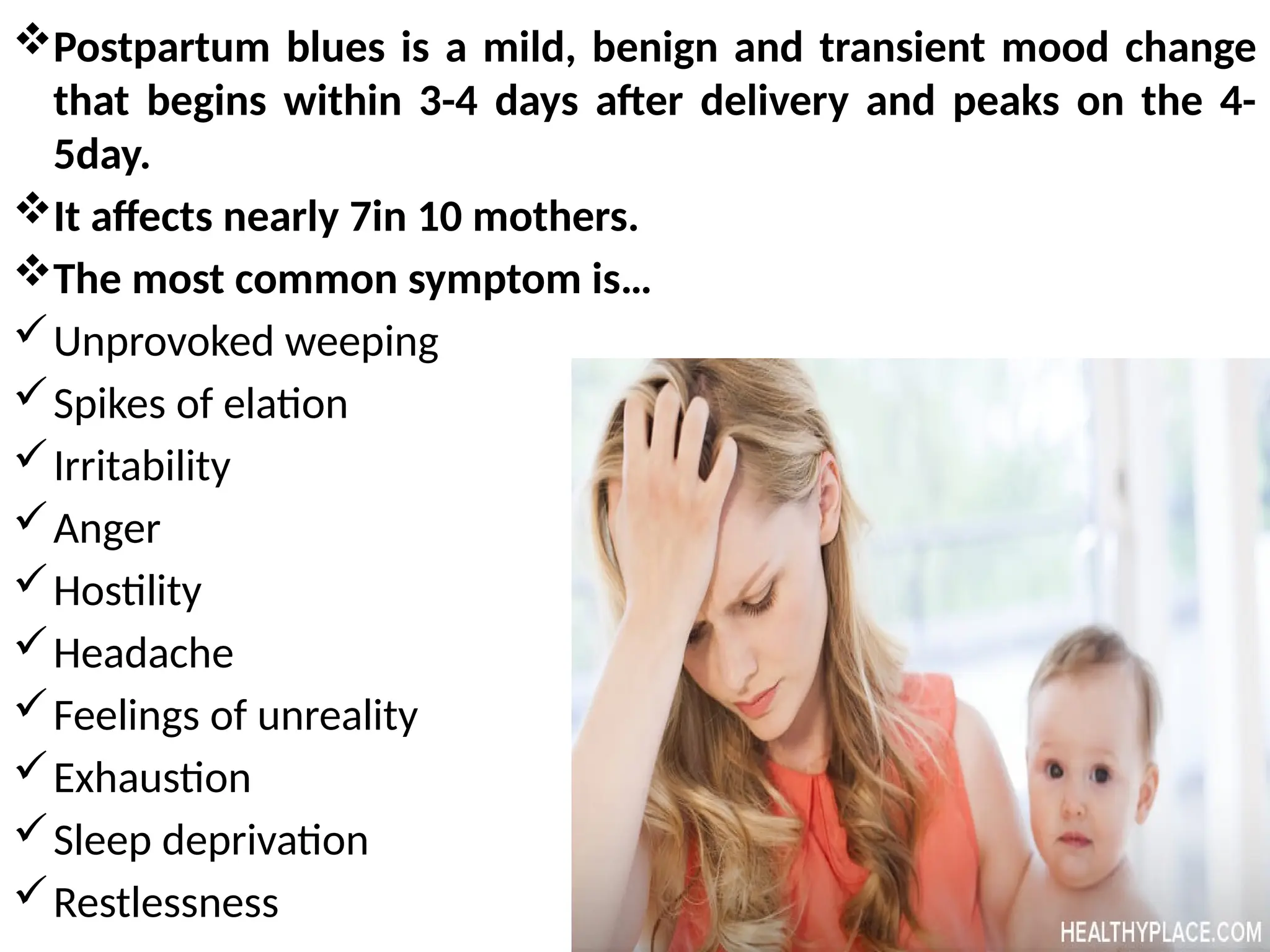
POSTPARTUM BLUES
Postpartum blues is a mild, benign and transient mood change
that begins within 3-4 days after delivery and peaks on the 4-
5day.
It affects nearly 7in 10 mothers.
The most common symptom is…
Unprovoked weeping
Spikes of elation
Irritability
Anger
Hostility
Headache
Feelings of unreality
Exhaustion
Sleep deprivation
Restlessness
• Baby blue generally disappears without
medical intervention within 2 weeks.
• If the symptoms persist longer, another
diagnosis may be identified.
• Social interventions such as baby sitting for
few hours, for household chores on newborn
care.
POSTPARTUM DEPRESSION
• The onset of postpartum depression is gradual
developing after the 2nd
week.
• The condition may last for 3-6months, and in
some cases, it will persist throughout the 1st
year of the baby's life.
CAUSES
• Demand overload
• Exact Etiology is unknown
• Stress inducing life events
• Low self esteem
• Lack of support
• Stress associated with postnatal care
• Severe maternal blues-----depression
• Loss of personal freedom
MANAGEMENT
• Early detection
• Initiation of appropriate treatment
• Mild sedation
• Antidepressants
• Counseling-spouse and family members
includes…
• Advanced symptoms-hospitalization is
required.
Puerperal Psychosis
• The onset of puerperal psychosis is usually
rapid occurring within the first few days of
delivery and rarely beyond the first 2-3 weeks.
• The condition is more common in primi-
parous women.
• Previous psychosis
Postpartum Depression.pptxpostpartum blues

Postpartum Depression.pptxpostpartum blues

  • 1.
  • 2.
    INTRODUCTION Women with psychiatricdisorders are at elevated risks of cesarean delivery, placental abruption, pre-term delivery, PROM, Hemorrhage, FGR, Fetal distress, and even fetal death.
  • 3.
    HIGH RISK FACTORSFOR POSTPARTUM DEPRESSIVE DISORDERS (PPDD)
  • 4.
    FACTORS • Past History •Family History • Marital Conflict • Poor social Situation • Young age • Cesarean delivery • Difficult labor • Neonatal complications
  • 5.
    PSYCHOLOGICAL DISORDERS INPREGNANCY • Bipolar Affective Disorders (BPAD) • Perinatal Mood and Anxiety Disorders (PMADs) • Obsessive-Compulsive Disorder (OCD)
  • 6.
    BIPOLAR AFFECTIVE DISORDERS(BPAD) •It is a severe mood disorder characterized by periods of depression and periods of abnormally elevated mood. • Genetic involvement is stronger in BPAD. • Suspected cases should be reported to psychiatrist.
  • 7.
    PERINATAL MOOD ANDANXIETY DISORDERS(PMADs)
  • 8.
  • 9.
  • 10.
    OCD • OCD isnot uncommon in pregnancy and postpartum period. • Obsessions are repetitive, intrusive, less wanted thoughts and can be directed toward the fetus or the infant. • Thoughts may be the fear of loss or death, fear of infections. • Patient recognizes obsessions as irrational but unable to control them. • Delusion is a false belief but the patient firmly believes it is true, despite the evidence of contrary.
  • 12.
    COMMONLY USED DRUGS •SSRI: Escitalopram, Sertraline, Fluoxetine • Tricyclic antidepressants-Amitriptyline, Imipramine, Duloxetine. • Antipsychotics: Olanzapine, Lithium, Carbamazepine • Psychotherapy • Electro-Convulsive Therapy • Congenic Behavioral Therapy (CBT) • Interpersonal Psychotherapy (IPT) • Perinatal Mood and Anxiety (PMAD)
  • 14.
    Psychological Disturbances inthe Puerperium • The events of pregnancy, labor and delivery together with the peak experience of giving birth, all contribute to a mixture of emotional reactions in the mother during 1st week of puerperium. • There are 3 distinctive types of psychological disturbances seen in the puerperium- 1. Postpartum blues 2. Postpartum Depression 3. Puerperal Psychosis
  • 15.
  • 16.
    Postpartum blues isa mild, benign and transient mood change that begins within 3-4 days after delivery and peaks on the 4- 5day. It affects nearly 7in 10 mothers. The most common symptom is… Unprovoked weeping Spikes of elation Irritability Anger Hostility Headache Feelings of unreality Exhaustion Sleep deprivation Restlessness
  • 17.
    • Baby bluegenerally disappears without medical intervention within 2 weeks. • If the symptoms persist longer, another diagnosis may be identified. • Social interventions such as baby sitting for few hours, for household chores on newborn care.
  • 18.
    POSTPARTUM DEPRESSION • Theonset of postpartum depression is gradual developing after the 2nd week. • The condition may last for 3-6months, and in some cases, it will persist throughout the 1st year of the baby's life.
  • 19.
    CAUSES • Demand overload •Exact Etiology is unknown • Stress inducing life events • Low self esteem • Lack of support • Stress associated with postnatal care • Severe maternal blues-----depression • Loss of personal freedom
  • 22.
    MANAGEMENT • Early detection •Initiation of appropriate treatment • Mild sedation • Antidepressants • Counseling-spouse and family members includes… • Advanced symptoms-hospitalization is required.
  • 24.
    Puerperal Psychosis • Theonset of puerperal psychosis is usually rapid occurring within the first few days of delivery and rarely beyond the first 2-3 weeks. • The condition is more common in primi- parous women. • Previous psychosis