SOCIAL COGNITIVE
THEORY
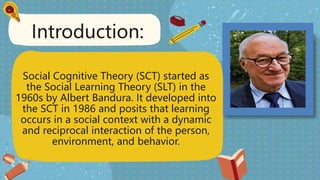
Social Cognitive Theory (SCT) started as
the Social Learning Theory (SLT) in the
1960s by Albert Bandura. It developed into
the SCT in 1986 and posits that learning
occurs in a social context with a dynamic
and reciprocal interaction of the person,
environment, and behavior.
Introduction:
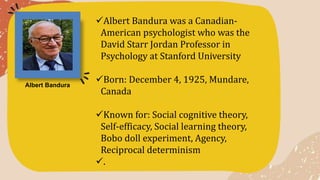
Albert Bandura was a Canadian-
American psychologist who was the
David Starr Jordan Professor in
Psychology at Stanford University
Born: December 4, 1925, Mundare,
Canada
Known for: Social cognitive theory,
Self-efficacy, Social learning theory,
Bobo doll experiment, Agency,
Reciprocal determinism
.
Albert Bandura
The social-cognitive learning theory is a
theoretical perspective that focuses on the learning
learning that occurs within a social context.
Albert Bandura disagreed with Skinner’s strict
behaviorist approach to learning and development
development because he felt that thinking and
reasoning are important components of learning. He
He presented a social-cognitive theory that
emphasizes that the environment and cognitive
factors influence behavior
Social-cognitive Theory
3 MAIN CONCEPTS OF SCT
 Reciprocal Determinism
Observational Learning
Self-Efficacy
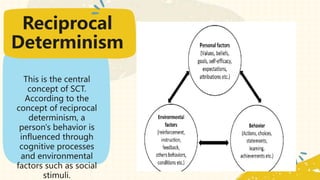
This is the central
concept of SCT.
According to the
concept of reciprocal
determinism, a
person's behavior is
influenced through
cognitive processes
and environmental
factors such as social
stimuli.
Reciprocal
Determinism
Observational
Learning
This asserts that people can
witness and observe a behavior
conducted by others, and then
reproduce those actions. This is
often exhibited through
"modeling" of behaviors. If
individuals see successful
demonstration of a behavior,
they can also complete the
behavior successfully.
Bandura and other researchers proposed a brand
of behaviorism called social learning theory,
which took cognitive processes into account.
According to Bandura, pure behaviorism could
not explain why learning can take place in the
absence of external reinforcement. He felt that
internal mental states must also have a role in
learning and that observational learning
much more than imitation.
In imitation, a person simply copies what the
model does.
Observational learning is much more complex.
According to Lefrançois (2012) there are several
ways that observational learning can occur:
You learn a new response.
You choose whether or not to imitate the
model depending on what you saw happen to
the model.
You learn a general rule that you can apply to
other situations.
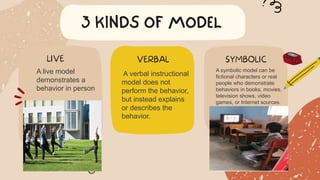
A live model
demonstrates a
behavior in person
A verbal instructional
model does not
perform the behavior,
but instead explains
or describes the
behavior.
A symbolic model can be
fictional characters or real
people who demonstrate
behaviors in books, movies,
television shows, video
games, or Internet sources.
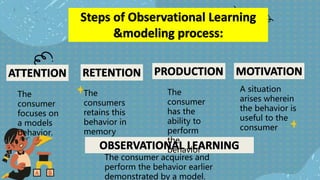
The
consumer
focuses on
a models
behavior.
The
consumers
retains this
behavior in
memory
The
consumer
has the
ability to
perform
the
behavior
A situation
arises wherein
the behavior is
useful to the
consumer
The consumer acquires and
perform the behavior earlier
demonstrated by a model.
Self-Efficacy
Self-efficacy is our level of confidence in our own abilities,
developed through our social experiences. Self-efficacy
affects how we approach challenges and reach goals. In
observational learning, self-efficacy is a cognitive factor that
affects which behaviors we choose to imitate as well as our
success in performing those behaviors.
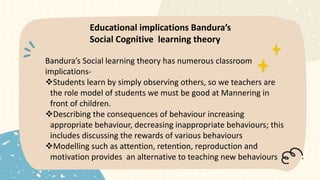
Bandura’s Social learning theory has numerous classroom
implications-
Students learn by simply observing others, so we teachers are
the role model of students we must be good at Mannering in
front of children.
Describing the consequences of behaviour increasing
appropriate behaviour, decreasing inappropriate behaviours; this
includes discussing the rewards of various behaviours
Modelling such as attention, retention, reproduction and
motivation provides an alternative to teaching new behaviours
Educational implications Bandura’s
Social Cognitive learning theory
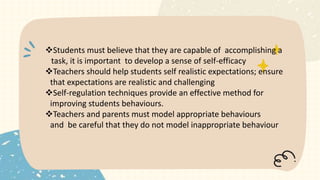
Students must believe that they are capable of accomplishing a
task, it is important to develop a sense of self-efficacy
Teachers should help students self realistic expectations; ensure
that expectations are realistic and challenging
Self-regulation techniques provide an effective method for
improving students behaviours.
Teachers and parents must model appropriate behaviours
and be careful that they do not model inappropriate behaviour
References
https://courses.lumenlearning.com/ed
psy/chapter/social-cognitive-learning-
theory/
https://slideplayer.com/slide/13119104/
https://www.slideshare.net/ricanice16/albert-banduras-social-cognitive-theory-52715769
THANK
YOU

Social-Cognitve-Theory.pptx

  • 1.
  • 2.
    Social Cognitive Theory(SCT) started as the Social Learning Theory (SLT) in the 1960s by Albert Bandura. It developed into the SCT in 1986 and posits that learning occurs in a social context with a dynamic and reciprocal interaction of the person, environment, and behavior. Introduction:
  • 3.
    Albert Bandura wasa Canadian- American psychologist who was the David Starr Jordan Professor in Psychology at Stanford University Born: December 4, 1925, Mundare, Canada Known for: Social cognitive theory, Self-efficacy, Social learning theory, Bobo doll experiment, Agency, Reciprocal determinism . Albert Bandura
  • 4.
    The social-cognitive learningtheory is a theoretical perspective that focuses on the learning learning that occurs within a social context. Albert Bandura disagreed with Skinner’s strict behaviorist approach to learning and development development because he felt that thinking and reasoning are important components of learning. He He presented a social-cognitive theory that emphasizes that the environment and cognitive factors influence behavior Social-cognitive Theory
  • 5.
    3 MAIN CONCEPTSOF SCT  Reciprocal Determinism Observational Learning Self-Efficacy
  • 6.
    This is thecentral concept of SCT. According to the concept of reciprocal determinism, a person's behavior is influenced through cognitive processes and environmental factors such as social stimuli. Reciprocal Determinism
  • 7.
    Observational Learning This asserts thatpeople can witness and observe a behavior conducted by others, and then reproduce those actions. This is often exhibited through "modeling" of behaviors. If individuals see successful demonstration of a behavior, they can also complete the behavior successfully.
  • 8.
    Bandura and otherresearchers proposed a brand of behaviorism called social learning theory, which took cognitive processes into account. According to Bandura, pure behaviorism could not explain why learning can take place in the absence of external reinforcement. He felt that internal mental states must also have a role in learning and that observational learning much more than imitation.
  • 9.
    In imitation, aperson simply copies what the model does. Observational learning is much more complex. According to Lefrançois (2012) there are several ways that observational learning can occur: You learn a new response. You choose whether or not to imitate the model depending on what you saw happen to the model. You learn a general rule that you can apply to other situations.
  • 10.
    A live model demonstratesa behavior in person A verbal instructional model does not perform the behavior, but instead explains or describes the behavior. A symbolic model can be fictional characters or real people who demonstrate behaviors in books, movies, television shows, video games, or Internet sources.
  • 11.
    The consumer focuses on a models behavior. The consumers retainsthis behavior in memory The consumer has the ability to perform the behavior A situation arises wherein the behavior is useful to the consumer The consumer acquires and perform the behavior earlier demonstrated by a model.
  • 12.
    Self-Efficacy Self-efficacy is ourlevel of confidence in our own abilities, developed through our social experiences. Self-efficacy affects how we approach challenges and reach goals. In observational learning, self-efficacy is a cognitive factor that affects which behaviors we choose to imitate as well as our success in performing those behaviors.
  • 13.
    Bandura’s Social learningtheory has numerous classroom implications- Students learn by simply observing others, so we teachers are the role model of students we must be good at Mannering in front of children. Describing the consequences of behaviour increasing appropriate behaviour, decreasing inappropriate behaviours; this includes discussing the rewards of various behaviours Modelling such as attention, retention, reproduction and motivation provides an alternative to teaching new behaviours Educational implications Bandura’s Social Cognitive learning theory
  • 14.
    Students must believethat they are capable of accomplishing a task, it is important to develop a sense of self-efficacy Teachers should help students self realistic expectations; ensure that expectations are realistic and challenging Self-regulation techniques provide an effective method for improving students behaviours. Teachers and parents must model appropriate behaviours and be careful that they do not model inappropriate behaviour
  • 15.
  • 16.