Psychoanalytic Theory
Personality According to
Sigmund Freud
Personality
An individual’s unique and relatively
consistent patterns of thinking,
feeling, and behaving
Attempt to describe and explain
how people are similar, how
they are different, and why
every individual is unique
Personality Theory
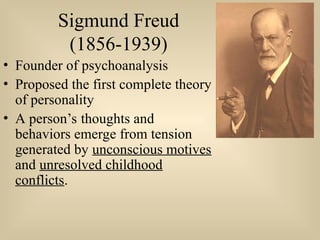
Sigmund Freud
(1856-1939)
• Founder of psychoanalysis
• Proposed the first complete theory
of personality
• A person’s thoughts and
behaviors emerge from tension
generated by unconscious motives
and unresolved childhood
conflicts.
Psychoanalytic Approach
• Developed by Sigmund Freud
• Psychoanalysis is both an approach
to therapy and a theory of personality
• Emphasizes unconscious motivation
– the main causes of behavior lie
buried in the unconscious mind
Psychoanalysis as a Therapy
• A therapeutic technique that attempts
to provide insight into one’s thoughts
and actions
• Does so by exposing and interpreting
the underlying unconscious motives
and conflicts
Personality Assessment
Projective Techniques
• Interpretation of an ambiguous to trigger
projection of one’s inner thoughts and feelings
• Used to determine unconscious motives, conflicts,
and psychological defenses & traits
Freud’s View of the
Mind
Conscious Mind
•All the thoughts, feelings, and
sensations that you are aware of
at this particular moment
represent the conscious level
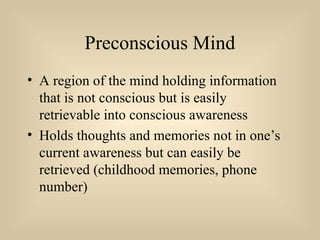
Preconscious Mind
• A region of the mind holding information
that is not conscious but is easily
retrievable into conscious awareness
• Holds thoughts and memories not in one’s
current awareness but can easily be
retrieved (childhood memories, phone
number)
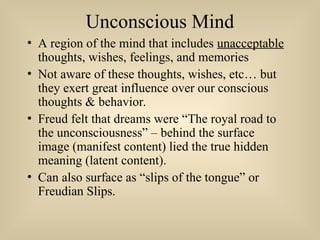
Unconscious Mind
• A region of the mind that includes unacceptable
thoughts, wishes, feelings, and memories
• Not aware of these thoughts, wishes, etc… but
they exert great influence over our conscious
thoughts & behavior.
• Freud felt that dreams were “The royal road to
the unconsciousness” – behind the surface
image (manifest content) lied the true hidden
meaning (latent content).
• Can also surface as “slips of the tongue” or
Freudian Slips.
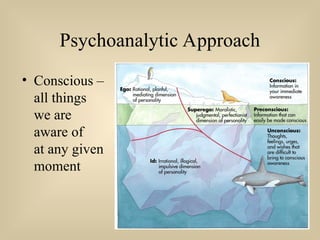
Psychoanalytic Approach
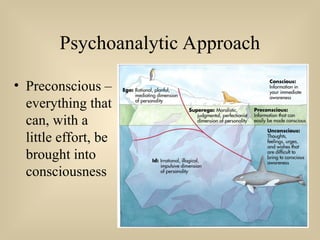
• Conscious –
all things
we are
aware of
at any given
moment
Psychoanalytic Approach
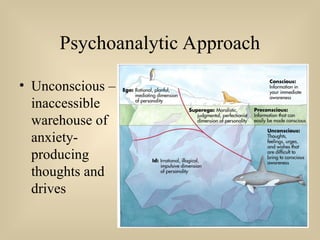
• Preconscious –
everything that
can, with a
little effort, be
brought into
consciousness
Psychoanalytic Approach
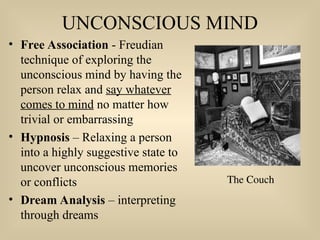
• Unconscious –
inaccessible
warehouse of
anxiety-
producing
thoughts and
drives
UNCONSCIOUS MIND
• Free Association - Freudian
technique of exploring the
unconscious mind by having the
person relax and say whatever
comes to mind no matter how
trivial or embarrassing
• Hypnosis – Relaxing a person
into a highly suggestive state to
uncover unconscious memories
or conflicts
• Dream Analysis – interpreting
through dreams
The Couch
The Id, Ego, and
Superego
Psychoanalytic
Divisions of the Mind
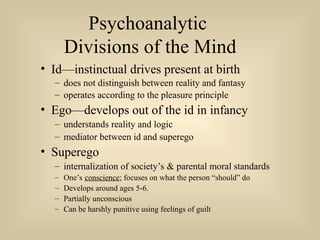
• Id—instinctual drives present at birth
– does not distinguish between reality and fantasy
– operates according to the pleasure principle
• Ego—develops out of the id in infancy
– understands reality and logic
– mediator between id and superego
• Superego
– internalization of society’s & parental moral standards
– One’s conscience; focuses on what the person “should” do
– Develops around ages 5-6.
– Partially unconscious
– Can be harshly punitive using feelings of guilt
Freud’s Concept of the “Id”
• The part of personality that consists of
unconscious energy from basic
aggressive and sexual drives
• Operates on the “pleasure principle” -
the id demands immediate
gratification
• Is present from birth
Id: The Pleasure Principle
• Pleasure principle—drive toward immediate
gratification, most fundamental human
motive
• Sources of energy
– Eros—life instinct, perpetuates life
• Libido—sexual energy or motivation
– Thanatos—death instinct, aggression, self-
destructive actions
Freud’s Concept of the “Ego”
• The part of personality that mediates
the demands of the id without going
against the restraints of the superego
• Follows the reality principle
Ego: The Reality Principle
• Reality principle—ability to postpone
gratification in accordance with demands of
reality
• Ego—rational, organized, logical, mediator
to demands of reality
• Can repress desires that cannot be met in an
acceptable manner
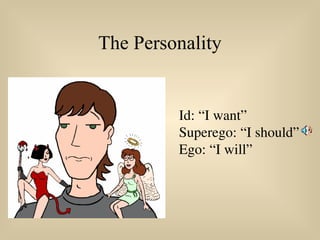
The Personality
Id: “I want”
Superego: “I should”
Ego: “I will”
EXAMPLES
ID
Situation: You’re at a party, and there's a
delicious cake in front of you. You're on a strict
diet, but the cake looks so tempting. The id
would just want you to eat it immediately
without thinking about the consequences.
EXAMPLES
EGO
Situation: You're still at the party with the cake
in front of you. The ego comes into play,
considering both your desire to eat the cake
and your awareness of your diet. It might say,
"I really want this, but I should wait and have
just one small piece later so it doesn’t ruin my
progress.
EXAMPLES
SUPEREGO
Situation: You’re still thinking about the cake,
but now the superego kicks in. It might say, "I
shouldn't eat the cake at all, because it's
unhealthy and it's against my values to
overindulge when I know I should be taking
care of my body."
EXAMPLES
ID
You’re shopping for a car. The id might think, "I
want the most expensive, flashy car. I deserve it.
It looks amazing and will make me feel great!"
EXAMPLES
EGO
The ego could intervene with a more realistic
thought: "I want a new car, but I need to
consider my budget and practical needs. Let me
see which cars are affordable and reliable.
EXAMPLES
SUPER EGO
The superego might say, "I shouldn’t buy an
expensive car because it’s not responsible with
money. I should save or invest in something
more practical and secure for the future."
EXAMPLES
ID
ThYou’re about to take a test, but you’re
unprepared. The id may tempt you with the
thought, "I’ll just look at my notes or cheat. It’ll
be so much easier, and I’ll pass."e superego
might say, "I shouldn’t buy an expensive car
because it’s not responsible with money. I
should save or invest in something more
practical and secure for the future."
EXAMPLES
EGO
The ego might think, "I could cheat and
probably get away with it, but it’s wrong, and
I’d feel guilty afterward. It’s better to try my
best honestly, even if I don’t do well."
EXAMPLES
SUPER EGO
The superego would say, "Cheating is morally
wrong, and I should study and do my best. It’s
more important to uphold my integrity and learn
the material."
EXAMPLES
ID
You’re in a heated argument with someone.
The id might want to lash out, yell, or insult the
person to defend yourself or "win" the
argument.
EXAMPLES
EGO
The ego could step in with a more balanced
approach, thinking, "I’m really angry, but
yelling isn’t going to help. Let me take a deep
breath and try to communicate calmly to resolve
this."
EXAMPLES
SUPER EGO
"It’s important to stay respectful and considerate
even if I’m upset. I should try to understand the
other person’s point of view and maintain my
dignity."
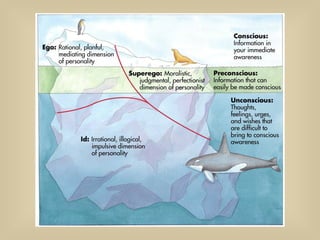
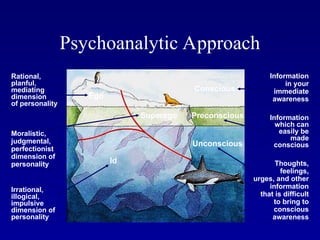
Psychoanalytic Approach
Conscious
Unconscious
Superego Preconscious
Id
Ego
Information
which can
easily be
made
conscious
Thoughts,
feelings,
urges, and other
information
that is difficult
to bring to
conscious
awareness
Information
in your
immediate
awareness
Rational,
planful,
mediating
dimension
of personality
Moralistic,
judgmental,
perfectionist
dimension of
personality
Irrational,
illogical,
impulsive
dimension of
personality
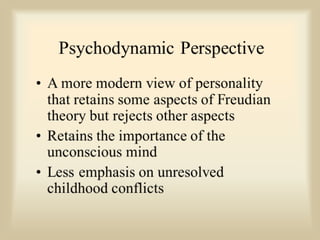
The Psychodynamic
Perspective:
Freud’s Psychosexual
Stages
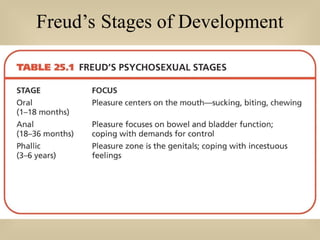
Psychosexual Stages
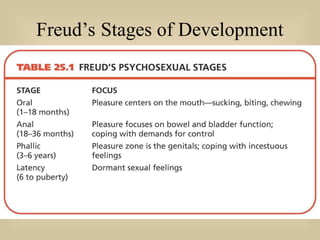
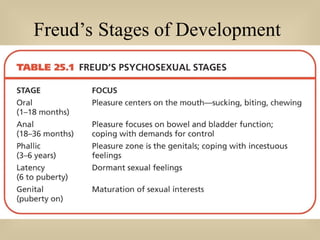
• In Freudian theory, the childhood stages of
development during which the id’s pleasure
seeking energies are focused on different parts of
the body
• The stages include: oral, anal, phallic, latency,
and genital
• A person can become “fixated” or stuck at a
stage and as an adult attempt to achieve pleasure
as in ways that are equivalent to how it was
achieved in these stages
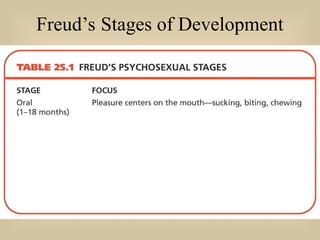
Oral Stage (birth – 18 mo.)
• Mouth is associated with sexual pleasure
• Pleasure comes from activities involving
the mouth such as chewing, biting, and
sucking.
• Weaning a child can lead to fixation if not
handled correctly
• Fixation can lead to oral activities
in adulthood
Freud’s Stages of Development
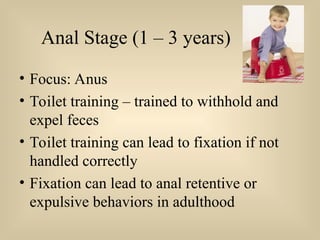
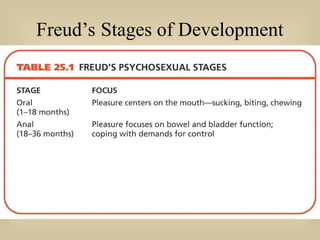
Anal Stage (1 – 3 years)
• Focus: Anus
• Toilet training – trained to withhold and
expel feces
• Toilet training can lead to fixation if not
handled correctly
• Fixation can lead to anal retentive or
expulsive behaviors in adulthood
Freud’s Stages of Development
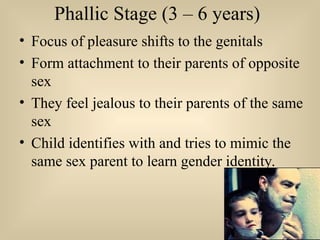
Phallic Stage (3 – 6 years)
• Focus of pleasure shifts to the genitals
• Form attachment to their parents of opposite
sex
• They feel jealous to their parents of the same
sex
• Child identifies with and tries to mimic the
same sex parent to learn gender identity.
Oedipus Complex
• Boys feel hostility and jealousy towards their fathers
but knows their father is more powerful. This leads
to…
• Castration Anxiety results in boys who feel their father
will punish them by castrating them.
• Resolve this through Identification – imitating and
internalizing one’s father’s values, attitudes and
mannerisms. (Formation of gender identity &
superego)
• The fact that only the father can have sexual relations
with the mother becomes internalized in the boy as
taboo against incest in the boy’s superego.
Electra Complex
• Girls also have incestuous feelings for their
dad and compete with their mother.
• Penis Envy – Little girl suffer from deprivation
and loss and blames her mother for “sending
her into the world insufficiently equipped”
causing her to resent her mother
• In an attempt to take her mother’s place she
eventually indentifies with her mother
• Fixation can lead to excessive masculinity in
males and the need for attention or domination
in females
Freud’s Stages of Development
Latency Stage (5 – puberty)
• Sexuality is repressed (Latent means
“hidden”) due to intense anxiety caused by
Oedipus complex
• Children participate in hobbies, school, and
same-sex friendships that strengthen their
sexual identity
Freud’s Stages of Development
Genital Stage (puberty on)
• Incestuous sexual feelings re-emerge but
being prohibited by the superego are
redirected toward others who resemble
the person’s opposite sex parent.
• Healthy adults find pleasure in love and
work, fixated adults have their energy
tied up in earlier stages
Freud’s Stages of Development
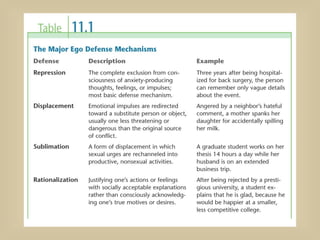
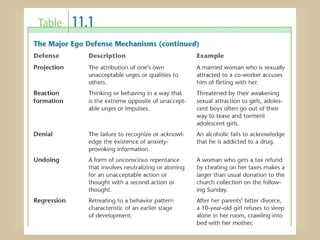
Defense Mechanisms
Unconscious Self-Deceptions
Defense Mechanisms
• Unconscious mental processes
employed by the ego to reduce
anxiety by unconsciously distorting
reality.
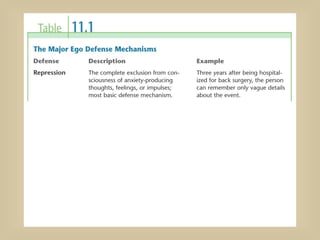
Repression
• Puts anxiety-producing thoughts,
feelings, and memories into the
unconscious mind
• Unconscious forgetting
• The basis for all other defense
mechanisms
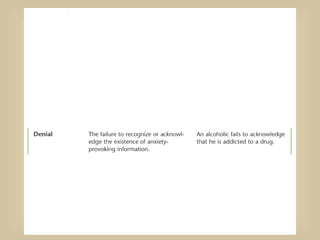
Denial
• Rejecting the truth of a painful reality.
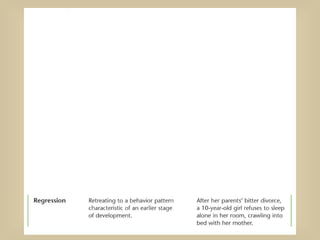
Regression
• Going back to a safer, simpler way of
being.
• Assuming childlike behaviors when
facing stress or trauma
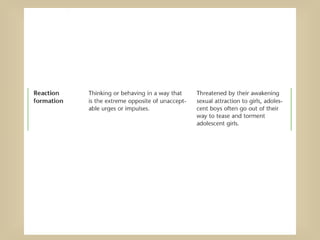
Reaction Formation
• Replacing an unacceptable wish
with its opposite
• Behaving in ways that are exactly
opposite of how we truly feel.
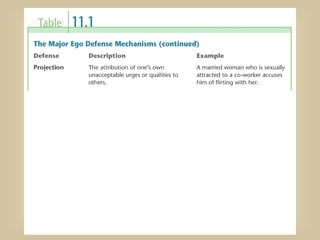
Projection
• Attributing something that we don’t
like about ourselves to someone else.
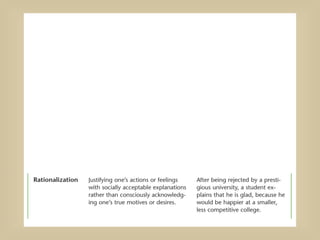
Rationalization
• Displaces real, anxiety-provoking
explanations with more comforting
justifications for one’s actions
• Reasoning away or making excuses to
reduce anxiety-producing thoughts
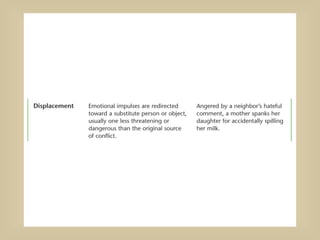
Displacement
• Shifts an unacceptable impulse
toward a more acceptable or less
threatening object or person
• “Taking out” an emotion on a safe or
more accessible target than the actual
source of the emotion.
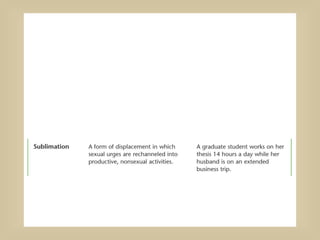
Sublimation
• Substitute an undesirable emotion or
drive with a socially acceptable one.
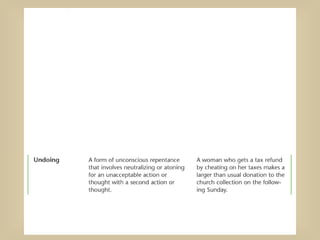
Undoing
• Unconsciously neutralizing an anxiety
causing action by doing a second action that
undoes the first.
PPT 6 - Psychoanalytic-.Theory-Freud.ppt

PPT 6 - Psychoanalytic-.Theory-Freud.ppt

  • 1.
  • 2.
    Personality An individual’s uniqueand relatively consistent patterns of thinking, feeling, and behaving
  • 3.
    Attempt to describeand explain how people are similar, how they are different, and why every individual is unique Personality Theory
  • 4.
    Sigmund Freud (1856-1939) • Founderof psychoanalysis • Proposed the first complete theory of personality • A person’s thoughts and behaviors emerge from tension generated by unconscious motives and unresolved childhood conflicts.
  • 5.
    Psychoanalytic Approach • Developedby Sigmund Freud • Psychoanalysis is both an approach to therapy and a theory of personality • Emphasizes unconscious motivation – the main causes of behavior lie buried in the unconscious mind
  • 6.
    Psychoanalysis as aTherapy • A therapeutic technique that attempts to provide insight into one’s thoughts and actions • Does so by exposing and interpreting the underlying unconscious motives and conflicts
  • 7.
    Personality Assessment Projective Techniques •Interpretation of an ambiguous to trigger projection of one’s inner thoughts and feelings • Used to determine unconscious motives, conflicts, and psychological defenses & traits
  • 8.
  • 9.
    Conscious Mind •All thethoughts, feelings, and sensations that you are aware of at this particular moment represent the conscious level
  • 10.
    Preconscious Mind • Aregion of the mind holding information that is not conscious but is easily retrievable into conscious awareness • Holds thoughts and memories not in one’s current awareness but can easily be retrieved (childhood memories, phone number)
  • 11.
    Unconscious Mind • Aregion of the mind that includes unacceptable thoughts, wishes, feelings, and memories • Not aware of these thoughts, wishes, etc… but they exert great influence over our conscious thoughts & behavior. • Freud felt that dreams were “The royal road to the unconsciousness” – behind the surface image (manifest content) lied the true hidden meaning (latent content). • Can also surface as “slips of the tongue” or Freudian Slips.
  • 13.
    Psychoanalytic Approach • Conscious– all things we are aware of at any given moment
  • 14.
    Psychoanalytic Approach • Preconscious– everything that can, with a little effort, be brought into consciousness
  • 15.
    Psychoanalytic Approach • Unconscious– inaccessible warehouse of anxiety- producing thoughts and drives
  • 16.
    UNCONSCIOUS MIND • FreeAssociation - Freudian technique of exploring the unconscious mind by having the person relax and say whatever comes to mind no matter how trivial or embarrassing • Hypnosis – Relaxing a person into a highly suggestive state to uncover unconscious memories or conflicts • Dream Analysis – interpreting through dreams The Couch
  • 17.
    The Id, Ego,and Superego
  • 18.
    Psychoanalytic Divisions of theMind • Id—instinctual drives present at birth – does not distinguish between reality and fantasy – operates according to the pleasure principle • Ego—develops out of the id in infancy – understands reality and logic – mediator between id and superego • Superego – internalization of society’s & parental moral standards – One’s conscience; focuses on what the person “should” do – Develops around ages 5-6. – Partially unconscious – Can be harshly punitive using feelings of guilt
  • 19.
    Freud’s Concept ofthe “Id” • The part of personality that consists of unconscious energy from basic aggressive and sexual drives • Operates on the “pleasure principle” - the id demands immediate gratification • Is present from birth
  • 20.
    Id: The PleasurePrinciple • Pleasure principle—drive toward immediate gratification, most fundamental human motive • Sources of energy – Eros—life instinct, perpetuates life • Libido—sexual energy or motivation – Thanatos—death instinct, aggression, self- destructive actions
  • 21.
    Freud’s Concept ofthe “Ego” • The part of personality that mediates the demands of the id without going against the restraints of the superego • Follows the reality principle
  • 22.
    Ego: The RealityPrinciple • Reality principle—ability to postpone gratification in accordance with demands of reality • Ego—rational, organized, logical, mediator to demands of reality • Can repress desires that cannot be met in an acceptable manner
  • 23.
    The Personality Id: “Iwant” Superego: “I should” Ego: “I will”
  • 24.
    EXAMPLES ID Situation: You’re ata party, and there's a delicious cake in front of you. You're on a strict diet, but the cake looks so tempting. The id would just want you to eat it immediately without thinking about the consequences.
  • 25.
    EXAMPLES EGO Situation: You're stillat the party with the cake in front of you. The ego comes into play, considering both your desire to eat the cake and your awareness of your diet. It might say, "I really want this, but I should wait and have just one small piece later so it doesn’t ruin my progress.
  • 26.
    EXAMPLES SUPEREGO Situation: You’re stillthinking about the cake, but now the superego kicks in. It might say, "I shouldn't eat the cake at all, because it's unhealthy and it's against my values to overindulge when I know I should be taking care of my body."
  • 27.
    EXAMPLES ID You’re shopping fora car. The id might think, "I want the most expensive, flashy car. I deserve it. It looks amazing and will make me feel great!"
  • 28.
    EXAMPLES EGO The ego couldintervene with a more realistic thought: "I want a new car, but I need to consider my budget and practical needs. Let me see which cars are affordable and reliable.
  • 29.
    EXAMPLES SUPER EGO The superegomight say, "I shouldn’t buy an expensive car because it’s not responsible with money. I should save or invest in something more practical and secure for the future."
  • 30.
    EXAMPLES ID ThYou’re about totake a test, but you’re unprepared. The id may tempt you with the thought, "I’ll just look at my notes or cheat. It’ll be so much easier, and I’ll pass."e superego might say, "I shouldn’t buy an expensive car because it’s not responsible with money. I should save or invest in something more practical and secure for the future."
  • 31.
    EXAMPLES EGO The ego mightthink, "I could cheat and probably get away with it, but it’s wrong, and I’d feel guilty afterward. It’s better to try my best honestly, even if I don’t do well."
  • 32.
    EXAMPLES SUPER EGO The superegowould say, "Cheating is morally wrong, and I should study and do my best. It’s more important to uphold my integrity and learn the material."
  • 33.
    EXAMPLES ID You’re in aheated argument with someone. The id might want to lash out, yell, or insult the person to defend yourself or "win" the argument.
  • 34.
    EXAMPLES EGO The ego couldstep in with a more balanced approach, thinking, "I’m really angry, but yelling isn’t going to help. Let me take a deep breath and try to communicate calmly to resolve this."
  • 35.
    EXAMPLES SUPER EGO "It’s importantto stay respectful and considerate even if I’m upset. I should try to understand the other person’s point of view and maintain my dignity."
  • 36.
    Psychoanalytic Approach Conscious Unconscious Superego Preconscious Id Ego Information whichcan easily be made conscious Thoughts, feelings, urges, and other information that is difficult to bring to conscious awareness Information in your immediate awareness Rational, planful, mediating dimension of personality Moralistic, judgmental, perfectionist dimension of personality Irrational, illogical, impulsive dimension of personality
  • 37.
  • 38.
    Psychosexual Stages • InFreudian theory, the childhood stages of development during which the id’s pleasure seeking energies are focused on different parts of the body • The stages include: oral, anal, phallic, latency, and genital • A person can become “fixated” or stuck at a stage and as an adult attempt to achieve pleasure as in ways that are equivalent to how it was achieved in these stages
  • 39.
    Oral Stage (birth– 18 mo.) • Mouth is associated with sexual pleasure • Pleasure comes from activities involving the mouth such as chewing, biting, and sucking. • Weaning a child can lead to fixation if not handled correctly • Fixation can lead to oral activities in adulthood
  • 40.
  • 41.
    Anal Stage (1– 3 years) • Focus: Anus • Toilet training – trained to withhold and expel feces • Toilet training can lead to fixation if not handled correctly • Fixation can lead to anal retentive or expulsive behaviors in adulthood
  • 42.
  • 43.
    Phallic Stage (3– 6 years) • Focus of pleasure shifts to the genitals • Form attachment to their parents of opposite sex • They feel jealous to their parents of the same sex • Child identifies with and tries to mimic the same sex parent to learn gender identity.
  • 44.
    Oedipus Complex • Boysfeel hostility and jealousy towards their fathers but knows their father is more powerful. This leads to… • Castration Anxiety results in boys who feel their father will punish them by castrating them. • Resolve this through Identification – imitating and internalizing one’s father’s values, attitudes and mannerisms. (Formation of gender identity & superego) • The fact that only the father can have sexual relations with the mother becomes internalized in the boy as taboo against incest in the boy’s superego.
  • 45.
    Electra Complex • Girlsalso have incestuous feelings for their dad and compete with their mother. • Penis Envy – Little girl suffer from deprivation and loss and blames her mother for “sending her into the world insufficiently equipped” causing her to resent her mother • In an attempt to take her mother’s place she eventually indentifies with her mother • Fixation can lead to excessive masculinity in males and the need for attention or domination in females
  • 46.
  • 47.
    Latency Stage (5– puberty) • Sexuality is repressed (Latent means “hidden”) due to intense anxiety caused by Oedipus complex • Children participate in hobbies, school, and same-sex friendships that strengthen their sexual identity
  • 48.
  • 49.
    Genital Stage (pubertyon) • Incestuous sexual feelings re-emerge but being prohibited by the superego are redirected toward others who resemble the person’s opposite sex parent. • Healthy adults find pleasure in love and work, fixated adults have their energy tied up in earlier stages
  • 50.
  • 51.
  • 52.
    Defense Mechanisms • Unconsciousmental processes employed by the ego to reduce anxiety by unconsciously distorting reality.
  • 53.
    Repression • Puts anxiety-producingthoughts, feelings, and memories into the unconscious mind • Unconscious forgetting • The basis for all other defense mechanisms
  • 55.
    Denial • Rejecting thetruth of a painful reality.
  • 57.
    Regression • Going backto a safer, simpler way of being. • Assuming childlike behaviors when facing stress or trauma
  • 59.
    Reaction Formation • Replacingan unacceptable wish with its opposite • Behaving in ways that are exactly opposite of how we truly feel.
  • 61.
    Projection • Attributing somethingthat we don’t like about ourselves to someone else.
  • 63.
    Rationalization • Displaces real,anxiety-provoking explanations with more comforting justifications for one’s actions • Reasoning away or making excuses to reduce anxiety-producing thoughts
  • 65.
    Displacement • Shifts anunacceptable impulse toward a more acceptable or less threatening object or person • “Taking out” an emotion on a safe or more accessible target than the actual source of the emotion.
  • 67.
    Sublimation • Substitute anundesirable emotion or drive with a socially acceptable one.
  • 69.
    Undoing • Unconsciously neutralizingan anxiety causing action by doing a second action that undoes the first.

Editor's Notes

  • #2 Keywords: personality
  • #5 Keywords: psychoanalytic approach, unconscious motivation Graphics: picture of Freud pg. 420 Myers
  • #13 Keywords: conscious, preconscious, unconscious Graphics: fig. 11.1 pg. 475 Hockenbury
  • #14 Graphics: fig. 11.1 pg. 475 Hockenbury
  • #15 Graphics: fig. 11.1 pg. 475 Hockenbury
  • #18 Keywords: id
  • #39 Keywords: oral stage
  • #41 Keywords: anal stage
  • #43 Keywords: phallic stage, Oedipus complex, Electra complex
  • #47 Keywords: latency stage
  • #49 Keywords: genital stage
  • #54 Discovering psych2e Table 10.1 p375
  • #64 Discovering psych2e Table 10.1 p375
  • #66 Discovering psych2e Table 10.1 p375
  • #67 Keywords: displacement, sublimation
  • #68 Discovering psych2e Table 10.1 p375
  • #71 Discovering psych2e Table 10.1 p375