Reproductive PhysiologyReproductive Physiology
Lecture 42: Principles of Reproductive PhysiologyLecture 42: Principles of Reproductive Physiology
Lecture 43: Male Reproductive SystemLecture 43: Male Reproductive System
Lecture 44: Female Reproductive System - Ovarian CycleLecture 44: Female Reproductive System - Ovarian Cycle
Lecture 45: Female Reproductive System - PregnancyLecture 45: Female Reproductive System - Pregnancy
Lecture 42: Principles of ReproductiveLecture 42: Principles of Reproductive
PhysiologyPhysiology
Reading: Ch 20, introduction
Reproductive systemReproductive system
- Does not contribute to homeostasisDoes not contribute to homeostasis
- Is not essential for survival of the individualIs not essential for survival of the individual
- Is essential for perpetuating the speciesIs essential for perpetuating the species
- Influences individualInfluences individual’’s psychology and emotional makeups psychology and emotional makeup
- Has profound social ramifications i.e. population densityHas profound social ramifications i.e. population density
and resource managementand resource management
Reproductive physiologyReproductive physiology – study of the interactions– study of the interactions
among the reproductive organs, hypothalamus, anterioramong the reproductive organs, hypothalamus, anterior
pituitary, and target cells of the sex hormones that collectivelypituitary, and target cells of the sex hormones that collectively
lead to the production and union of male and female gametes,lead to the production and union of male and female gametes,
and ultimately the production and nourishment of offspring.and ultimately the production and nourishment of offspring.
Primary reproductive organs (gonads):Primary reproductive organs (gonads):
testestestes in male;in male; ovariesovaries in femalein female
1)1) produce gametes: sperm in males, ova (eggs) in femalesproduce gametes: sperm in males, ova (eggs) in females
2)2) secrete sex hormones: testosterone in males, estrogensecrete sex hormones: testosterone in males, estrogen
and progesterone in femalesand progesterone in females
Secondary sexual characteristicsSecondary sexual characteristics
External characteristics not directly involved withExternal characteristics not directly involved with
reproductive physiologyreproductive physiology
e.g. body configuration and hair distributione.g. body configuration and hair distribution
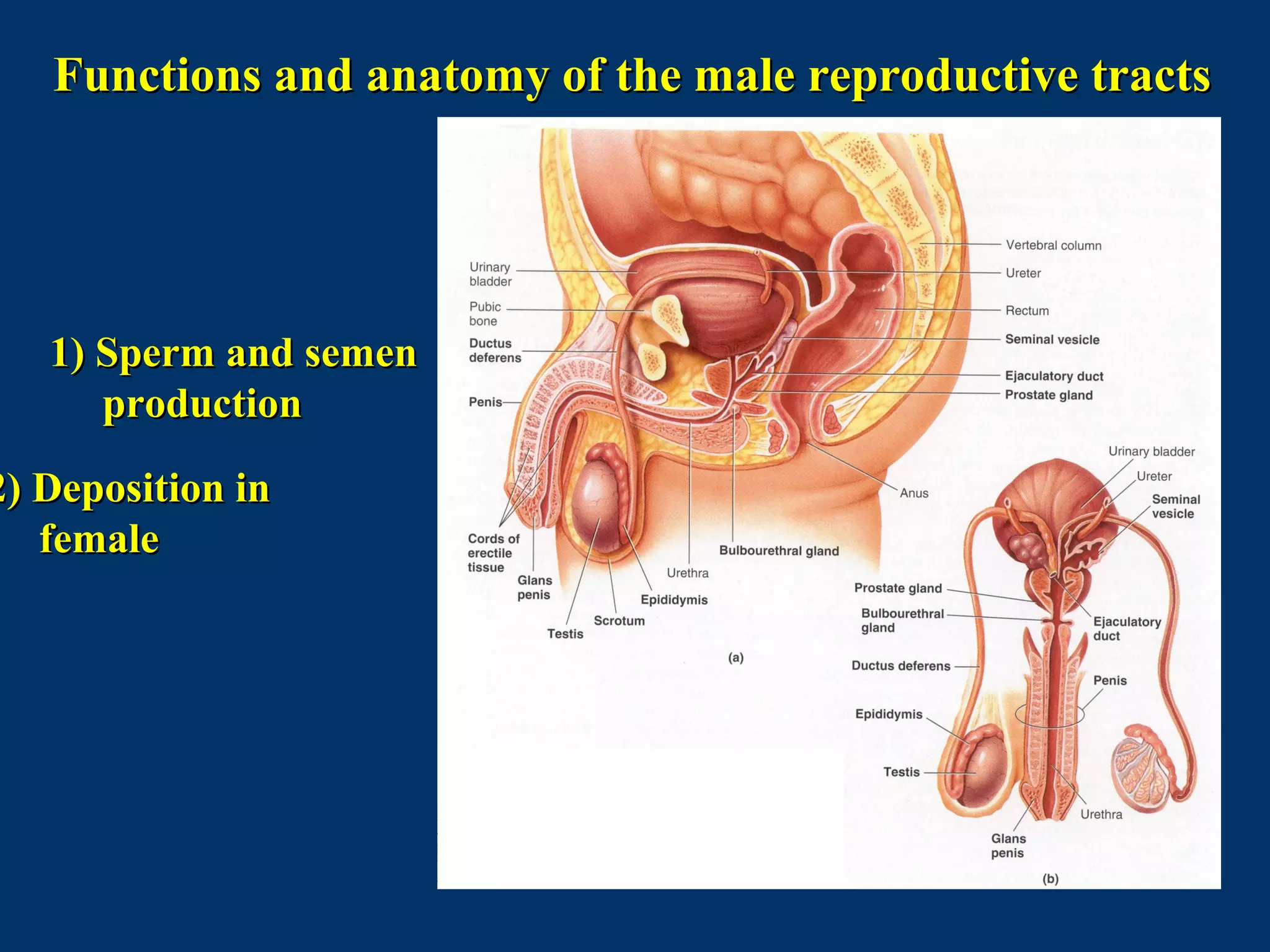
Functions and anatomy of the male reproductive tractsFunctions and anatomy of the male reproductive tracts
1) Sperm and semen1) Sperm and semen
productionproduction
2) Deposition in2) Deposition in
femalefemale
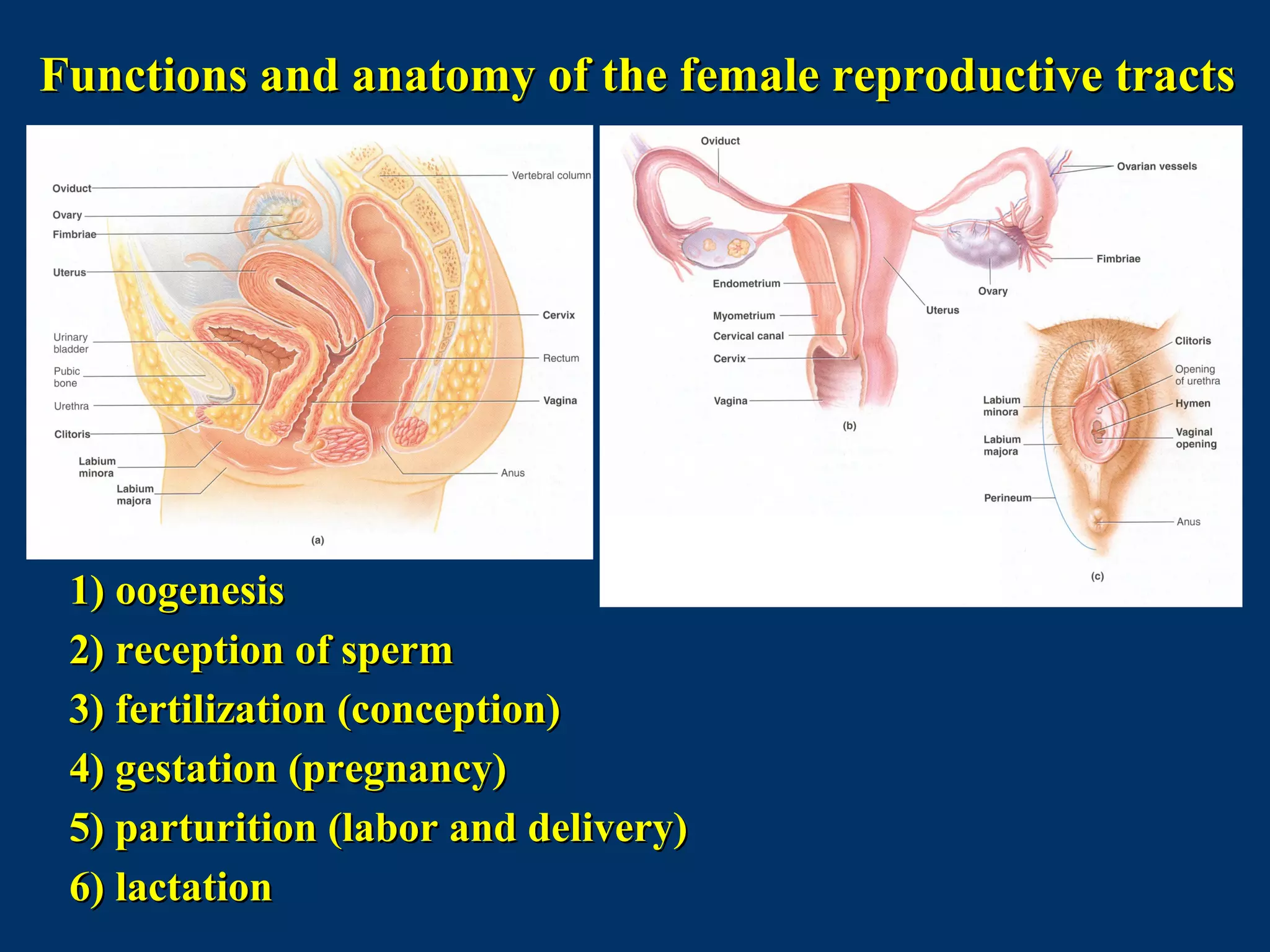
Functions and anatomy of the female reproductive tractsFunctions and anatomy of the female reproductive tracts
1) oogenesis1) oogenesis
2) reception of sperm2) reception of sperm
3) fertilization (conception)3) fertilization (conception)
4) gestation (pregnancy)4) gestation (pregnancy)
5) parturition (labor and delivery)5) parturition (labor and delivery)
6) lactation6) lactation
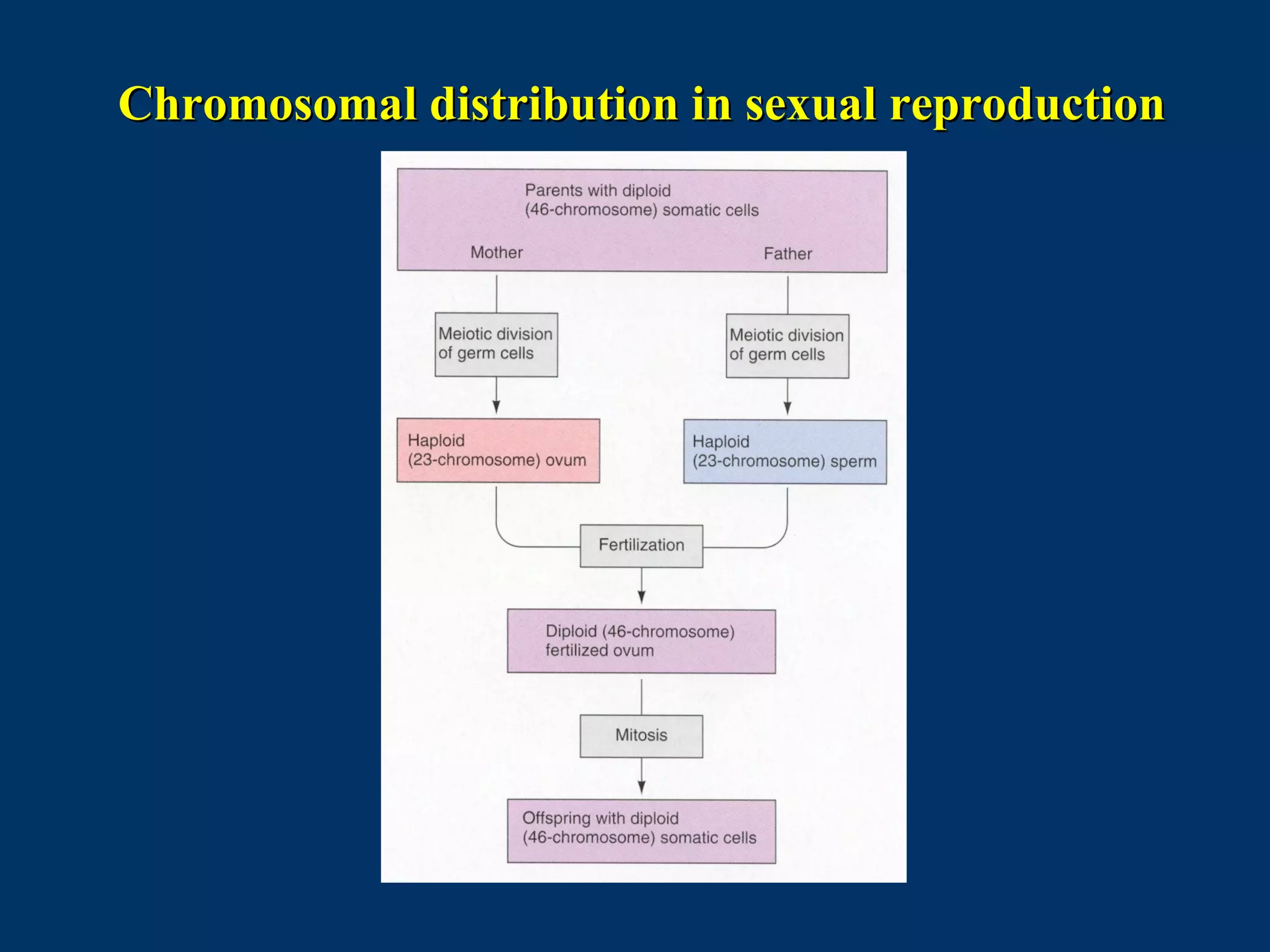
Chromosomal distribution in sexual reproductionChromosomal distribution in sexual reproduction
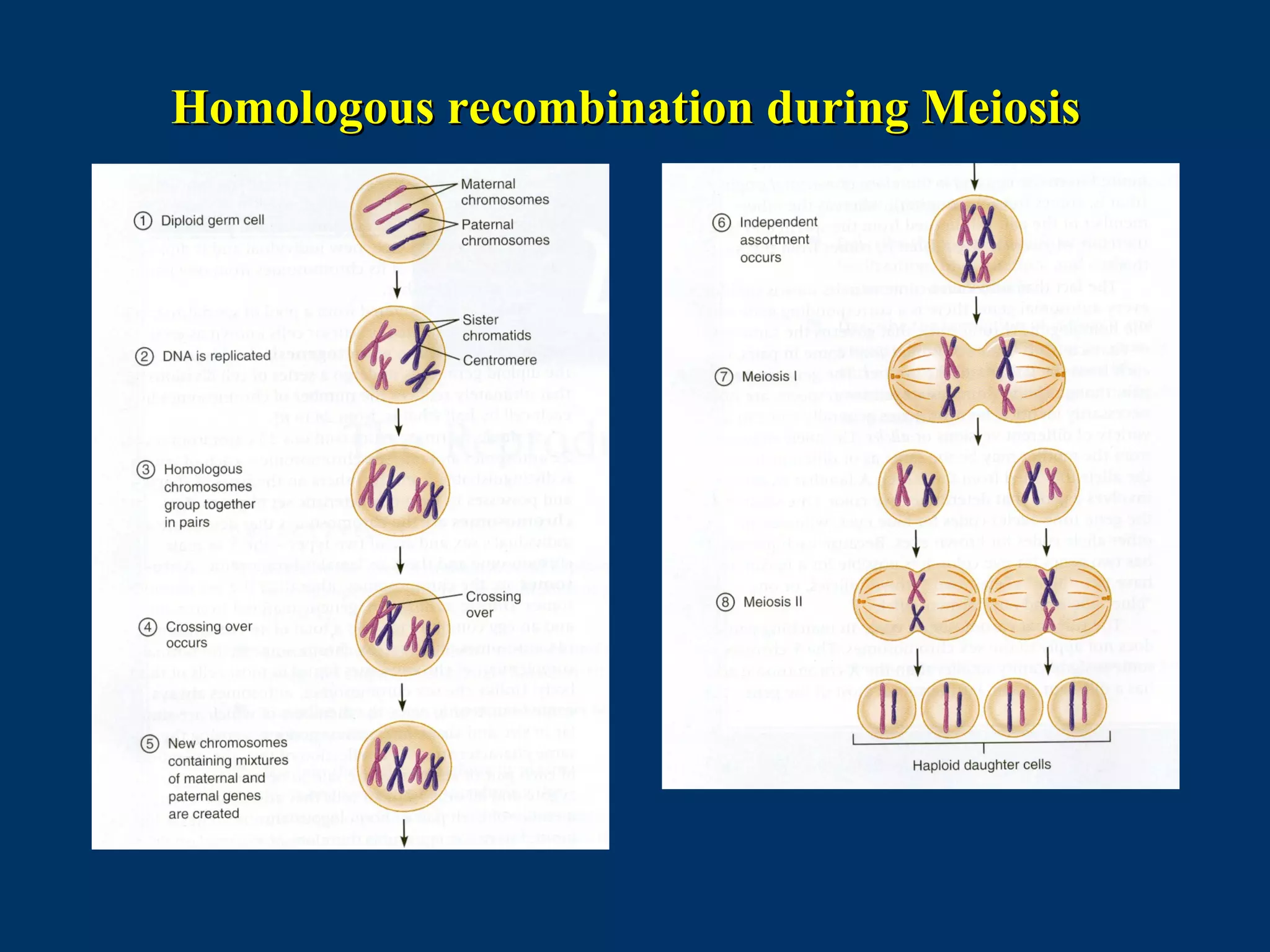
Homologous recombination during MeiosisHomologous recombination during Meiosis
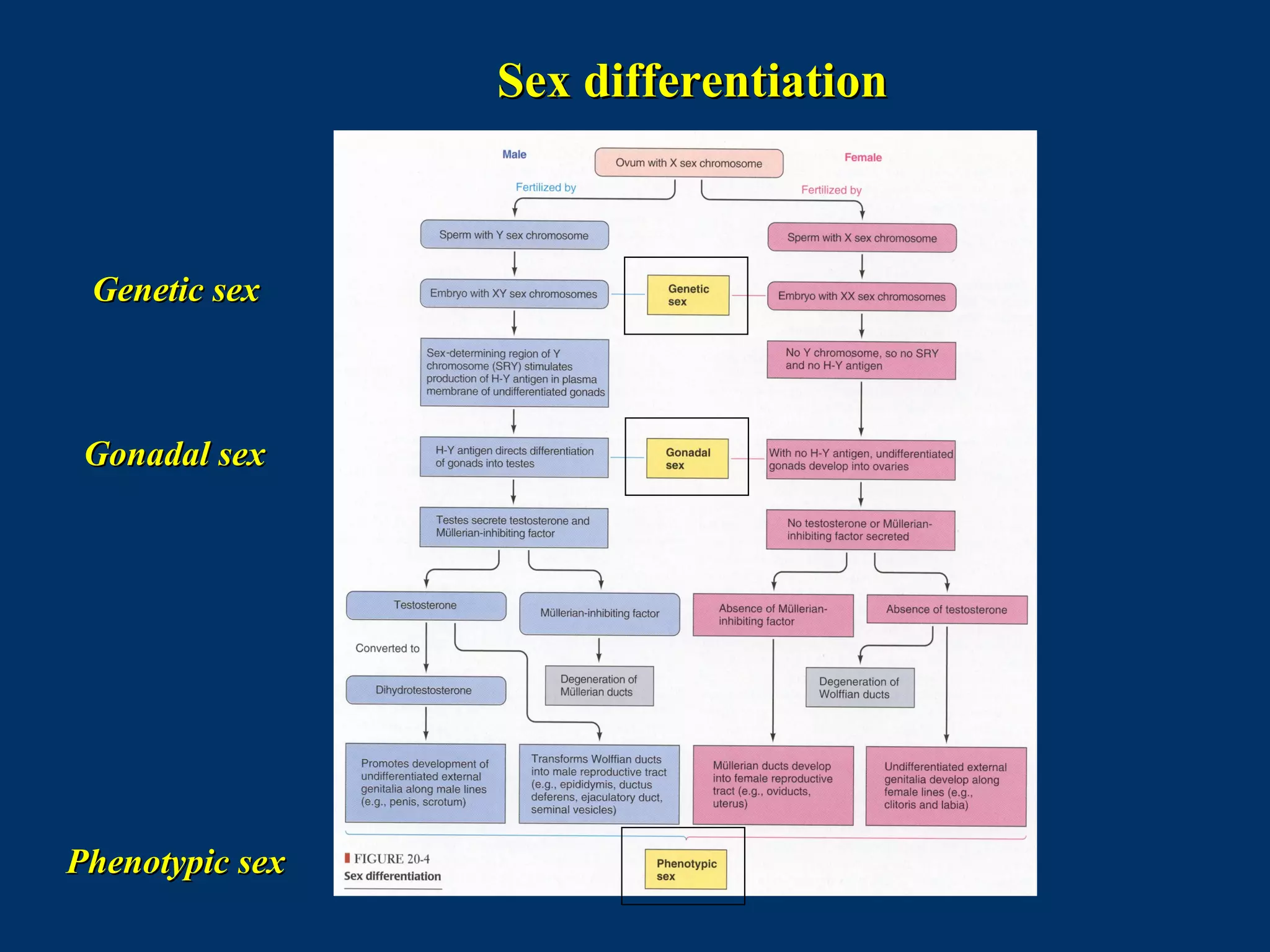
Sex differentiationSex differentiation
Genetic sexGenetic sex
Gonadal sexGonadal sex
Phenotypic sexPhenotypic sex
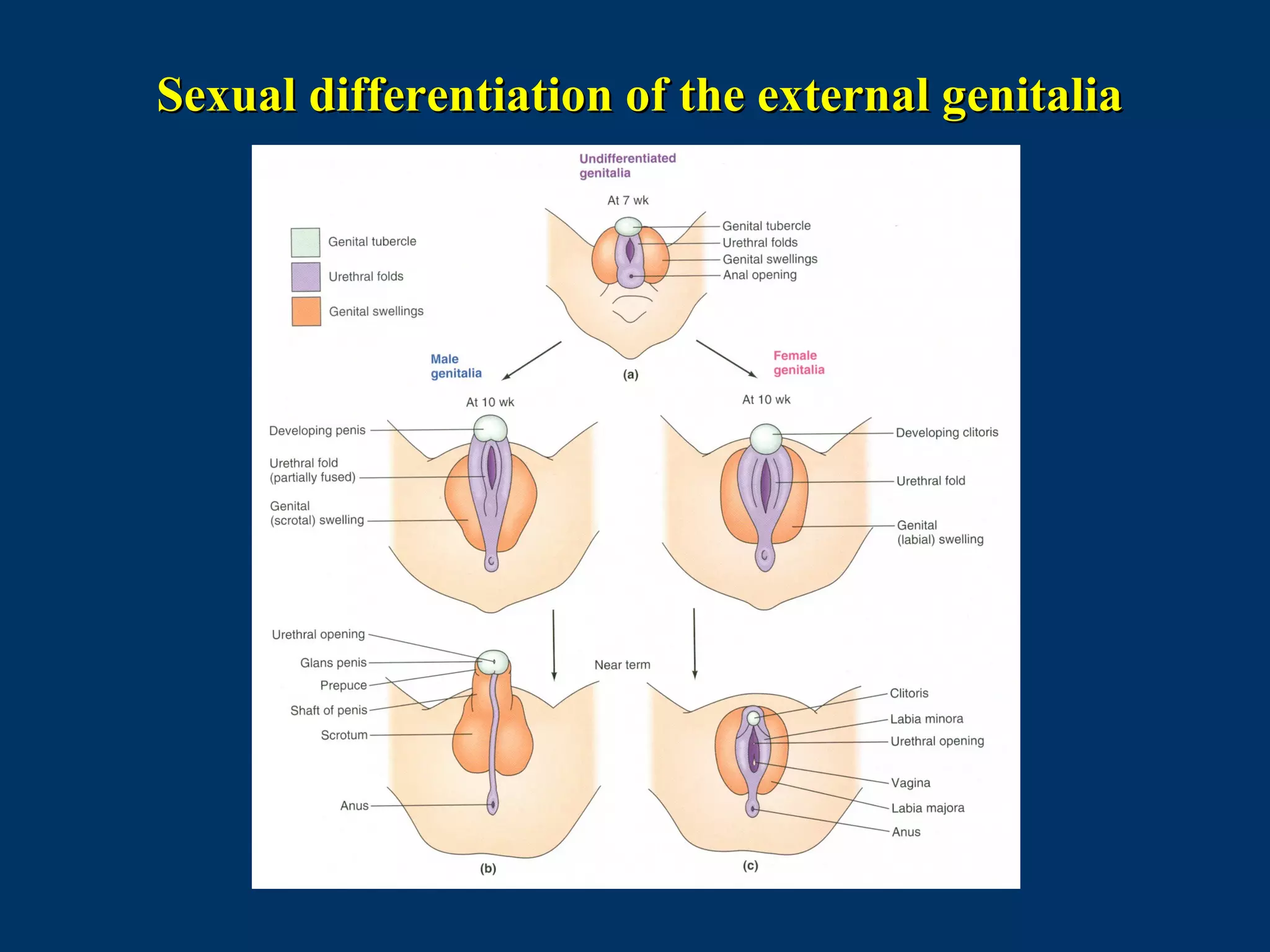
Sexual differentiation of the external genitaliaSexual differentiation of the external genitalia
Effects of prenatal hormones on human brainEffects of prenatal hormones on human brain
- Fetuses and newborns are exposed to high levels of sex hormones during the
prenatal/perinatal sensitive period (gestational weeks 12-18, 34-41, postnatal ~2 months)
and express high levels of hormone receptors in their brains.
- Sources of testosterone: male gonad, adrenal gland (CAH, adrenogenital syndrome)
- Sources of estrogens: conversion from testosterone via aromatase, female gonad, local
synthesis within the brain, mom via placenta (mitigated by alpha-fetoprotein).
- In the adult brain, sex differences are widespread and vary in magnitude and impact
depending on the brain region. They include structural dimorphisms (e.g. preoptic area,
hypothalamus) as well as differences in cognition, aggression and language organization.
- The majority of sex differences in the brain are permanently established during a restricted
developmental window by the actions of prenatal hormones on a bipotential substrate.
Genetic or other biological co-factors likely play an important complementary role.
- Current evidence strongly suggests that gender role, gender identity and sexual orientation
are largely (if not entirely) determined via this mechanism.
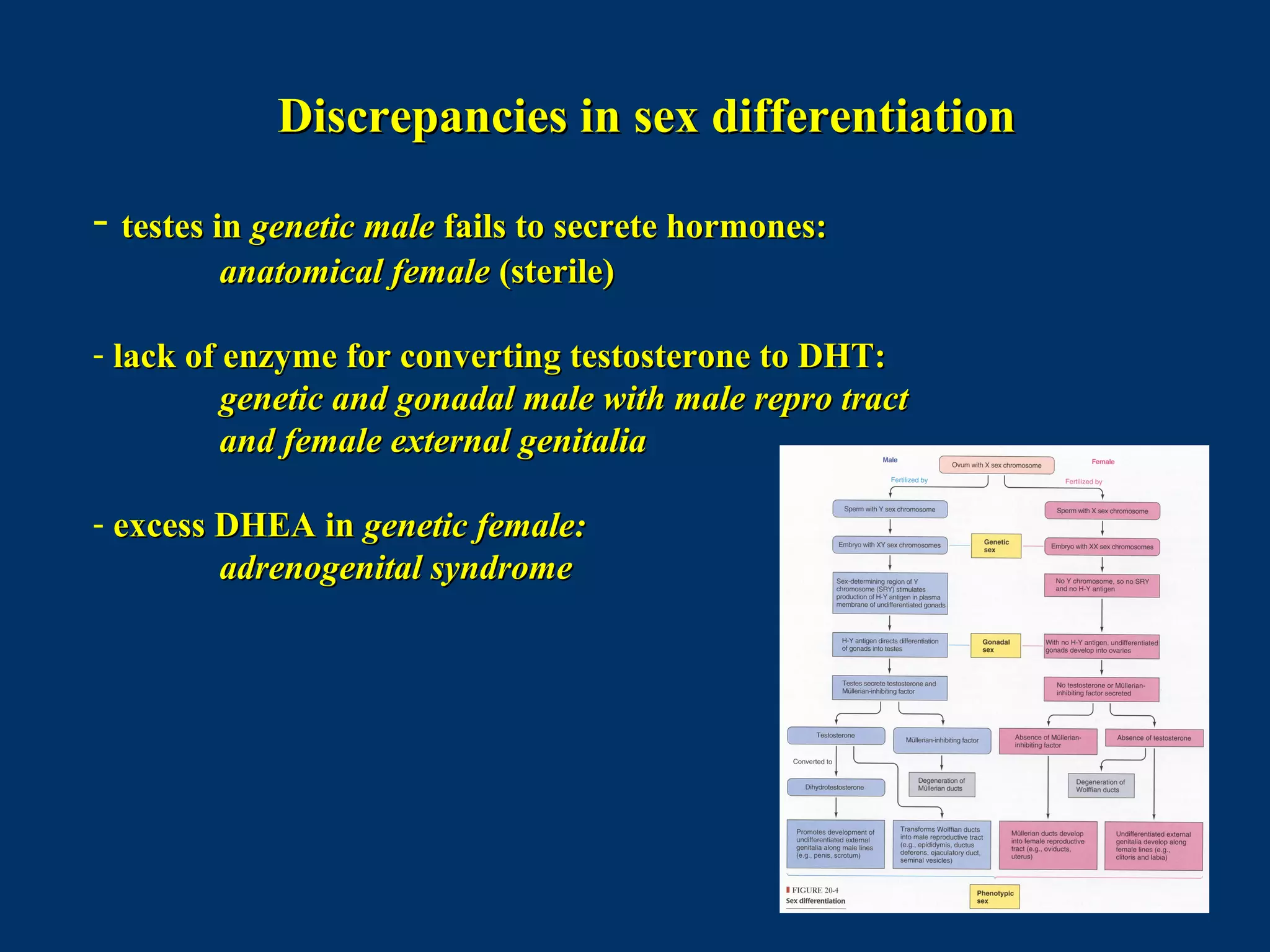
Discrepancies in sex differentiationDiscrepancies in sex differentiation
- testes intestes in genetic malegenetic male fails to secrete hormones:fails to secrete hormones:
anatomical femaleanatomical female (sterile)(sterile)
- lack of enzyme for converting testosterone to DHT:lack of enzyme for converting testosterone to DHT:
genetic and gonadal male with male repro tractgenetic and gonadal male with male repro tract
and female external genitaliaand female external genitalia
- excess DHEA inexcess DHEA in genetic female:genetic female:
adrenogenital syndromeadrenogenital syndrome
Lecture 43: Male Reproductive System /Lecture 43: Male Reproductive System /
IntercourseIntercourse
Reading: Ch 20, male reproductive physiology and
sexual intercourse
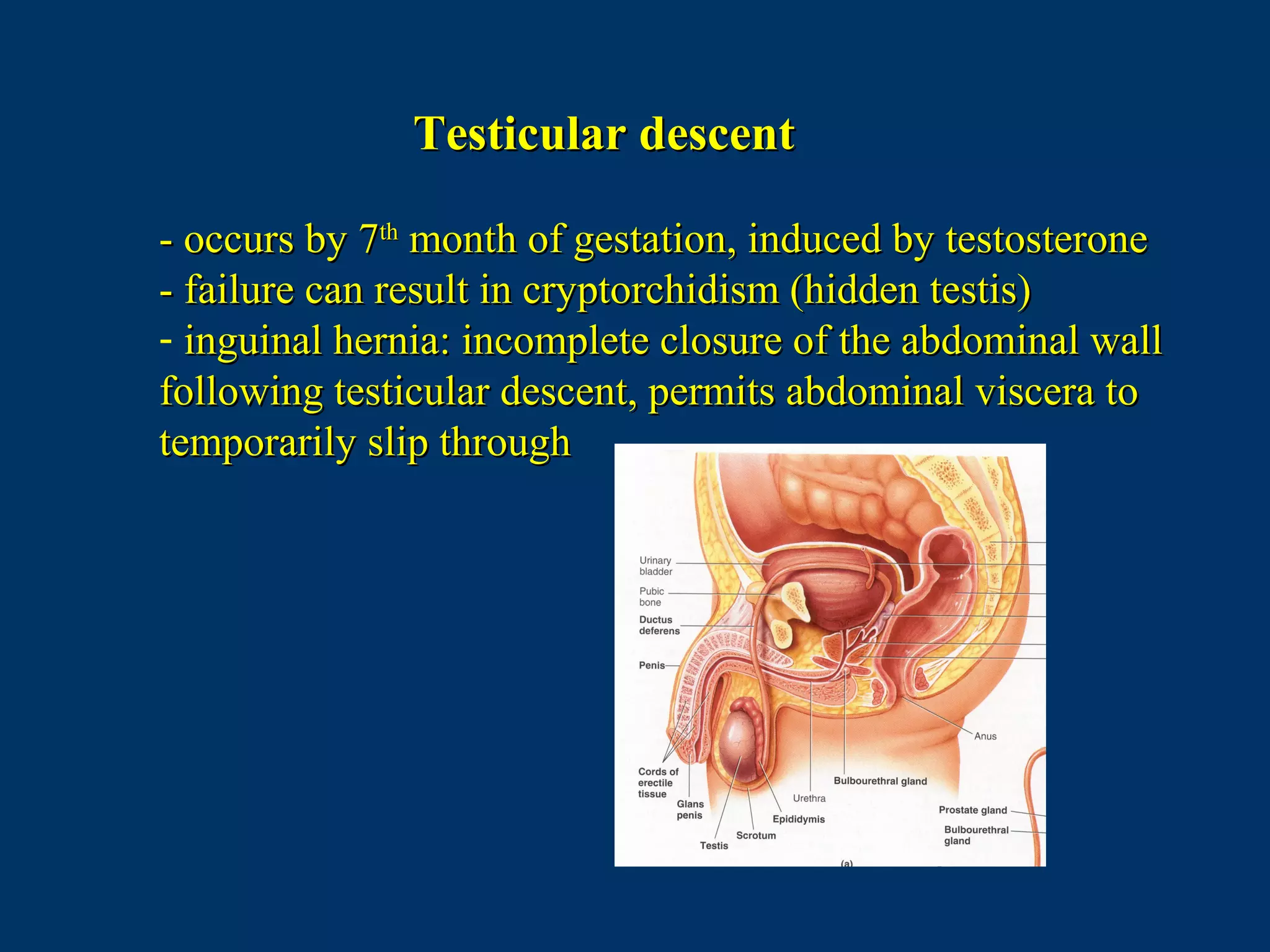
Testicular descentTesticular descent
- occurs by 7- occurs by 7thth
month of gestation, induced by testosteronemonth of gestation, induced by testosterone
- failure can result in cryptorchidism (hidden testis)- failure can result in cryptorchidism (hidden testis)
- inguinal hernia: incomplete closure of the abdominal wallinguinal hernia: incomplete closure of the abdominal wall
following testicular descent, permits abdominal viscera tofollowing testicular descent, permits abdominal viscera to
temporarily slip throughtemporarily slip through
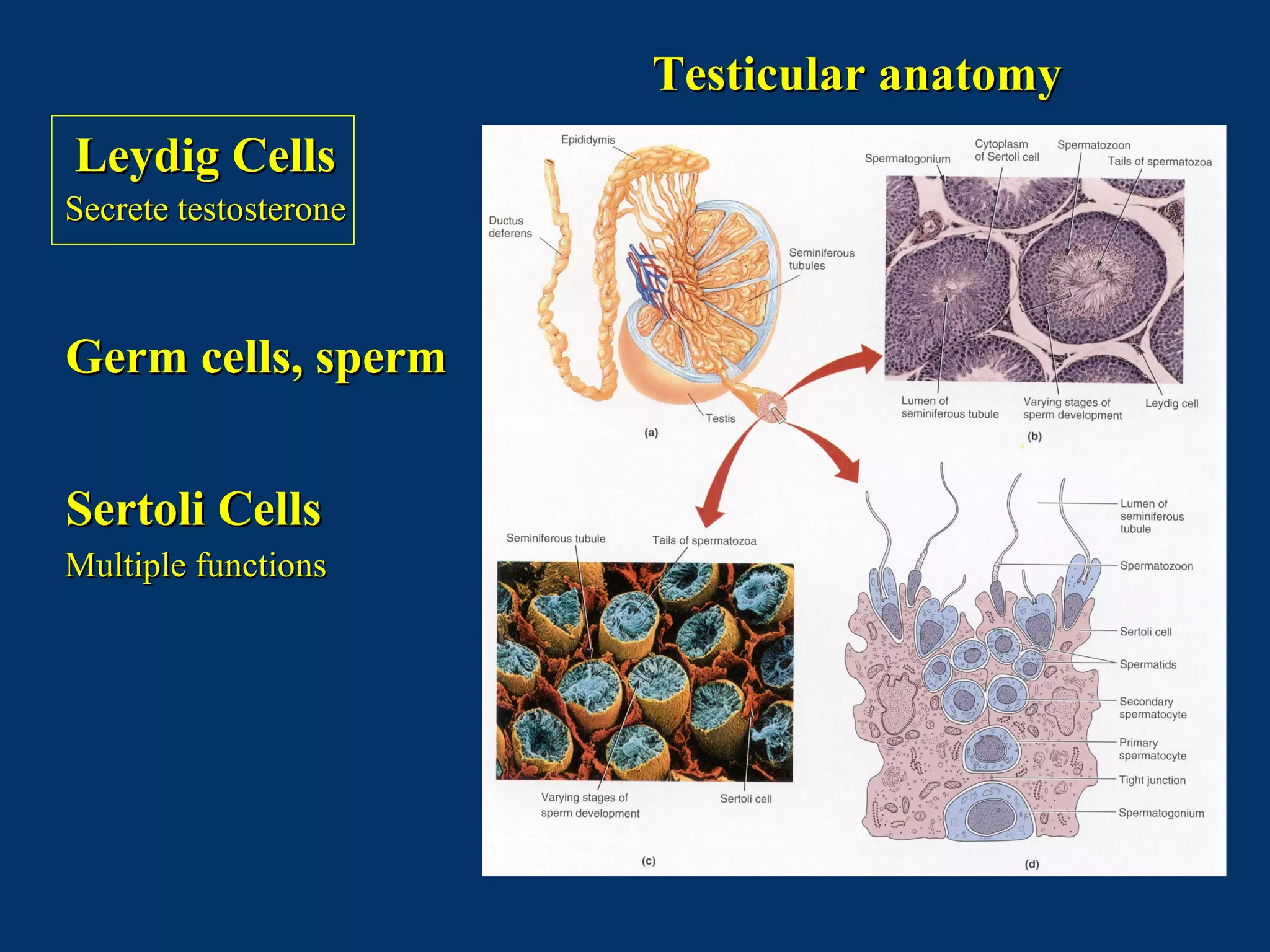
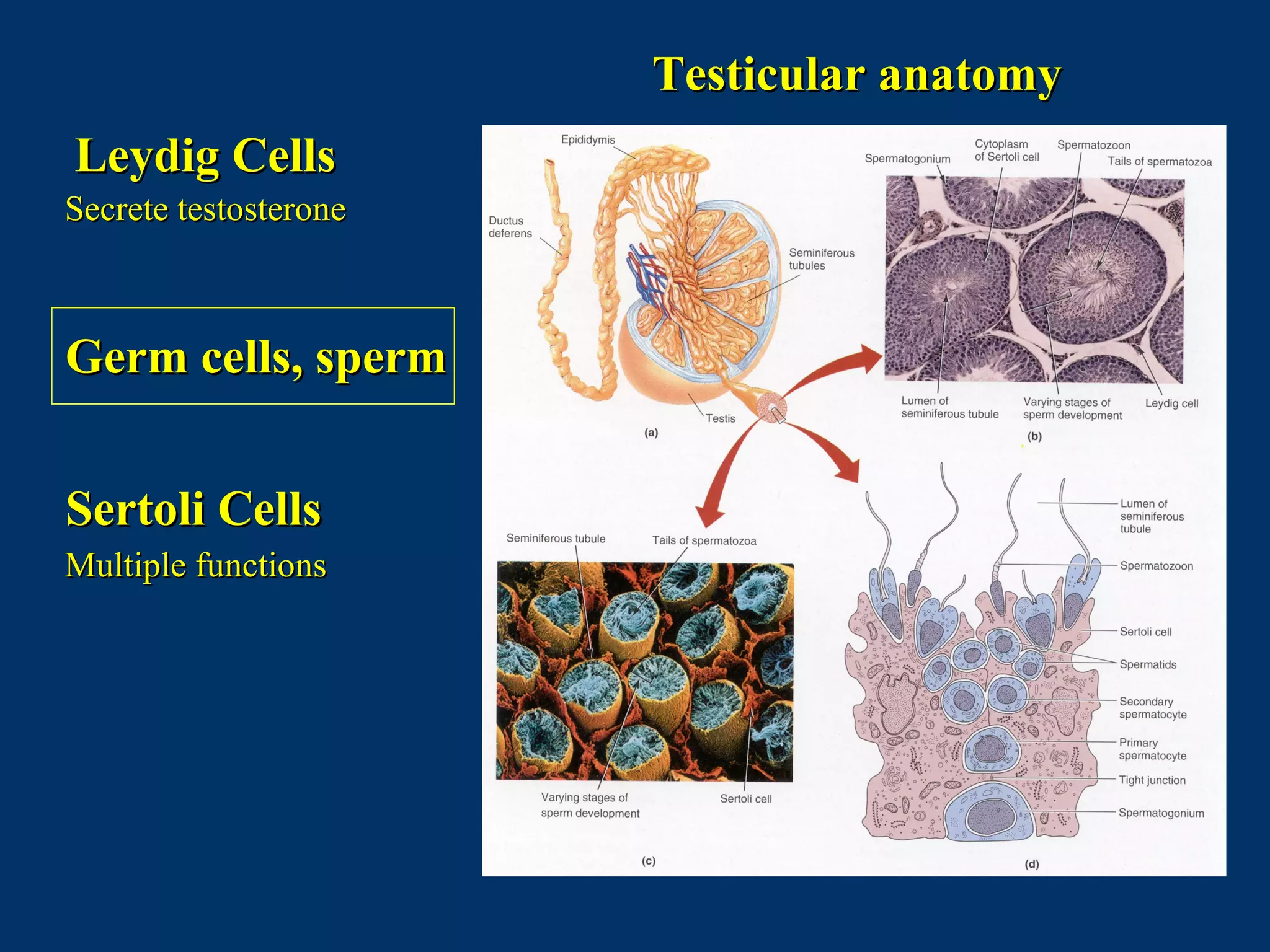
Testicular anatomyTesticular anatomy
Leydig CellsLeydig Cells
Secrete testosteroneSecrete testosterone
Germ cells, spermGerm cells, sperm
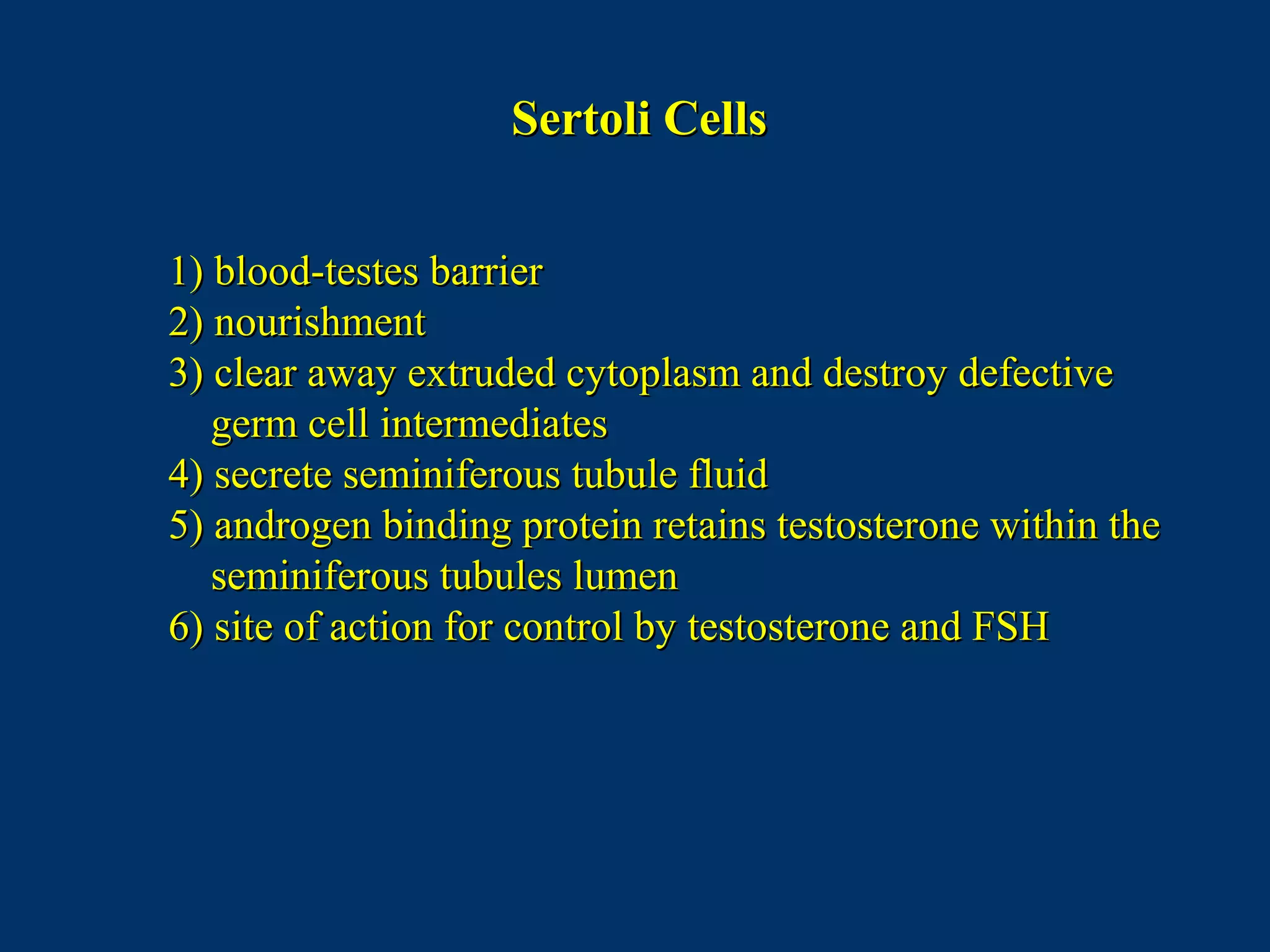
Sertoli CellsSertoli Cells
Multiple functionsMultiple functions
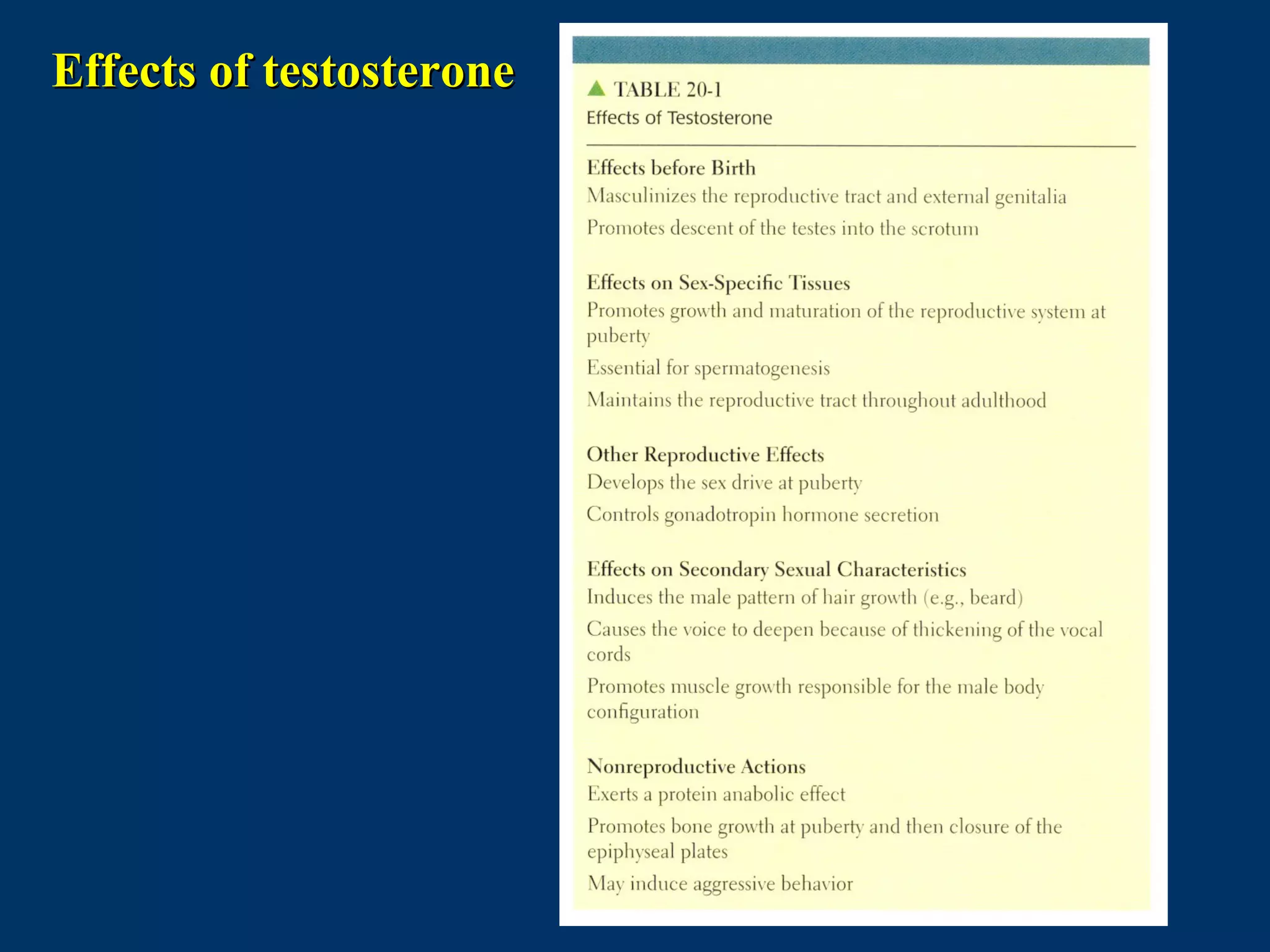
Effects of testosteroneEffects of testosterone
Testicular anatomyTesticular anatomy
Leydig CellsLeydig Cells
Secrete testosteroneSecrete testosterone
Germ cells, spermGerm cells, sperm
Sertoli CellsSertoli Cells
Multiple functionsMultiple functions
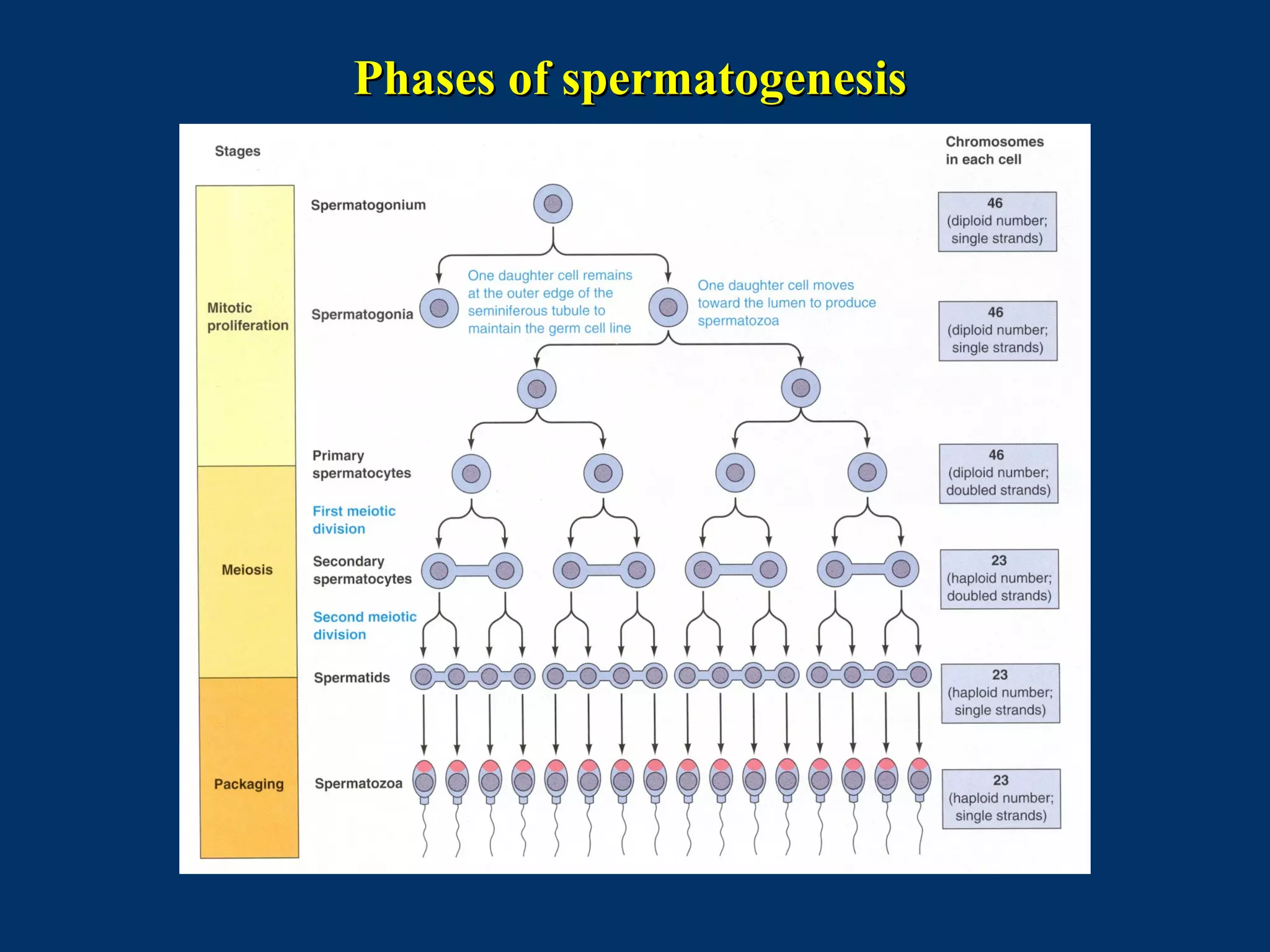
Phases of spermatogenesisPhases of spermatogenesis
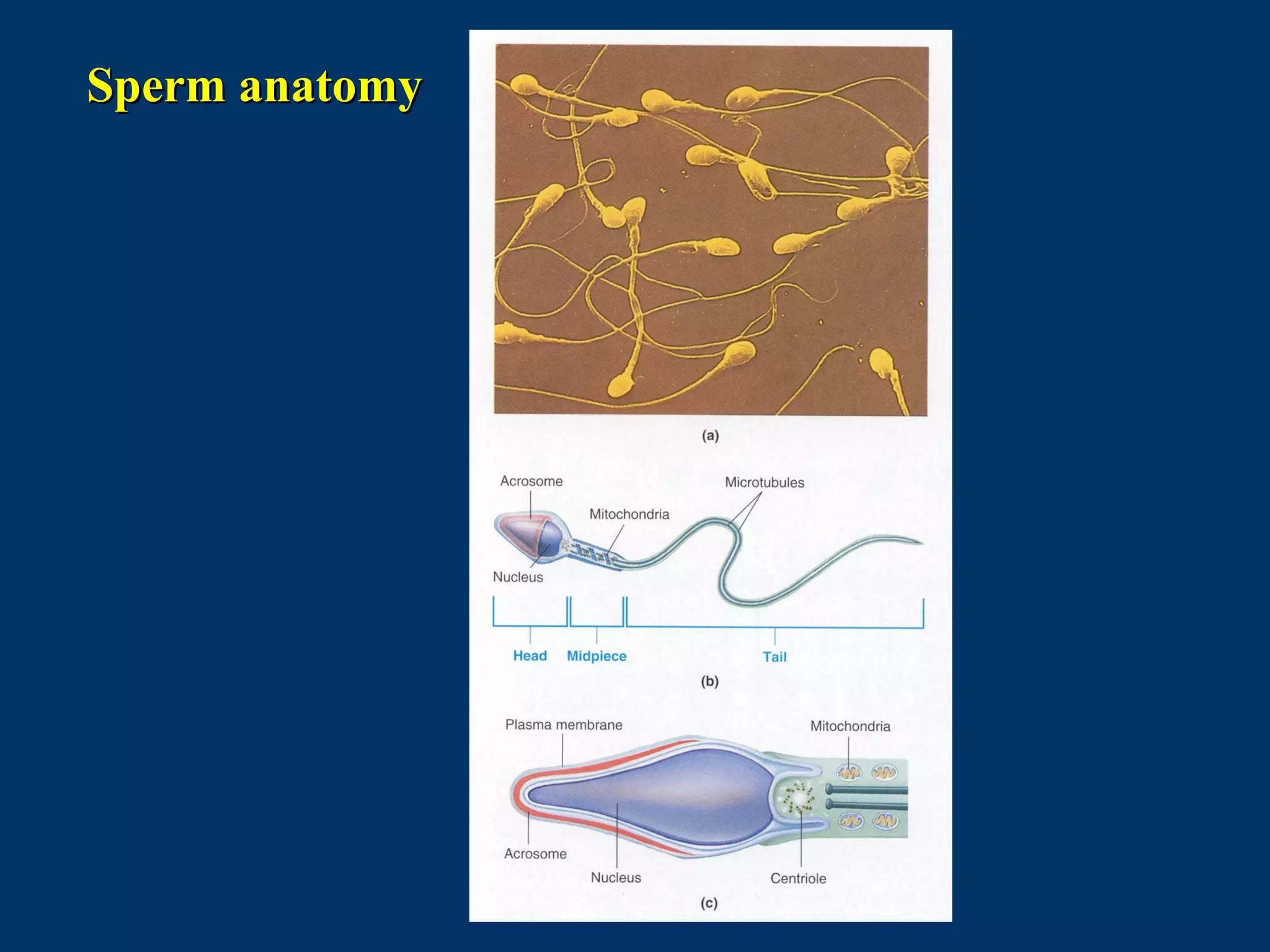
Sperm anatomySperm anatomy
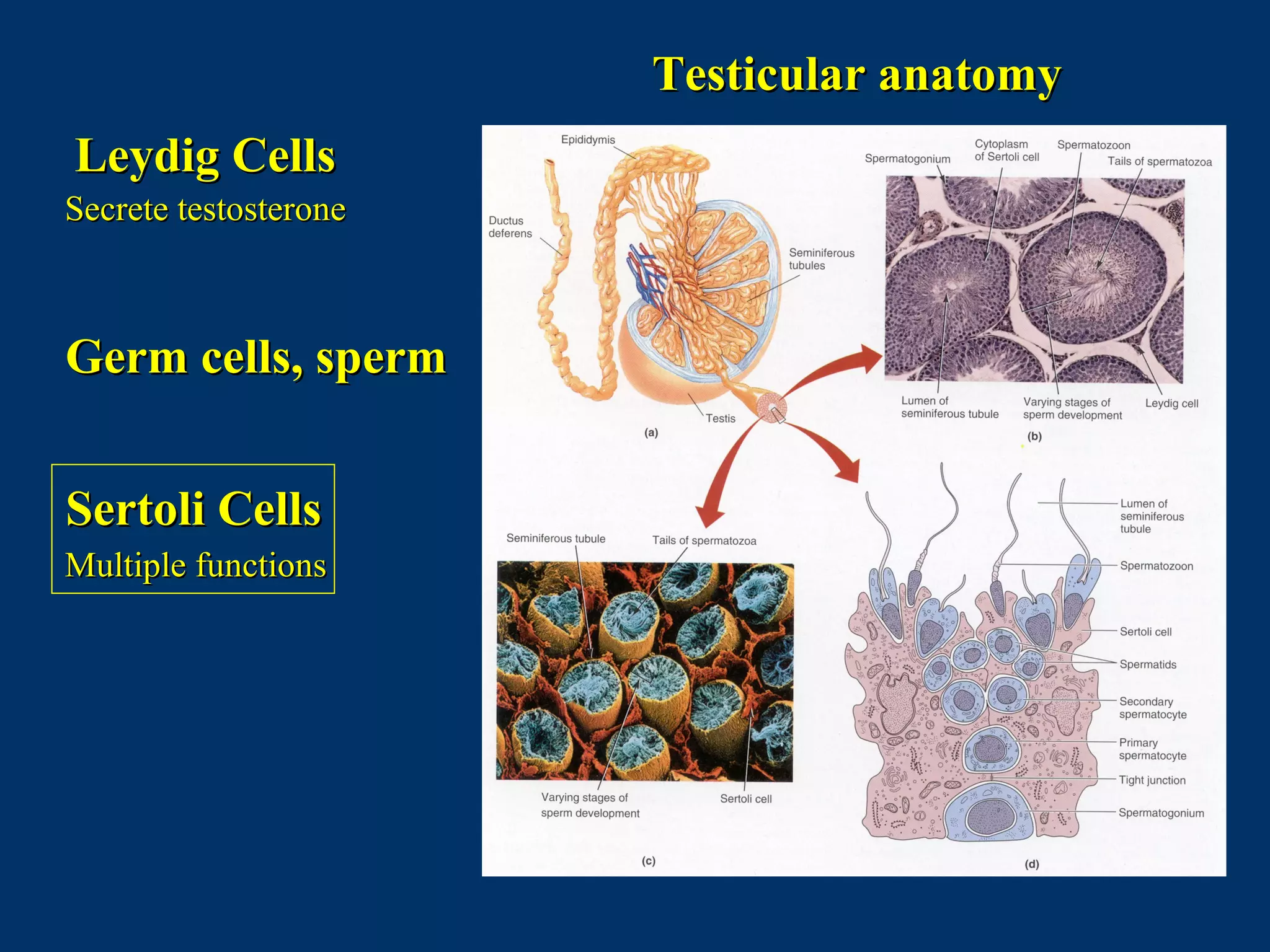
Testicular anatomyTesticular anatomy
Leydig CellsLeydig Cells
Secrete testosteroneSecrete testosterone
Germ cells, spermGerm cells, sperm
Sertoli CellsSertoli Cells
Multiple functionsMultiple functions
1)1) blood-testes barrierblood-testes barrier
2)2) nourishmentnourishment
3)3) clear away extruded cytoplasm and destroy defectiveclear away extruded cytoplasm and destroy defective
germ cell intermediatesgerm cell intermediates
4)4) secrete seminiferous tubule fluidsecrete seminiferous tubule fluid
5)5) androgen binding protein retains testosterone within theandrogen binding protein retains testosterone within the
seminiferous tubules lumenseminiferous tubules lumen
6)6) site of action for control by testosterone and FSHsite of action for control by testosterone and FSH
Sertoli CellsSertoli Cells
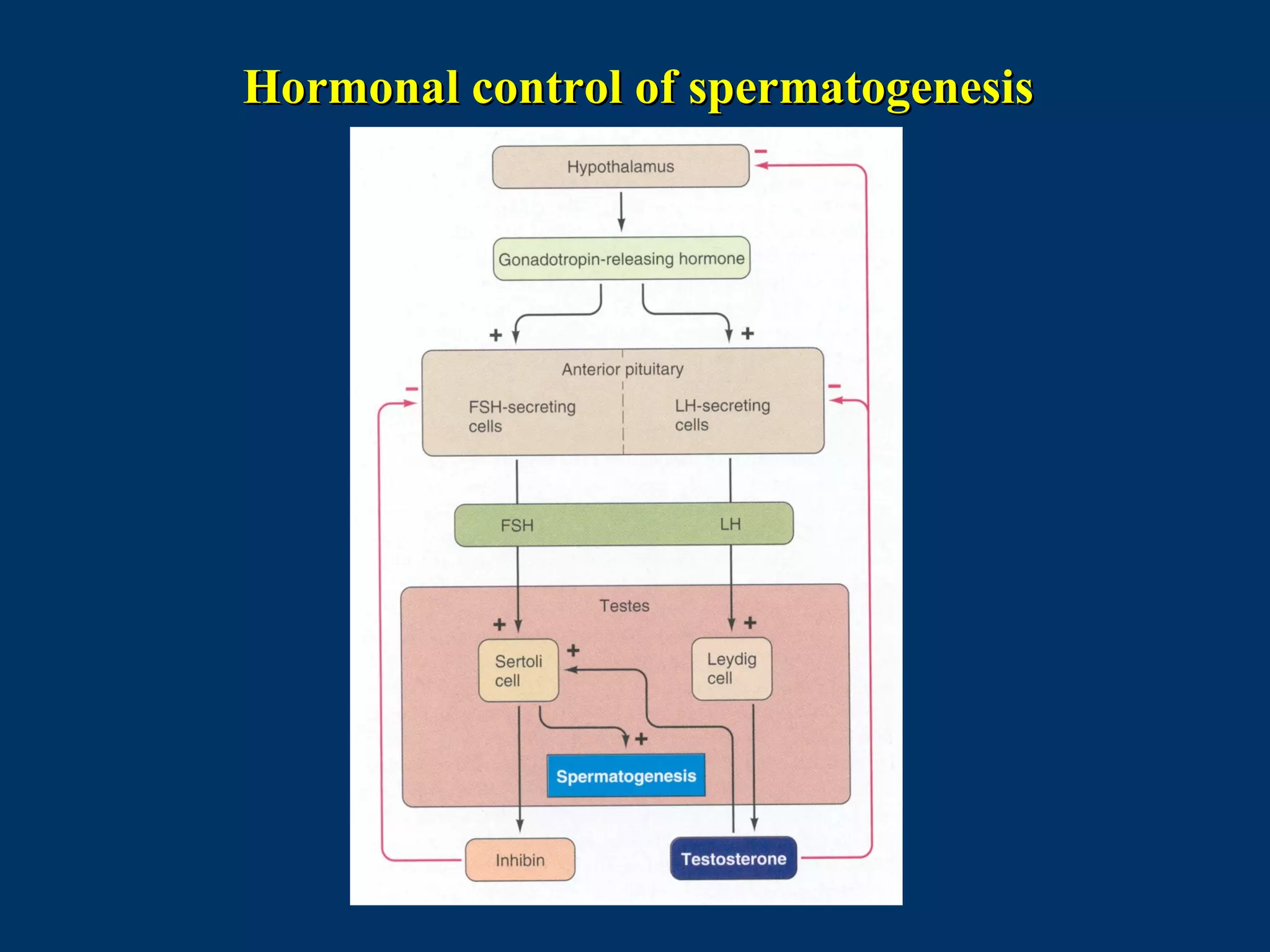
Hormonal control of spermatogenesisHormonal control of spermatogenesis
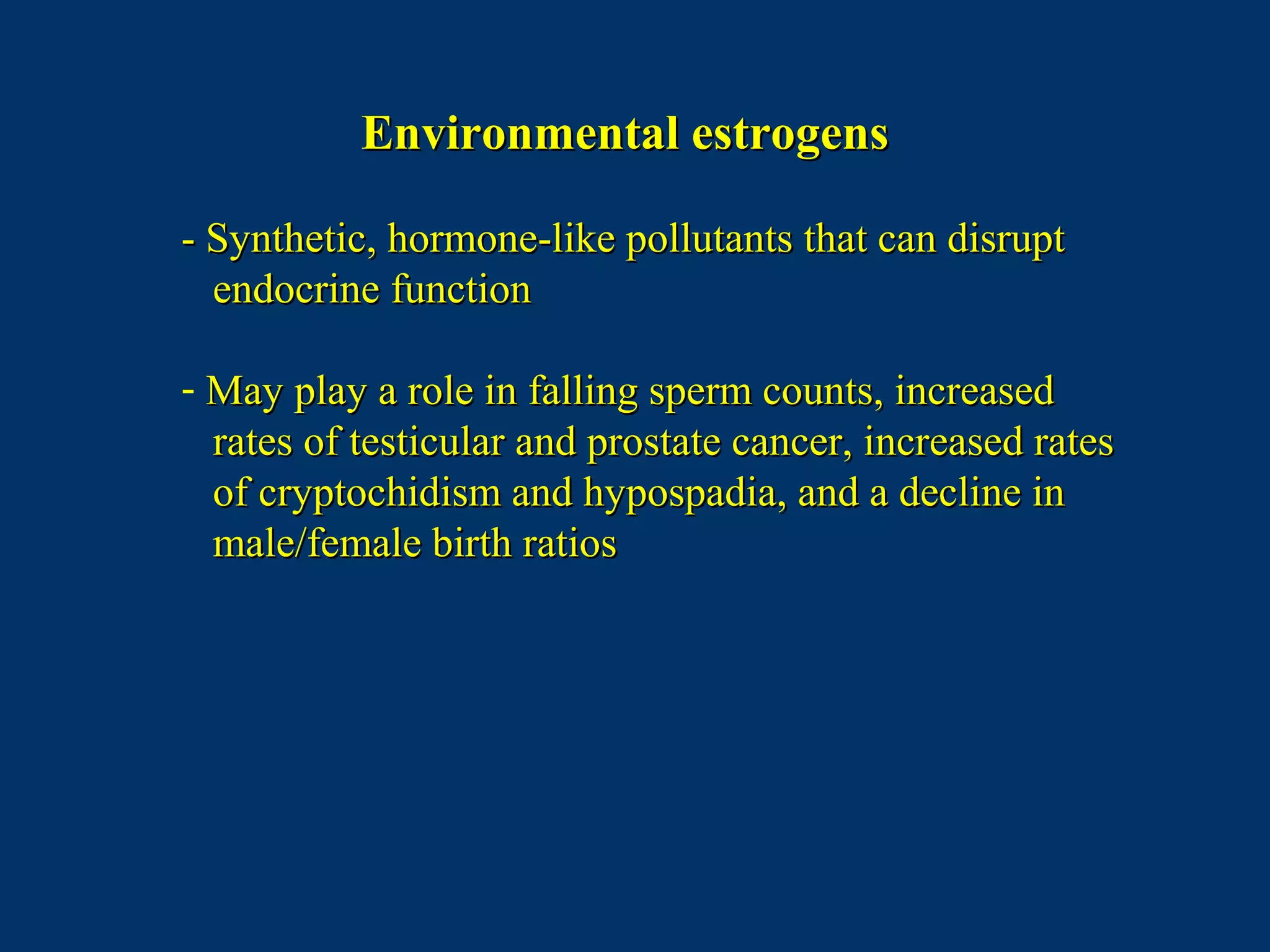
Environmental estrogensEnvironmental estrogens
- Synthetic, hormone-like pollutants that can disrupt- Synthetic, hormone-like pollutants that can disrupt
endocrine functionendocrine function
- May play a role in falling sperm counts, increasedMay play a role in falling sperm counts, increased
rates of testicular and prostate cancer, increased ratesrates of testicular and prostate cancer, increased rates
of cryptochidism and hypospadia, and a decline inof cryptochidism and hypospadia, and a decline in
male/female birth ratiosmale/female birth ratios
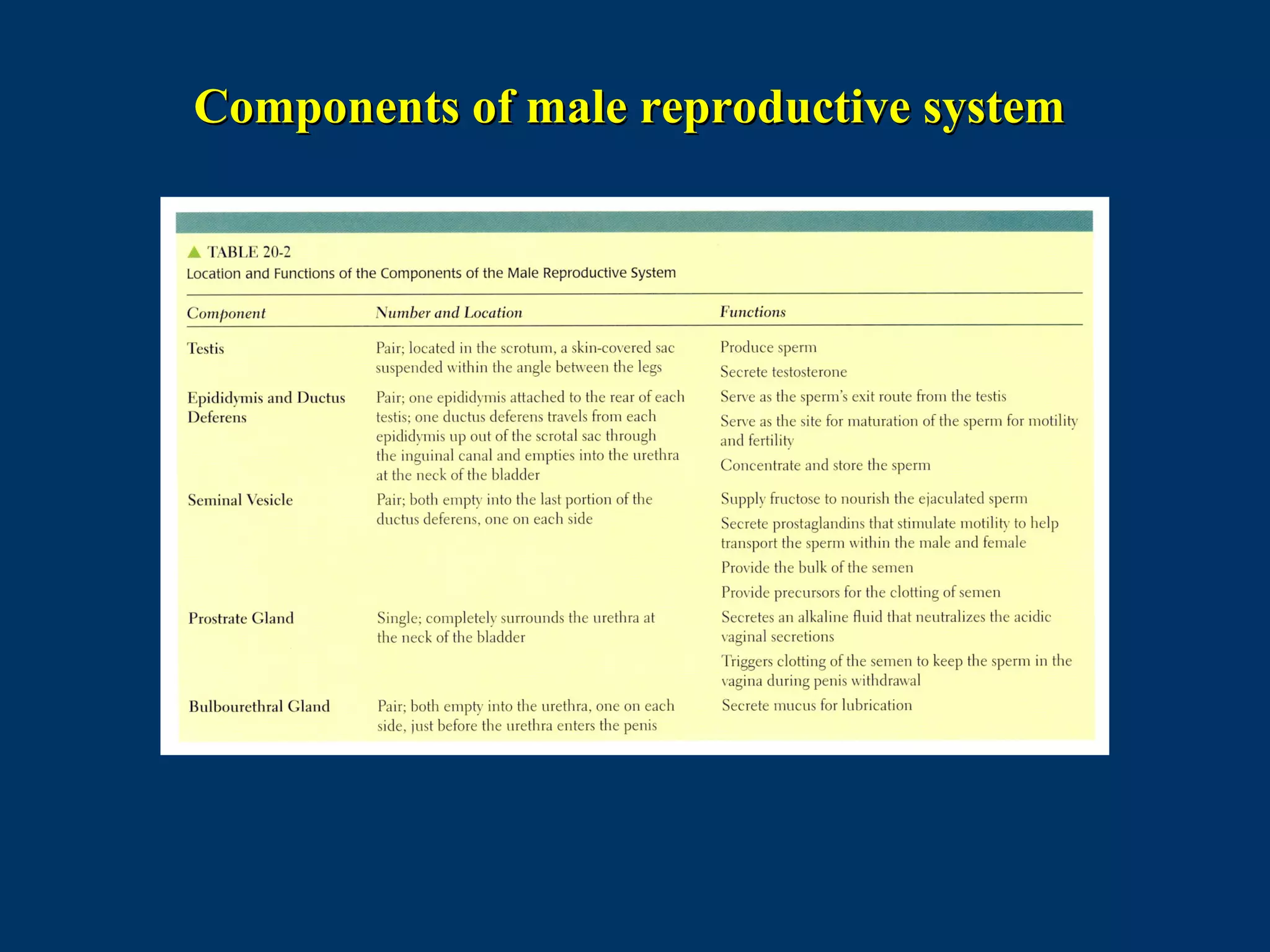
Components of male reproductive systemComponents of male reproductive system
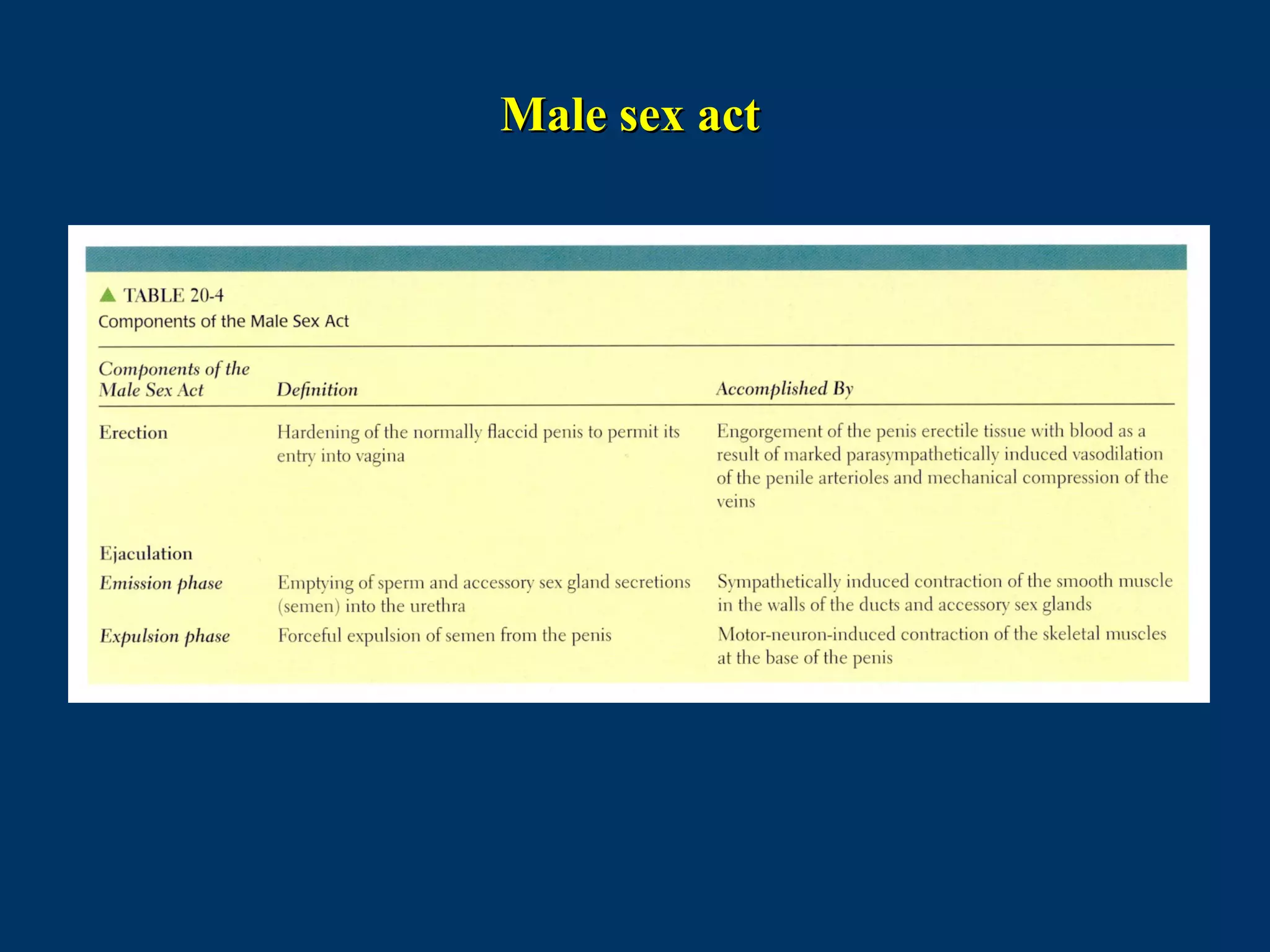
Male sex actMale sex act
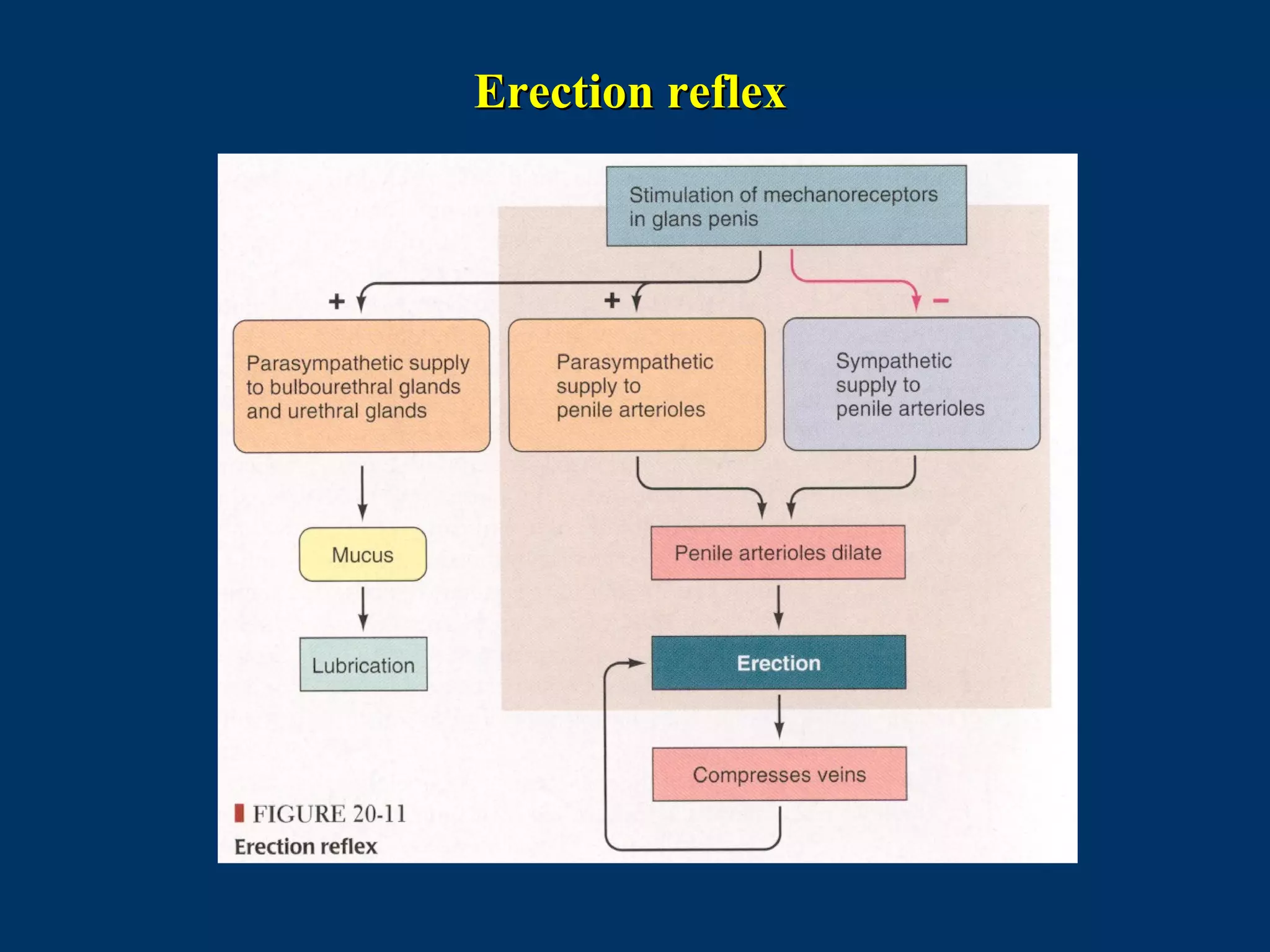
Erection reflexErection reflex
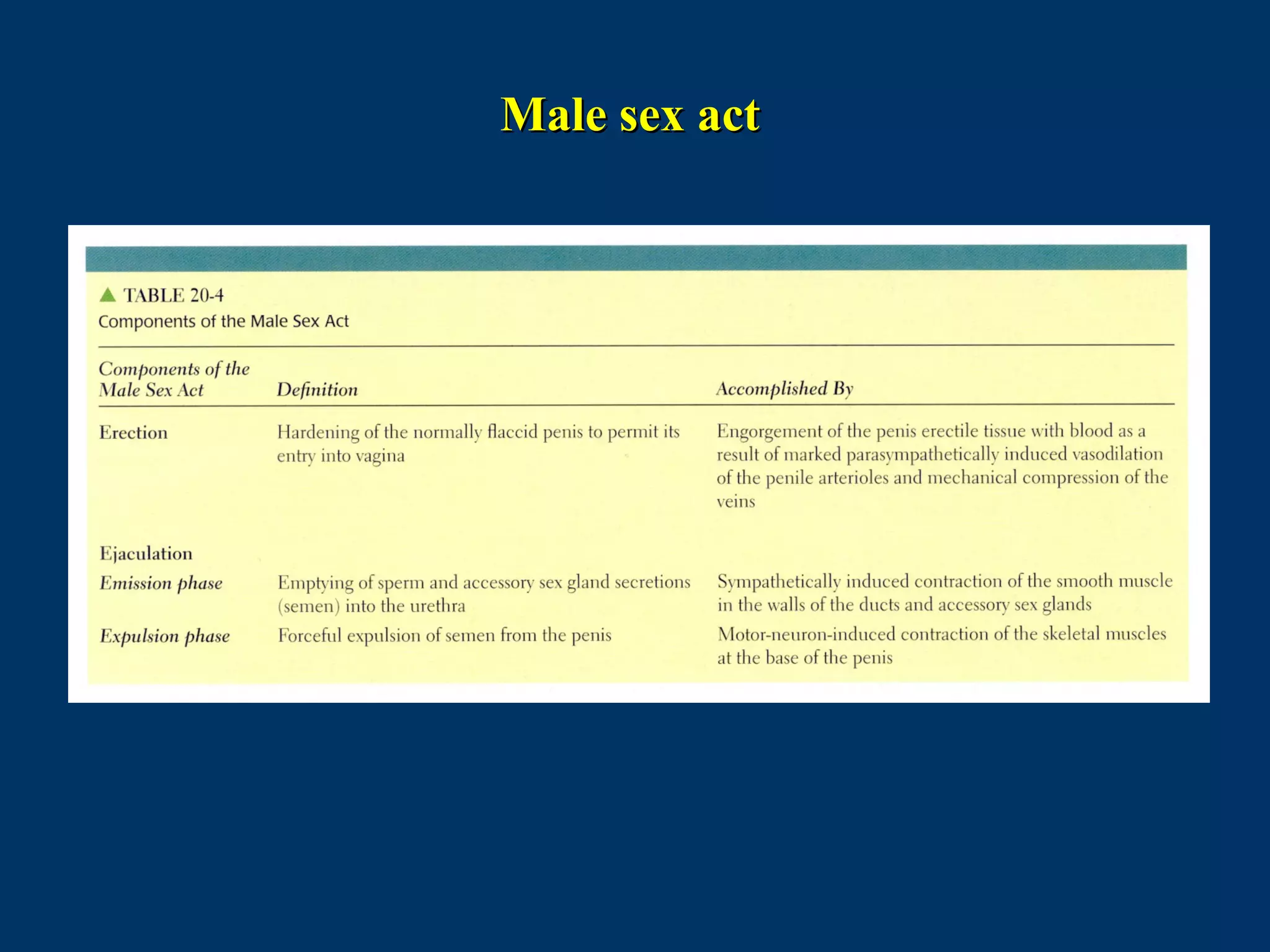
Male sex actMale sex act
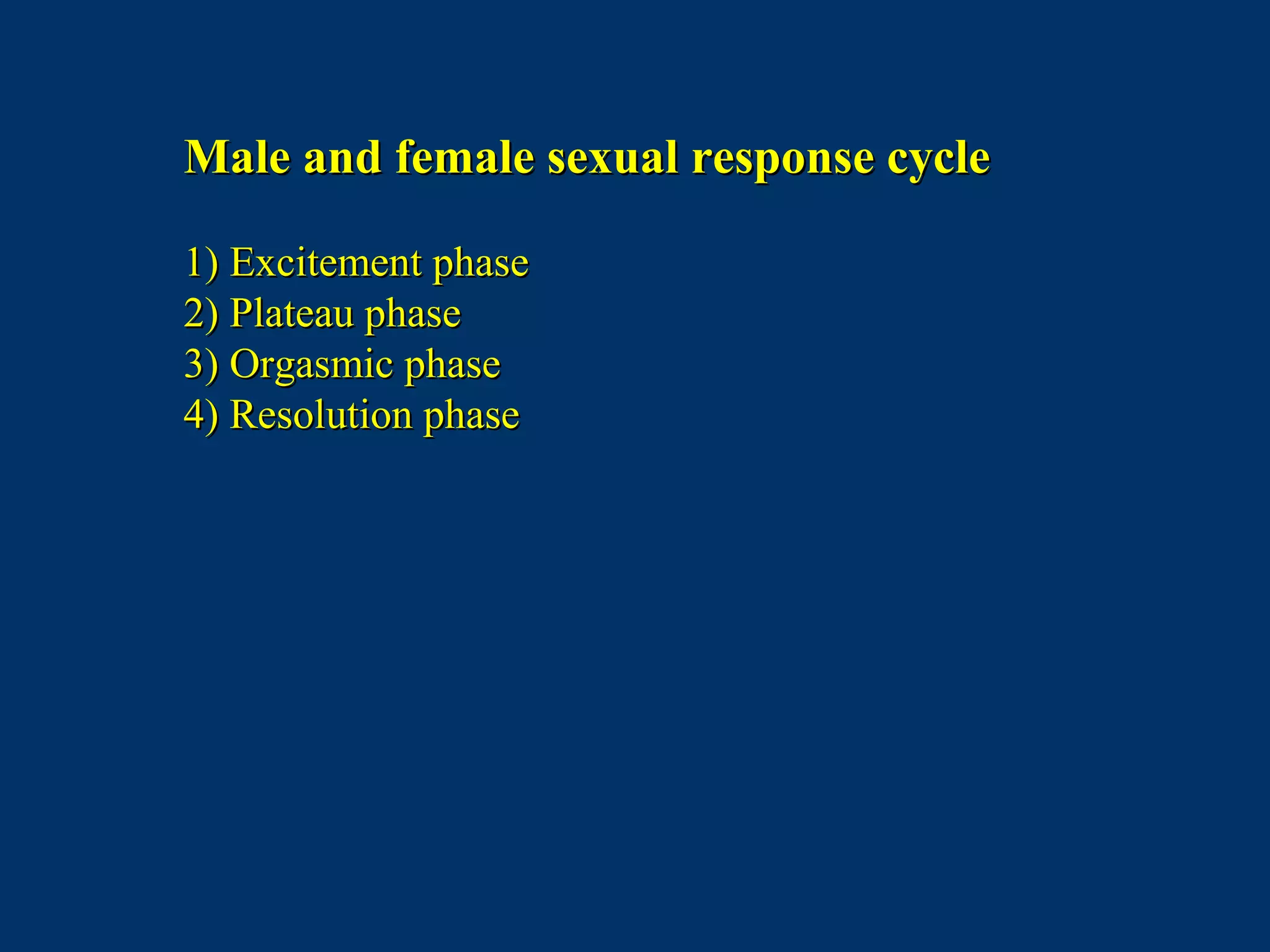
Male and female sexual response cycleMale and female sexual response cycle
1) Excitement phase1) Excitement phase
2)2) Plateau phasePlateau phase
3)3) Orgasmic phaseOrgasmic phase
4) Resolution phase4) Resolution phase
Lecture 44: Female Reproductive System -Lecture 44: Female Reproductive System -
Ovarian CycleOvarian Cycle
Reading: Ch 20, female reproductive physiology
OvariesOvaries
1) produce ova1) produce ova
2) secrete estrogen and progesterone2) secrete estrogen and progesterone
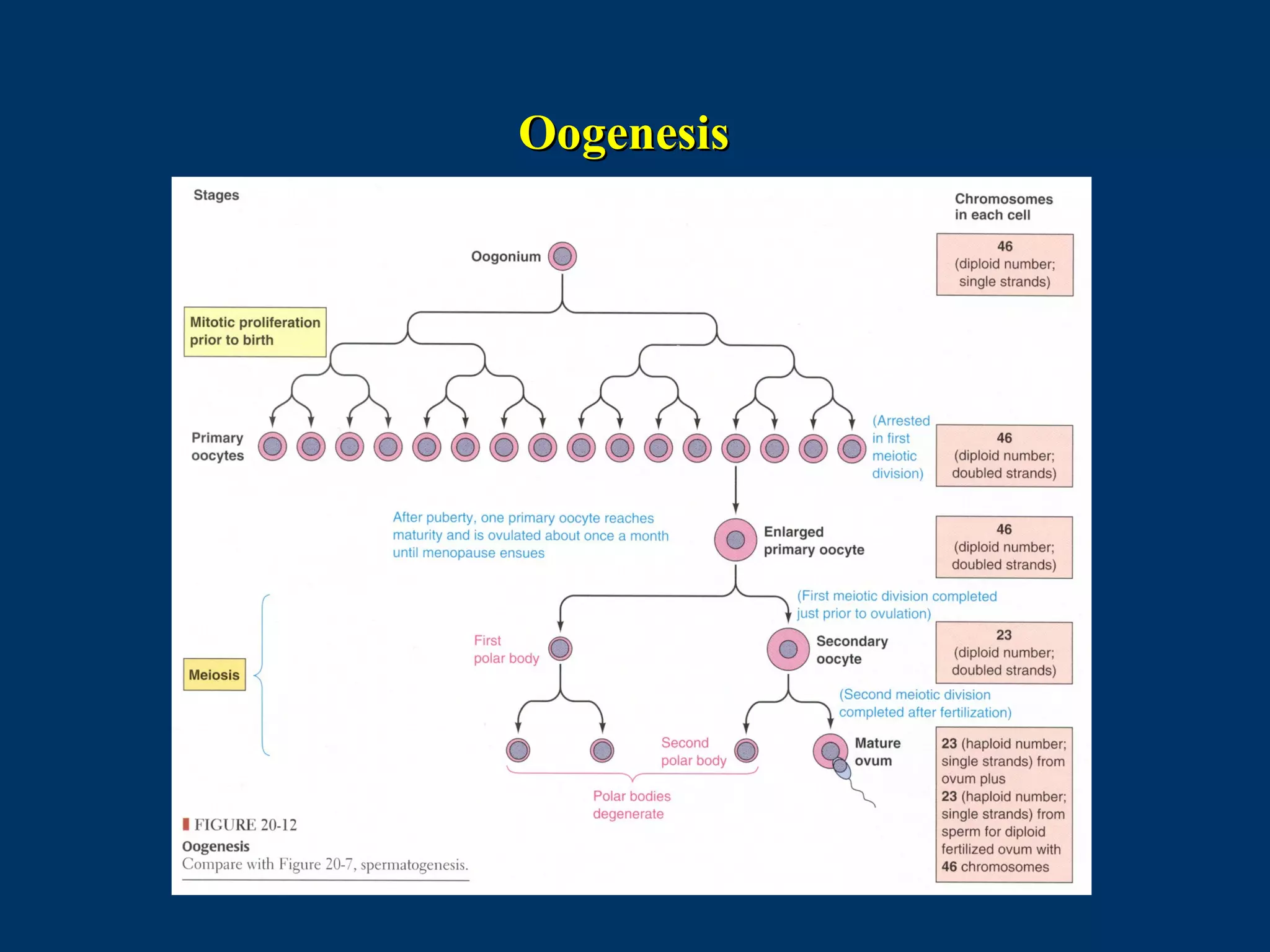
OogenesisOogenesis
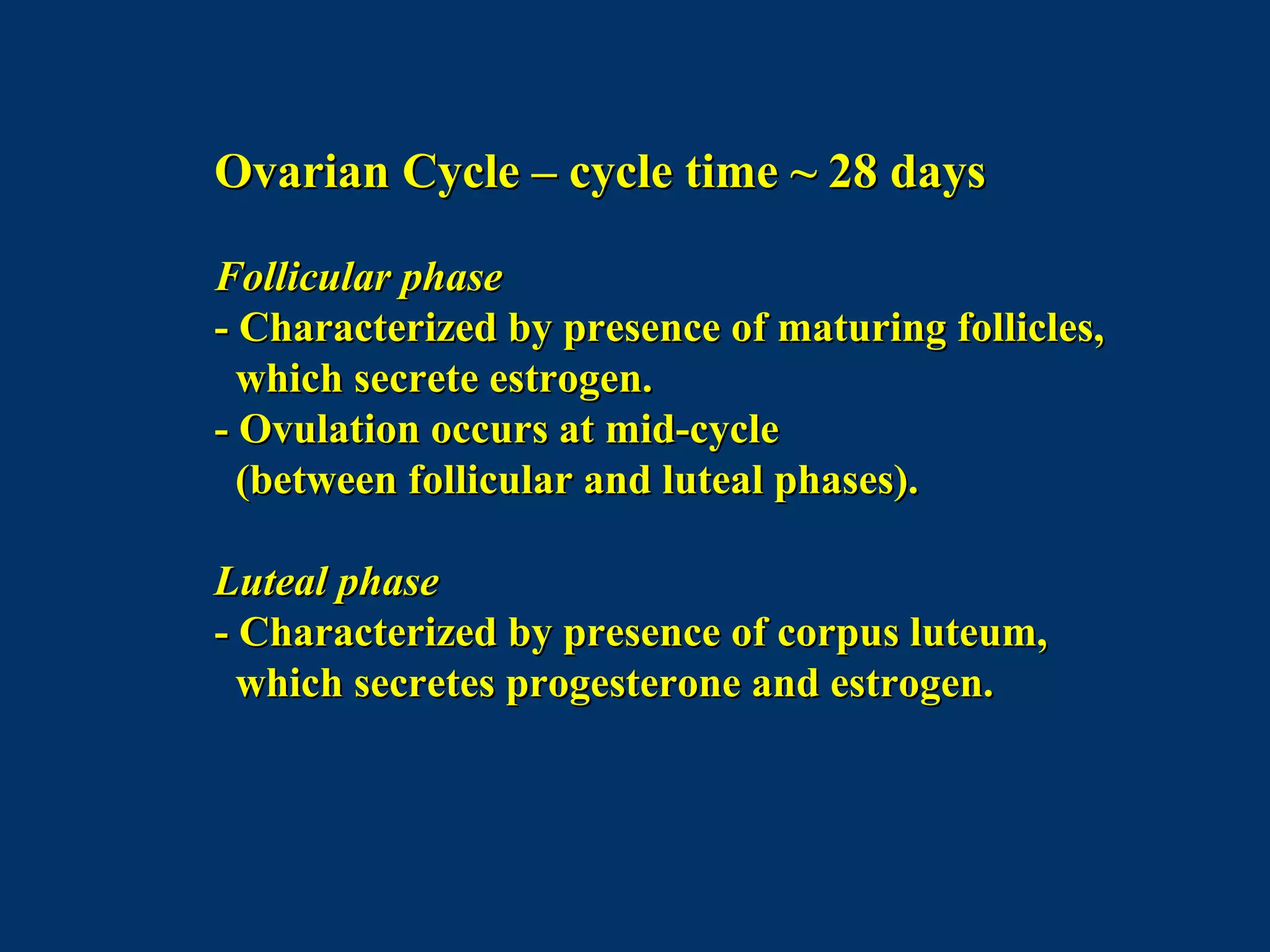
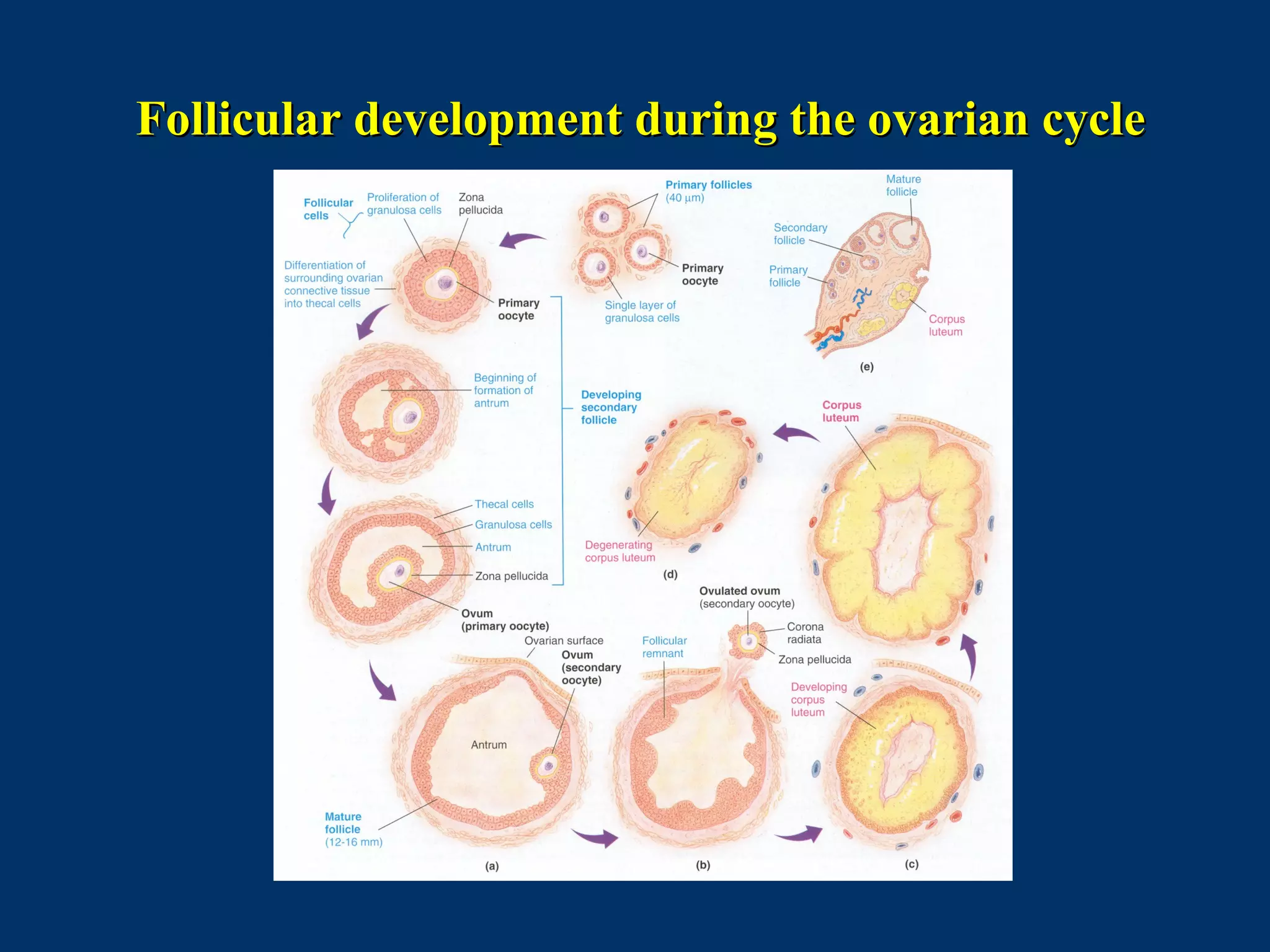
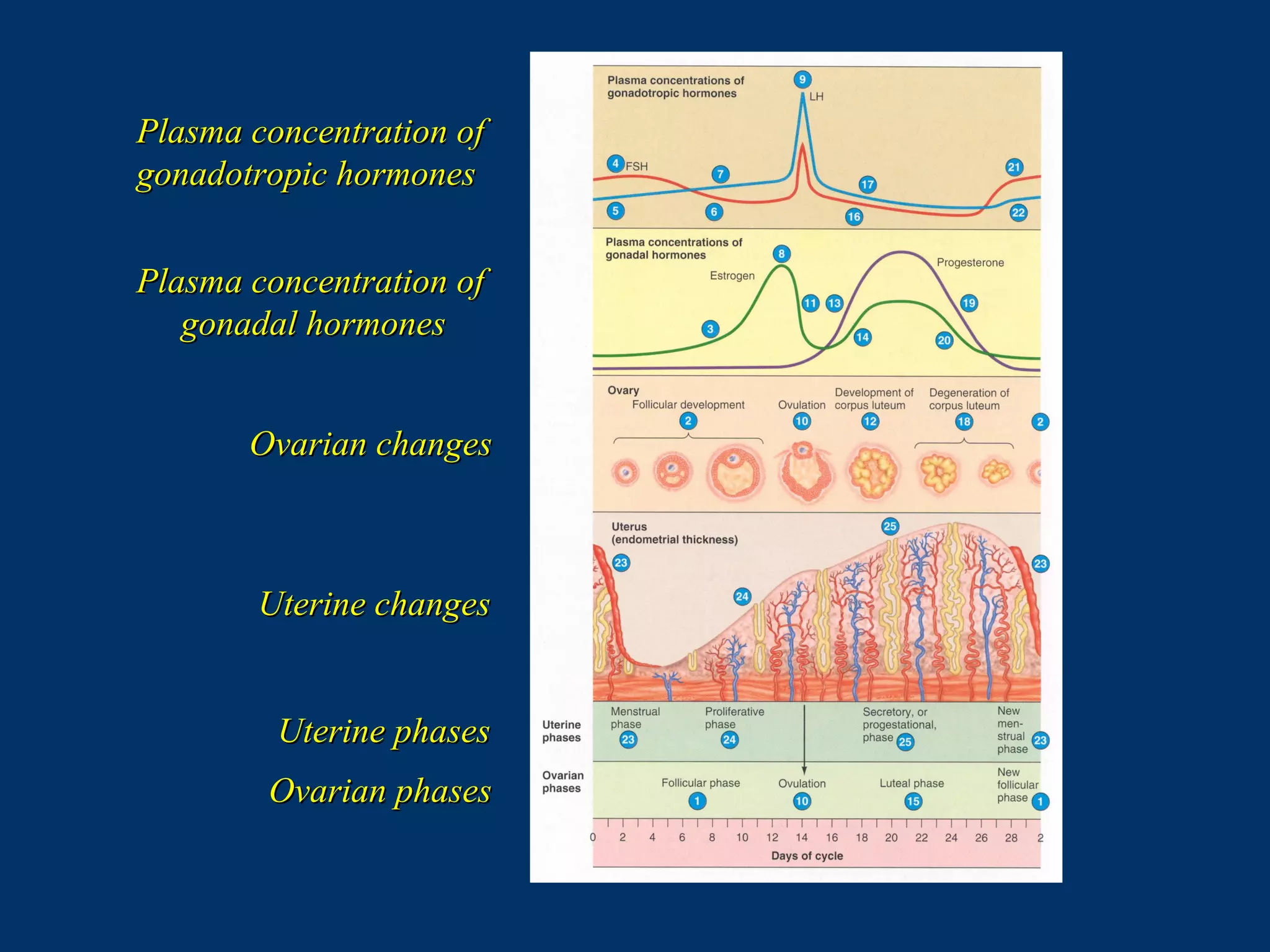
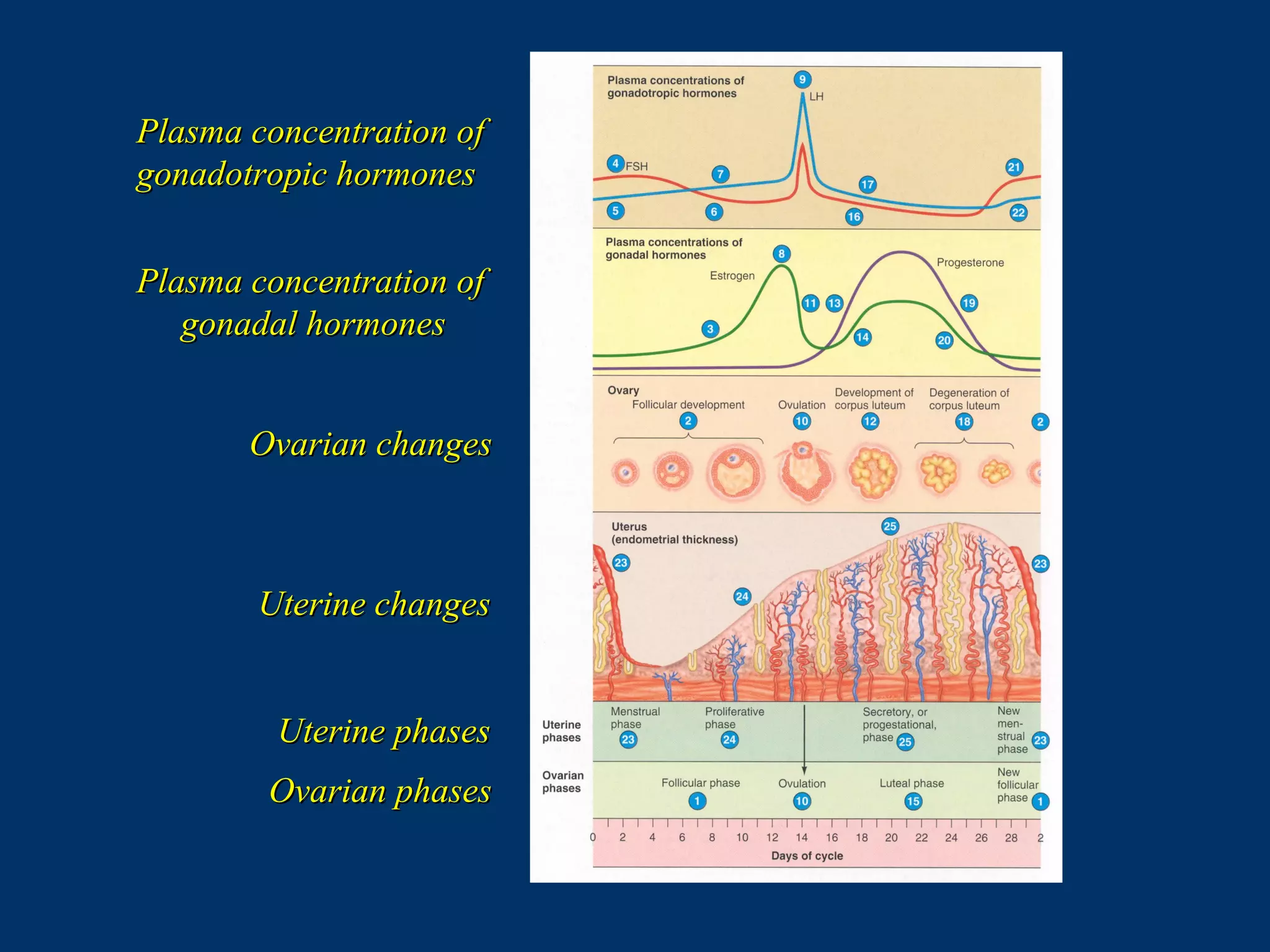
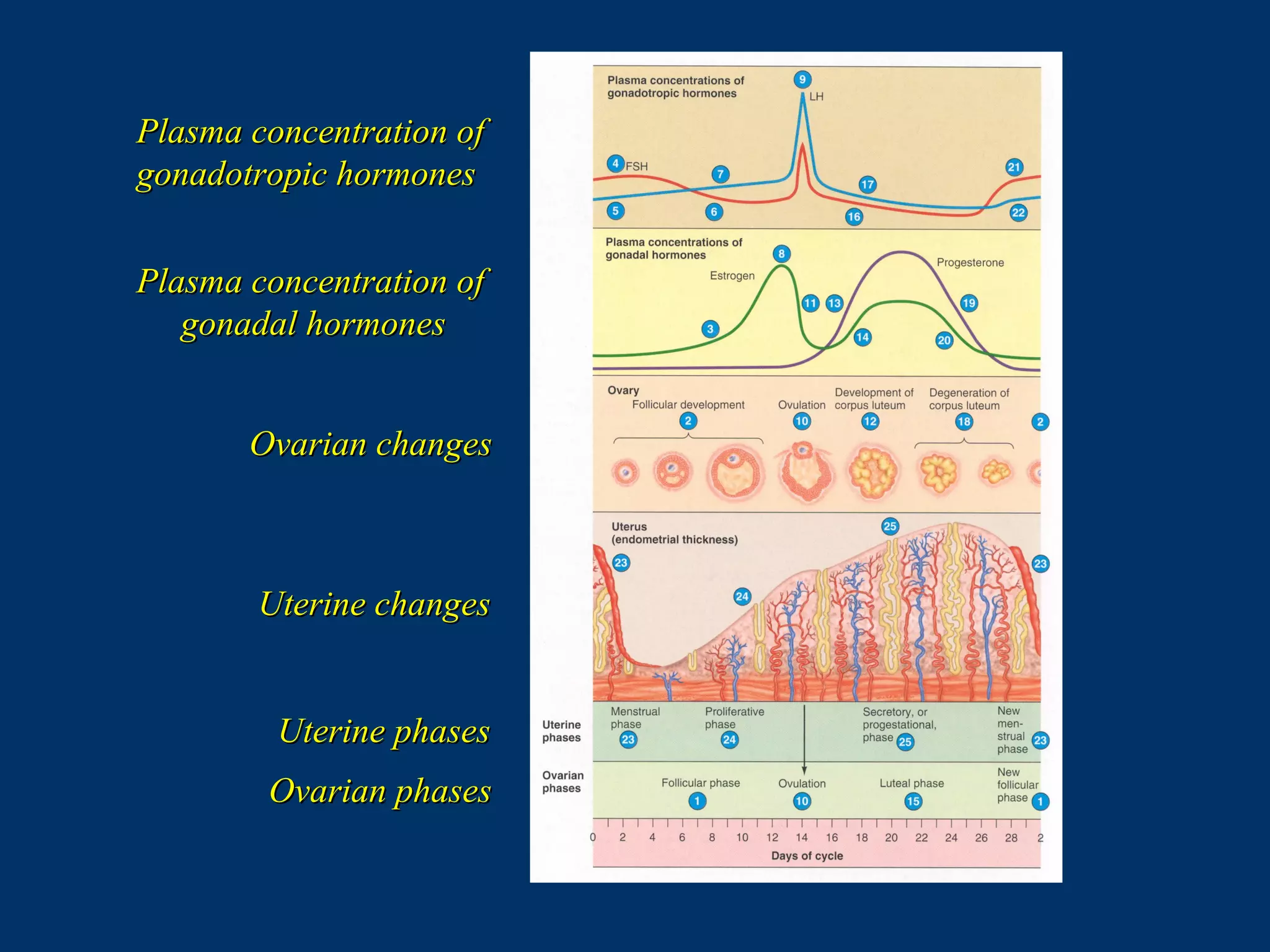
Ovarian Cycle – cycle time ~ 28 daysOvarian Cycle – cycle time ~ 28 days
Follicular phaseFollicular phase
- Characterized by presence of maturing follicles,- Characterized by presence of maturing follicles,
which secrete estrogen.which secrete estrogen.
- Ovulation occurs at mid-cycle- Ovulation occurs at mid-cycle
(between follicular and luteal phases).(between follicular and luteal phases).
Luteal phaseLuteal phase
- Characterized by presence of corpus luteum,- Characterized by presence of corpus luteum,
which secretes progesterone and estrogen.which secretes progesterone and estrogen.
Follicular development during the ovarian cycleFollicular development during the ovarian cycle
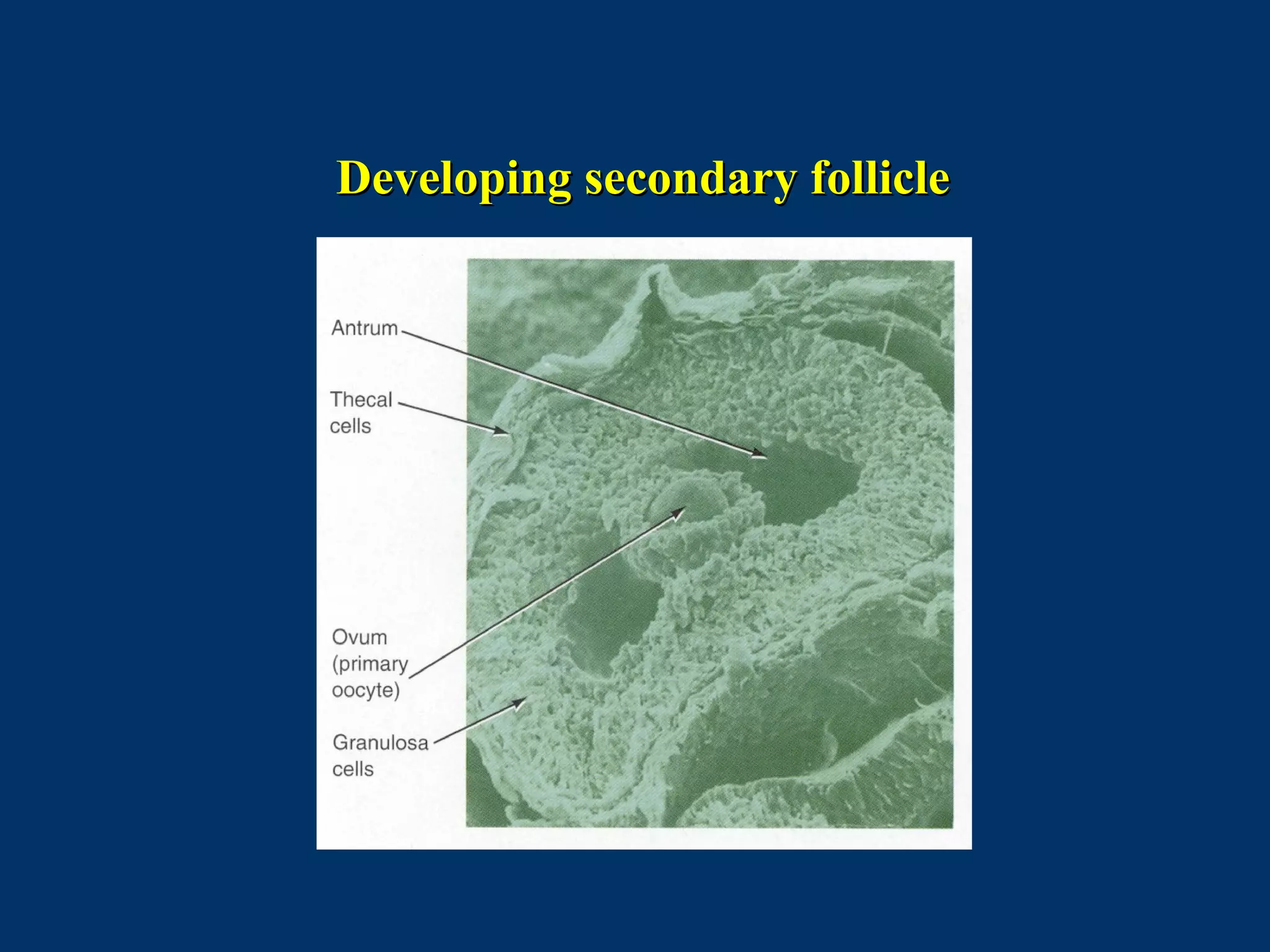
Developing secondary follicleDeveloping secondary follicle
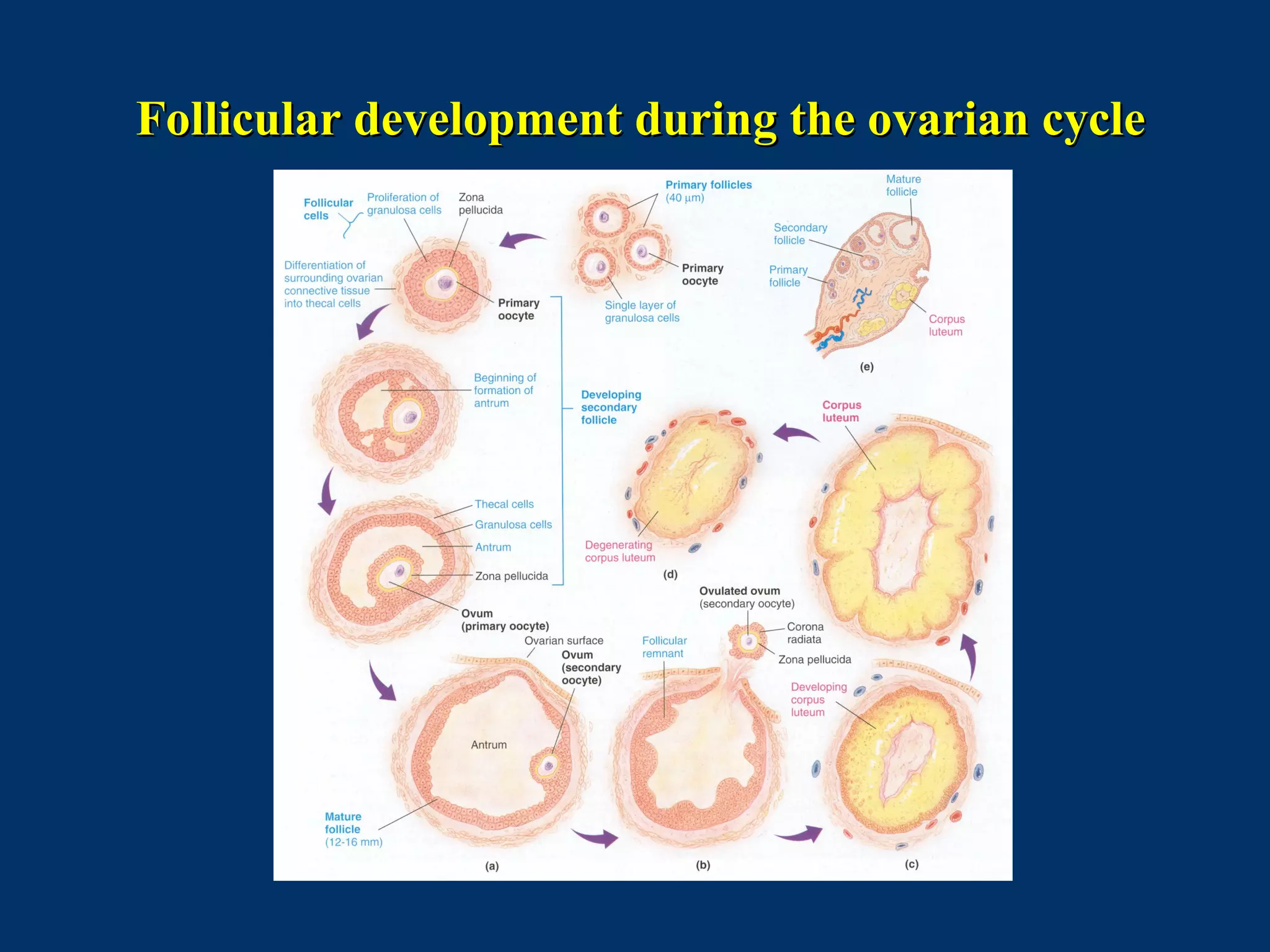
Follicular development during the ovarian cycleFollicular development during the ovarian cycle
Plasma concentration ofPlasma concentration of
gonadotropic hormonesgonadotropic hormones
Plasma concentration ofPlasma concentration of
gonadal hormonesgonadal hormones
Ovarian phasesOvarian phases
Uterine changesUterine changes
Uterine phasesUterine phases
Ovarian changesOvarian changes
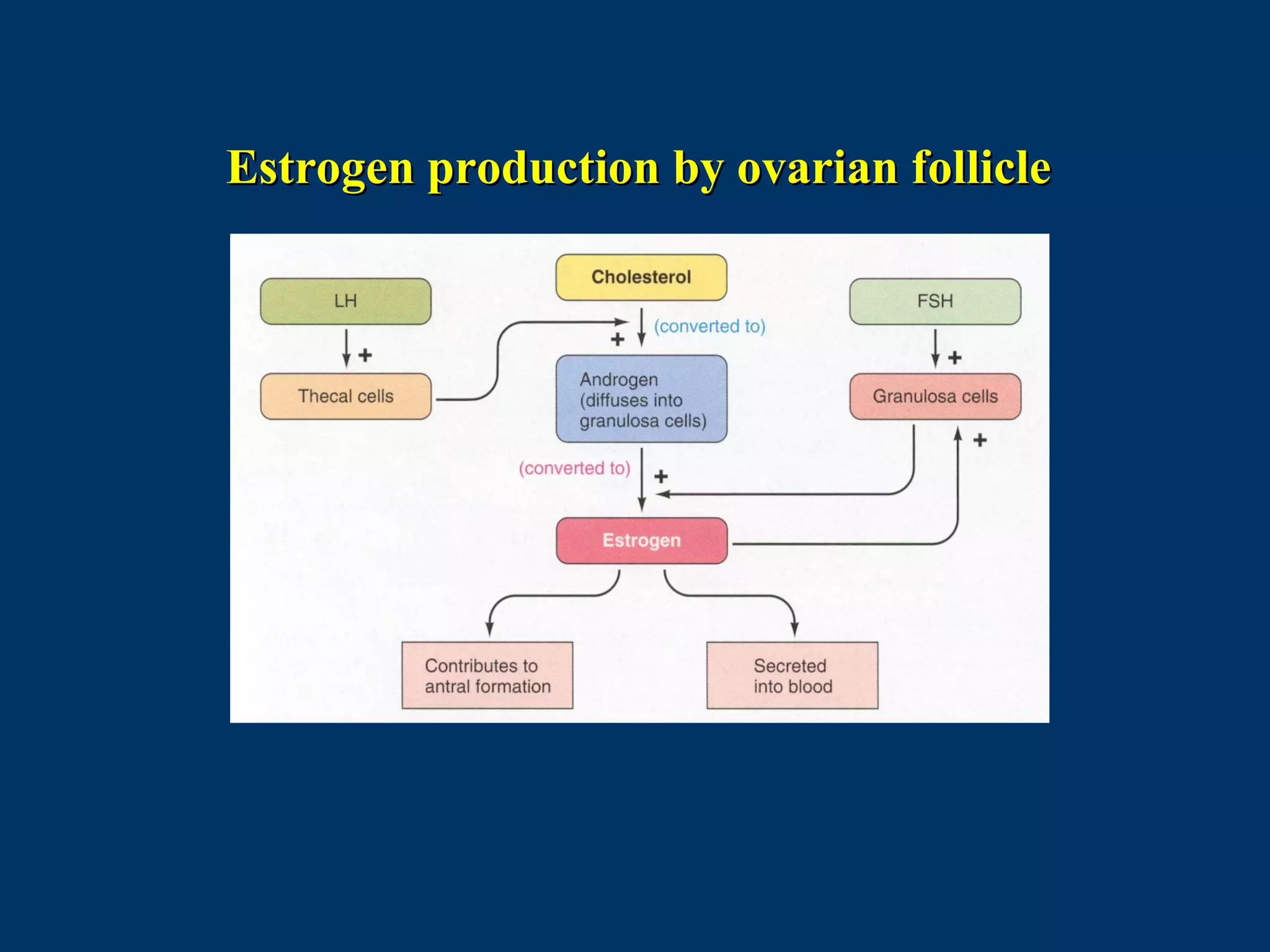
Estrogen production by ovarian follicleEstrogen production by ovarian follicle
Plasma concentration ofPlasma concentration of
gonadotropic hormonesgonadotropic hormones
Plasma concentration ofPlasma concentration of
gonadal hormonesgonadal hormones
Ovarian phasesOvarian phases
Uterine changesUterine changes
Uterine phasesUterine phases
Ovarian changesOvarian changes
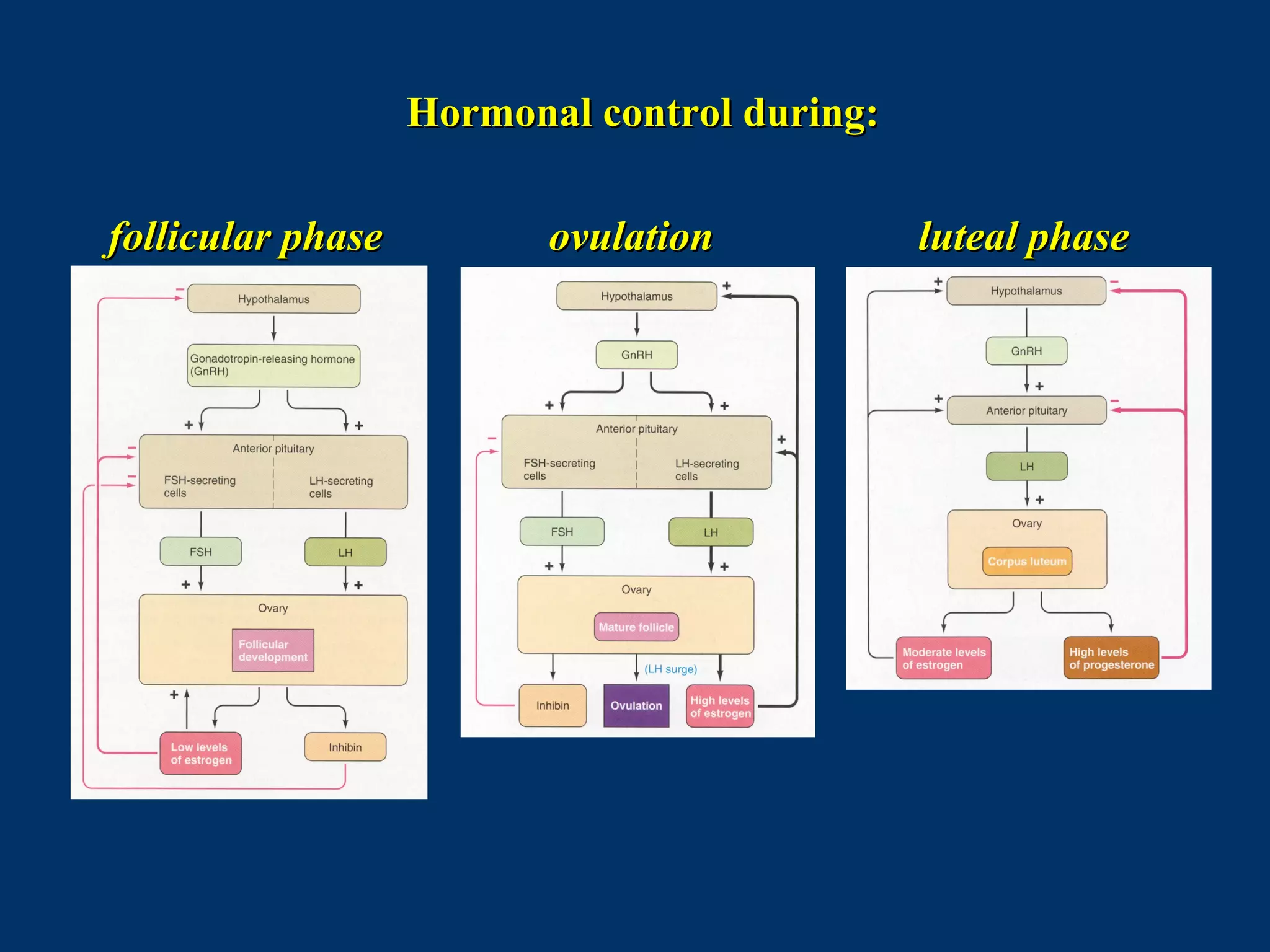
LH SurgeLH Surge
1)1) Halts estrogen synthesis by the follicular cells.Halts estrogen synthesis by the follicular cells.
2)2) Reinitiates meiosis in the follicle.Reinitiates meiosis in the follicle.
3)3) Triggers prostagladins, which cause ovulation.Triggers prostagladins, which cause ovulation.
4)4) Luteinizes the follicular remnant.Luteinizes the follicular remnant.
Estrogen alone does not shut down tonic LH release.Estrogen alone does not shut down tonic LH release.
Estrogen and progesterone together does shut down LH release.Estrogen and progesterone together does shut down LH release.
Plasma concentration ofPlasma concentration of
gonadotropic hormonesgonadotropic hormones
Plasma concentration ofPlasma concentration of
gonadal hormonesgonadal hormones
Ovarian phasesOvarian phases
Uterine changesUterine changes
Uterine phasesUterine phases
Ovarian changesOvarian changes
luteal phaseluteal phaseovulationovulationfollicular phasefollicular phase
Hormonal control during:Hormonal control during:
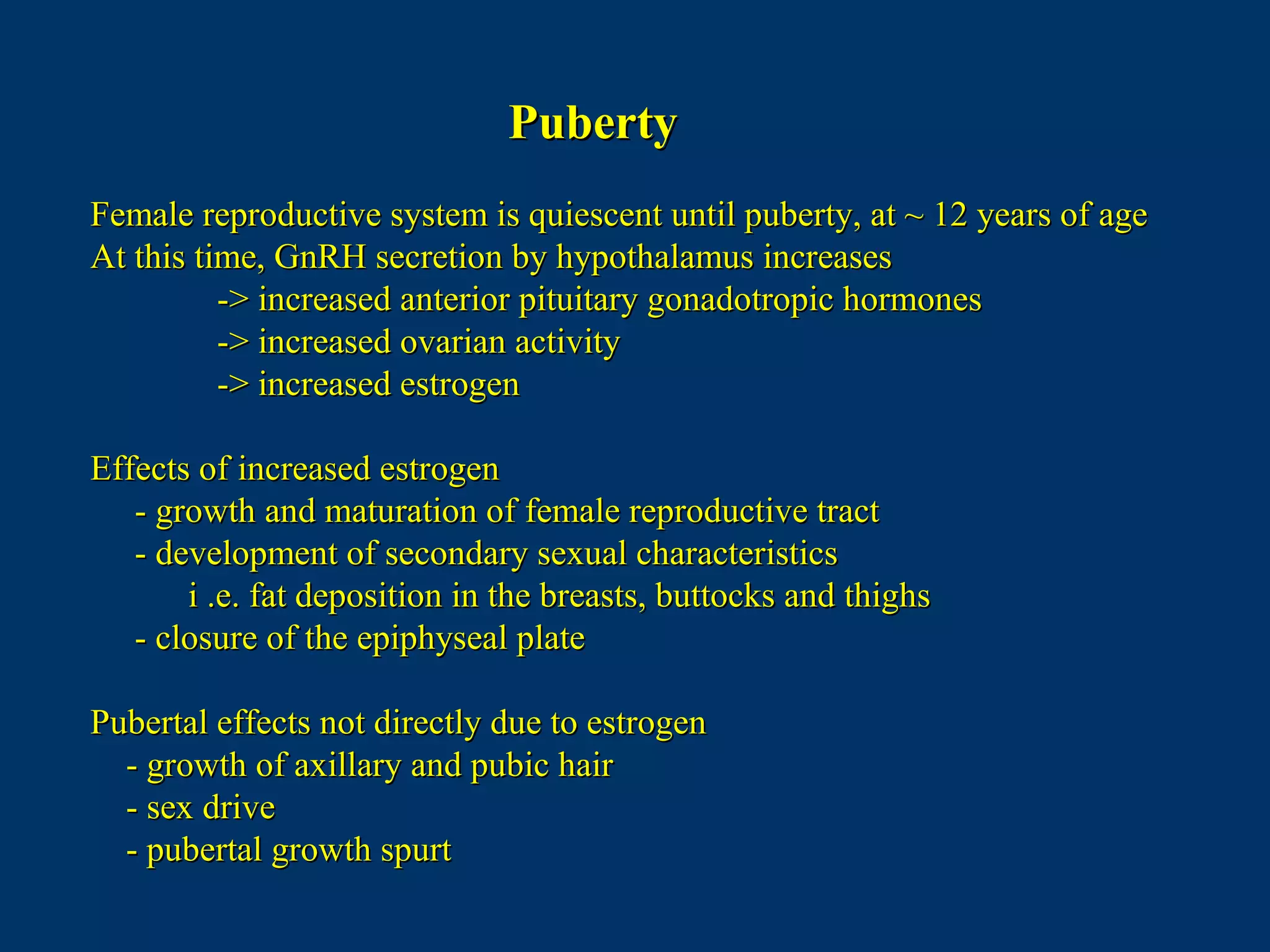
PubertyPuberty
Female reproductive system is quiescent until puberty, at ~ 12 years of ageFemale reproductive system is quiescent until puberty, at ~ 12 years of age
At this time, GnRH secretion by hypothalamus increasesAt this time, GnRH secretion by hypothalamus increases
-> increased anterior pituitary gonadotropic hormones-> increased anterior pituitary gonadotropic hormones
-> increased ovarian activity-> increased ovarian activity
-> increased estrogen-> increased estrogen
Effects of increased estrogenEffects of increased estrogen
- growth and maturation of female reproductive tract- growth and maturation of female reproductive tract
- development of secondary sexual characteristics- development of secondary sexual characteristics
i .e. fat deposition in the breasts, buttocks and thighsi .e. fat deposition in the breasts, buttocks and thighs
- closure of the epiphyseal plate- closure of the epiphyseal plate
Pubertal effects not directly due to estrogenPubertal effects not directly due to estrogen
- growth of axillary and pubic hair- growth of axillary and pubic hair
- sex drive- sex drive
- pubertal growth spurt- pubertal growth spurt
MenopauseMenopause
- Cessation of menstrual cycles – usually occurs at age 45-55- Cessation of menstrual cycles – usually occurs at age 45-55
- In part due to depletion of limited supply of ovarian follicles- In part due to depletion of limited supply of ovarian follicles
- Midlife hypothalamic failure may also play a role- Midlife hypothalamic failure may also play a role
- Preceded by a period of irregular cycles and diminished estrogen levels- Preceded by a period of irregular cycles and diminished estrogen levels
Effects of diminished estrogen levels:Effects of diminished estrogen levels:
- decrease in bone density, increase in osteoporosis- decrease in bone density, increase in osteoporosis
- increase in coronary artery disease- increase in coronary artery disease
- HDL/LDL ratio- HDL/LDL ratio
- loss of antioxidant activity- loss of antioxidant activity
- increased proliferation of smooth muscle cells- increased proliferation of smooth muscle cells
following vessel wall damagefollowing vessel wall damage
-- ““Hot flashesHot flashes”” due to unstable control of blood flowdue to unstable control of blood flow
- possibly, depression and irritability- possibly, depression and irritability
Lecture 45: Female Reproductive System -Lecture 45: Female Reproductive System -
PregnancyPregnancy
Reading: Ch 20, female reproductive physiology
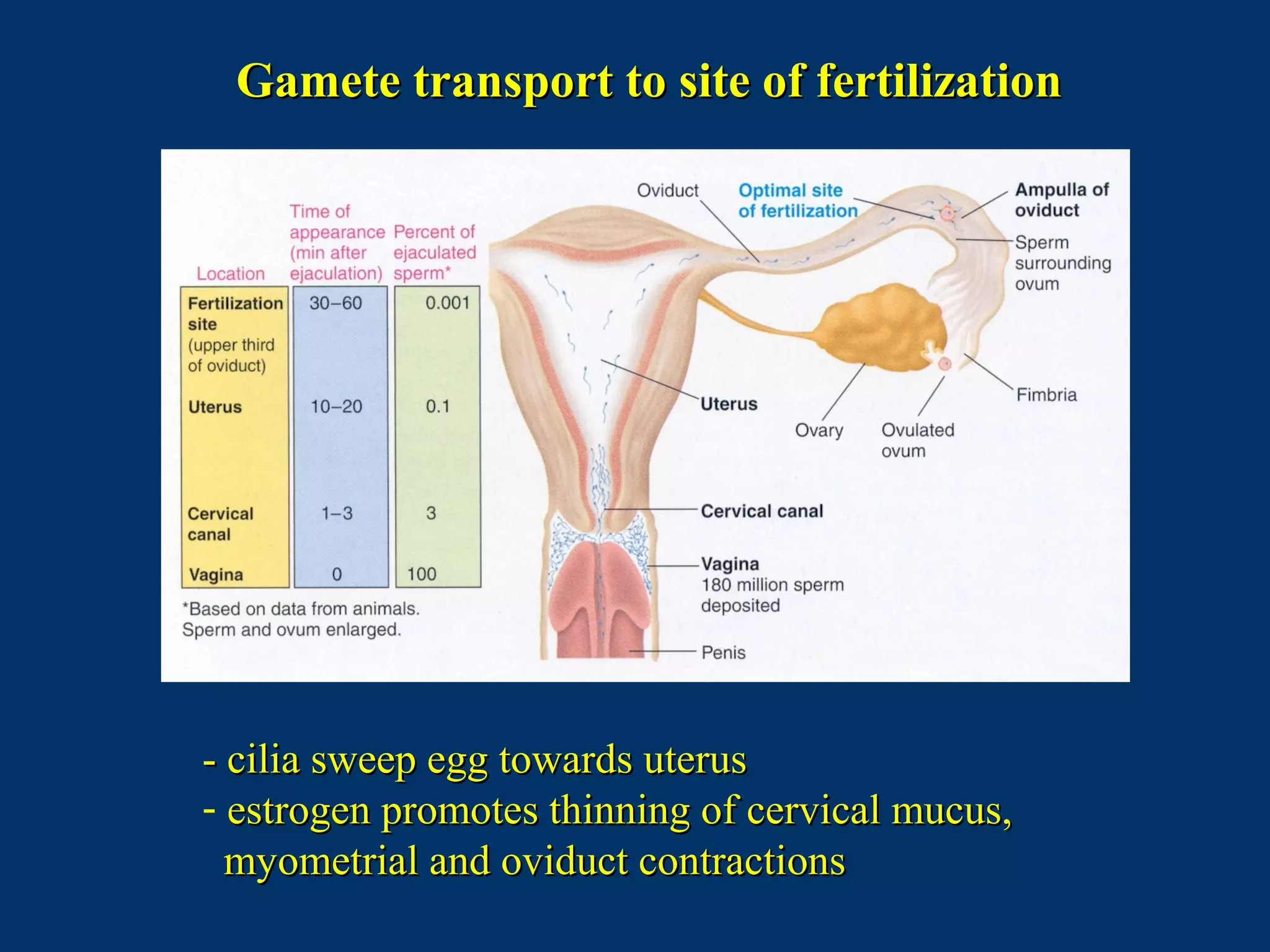
Gamete transport to site of fertilizationGamete transport to site of fertilization
- cilia sweep egg towards uterus- cilia sweep egg towards uterus
- estrogen promotes thinning of cervical mucus,estrogen promotes thinning of cervical mucus,
myometrial and oviduct contractionsmyometrial and oviduct contractions
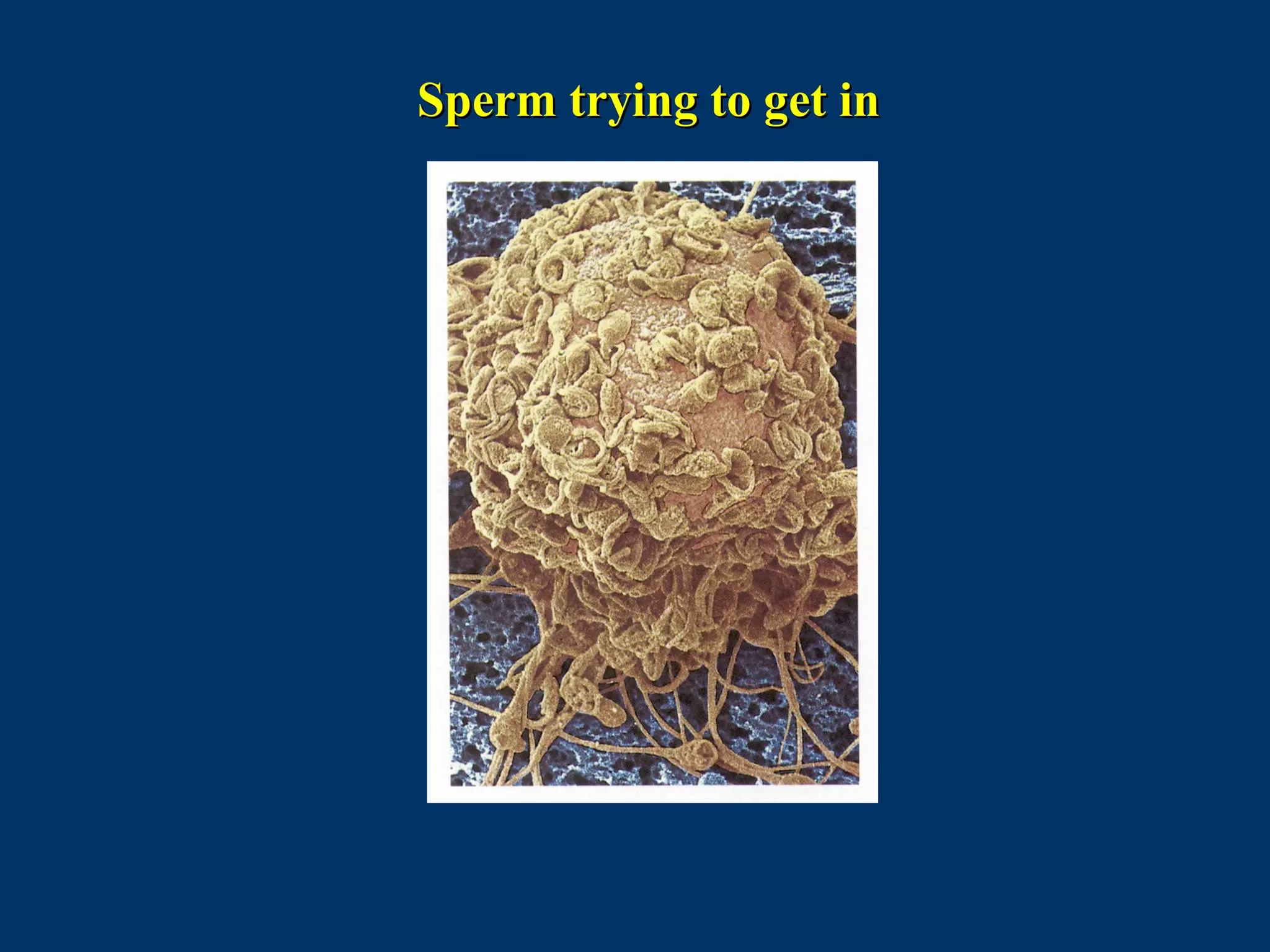
Sperm trying to get inSperm trying to get in
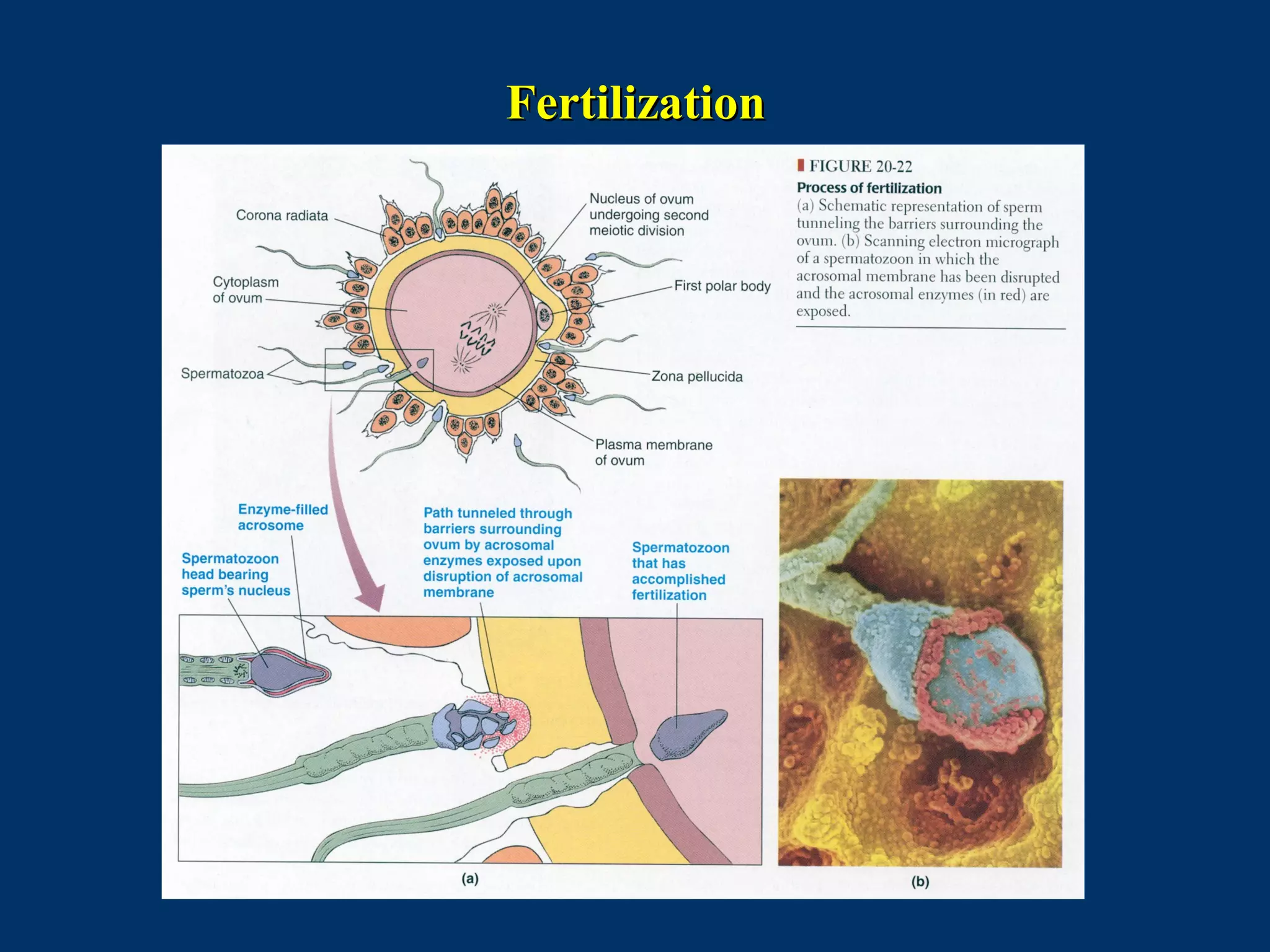
FertilizationFertilization
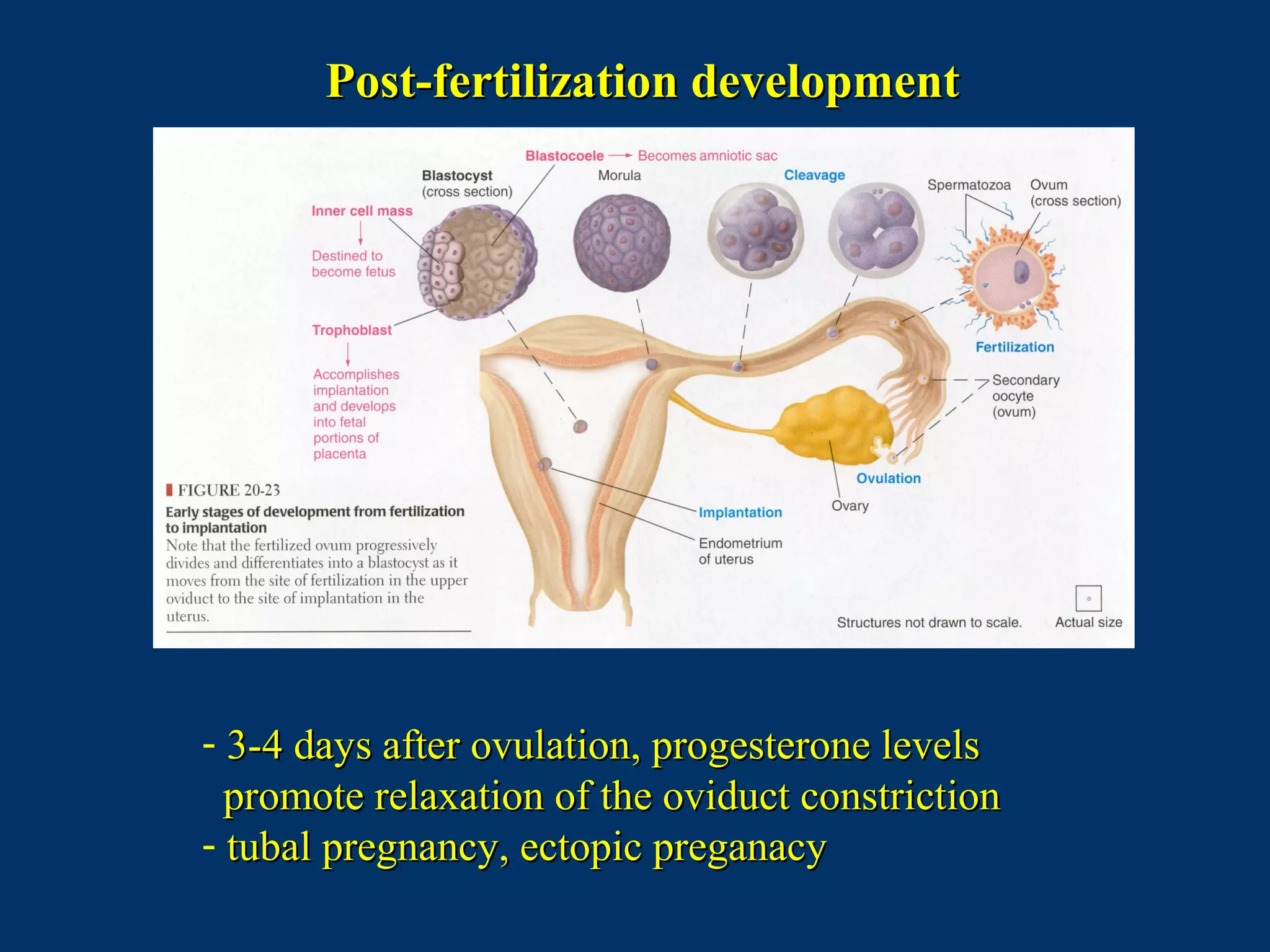
Post-fertilization developmentPost-fertilization development
- 3-4 days after ovulation, progesterone levels3-4 days after ovulation, progesterone levels
promote relaxation of the oviduct constrictionpromote relaxation of the oviduct constriction
- tubal pregnancy, ectopic preganacytubal pregnancy, ectopic preganacy
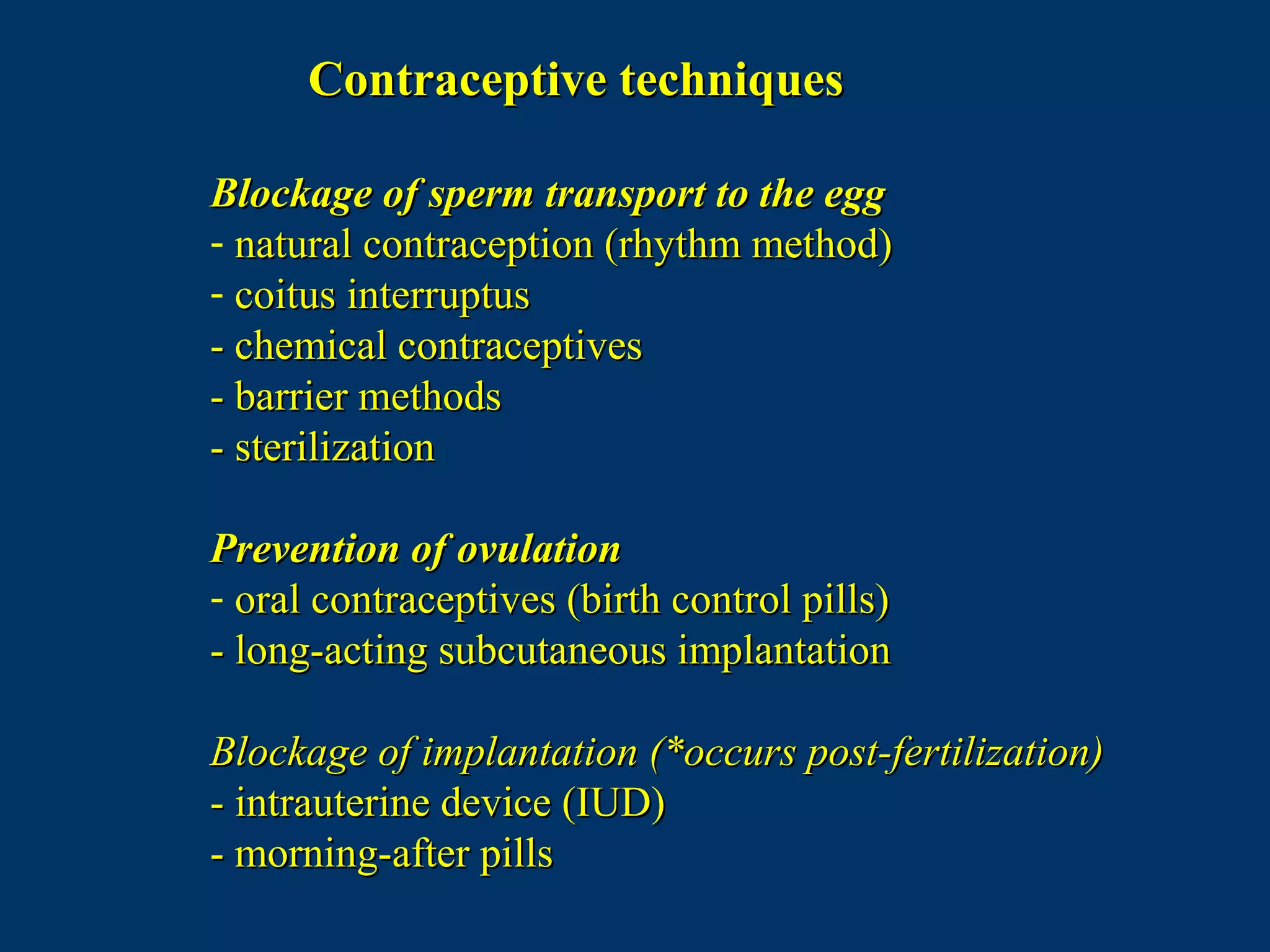
Contraceptive techniquesContraceptive techniques
Blockage of sperm transport to the eggBlockage of sperm transport to the egg
- natural contraception (rhythm method)natural contraception (rhythm method)
- coitus interruptuscoitus interruptus
- chemical contraceptives- chemical contraceptives
- barrier methods- barrier methods
- sterilization- sterilization
Prevention of ovulationPrevention of ovulation
- oral contraceptives (birth control pills)oral contraceptives (birth control pills)
- long-acting subcutaneous implantation- long-acting subcutaneous implantation
Blockage of implantation (*occurs post-fertilization)Blockage of implantation (*occurs post-fertilization)
- intrauterine device (IUD)- intrauterine device (IUD)
- morning-after pills- morning-after pills
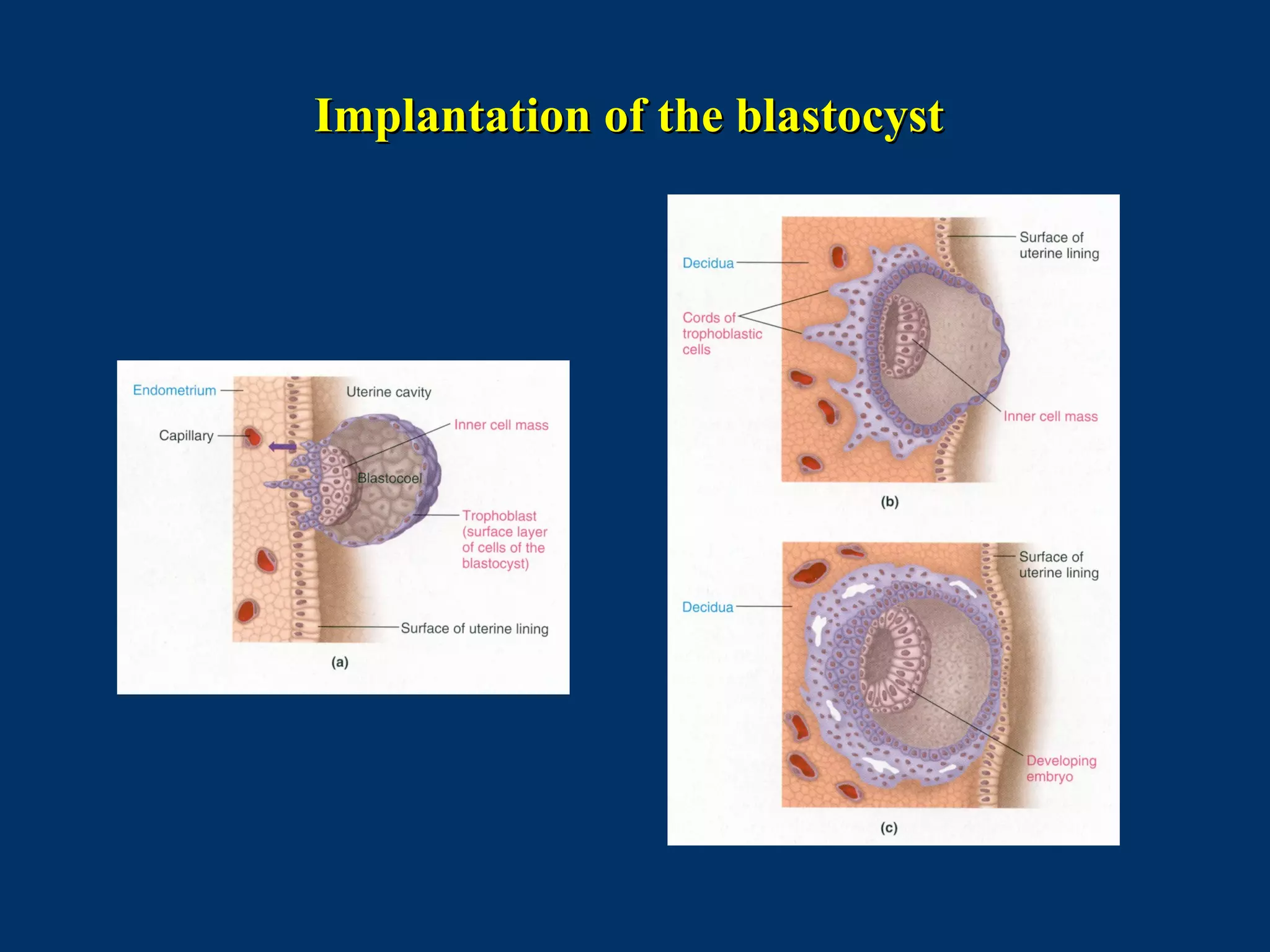
Implantation of the blastocystImplantation of the blastocyst
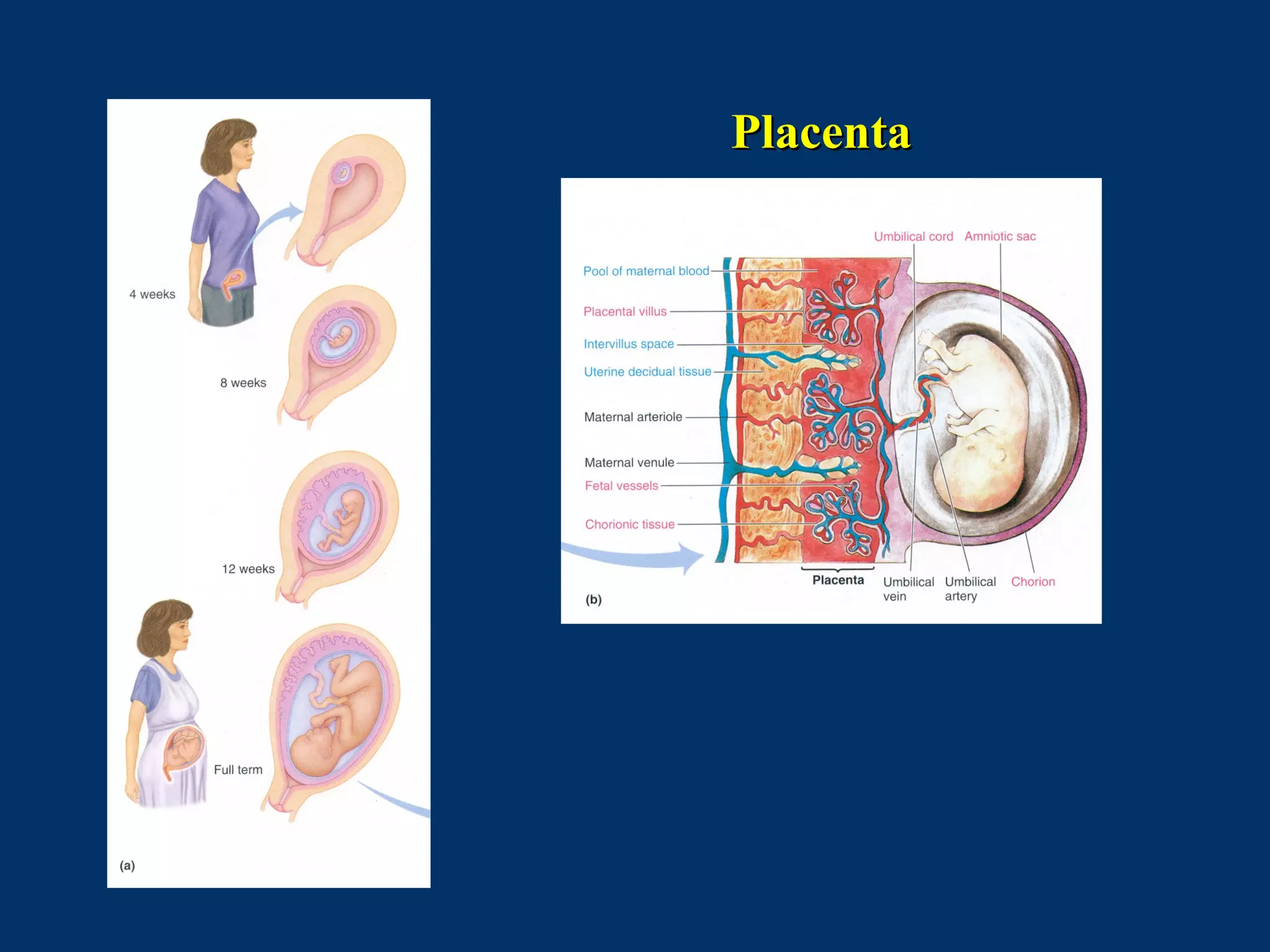
PlacentaPlacenta
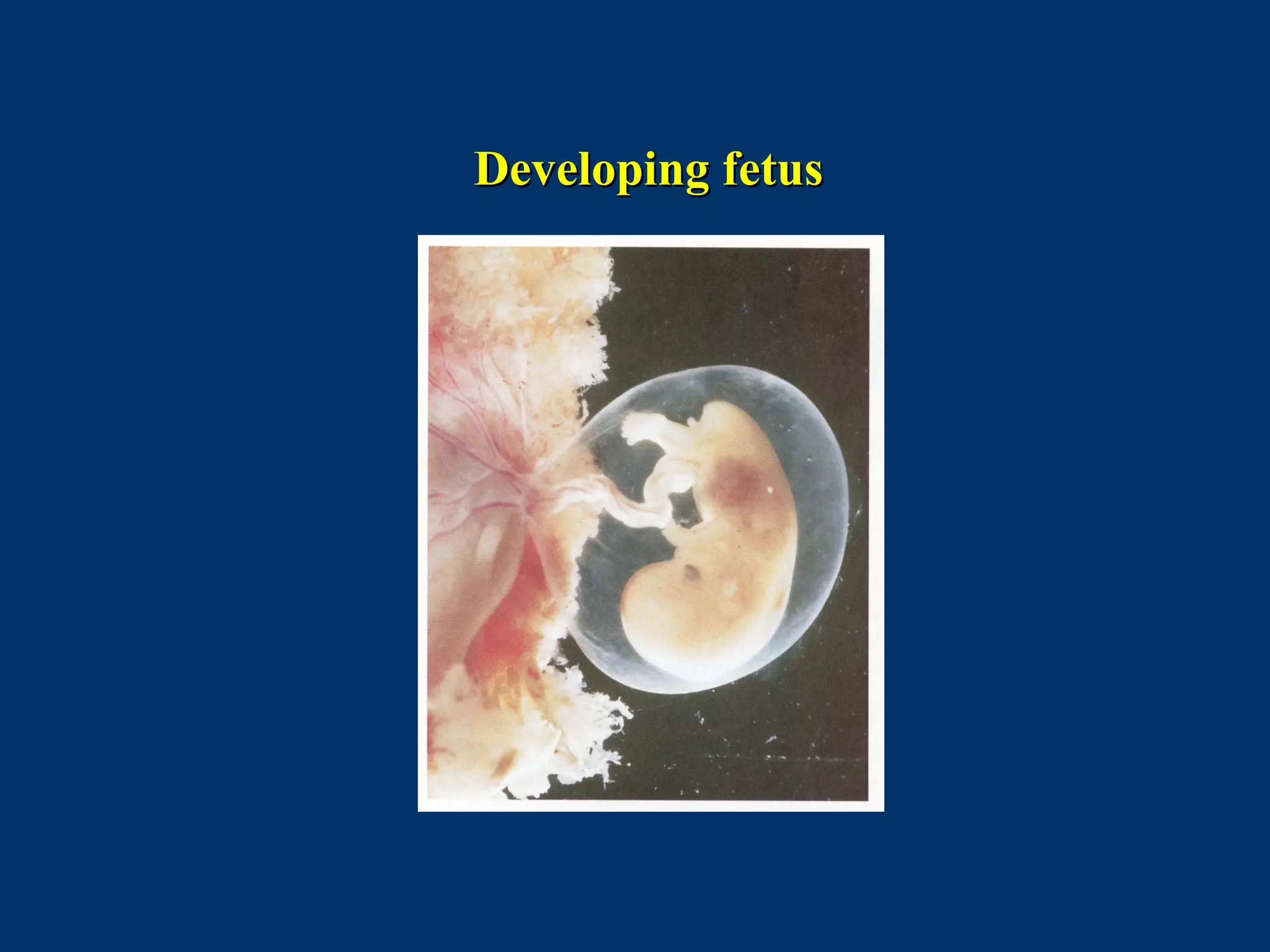
Developing fetusDeveloping fetus
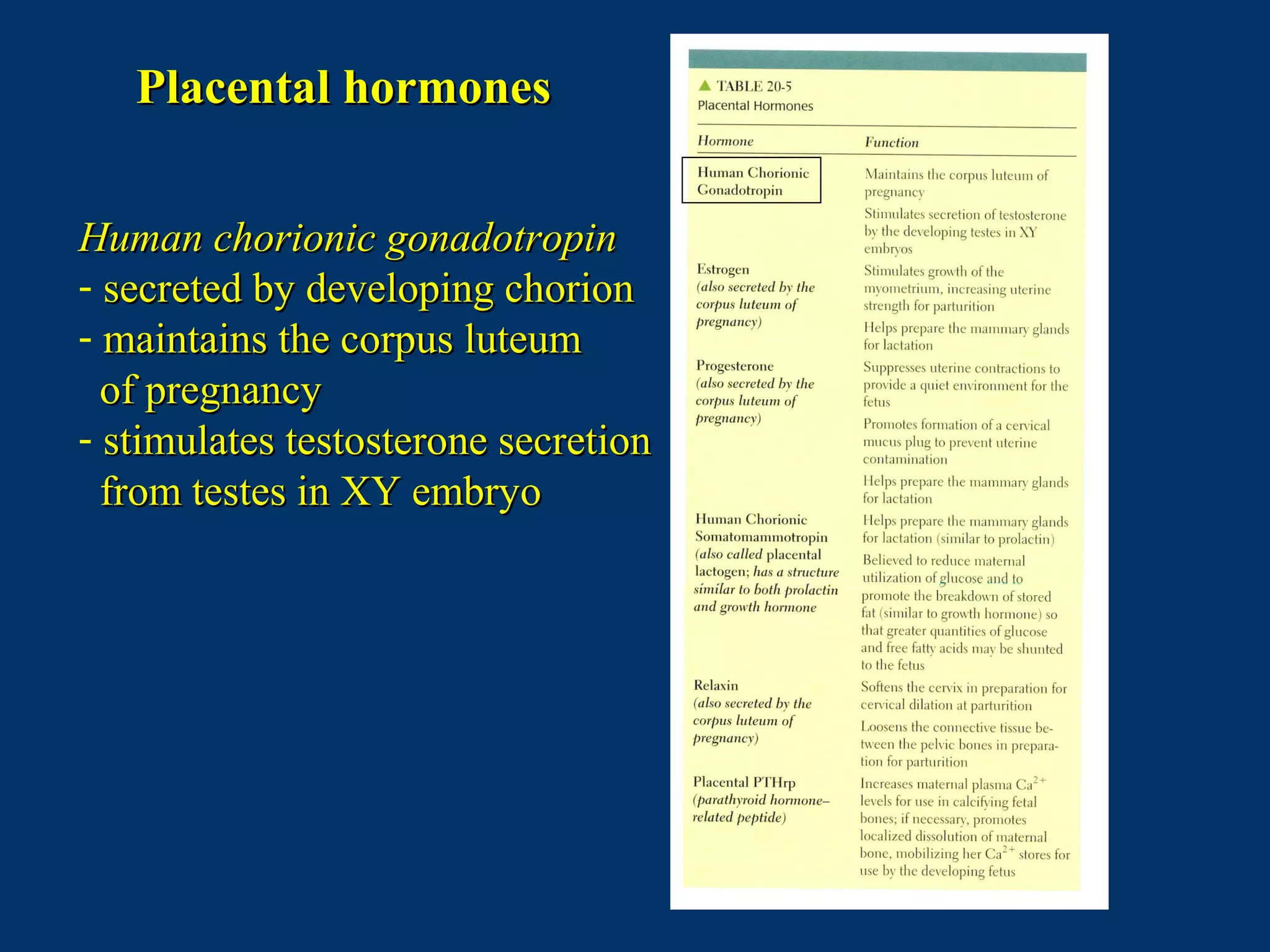
Placental hormonesPlacental hormones
Human chorionic gonadotropinHuman chorionic gonadotropin
- secreted by developing chorionsecreted by developing chorion
- maintains the corpus luteummaintains the corpus luteum
of pregnancyof pregnancy
- stimulates testosterone secretionstimulates testosterone secretion
from testes in XY embryofrom testes in XY embryo
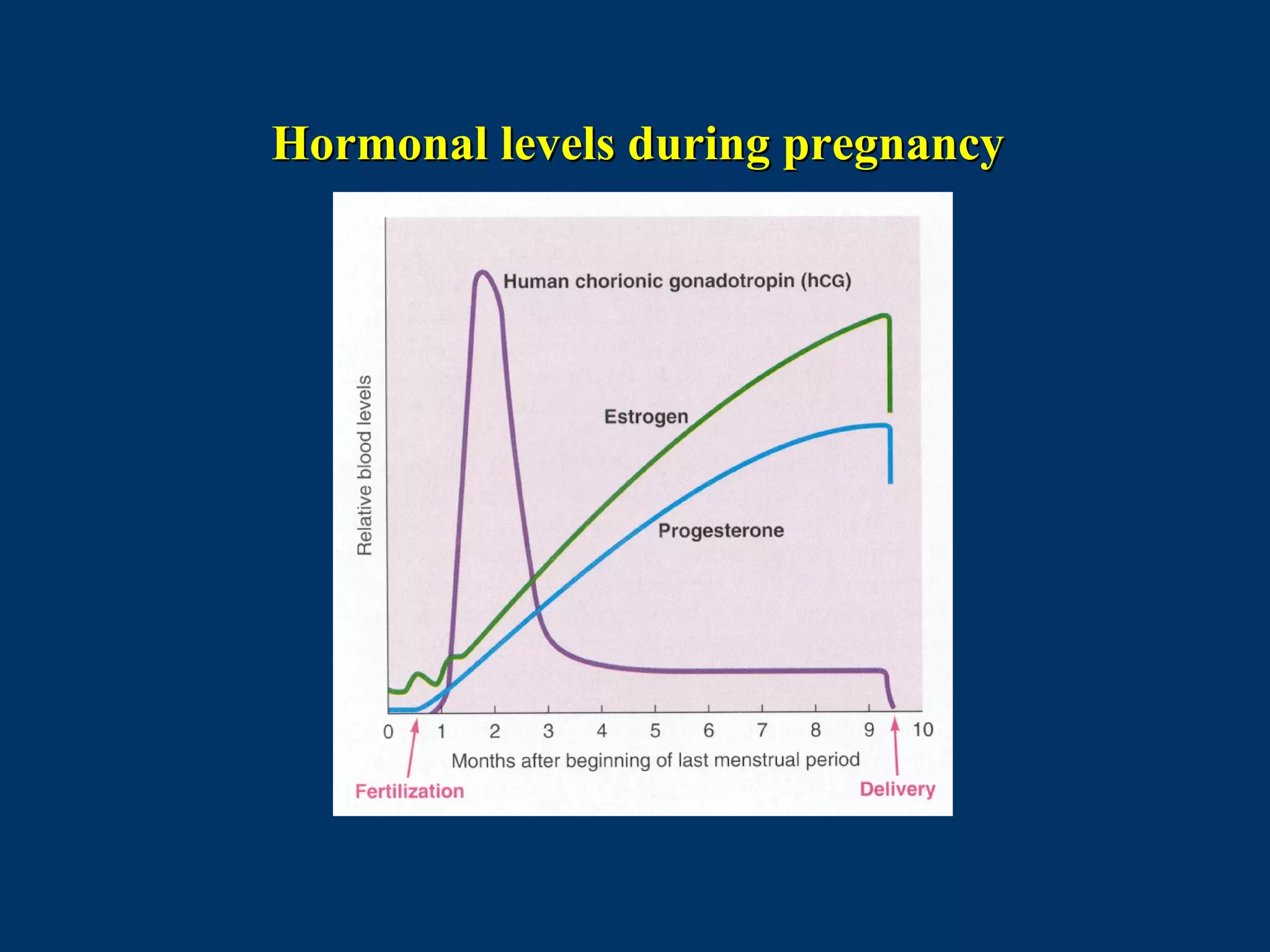
Hormonal levels during pregnancyHormonal levels during pregnancy
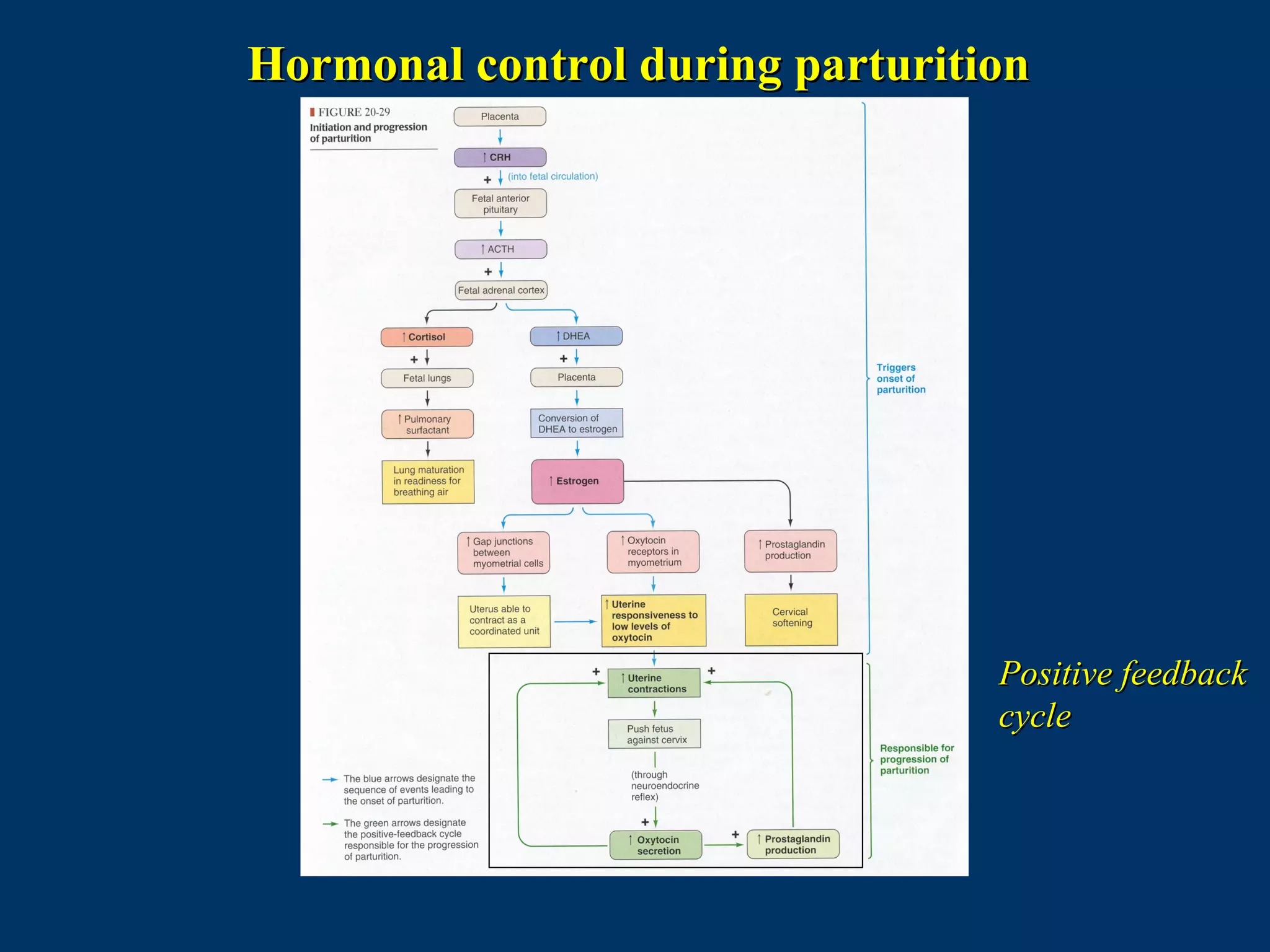
Hormonal control during parturitionHormonal control during parturition
Positive feedbackPositive feedback
cyclecycle
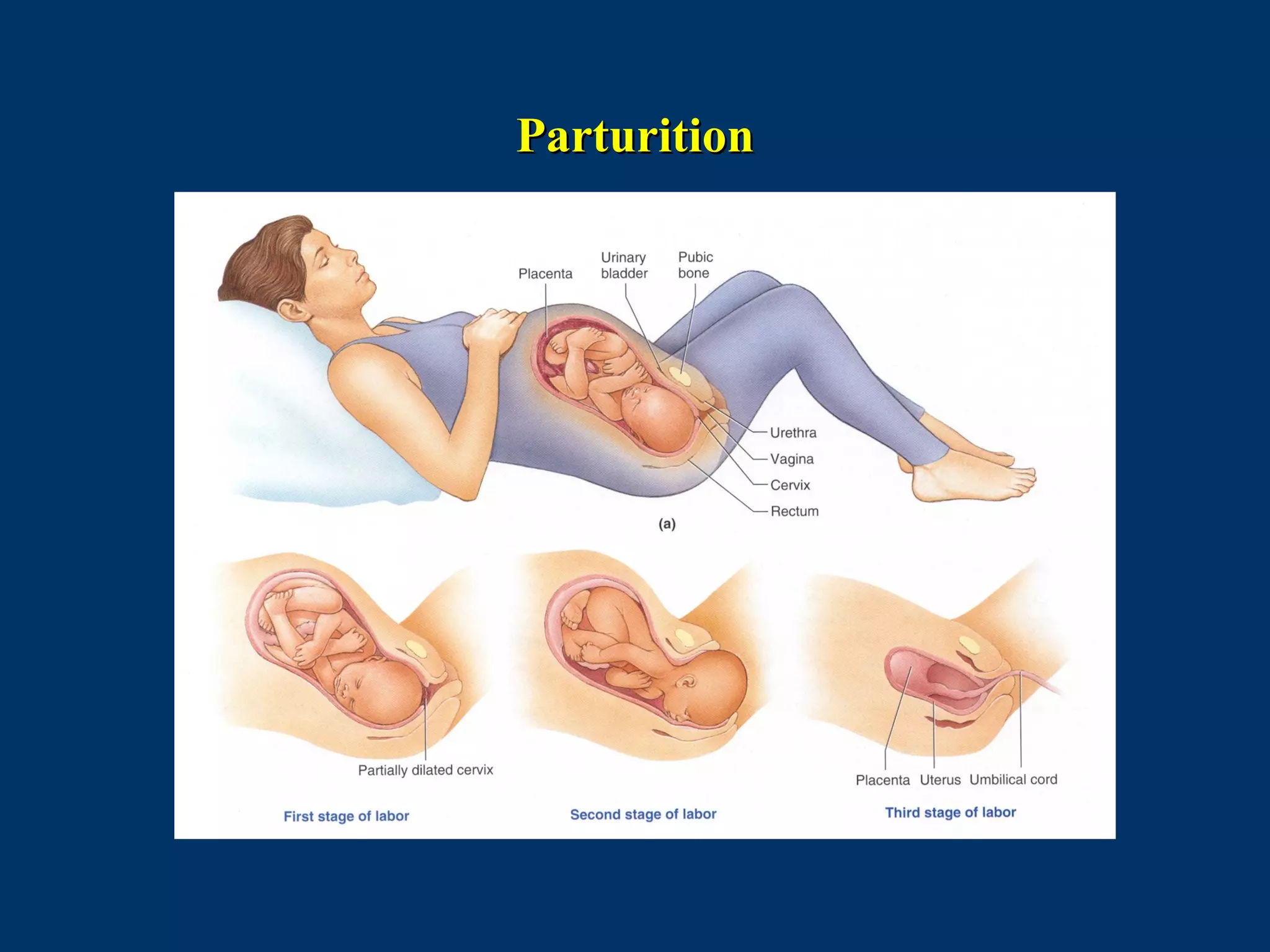
ParturitionParturition
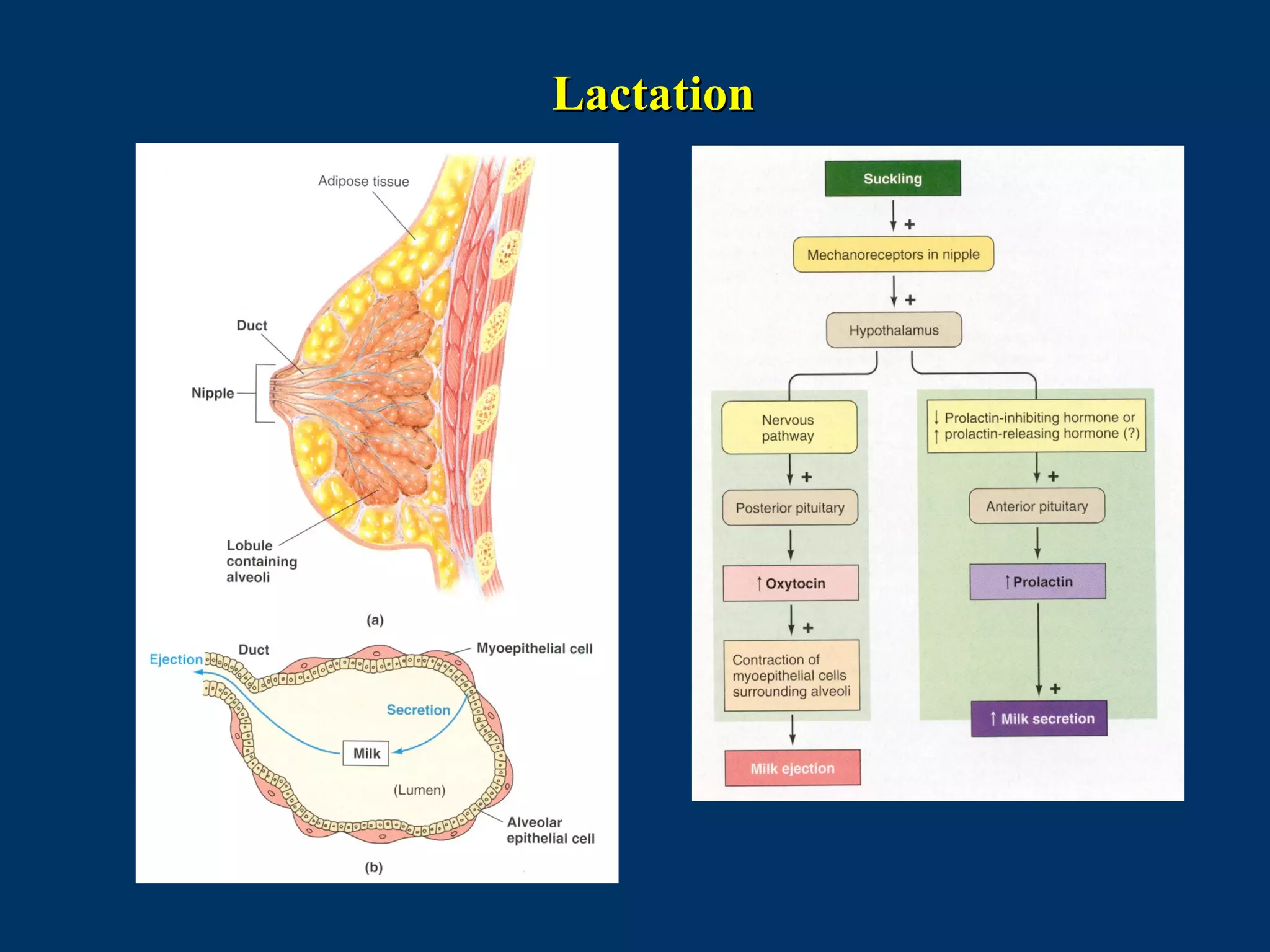
LactationLactation
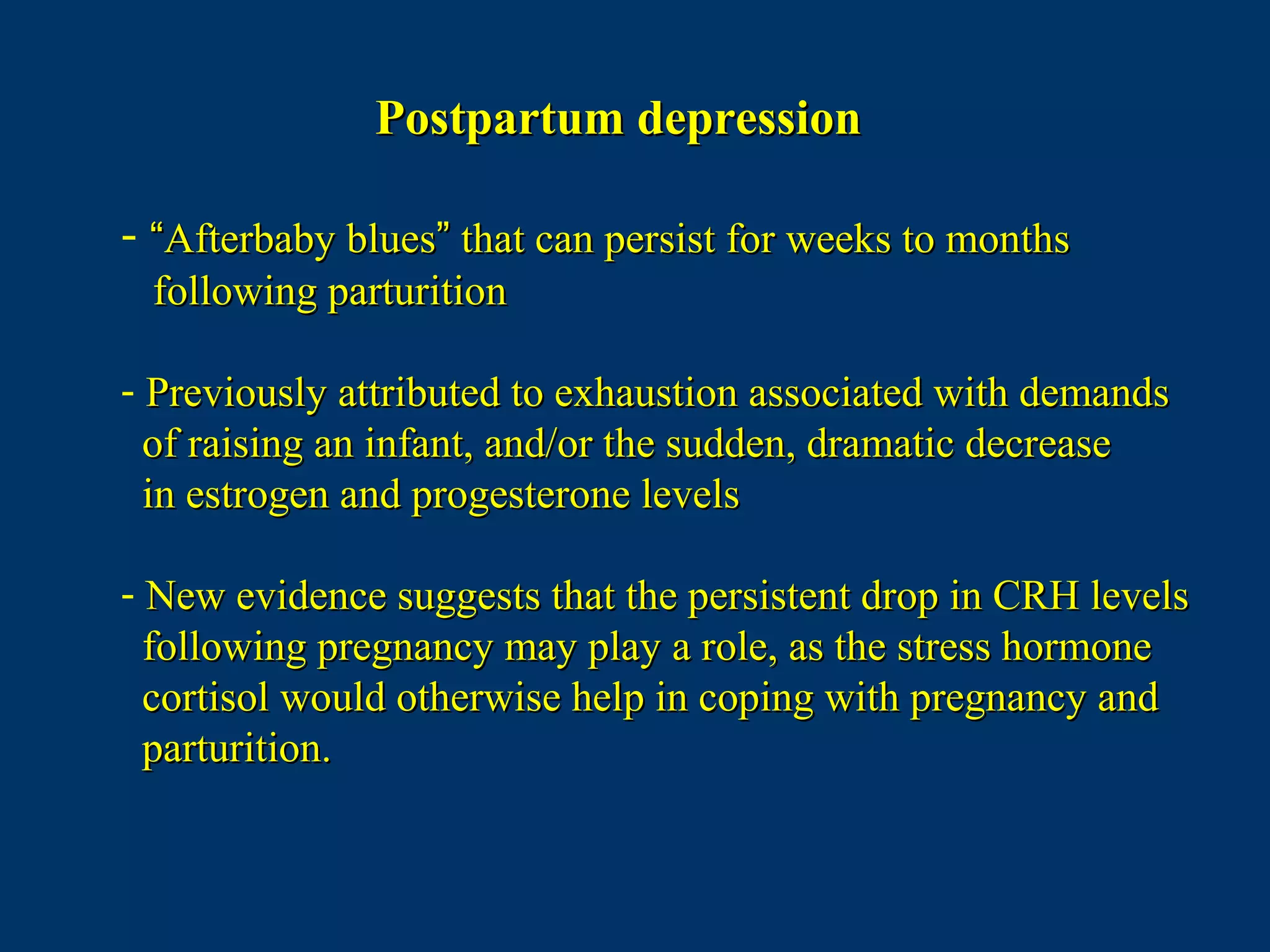
Postpartum depressionPostpartum depression
- ““Afterbaby bluesAfterbaby blues”” that can persist for weeks to monthsthat can persist for weeks to months
following parturitionfollowing parturition
- Previously attributed to exhaustion associated with demandsPreviously attributed to exhaustion associated with demands
of raising an infant, and/or the sudden, dramatic decreaseof raising an infant, and/or the sudden, dramatic decrease
in estrogen and progesterone levelsin estrogen and progesterone levels
- New evidence suggests that the persistent drop in CRH levelsNew evidence suggests that the persistent drop in CRH levels
following pregnancy may play a role, as the stress hormonefollowing pregnancy may play a role, as the stress hormone
cortisol would otherwise help in coping with pregnancy andcortisol would otherwise help in coping with pregnancy and
parturition.parturition.

Lectures42 45

  • 1.
    Reproductive PhysiologyReproductive Physiology Lecture42: Principles of Reproductive PhysiologyLecture 42: Principles of Reproductive Physiology Lecture 43: Male Reproductive SystemLecture 43: Male Reproductive System Lecture 44: Female Reproductive System - Ovarian CycleLecture 44: Female Reproductive System - Ovarian Cycle Lecture 45: Female Reproductive System - PregnancyLecture 45: Female Reproductive System - Pregnancy
  • 2.
    Lecture 42: Principlesof ReproductiveLecture 42: Principles of Reproductive PhysiologyPhysiology Reading: Ch 20, introduction
  • 3.
    Reproductive systemReproductive system -Does not contribute to homeostasisDoes not contribute to homeostasis - Is not essential for survival of the individualIs not essential for survival of the individual - Is essential for perpetuating the speciesIs essential for perpetuating the species - Influences individualInfluences individual’’s psychology and emotional makeups psychology and emotional makeup - Has profound social ramifications i.e. population densityHas profound social ramifications i.e. population density and resource managementand resource management Reproductive physiologyReproductive physiology – study of the interactions– study of the interactions among the reproductive organs, hypothalamus, anterioramong the reproductive organs, hypothalamus, anterior pituitary, and target cells of the sex hormones that collectivelypituitary, and target cells of the sex hormones that collectively lead to the production and union of male and female gametes,lead to the production and union of male and female gametes, and ultimately the production and nourishment of offspring.and ultimately the production and nourishment of offspring.
  • 4.
    Primary reproductive organs(gonads):Primary reproductive organs (gonads): testestestes in male;in male; ovariesovaries in femalein female 1)1) produce gametes: sperm in males, ova (eggs) in femalesproduce gametes: sperm in males, ova (eggs) in females 2)2) secrete sex hormones: testosterone in males, estrogensecrete sex hormones: testosterone in males, estrogen and progesterone in femalesand progesterone in females Secondary sexual characteristicsSecondary sexual characteristics External characteristics not directly involved withExternal characteristics not directly involved with reproductive physiologyreproductive physiology e.g. body configuration and hair distributione.g. body configuration and hair distribution
  • 5.
    Functions and anatomyof the male reproductive tractsFunctions and anatomy of the male reproductive tracts 1) Sperm and semen1) Sperm and semen productionproduction 2) Deposition in2) Deposition in femalefemale
  • 6.
    Functions and anatomyof the female reproductive tractsFunctions and anatomy of the female reproductive tracts 1) oogenesis1) oogenesis 2) reception of sperm2) reception of sperm 3) fertilization (conception)3) fertilization (conception) 4) gestation (pregnancy)4) gestation (pregnancy) 5) parturition (labor and delivery)5) parturition (labor and delivery) 6) lactation6) lactation
  • 7.
    Chromosomal distribution insexual reproductionChromosomal distribution in sexual reproduction
  • 8.
    Homologous recombination duringMeiosisHomologous recombination during Meiosis
  • 9.
    Sex differentiationSex differentiation GeneticsexGenetic sex Gonadal sexGonadal sex Phenotypic sexPhenotypic sex
  • 10.
    Sexual differentiation ofthe external genitaliaSexual differentiation of the external genitalia
  • 11.
    Effects of prenatalhormones on human brainEffects of prenatal hormones on human brain - Fetuses and newborns are exposed to high levels of sex hormones during the prenatal/perinatal sensitive period (gestational weeks 12-18, 34-41, postnatal ~2 months) and express high levels of hormone receptors in their brains. - Sources of testosterone: male gonad, adrenal gland (CAH, adrenogenital syndrome) - Sources of estrogens: conversion from testosterone via aromatase, female gonad, local synthesis within the brain, mom via placenta (mitigated by alpha-fetoprotein). - In the adult brain, sex differences are widespread and vary in magnitude and impact depending on the brain region. They include structural dimorphisms (e.g. preoptic area, hypothalamus) as well as differences in cognition, aggression and language organization. - The majority of sex differences in the brain are permanently established during a restricted developmental window by the actions of prenatal hormones on a bipotential substrate. Genetic or other biological co-factors likely play an important complementary role. - Current evidence strongly suggests that gender role, gender identity and sexual orientation are largely (if not entirely) determined via this mechanism.
  • 12.
    Discrepancies in sexdifferentiationDiscrepancies in sex differentiation - testes intestes in genetic malegenetic male fails to secrete hormones:fails to secrete hormones: anatomical femaleanatomical female (sterile)(sterile) - lack of enzyme for converting testosterone to DHT:lack of enzyme for converting testosterone to DHT: genetic and gonadal male with male repro tractgenetic and gonadal male with male repro tract and female external genitaliaand female external genitalia - excess DHEA inexcess DHEA in genetic female:genetic female: adrenogenital syndromeadrenogenital syndrome
  • 13.
    Lecture 43: MaleReproductive System /Lecture 43: Male Reproductive System / IntercourseIntercourse Reading: Ch 20, male reproductive physiology and sexual intercourse
  • 14.
    Testicular descentTesticular descent -occurs by 7- occurs by 7thth month of gestation, induced by testosteronemonth of gestation, induced by testosterone - failure can result in cryptorchidism (hidden testis)- failure can result in cryptorchidism (hidden testis) - inguinal hernia: incomplete closure of the abdominal wallinguinal hernia: incomplete closure of the abdominal wall following testicular descent, permits abdominal viscera tofollowing testicular descent, permits abdominal viscera to temporarily slip throughtemporarily slip through
  • 15.
    Testicular anatomyTesticular anatomy LeydigCellsLeydig Cells Secrete testosteroneSecrete testosterone Germ cells, spermGerm cells, sperm Sertoli CellsSertoli Cells Multiple functionsMultiple functions
  • 16.
  • 17.
    Testicular anatomyTesticular anatomy LeydigCellsLeydig Cells Secrete testosteroneSecrete testosterone Germ cells, spermGerm cells, sperm Sertoli CellsSertoli Cells Multiple functionsMultiple functions
  • 18.
  • 19.
  • 20.
    Testicular anatomyTesticular anatomy LeydigCellsLeydig Cells Secrete testosteroneSecrete testosterone Germ cells, spermGerm cells, sperm Sertoli CellsSertoli Cells Multiple functionsMultiple functions
  • 21.
    1)1) blood-testes barrierblood-testesbarrier 2)2) nourishmentnourishment 3)3) clear away extruded cytoplasm and destroy defectiveclear away extruded cytoplasm and destroy defective germ cell intermediatesgerm cell intermediates 4)4) secrete seminiferous tubule fluidsecrete seminiferous tubule fluid 5)5) androgen binding protein retains testosterone within theandrogen binding protein retains testosterone within the seminiferous tubules lumenseminiferous tubules lumen 6)6) site of action for control by testosterone and FSHsite of action for control by testosterone and FSH Sertoli CellsSertoli Cells
  • 22.
    Hormonal control ofspermatogenesisHormonal control of spermatogenesis
  • 23.
    Environmental estrogensEnvironmental estrogens -Synthetic, hormone-like pollutants that can disrupt- Synthetic, hormone-like pollutants that can disrupt endocrine functionendocrine function - May play a role in falling sperm counts, increasedMay play a role in falling sperm counts, increased rates of testicular and prostate cancer, increased ratesrates of testicular and prostate cancer, increased rates of cryptochidism and hypospadia, and a decline inof cryptochidism and hypospadia, and a decline in male/female birth ratiosmale/female birth ratios
  • 24.
    Components of malereproductive systemComponents of male reproductive system
  • 25.
  • 26.
  • 27.
  • 28.
    Male and femalesexual response cycleMale and female sexual response cycle 1) Excitement phase1) Excitement phase 2)2) Plateau phasePlateau phase 3)3) Orgasmic phaseOrgasmic phase 4) Resolution phase4) Resolution phase
  • 29.
    Lecture 44: FemaleReproductive System -Lecture 44: Female Reproductive System - Ovarian CycleOvarian Cycle Reading: Ch 20, female reproductive physiology
  • 30.
    OvariesOvaries 1) produce ova1)produce ova 2) secrete estrogen and progesterone2) secrete estrogen and progesterone
  • 31.
  • 32.
    Ovarian Cycle –cycle time ~ 28 daysOvarian Cycle – cycle time ~ 28 days Follicular phaseFollicular phase - Characterized by presence of maturing follicles,- Characterized by presence of maturing follicles, which secrete estrogen.which secrete estrogen. - Ovulation occurs at mid-cycle- Ovulation occurs at mid-cycle (between follicular and luteal phases).(between follicular and luteal phases). Luteal phaseLuteal phase - Characterized by presence of corpus luteum,- Characterized by presence of corpus luteum, which secretes progesterone and estrogen.which secretes progesterone and estrogen.
  • 33.
    Follicular development duringthe ovarian cycleFollicular development during the ovarian cycle
  • 34.
  • 35.
    Follicular development duringthe ovarian cycleFollicular development during the ovarian cycle
  • 36.
    Plasma concentration ofPlasmaconcentration of gonadotropic hormonesgonadotropic hormones Plasma concentration ofPlasma concentration of gonadal hormonesgonadal hormones Ovarian phasesOvarian phases Uterine changesUterine changes Uterine phasesUterine phases Ovarian changesOvarian changes
  • 37.
    Estrogen production byovarian follicleEstrogen production by ovarian follicle
  • 38.
    Plasma concentration ofPlasmaconcentration of gonadotropic hormonesgonadotropic hormones Plasma concentration ofPlasma concentration of gonadal hormonesgonadal hormones Ovarian phasesOvarian phases Uterine changesUterine changes Uterine phasesUterine phases Ovarian changesOvarian changes
  • 39.
    LH SurgeLH Surge 1)1)Halts estrogen synthesis by the follicular cells.Halts estrogen synthesis by the follicular cells. 2)2) Reinitiates meiosis in the follicle.Reinitiates meiosis in the follicle. 3)3) Triggers prostagladins, which cause ovulation.Triggers prostagladins, which cause ovulation. 4)4) Luteinizes the follicular remnant.Luteinizes the follicular remnant. Estrogen alone does not shut down tonic LH release.Estrogen alone does not shut down tonic LH release. Estrogen and progesterone together does shut down LH release.Estrogen and progesterone together does shut down LH release.
  • 40.
    Plasma concentration ofPlasmaconcentration of gonadotropic hormonesgonadotropic hormones Plasma concentration ofPlasma concentration of gonadal hormonesgonadal hormones Ovarian phasesOvarian phases Uterine changesUterine changes Uterine phasesUterine phases Ovarian changesOvarian changes
  • 41.
    luteal phaseluteal phaseovulationovulationfollicularphasefollicular phase Hormonal control during:Hormonal control during:
  • 42.
    PubertyPuberty Female reproductive systemis quiescent until puberty, at ~ 12 years of ageFemale reproductive system is quiescent until puberty, at ~ 12 years of age At this time, GnRH secretion by hypothalamus increasesAt this time, GnRH secretion by hypothalamus increases -> increased anterior pituitary gonadotropic hormones-> increased anterior pituitary gonadotropic hormones -> increased ovarian activity-> increased ovarian activity -> increased estrogen-> increased estrogen Effects of increased estrogenEffects of increased estrogen - growth and maturation of female reproductive tract- growth and maturation of female reproductive tract - development of secondary sexual characteristics- development of secondary sexual characteristics i .e. fat deposition in the breasts, buttocks and thighsi .e. fat deposition in the breasts, buttocks and thighs - closure of the epiphyseal plate- closure of the epiphyseal plate Pubertal effects not directly due to estrogenPubertal effects not directly due to estrogen - growth of axillary and pubic hair- growth of axillary and pubic hair - sex drive- sex drive - pubertal growth spurt- pubertal growth spurt
  • 43.
    MenopauseMenopause - Cessation ofmenstrual cycles – usually occurs at age 45-55- Cessation of menstrual cycles – usually occurs at age 45-55 - In part due to depletion of limited supply of ovarian follicles- In part due to depletion of limited supply of ovarian follicles - Midlife hypothalamic failure may also play a role- Midlife hypothalamic failure may also play a role - Preceded by a period of irregular cycles and diminished estrogen levels- Preceded by a period of irregular cycles and diminished estrogen levels Effects of diminished estrogen levels:Effects of diminished estrogen levels: - decrease in bone density, increase in osteoporosis- decrease in bone density, increase in osteoporosis - increase in coronary artery disease- increase in coronary artery disease - HDL/LDL ratio- HDL/LDL ratio - loss of antioxidant activity- loss of antioxidant activity - increased proliferation of smooth muscle cells- increased proliferation of smooth muscle cells following vessel wall damagefollowing vessel wall damage -- ““Hot flashesHot flashes”” due to unstable control of blood flowdue to unstable control of blood flow - possibly, depression and irritability- possibly, depression and irritability
  • 44.
    Lecture 45: FemaleReproductive System -Lecture 45: Female Reproductive System - PregnancyPregnancy Reading: Ch 20, female reproductive physiology
  • 45.
    Gamete transport tosite of fertilizationGamete transport to site of fertilization - cilia sweep egg towards uterus- cilia sweep egg towards uterus - estrogen promotes thinning of cervical mucus,estrogen promotes thinning of cervical mucus, myometrial and oviduct contractionsmyometrial and oviduct contractions
  • 46.
    Sperm trying toget inSperm trying to get in
  • 47.
  • 48.
    Post-fertilization developmentPost-fertilization development -3-4 days after ovulation, progesterone levels3-4 days after ovulation, progesterone levels promote relaxation of the oviduct constrictionpromote relaxation of the oviduct constriction - tubal pregnancy, ectopic preganacytubal pregnancy, ectopic preganacy
  • 49.
    Contraceptive techniquesContraceptive techniques Blockageof sperm transport to the eggBlockage of sperm transport to the egg - natural contraception (rhythm method)natural contraception (rhythm method) - coitus interruptuscoitus interruptus - chemical contraceptives- chemical contraceptives - barrier methods- barrier methods - sterilization- sterilization Prevention of ovulationPrevention of ovulation - oral contraceptives (birth control pills)oral contraceptives (birth control pills) - long-acting subcutaneous implantation- long-acting subcutaneous implantation Blockage of implantation (*occurs post-fertilization)Blockage of implantation (*occurs post-fertilization) - intrauterine device (IUD)- intrauterine device (IUD) - morning-after pills- morning-after pills
  • 50.
    Implantation of theblastocystImplantation of the blastocyst
  • 51.
  • 52.
  • 53.
    Placental hormonesPlacental hormones Humanchorionic gonadotropinHuman chorionic gonadotropin - secreted by developing chorionsecreted by developing chorion - maintains the corpus luteummaintains the corpus luteum of pregnancyof pregnancy - stimulates testosterone secretionstimulates testosterone secretion from testes in XY embryofrom testes in XY embryo
  • 54.
    Hormonal levels duringpregnancyHormonal levels during pregnancy
  • 55.
    Hormonal control duringparturitionHormonal control during parturition Positive feedbackPositive feedback cyclecycle
  • 56.
  • 57.
  • 58.
    Postpartum depressionPostpartum depression -““Afterbaby bluesAfterbaby blues”” that can persist for weeks to monthsthat can persist for weeks to months following parturitionfollowing parturition - Previously attributed to exhaustion associated with demandsPreviously attributed to exhaustion associated with demands of raising an infant, and/or the sudden, dramatic decreaseof raising an infant, and/or the sudden, dramatic decrease in estrogen and progesterone levelsin estrogen and progesterone levels - New evidence suggests that the persistent drop in CRH levelsNew evidence suggests that the persistent drop in CRH levels following pregnancy may play a role, as the stress hormonefollowing pregnancy may play a role, as the stress hormone cortisol would otherwise help in coping with pregnancy andcortisol would otherwise help in coping with pregnancy and parturition.parturition.