PRINCIPLES OF GENETICS IN
DERMATOLOGY
PRESENTER – DEEPASHREE R
MODERATOR – DR.SUPARNA M.Y
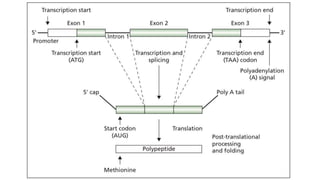
• Transmission of characters through generations is determined by genes
located on the chromosomes.
• Human beings – 46 chromosomes
• 22 pairs of autosomes
• 1 pair of sex chromosome
• Human genome contains
• 20,000 genes
• 3 x 10⁹ bases
• 1,00,000 gene products
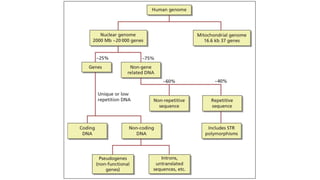
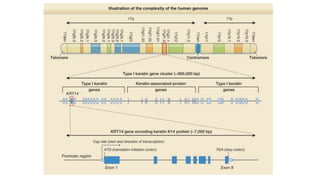
• Coding region occupies only 1.5% of total DNA.
• GENE – sequence of bases
• LOCUS – precise position of a gene on the genetic map
• ALLELE – alternative gene at a single locus
• HETEROZYGOUS – individual with 2 different alleles at a particular locus
• HOMOZYGOUS – where both alleles are identical
• HEMIZYGOUS – males with expression of X- linked characters (unpaired alleles)
• COPY NUMBER VARIATION – genome containing multiple copies of genes
• INTRAGENIC COPY NUMBER VARIATION – individual gene containing multiple copies
• FAMILIAL – refers to clustering of a disorder, with more close relatives
affected than predicted by the population prevalence of the condition
• INHERITED – requires the transmission of genetic variants from one
generation to the next.
• CONGENITAL - means that the character was present at or detected
before birth.
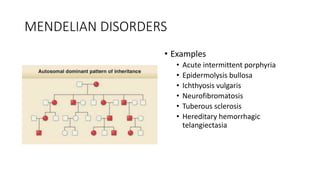
MENDELIAN DISORDERS
• Examples
• Acute intermittent porphyria
• Epidermolysis bullosa
• Ichthyosis vulgaris
• Neurofibromatosis
• Tuberous sclerosis
• Hereditary hemorrhagic
telangiectasia
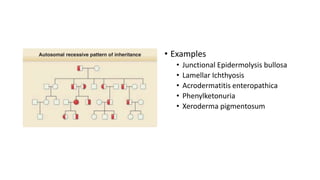
• Examples
• Junctional Epidermolysis bullosa
• Lamellar Ichthyosis
• Acrodermatitis enteropathica
• Phenylketonuria
• Xeroderma pigmentosum
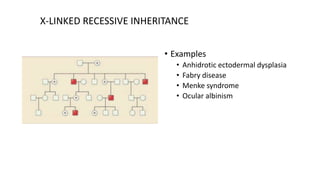
• Examples
• Anhidrotic ectodermal dysplasia
• Fabry disease
• Menke syndrome
• Ocular albinism
X-LINKED RECESSIVE INHERITANCE
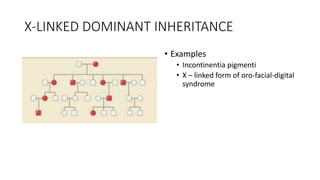
X-LINKED DOMINANT INHERITANCE
• Examples
• Incontinentia pigmenti
• X – linked form of oro-facial-digital
syndrome
Y-LINKED TRANSMISSION
• Also called as Holandric transmission
• Exclusively seen in males
• Father is always affected
• Eg – hairy pinna , azoospermia
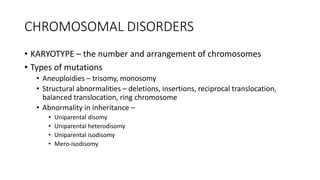
CHROMOSOMAL DISORDERS
• KARYOTYPE – the number and arrangement of chromosomes
• Types of mutations
• Aneuploidies – trisomy, monosomy
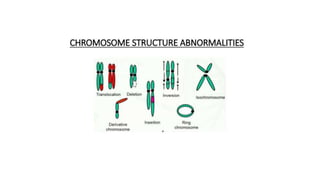
• Structural abnormalities – deletions, insertions, reciprocal translocation,
balanced translocation, ring chromosome
• Abnormality in inheritance –
• Uniparental disomy
• Uniparental heterodisomy
• Uniparental isodisomy
• Mero-isodisomy
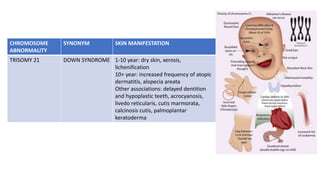
CHROMOSOME
ABNORMALITY
SYNONYM SKIN MANIFESTATION
TRISOMY 21 DOWN SYNDROME 1-10 year: dry skin, xerosis,
lichenification
10+ year: increased frequency of atopic
dermatitis, alopecia areata
Other associations: delayed dentition
and hypoplastic teeth, acrocyanosis,
livedo reticularis, cutis marmorata,
calcinosis cutis, palmoplantar
keratoderma
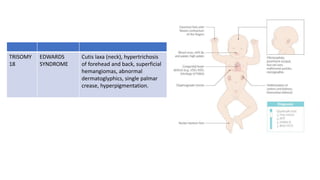
TRISOMY
18
EDWARDS
SYNDROME
Cutis laxa (neck), hypertrichosis
of forehead and back, superficial
hemangiomas, abnormal
dermatoglyphics, single palmar
crease, hyperpigmentation.
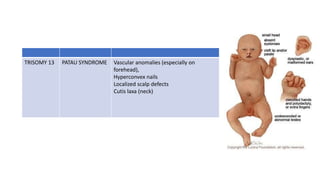
TRISOMY 13 PATAU SYNDROME Vascular anomalies (especially on
forehead),
Hyperconvex nails
Localized scalp defects
Cutis laxa (neck)
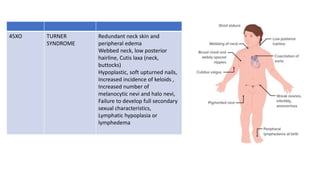
45XO TURNER
SYNDROME
Redundant neck skin and
peripheral edema
Webbed neck, low posterior
hairline, Cutis laxa (neck,
buttocks)
Hypoplastic, soft upturned nails,
Increased incidence of keloids ,
Increased number of
melanocytic nevi and halo nevi,
Failure to develop full secondary
sexual characteristics,
Lymphatic hypoplasia or
lymphedema
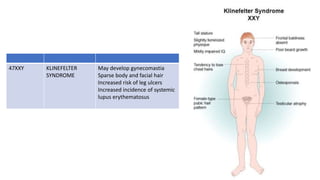
47XXY KLINEFELTER
SYNDROME
May develop gynecomastia
Sparse body and facial hair
Increased risk of leg ulcers
Increased incidence of systemic
lupus erythematosus
MITOCHONDRIAL DISORDERS
• Mitochondrial DNA mostly encodes for enzymes involved in respiratory chain and
oxidative phosphorylation.
• Mitochondrial disorders are predominantly muscular, neurological and
ophthalmological.
• Transmission is exclusively from the mother
• Examples –
• Palmoplantar keratoderma with sensorineural deafness
• Pigmentary abnormalities and hair anomalies
• HETEROPLASMY – the phenomenon of having mixed mitochondrial DNA species
within a cell.
• EXPRESSION – degree to which the effects of a mutant allele are variable
• PENETRANCE – frequency with which a gene produces any effect at all
• CLINICAL HETEROGENEITY – clinically distinct phenotype produced by
different mutations in the same gene.
• GENETIC HETEROGENEITY – situation in which the same disease phenotype
occurs due to different underlying genes
• NON-ALLELIC HETEROGENEITY – mutations in genes at different
chromosomal loci cause the same phenotype
• ALLELIC HETEROGENEITY – results from mutation at different alleles of one
locus and determines the clinical severity in a disease spectrum
• GENOMIC IMPRINTING –
• A phenomenon whereby a DNA sequence derived from one parent acts in a
different way compared with that derived from the other parent.
• Molecular basis of imprinting – methylation ( process whereby a methyl group
is added to DNA nucleotides)
• Methylation is usually associated with reduced levels of expression of a gene.
POLYMORPHISMS
• They are alterations in the DNA sequence that are present in
unrelated individuals that usually do not cause disease although they
may modify disease expression or contribute to some phenotypic
manifestations.
• Polymorphisms occur in both coding and non-coding DNA.
• Polymorphisms in coding DNA can lead to an amino acid change.
EPIGENETIC PHENOMENON
• Epigenetic effects involve chemical modifications to DNA that do not alter
the DNA sequence but do alter the probability of gene transcription.
• Example – DNA methylation
• DNA hypermethylation contributes to gene silencing by preventing the
binding of activating transcription factors and by attracting repressor
complexes that induce the formation of inactive chromatin structures.
• DNA methylation machinery –
• DNA methyltransferases
• Methyl- CpG-binding proteins
• The analysis of any changes in these processes is known as Epigenomics.
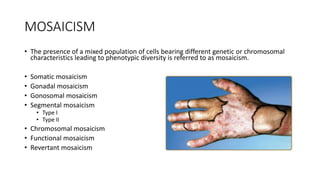
MOSAICISM
• The presence of a mixed population of cells bearing different genetic or chromosomal
characteristics leading to phenotypic diversity is referred to as mosaicism.
• Somatic mosaicism
• Gonadal mosaicism
• Gonosomal mosaicism
• Segmental mosaicism
• Type I
• Type II
• Chromosomal mosaicism
• Functional mosaicism
• Revertant mosaicism
HLA ASSOCIATION
• HLAs are glycoproteins on the cell surface of most nucleated human cells.
• They allow an individual’s immune system to recognize if a given cell is its
own.
• Located on short arm of chromosome 6 – MHC
• 5 genetic loci – A,B,C,D,DR
• Gene products – HLA-A, HLA-B, HLA-C, HLA-D, HLA-DR
• Mechanism of pathogenesis -
• Molecular mimicry
• Receptor effects
• Genetic linkage
• Molecular mimicry –
• An infective agent may have a similar configuration to HLA, so that the agent is then
not attacked by the body’s defense system and vice-versa.
• Receptor effects –
• Many chemicals including drugs and toxins bind to the cell surface before they are
taken into the cytoplasm. HLAs present on the cell surface modify the binding of
these potentially toxic substances.
• Genetic linkage –
• HLA may be close to another gene on the same chromosome that produces a
disease, which may be abnormally enhanced leading to autoimmunity or abnormally
decreased leading to infection.
GENETIC COUNSELLING
• “the process of helping people understand and adapt to the medical,
psychological and familial implications of genetic contributions to
disease”
• Includes –
• An interpretation of family and medical histories to assess the change of
disease occurrence or recurrence
• Education about inheritance, testing, management, prevention, resources and
research
• Counselling to promote informed choice and adaptation to the risk or
condition
• Information exchange on the implications or limitations of personal genetic
data
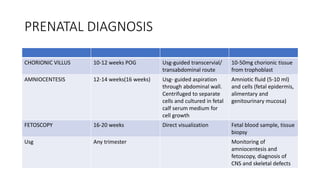
PRENATAL DIAGNOSIS
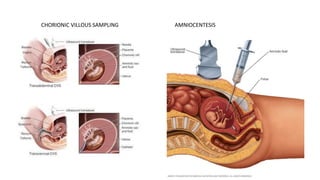
CHORIONIC VILLUS 10-12 weeks POG Usg-guided transcervial/
transabdominal route
10-50mg chorionic tissue
from trophoblast
AMNIOCENTESIS 12-14 weeks(16 weeks) Usg- guided aspiration
through abdominal wall.
Centrifuged to separate
cells and cultured in fetal
calf serum medium for
cell growth
Amniotic fluid (5-10 ml)
and cells (fetal epidermis,
alimentary and
genitourinary mucosa)
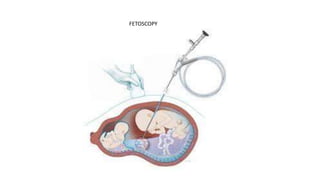
FETOSCOPY 16-20 weeks Direct visualization Fetal blood sample, tissue
biopsy
Usg Any trimester Monitoring of
amniocentesis and
fetoscopy, diagnosis of
CNS and skeletal defects
CHORIONIC VILLOUS SAMPLING AMNIOCENTESIS
FETOSCOPY
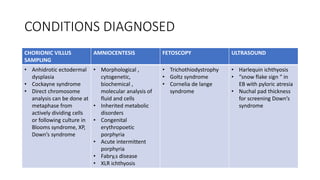
CONDITIONS DIAGNOSED
CHORIONIC VILLUS
SAMPLING
AMNIOCENTESIS FETOSCOPY ULTRASOUND
• Anhidrotic ectodermal
dysplasia
• Cockayne syndrome
• Direct chromosome
analysis can be done at
metaphase from
actively dividing cells
or following culture in
Blooms syndrome, XP,
Down’s syndrome
• Morphological ,
cytogenetic,
biochemical ,
molecular analysis of
fluid and cells
• Inherited metabolic
disorders
• Congenital
erythropoetic
porphyria
• Acute intermittent
porphyria
• Fabry,s disease
• XLR ichthyosis
• Trichothiodystrophy
• Goltz syndrome
• Cornelia de lange
syndrome
• Harlequin ichthyosis
• “snow flake sign “ in
EB with pyloric atresia
• Nuchal pad thickness
for screening Down’s
syndrome
OTHER APPROACHES
• PRE-IMPLANTATION GENETIC DIAGNOSIS –
• Herlitz junctional EB
• ANALYSIS OF FREE FETAL DNA – in maternal circulation
• DNA is detectable from 6 weeks gestation and is rapidly cleared from the
circulation after delivery
GENE THERAPY
• Types –
• Treatment of recessive genetic diseases where homozygous or compound
heterozygous loss-of-function mutations lead to complete absence or complete
functional ablation of a vital protein.
• Treatment of dominant- negative genetic disorders known as gene inhibition therapy
• Two approaches –
• In-vivo
• Ex-vivo
• Vectors – viral
• Retrovirus
• Adeno virus
• Lentivirus
THANK YOU

GENETIC IN DERMATOLOGY.pptx

  • 1.
    PRINCIPLES OF GENETICSIN DERMATOLOGY PRESENTER – DEEPASHREE R MODERATOR – DR.SUPARNA M.Y
  • 2.
    • Transmission ofcharacters through generations is determined by genes located on the chromosomes. • Human beings – 46 chromosomes • 22 pairs of autosomes • 1 pair of sex chromosome • Human genome contains • 20,000 genes • 3 x 10⁹ bases • 1,00,000 gene products • Coding region occupies only 1.5% of total DNA.
  • 6.
    • GENE –sequence of bases • LOCUS – precise position of a gene on the genetic map • ALLELE – alternative gene at a single locus • HETEROZYGOUS – individual with 2 different alleles at a particular locus • HOMOZYGOUS – where both alleles are identical • HEMIZYGOUS – males with expression of X- linked characters (unpaired alleles) • COPY NUMBER VARIATION – genome containing multiple copies of genes • INTRAGENIC COPY NUMBER VARIATION – individual gene containing multiple copies
  • 7.
    • FAMILIAL –refers to clustering of a disorder, with more close relatives affected than predicted by the population prevalence of the condition • INHERITED – requires the transmission of genetic variants from one generation to the next. • CONGENITAL - means that the character was present at or detected before birth.
  • 8.
    MENDELIAN DISORDERS • Examples •Acute intermittent porphyria • Epidermolysis bullosa • Ichthyosis vulgaris • Neurofibromatosis • Tuberous sclerosis • Hereditary hemorrhagic telangiectasia
  • 9.
    • Examples • JunctionalEpidermolysis bullosa • Lamellar Ichthyosis • Acrodermatitis enteropathica • Phenylketonuria • Xeroderma pigmentosum
  • 10.
    • Examples • Anhidroticectodermal dysplasia • Fabry disease • Menke syndrome • Ocular albinism X-LINKED RECESSIVE INHERITANCE
  • 11.
    X-LINKED DOMINANT INHERITANCE •Examples • Incontinentia pigmenti • X – linked form of oro-facial-digital syndrome
  • 12.
    Y-LINKED TRANSMISSION • Alsocalled as Holandric transmission • Exclusively seen in males • Father is always affected • Eg – hairy pinna , azoospermia
  • 13.
    CHROMOSOMAL DISORDERS • KARYOTYPE– the number and arrangement of chromosomes • Types of mutations • Aneuploidies – trisomy, monosomy • Structural abnormalities – deletions, insertions, reciprocal translocation, balanced translocation, ring chromosome • Abnormality in inheritance – • Uniparental disomy • Uniparental heterodisomy • Uniparental isodisomy • Mero-isodisomy
  • 15.
    CHROMOSOME ABNORMALITY SYNONYM SKIN MANIFESTATION TRISOMY21 DOWN SYNDROME 1-10 year: dry skin, xerosis, lichenification 10+ year: increased frequency of atopic dermatitis, alopecia areata Other associations: delayed dentition and hypoplastic teeth, acrocyanosis, livedo reticularis, cutis marmorata, calcinosis cutis, palmoplantar keratoderma
  • 16.
    TRISOMY 18 EDWARDS SYNDROME Cutis laxa (neck),hypertrichosis of forehead and back, superficial hemangiomas, abnormal dermatoglyphics, single palmar crease, hyperpigmentation.
  • 17.
    TRISOMY 13 PATAUSYNDROME Vascular anomalies (especially on forehead), Hyperconvex nails Localized scalp defects Cutis laxa (neck)
  • 18.
    45XO TURNER SYNDROME Redundant neckskin and peripheral edema Webbed neck, low posterior hairline, Cutis laxa (neck, buttocks) Hypoplastic, soft upturned nails, Increased incidence of keloids , Increased number of melanocytic nevi and halo nevi, Failure to develop full secondary sexual characteristics, Lymphatic hypoplasia or lymphedema
  • 19.
    47XXY KLINEFELTER SYNDROME May developgynecomastia Sparse body and facial hair Increased risk of leg ulcers Increased incidence of systemic lupus erythematosus
  • 20.
    MITOCHONDRIAL DISORDERS • MitochondrialDNA mostly encodes for enzymes involved in respiratory chain and oxidative phosphorylation. • Mitochondrial disorders are predominantly muscular, neurological and ophthalmological. • Transmission is exclusively from the mother • Examples – • Palmoplantar keratoderma with sensorineural deafness • Pigmentary abnormalities and hair anomalies • HETEROPLASMY – the phenomenon of having mixed mitochondrial DNA species within a cell.
  • 21.
    • EXPRESSION –degree to which the effects of a mutant allele are variable • PENETRANCE – frequency with which a gene produces any effect at all • CLINICAL HETEROGENEITY – clinically distinct phenotype produced by different mutations in the same gene. • GENETIC HETEROGENEITY – situation in which the same disease phenotype occurs due to different underlying genes • NON-ALLELIC HETEROGENEITY – mutations in genes at different chromosomal loci cause the same phenotype • ALLELIC HETEROGENEITY – results from mutation at different alleles of one locus and determines the clinical severity in a disease spectrum
  • 22.
    • GENOMIC IMPRINTING– • A phenomenon whereby a DNA sequence derived from one parent acts in a different way compared with that derived from the other parent. • Molecular basis of imprinting – methylation ( process whereby a methyl group is added to DNA nucleotides) • Methylation is usually associated with reduced levels of expression of a gene.
  • 23.
    POLYMORPHISMS • They arealterations in the DNA sequence that are present in unrelated individuals that usually do not cause disease although they may modify disease expression or contribute to some phenotypic manifestations. • Polymorphisms occur in both coding and non-coding DNA. • Polymorphisms in coding DNA can lead to an amino acid change.
  • 24.
    EPIGENETIC PHENOMENON • Epigeneticeffects involve chemical modifications to DNA that do not alter the DNA sequence but do alter the probability of gene transcription. • Example – DNA methylation • DNA hypermethylation contributes to gene silencing by preventing the binding of activating transcription factors and by attracting repressor complexes that induce the formation of inactive chromatin structures. • DNA methylation machinery – • DNA methyltransferases • Methyl- CpG-binding proteins • The analysis of any changes in these processes is known as Epigenomics.
  • 25.
    MOSAICISM • The presenceof a mixed population of cells bearing different genetic or chromosomal characteristics leading to phenotypic diversity is referred to as mosaicism. • Somatic mosaicism • Gonadal mosaicism • Gonosomal mosaicism • Segmental mosaicism • Type I • Type II • Chromosomal mosaicism • Functional mosaicism • Revertant mosaicism
  • 26.
    HLA ASSOCIATION • HLAsare glycoproteins on the cell surface of most nucleated human cells. • They allow an individual’s immune system to recognize if a given cell is its own. • Located on short arm of chromosome 6 – MHC • 5 genetic loci – A,B,C,D,DR • Gene products – HLA-A, HLA-B, HLA-C, HLA-D, HLA-DR • Mechanism of pathogenesis - • Molecular mimicry • Receptor effects • Genetic linkage
  • 27.
    • Molecular mimicry– • An infective agent may have a similar configuration to HLA, so that the agent is then not attacked by the body’s defense system and vice-versa. • Receptor effects – • Many chemicals including drugs and toxins bind to the cell surface before they are taken into the cytoplasm. HLAs present on the cell surface modify the binding of these potentially toxic substances. • Genetic linkage – • HLA may be close to another gene on the same chromosome that produces a disease, which may be abnormally enhanced leading to autoimmunity or abnormally decreased leading to infection.
  • 28.
    GENETIC COUNSELLING • “theprocess of helping people understand and adapt to the medical, psychological and familial implications of genetic contributions to disease” • Includes – • An interpretation of family and medical histories to assess the change of disease occurrence or recurrence • Education about inheritance, testing, management, prevention, resources and research • Counselling to promote informed choice and adaptation to the risk or condition • Information exchange on the implications or limitations of personal genetic data
  • 29.
    PRENATAL DIAGNOSIS CHORIONIC VILLUS10-12 weeks POG Usg-guided transcervial/ transabdominal route 10-50mg chorionic tissue from trophoblast AMNIOCENTESIS 12-14 weeks(16 weeks) Usg- guided aspiration through abdominal wall. Centrifuged to separate cells and cultured in fetal calf serum medium for cell growth Amniotic fluid (5-10 ml) and cells (fetal epidermis, alimentary and genitourinary mucosa) FETOSCOPY 16-20 weeks Direct visualization Fetal blood sample, tissue biopsy Usg Any trimester Monitoring of amniocentesis and fetoscopy, diagnosis of CNS and skeletal defects
  • 30.
  • 31.
  • 32.
    CONDITIONS DIAGNOSED CHORIONIC VILLUS SAMPLING AMNIOCENTESISFETOSCOPY ULTRASOUND • Anhidrotic ectodermal dysplasia • Cockayne syndrome • Direct chromosome analysis can be done at metaphase from actively dividing cells or following culture in Blooms syndrome, XP, Down’s syndrome • Morphological , cytogenetic, biochemical , molecular analysis of fluid and cells • Inherited metabolic disorders • Congenital erythropoetic porphyria • Acute intermittent porphyria • Fabry,s disease • XLR ichthyosis • Trichothiodystrophy • Goltz syndrome • Cornelia de lange syndrome • Harlequin ichthyosis • “snow flake sign “ in EB with pyloric atresia • Nuchal pad thickness for screening Down’s syndrome
  • 33.
    OTHER APPROACHES • PRE-IMPLANTATIONGENETIC DIAGNOSIS – • Herlitz junctional EB • ANALYSIS OF FREE FETAL DNA – in maternal circulation • DNA is detectable from 6 weeks gestation and is rapidly cleared from the circulation after delivery
  • 34.
    GENE THERAPY • Types– • Treatment of recessive genetic diseases where homozygous or compound heterozygous loss-of-function mutations lead to complete absence or complete functional ablation of a vital protein. • Treatment of dominant- negative genetic disorders known as gene inhibition therapy • Two approaches – • In-vivo • Ex-vivo • Vectors – viral • Retrovirus • Adeno virus • Lentivirus
  • 35.