
Seminar on
 INTRODUCTION
 DEFINITION
 ORIGIN
 FORMATION
Seismic faulting
Landslides
Impact structure
 OCCURRENCE
 REFERENCE
 CONCLUSION
 The word pseudotachylite was coined early
in the 1900s .
 “PSEUDOTACHYLITE” is the name given by
Shand(1916).
 Local rock melting by friction on fractures,
and the formation of pseudotachylite.
 They are commonly dark colored glass and
enclose numerous mineral and rock
fragments.
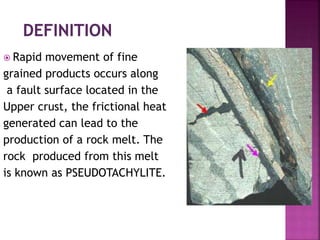
 Rapid movement of fine
grained products occurs along
a fault surface located in the
Upper crust, the frictional heat
generated can lead to the
production of a rock melt. The
rock produced from this melt
is known as PSEUDOTACHYLITE.
 Pseudotachylite is restricted to quartz-
bearing rocks.
 Relative to country rocks, pseudotachylite is
lower in soda and lime and higher in potash
and silica.
 The gas phase is mostly water and carbon
dioxide, but contains some iron and possibly
silica.
 Fault related pseudotachylites are generated
as the result of brittle – ductile deformation
related to seismic faulting.
SEISMIC FAULTING
 It is generally found either along fault surfaces,
often as the matrix to a breccia or as veins injected
into the walls of the fault.
 In most cases there is good evidence, that the
Pseudotachytalite formed by frictional melting of
the wall rock during rapid fault movement associated
with a seismic event.
 Pseudotachylite has been found at the base of large
landslides involving the movement of large coherent
blocks .
 For example the one that moved Heart Mountain in
the U.S. state of wyoming to its present location, the
largest known landslide in history on land.
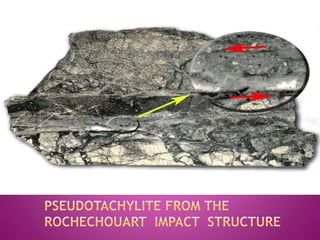
 Pseudotachylites is also associated with impact structure.
In an impact event, the melting forms part of the shock
metamorphic effects .
 The Pseudotachylite veins associated with impacts are
much larger than those associated with faults and are
though to have formed by frictional effects within the
crater floor and below the crater.
 The most expansive example of impact related
pseuotachlite is Vredefort crater, South Africa and the
Sudbury basin Canada.
 Pseudotachylite is widespred in the
precambrian granite core of the Vredefort
ring.
 The pseudotachylite occurs as thin, widely
spaced veins separating slightly rotated
blocks of country rock.
 In Deccan Traps, occurrence of a thick quartz
layer below the lowermost lava flow strongly
imply the Deccan Volcanism.
 Local rock melting by friction on fractures , and
the formation of pseudotachylite.
 Cataclastic deformation and frictional melting
during seismic faulting have played the most
important role in the formation of pseudotachylite.
 The thickness of the pseudotachylite zone gives
geologist a general idea of the magnitude of the
associated displacement and the general magnitude
of the paleoseismic event.
 THON G.RAMSAY AND MARTINI.HUBER, The
techniques of modern structural geology,
Volume2 folds and fractures.
 www.google.com
 www.wikipedia.com
Thank u

Pseudotachylite

  • 1.
  • 2.
     INTRODUCTION  DEFINITION ORIGIN  FORMATION Seismic faulting Landslides Impact structure  OCCURRENCE  REFERENCE  CONCLUSION
  • 3.
     The wordpseudotachylite was coined early in the 1900s .  “PSEUDOTACHYLITE” is the name given by Shand(1916).  Local rock melting by friction on fractures, and the formation of pseudotachylite.  They are commonly dark colored glass and enclose numerous mineral and rock fragments.
  • 4.
     Rapid movementof fine grained products occurs along a fault surface located in the Upper crust, the frictional heat generated can lead to the production of a rock melt. The rock produced from this melt is known as PSEUDOTACHYLITE.
  • 5.
     Pseudotachylite isrestricted to quartz- bearing rocks.  Relative to country rocks, pseudotachylite is lower in soda and lime and higher in potash and silica.  The gas phase is mostly water and carbon dioxide, but contains some iron and possibly silica.  Fault related pseudotachylites are generated as the result of brittle – ductile deformation related to seismic faulting.
  • 6.
    SEISMIC FAULTING  Itis generally found either along fault surfaces, often as the matrix to a breccia or as veins injected into the walls of the fault.  In most cases there is good evidence, that the Pseudotachytalite formed by frictional melting of the wall rock during rapid fault movement associated with a seismic event.
  • 7.
     Pseudotachylite hasbeen found at the base of large landslides involving the movement of large coherent blocks .  For example the one that moved Heart Mountain in the U.S. state of wyoming to its present location, the largest known landslide in history on land.
  • 8.
     Pseudotachylites isalso associated with impact structure. In an impact event, the melting forms part of the shock metamorphic effects .  The Pseudotachylite veins associated with impacts are much larger than those associated with faults and are though to have formed by frictional effects within the crater floor and below the crater.  The most expansive example of impact related pseuotachlite is Vredefort crater, South Africa and the Sudbury basin Canada.
  • 10.
     Pseudotachylite iswidespred in the precambrian granite core of the Vredefort ring.  The pseudotachylite occurs as thin, widely spaced veins separating slightly rotated blocks of country rock.  In Deccan Traps, occurrence of a thick quartz layer below the lowermost lava flow strongly imply the Deccan Volcanism.
  • 11.
     Local rockmelting by friction on fractures , and the formation of pseudotachylite.  Cataclastic deformation and frictional melting during seismic faulting have played the most important role in the formation of pseudotachylite.  The thickness of the pseudotachylite zone gives geologist a general idea of the magnitude of the associated displacement and the general magnitude of the paleoseismic event.
  • 12.
     THON G.RAMSAYAND MARTINI.HUBER, The techniques of modern structural geology, Volume2 folds and fractures.  www.google.com  www.wikipedia.com
  • 13.