GEO-E- 362
Earthquake Seismology
&
Risk Assessment
Dr. M. Farooq Ahmed
Week 1
Course Introduction & Earthquake Hazards
Earthquake
An earthquake is the way
the Earth relieves its
stress by transferring it to
the people who live on it
Jones L, USGS
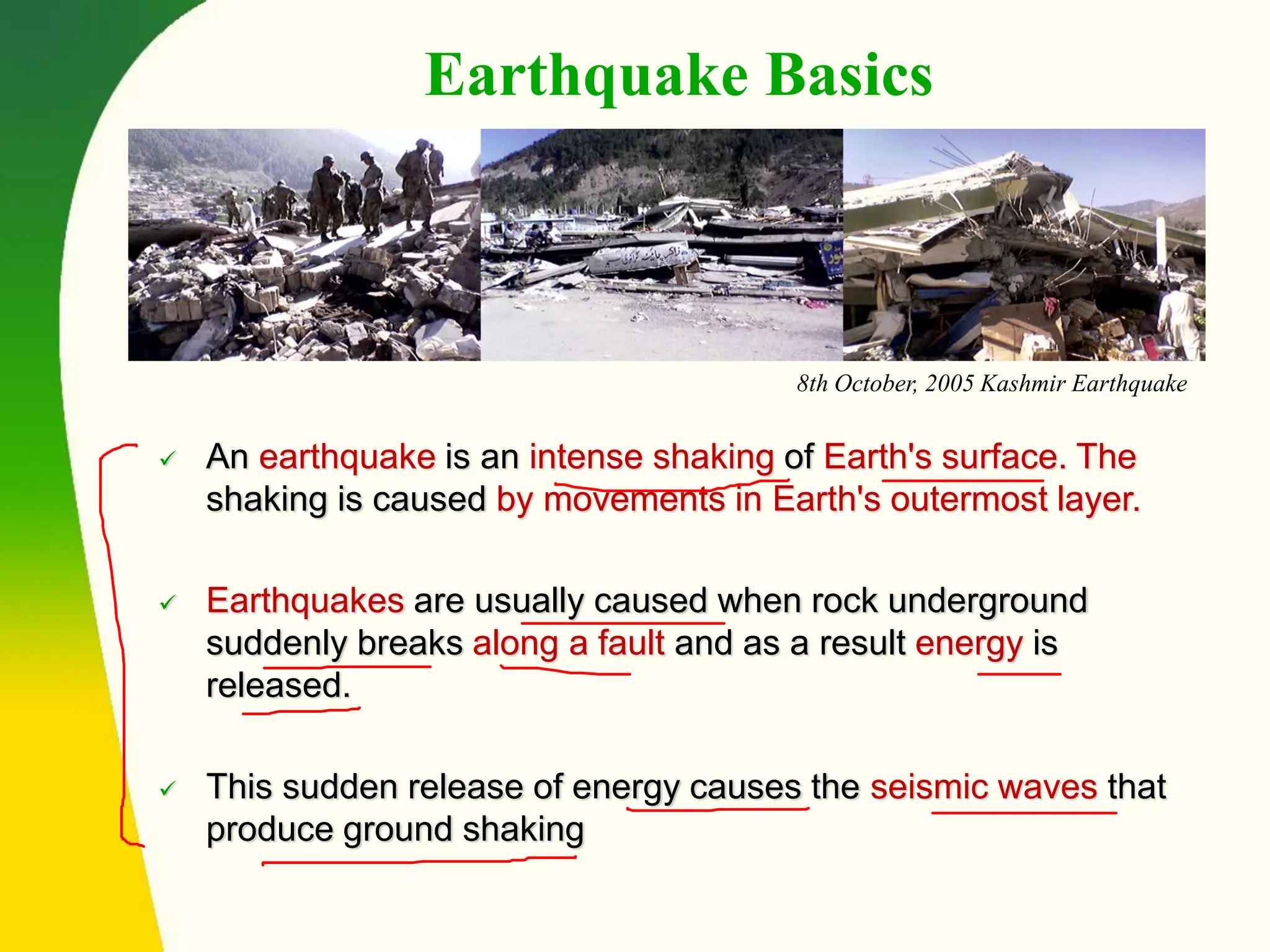
✓ An earthquake is an intense shaking of Earth's surface. The
shaking is caused by movements in Earth's outermost layer.
✓ Earthquakes are usually caused when rock underground
suddenly breaks along a fault and as a result energy is
released.
✓ This sudden release of energy causes the seismic waves that
produce ground shaking
8th October, 2005 Kashmir Earthquake
Earthquake Basics
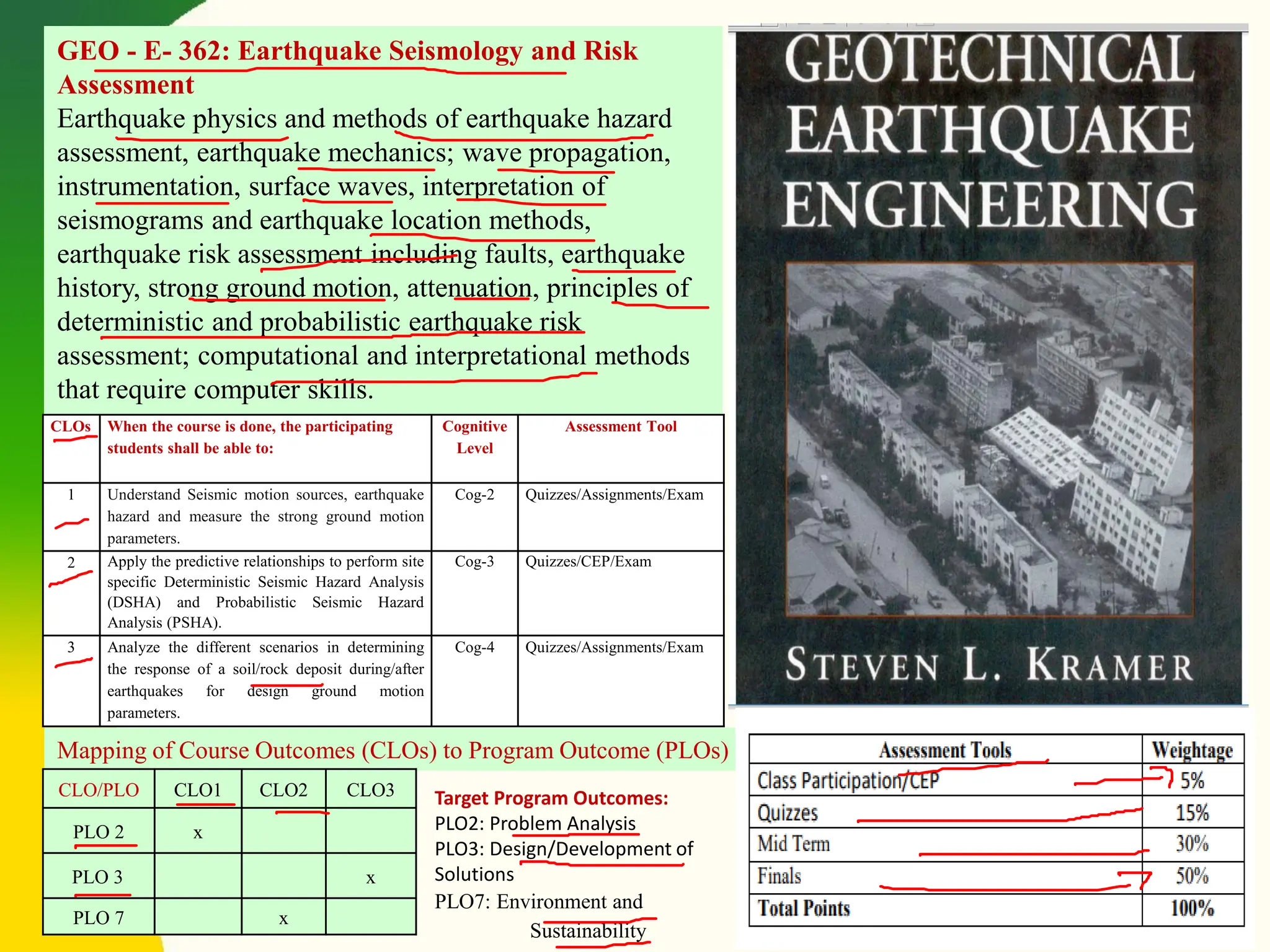
GEO - E- 362: Earthquake Seismology and Risk
Assessment
Earthquake physics and methods of earthquake hazard
assessment, earthquake mechanics; wave propagation,
instrumentation, surface waves, interpretation of
seismograms and earthquake location methods,
earthquake risk assessment including faults, earthquake
history, strong ground motion, attenuation, principles of
deterministic and probabilistic earthquake risk
assessment; computational and interpretational methods
that require computer skills.
Target Program Outcomes:
PLO2: Problem Analysis
PLO3: Design/Development of
Solutions
PLO7: Environment and
Sustainability
Mapping of Course Outcomes (CLOs) to Program Outcome (PLOs)
CLOs When the course is done, the participating
students shall be able to:
Cognitive
Level
Assessment Tool
1 Understand Seismic motion sources, earthquake
hazard and measure the strong ground motion
parameters.
Cog-2 Quizzes/Assignments/Exam
2 Apply the predictive relationships to perform site
specific Deterministic Seismic Hazard Analysis
(DSHA) and Probabilistic Seismic Hazard
Analysis (PSHA).
Cog-3 Quizzes/CEP/Exam
3 Analyze the different scenarios in determining
the response of a soil/rock deposit during/after
earthquakes for design ground motion
parameters.
Cog-4 Quizzes/Assignments/Exam
CLO/PLO CLO1 CLO2 CLO3
PLO 2 x
PLO 3 x
PLO 7 x
Sources of Vibrations in ground
◼ Vibrating machines
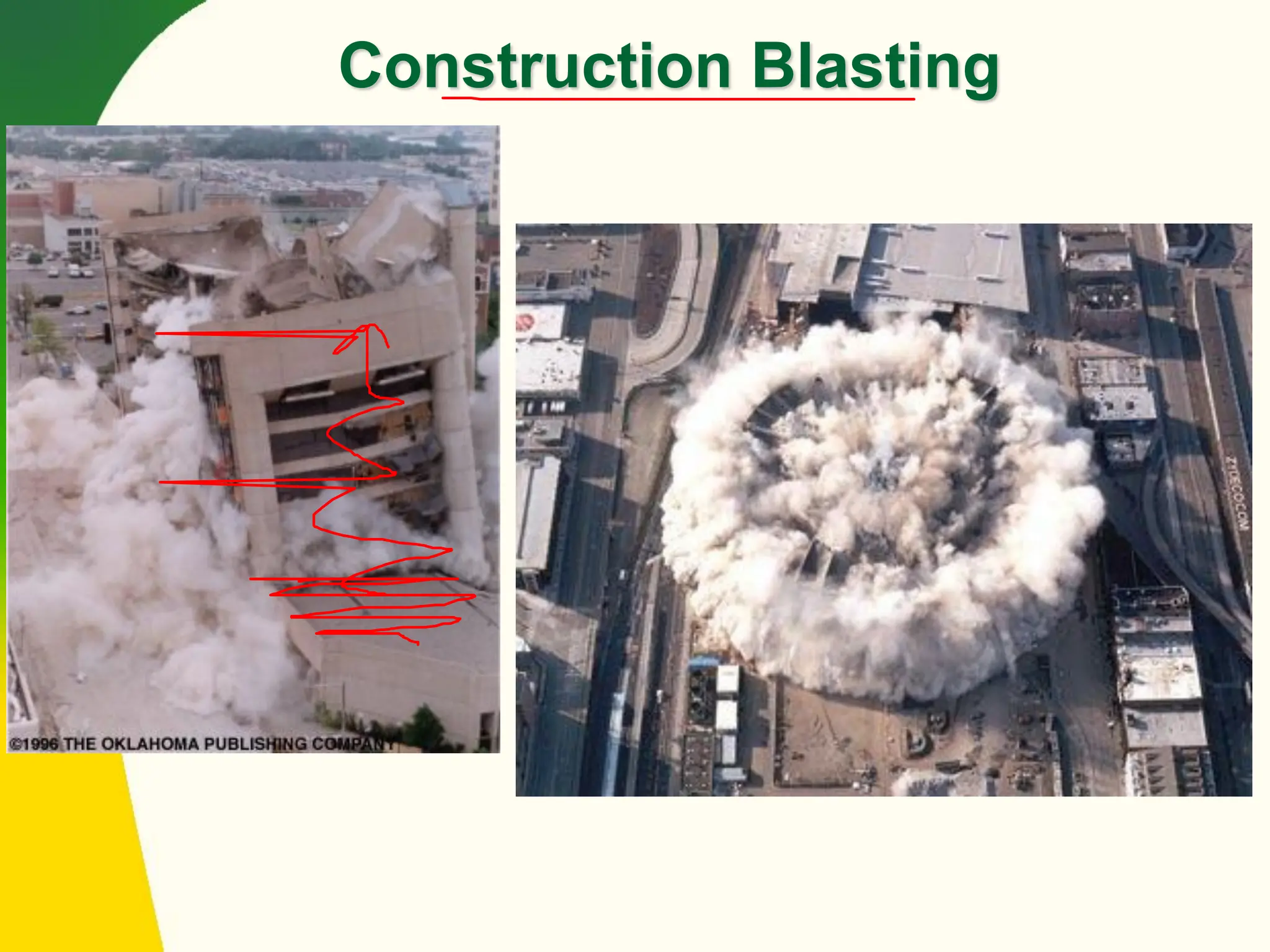
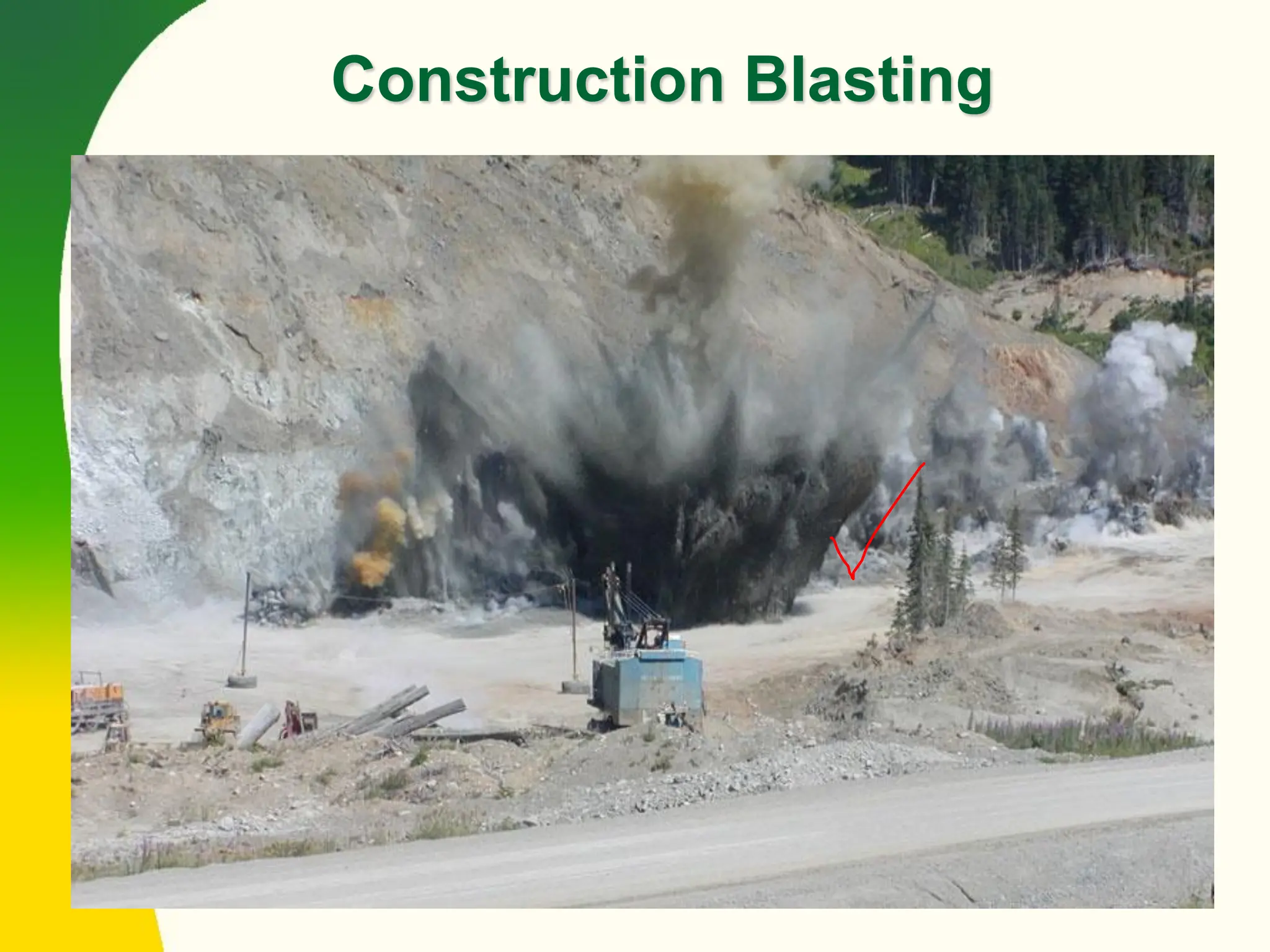
◼ Construction Equip: Pile driving & blasting
◼ Fault Displacement
◼ Volcanoes
◼ Explosives
◼ Mine Burst/Collapse
◼ Landslides/Rockfalls (e.g., Attabad)
◼ Reservoir-induced (e.g., Tarbela Dam)
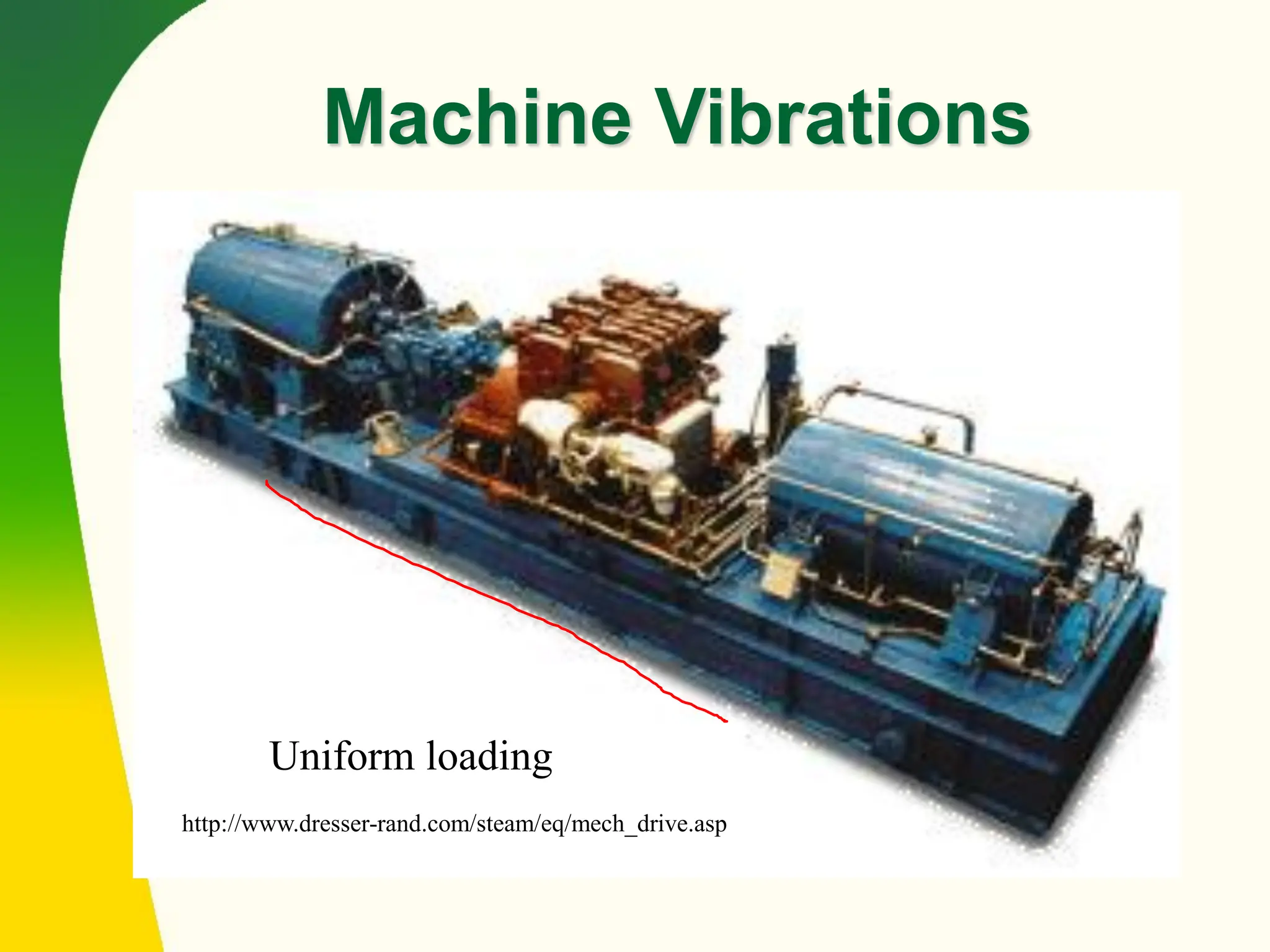
Machine Vibrations
http://www.dresser-rand.com/steam/eq/mech_drive.asp
Uniform loading
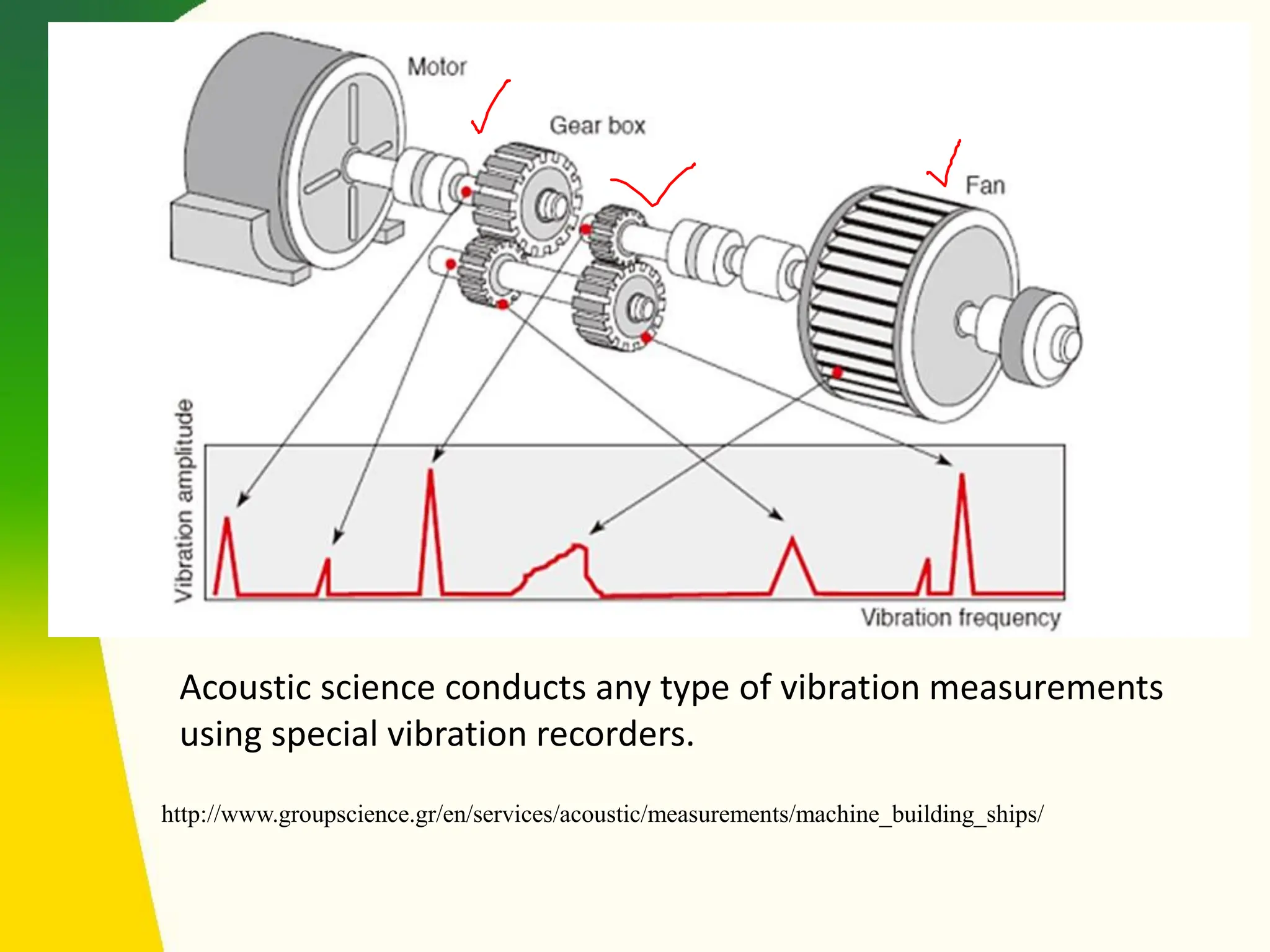
Acoustic science conducts any type of vibration measurements
using special vibration recorders.
http://www.groupscience.gr/en/services/acoustic/measurements/machine_building_ships/
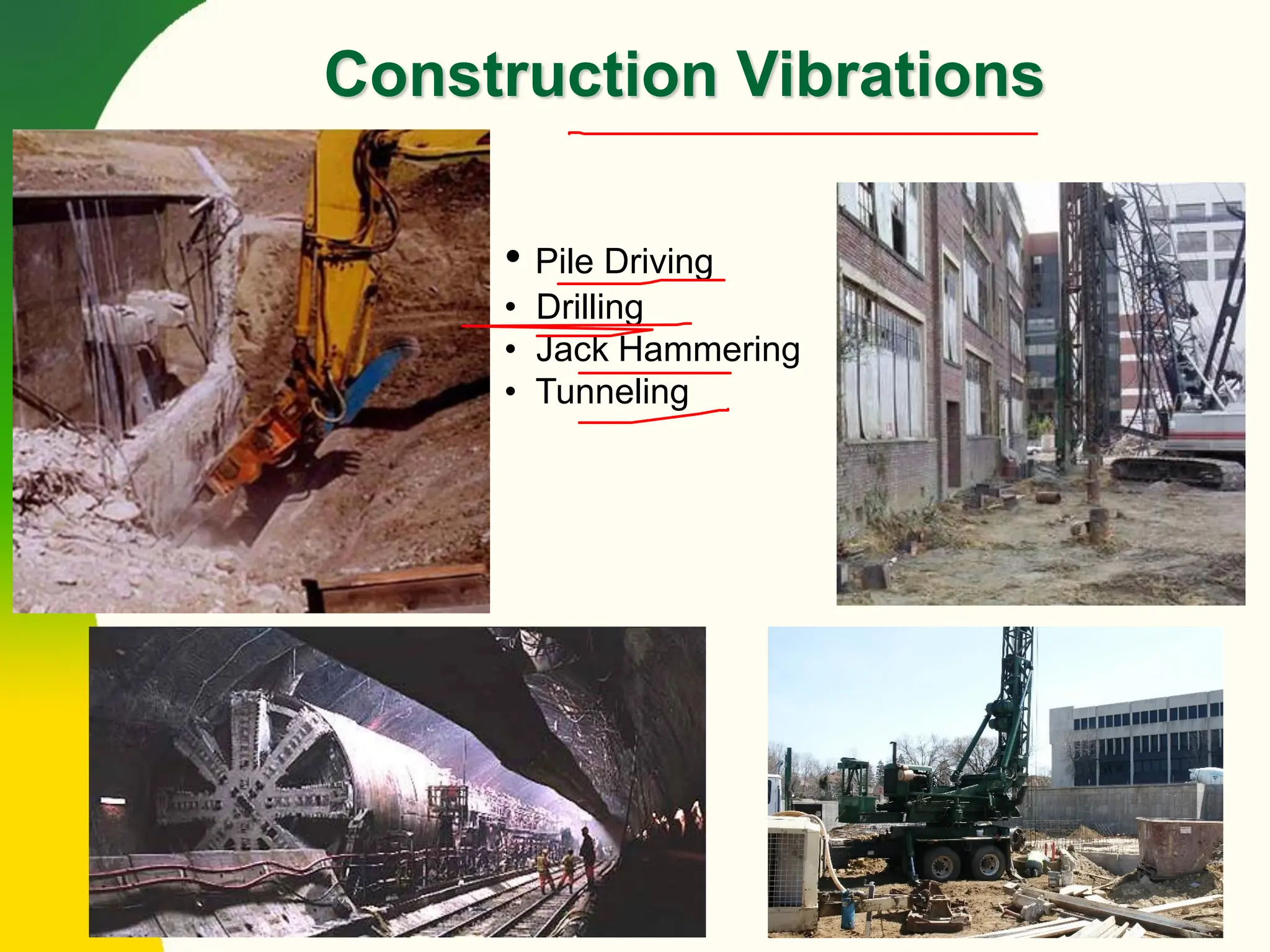
Construction Vibrations
• Pile Driving
• Drilling
• Jack Hammering
• Tunneling
Construction Blasting
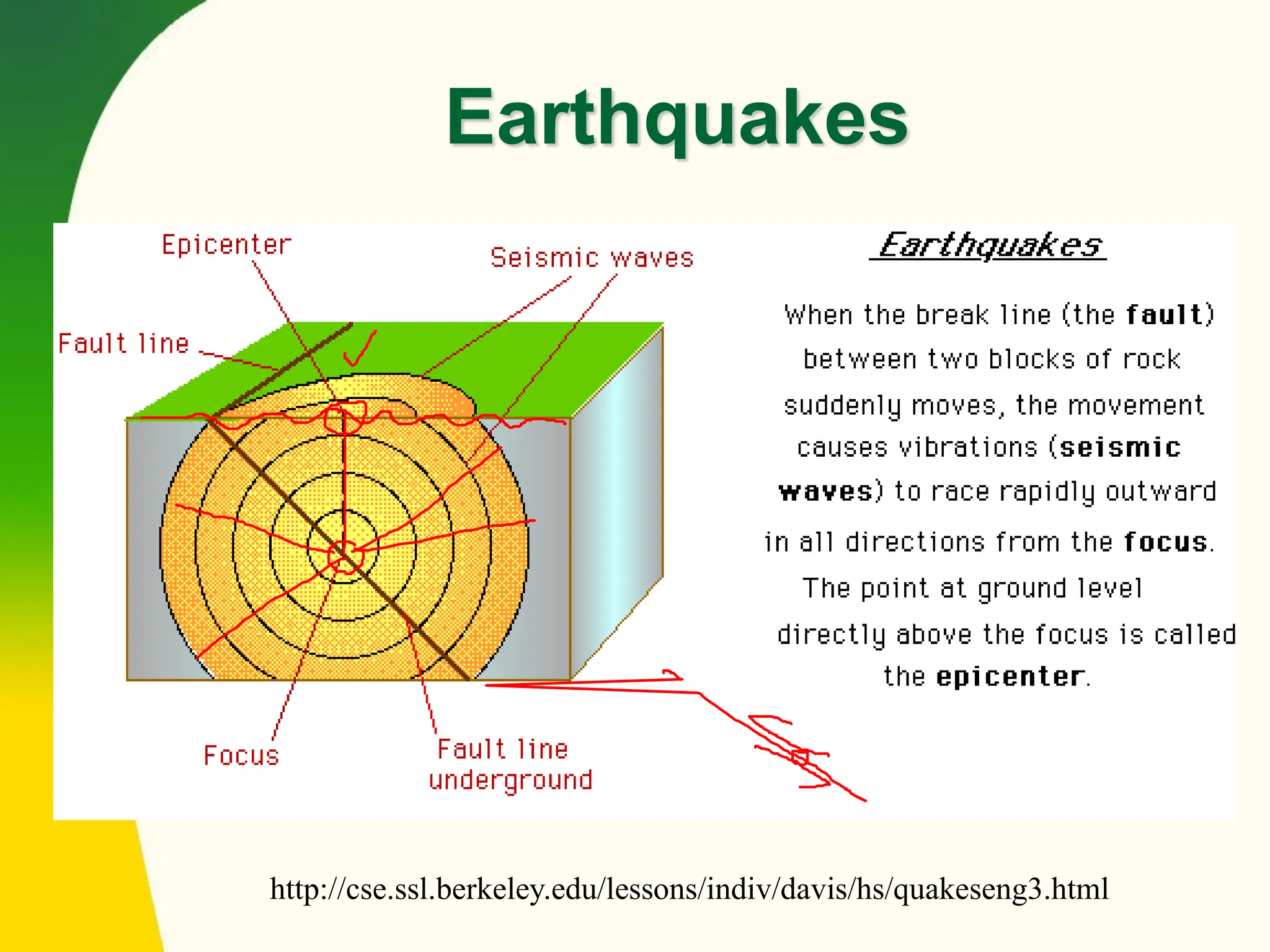
Earthquakes
http://cse.ssl.berkeley.edu/lessons/indiv/davis/hs/quakeseng3.html
Earthquake Depth
✓ Earthquakes usually occur at some depth below the
ground Surface. The depth can also be calculated
from seismograph records
✓ Earthquakes are described as:
✓ Shallow: less than 70 km depth
✓ Intermediate: 70 - 300 km depth
✓ Deep: 300 - 700 km depth
✓ 90% of earthquake foci are less than 100 km deep.
✓ Large earthquakes are mostly at < 60 km depth
✓ No earthquakes occur deeper than 700 km
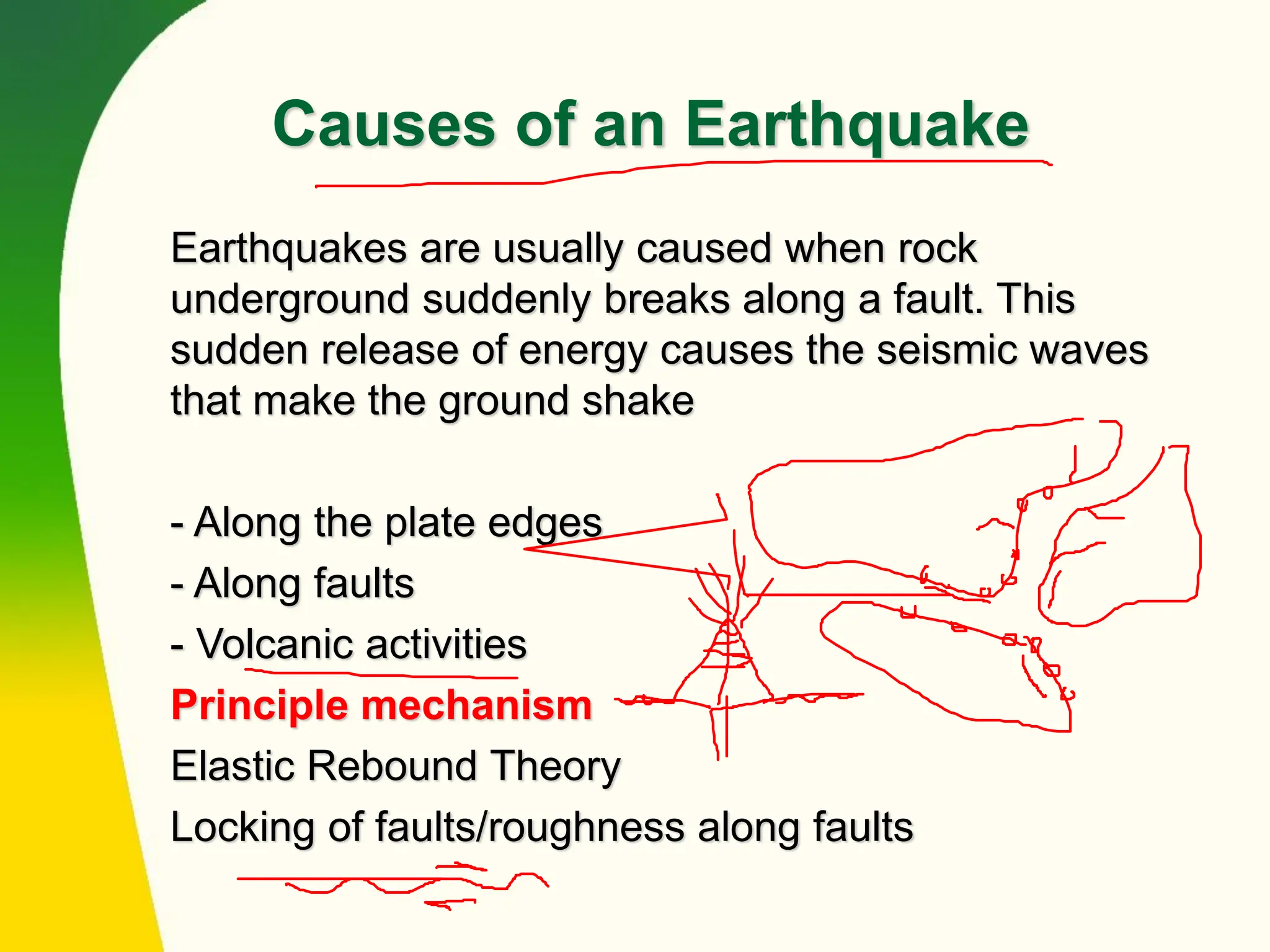
Causes of an Earthquake
Earthquakes are usually caused when rock
underground suddenly breaks along a fault. This
sudden release of energy causes the seismic waves
that make the ground shake
- Along the plate edges
- Along faults
- Volcanic activities
Principle mechanism
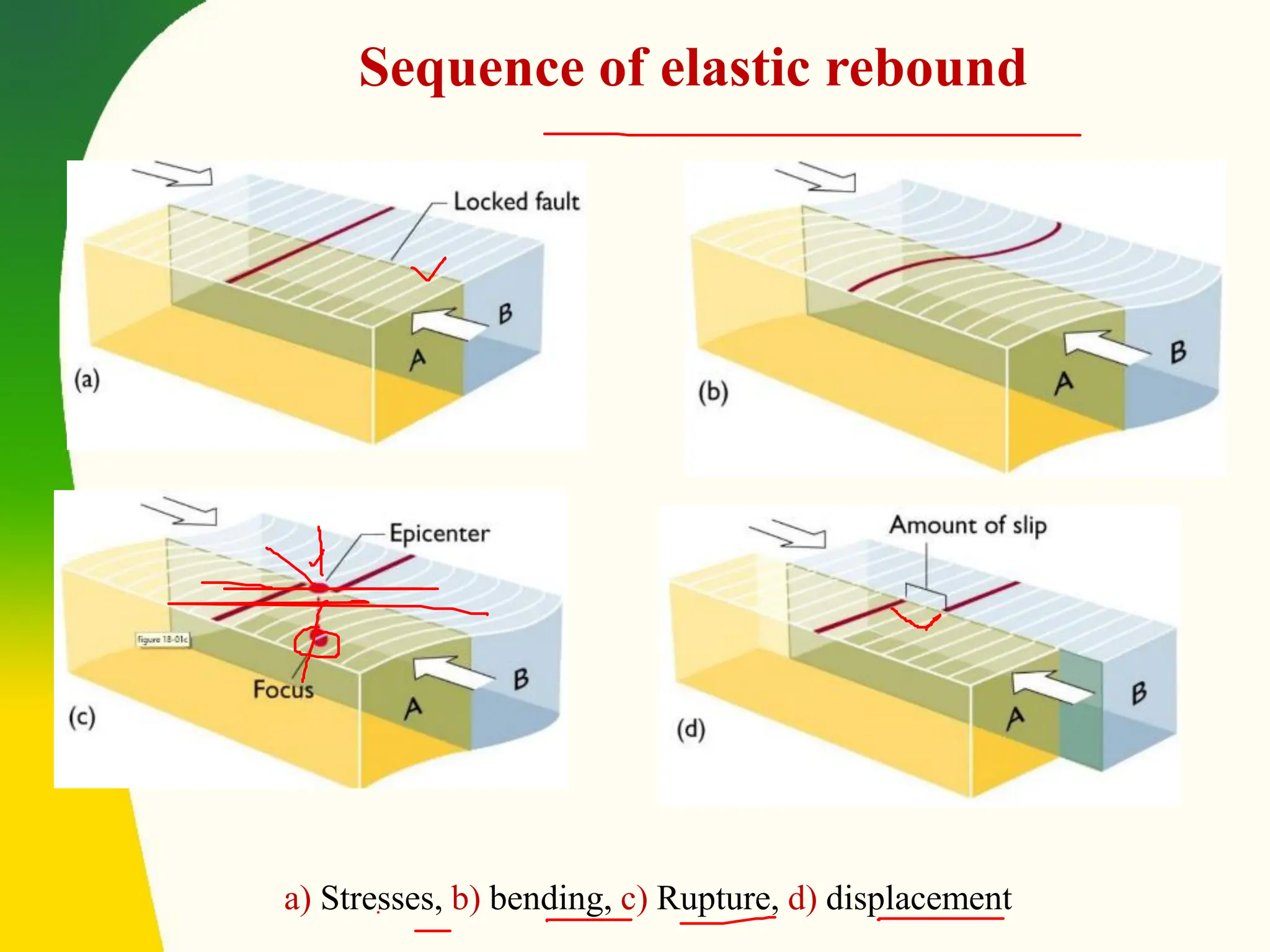
Elastic Rebound Theory
Locking of faults/roughness along faults
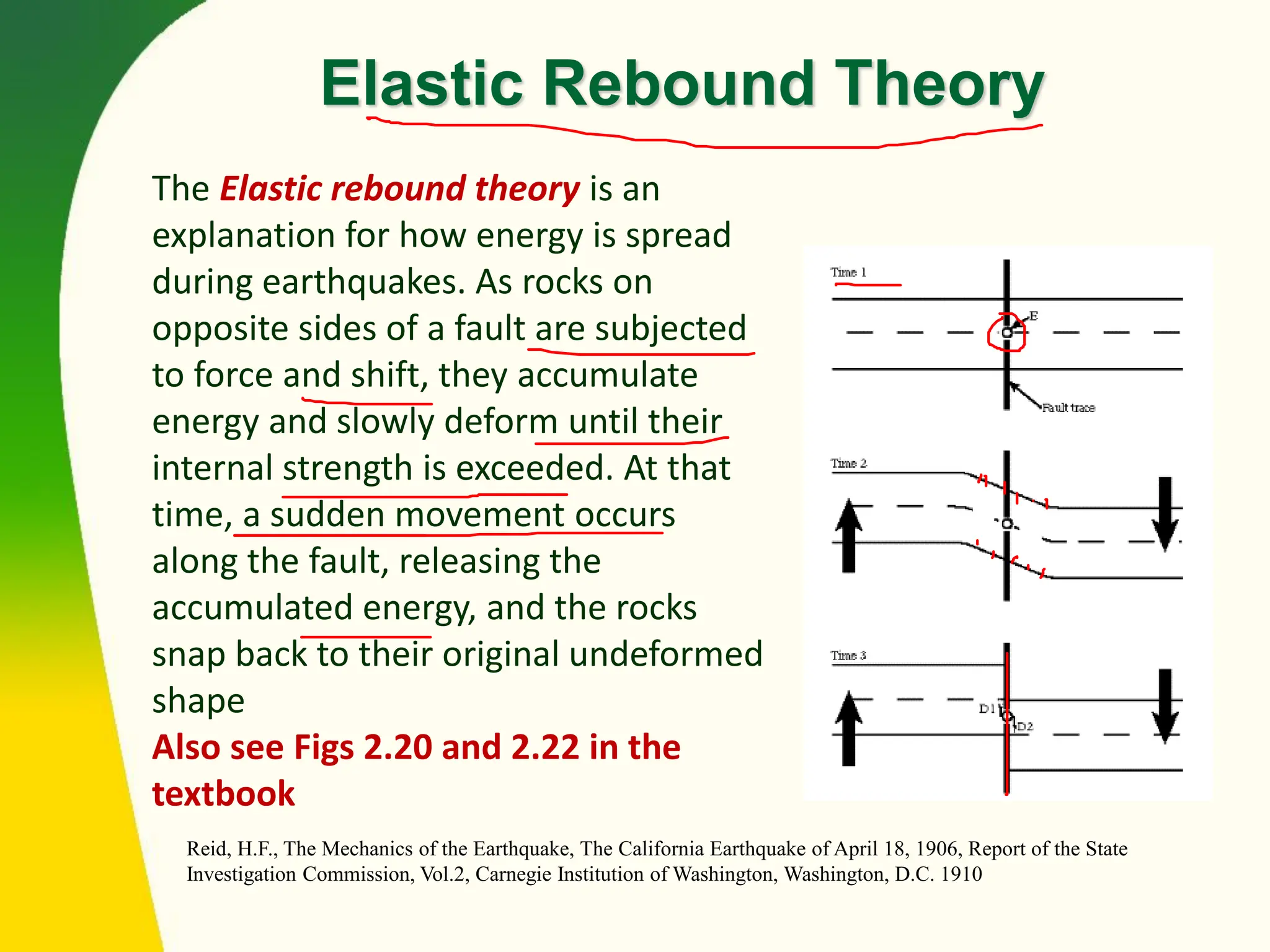
Elastic Rebound Theory
The Elastic rebound theory is an
explanation for how energy is spread
during earthquakes. As rocks on
opposite sides of a fault are subjected
to force and shift, they accumulate
energy and slowly deform until their
internal strength is exceeded. At that
time, a sudden movement occurs
along the fault, releasing the
accumulated energy, and the rocks
snap back to their original undeformed
shape
Also see Figs 2.20 and 2.22 in the
textbook
Reid, H.F., The Mechanics of the Earthquake, The California Earthquake of April 18, 1906, Report of the State
Investigation Commission, Vol.2, Carnegie Institution of Washington, Washington, D.C. 1910
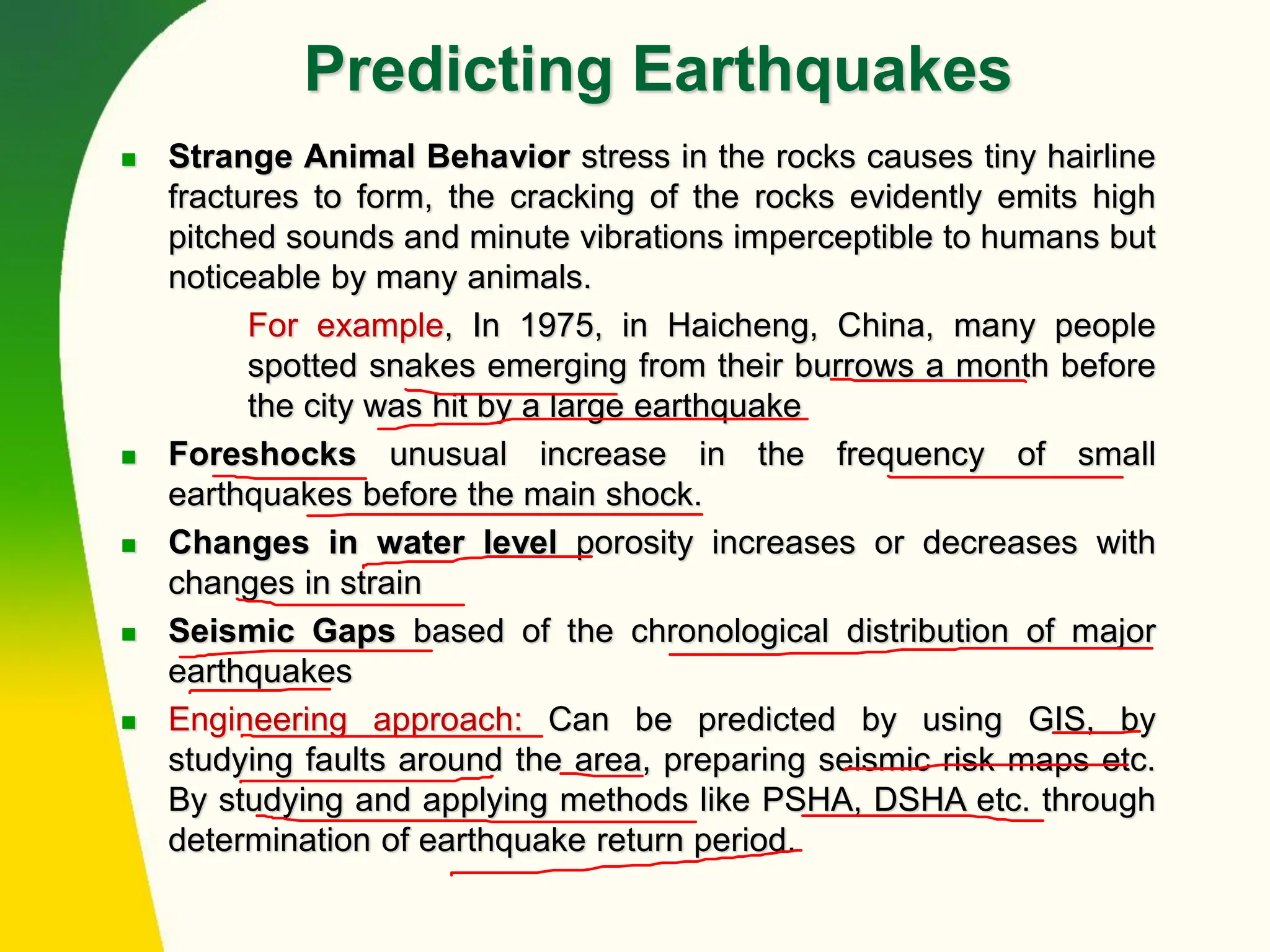
Predicting Earthquakes
◼ Strange Animal Behavior stress in the rocks causes tiny hairline
fractures to form, the cracking of the rocks evidently emits high
pitched sounds and minute vibrations imperceptible to humans but
noticeable by many animals.
For example, In 1975, in Haicheng, China, many people
spotted snakes emerging from their burrows a month before
the city was hit by a large earthquake
◼ Foreshocks unusual increase in the frequency of small
earthquakes before the main shock.
◼ Changes in water level porosity increases or decreases with
changes in strain
◼ Seismic Gaps based of the chronological distribution of major
earthquakes
◼ Engineering approach: Can be predicted by using GIS, by
studying faults around the area, preparing seismic risk maps etc.
By studying and applying methods like PSHA, DSHA etc. through
determination of earthquake return period.
Types of an Earthquake
There are four different types of earthquakes: Tectonic,
volcanic, collapse and explosion.
◼ A tectonic earthquake is one that occurs when the earth's
crust breaks due to geological forces on rocks and adjoining
plates that cause physical and chemical changes.
◼ A volcanic earthquake is any earthquake that results from
tectonic forces which occur in conjunction with volcanic
activity.
◼ A collapse earthquake are small earthquakes in
underground caverns and mines that are caused by seismic
waves produced from the explosion of rock on the surface.
◼ An explosion earthquake is an earthquake that is the
result of the detonation of a nuclear and/or chemical device.
a) Stresses, b) bending, c) Rupture, d) displacement
Sequence of elastic rebound
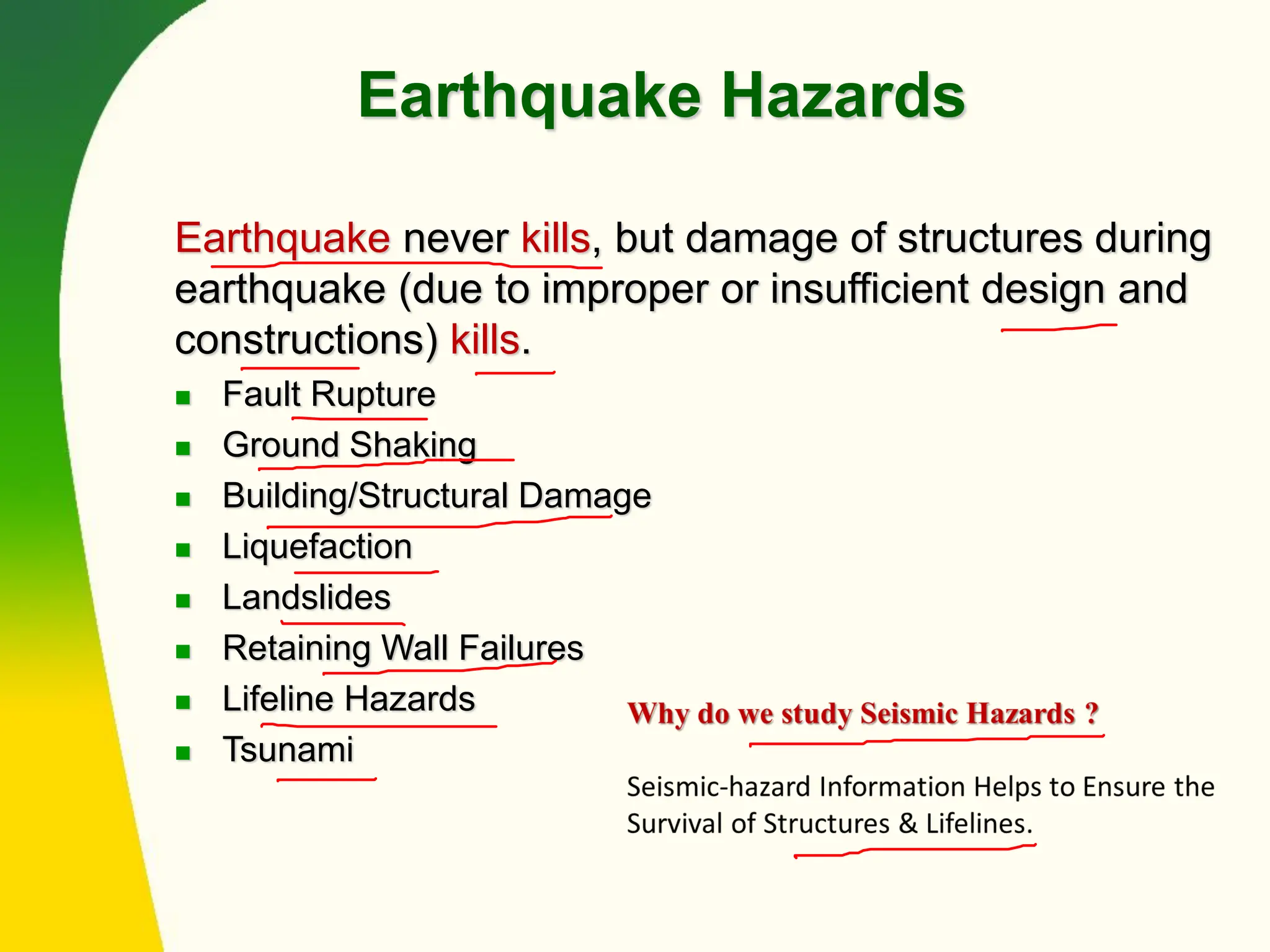
Earthquake Hazards
Earthquake never kills, but damage of structures during
earthquake (due to improper or insufficient design and
constructions) kills.
◼ Fault Rupture
◼ Ground Shaking
◼ Building/Structural Damage
◼ Liquefaction
◼ Landslides
◼ Retaining Wall Failures
◼ Lifeline Hazards
◼ Tsunami
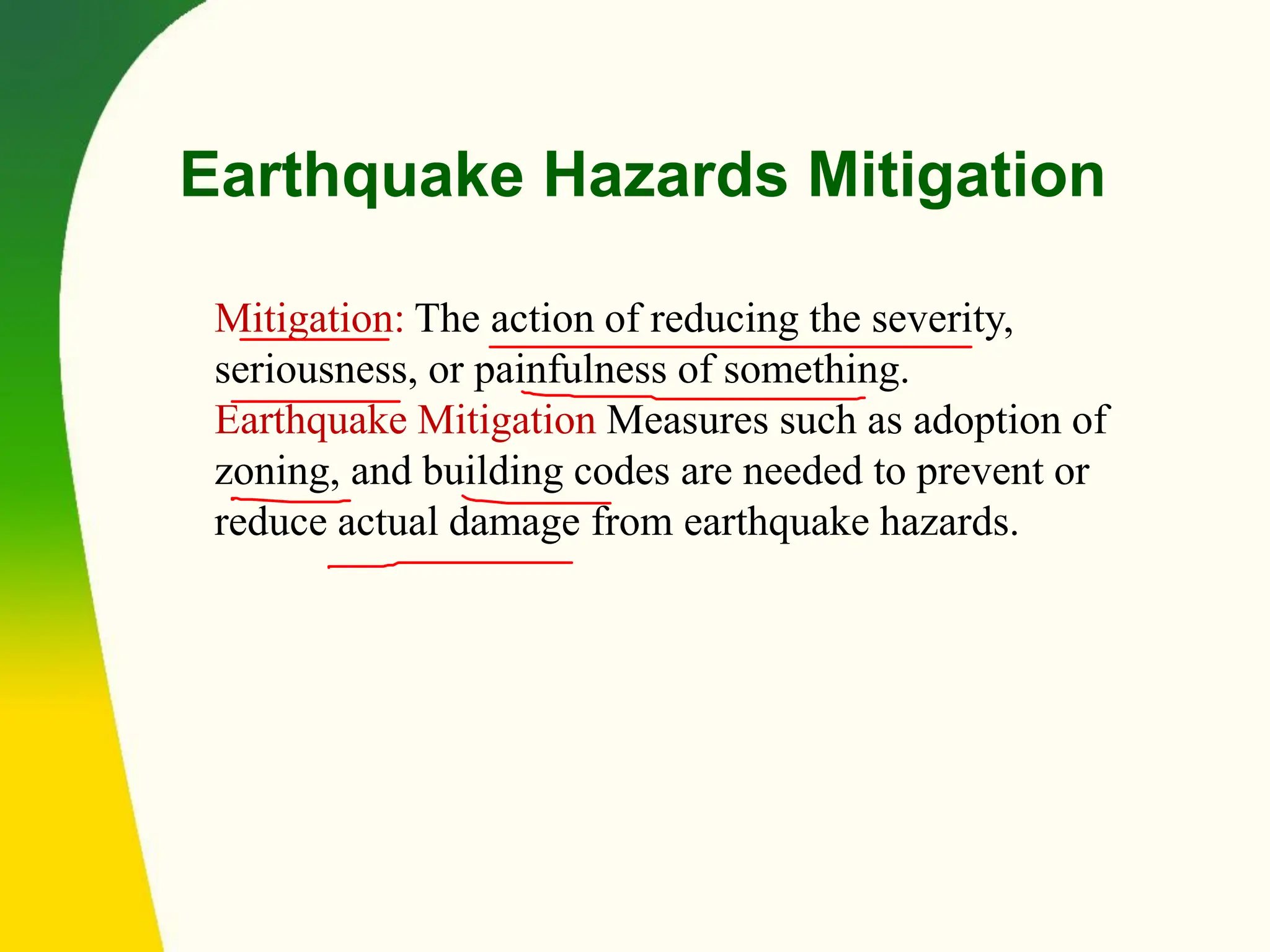
Earthquake Hazards Mitigation
Mitigation: The action of reducing the severity,
seriousness, or painfulness of something.
Earthquake Mitigation Measures such as adoption of
zoning, and building codes are needed to prevent or
reduce actual damage from earthquake hazards.
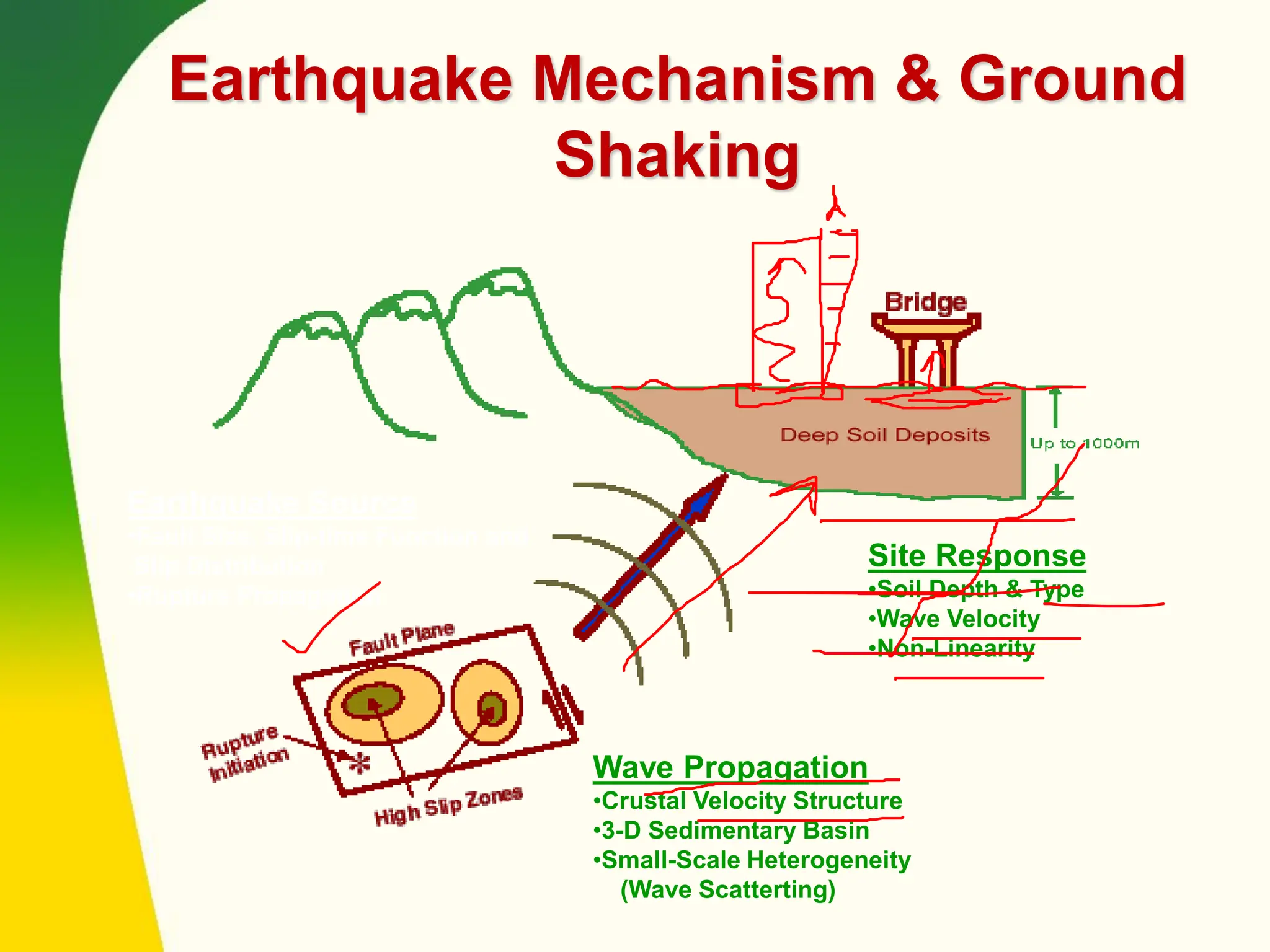
Earthquake Source
•Fault Size, Slip-time Function and
Slip Distribution
•Rupture Propagation
Wave Propagation
•Crustal Velocity Structure
•3-D Sedimentary Basin
•Small-Scale Heterogeneity
(Wave Scatterting)
Site Response
•Soil Depth & Type
•Wave Velocity
•Non-Linearity
Earthquake Mechanism & Ground
Shaking
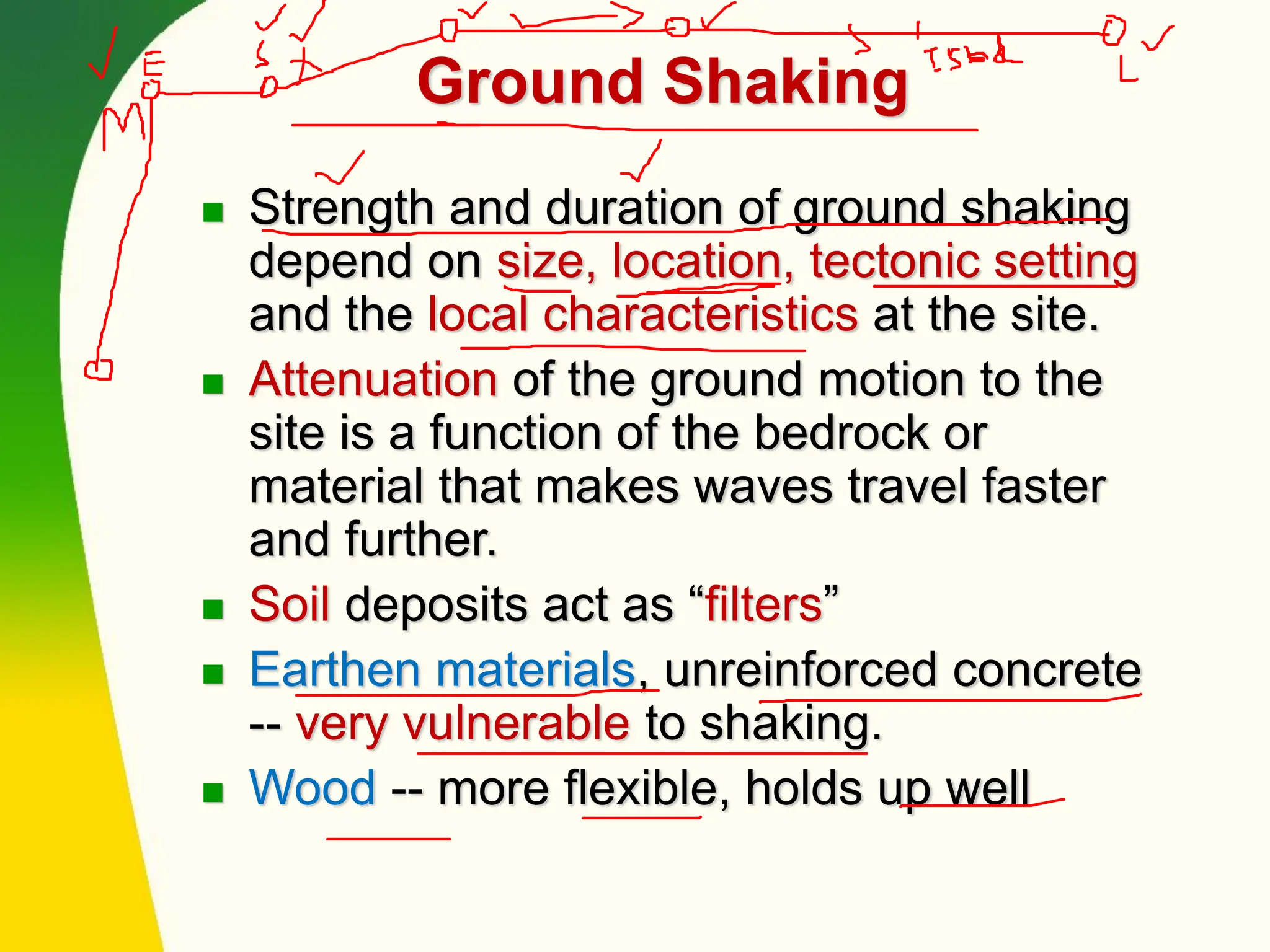
Ground Shaking
◼ Strength and duration of ground shaking
depend on size, location, tectonic setting
and the local characteristics at the site.
◼ Attenuation of the ground motion to the
site is a function of the bedrock or
material that makes waves travel faster
and further.
◼ Soil deposits act as “filters”
◼ Earthen materials, unreinforced concrete
-- very vulnerable to shaking.
◼ Wood -- more flexible, holds up well
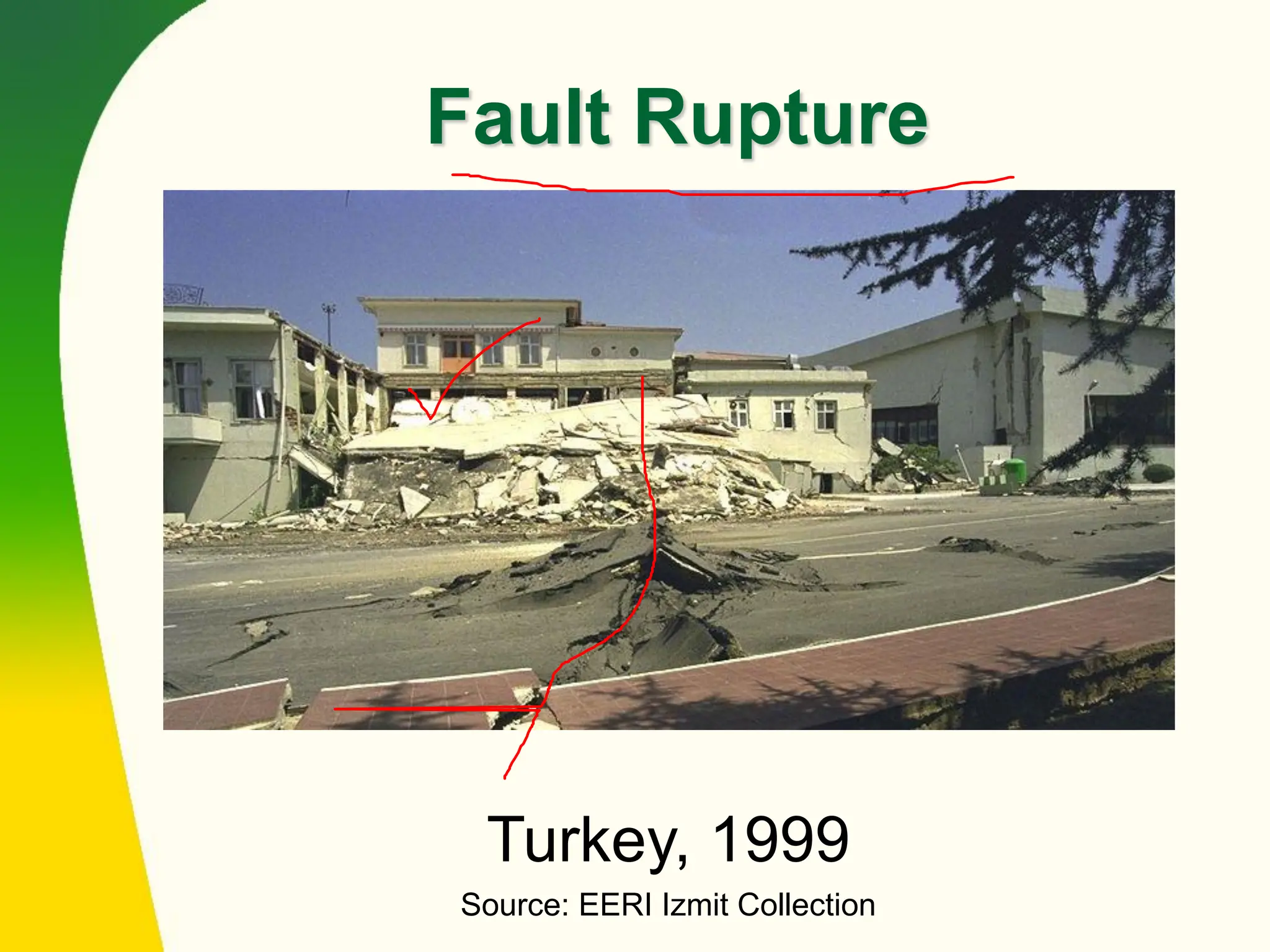
Fault Rupture
Turkey, 1999
Source: EERI Izmit Collection
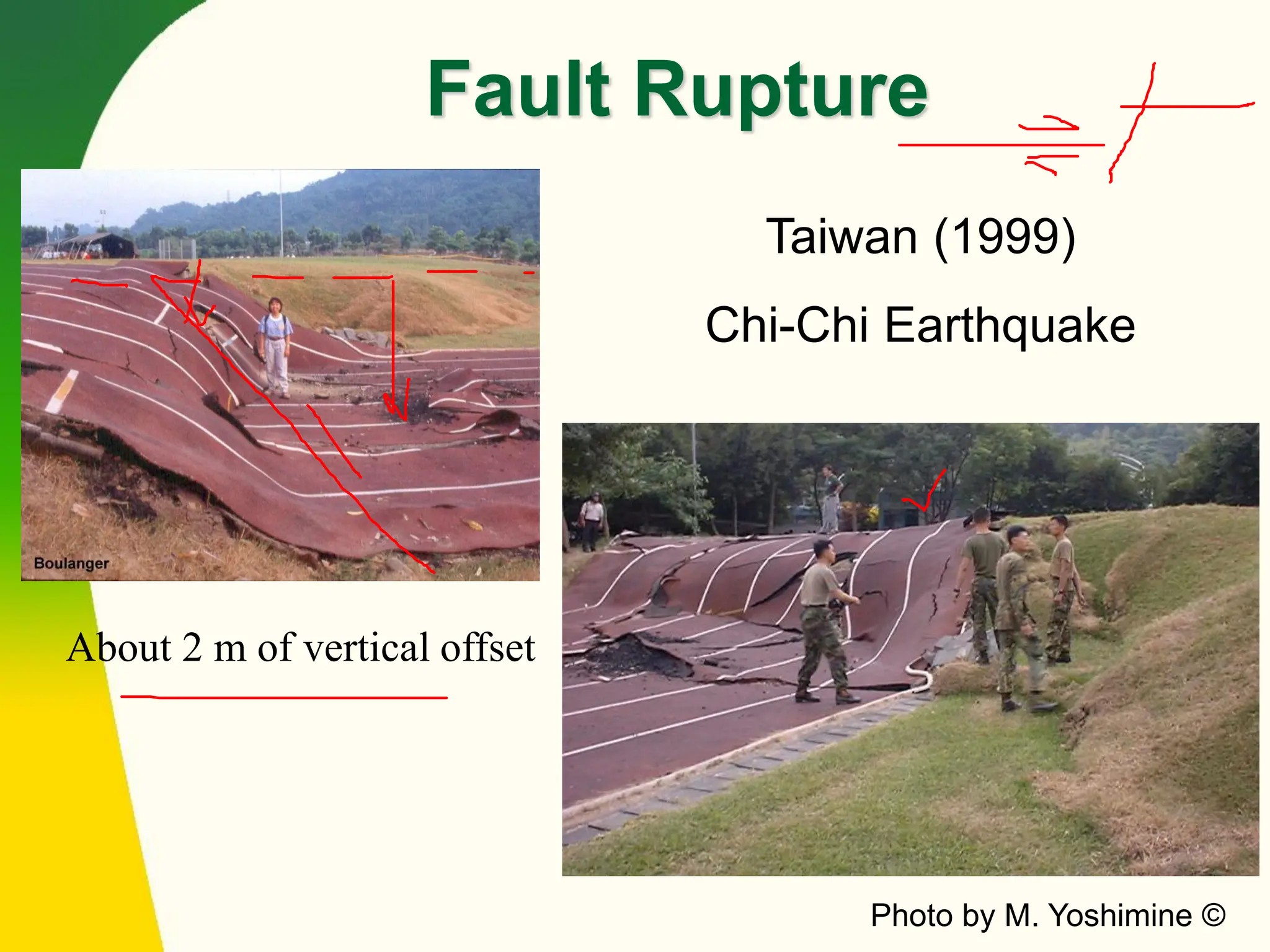
Fault Rupture
Taiwan (1999)
Chi-Chi Earthquake
Photo by M. Yoshimine ©
About 2 m of vertical offset
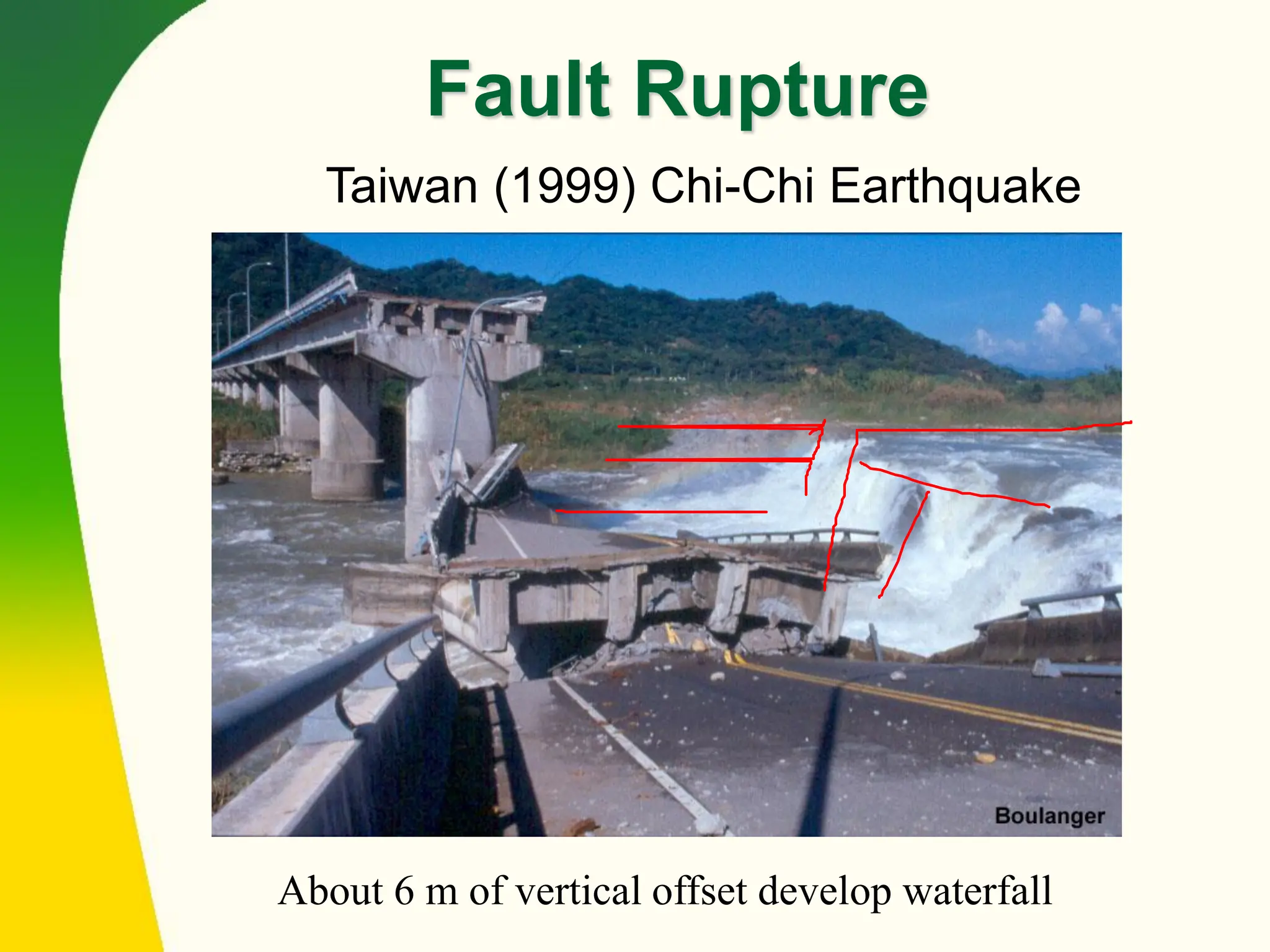
Fault Rupture
Taiwan (1999) Chi-Chi Earthquake
About 6 m of vertical offset develop waterfall
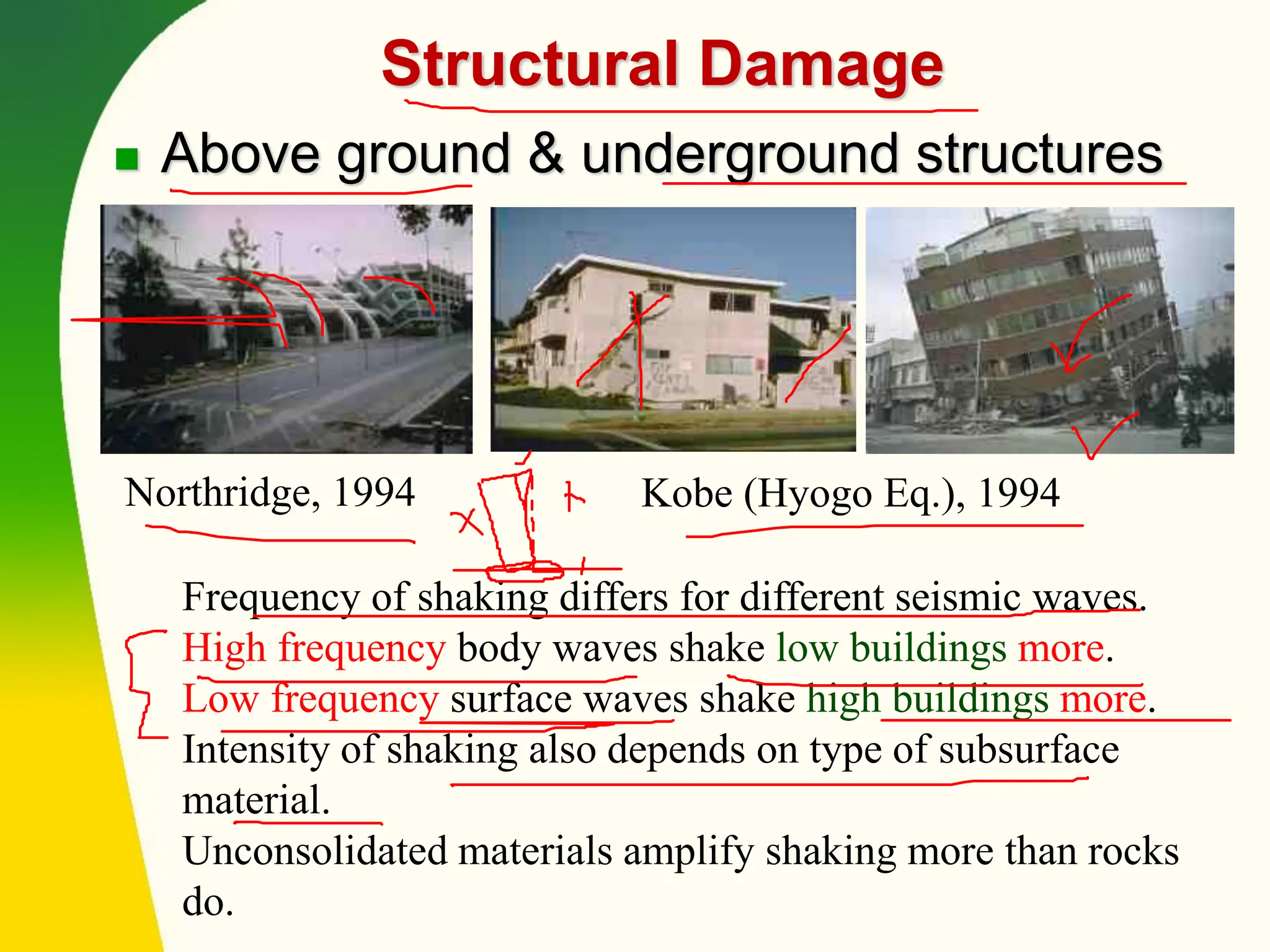
Structural Damage
◼ Above ground & underground structures
Northridge, 1994 Kobe (Hyogo Eq.), 1994
Frequency of shaking differs for different seismic waves.
High frequency body waves shake low buildings more.
Low frequency surface waves shake high buildings more.
Intensity of shaking also depends on type of subsurface
material.
Unconsolidated materials amplify shaking more than rocks
do.
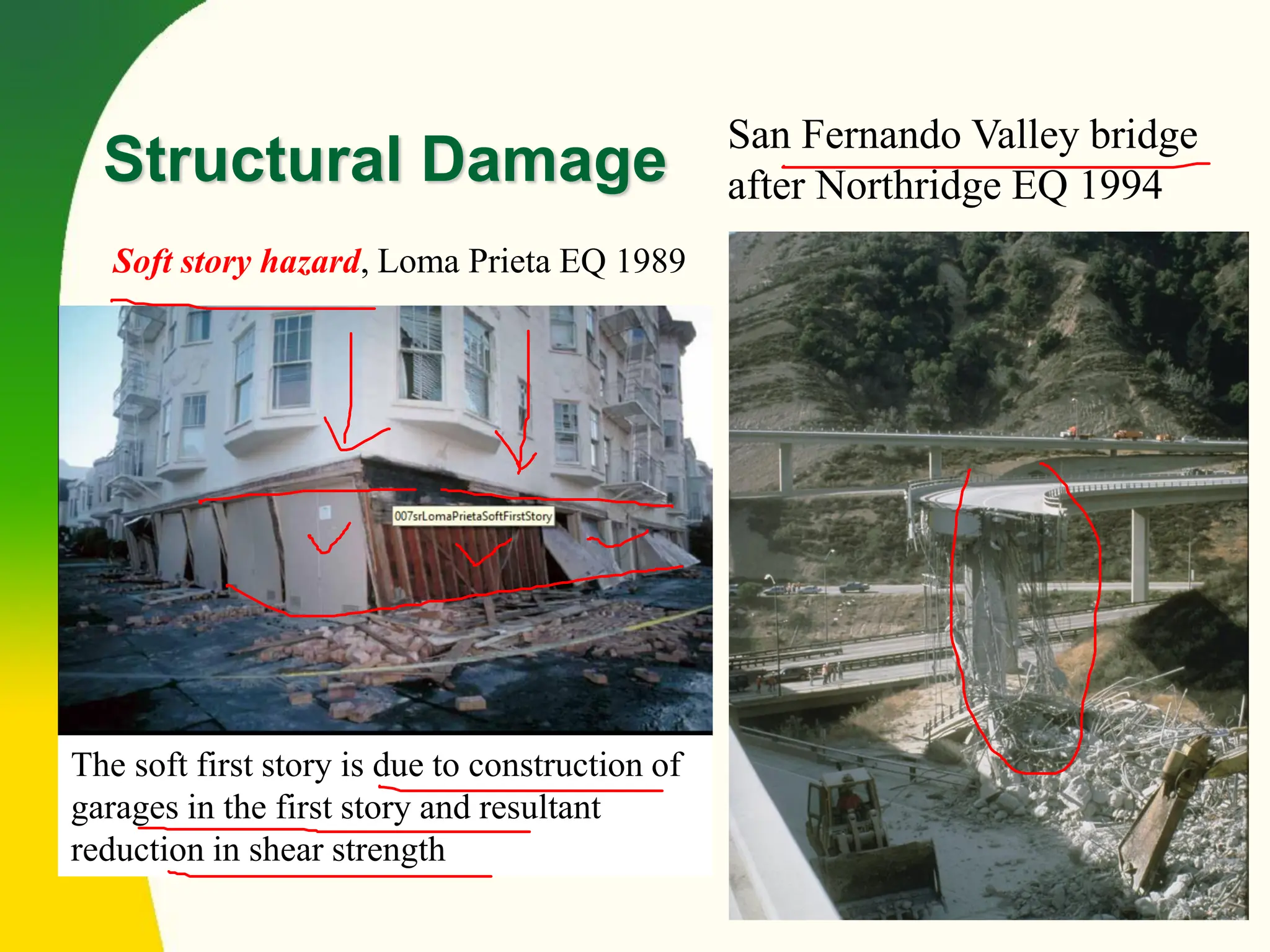
Structural Damage
San Fernando Valley bridge
after Northridge EQ 1994
Soft story hazard, Loma Prieta EQ 1989
The soft first story is due to construction of
garages in the first story and resultant
reduction in shear strength
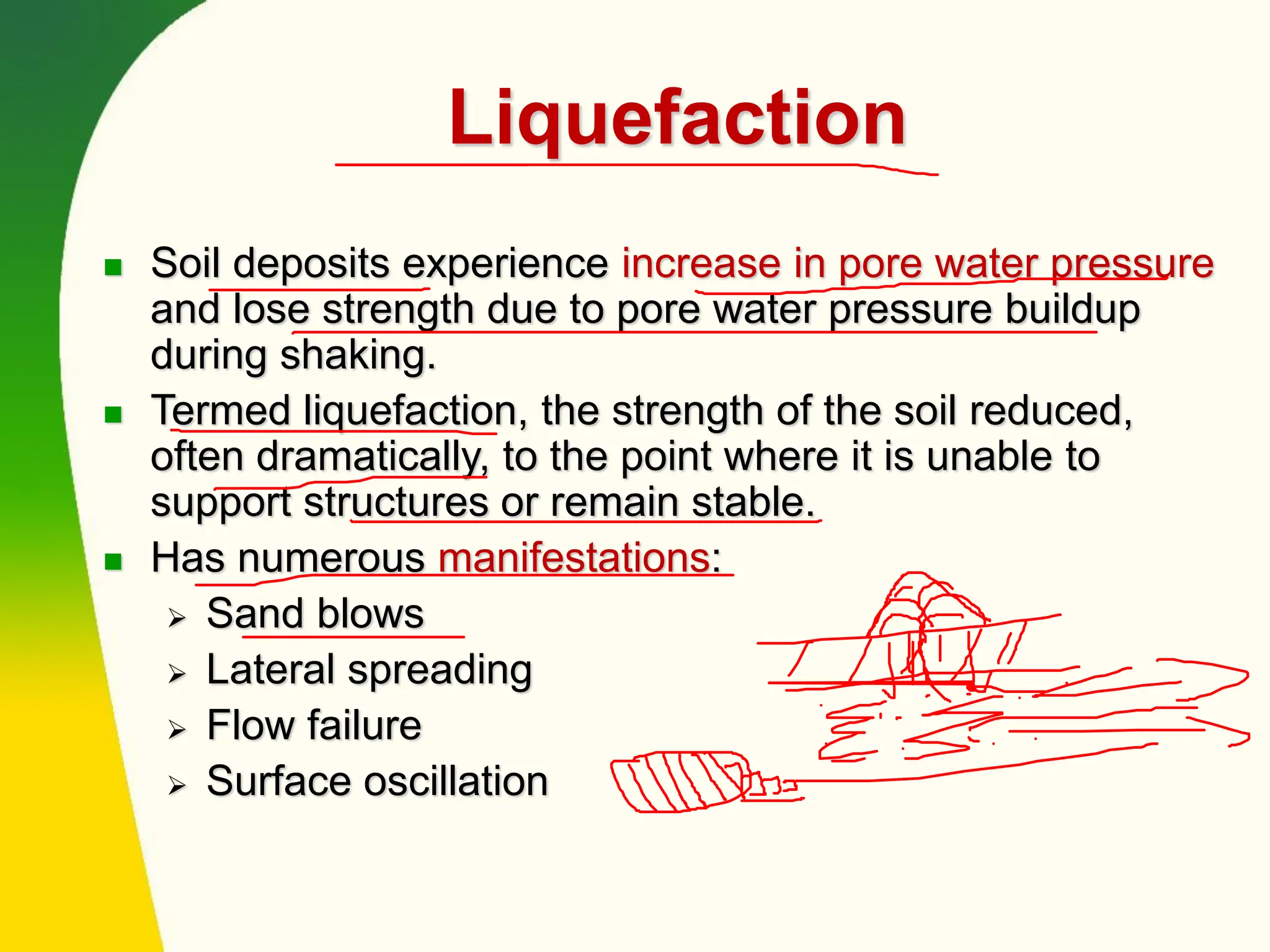
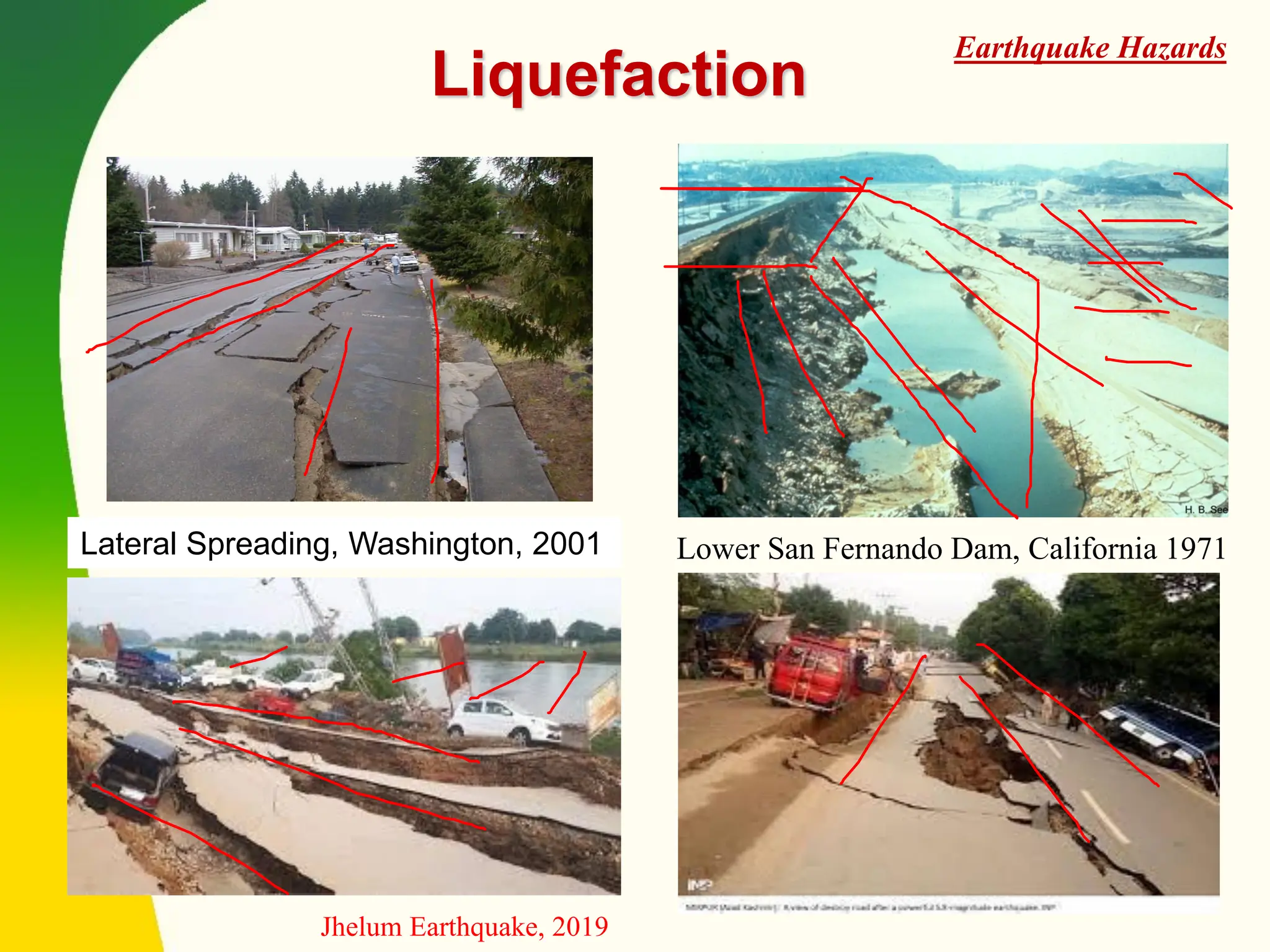
Liquefaction
◼ Soil deposits experience increase in pore water pressure
and lose strength due to pore water pressure buildup
during shaking.
◼ Termed liquefaction, the strength of the soil reduced,
often dramatically, to the point where it is unable to
support structures or remain stable.
◼ Has numerous manifestations:
➢ Sand blows
➢ Lateral spreading
➢ Flow failure
➢ Surface oscillation
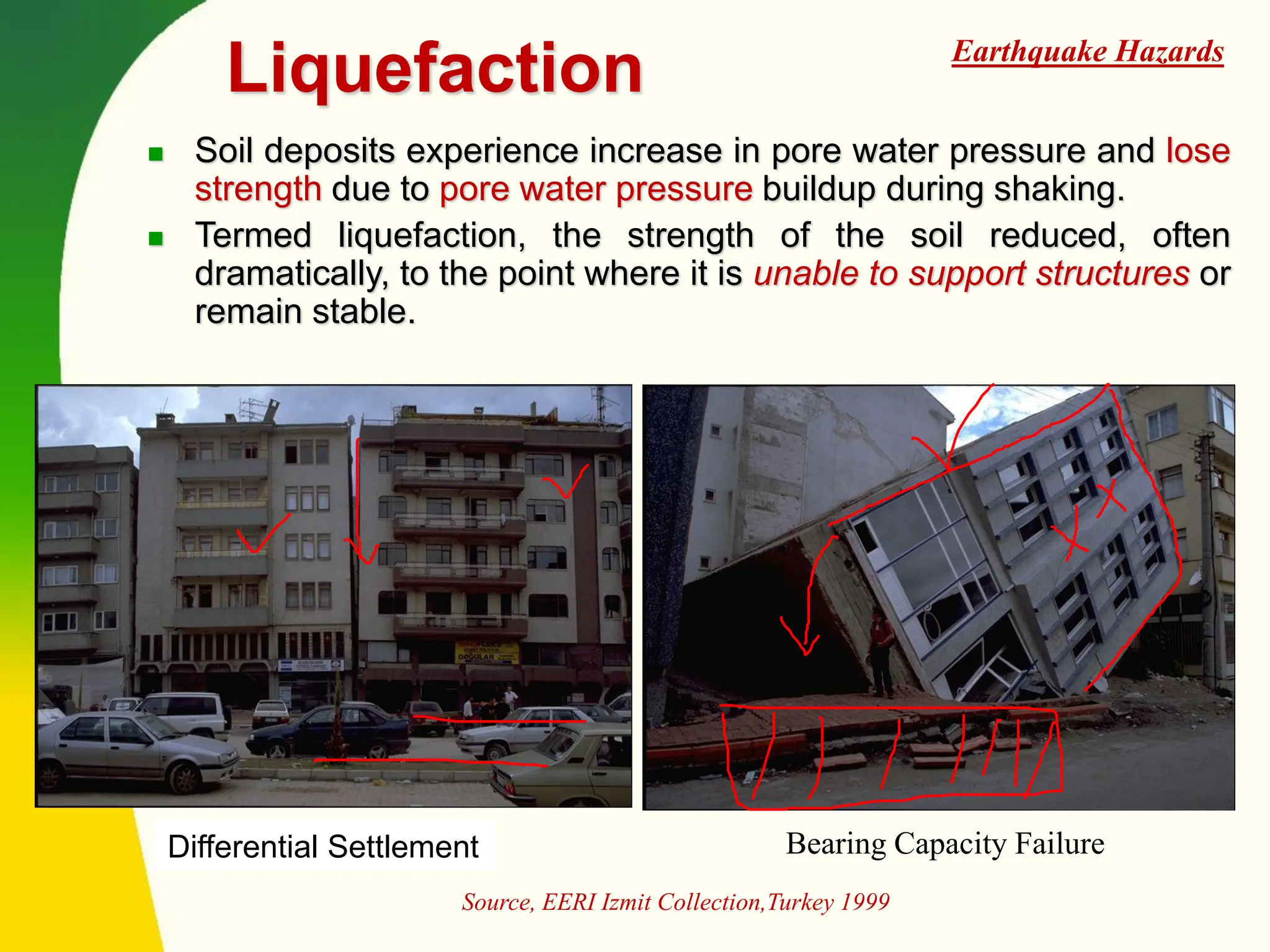
Liquefaction
◼ Soil deposits experience increase in pore water pressure and lose
strength due to pore water pressure buildup during shaking.
◼ Termed liquefaction, the strength of the soil reduced, often
dramatically, to the point where it is unable to support structures or
remain stable.
Differential Settlement Bearing Capacity Failure
Source, EERI Izmit Collection,Turkey 1999
Earthquake Hazards
Liquefaction
Lateral Spreading, Washington, 2001 Lower San Fernando Dam, California 1971
Jhelum Earthquake, 2019
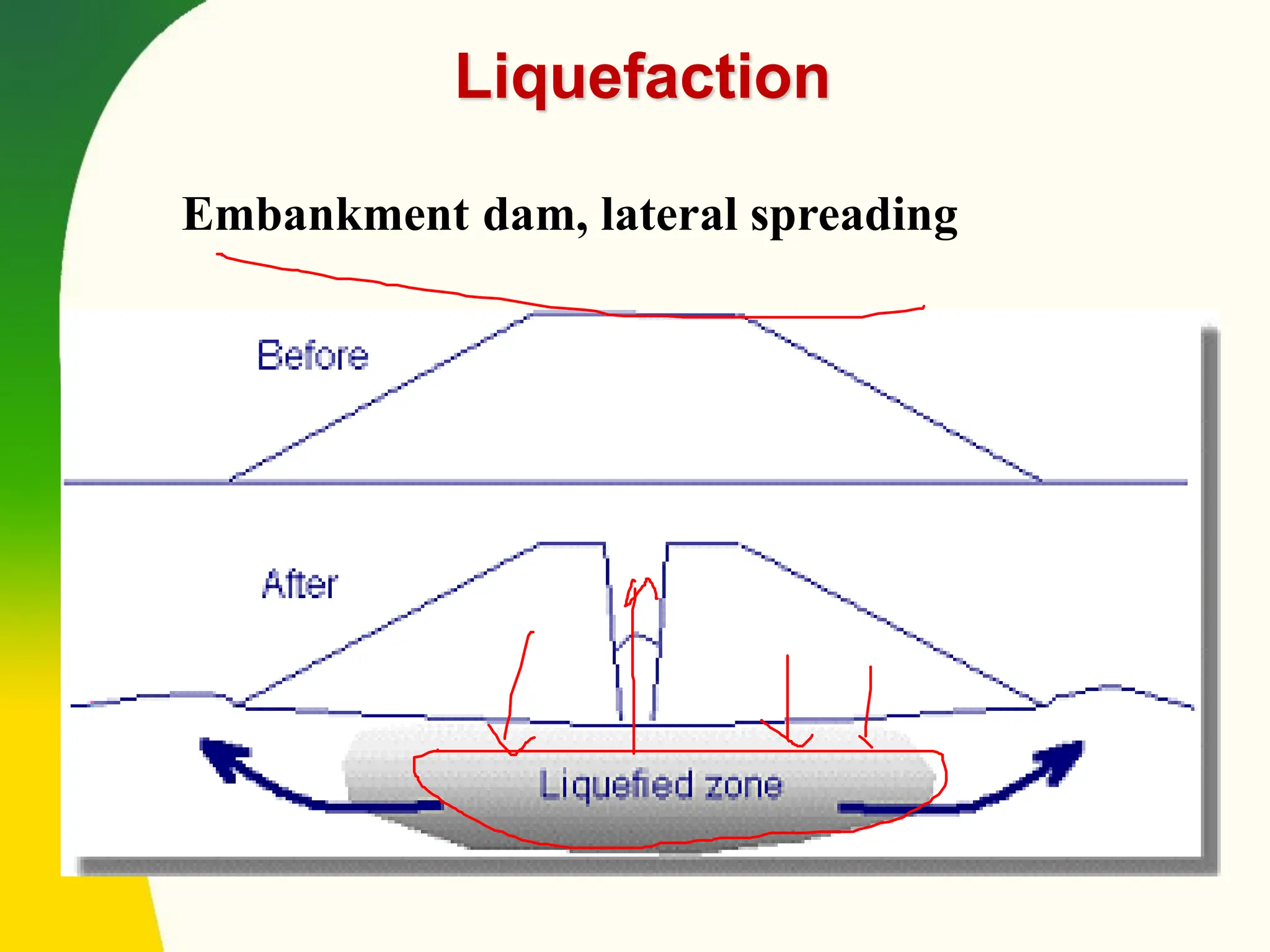
Earthquake Hazards
Embankment dam, lateral spreading
Liquefaction
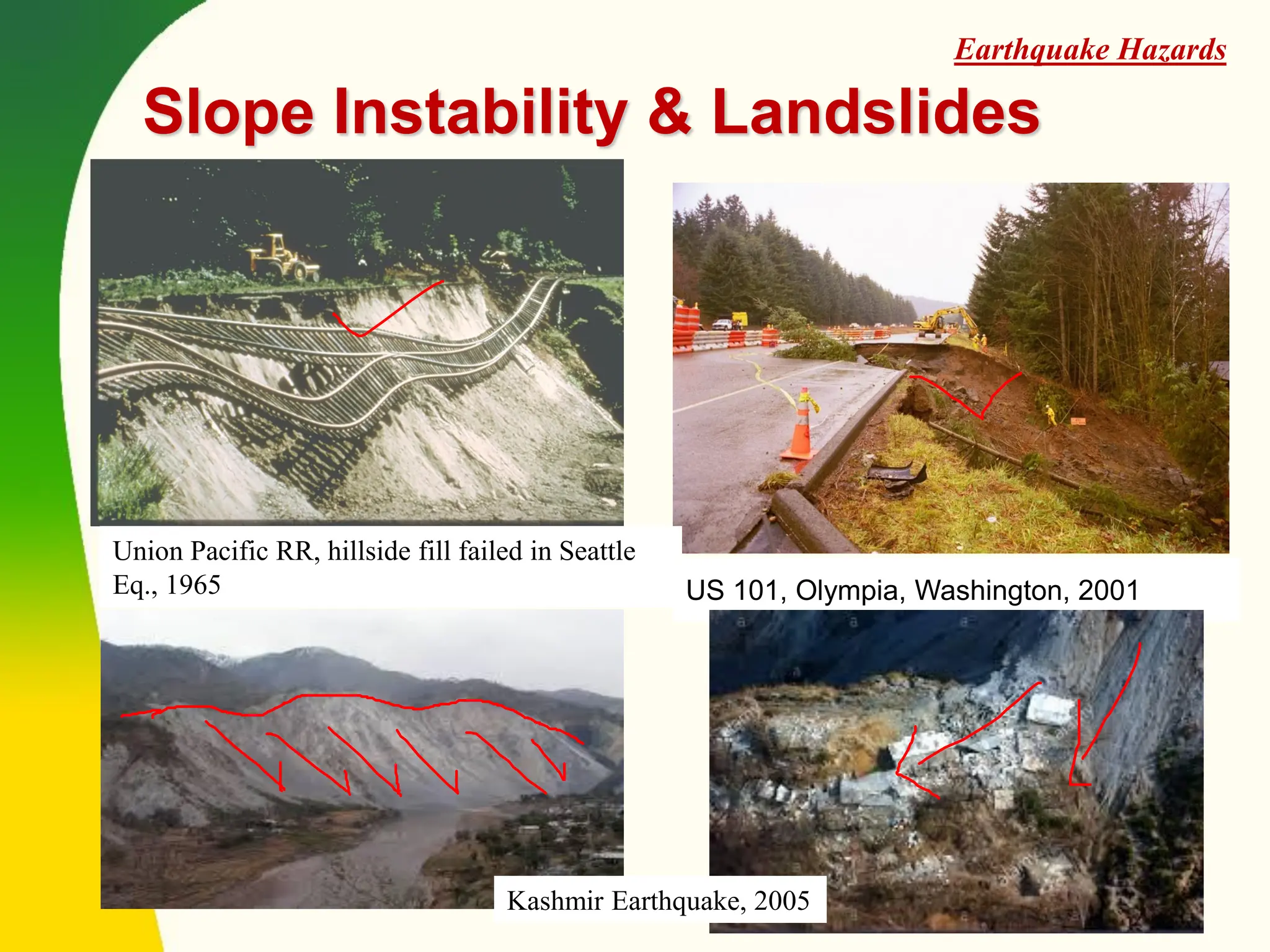
Slope Instability & Landslides
US 101, Olympia, Washington, 2001
Union Pacific RR, hillside fill failed in Seattle
Eq., 1965
Earthquake Hazards
Kashmir Earthquake, 2005
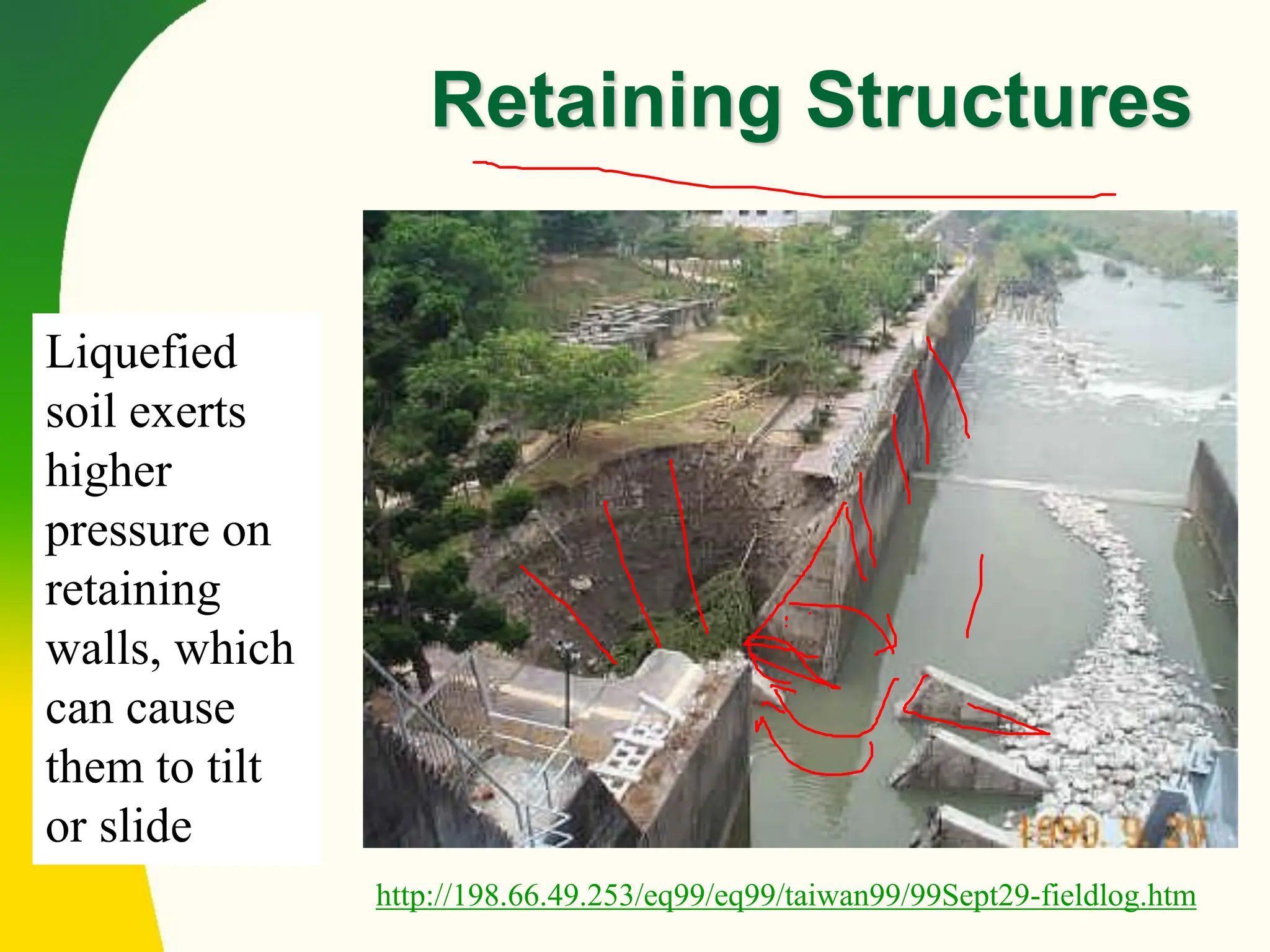
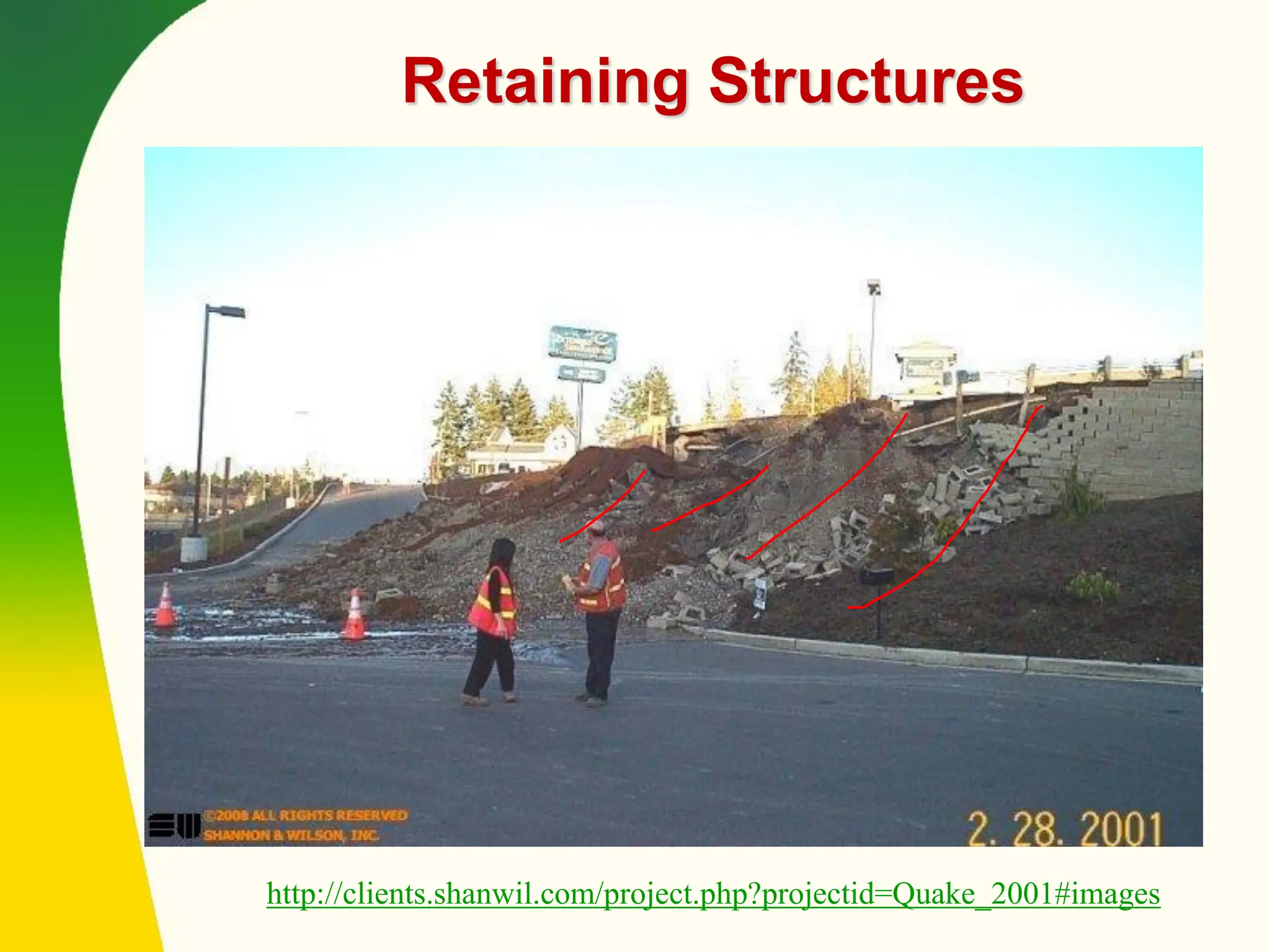
Retaining Structures
http://198.66.49.253/eq99/eq99/taiwan99/99Sept29-fieldlog.htm
Liquefied
soil exerts
higher
pressure on
retaining
walls, which
can cause
them to tilt
or slide
Retaining Structures
http://clients.shanwil.com/project.php?projectid=Quake_2001#images
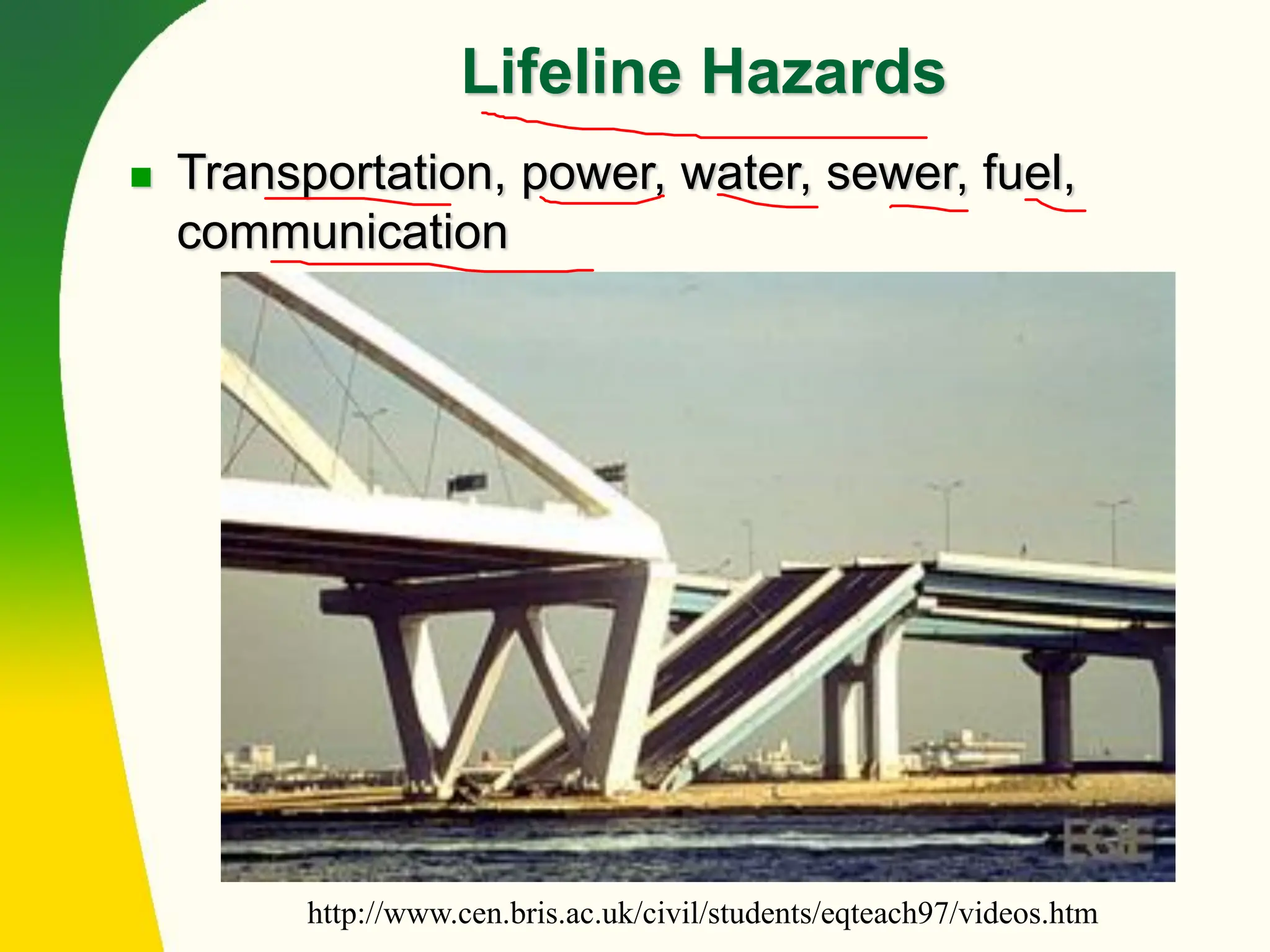
Lifeline Hazards
◼ Transportation, power, water, sewer, fuel,
communication
http://www.cen.bris.ac.uk/civil/students/eqteach97/videos.htm
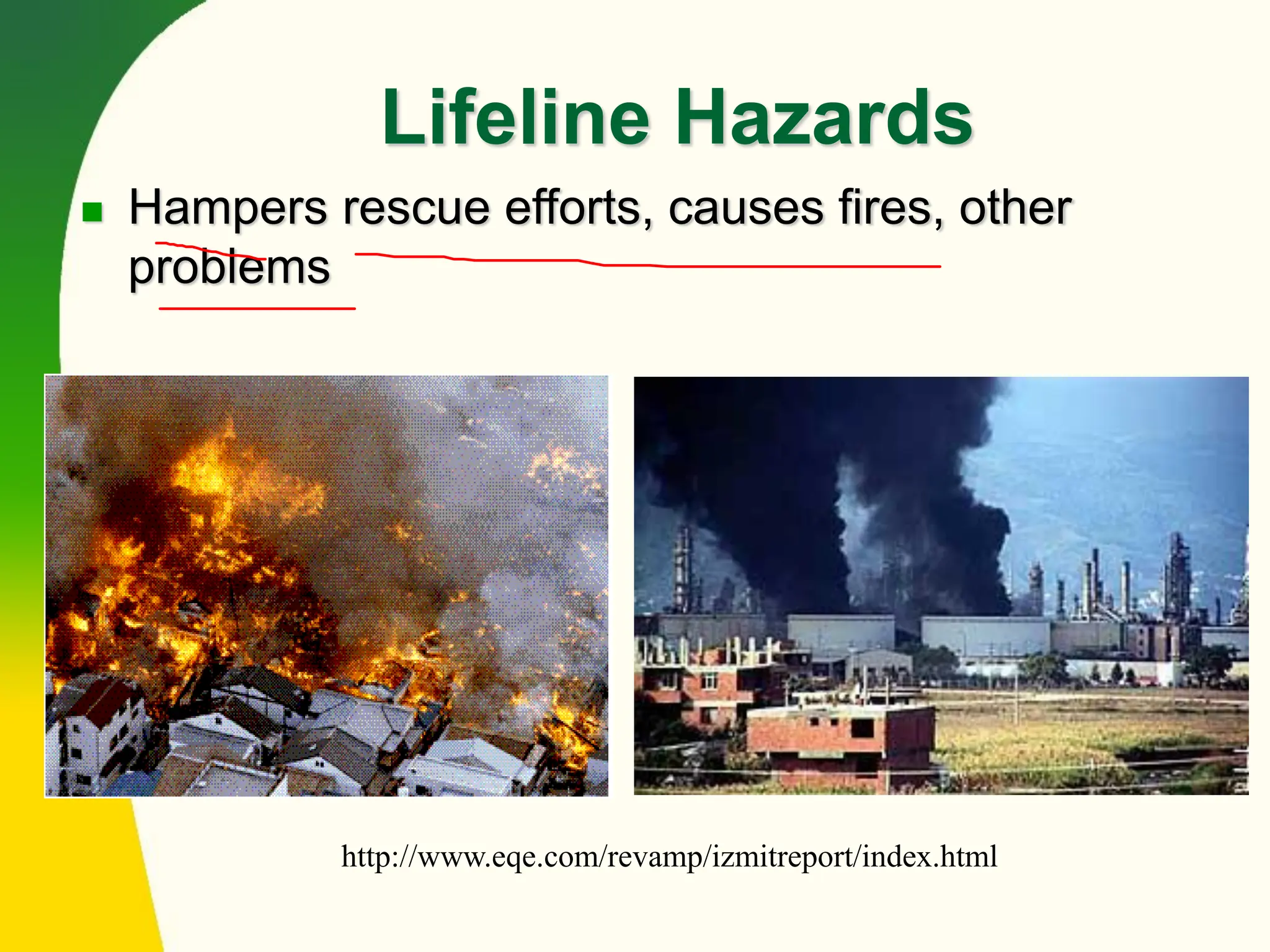
Lifeline Hazards
◼ Hampers rescue efforts, causes fires, other
problems
http://www.eqe.com/revamp/izmitreport/index.html
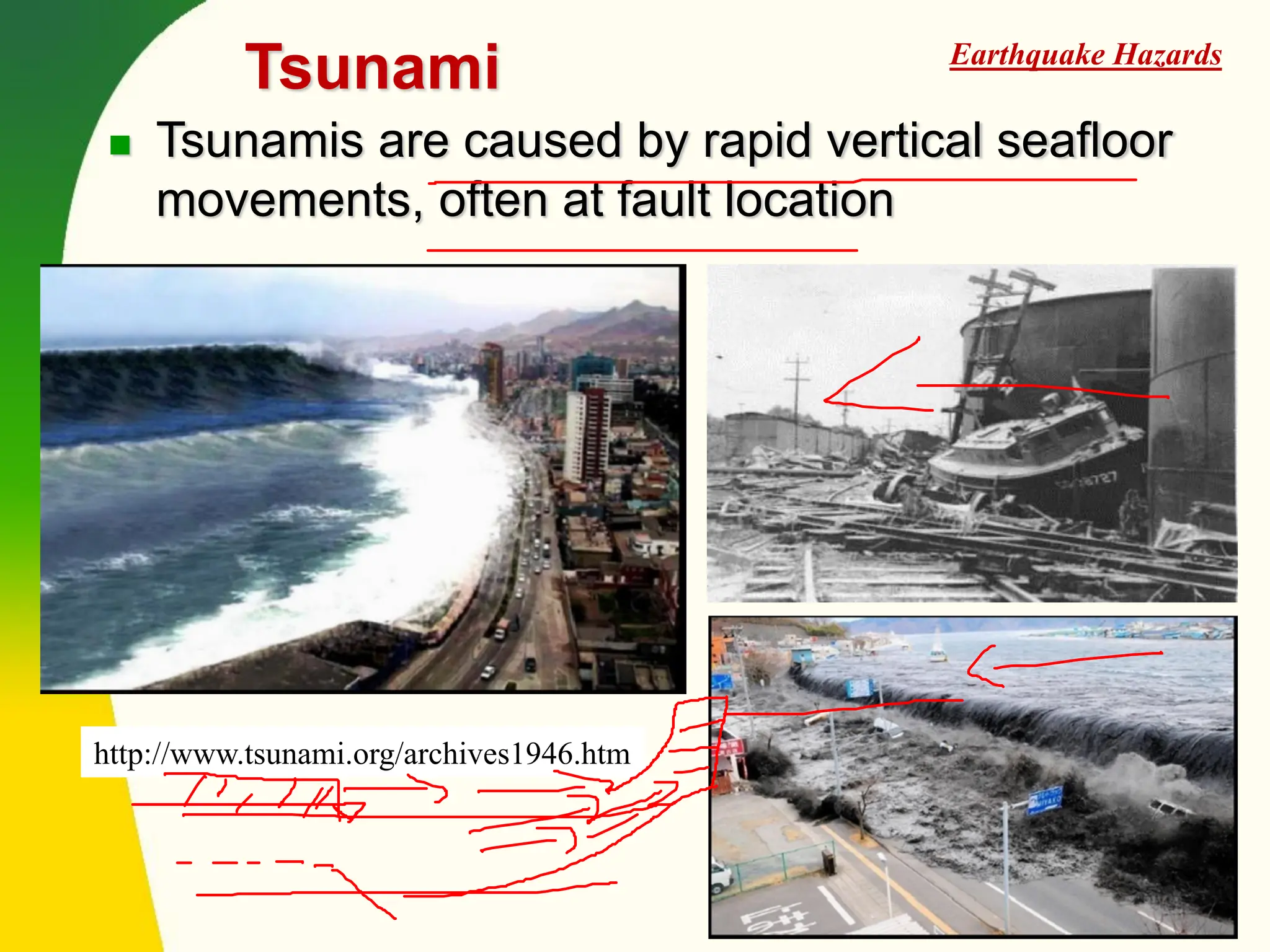
Tsunami
◼ Tsunamis are caused by rapid vertical seafloor
movements, often at fault location
http://www.tsunami.org/archives1946.htm
Earthquake Hazards
Why do we study Seismic Hazards ?
Seismic-hazard Information Helps to Ensure the
Survival of Structures & Lifelines.
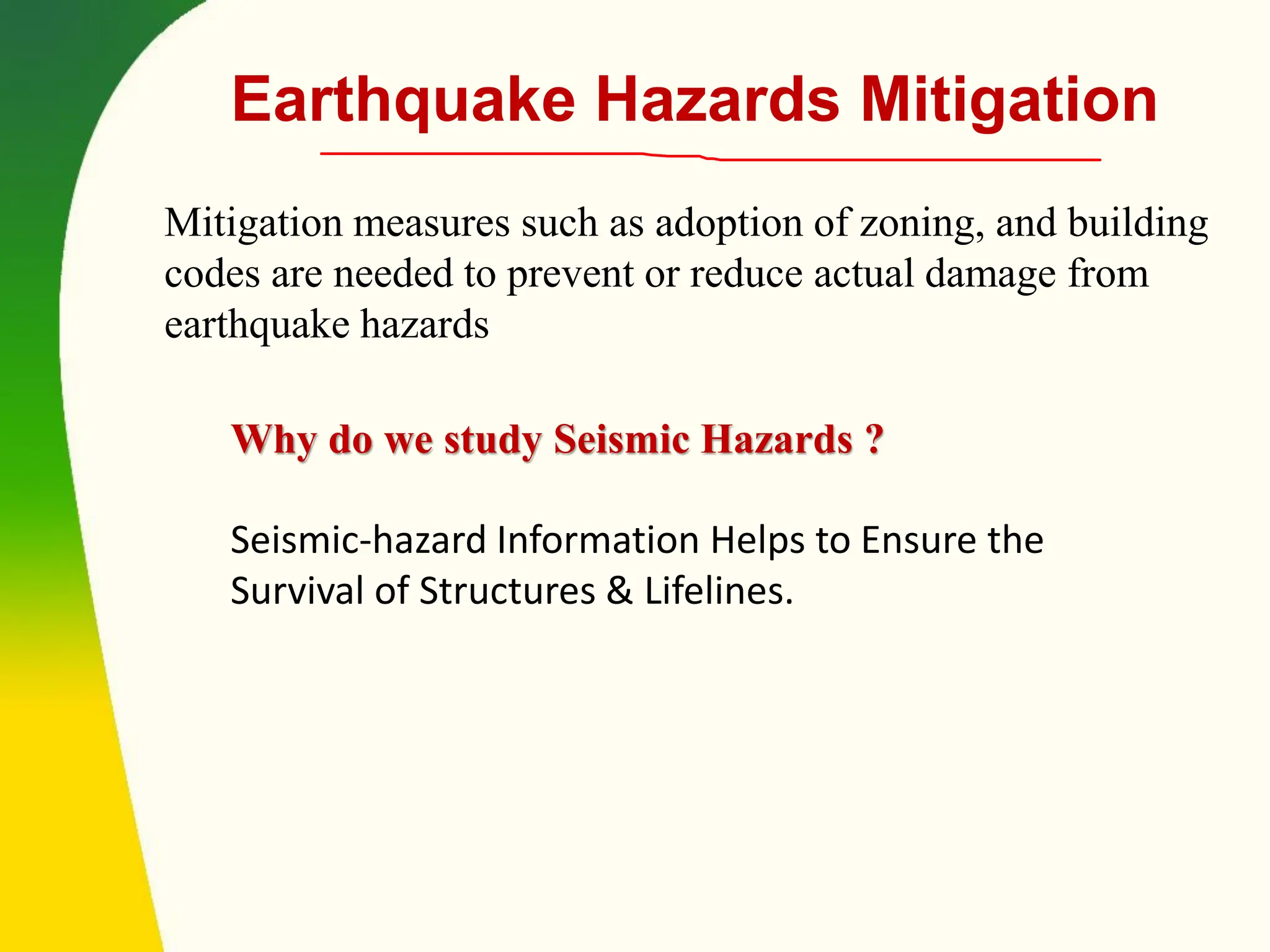
Earthquake Hazards Mitigation
Mitigation measures such as adoption of zoning, and building
codes are needed to prevent or reduce actual damage from
earthquake hazards
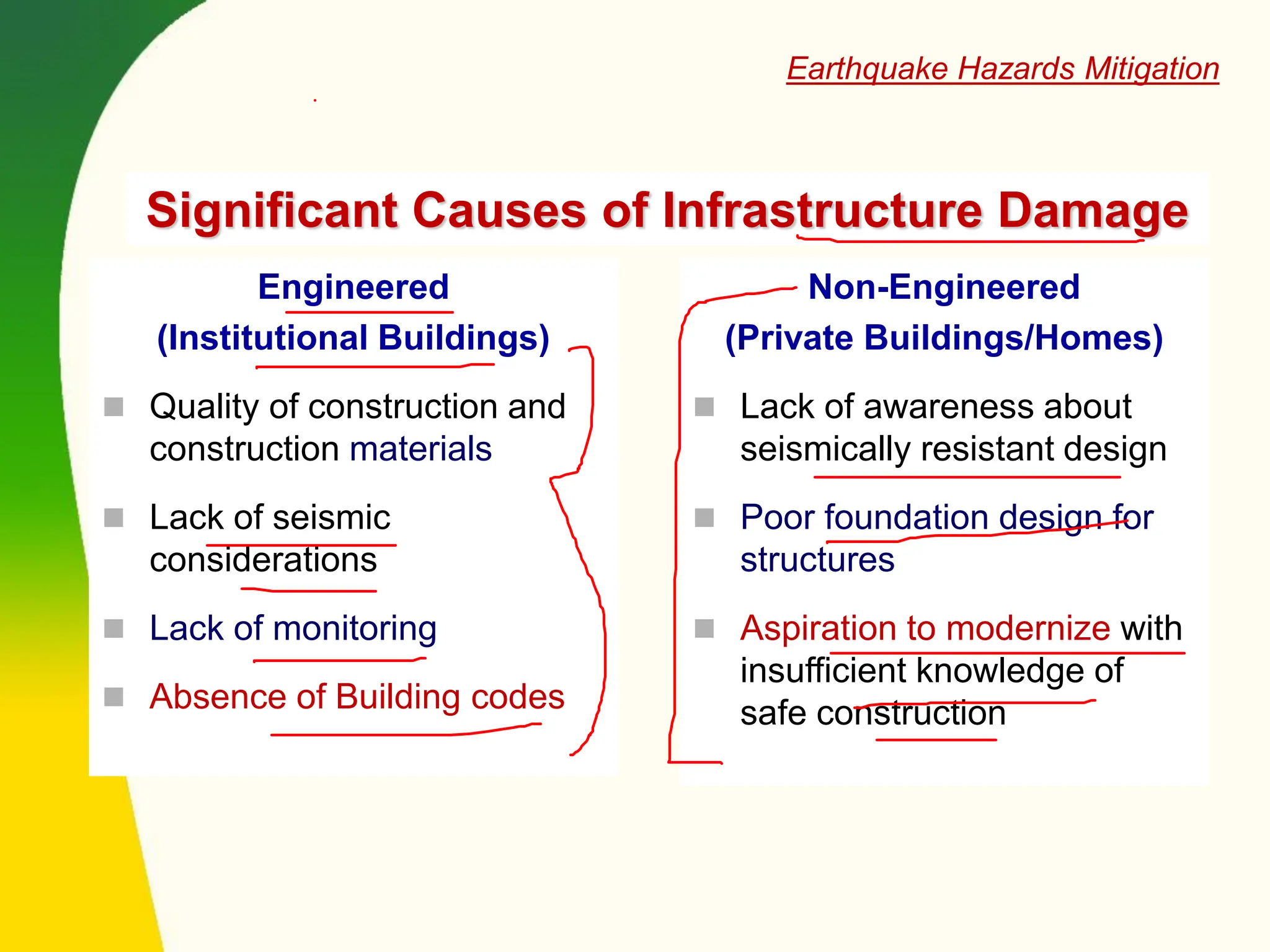
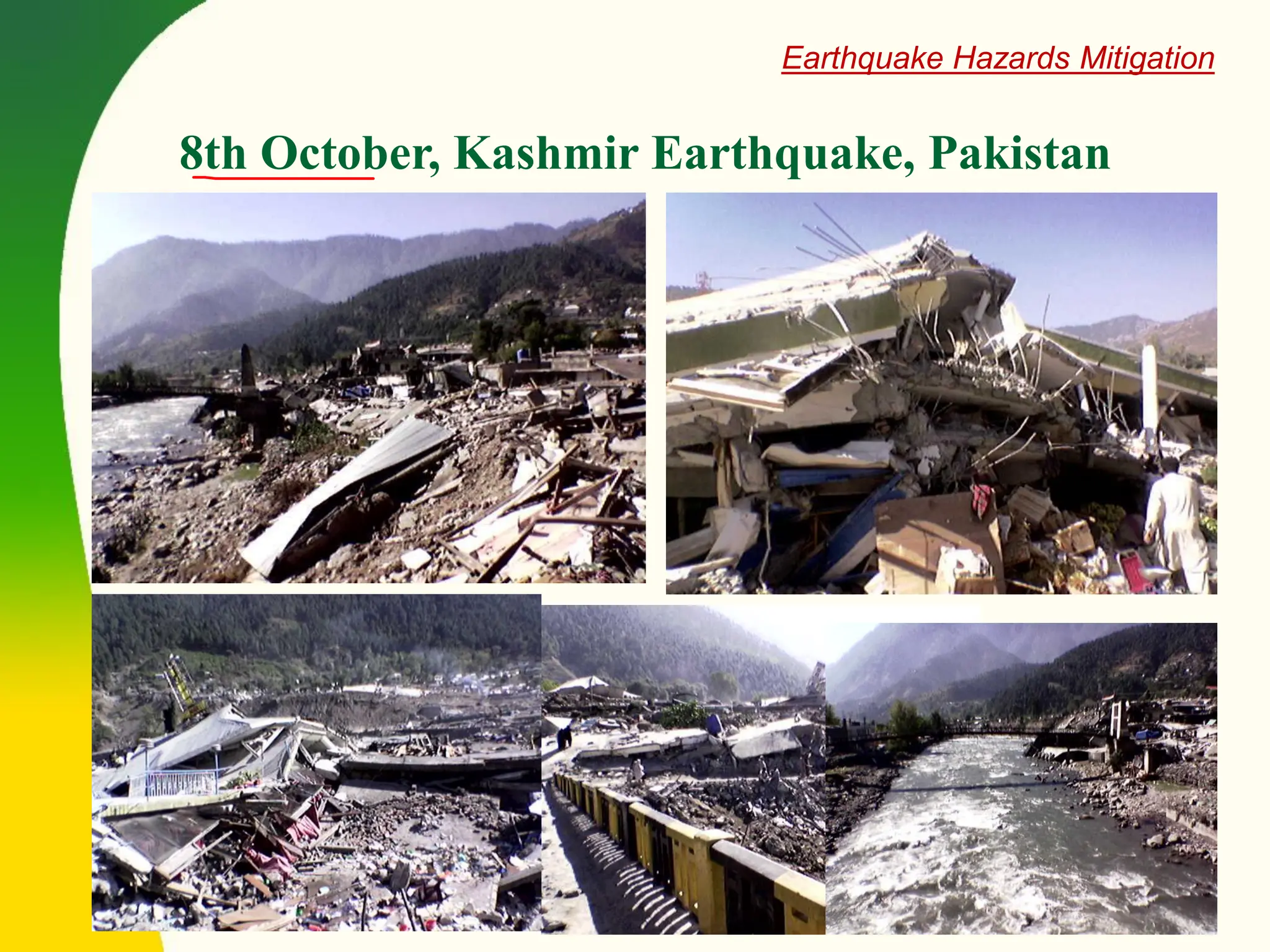
8th October, Kashmir Earthquake, Pakistan
Earthquake Hazards Mitigation
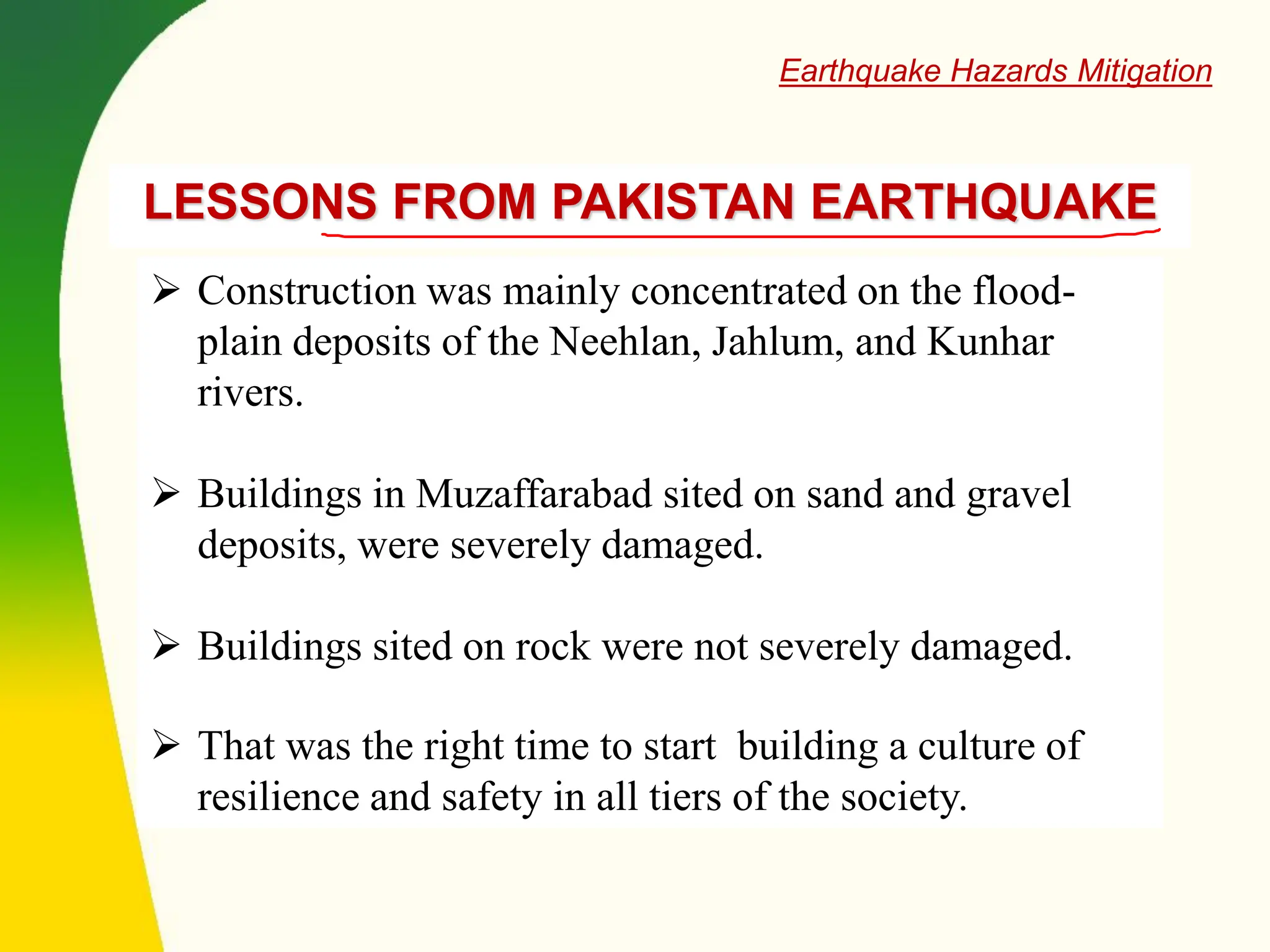
LESSONS FROM PAKISTAN EARTHQUAKE
➢ Construction was mainly concentrated on the flood-
plain deposits of the Neehlan, Jahlum, and Kunhar
rivers.
➢ Buildings in Muzaffarabad sited on sand and gravel
deposits, were severely damaged.
➢ Buildings sited on rock were not severely damaged.
➢ That was the right time to start building a culture of
resilience and safety in all tiers of the society.
Earthquake Hazards Mitigation
Significant Causes of Infrastructure Damage
Engineered
(Institutional Buildings)
◼ Quality of construction and
construction materials
◼ Lack of seismic
considerations
◼ Lack of monitoring
◼ Absence of Building codes
Non-Engineered
(Private Buildings/Homes)
◼ Lack of awareness about
seismically resistant design
◼ Poor foundation design for
structures
◼ Aspiration to modernize with
insufficient knowledge of
safe construction
Earthquake Hazards Mitigation

Week 1 Course Intro & Earthquake hazards

  • 1.
    GEO-E- 362 Earthquake Seismology & RiskAssessment Dr. M. Farooq Ahmed Week 1 Course Introduction & Earthquake Hazards
  • 2.
    Earthquake An earthquake isthe way the Earth relieves its stress by transferring it to the people who live on it Jones L, USGS
  • 3.
    ✓ An earthquakeis an intense shaking of Earth's surface. The shaking is caused by movements in Earth's outermost layer. ✓ Earthquakes are usually caused when rock underground suddenly breaks along a fault and as a result energy is released. ✓ This sudden release of energy causes the seismic waves that produce ground shaking 8th October, 2005 Kashmir Earthquake Earthquake Basics
  • 4.
    GEO - E-362: Earthquake Seismology and Risk Assessment Earthquake physics and methods of earthquake hazard assessment, earthquake mechanics; wave propagation, instrumentation, surface waves, interpretation of seismograms and earthquake location methods, earthquake risk assessment including faults, earthquake history, strong ground motion, attenuation, principles of deterministic and probabilistic earthquake risk assessment; computational and interpretational methods that require computer skills. Target Program Outcomes: PLO2: Problem Analysis PLO3: Design/Development of Solutions PLO7: Environment and Sustainability Mapping of Course Outcomes (CLOs) to Program Outcome (PLOs) CLOs When the course is done, the participating students shall be able to: Cognitive Level Assessment Tool 1 Understand Seismic motion sources, earthquake hazard and measure the strong ground motion parameters. Cog-2 Quizzes/Assignments/Exam 2 Apply the predictive relationships to perform site specific Deterministic Seismic Hazard Analysis (DSHA) and Probabilistic Seismic Hazard Analysis (PSHA). Cog-3 Quizzes/CEP/Exam 3 Analyze the different scenarios in determining the response of a soil/rock deposit during/after earthquakes for design ground motion parameters. Cog-4 Quizzes/Assignments/Exam CLO/PLO CLO1 CLO2 CLO3 PLO 2 x PLO 3 x PLO 7 x
  • 5.
    Sources of Vibrationsin ground ◼ Vibrating machines ◼ Construction Equip: Pile driving & blasting ◼ Fault Displacement ◼ Volcanoes ◼ Explosives ◼ Mine Burst/Collapse ◼ Landslides/Rockfalls (e.g., Attabad) ◼ Reservoir-induced (e.g., Tarbela Dam)
  • 6.
  • 7.
    Acoustic science conductsany type of vibration measurements using special vibration recorders. http://www.groupscience.gr/en/services/acoustic/measurements/machine_building_ships/
  • 8.
    Construction Vibrations • PileDriving • Drilling • Jack Hammering • Tunneling
  • 9.
  • 10.
  • 11.
  • 12.
    Earthquake Depth ✓ Earthquakesusually occur at some depth below the ground Surface. The depth can also be calculated from seismograph records ✓ Earthquakes are described as: ✓ Shallow: less than 70 km depth ✓ Intermediate: 70 - 300 km depth ✓ Deep: 300 - 700 km depth ✓ 90% of earthquake foci are less than 100 km deep. ✓ Large earthquakes are mostly at < 60 km depth ✓ No earthquakes occur deeper than 700 km
  • 13.
    Causes of anEarthquake Earthquakes are usually caused when rock underground suddenly breaks along a fault. This sudden release of energy causes the seismic waves that make the ground shake - Along the plate edges - Along faults - Volcanic activities Principle mechanism Elastic Rebound Theory Locking of faults/roughness along faults
  • 14.
    Elastic Rebound Theory TheElastic rebound theory is an explanation for how energy is spread during earthquakes. As rocks on opposite sides of a fault are subjected to force and shift, they accumulate energy and slowly deform until their internal strength is exceeded. At that time, a sudden movement occurs along the fault, releasing the accumulated energy, and the rocks snap back to their original undeformed shape Also see Figs 2.20 and 2.22 in the textbook Reid, H.F., The Mechanics of the Earthquake, The California Earthquake of April 18, 1906, Report of the State Investigation Commission, Vol.2, Carnegie Institution of Washington, Washington, D.C. 1910
  • 15.
    Predicting Earthquakes ◼ StrangeAnimal Behavior stress in the rocks causes tiny hairline fractures to form, the cracking of the rocks evidently emits high pitched sounds and minute vibrations imperceptible to humans but noticeable by many animals. For example, In 1975, in Haicheng, China, many people spotted snakes emerging from their burrows a month before the city was hit by a large earthquake ◼ Foreshocks unusual increase in the frequency of small earthquakes before the main shock. ◼ Changes in water level porosity increases or decreases with changes in strain ◼ Seismic Gaps based of the chronological distribution of major earthquakes ◼ Engineering approach: Can be predicted by using GIS, by studying faults around the area, preparing seismic risk maps etc. By studying and applying methods like PSHA, DSHA etc. through determination of earthquake return period.
  • 16.
    Types of anEarthquake There are four different types of earthquakes: Tectonic, volcanic, collapse and explosion. ◼ A tectonic earthquake is one that occurs when the earth's crust breaks due to geological forces on rocks and adjoining plates that cause physical and chemical changes. ◼ A volcanic earthquake is any earthquake that results from tectonic forces which occur in conjunction with volcanic activity. ◼ A collapse earthquake are small earthquakes in underground caverns and mines that are caused by seismic waves produced from the explosion of rock on the surface. ◼ An explosion earthquake is an earthquake that is the result of the detonation of a nuclear and/or chemical device.
  • 17.
    a) Stresses, b)bending, c) Rupture, d) displacement Sequence of elastic rebound
  • 18.
    Earthquake Hazards Earthquake neverkills, but damage of structures during earthquake (due to improper or insufficient design and constructions) kills. ◼ Fault Rupture ◼ Ground Shaking ◼ Building/Structural Damage ◼ Liquefaction ◼ Landslides ◼ Retaining Wall Failures ◼ Lifeline Hazards ◼ Tsunami
  • 19.
    Earthquake Hazards Mitigation Mitigation:The action of reducing the severity, seriousness, or painfulness of something. Earthquake Mitigation Measures such as adoption of zoning, and building codes are needed to prevent or reduce actual damage from earthquake hazards.
  • 20.
    Earthquake Source •Fault Size,Slip-time Function and Slip Distribution •Rupture Propagation Wave Propagation •Crustal Velocity Structure •3-D Sedimentary Basin •Small-Scale Heterogeneity (Wave Scatterting) Site Response •Soil Depth & Type •Wave Velocity •Non-Linearity Earthquake Mechanism & Ground Shaking
  • 21.
    Ground Shaking ◼ Strengthand duration of ground shaking depend on size, location, tectonic setting and the local characteristics at the site. ◼ Attenuation of the ground motion to the site is a function of the bedrock or material that makes waves travel faster and further. ◼ Soil deposits act as “filters” ◼ Earthen materials, unreinforced concrete -- very vulnerable to shaking. ◼ Wood -- more flexible, holds up well
  • 22.
  • 23.
    Fault Rupture Taiwan (1999) Chi-ChiEarthquake Photo by M. Yoshimine © About 2 m of vertical offset
  • 24.
    Fault Rupture Taiwan (1999)Chi-Chi Earthquake About 6 m of vertical offset develop waterfall
  • 25.
    Structural Damage ◼ Aboveground & underground structures Northridge, 1994 Kobe (Hyogo Eq.), 1994 Frequency of shaking differs for different seismic waves. High frequency body waves shake low buildings more. Low frequency surface waves shake high buildings more. Intensity of shaking also depends on type of subsurface material. Unconsolidated materials amplify shaking more than rocks do.
  • 26.
    Structural Damage San FernandoValley bridge after Northridge EQ 1994 Soft story hazard, Loma Prieta EQ 1989 The soft first story is due to construction of garages in the first story and resultant reduction in shear strength
  • 27.
    Liquefaction ◼ Soil depositsexperience increase in pore water pressure and lose strength due to pore water pressure buildup during shaking. ◼ Termed liquefaction, the strength of the soil reduced, often dramatically, to the point where it is unable to support structures or remain stable. ◼ Has numerous manifestations: ➢ Sand blows ➢ Lateral spreading ➢ Flow failure ➢ Surface oscillation
  • 28.
    Liquefaction ◼ Soil depositsexperience increase in pore water pressure and lose strength due to pore water pressure buildup during shaking. ◼ Termed liquefaction, the strength of the soil reduced, often dramatically, to the point where it is unable to support structures or remain stable. Differential Settlement Bearing Capacity Failure Source, EERI Izmit Collection,Turkey 1999 Earthquake Hazards
  • 29.
    Liquefaction Lateral Spreading, Washington,2001 Lower San Fernando Dam, California 1971 Jhelum Earthquake, 2019 Earthquake Hazards
  • 30.
    Embankment dam, lateralspreading Liquefaction
  • 31.
    Slope Instability &Landslides US 101, Olympia, Washington, 2001 Union Pacific RR, hillside fill failed in Seattle Eq., 1965 Earthquake Hazards Kashmir Earthquake, 2005
  • 32.
  • 33.
  • 34.
    Lifeline Hazards ◼ Transportation,power, water, sewer, fuel, communication http://www.cen.bris.ac.uk/civil/students/eqteach97/videos.htm
  • 35.
    Lifeline Hazards ◼ Hampersrescue efforts, causes fires, other problems http://www.eqe.com/revamp/izmitreport/index.html
  • 36.
    Tsunami ◼ Tsunamis arecaused by rapid vertical seafloor movements, often at fault location http://www.tsunami.org/archives1946.htm Earthquake Hazards
  • 37.
    Why do westudy Seismic Hazards ? Seismic-hazard Information Helps to Ensure the Survival of Structures & Lifelines. Earthquake Hazards Mitigation Mitigation measures such as adoption of zoning, and building codes are needed to prevent or reduce actual damage from earthquake hazards
  • 38.
    8th October, KashmirEarthquake, Pakistan Earthquake Hazards Mitigation
  • 39.
    LESSONS FROM PAKISTANEARTHQUAKE ➢ Construction was mainly concentrated on the flood- plain deposits of the Neehlan, Jahlum, and Kunhar rivers. ➢ Buildings in Muzaffarabad sited on sand and gravel deposits, were severely damaged. ➢ Buildings sited on rock were not severely damaged. ➢ That was the right time to start building a culture of resilience and safety in all tiers of the society. Earthquake Hazards Mitigation
  • 40.
    Significant Causes ofInfrastructure Damage Engineered (Institutional Buildings) ◼ Quality of construction and construction materials ◼ Lack of seismic considerations ◼ Lack of monitoring ◼ Absence of Building codes Non-Engineered (Private Buildings/Homes) ◼ Lack of awareness about seismically resistant design ◼ Poor foundation design for structures ◼ Aspiration to modernize with insufficient knowledge of safe construction Earthquake Hazards Mitigation