Proteins involved in
DNA replication
—25
OVERVIEW
DNA is the reserve bank of genetic information. DNA is the chemical basis of
heredity. DNA is not only present in chromosomes of eaukaryotes ,but also in
the single chromosome of prokaryotes.
The genetic information present in DNA is copied and transmitted to
daughter cells.
PROKARYOTES
In prokaryotes DNA replication is much simpler than in eukaryotes but
involves the same type of mechanisms.
Proteins involved :-
● DnaA protein
● DNA helicases
● DNA primase
● Single stranded Dna binding protein
● Topoisomerses
● DNA polymerase
● DNA ligase
DnaA
It initiates replication by binding with specific nucleotide sequences within
oriC
Binding causes AT-rich region in origin to melt
Melting results in localised region of ssDNA
DNA helicases
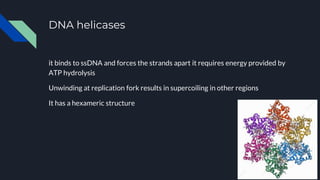
it binds to ssDNA and forces the strands apart it requires energy provided by
ATP hydrolysis
Unwinding at replication fork results in supercoiling in other regions
It has a hexameric structure
DNA primase
Primase is an enzyme that is capable to synthesize short stretches of
RNA sequences which are complementary and antiparallel to template
,known as a primer.
Primers are an integral part of DNA replication. These primers serve as
an initiating site for the addition of nucleotides by DNA polymerase.
Single stranded DNA binding protein
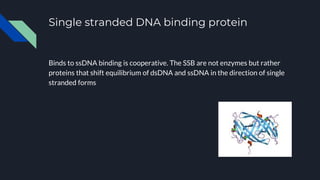
Binds to ssDNA binding is cooperative. The SSB are not enzymes but rather
proteins that shift equilibrium of dsDNA and ssDNA in the direction of single
stranded forms
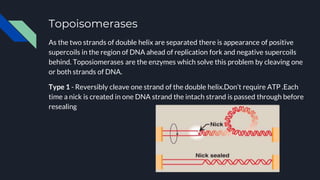
Topoisomerases
As the two strands of double helix are separated there is appearance of positive
supercoils in the region of DNA ahead of replication fork and negative supercoils
behind. Toposiomerases are the enzymes which solve this problem by cleaving one
or both strands of DNA.
Type 1 - Reversibly cleave one strand of the double helix.Don’t require ATP .Each
time a nick is created in one DNA strand the intach strand is passed through before
resealing
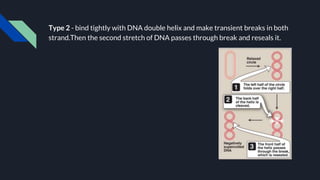
Type 2 - bind tightly with DNA double helix and make transient breaks in both
strand.Then the second stretch of DNA passes through break and reseals it.
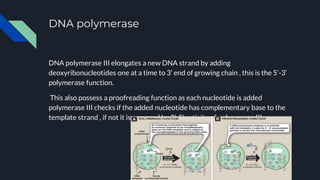
DNA polymerase
DNA polymerase III elongates a new DNA strand by adding
deoxyribonucleotides one at a time to 3’ end of growing chain , this is the 5’-3’
polymerase function.
This also possess a proofreading function as each nucleotide is added
polymerase III checks if the added nucleotide has complementary base to the
template strand , if not it is removed by 3’-5’ activity of polymerase III.
DNA ligase
DNA ligase is a specific type of enzyme that facilitates the joining of DNA
strands together by catalyzing the formation of a phosphodiester bond.
This enzyme joins the 3′ hydroxyl group of one nucleotide with the 5′
phosphate end of another nucleotide at an expense of ATP
EUKARYOTES
DNA replication in eukaryotes closely follow prokaryotes.
Proteins involved :-
● Origin recognition complex(ORC)
● Minichromosome maintenance complex(MCM)
● Replication Protein A (RPA)
● Polymerases
● Proliferating Cell Nuclear Antigen (PCNA)
● RNase H
Origin recognition complex(ORC)
Multi-subunit DNA binding complex. It binds to the Origin of replication site
in ATP dependent manner
Minichromosome maintenance
complex(MCM)
Minichromosome maintenance complex(MCM) is a DNA helicase
essential for genomic DNA replicatio
Replication Protein A (RPA)
Single-stranded DNA binding protein called replication protein A (RPA) binds
to the exposed single-stranded template in lagging strand
The RPA has a function to protect ssDNAA.
Polymerases
DNA polymerase αcontains primase and initiates DNA synthesis
DNA polymerase δ elongates okazaki fragments of the lagging strand.
Involved in proof reading
DNA polymerase ε elongates the leading strand
Proliferating Cell Nuclear Antigen (PCNA)
The assembly of proliferating cell nuclear antigen (PCNA) is catalysed by
Replication Factor C (RFC) which serves as clamp loader
The PCNA functions as sliding clamp
Rnase H & Flap Endonuclease 1 (FEN 1)
Rnase H and FEN 1 together carry out RNA primer removal
THANK YOU

Proteins involved in DNA replication (25).pptx

  • 1.
    Proteins involved in DNAreplication —25
  • 2.
    OVERVIEW DNA is thereserve bank of genetic information. DNA is the chemical basis of heredity. DNA is not only present in chromosomes of eaukaryotes ,but also in the single chromosome of prokaryotes. The genetic information present in DNA is copied and transmitted to daughter cells.
  • 3.
    PROKARYOTES In prokaryotes DNAreplication is much simpler than in eukaryotes but involves the same type of mechanisms. Proteins involved :- ● DnaA protein ● DNA helicases ● DNA primase ● Single stranded Dna binding protein ● Topoisomerses ● DNA polymerase ● DNA ligase
  • 4.
    DnaA It initiates replicationby binding with specific nucleotide sequences within oriC Binding causes AT-rich region in origin to melt Melting results in localised region of ssDNA
  • 5.
    DNA helicases it bindsto ssDNA and forces the strands apart it requires energy provided by ATP hydrolysis Unwinding at replication fork results in supercoiling in other regions It has a hexameric structure
  • 6.
    DNA primase Primase isan enzyme that is capable to synthesize short stretches of RNA sequences which are complementary and antiparallel to template ,known as a primer. Primers are an integral part of DNA replication. These primers serve as an initiating site for the addition of nucleotides by DNA polymerase.
  • 7.
    Single stranded DNAbinding protein Binds to ssDNA binding is cooperative. The SSB are not enzymes but rather proteins that shift equilibrium of dsDNA and ssDNA in the direction of single stranded forms
  • 8.
    Topoisomerases As the twostrands of double helix are separated there is appearance of positive supercoils in the region of DNA ahead of replication fork and negative supercoils behind. Toposiomerases are the enzymes which solve this problem by cleaving one or both strands of DNA. Type 1 - Reversibly cleave one strand of the double helix.Don’t require ATP .Each time a nick is created in one DNA strand the intach strand is passed through before resealing
  • 9.
    Type 2 -bind tightly with DNA double helix and make transient breaks in both strand.Then the second stretch of DNA passes through break and reseals it.
  • 10.
    DNA polymerase DNA polymeraseIII elongates a new DNA strand by adding deoxyribonucleotides one at a time to 3’ end of growing chain , this is the 5’-3’ polymerase function. This also possess a proofreading function as each nucleotide is added polymerase III checks if the added nucleotide has complementary base to the template strand , if not it is removed by 3’-5’ activity of polymerase III.
  • 11.
    DNA ligase DNA ligaseis a specific type of enzyme that facilitates the joining of DNA strands together by catalyzing the formation of a phosphodiester bond. This enzyme joins the 3′ hydroxyl group of one nucleotide with the 5′ phosphate end of another nucleotide at an expense of ATP
  • 12.
    EUKARYOTES DNA replication ineukaryotes closely follow prokaryotes. Proteins involved :- ● Origin recognition complex(ORC) ● Minichromosome maintenance complex(MCM) ● Replication Protein A (RPA) ● Polymerases ● Proliferating Cell Nuclear Antigen (PCNA) ● RNase H
  • 13.
    Origin recognition complex(ORC) Multi-subunitDNA binding complex. It binds to the Origin of replication site in ATP dependent manner Minichromosome maintenance complex(MCM) Minichromosome maintenance complex(MCM) is a DNA helicase essential for genomic DNA replicatio
  • 14.
    Replication Protein A(RPA) Single-stranded DNA binding protein called replication protein A (RPA) binds to the exposed single-stranded template in lagging strand The RPA has a function to protect ssDNAA.
  • 15.
    Polymerases DNA polymerase αcontainsprimase and initiates DNA synthesis DNA polymerase δ elongates okazaki fragments of the lagging strand. Involved in proof reading DNA polymerase ε elongates the leading strand
  • 16.
    Proliferating Cell NuclearAntigen (PCNA) The assembly of proliferating cell nuclear antigen (PCNA) is catalysed by Replication Factor C (RFC) which serves as clamp loader The PCNA functions as sliding clamp Rnase H & Flap Endonuclease 1 (FEN 1) Rnase H and FEN 1 together carry out RNA primer removal
  • 17.