Protecting vital data with
NIST Framework
Tweet along: #Sec360
@pjktech @cohesivenet
About me
Patrick Kerpan
CEO at Cohesive Networks
@pjktech
BANKS
Tweet along: #Sec360
@pjktech @cohesivenet
About Cohesive Networks
2,000+ customers
protect cloud-
based applications
User-controlled
security &
connectivity at the
top of the cloud
Cloud is creating
demand for more
connectivity and
security
honest approach to cloud security
Tweet along: #Sec360
@pjktech @cohesivenet
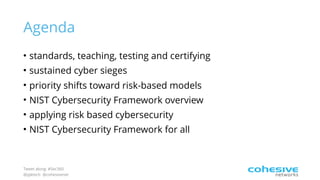
Agenda
• standards, teaching, testing and certifying
• sustained cyber sieges
• priority shifts toward risk-based models
• NIST Cybersecurity Framework overview
• applying risk based cybersecurity
• NIST Cybersecurity Framework for all
Tweet along: #Sec360
@pjktech @cohesivenet
standards, teaching, testing and certifying
Tweet along: #Sec360
@pjktech @cohesivenet
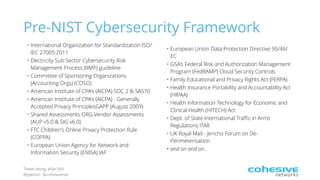
Pre-NIST Cybersecurity Framework
• International Organization for Standardization ISO/
IEC 27005:2011
• Electricity Sub-Sector Cybersecurity Risk
Management Process (RMP) guideline
• Committee of Sponsoring Organizations
(Accounting Orgs) (COSO)
• American Institute of CPA's (AICPA) SOC 2 & SAS70
• American Institute of CPA's (AICPA) - Generally
Accepted Privacy PrinciplesGAPP (August 2009)
• Shared Assessments ORG Vendor Assessments
(AUP v5.0 & SIG v6.0)
• FTC Children's Online Privacy Protection Rule
(COPPA)
• European Union Agency for Network and
Information Security (ENISA) IAF
• European Union Data Protection Directive 95/46/
EC
• GSA's Federal Risk and Authorization Management
Program (FedRAMP) Cloud Security Controls
• Family Educational and Privacy Rights Act (FERPA)
• Health Insurance Portability and Accountability Act
(HIPAA)
• Health Information Technology for Economic and
Clinical Health (HITECH) Act
• Dept. of State International Traffic in Arms
Regulations ITAR
• UK Royal Mail - Jericho Forum on De-
Perimeterisation
• and on and on…
Tweet along: #Sec360
@pjktech @cohesivenet
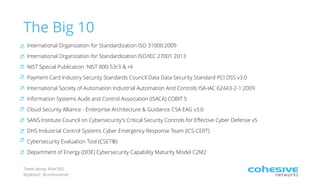
The Big 10
International Organization for Standardization ISO 31000:2009
International Organization for Standardization ISO/IEC 27001 2013
NIST Special Publication NIST 800-53r3 & r4
Payment Card Industry Security Standards Council Data Data Security Standard PCI DSS v3.0
International Society of Automation Industrial Automation And Controls ISA-IAC 62443-2-1:2009
Information Systems Audit and Control Association (ISACA) COBIT 5
Cloud Security Alliance - Enterprise Architecture & Guidance CSA EAG v3.0
SANS Institute Council on Cybersecurity's Critical Security Controls for Effective Cyber Defense v5
DHS Industrial Control Systems Cyber Emergency Response Team (ICS-CERT)
Cybersecurity Evaluation Tool (CSET®)
Department of Energy (DOE) Cybersecurity Capability Maturity Model C2M2
Tweet along: #Sec360
@pjktech @cohesivenet
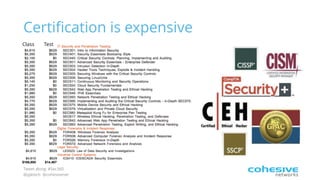
Certification is expensive
Class Test
Tweet along: #Sec360
@pjktech @cohesivenet
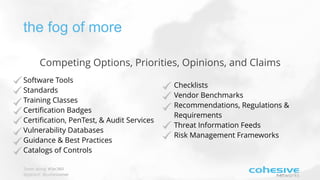
the fog of more
Software Tools
Standards
Training Classes
Certification Badges
Certification, PenTest, & Audit Services
Vulnerability Databases
Guidance & Best Practices
Catalogs of Controls
Checklists
Vendor Benchmarks
Recommendations, Regulations &
Requirements
Threat Information Feeds
Risk Management Frameworks
Competing Options, Priorities, Opinions, and Claims
Tweet along: #Sec360
@pjktech @cohesivenet
sustained cyber siege
Tweet along: #Sec360
@pjktech @cohesivenet
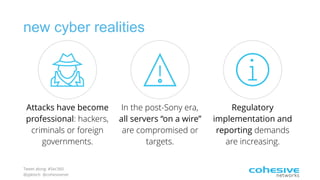
new cyber realities
Attacks have become
professional: hackers,
criminals or foreign
governments.
In the post-Sony era,
all servers “on a wire”
are compromised or
targets.
Regulatory
implementation and
reporting demands
are increasing.
Tweet along: #Sec360
@pjktech @cohesivenet
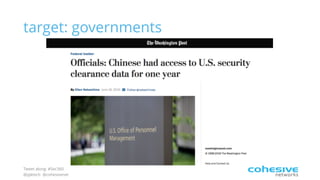
target: governments
Tweet along: #Sec360
@pjktech @cohesivenet
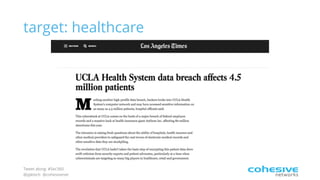
target: healthcare
Tweet along: #Sec360
@pjktech @cohesivenet
target: retail
Tweet along: #Sec360
@pjktech @cohesivenet
target: you
Tweet along: #Sec360
@pjktech @cohesivenet
shifting priorities
Tweet along: #Sec360
@pjktech @cohesivenet
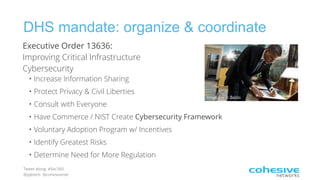
DHS mandate: organize & coordinate
Image credit: Beldin
Executive Order 13636: 

Improving Critical Infrastructure
Cybersecurity
• Increase Information Sharing
• Protect Privacy & Civil Liberties
• Consult with Everyone
• Have Commerce / NIST Create Cybersecurity Framework
• Voluntary Adoption Program w/ Incentives
• Identify Greatest Risks
• Determine Need for More Regulation
Tweet along: #Sec360
@pjktech @cohesivenet
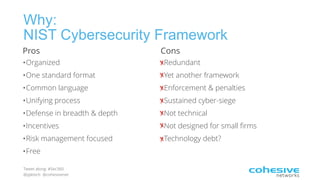
Why:
NIST Cybersecurity Framework
Pros
•Organized
•One standard format
•Common language
•Unifying process
•Defense in breadth & depth
•Incentives
•Risk management focused
•Free
Cons
•Redundant
•Yet another framework
•Enforcement & penalties
•Sustained cyber-siege
•Not technical
•Not designed for small firms
•Technology debt?
Tweet along: #Sec360
@pjktech @cohesivenet
NIST Cybersecurity Framework
Tweet along: #Sec360
@pjktech @cohesivenet
Who:
16 critical infrastructure sectors
Nuclear Chemical Facilities CommsManufacturing EmergencyDamsDefense
Financial Energy Agriculture HealthWater IT
Gov
Facilities
Transportation
Image credit: dhs.gov
Tweet along: #Sec360
@pjktech @cohesivenet
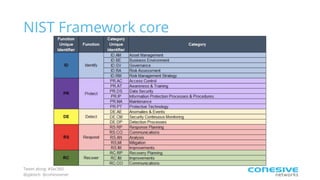
NIST Framework core
Tweet along: #Sec360
@pjktech @cohesivenet
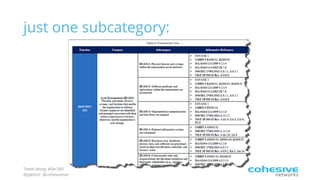
just one subcategory:
Tweet along: #Sec360
@pjktech @cohesivenet
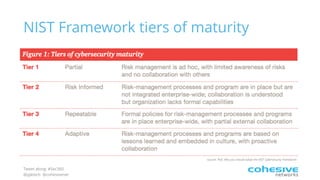
NIST Framework tiers of maturity
source: PwC Why you should adopt the NIST Cybersecurity Framework
Tweet along: #Sec360
@pjktech @cohesivenet
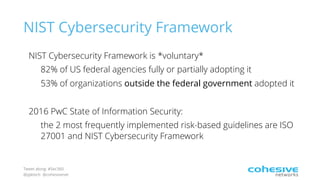
NIST Cybersecurity Framework
NIST Cybersecurity Framework is *voluntary*
82% of US federal agencies fully or partially adopting it
53% of organizations outside the federal government adopted it
2016 PwC State of Information Security:
the 2 most frequently implemented risk-based guidelines are ISO
27001 and NIST Cybersecurity Framework
Tweet along: #Sec360
@pjktech @cohesivenet
applying risk based cybersecurity
Tweet along: #Sec360
@pjktech @cohesivenet
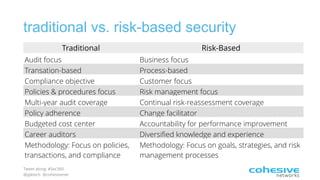
traditional vs. risk-based security
Traditional Risk-Based
Audit focus Business focus
Transation-based Process-based
Compliance objective Customer focus
Policies & procedures focus Risk management focus
Multi-year audit coverage Continual risk-reassessment coverage
Policy adherence Change facilitator
Budgeted cost center Accountability for performance improvement
resultsCareer auditors Diversified knowledge and experience
Methodology: Focus on policies,
transactions, and compliance
Methodology: Focus on goals, strategies, and risk
management processes
Tweet along: #Sec360
@pjktech @cohesivenet
risk-based security frameworks
2016 PwC State of Information Security:
91% of companies have already adopted a risk-based cybersecurity
framework
Risk-based security can help:
• identify and prioritize risks
• gauge the maturity of cybersecurity practices
• better communicate internally and externally
• design, measure and monitor goals
• build program that centers around safety and security of data
Tweet along: #Sec360
@pjktech @cohesivenet
NIST Cybersecurity Framework for all
Tweet along: #Sec360
@pjktech @cohesivenet
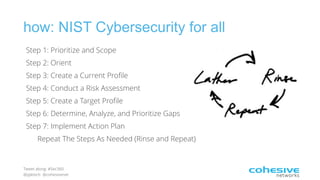
how: NIST Cybersecurity for all
Step 1: Prioritize and Scope
Step 2: Orient
Step 3: Create a Current Profile
Step 4: Conduct a Risk Assessment
Step 5: Create a Target Profile
Step 6: Determine, Analyze, and Prioritize Gaps
Step 7: Implement Action Plan
Repeat The Steps As Needed (Rinse and Repeat)
Tweet along: #Sec360
@pjktech @cohesivenet
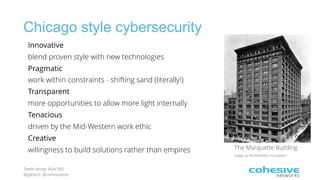
Chicago style cybersecurity
Innovative
blend proven style with new technologies
Pragmatic
work within constraints - shifting sand (literally!)
Transparent
more opportunities to allow more light internally
Tenacious
driven by the Mid-Western work ethic
Creative
willingness to build solutions rather than empires The Marquette Building
Image via the MacArthur Foundation
Tweet along: #Sec360
@pjktech @cohesivenet
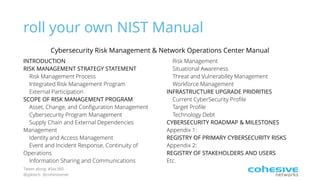
roll your own NIST Manual
INTRODUCTION
RISK MANAGEMENT STRATEGY STATEMENT
Risk Management Process
Integrated Risk Management Program
External Participation
SCOPE OF RISK MANAGEMENT PROGRAM
Asset, Change, and Configuration Management
Cybersecurity Program Management
Supply Chain and External Dependencies
Management
Identity and Access Management
Event and Incident Response, Continuity of
Operations
Information Sharing and Communications
Risk Management
Situational Awareness
Threat and Vulnerability Management
Workforce Management
INFRASTRUCTURE UPGRADE PRIORITIES
Current CyberSecurity Profile
Target Profile
Technology Debt
CYBERSECURITY ROADMAP & MILESTONES
Appendix 1:
REGISTRY OF PRIMARY CYBERSECURITY RISKS
Appendix 2:
REGISTRY OF STAKEHOLDERS AND USERS
Etc.
Cybersecurity Risk Management & Network Operations Center Manual
Tweet along: #Sec360
@pjktech @cohesivenet
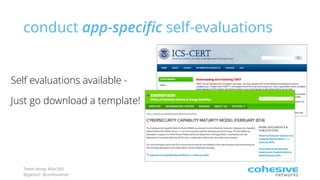
conduct app-specific self-evaluations
Self evaluations available -
Just go download a template!
Tweet along: #Sec360
@pjktech @cohesivenet
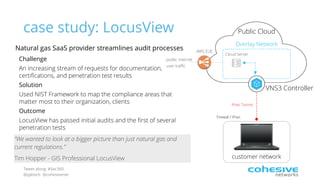
case study: LocusView
Natural gas SaaS provider streamlines audit processes
customer network
Public Cloud
Overlay Network
IPsec Tunnel
Firewall / IPsec
Cloud Server
AWS ELB
VNS3 Controller
public internet
user traffic
“We wanted to look at a bigger picture than just natural gas and
current regulations.”
Tim Hopper - GIS Professional LocusView
Challenge
An increasing stream of requests for documentation,
certifications, and penetration test results
Solution
Used NIST Framework to map the compliance areas that
matter most to their organization, clients
Outcome
LocusView has passed initial audits and the first of several
penetration tests
Tweet along: #Sec360
@pjktech @cohesivenet
conclusions
• Standards are still relevant — Map from standards, not to
• Shift from audit-heavy compliance to risk-based prevention
• Prioritize current compliance over post-mortem disaster
recovery
• Holistic security for each business unit
• NIST Framework can make everyone’s jobs less complicated
Tweet along: #Sec360
@pjktech @cohesivenet
Q&A
Stay in touch:
@pjktech
@cohesivenet
contactme@cohesive.net

Protecting Vital Data With NIST Framework - Patrick Kerpan's Secure260 presentation 2016

  • 1.
    Protecting vital datawith NIST Framework
  • 2.
    Tweet along: #Sec360 @pjktech@cohesivenet About me Patrick Kerpan CEO at Cohesive Networks @pjktech BANKS
  • 3.
    Tweet along: #Sec360 @pjktech@cohesivenet About Cohesive Networks 2,000+ customers protect cloud- based applications User-controlled security & connectivity at the top of the cloud Cloud is creating demand for more connectivity and security honest approach to cloud security
  • 4.
    Tweet along: #Sec360 @pjktech@cohesivenet Agenda • standards, teaching, testing and certifying • sustained cyber sieges • priority shifts toward risk-based models • NIST Cybersecurity Framework overview • applying risk based cybersecurity • NIST Cybersecurity Framework for all
  • 5.
    Tweet along: #Sec360 @pjktech@cohesivenet standards, teaching, testing and certifying
  • 6.
    Tweet along: #Sec360 @pjktech@cohesivenet Pre-NIST Cybersecurity Framework • International Organization for Standardization ISO/ IEC 27005:2011 • Electricity Sub-Sector Cybersecurity Risk Management Process (RMP) guideline • Committee of Sponsoring Organizations (Accounting Orgs) (COSO) • American Institute of CPA's (AICPA) SOC 2 & SAS70 • American Institute of CPA's (AICPA) - Generally Accepted Privacy PrinciplesGAPP (August 2009) • Shared Assessments ORG Vendor Assessments (AUP v5.0 & SIG v6.0) • FTC Children's Online Privacy Protection Rule (COPPA) • European Union Agency for Network and Information Security (ENISA) IAF • European Union Data Protection Directive 95/46/ EC • GSA's Federal Risk and Authorization Management Program (FedRAMP) Cloud Security Controls • Family Educational and Privacy Rights Act (FERPA) • Health Insurance Portability and Accountability Act (HIPAA) • Health Information Technology for Economic and Clinical Health (HITECH) Act • Dept. of State International Traffic in Arms Regulations ITAR • UK Royal Mail - Jericho Forum on De- Perimeterisation • and on and on…
  • 7.
    Tweet along: #Sec360 @pjktech@cohesivenet The Big 10 International Organization for Standardization ISO 31000:2009 International Organization for Standardization ISO/IEC 27001 2013 NIST Special Publication NIST 800-53r3 & r4 Payment Card Industry Security Standards Council Data Data Security Standard PCI DSS v3.0 International Society of Automation Industrial Automation And Controls ISA-IAC 62443-2-1:2009 Information Systems Audit and Control Association (ISACA) COBIT 5 Cloud Security Alliance - Enterprise Architecture & Guidance CSA EAG v3.0 SANS Institute Council on Cybersecurity's Critical Security Controls for Effective Cyber Defense v5 DHS Industrial Control Systems Cyber Emergency Response Team (ICS-CERT) Cybersecurity Evaluation Tool (CSET®) Department of Energy (DOE) Cybersecurity Capability Maturity Model C2M2
  • 8.
    Tweet along: #Sec360 @pjktech@cohesivenet Certification is expensive Class Test
  • 9.
    Tweet along: #Sec360 @pjktech@cohesivenet the fog of more Software Tools Standards Training Classes Certification Badges Certification, PenTest, & Audit Services Vulnerability Databases Guidance & Best Practices Catalogs of Controls Checklists Vendor Benchmarks Recommendations, Regulations & Requirements Threat Information Feeds Risk Management Frameworks Competing Options, Priorities, Opinions, and Claims
  • 10.
    Tweet along: #Sec360 @pjktech@cohesivenet sustained cyber siege
  • 11.
    Tweet along: #Sec360 @pjktech@cohesivenet new cyber realities Attacks have become professional: hackers, criminals or foreign governments. In the post-Sony era, all servers “on a wire” are compromised or targets. Regulatory implementation and reporting demands are increasing.
  • 12.
    Tweet along: #Sec360 @pjktech@cohesivenet target: governments
  • 13.
    Tweet along: #Sec360 @pjktech@cohesivenet target: healthcare
  • 14.
    Tweet along: #Sec360 @pjktech@cohesivenet target: retail
  • 15.
    Tweet along: #Sec360 @pjktech@cohesivenet target: you
  • 16.
    Tweet along: #Sec360 @pjktech@cohesivenet shifting priorities
  • 17.
    Tweet along: #Sec360 @pjktech@cohesivenet DHS mandate: organize & coordinate Image credit: Beldin Executive Order 13636: 
 Improving Critical Infrastructure Cybersecurity • Increase Information Sharing • Protect Privacy & Civil Liberties • Consult with Everyone • Have Commerce / NIST Create Cybersecurity Framework • Voluntary Adoption Program w/ Incentives • Identify Greatest Risks • Determine Need for More Regulation
  • 18.
    Tweet along: #Sec360 @pjktech@cohesivenet Why: NIST Cybersecurity Framework Pros •Organized •One standard format •Common language •Unifying process •Defense in breadth & depth •Incentives •Risk management focused •Free Cons •Redundant •Yet another framework •Enforcement & penalties •Sustained cyber-siege •Not technical •Not designed for small firms •Technology debt?
  • 19.
    Tweet along: #Sec360 @pjktech@cohesivenet NIST Cybersecurity Framework
  • 20.
    Tweet along: #Sec360 @pjktech@cohesivenet Who: 16 critical infrastructure sectors Nuclear Chemical Facilities CommsManufacturing EmergencyDamsDefense Financial Energy Agriculture HealthWater IT Gov Facilities Transportation Image credit: dhs.gov
  • 21.
    Tweet along: #Sec360 @pjktech@cohesivenet NIST Framework core
  • 22.
    Tweet along: #Sec360 @pjktech@cohesivenet just one subcategory:
  • 23.
    Tweet along: #Sec360 @pjktech@cohesivenet NIST Framework tiers of maturity source: PwC Why you should adopt the NIST Cybersecurity Framework
  • 24.
    Tweet along: #Sec360 @pjktech@cohesivenet NIST Cybersecurity Framework NIST Cybersecurity Framework is *voluntary* 82% of US federal agencies fully or partially adopting it 53% of organizations outside the federal government adopted it 2016 PwC State of Information Security: the 2 most frequently implemented risk-based guidelines are ISO 27001 and NIST Cybersecurity Framework
  • 25.
    Tweet along: #Sec360 @pjktech@cohesivenet applying risk based cybersecurity
  • 26.
    Tweet along: #Sec360 @pjktech@cohesivenet traditional vs. risk-based security Traditional Risk-Based Audit focus Business focus Transation-based Process-based Compliance objective Customer focus Policies & procedures focus Risk management focus Multi-year audit coverage Continual risk-reassessment coverage Policy adherence Change facilitator Budgeted cost center Accountability for performance improvement resultsCareer auditors Diversified knowledge and experience Methodology: Focus on policies, transactions, and compliance Methodology: Focus on goals, strategies, and risk management processes
  • 27.
    Tweet along: #Sec360 @pjktech@cohesivenet risk-based security frameworks 2016 PwC State of Information Security: 91% of companies have already adopted a risk-based cybersecurity framework Risk-based security can help: • identify and prioritize risks • gauge the maturity of cybersecurity practices • better communicate internally and externally • design, measure and monitor goals • build program that centers around safety and security of data
  • 28.
    Tweet along: #Sec360 @pjktech@cohesivenet NIST Cybersecurity Framework for all
  • 29.
    Tweet along: #Sec360 @pjktech@cohesivenet how: NIST Cybersecurity for all Step 1: Prioritize and Scope Step 2: Orient Step 3: Create a Current Profile Step 4: Conduct a Risk Assessment Step 5: Create a Target Profile Step 6: Determine, Analyze, and Prioritize Gaps Step 7: Implement Action Plan Repeat The Steps As Needed (Rinse and Repeat)
  • 30.
    Tweet along: #Sec360 @pjktech@cohesivenet Chicago style cybersecurity Innovative blend proven style with new technologies Pragmatic work within constraints - shifting sand (literally!) Transparent more opportunities to allow more light internally Tenacious driven by the Mid-Western work ethic Creative willingness to build solutions rather than empires The Marquette Building Image via the MacArthur Foundation
  • 31.
    Tweet along: #Sec360 @pjktech@cohesivenet roll your own NIST Manual INTRODUCTION RISK MANAGEMENT STRATEGY STATEMENT Risk Management Process Integrated Risk Management Program External Participation SCOPE OF RISK MANAGEMENT PROGRAM Asset, Change, and Configuration Management Cybersecurity Program Management Supply Chain and External Dependencies Management Identity and Access Management Event and Incident Response, Continuity of Operations Information Sharing and Communications Risk Management Situational Awareness Threat and Vulnerability Management Workforce Management INFRASTRUCTURE UPGRADE PRIORITIES Current CyberSecurity Profile Target Profile Technology Debt CYBERSECURITY ROADMAP & MILESTONES Appendix 1: REGISTRY OF PRIMARY CYBERSECURITY RISKS Appendix 2: REGISTRY OF STAKEHOLDERS AND USERS Etc. Cybersecurity Risk Management & Network Operations Center Manual
  • 32.
    Tweet along: #Sec360 @pjktech@cohesivenet conduct app-specific self-evaluations Self evaluations available - Just go download a template!
  • 33.
    Tweet along: #Sec360 @pjktech@cohesivenet case study: LocusView Natural gas SaaS provider streamlines audit processes customer network Public Cloud Overlay Network IPsec Tunnel Firewall / IPsec Cloud Server AWS ELB VNS3 Controller public internet user traffic “We wanted to look at a bigger picture than just natural gas and current regulations.” Tim Hopper - GIS Professional LocusView Challenge An increasing stream of requests for documentation, certifications, and penetration test results Solution Used NIST Framework to map the compliance areas that matter most to their organization, clients Outcome LocusView has passed initial audits and the first of several penetration tests
  • 34.
    Tweet along: #Sec360 @pjktech@cohesivenet conclusions • Standards are still relevant — Map from standards, not to • Shift from audit-heavy compliance to risk-based prevention • Prioritize current compliance over post-mortem disaster recovery • Holistic security for each business unit • NIST Framework can make everyone’s jobs less complicated
  • 35.
    Tweet along: #Sec360 @pjktech@cohesivenet Q&A Stay in touch: @pjktech @cohesivenet contactme@cohesive.net