Beyond NIST, CMMC Certification:
Fusion and Future
1
1
October 31, 2023
2
2
3
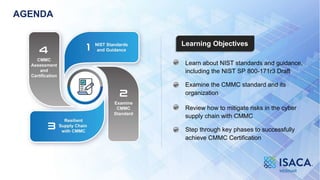
Learning Objectives
AGENDA
Learn about NIST standards and guidance,
including the NIST SP 800-171r3 Draft
Examine the CMMC standard and its
organization
Review how to mitigate risks in the cyber
supply chain with CMMC
Step through key phases to successfully
achieve CMMC Certification
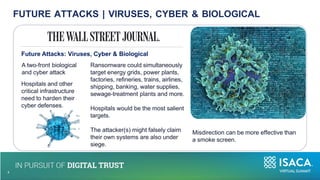
Future Attacks: Viruses, Cyber & Biological
Ransomware could simultaneously
target energy grids, power plants,
factories, refineries, trains, airlines,
shipping, banking, water supplies,
sewage-treatment plants and more.
Hospitals would be the most salient
targets.
The attacker(s) might falsely claim
their own systems are also under
siege.
A two-front biological
and cyber attack
Hospitals and other
critical infrastructure
need to harden their
cyber defenses.
FUTURE ATTACKS | VIRUSES, CYBER & BIOLOGICAL
4
4
Misdirection can be more effective than
a smoke screen.
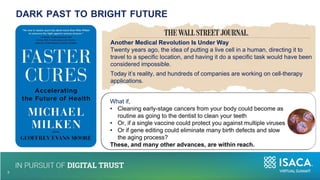
Another Medical Revolution Is Under Way
Twenty years ago, the idea of putting a live cell in a human, directing it to
travel to a specific location, and having it do a specific task would have been
considered impossible.
Today it’s reality, and hundreds of companies are working on cell-therapy
applications.
What if,
• Cleaning early-stage cancers from your body could become as
routine as going to the dentist to clean your teeth
• Or, if a single vaccine could protect you against multiple viruses
• Or if gene editing could eliminate many birth defects and slow
the aging process?
These, and many other advances, are within reach.
DARK PAST TO BRIGHT FUTURE
4
5
NIST Standards and Guidance
4
6
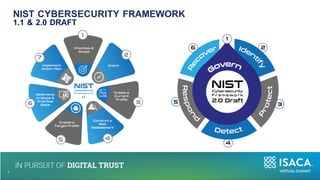
NIST CYBERSECURITY FRAMEWORK
4
7
1.1 & 2.0 DRAFT
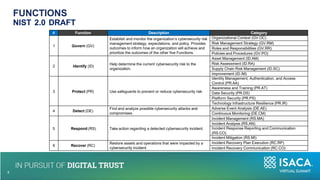
# Function Description Category
1 Govern (GV)
Establish and monitor the organization’s cybersecurity risk
management strategy, expectations, and policy. Provides
outcomes to inform how an organization will achieve and
prioritize the outcomes of the other five Functions.
Organizational Context (GV.OC)
Risk Management Strategy (GV.RM)
Roles and Responsibilities (GV.RR)
Policies and Procedures (GV.PO)
2 Identify (ID)
Help determine the current cybersecurity risk to the
organization.
Asset Management (ID.AM)
Risk Assessment (ID.RA)
Supply Chain Risk Management (ID.SC)
Improvement (ID.IM)
3 Protect (PR) Use safeguards to prevent or reduce cybersecurity risk
Identity Management, Authentication, and Access
Control (PR.AA)
Awareness and Training (PR.AT)
Data Security (PR.DS)
Platform Security (PR.PS)
Technology Infrastructure Resilience (PR.IR)
4 Detect (DE)
Find and analyze possible cybersecurity attacks and
compromises.
Adverse Event Analysis (DE.AE)
Continuous Monitoring (DE.CM)
5 Respond (RS) Take action regarding a detected cybersecurity incident.
Incident Management (RS.MA)
Incident Analysis (RS.AN)
Incident Response Reporting and Communication
(RS.CO)
Incident Mitigation (RS.MI)
6 Recover (RC)
Restore assets and operations that were impacted by a
cybersecurity incident.
Incident Recovery Plan Execution (RC.RP)
Incident Recovery Communication (RC.CO)
4
8
FUNCTIONS
NIST 2.0 DRAFT
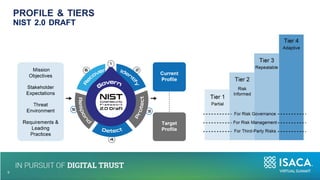
PROFILE & TIERS
NIST 2.0 DRAFT
4
9
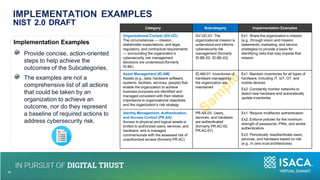
Category Subcategory Implementation Examples
Organizational Context (GV.OC)
The circumstances — mission,
stakeholder expectations, and legal,
regulatory, and contractual requirements
— surrounding the organization’s
cybersecurity risk management
decisions are understood (formerly
ID.BE)
GV.OC-01: The
organizational mission is
understood and informs
cybersecurity risk
management (formerly
ID.BE-02, ID.BE-03)
Ex1: Share the organization’s mission
(e.g., through vision and mission
statements, marketing, and service
strategies) to provide a basis for
identifying risks that may impede that
mission
Asset Management (ID.AM)
Assets (e.g., data, hardware software,
systems, facilities, services, people) that
enable the organization to achieve
business purposes are identified and
managed consistent with their relative
importance to organizational objectives
and the organization’s risk strategy
ID.AM-01: Inventories of
hardware managed by
the organization are
maintained
Ex1: Maintain inventories for all types of
hardware, including IT, IoT, OT, and
mobile devices
Ex2: Constantly monitor networks to
detect new hardware and automatically
update inventories
Identity Management, Authentication,
and Access Control (PR.AA)
Access to physical and logical assets is
limited to authorized users, services, and
hardware, and is managed
commensurate with the assessed risk of
unauthorized access (formerly PR.AC)
PR.AA-03: Users,
services, and hardware
are authenticated
(formerly PR.AC-03,
PR.AC-07)
Ex1: Require multifactor authentication
Ex2: Enforce policies for the minimum
strength of passwords, PINs, and similar
authenticators
Ex3: Periodically reauthenticate users,
services, and hardware based on risk
(e.g., in zero trust architectures)
10
10
IMPLEMENTATION EXAMPLES
NIST 2.0 DRAFT
Implementation Examples
Provide concise, action-oriented
steps to help achieve the
outcomes of the Subcategories.
The examples are not a
comprehensive list of all actions
that could be taken by an
organization to achieve an
outcome, nor do they represent
a baseline of required actions to
address cybersecurity risk.
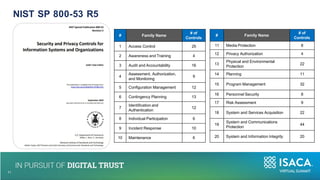
# Family Name
# of
Controls
1 Access Control 25
2 Awareness and Training 4
3 Audit and Accountability 16
4
Assessment, Authorization,
and Monitoring
9
5 Configuration Management 12
6 Contingency Planning 13
7
Identification and
Authentication
12
8 Individual Participation 6
9 Incident Response 10
10 Maintenance 6
10
11
# Family Name
# of
Controls
11 Media Protection 8
12 Privacy Authorization 4
13
Physical and Environmental
Protection
22
14 Planning 11
15 Program Management 32
16 Personnel Security 8
17 Risk Assessment 9
18 System and Services Acquisition 22
19
System and Communications
Protection
44
20 System and Information Integrity 20
NIST SP 800-53 R5
Regulated
Entities
Covered
Healthcare
Providers
Healthcare
Clearinghouses
Business
Associate
Health
Plans
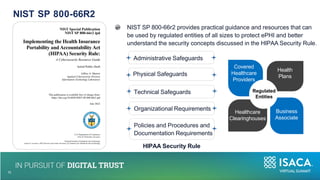
NIST SP 800-66r2 provides practical guidance and resources that can
be used by regulated entities of all sizes to protect ePHI and better
understand the security concepts discussed in the HIPAA Security Rule.
Administrative Safeguards
Technical Safeguards
Organizational Requirements
Policies and Procedures and
Documentation Requirements
HIPAA Security Rule
Physical Safeguards
NIST SP 800-66R2
10
12
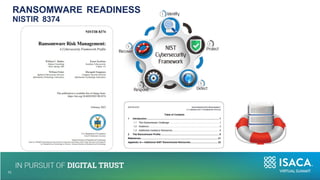
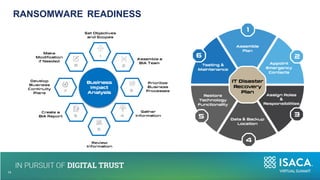
RANSOMWARE READINESS
NISTIR 8374
10
13
RANSOMWARE READINESS
10
14
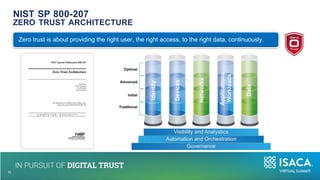
NIST SP 800-207
10
15
ZERO TRUST ARCHITECTURE
Zero trust is about providing the right user, the right access, to the right data, continuously.
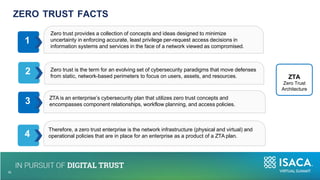
ZTA
Zero Trust
Architecture
1
Zero trust provides a collection of concepts and ideas designed to minimize
uncertainty in enforcing accurate, least privilege per-request access decisions in
information systems and services in the face of a network viewed as compromised.
2 Zero trust is the term for an evolving set of cybersecurity paradigms that move defenses
from static, network-based perimeters to focus on users, assets, and resources.
3 ZTA is an enterprise’s cybersecurity plan that utilizes zero trust concepts and
encompasses component relationships, workflow planning, and access policies.
4
Therefore, a zero trust enterprise is the network infrastructure (physical and virtual) and
operational policies that are in place for an enterprise as a product of a ZTA plan.
10
16
ZERO TRUST FACTS
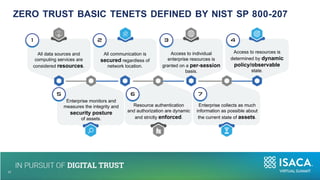
ZERO TRUST BASIC TENETS DEFINED BY NIST SP 800-207
10
17
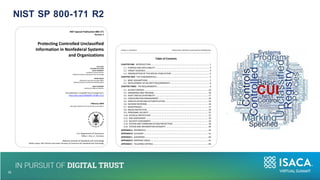
NIST SP 800-171 R2
10
18
New Addition Modification
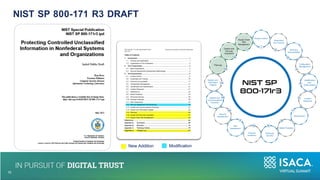
NIST SP 800-171 R3 DRAFT
10
19
EO
Executive
Order
CUI
Controlled
Unclassified
Information
NARA
National
Archives and
Records
Administration
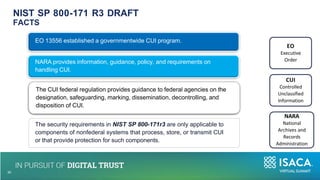
EO 13556 established a governmentwide CUI program.
NARA provides information, guidance, policy, and requirements on
handling CUI.
The CUI federal regulation provides guidance to federal agencies on the
designation, safeguarding, marking, dissemination, decontrolling, and
disposition of CUI.
The security requirements in NIST SP 800-171r3 are only applicable to
components of nonfederal systems that process, store, or transmit CUI
or that provide protection for such components.
10
20
NIST SP 800-171 R3 DRAFT
FACTS
NIST SP 800-171 R3 DRAFT
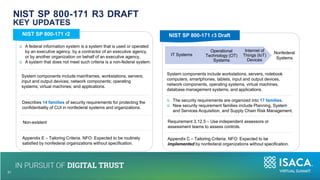
A federal information system is a system that is used or operated
by an executive agency, by a contractor of an executive agency,
or by another organization on behalf of an executive agency.
A system that does not meet such criteria is a non-federal system.
Nonfederal
Systems
IT Systems
Operational
Technology (OT)
Systems
Internet of
Things (IoT)
Devices
System components include mainframes, workstations, servers;
input and output devices; network components; operating
systems; virtual machines; and applications.
System components include workstations, servers, notebook
computers, smartphones, tablets, input and output devices,
network components, operating systems, virtual machines,
database management systems, and applications.
Describes 14 families of security requirements for protecting the
confidentiality of CUI in nonfederal systems and organizations.
The security requirements are organized into 17 families.
New security requirement families include Planning, System
and Services Acquisition, and Supply Chain Risk Management.
Non-existent Requirement 3.12.5 – Use independent assessors or
assessment teams to assess controls.
Appendix E – Tailoring Criteria. NFO: Expected to be routinely
satisfied by nonfederal organizations without specification.
Appendix C – Tailoring Criteria. NFO: Expected to be
implemented by nonfederal organizations without specification.
KEY UPDATES
NIST SP 800-171 r2 NIST SP 800-171 r3 Draft
10
21
https://dodcio.defense.gov/Portals/0/Documents/CMMC/
ModelOverview_V2.0_FINAL2_20211202_508.pdf
10
22
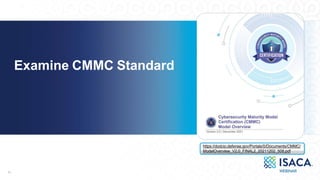
Examine CMMC Standard
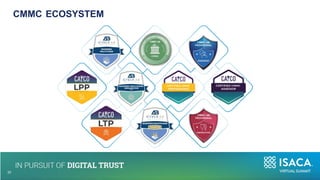
CMMC ECOSYSTEM
10
23
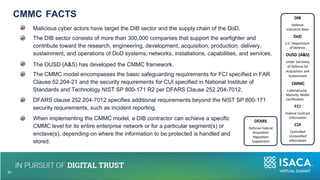
Malicious cyber actors have target the DIB sector and the supply chain of the DoD.
The DIB sector consists of more than 300,000 companies that support the warfighter and
contribute toward the research, engineering, development, acquisition, production, delivery,
sustainment, and operations of DoD systems, networks, installations, capabilities, and services.
The OUSD (A&S) has developed the CMMC framework.
The CMMC model encompasses the basic safeguarding requirements for FCI specified in FAR
Clause 52.204-21 and the security requirements for CUI specified in National Institute of
Standards and Technology NIST SP 800-171 R2 per DFARS Clause 252.204-7012.
DFARS clause 252.204-7012 specifies additional requirements beyond the NIST SP 800-171
security requirements, such as incident reporting.
DIB
Defense
Industrial Base
DoD
U.S. Department
of Defense
OUSD (A&S)
Under Secretary
of Defense for
Acquisition and
Sustainment
CMMC
Cybersecurity
Maturity Model
Certification
FCI
Federal Contract
Information
CUI
Controlled
Unclassified
Information
When implementing the CMMC model, a DIB contractor can achieve a specific
CMMC level for its entire enterprise network or for a particular segment(s) or
enclave(s), depending on where the information to be protected is handled and
stored.
DFARS
Defense Federal
Acquisition
Regulation
Supplement
10
24
CMMC FACTS
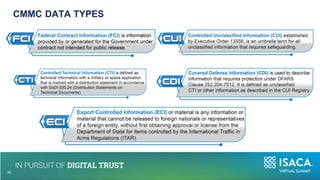
CMMC DATA TYPES
10
25
Resilient Supply Chain
with CMMC
10
26
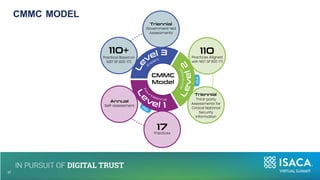
CMMC MODEL
10
27
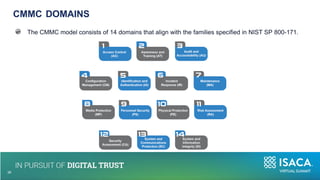
The CMMC model consists of 14 domains that align with the families specified in NIST SP 800-171.
CMMC DOMAINS
10
28
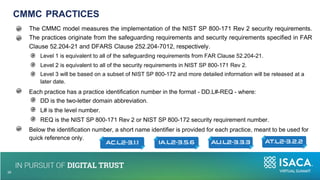
The CMMC model measures the implementation of the NIST SP 800-171 Rev 2 security requirements.
The practices originate from the safeguarding requirements and security requirements specified in FAR
Clause 52.204-21 and DFARS Clause 252.204-7012, respectively.
Level 1 is equivalent to all of the safeguarding requirements from FAR Clause 52.204-21.
Level 2 is equivalent to all of the security requirements in NIST SP 800-171 Rev 2.
Level 3 will be based on a subset of NIST SP 800-172 and more detailed information will be released at a
later date.
Each practice has a practice identification number in the format - DD.L#-REQ - where:
DD is the two-letter domain abbreviation.
L# is the level number.
REQ is the NIST SP 800-171 Rev 2 or NIST SP 800-172 security requirement number.
Below the identification number, a short name identifier is provided for each practice, meant to be used for
quick reference only.
CMMC PRACTICES
10
29
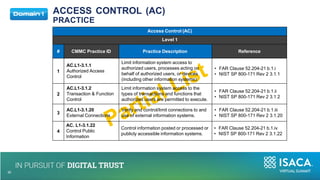
Access Control (AC)
Level 1
# CMMC Practice ID Practice Description Reference
1
AC.L1-3.1.1
Authorized Access
Control
Limit information system access to
authorized users, processes acting on
behalf of authorized users, or devices
(including other information systems).
• FAR Clause 52.204-21 b.1.i
• NIST SP 800-171 Rev 2 3.1.1
2
AC.L1-3.1.2
Transaction & Function
Control
Limit information system access to the
types of transactions and functions that
authorized users are permitted to execute.
• FAR Clause 52.204-21 b.1.ii
• NIST SP 800-171 Rev 2 3.1.2
3
AC.L1-3.1.20
External Connections
Verify and control/limit connections to and
use of external information systems.
• FAR Clause 52.204-21 b.1.iii
• NIST SP 800-171 Rev 2 3.1.20
4
AC. L1-3.1.22
Control Public
Information
Control information posted or processed or
publicly accessible information systems.
• FAR Clause 52.204-21 b.1.iv
• NIST SP 800-171 Rev 2 3.1.22
ACCESS CONTROL (AC)
PRACTICE
10
30
CMMC Assessment
and Certification
10
31
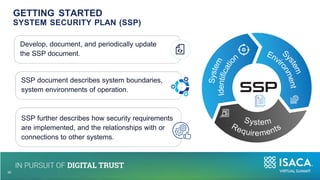
Develop, document, and periodically update
the SSP document.
SSP document describes system boundaries,
system environments of operation.
SSP further describes how security requirements
are implemented, and the relationships with or
connections to other systems.
GETTING STARTED
SYSTEM SECURITY PLAN (SSP)
10
32
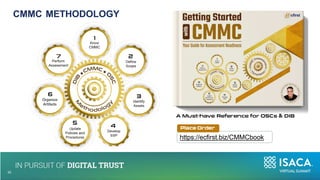
https://ecfirst.biz/CMMCbook
CMMC METHODOLOGY
10
33
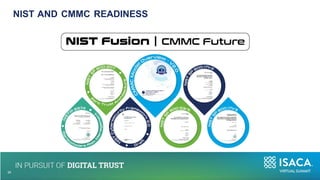
NIST AND CMMC READINESS
10
34
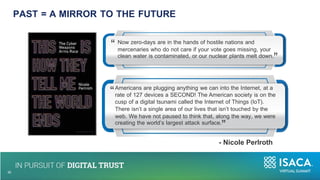
“ Now zero-days are in the hands of hostile nations and
mercenaries who do not care if your vote goes missing, your
clean water is contaminated, or our nuclear plants melt down.
”
“
10
35
Americans are plugging anything we can into the Internet, at a
rate of 127 devices a SECOND! The American society is on the
cusp of a digital tsunami called the Internet of Things (IoT).
There isn’t a single area of our lives that isn’t touched by the
web. We have not paused to think that, along the way, we were
creating the world’s largest attack surface.
”
- Nicole Perlroth
PAST = A MIRROR TO THE FUTURE
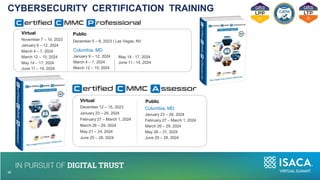
Virtual
December 12 – 15, 2023
January 23 – 26, 2024
February 27 – March 1, 2024
March 26 – 29, 2024
May 21 – 24, 2024
June 25 – 28, 2024
Public
Columbia, MD
January 23 – 26, 2024
February 27 – March 1, 2024
March 26 – 29, 2024
May 28 – 31, 2024
June 25 – 28, 2024
Virtual
November 7 – 10, 2023
January 9 – 12, 2024
Public
December 5 – 8, 2023 | Las Vegas, NV
March 4 – 7, 2024
March 12 – 15, 2024
Columbia, MD
January 9 – 12, 2024 May 14 - 17, 2024
May 14 – 17, 2024
June 11 – 14, 2024
March 4 – 7, 2024
March 12 – 15, 2024
June 11 - 14, 2024
CYBERSECURITY CERTIFICATION TRAINING
10
36
Questions?
THANK YOU FOR ATTENDING
Beyond NIST, CMMC certification_webinar.pdf

Beyond NIST, CMMC certification_webinar.pdf

  • 1.
    Beyond NIST, CMMCCertification: Fusion and Future 1 1 October 31, 2023
  • 2.
  • 3.
    3 Learning Objectives AGENDA Learn aboutNIST standards and guidance, including the NIST SP 800-171r3 Draft Examine the CMMC standard and its organization Review how to mitigate risks in the cyber supply chain with CMMC Step through key phases to successfully achieve CMMC Certification
  • 4.
    Future Attacks: Viruses,Cyber & Biological Ransomware could simultaneously target energy grids, power plants, factories, refineries, trains, airlines, shipping, banking, water supplies, sewage-treatment plants and more. Hospitals would be the most salient targets. The attacker(s) might falsely claim their own systems are also under siege. A two-front biological and cyber attack Hospitals and other critical infrastructure need to harden their cyber defenses. FUTURE ATTACKS | VIRUSES, CYBER & BIOLOGICAL 4 4 Misdirection can be more effective than a smoke screen.
  • 5.
    Another Medical RevolutionIs Under Way Twenty years ago, the idea of putting a live cell in a human, directing it to travel to a specific location, and having it do a specific task would have been considered impossible. Today it’s reality, and hundreds of companies are working on cell-therapy applications. What if, • Cleaning early-stage cancers from your body could become as routine as going to the dentist to clean your teeth • Or, if a single vaccine could protect you against multiple viruses • Or if gene editing could eliminate many birth defects and slow the aging process? These, and many other advances, are within reach. DARK PAST TO BRIGHT FUTURE 4 5
  • 6.
    NIST Standards andGuidance 4 6
  • 7.
  • 8.
    # Function DescriptionCategory 1 Govern (GV) Establish and monitor the organization’s cybersecurity risk management strategy, expectations, and policy. Provides outcomes to inform how an organization will achieve and prioritize the outcomes of the other five Functions. Organizational Context (GV.OC) Risk Management Strategy (GV.RM) Roles and Responsibilities (GV.RR) Policies and Procedures (GV.PO) 2 Identify (ID) Help determine the current cybersecurity risk to the organization. Asset Management (ID.AM) Risk Assessment (ID.RA) Supply Chain Risk Management (ID.SC) Improvement (ID.IM) 3 Protect (PR) Use safeguards to prevent or reduce cybersecurity risk Identity Management, Authentication, and Access Control (PR.AA) Awareness and Training (PR.AT) Data Security (PR.DS) Platform Security (PR.PS) Technology Infrastructure Resilience (PR.IR) 4 Detect (DE) Find and analyze possible cybersecurity attacks and compromises. Adverse Event Analysis (DE.AE) Continuous Monitoring (DE.CM) 5 Respond (RS) Take action regarding a detected cybersecurity incident. Incident Management (RS.MA) Incident Analysis (RS.AN) Incident Response Reporting and Communication (RS.CO) Incident Mitigation (RS.MI) 6 Recover (RC) Restore assets and operations that were impacted by a cybersecurity incident. Incident Recovery Plan Execution (RC.RP) Incident Recovery Communication (RC.CO) 4 8 FUNCTIONS NIST 2.0 DRAFT
  • 9.
    PROFILE & TIERS NIST2.0 DRAFT 4 9
  • 10.
    Category Subcategory ImplementationExamples Organizational Context (GV.OC) The circumstances — mission, stakeholder expectations, and legal, regulatory, and contractual requirements — surrounding the organization’s cybersecurity risk management decisions are understood (formerly ID.BE) GV.OC-01: The organizational mission is understood and informs cybersecurity risk management (formerly ID.BE-02, ID.BE-03) Ex1: Share the organization’s mission (e.g., through vision and mission statements, marketing, and service strategies) to provide a basis for identifying risks that may impede that mission Asset Management (ID.AM) Assets (e.g., data, hardware software, systems, facilities, services, people) that enable the organization to achieve business purposes are identified and managed consistent with their relative importance to organizational objectives and the organization’s risk strategy ID.AM-01: Inventories of hardware managed by the organization are maintained Ex1: Maintain inventories for all types of hardware, including IT, IoT, OT, and mobile devices Ex2: Constantly monitor networks to detect new hardware and automatically update inventories Identity Management, Authentication, and Access Control (PR.AA) Access to physical and logical assets is limited to authorized users, services, and hardware, and is managed commensurate with the assessed risk of unauthorized access (formerly PR.AC) PR.AA-03: Users, services, and hardware are authenticated (formerly PR.AC-03, PR.AC-07) Ex1: Require multifactor authentication Ex2: Enforce policies for the minimum strength of passwords, PINs, and similar authenticators Ex3: Periodically reauthenticate users, services, and hardware based on risk (e.g., in zero trust architectures) 10 10 IMPLEMENTATION EXAMPLES NIST 2.0 DRAFT Implementation Examples Provide concise, action-oriented steps to help achieve the outcomes of the Subcategories. The examples are not a comprehensive list of all actions that could be taken by an organization to achieve an outcome, nor do they represent a baseline of required actions to address cybersecurity risk.
  • 11.
    # Family Name #of Controls 1 Access Control 25 2 Awareness and Training 4 3 Audit and Accountability 16 4 Assessment, Authorization, and Monitoring 9 5 Configuration Management 12 6 Contingency Planning 13 7 Identification and Authentication 12 8 Individual Participation 6 9 Incident Response 10 10 Maintenance 6 10 11 # Family Name # of Controls 11 Media Protection 8 12 Privacy Authorization 4 13 Physical and Environmental Protection 22 14 Planning 11 15 Program Management 32 16 Personnel Security 8 17 Risk Assessment 9 18 System and Services Acquisition 22 19 System and Communications Protection 44 20 System and Information Integrity 20 NIST SP 800-53 R5
  • 12.
    Regulated Entities Covered Healthcare Providers Healthcare Clearinghouses Business Associate Health Plans NIST SP 800-66r2provides practical guidance and resources that can be used by regulated entities of all sizes to protect ePHI and better understand the security concepts discussed in the HIPAA Security Rule. Administrative Safeguards Technical Safeguards Organizational Requirements Policies and Procedures and Documentation Requirements HIPAA Security Rule Physical Safeguards NIST SP 800-66R2 10 12
  • 13.
  • 14.
  • 15.
    NIST SP 800-207 10 15 ZEROTRUST ARCHITECTURE Zero trust is about providing the right user, the right access, to the right data, continuously.
  • 16.
    ZTA Zero Trust Architecture 1 Zero trustprovides a collection of concepts and ideas designed to minimize uncertainty in enforcing accurate, least privilege per-request access decisions in information systems and services in the face of a network viewed as compromised. 2 Zero trust is the term for an evolving set of cybersecurity paradigms that move defenses from static, network-based perimeters to focus on users, assets, and resources. 3 ZTA is an enterprise’s cybersecurity plan that utilizes zero trust concepts and encompasses component relationships, workflow planning, and access policies. 4 Therefore, a zero trust enterprise is the network infrastructure (physical and virtual) and operational policies that are in place for an enterprise as a product of a ZTA plan. 10 16 ZERO TRUST FACTS
  • 17.
    ZERO TRUST BASICTENETS DEFINED BY NIST SP 800-207 10 17
  • 18.
  • 19.
    New Addition Modification NISTSP 800-171 R3 DRAFT 10 19
  • 20.
    EO Executive Order CUI Controlled Unclassified Information NARA National Archives and Records Administration EO 13556established a governmentwide CUI program. NARA provides information, guidance, policy, and requirements on handling CUI. The CUI federal regulation provides guidance to federal agencies on the designation, safeguarding, marking, dissemination, decontrolling, and disposition of CUI. The security requirements in NIST SP 800-171r3 are only applicable to components of nonfederal systems that process, store, or transmit CUI or that provide protection for such components. 10 20 NIST SP 800-171 R3 DRAFT FACTS

  • 21.

    NIST SP 800-171R3 DRAFT A federal information system is a system that is used or operated by an executive agency, by a contractor of an executive agency, or by another organization on behalf of an executive agency. A system that does not meet such criteria is a non-federal system. Nonfederal Systems IT Systems Operational Technology (OT) Systems Internet of Things (IoT) Devices System components include mainframes, workstations, servers; input and output devices; network components; operating systems; virtual machines; and applications. System components include workstations, servers, notebook computers, smartphones, tablets, input and output devices, network components, operating systems, virtual machines, database management systems, and applications. Describes 14 families of security requirements for protecting the confidentiality of CUI in nonfederal systems and organizations. The security requirements are organized into 17 families. New security requirement families include Planning, System and Services Acquisition, and Supply Chain Risk Management. Non-existent Requirement 3.12.5 – Use independent assessors or assessment teams to assess controls. Appendix E – Tailoring Criteria. NFO: Expected to be routinely satisfied by nonfederal organizations without specification. Appendix C – Tailoring Criteria. NFO: Expected to be implemented by nonfederal organizations without specification. KEY UPDATES NIST SP 800-171 r2 NIST SP 800-171 r3 Draft 10 21
  • 22.
  • 23.
  • 24.
    Malicious cyber actorshave target the DIB sector and the supply chain of the DoD. The DIB sector consists of more than 300,000 companies that support the warfighter and contribute toward the research, engineering, development, acquisition, production, delivery, sustainment, and operations of DoD systems, networks, installations, capabilities, and services. The OUSD (A&S) has developed the CMMC framework. The CMMC model encompasses the basic safeguarding requirements for FCI specified in FAR Clause 52.204-21 and the security requirements for CUI specified in National Institute of Standards and Technology NIST SP 800-171 R2 per DFARS Clause 252.204-7012. DFARS clause 252.204-7012 specifies additional requirements beyond the NIST SP 800-171 security requirements, such as incident reporting. DIB Defense Industrial Base DoD U.S. Department of Defense OUSD (A&S) Under Secretary of Defense for Acquisition and Sustainment CMMC Cybersecurity Maturity Model Certification FCI Federal Contract Information CUI Controlled Unclassified Information When implementing the CMMC model, a DIB contractor can achieve a specific CMMC level for its entire enterprise network or for a particular segment(s) or enclave(s), depending on where the information to be protected is handled and stored. DFARS Defense Federal Acquisition Regulation Supplement 10 24 CMMC FACTS
  • 25.
  • 26.
  • 27.
  • 28.
    The CMMC modelconsists of 14 domains that align with the families specified in NIST SP 800-171. CMMC DOMAINS 10 28
  • 29.
    The CMMC modelmeasures the implementation of the NIST SP 800-171 Rev 2 security requirements. The practices originate from the safeguarding requirements and security requirements specified in FAR Clause 52.204-21 and DFARS Clause 252.204-7012, respectively. Level 1 is equivalent to all of the safeguarding requirements from FAR Clause 52.204-21. Level 2 is equivalent to all of the security requirements in NIST SP 800-171 Rev 2. Level 3 will be based on a subset of NIST SP 800-172 and more detailed information will be released at a later date. Each practice has a practice identification number in the format - DD.L#-REQ - where: DD is the two-letter domain abbreviation. L# is the level number. REQ is the NIST SP 800-171 Rev 2 or NIST SP 800-172 security requirement number. Below the identification number, a short name identifier is provided for each practice, meant to be used for quick reference only. CMMC PRACTICES 10 29
  • 30.
    Access Control (AC) Level1 # CMMC Practice ID Practice Description Reference 1 AC.L1-3.1.1 Authorized Access Control Limit information system access to authorized users, processes acting on behalf of authorized users, or devices (including other information systems). • FAR Clause 52.204-21 b.1.i • NIST SP 800-171 Rev 2 3.1.1 2 AC.L1-3.1.2 Transaction & Function Control Limit information system access to the types of transactions and functions that authorized users are permitted to execute. • FAR Clause 52.204-21 b.1.ii • NIST SP 800-171 Rev 2 3.1.2 3 AC.L1-3.1.20 External Connections Verify and control/limit connections to and use of external information systems. • FAR Clause 52.204-21 b.1.iii • NIST SP 800-171 Rev 2 3.1.20 4 AC. L1-3.1.22 Control Public Information Control information posted or processed or publicly accessible information systems. • FAR Clause 52.204-21 b.1.iv • NIST SP 800-171 Rev 2 3.1.22 ACCESS CONTROL (AC) PRACTICE 10 30
  • 31.
  • 32.
    Develop, document, andperiodically update the SSP document. SSP document describes system boundaries, system environments of operation. SSP further describes how security requirements are implemented, and the relationships with or connections to other systems. GETTING STARTED SYSTEM SECURITY PLAN (SSP) 10 32
  • 33.
  • 34.
    NIST AND CMMCREADINESS 10 34
  • 35.
    “ Now zero-daysare in the hands of hostile nations and mercenaries who do not care if your vote goes missing, your clean water is contaminated, or our nuclear plants melt down. ” “ 10 35 Americans are plugging anything we can into the Internet, at a rate of 127 devices a SECOND! The American society is on the cusp of a digital tsunami called the Internet of Things (IoT). There isn’t a single area of our lives that isn’t touched by the web. We have not paused to think that, along the way, we were creating the world’s largest attack surface. ” - Nicole Perlroth PAST = A MIRROR TO THE FUTURE
  • 36.
    Virtual December 12 –15, 2023 January 23 – 26, 2024 February 27 – March 1, 2024 March 26 – 29, 2024 May 21 – 24, 2024 June 25 – 28, 2024 Public Columbia, MD January 23 – 26, 2024 February 27 – March 1, 2024 March 26 – 29, 2024 May 28 – 31, 2024 June 25 – 28, 2024 Virtual November 7 – 10, 2023 January 9 – 12, 2024 Public December 5 – 8, 2023 | Las Vegas, NV March 4 – 7, 2024 March 12 – 15, 2024 Columbia, MD January 9 – 12, 2024 May 14 - 17, 2024 May 14 – 17, 2024 June 11 – 14, 2024 March 4 – 7, 2024 March 12 – 15, 2024 June 11 - 14, 2024 CYBERSECURITY CERTIFICATION TRAINING 10 36
  • 37.
  • 38.
    THANK YOU FORATTENDING