Created by SideChannel
Readme: Slides Guidelines
SLIDE
4 General framing of NIST framework as common language.
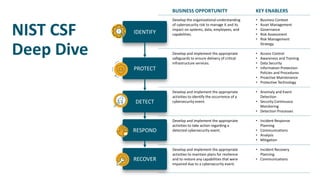
5 NIST CSF deep dive to use per specific needs.
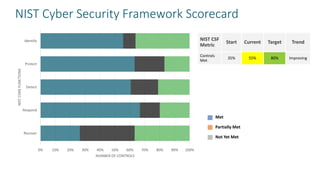
6 NIST scorecard. To fill this you must map your existing technologies and procedures to the detailed NIST 800-171 controls’
list. Alternatively, if you’re engaged in a 3rd party assessment, present the interim results. That way or the other, you’ll need
to populate a NIST 800-171 controls’ spreadsheet to aggregate into a bar chart.
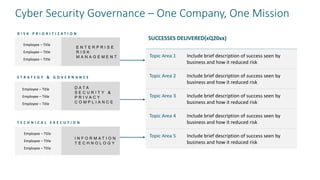
7 Map the various security stakeholders within your organization + description of delivered success.
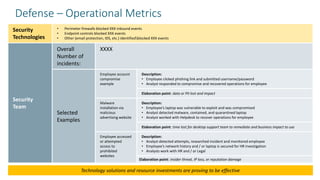
8 • Operational metrics, divided to two parts:
• Security technologies – the example in this slides includes events from firewall and endpoint. In real life you’ll
include the outputs of your entire security stack.
• Security team - overall number + selected examples. We suggest to pick three that represent the events in the
given timeframe. Each example can trigger elaboration on the related security risk and needs.
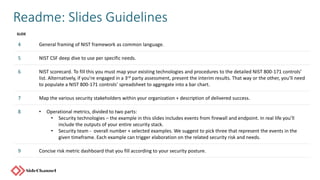
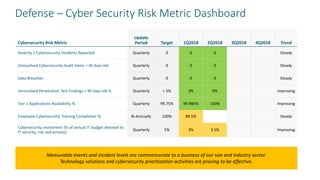
9 Concise risk metric dashboard that you fill according to your security posture.
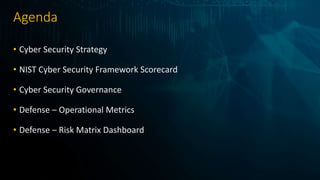
Agenda
• Cyber Security Strategy
• NIST Cyber Security Framework Scorecard
• Cyber Security Governance
• Defense – Operational Metrics
• Defense – Risk Matrix Dashboard
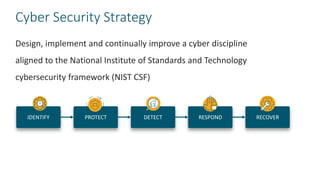
Cyber Security Strategy
Design, implement and continually improve a cyber discipline
aligned to the National Institute of Standards and Technology
cybersecurity framework (NIST CSF)
IDENTIFY PROTECT DETECT RESPOND RECOVER
BUSINESS OPPORTUNITY KEY ENABLERS
Develop the organizational understanding
of cybersecurity risk to manage it and its
impact on systems, data, employees, and
capabilities.
• Business Context
• Asset Management
• Governance
• Risk Assessment
• Risk Management
Strategy
Develop and implement the appropriate
safeguards to ensure delivery of critical
infrastructure services.
• Access Control
• Awareness and Training
• Data Security
• Information Protection
Policies and Procedures
• Proactive Maintenance
• Protective Technology
Develop and implement the appropriate
activities to identify the occurrence of a
cybersecurity event.
• Anomaly and Event
Detection
• Security Continuous
Monitoring
• Detection Processes
Develop and implement the appropriate
activities to take action regarding a
detected cybersecurity event.
• Incident Response
Planning
• Communications
• Analysis
• Mitigation
Develop and implement the appropriate
activities to maintain plans for resilience
and to restore any capabilities that were
impaired due to a cybersecurity event.
• Incident Recovery
Planning
• Communications
NIST CSF
Deep Dive
IDENTIFY
PROTECT
DETECT
RESPOND
RECOVER
0% 10% 20% 30% 40% 50% 60% 70% 80% 90% 100%
Recover
Respond
Detect
Protect
Identify
NUMBER OF CONTROLS
NIST
CORE
FUNCTIONS
NIST Cyber Security Framework Scorecard
NIST CSF
Metric
Start Current Target Trend
Controls
Met
35% 55% 80% Improving
Met
Partially Met
Not Yet Met
Employee – Title
Employee – Title
Employee – Title
Employee – Title
Employee – Title
Employee – Title
D A T A
S E C U R I T Y &
P R I V A C Y
C O M P L I A N C E
I N F O R M A T I O N
T E C H N O L O G Y
S T R A T E G Y & G O V E R N A N C E
T E C H N I C A L E X E C U T I O N
Employee – Title
Employee – Title
Employee – Title
R I S K P R I O R I T I Z A T I O N
E N T E R P R I S E
R I S K
M A N A G E M E N T
Cyber Security Governance – One Company, One Mission
SUCCESSES DELIVERED(xQ20xx)
Topic Area 1 Include brief description of success seen by
business and how it reduced risk
Topic Area 2 Include brief description of success seen by
business and how it reduced risk
Topic Area 3 Include brief description of success seen by
business and how it reduced risk
Topic Area 4 Include brief description of success seen by
business and how it reduced risk
Topic Area 5 Include brief description of success seen by
business and how it reduced risk
Security
Technologies
• Perimeter firewalls blocked XXX inbound events
• Endpoint controls blocked XXX events
• Other (email protection, IDS, etc.) identifiedblocked XXX events
Security
Team
Overall
Number of
incidents:
XXXX
Selected
Examples
Employee account
compromise
example
Description:
• Employee clicked phishing link and submitted username/password
• Analyst responded to compromise and recovered operations for employee
Elaboration point: data or PII lost and impact
Malware
installation via
malicious
advertising website
Description:
• Employee’s laptop was vulnerable to exploit and was compromised
• Analyst detected malware, contained, and quarantined laptop
• Analyst worked with Helpdesk to recover operations for employee
Elaboration point: time lost for desktop support team to remediate and business impact to use
Employee accessed
or attempted
access to
prohibited
websites
Description:
• Analyst detected attempts, researched incident and monitored employee
• Employee’s network history and / or laptop is secured for HR investigation
• Analysts work with HR and / or Legal
Elaboration point: insider threat, IP loss, or reputation damage
Technology solutions and resource investments are proving to be effective
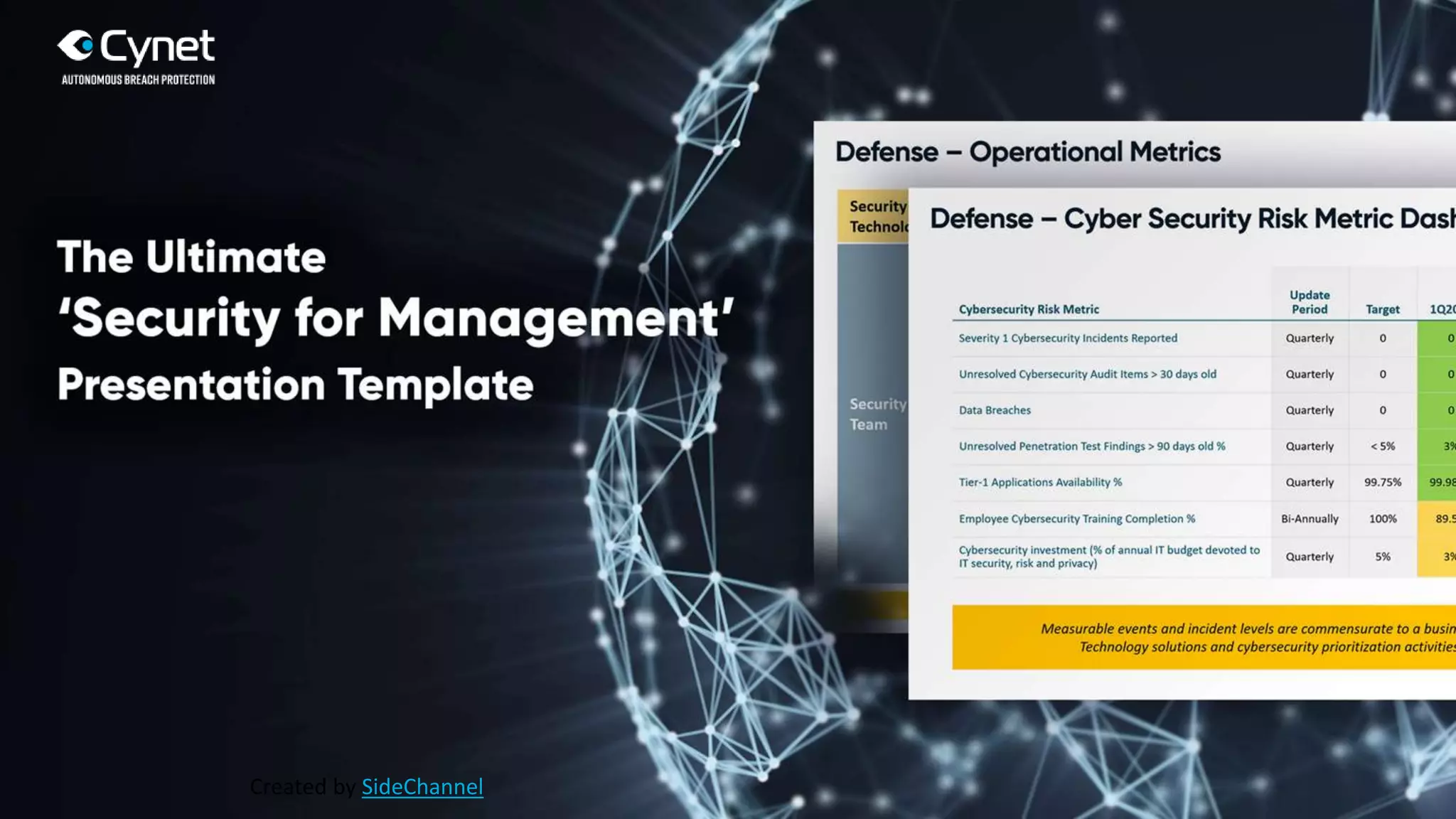
Defense – Operational Metrics
Cybersecurity Risk Metric
Update
Period Target 1Q2018 2Q2018 3Q2018 4Q2018 Trend
Severity 1 Cybersecurity Incidents Reported Quarterly 0 0 0 Steady
Unresolved Cybersecurity Audit Items > 30 days old Quarterly 0 0 0 Steady
Data Breaches Quarterly 0 0 0 Steady
Unresolved Penetration Test Findings > 90 days old % Quarterly < 5% 3% 0% Improving
Tier-1 Applications Availability % Quarterly 99.75% 99.985% 100% Improving
Employee Cybersecurity Training Completion % Bi-Annually 100% 89.5% Steady
Cybersecurity investment (% of annual IT budget devoted to
IT security, risk and privacy)
Quarterly 5% 3% 3.5% Improving
Measurable events and incident levels are commensurate to a business of our size and industry sector.
Technology solutions and cybersecurity prioritization activities are proving to be effective.
Defense – Cyber Security Risk Metric Dashboard

PPT-Security-for-Management.pptx

  • 1.
  • 2.
    Readme: Slides Guidelines SLIDE 4General framing of NIST framework as common language. 5 NIST CSF deep dive to use per specific needs. 6 NIST scorecard. To fill this you must map your existing technologies and procedures to the detailed NIST 800-171 controls’ list. Alternatively, if you’re engaged in a 3rd party assessment, present the interim results. That way or the other, you’ll need to populate a NIST 800-171 controls’ spreadsheet to aggregate into a bar chart. 7 Map the various security stakeholders within your organization + description of delivered success. 8 • Operational metrics, divided to two parts: • Security technologies – the example in this slides includes events from firewall and endpoint. In real life you’ll include the outputs of your entire security stack. • Security team - overall number + selected examples. We suggest to pick three that represent the events in the given timeframe. Each example can trigger elaboration on the related security risk and needs. 9 Concise risk metric dashboard that you fill according to your security posture.
  • 3.
    Agenda • Cyber SecurityStrategy • NIST Cyber Security Framework Scorecard • Cyber Security Governance • Defense – Operational Metrics • Defense – Risk Matrix Dashboard
  • 4.
    Cyber Security Strategy Design,implement and continually improve a cyber discipline aligned to the National Institute of Standards and Technology cybersecurity framework (NIST CSF) IDENTIFY PROTECT DETECT RESPOND RECOVER
  • 5.
    BUSINESS OPPORTUNITY KEYENABLERS Develop the organizational understanding of cybersecurity risk to manage it and its impact on systems, data, employees, and capabilities. • Business Context • Asset Management • Governance • Risk Assessment • Risk Management Strategy Develop and implement the appropriate safeguards to ensure delivery of critical infrastructure services. • Access Control • Awareness and Training • Data Security • Information Protection Policies and Procedures • Proactive Maintenance • Protective Technology Develop and implement the appropriate activities to identify the occurrence of a cybersecurity event. • Anomaly and Event Detection • Security Continuous Monitoring • Detection Processes Develop and implement the appropriate activities to take action regarding a detected cybersecurity event. • Incident Response Planning • Communications • Analysis • Mitigation Develop and implement the appropriate activities to maintain plans for resilience and to restore any capabilities that were impaired due to a cybersecurity event. • Incident Recovery Planning • Communications NIST CSF Deep Dive IDENTIFY PROTECT DETECT RESPOND RECOVER
  • 6.
    0% 10% 20%30% 40% 50% 60% 70% 80% 90% 100% Recover Respond Detect Protect Identify NUMBER OF CONTROLS NIST CORE FUNCTIONS NIST Cyber Security Framework Scorecard NIST CSF Metric Start Current Target Trend Controls Met 35% 55% 80% Improving Met Partially Met Not Yet Met
  • 7.
    Employee – Title Employee– Title Employee – Title Employee – Title Employee – Title Employee – Title D A T A S E C U R I T Y & P R I V A C Y C O M P L I A N C E I N F O R M A T I O N T E C H N O L O G Y S T R A T E G Y & G O V E R N A N C E T E C H N I C A L E X E C U T I O N Employee – Title Employee – Title Employee – Title R I S K P R I O R I T I Z A T I O N E N T E R P R I S E R I S K M A N A G E M E N T Cyber Security Governance – One Company, One Mission SUCCESSES DELIVERED(xQ20xx) Topic Area 1 Include brief description of success seen by business and how it reduced risk Topic Area 2 Include brief description of success seen by business and how it reduced risk Topic Area 3 Include brief description of success seen by business and how it reduced risk Topic Area 4 Include brief description of success seen by business and how it reduced risk Topic Area 5 Include brief description of success seen by business and how it reduced risk
  • 8.
    Security Technologies • Perimeter firewallsblocked XXX inbound events • Endpoint controls blocked XXX events • Other (email protection, IDS, etc.) identifiedblocked XXX events Security Team Overall Number of incidents: XXXX Selected Examples Employee account compromise example Description: • Employee clicked phishing link and submitted username/password • Analyst responded to compromise and recovered operations for employee Elaboration point: data or PII lost and impact Malware installation via malicious advertising website Description: • Employee’s laptop was vulnerable to exploit and was compromised • Analyst detected malware, contained, and quarantined laptop • Analyst worked with Helpdesk to recover operations for employee Elaboration point: time lost for desktop support team to remediate and business impact to use Employee accessed or attempted access to prohibited websites Description: • Analyst detected attempts, researched incident and monitored employee • Employee’s network history and / or laptop is secured for HR investigation • Analysts work with HR and / or Legal Elaboration point: insider threat, IP loss, or reputation damage Technology solutions and resource investments are proving to be effective Defense – Operational Metrics
  • 9.
    Cybersecurity Risk Metric Update PeriodTarget 1Q2018 2Q2018 3Q2018 4Q2018 Trend Severity 1 Cybersecurity Incidents Reported Quarterly 0 0 0 Steady Unresolved Cybersecurity Audit Items > 30 days old Quarterly 0 0 0 Steady Data Breaches Quarterly 0 0 0 Steady Unresolved Penetration Test Findings > 90 days old % Quarterly < 5% 3% 0% Improving Tier-1 Applications Availability % Quarterly 99.75% 99.985% 100% Improving Employee Cybersecurity Training Completion % Bi-Annually 100% 89.5% Steady Cybersecurity investment (% of annual IT budget devoted to IT security, risk and privacy) Quarterly 5% 3% 3.5% Improving Measurable events and incident levels are commensurate to a business of our size and industry sector. Technology solutions and cybersecurity prioritization activities are proving to be effective. Defense – Cyber Security Risk Metric Dashboard

Editor's Notes

  • #7  This slide uses an excel sheet behind the chart to show percentages of met, partially met, or not met controls against the NIST CSF.