Dispatching and Unit Commitment
Features in TIMES
69th ETSAP Workshop, UCC, 30-31 May 2016
Update on project´s status
Evangelos Panos, PSI
Antti Lehtilä, VTT
The Unit Commitment problem (UC), is the optimisation problem for
power plant scheduling, subject to a number of technical-economic
constraints:
maximum and minimum generation power limits
start-up and shutdown power trajectories and costs
ramp-up and ramp-down limitations and costs
restrictions on online/offline times to minimise thermal stress
partial load efficiency losses
fuel and other variable costs
Economic dispatch only captures the «fuel and other variable costs»
The objective of this project is to improve the dispatch of power
generation plants in TIMES, by taking into account notions of the UC
problem
Main objective of the project
Page 2
Current status of the project
Page 3
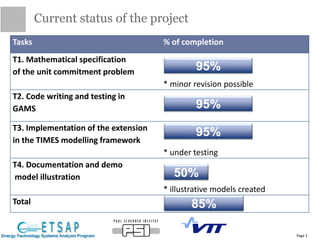
Tasks % of completion
T1. Mathematical specification
of the unit commitment problem
* minor revision possible
T2. Code writing and testing in
GAMS
T3. Implementation of the extension
in the TIMES modelling framework
* under testing
T4. Documentation and demo
model illustration
* illustrative models created
Total
95%
95%
95%
50%
85%
Integration within the TIMES objective function
the costs arising from the power plant scheduling are included to the
rest of the costs in the objective function
this leads to a single framework that optimises in “one-shot” long-term
investment decisions and short-term operational decisions
Timeslices definition can be flexible
the user is free to decide the intra-annual resolution, from 8760 hours
to only few typical operational hours per day
the timeslices do not have to be equal in length and do not necessarily
have to correspond to 1h intervals
Flexible cycling of the power plant schedule (from 1 to several days)
user defined according to user’s timeslice tree structure
allows modelling of power plant with long operating times (e.g. nuclear)
Main features of the UC design in TIMES (1)
Page 4
A generation unit does not necessarily correspond to a discrete plant
A unit can change stand-by condition from hot to warm and then to cold
depending on its non-operational time after shutdown
this identifies three different start-up types: hot, warm, cold
Start-up (and synchronisation) phase of a unit:
its duration depends on the chosen start-up type
load is linearly increased up to the minimum stable operation level
start-up costs can occur:
 capacity related  based on the started capacity
 fuel related  due to partial load efficiency losses
Main features of the UC design in TIMES (2)
Page 5
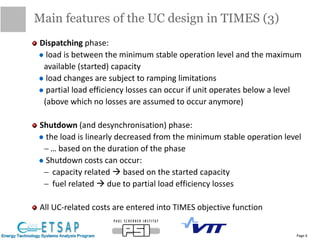
Dispatching phase:
load is between the minimum stable operation level and the maximum
available (started) capacity
load changes are subject to ramping limitations
partial load efficiency losses can occur if unit operates below a level
(above which no losses are assumed to occur anymore)
Shutdown (and desynchronisation) phase:
the load is linearly decreased from the minimum stable operation level
 … based on the duration of the phase
Shutdown costs can occur:
 capacity related  based on the started capacity
 fuel related  due to partial load efficiency losses
All UC-related costs are entered into TIMES objective function
Main features of the UC design in TIMES (3)
Page 6
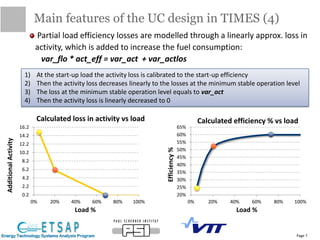
Partial load efficiency losses are modelled through a linearly approx. loss in
activity, which is added to increase the fuel consumption:
var_flo * act_eff = var_act + var_actlos
Main features of the UC design in TIMES (4)
Page 7
20%
25%
30%
35%
40%
45%
50%
55%
60%
65%
0% 20% 40% 60% 80% 100%
Efficiency%
Load %
Calculated efficiency % vs load
0.2
2.2
4.2
6.2
8.2
10.2
12.2
14.2
16.2
0% 20% 40% 60% 80% 100%
AdditionalActivity
Load %
Calculated loss in activity vs load
1) At the start-up load the activity loss is calibrated to the start-up efficiency
2) Then the activity loss decreases linearly to the losses at the minimum stable operation level
3) The loss at the minimum stable operation level equals to var_act
4) Then the activity loss is linearly decreased to 0
New TIMES user-defined parameters
Page 8
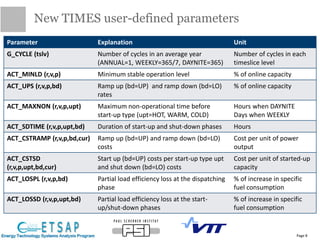
Parameter Explanation Unit
G_CYCLE (tslv) Number of cycles in an average year
(ANNUAL=1, WEEKLY=365/7, DAYNITE=365)
Number of cycles in each
timeslice level
ACT_MINLD (r,v,p) Minimum stable operation level % of online capacity
ACT_UPS (r,v,p,bd) Ramp up (bd=UP) and ramp down (bd=LO)
rates
% of online capacity
ACT_MAXNON (r,v,p,upt) Maximum non-operational time before
start-up type (upt=HOT, WARM, COLD)
Hours when DAYNITE
Days when WEEKLY
ACT_SDTIME (r,v,p,upt,bd) Duration of start-up and shut-down phases Hours
ACT_CSTRAMP (r,v,p,bd,cur) Ramp up (bd=UP) and ramp down (bd=LO)
costs
Cost per unit of power
output
ACT_CSTSD
(r,v,p,upt,bd,cur)
Start up (bd=UP) costs per start-up type upt
and shut down (bd=LO) costs
Cost per unit of started-up
capacity
ACT_LOSPL (r,v,p,bd) Partial load efficiency loss at the dispatching
phase
% of increase in specific
fuel consumption
ACT_LOSSD (r,v,p,upt,bd) Partial load efficiency loss at the start-
up/shut-down phases
% of increase in specific
fuel consumption
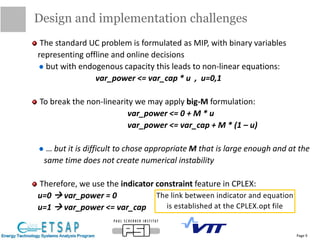
The standard UC problem is formulated as MIP, with binary variables
representing offline and online decisions
but with endogenous capacity this leads to non-linear equations:
var_power <= var_cap * u , u=0,1
To break the non-linearity we may apply big-M formulation:
var_power <= 0 + M * u
var_power <= var_cap + M * (1 – u)
… but it is difficult to chose appropriate M that is large enough and at the
same time does not create numerical instability
Therefore, we use the indicator constraint feature in CPLEX:
u=0  var_power = 0
u=1  var_power <= var_cap
Design and implementation challenges
Page 9
The link between indicator and equation
is established at the CPLEX.opt file
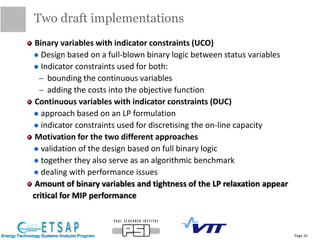
Binary variables with indicator constraints (UCO)
Design based on a full-blown binary logic between status variables
Indicator constraints used for both:
 bounding the continuous variables
 adding the costs into the objective function
Continuous variables with indicator constraints (DUC)
approach based on an LP formulation
indicator constraints used for discretising the on-line capacity
Motivation for the two different approaches
validation of the design based on full binary logic
together they also serve as an algorithmic benchmark
dealing with performance issues
Amount of binary variables and tightness of the LP relaxation appear
critical for MIP performance
Two draft implementations
Page 10
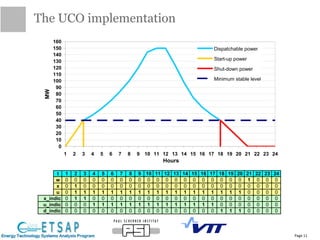
The UCO implementation
Page 11
0
10
20
30
40
50
60
70
80
90
100
110
120
130
140
150
160
1 2 3 4 5 6 7 8 9 10 11 12 13 14 15 16 17 18 19 20 21 22 23 24
Hours
MW Dispatchable power
Start-up power
Shut-down power
Minimum stable level
t 1 2 3 4 5 6 7 8 9 10 11 12 13 14 15 16 17 18 19 20 21 22 23 24
w 0 0 0 0 0 0 0 0 0 0 0 0 0 0 0 0 0 0 0 0 1 0 0 0
x 0 1 0 0 0 0 0 0 0 0 0 0 0 0 0 0 0 0 0 0 0 0 0 0
u 0 1 1 1 1 1 1 1 1 1 1 1 1 1 1 1 1 1 1 1 0 0 0 0
x_indic 0 1 1 0 0 0 0 0 0 0 0 0 0 0 0 0 0 0 0 0 0 0 0 0
u_indic 0 0 0 1 1 1 1 1 1 1 1 1 1 1 1 1 1 0 0 0 0 0 0 0
d_indic 0 0 0 0 0 0 0 0 0 0 0 0 0 0 0 0 0 1 1 1 0 0 0 0
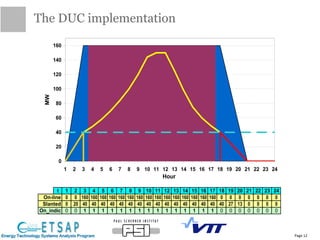
The DUC implementation
Page 12
0
20
40
60
80
100
120
140
160
1 2 3 4 5 6 7 8 9 10 11 12 13 14 15 16 17 18 19 20 21 22 23 24
Hour
MW
t 1 2 3 4 5 6 7 8 9 10 11 12 13 14 15 16 17 18 19 20 21 22 23 24
On-line 0 0 160 160 160 160 160 160 160 160 160 160 160 160 160 160 160 0 0 0 0 0 0 0
Slanted 0 20 40 40 40 40 40 40 40 40 40 40 40 40 40 40 40 40 27 13 0 0 0 0
On_indic 0 0 1 1 1 1 1 1 1 1 1 1 1 1 1 1 1 0 0 0 0 0 0 0
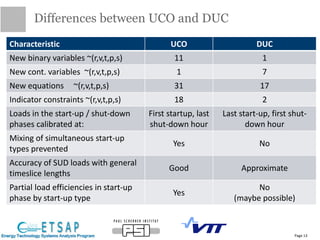
Characteristic UCO DUC
New binary variables ~(r,v,t,p,s) 11 1
New cont. variables ~(r,v,t,p,s) 1 7
New equations ~(r,v,t,p,s) 31 17
Indicator constraints ~(r,v,t,p,s) 18 2
Loads in the start-up / shut-down
phases calibrated at:
First startup, last
shut-down hour
Last start-up, first shut-
down hour
Mixing of simultaneous start-up
types prevented
Yes No
Accuracy of SUD loads with general
timeslice lengths
Good Approximate
Partial load efficiencies in start-up
phase by start-up type
Yes
No
(maybe possible)
Differences between UCO and DUC
Page 13
0
400
800
1200
1600
2000
2400
H01
H02
H03
H04
H05
H06
H07
H08
H09
H10
H11
H12
H13
H14
H15
H16
H17
H18
H19
H20
H21
H22
H23
H24
MW
DUC (VAR_OBJ=18987987)
ECOAL
To demonstrate the features in TIMES a controlled example is presented
In this example the ECOAL unit is forced to shutdown in H01 and start-up in H09
DUC and UCO equivalence & demonstration (1)
Page 14
NCAP_
PASTI
ACT_
MNLD
Minimum stable
operation load
ACT_
UPS
ACT_SDTIME
(UP, HOT)
ACT_SDTIME
(LO, HOT)
ECOAL 4000 40% 1600 10% 3 4
0
400
800
1200
1600
2000
2400
H01
H02
H03
H04
H05
H06
H07
H08
H09
H10
H11
H12
H13
H14
H15
H16
H17
H18
H19
H20
H21
H22
H23
H24
MW
UCO (VAR_OBJ=18987974)
Note: in the graphs the other units have been ommitted
ECOAL
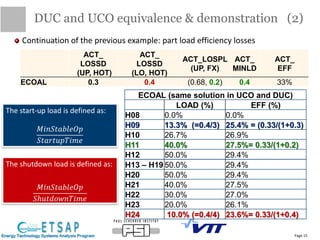
Continuation of the previous example: part load efficiency losses
DUC and UCO equivalence & demonstration (2)
Page 15
ACT_
LOSSD
(UP, HOT)
ACT_
LOSSD
(LO, HOT)
ACT_LOSPL
(UP, FX)
ACT_
MINLD
ACT_
EFF
ECOAL 0.3 0.4 (0.68, 0.2) 0.4 33%
The start-up load is defined as:
𝑀𝑖𝑛𝑆𝑡𝑎𝑏𝑙𝑒𝑂𝑝
𝑆𝑡𝑎𝑟𝑡𝑢𝑝𝑇𝑖𝑚𝑒
The shutdown load is defined as:
𝑀𝑖𝑛𝑆𝑡𝑎𝑏𝑙𝑒𝑂𝑝
𝑆ℎ𝑢𝑡𝑑𝑜𝑤𝑛𝑇𝑖𝑚𝑒
ECOAL (same solution in UCO and DUC)
LOAD (%) EFF (%)
H08 0.0% 0.0%
H09 13.3% (=0.4/3) 25.4% = (0.33/(1+0.3)
H10 26.7% 26.9%
H11 40.0% 27.5%= 0.33/(1+0.2)
H12 50.0% 29.4%
H13 – H19 50.0% 29.4%
H20 50.0% 29.4%
H21 40.0% 27.5%
H22 30.0% 27.0%
H23 20.0% 26.1%
H24 10.0% (=0.4/4) 23.6%= 0.33/(1+0.4)
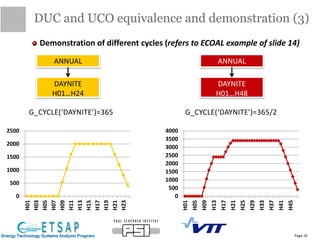
Demonstration of different cycles (refers to ECOAL example of slide 14)
DUC and UCO equivalence and demonstration (3)
Page 16
ANNUAL
DAYNITE
H01…H24
G_CYCLE(‘DAYNITE’)=365
ANNUAL
DAYNITE
H01…H48
G_CYCLE(‘DAYNITE’)=365/2
0
500
1000
1500
2000
2500
H01
H03
H05
H07
H09
H11
H13
H15
H17
H19
H21
H23
0
500
1000
1500
2000
2500
3000
3500
4000
H01
H05
H09
H13
H17
H21
H25
H29
H33
H37
H41
H45
ECOAL
0
400
800
1200
1600
2000
H01 H02 H03 H04 H05 H06
MW
UCO
ECOAL
0
400
800
1200
1600
2000
H01 H02 H03 H04 H05 H06
MW
DUC
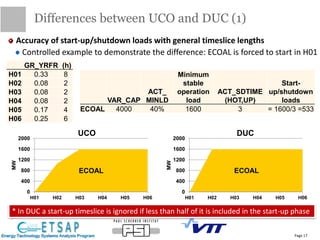
Accuracy of start-up/shutdown loads with general timeslice lengths
Controlled example to demonstrate the difference: ECOAL is forced to start in H01
Differences between UCO and DUC (1)
Page 17
GR_YRFR (h)
H01 0.33 8
H02 0.08 2
H03 0.08 2
H04 0.08 2
H05 0.17 4
H06 0.25 6
VAR_CAP
ACT_
MINLD
Minimum
stable
operation
load
ACT_SDTIME
(HOT,UP)
Start-
up/shutdown
loads
ECOAL 4000 40% 1600 3 = 1600/3 =533
* In DUC a start-up timeslice is ignored if less than half of it is included in the start-up phase
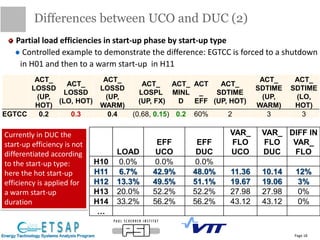
Differences between UCO and DUC (2)
Page 18
Partial load efficiencies in start-up phase by start-up type
Controlled example to demonstrate the difference: EGTCC is forced to a shutdown
in H01 and then to a warm start-up in H11
ACT_
LOSSD
(UP,
HOT)
ACT_
LOSSD
(LO, HOT)
ACT_
LOSSD
(UP,
WARM)
ACT_
LOSPL
(UP, FX)
ACT_
MINL
D
ACT
_
EFF
ACT_
SDTIME
(UP, HOT)
ACT_
SDTIME
(UP,
WARM)
ACT_
SDTIME
(LO,
HOT)
EGTCC 0.2 0.3 0.4 (0.68, 0.15) 0.2 60% 2 3 3
LOAD
EFF
UCO
EFF
DUC
VAR_
FLO
UCO
VAR_
FLO
DUC
DIFF IN
VAR_
FLO
H10 0.0% 0.0% 0.0%
H11 6.7% 42.9% 48.0% 11.36 10.14 12%
H12 13.3% 49.5% 51.1% 19.67 19.06 3%
H13 20.0% 52.2% 52.2% 27.98 27.98 0%
H14 33.2% 56.2% 56.2% 43.12 43.12 0%
…
Currently in DUC the
start-up efficiency is not
differentiated according
to the start-up type:
here the hot start-up
efficiency is applied for
a warm start-up
duration
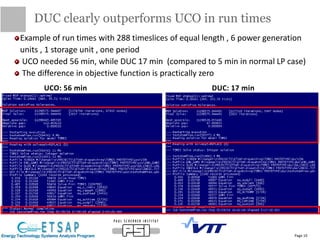
Example of run times with 288 timeslices of equal length , 6 power generation
units , 1 storage unit , one period
UCO needed 56 min, while DUC 17 min (compared to 5 min in normal LP case)
The difference in objective function is practically zero
DUC clearly outperforms UCO in run times
Page 19
DUC: 17 minUCO: 56 min
288 timeslices divided into 4 seasons, 3 typical days in a season, 24 operating hours
6 power generation units and 1 generic electricity storage device
all processes operate at the DAYNITE level
for thermal generation units only annual availability constraint (NCAP_AFA)
no curtailment of renewables (NCAP_AF~FX at the DAYNITE level)
hydro has seasonal (NCAP_AFS~LO, NCAP_AFS~UP) and annual (NCAP_AFA)
availability constraints
Two runs performed:
UC_OFF: standard TIMES run without the UC implemented features
UC_ON: TIMES run with the UC implemented features enabled
An example to demonstrate insights gained (1)
Page 20
An example to demonstrate insights gained (2)
Page 21
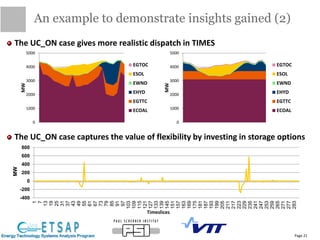
The UC_ON case gives more realistic dispatch in TIMES
The UC_ON case captures the value of flexibility by investing in storage options
0
1000
2000
3000
4000
5000
MW
EGTOC
ESOL
EWND
EHYD
EGTTC
ECOAL
0
1000
2000
3000
4000
5000
MW
EGTOC
ESOL
EWND
EHYD
EGTTC
ECOAL
-400
-200
0
200
400
600
800
1
7
13
19
25
31
37
43
49
55
61
67
73
79
85
91
97
103
109
115
121
127
133
139
145
151
157
163
169
175
181
187
193
199
205
211
217
223
229
235
241
247
253
259
265
271
277
283
MW
Timeslices
The UC features make TIMES a unique tool that combines long-term and short-
term decisions in a single and consistent framework
The UCO and DUC implementations can have their own merits, but DUC seems
to be more appropriate for TIMES models
key factors influencing the performance are the tightness of the MIP and the
optimality gap settings
Some improvements in the design and implementation could be foreseen in the
next 1.5 months, depending on outcomes from remaining testing
The new features will be also available in full LP mode, should anyone
interested in using the operational constraints in such a rough fashion:
ramping constraints, minimum online/offline times, partial load efficiencies
Special thanks to Antti for improving the UCO design & implementing DUC
Conclusions
Page 22
Thank you for your attention!
Questions and suggestions are welcomed !
Page 23

Introducing Electricity Dispatchability Features in TIMES modelling Framework

  • 1.
    Dispatching and UnitCommitment Features in TIMES 69th ETSAP Workshop, UCC, 30-31 May 2016 Update on project´s status Evangelos Panos, PSI Antti Lehtilä, VTT
  • 2.
    The Unit Commitmentproblem (UC), is the optimisation problem for power plant scheduling, subject to a number of technical-economic constraints: maximum and minimum generation power limits start-up and shutdown power trajectories and costs ramp-up and ramp-down limitations and costs restrictions on online/offline times to minimise thermal stress partial load efficiency losses fuel and other variable costs Economic dispatch only captures the «fuel and other variable costs» The objective of this project is to improve the dispatch of power generation plants in TIMES, by taking into account notions of the UC problem Main objective of the project Page 2
  • 3.
    Current status ofthe project Page 3 Tasks % of completion T1. Mathematical specification of the unit commitment problem * minor revision possible T2. Code writing and testing in GAMS T3. Implementation of the extension in the TIMES modelling framework * under testing T4. Documentation and demo model illustration * illustrative models created Total 95% 95% 95% 50% 85%
  • 4.
    Integration within theTIMES objective function the costs arising from the power plant scheduling are included to the rest of the costs in the objective function this leads to a single framework that optimises in “one-shot” long-term investment decisions and short-term operational decisions Timeslices definition can be flexible the user is free to decide the intra-annual resolution, from 8760 hours to only few typical operational hours per day the timeslices do not have to be equal in length and do not necessarily have to correspond to 1h intervals Flexible cycling of the power plant schedule (from 1 to several days) user defined according to user’s timeslice tree structure allows modelling of power plant with long operating times (e.g. nuclear) Main features of the UC design in TIMES (1) Page 4
  • 5.
    A generation unitdoes not necessarily correspond to a discrete plant A unit can change stand-by condition from hot to warm and then to cold depending on its non-operational time after shutdown this identifies three different start-up types: hot, warm, cold Start-up (and synchronisation) phase of a unit: its duration depends on the chosen start-up type load is linearly increased up to the minimum stable operation level start-up costs can occur:  capacity related  based on the started capacity  fuel related  due to partial load efficiency losses Main features of the UC design in TIMES (2) Page 5
  • 6.
    Dispatching phase: load isbetween the minimum stable operation level and the maximum available (started) capacity load changes are subject to ramping limitations partial load efficiency losses can occur if unit operates below a level (above which no losses are assumed to occur anymore) Shutdown (and desynchronisation) phase: the load is linearly decreased from the minimum stable operation level  … based on the duration of the phase Shutdown costs can occur:  capacity related  based on the started capacity  fuel related  due to partial load efficiency losses All UC-related costs are entered into TIMES objective function Main features of the UC design in TIMES (3) Page 6
  • 7.
    Partial load efficiencylosses are modelled through a linearly approx. loss in activity, which is added to increase the fuel consumption: var_flo * act_eff = var_act + var_actlos Main features of the UC design in TIMES (4) Page 7 20% 25% 30% 35% 40% 45% 50% 55% 60% 65% 0% 20% 40% 60% 80% 100% Efficiency% Load % Calculated efficiency % vs load 0.2 2.2 4.2 6.2 8.2 10.2 12.2 14.2 16.2 0% 20% 40% 60% 80% 100% AdditionalActivity Load % Calculated loss in activity vs load 1) At the start-up load the activity loss is calibrated to the start-up efficiency 2) Then the activity loss decreases linearly to the losses at the minimum stable operation level 3) The loss at the minimum stable operation level equals to var_act 4) Then the activity loss is linearly decreased to 0
  • 8.
    New TIMES user-definedparameters Page 8 Parameter Explanation Unit G_CYCLE (tslv) Number of cycles in an average year (ANNUAL=1, WEEKLY=365/7, DAYNITE=365) Number of cycles in each timeslice level ACT_MINLD (r,v,p) Minimum stable operation level % of online capacity ACT_UPS (r,v,p,bd) Ramp up (bd=UP) and ramp down (bd=LO) rates % of online capacity ACT_MAXNON (r,v,p,upt) Maximum non-operational time before start-up type (upt=HOT, WARM, COLD) Hours when DAYNITE Days when WEEKLY ACT_SDTIME (r,v,p,upt,bd) Duration of start-up and shut-down phases Hours ACT_CSTRAMP (r,v,p,bd,cur) Ramp up (bd=UP) and ramp down (bd=LO) costs Cost per unit of power output ACT_CSTSD (r,v,p,upt,bd,cur) Start up (bd=UP) costs per start-up type upt and shut down (bd=LO) costs Cost per unit of started-up capacity ACT_LOSPL (r,v,p,bd) Partial load efficiency loss at the dispatching phase % of increase in specific fuel consumption ACT_LOSSD (r,v,p,upt,bd) Partial load efficiency loss at the start- up/shut-down phases % of increase in specific fuel consumption
  • 9.
    The standard UCproblem is formulated as MIP, with binary variables representing offline and online decisions but with endogenous capacity this leads to non-linear equations: var_power <= var_cap * u , u=0,1 To break the non-linearity we may apply big-M formulation: var_power <= 0 + M * u var_power <= var_cap + M * (1 – u) … but it is difficult to chose appropriate M that is large enough and at the same time does not create numerical instability Therefore, we use the indicator constraint feature in CPLEX: u=0  var_power = 0 u=1  var_power <= var_cap Design and implementation challenges Page 9 The link between indicator and equation is established at the CPLEX.opt file
  • 10.
    Binary variables withindicator constraints (UCO) Design based on a full-blown binary logic between status variables Indicator constraints used for both:  bounding the continuous variables  adding the costs into the objective function Continuous variables with indicator constraints (DUC) approach based on an LP formulation indicator constraints used for discretising the on-line capacity Motivation for the two different approaches validation of the design based on full binary logic together they also serve as an algorithmic benchmark dealing with performance issues Amount of binary variables and tightness of the LP relaxation appear critical for MIP performance Two draft implementations Page 10
  • 11.
    The UCO implementation Page11 0 10 20 30 40 50 60 70 80 90 100 110 120 130 140 150 160 1 2 3 4 5 6 7 8 9 10 11 12 13 14 15 16 17 18 19 20 21 22 23 24 Hours MW Dispatchable power Start-up power Shut-down power Minimum stable level t 1 2 3 4 5 6 7 8 9 10 11 12 13 14 15 16 17 18 19 20 21 22 23 24 w 0 0 0 0 0 0 0 0 0 0 0 0 0 0 0 0 0 0 0 0 1 0 0 0 x 0 1 0 0 0 0 0 0 0 0 0 0 0 0 0 0 0 0 0 0 0 0 0 0 u 0 1 1 1 1 1 1 1 1 1 1 1 1 1 1 1 1 1 1 1 0 0 0 0 x_indic 0 1 1 0 0 0 0 0 0 0 0 0 0 0 0 0 0 0 0 0 0 0 0 0 u_indic 0 0 0 1 1 1 1 1 1 1 1 1 1 1 1 1 1 0 0 0 0 0 0 0 d_indic 0 0 0 0 0 0 0 0 0 0 0 0 0 0 0 0 0 1 1 1 0 0 0 0
  • 12.
    The DUC implementation Page12 0 20 40 60 80 100 120 140 160 1 2 3 4 5 6 7 8 9 10 11 12 13 14 15 16 17 18 19 20 21 22 23 24 Hour MW t 1 2 3 4 5 6 7 8 9 10 11 12 13 14 15 16 17 18 19 20 21 22 23 24 On-line 0 0 160 160 160 160 160 160 160 160 160 160 160 160 160 160 160 0 0 0 0 0 0 0 Slanted 0 20 40 40 40 40 40 40 40 40 40 40 40 40 40 40 40 40 27 13 0 0 0 0 On_indic 0 0 1 1 1 1 1 1 1 1 1 1 1 1 1 1 1 0 0 0 0 0 0 0
  • 13.
    Characteristic UCO DUC Newbinary variables ~(r,v,t,p,s) 11 1 New cont. variables ~(r,v,t,p,s) 1 7 New equations ~(r,v,t,p,s) 31 17 Indicator constraints ~(r,v,t,p,s) 18 2 Loads in the start-up / shut-down phases calibrated at: First startup, last shut-down hour Last start-up, first shut- down hour Mixing of simultaneous start-up types prevented Yes No Accuracy of SUD loads with general timeslice lengths Good Approximate Partial load efficiencies in start-up phase by start-up type Yes No (maybe possible) Differences between UCO and DUC Page 13
  • 14.
    0 400 800 1200 1600 2000 2400 H01 H02 H03 H04 H05 H06 H07 H08 H09 H10 H11 H12 H13 H14 H15 H16 H17 H18 H19 H20 H21 H22 H23 H24 MW DUC (VAR_OBJ=18987987) ECOAL To demonstratethe features in TIMES a controlled example is presented In this example the ECOAL unit is forced to shutdown in H01 and start-up in H09 DUC and UCO equivalence & demonstration (1) Page 14 NCAP_ PASTI ACT_ MNLD Minimum stable operation load ACT_ UPS ACT_SDTIME (UP, HOT) ACT_SDTIME (LO, HOT) ECOAL 4000 40% 1600 10% 3 4 0 400 800 1200 1600 2000 2400 H01 H02 H03 H04 H05 H06 H07 H08 H09 H10 H11 H12 H13 H14 H15 H16 H17 H18 H19 H20 H21 H22 H23 H24 MW UCO (VAR_OBJ=18987974) Note: in the graphs the other units have been ommitted ECOAL
  • 15.
    Continuation of theprevious example: part load efficiency losses DUC and UCO equivalence & demonstration (2) Page 15 ACT_ LOSSD (UP, HOT) ACT_ LOSSD (LO, HOT) ACT_LOSPL (UP, FX) ACT_ MINLD ACT_ EFF ECOAL 0.3 0.4 (0.68, 0.2) 0.4 33% The start-up load is defined as: 𝑀𝑖𝑛𝑆𝑡𝑎𝑏𝑙𝑒𝑂𝑝 𝑆𝑡𝑎𝑟𝑡𝑢𝑝𝑇𝑖𝑚𝑒 The shutdown load is defined as: 𝑀𝑖𝑛𝑆𝑡𝑎𝑏𝑙𝑒𝑂𝑝 𝑆ℎ𝑢𝑡𝑑𝑜𝑤𝑛𝑇𝑖𝑚𝑒 ECOAL (same solution in UCO and DUC) LOAD (%) EFF (%) H08 0.0% 0.0% H09 13.3% (=0.4/3) 25.4% = (0.33/(1+0.3) H10 26.7% 26.9% H11 40.0% 27.5%= 0.33/(1+0.2) H12 50.0% 29.4% H13 – H19 50.0% 29.4% H20 50.0% 29.4% H21 40.0% 27.5% H22 30.0% 27.0% H23 20.0% 26.1% H24 10.0% (=0.4/4) 23.6%= 0.33/(1+0.4)
  • 16.
    Demonstration of differentcycles (refers to ECOAL example of slide 14) DUC and UCO equivalence and demonstration (3) Page 16 ANNUAL DAYNITE H01…H24 G_CYCLE(‘DAYNITE’)=365 ANNUAL DAYNITE H01…H48 G_CYCLE(‘DAYNITE’)=365/2 0 500 1000 1500 2000 2500 H01 H03 H05 H07 H09 H11 H13 H15 H17 H19 H21 H23 0 500 1000 1500 2000 2500 3000 3500 4000 H01 H05 H09 H13 H17 H21 H25 H29 H33 H37 H41 H45
  • 17.
    ECOAL 0 400 800 1200 1600 2000 H01 H02 H03H04 H05 H06 MW UCO ECOAL 0 400 800 1200 1600 2000 H01 H02 H03 H04 H05 H06 MW DUC Accuracy of start-up/shutdown loads with general timeslice lengths Controlled example to demonstrate the difference: ECOAL is forced to start in H01 Differences between UCO and DUC (1) Page 17 GR_YRFR (h) H01 0.33 8 H02 0.08 2 H03 0.08 2 H04 0.08 2 H05 0.17 4 H06 0.25 6 VAR_CAP ACT_ MINLD Minimum stable operation load ACT_SDTIME (HOT,UP) Start- up/shutdown loads ECOAL 4000 40% 1600 3 = 1600/3 =533 * In DUC a start-up timeslice is ignored if less than half of it is included in the start-up phase
  • 18.
    Differences between UCOand DUC (2) Page 18 Partial load efficiencies in start-up phase by start-up type Controlled example to demonstrate the difference: EGTCC is forced to a shutdown in H01 and then to a warm start-up in H11 ACT_ LOSSD (UP, HOT) ACT_ LOSSD (LO, HOT) ACT_ LOSSD (UP, WARM) ACT_ LOSPL (UP, FX) ACT_ MINL D ACT _ EFF ACT_ SDTIME (UP, HOT) ACT_ SDTIME (UP, WARM) ACT_ SDTIME (LO, HOT) EGTCC 0.2 0.3 0.4 (0.68, 0.15) 0.2 60% 2 3 3 LOAD EFF UCO EFF DUC VAR_ FLO UCO VAR_ FLO DUC DIFF IN VAR_ FLO H10 0.0% 0.0% 0.0% H11 6.7% 42.9% 48.0% 11.36 10.14 12% H12 13.3% 49.5% 51.1% 19.67 19.06 3% H13 20.0% 52.2% 52.2% 27.98 27.98 0% H14 33.2% 56.2% 56.2% 43.12 43.12 0% … Currently in DUC the start-up efficiency is not differentiated according to the start-up type: here the hot start-up efficiency is applied for a warm start-up duration
  • 19.
    Example of runtimes with 288 timeslices of equal length , 6 power generation units , 1 storage unit , one period UCO needed 56 min, while DUC 17 min (compared to 5 min in normal LP case) The difference in objective function is practically zero DUC clearly outperforms UCO in run times Page 19 DUC: 17 minUCO: 56 min
  • 20.
    288 timeslices dividedinto 4 seasons, 3 typical days in a season, 24 operating hours 6 power generation units and 1 generic electricity storage device all processes operate at the DAYNITE level for thermal generation units only annual availability constraint (NCAP_AFA) no curtailment of renewables (NCAP_AF~FX at the DAYNITE level) hydro has seasonal (NCAP_AFS~LO, NCAP_AFS~UP) and annual (NCAP_AFA) availability constraints Two runs performed: UC_OFF: standard TIMES run without the UC implemented features UC_ON: TIMES run with the UC implemented features enabled An example to demonstrate insights gained (1) Page 20
  • 21.
    An example todemonstrate insights gained (2) Page 21 The UC_ON case gives more realistic dispatch in TIMES The UC_ON case captures the value of flexibility by investing in storage options 0 1000 2000 3000 4000 5000 MW EGTOC ESOL EWND EHYD EGTTC ECOAL 0 1000 2000 3000 4000 5000 MW EGTOC ESOL EWND EHYD EGTTC ECOAL -400 -200 0 200 400 600 800 1 7 13 19 25 31 37 43 49 55 61 67 73 79 85 91 97 103 109 115 121 127 133 139 145 151 157 163 169 175 181 187 193 199 205 211 217 223 229 235 241 247 253 259 265 271 277 283 MW Timeslices
  • 22.
    The UC featuresmake TIMES a unique tool that combines long-term and short- term decisions in a single and consistent framework The UCO and DUC implementations can have their own merits, but DUC seems to be more appropriate for TIMES models key factors influencing the performance are the tightness of the MIP and the optimality gap settings Some improvements in the design and implementation could be foreseen in the next 1.5 months, depending on outcomes from remaining testing The new features will be also available in full LP mode, should anyone interested in using the operational constraints in such a rough fashion: ramping constraints, minimum online/offline times, partial load efficiencies Special thanks to Antti for improving the UCO design & implementing DUC Conclusions Page 22
  • 23.
    Thank you foryour attention! Questions and suggestions are welcomed ! Page 23