Approaches to lift sectoral 
mitigation potential with markets 
in transition 
DEHSt Side Event 
2nd of December 2014, Lima, Peru 
Carsten Warnecke Hanna Fekete 
c.warnecke@newclimate.org h.Fekete@newclimate.org
About NewClimate Institute 
Non-profit research institute founded Nov. 2014 by 7 
former Ecofys colleagues 
Offices in Berlin and Cologne (Germany) 
Areas of expertise 
Climate negotiations 
Tracking climate action 
Climate and development 
Climate financing 
Carbon market mechanisms 
02/12/2014 www.newclimate.org 2
Background 
Insights from DEHSt research project 
Bilateral Agreements as Basis Towards Piloting Sectoral 
Market Mechanisms 
Duration: Sept 2012 – Aug 2015 
Activity gap in market-based mechanisms challenges 
maintaining the expertise of stakeholders and testing of 
new approaches in practice 
Demand for „reduction units“ could be created based on 
bilateral agreements between Parties 
Theoretically, the EU ETS with article 11a (5),(6) 
considers bilateral agreements 
02/12/2014 www.newclimate.org 3
Objectives 
Theoretic research to develop approaches based on a 
bilateral crediting system that allows pilot activities 
Pilot activities shall have a 
sectoral coverage based on benchmarks 
high level of environmental integrity 
generate net emission reductions 
Open to further ETS and regional markets to join the 
initiative 
Research shall 
Identify suitable countries and sectors for piloting 
Develop initial sector approaches including proposals for 
benchmark concepts 
Elaborate recommendations for the design of such bilateral 
agreements 
02/12/2014 www.newclimate.org 4
Country Selection methodology 
First part 
02/12/2014 www.newclimate.org 5
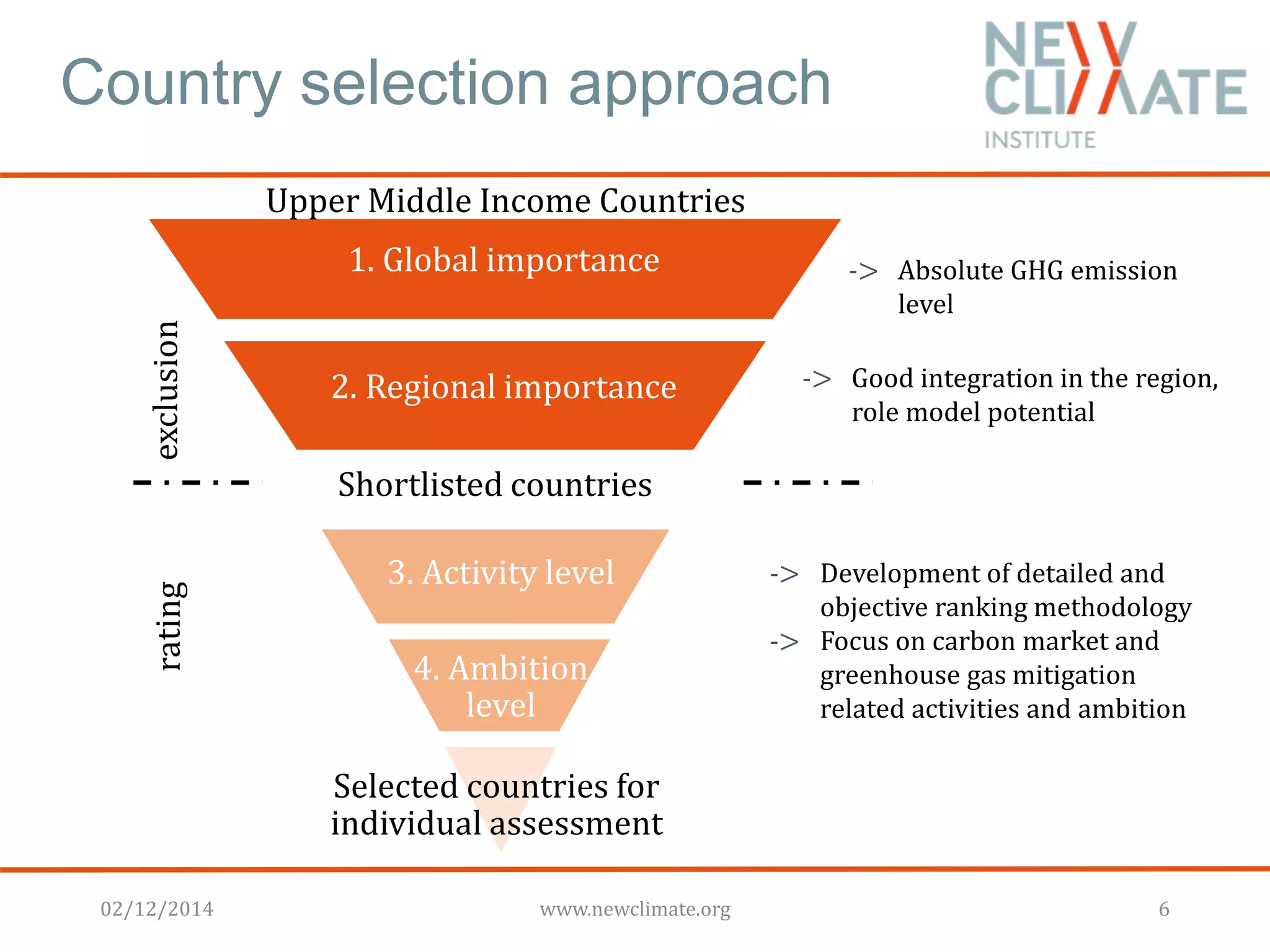
Country selection approach 
Upper Middle Income Countries 
1. Global importance 
2. Regional importance 
3. Activity level 
4. Ambition 
level 
Selected countries for 
individual assessment 
rating exclusion 
Shortlisted countries 
-> Absolute GHG emission 
level 
-> Good integration in the region, 
role model potential 
-> Development of detailed and 
objective ranking methodology 
-> Focus on carbon market and 
greenhouse gas mitigation 
related activities and ambition 
02/12/2014 www.newclimate.org 6
Criteria for ranking 
Indicators for criterion “level of activity”: 
 Participation in the Clean Development Mechanisms 
 Activities under the Partnership for Market Readiness (PMR) of the World Bank 
 Activities around Nationally Appropriate Mitigation Actions (NAMAs) 
 Activities around Monitoring, Reporting and Verification (MRV) of greenhouse gases; 
further described with the following sub-indicators: 
o Submission of National Communications to the UNFCCC; existence of greenhouse gas 
inventories 
o Activities under the Global Environment Facility (GEF) and the MRV partnership 
Indicators for criterion “level of ambition”: 
 Emission reduction pledges on an international level 
 Further targets: National energy efficiency or renewable targets 
 Engagement in Low Emission Development Strategies (LEDS) 
 Participation in regional or global networks 
02/12/2014 www.newclimate.org 7
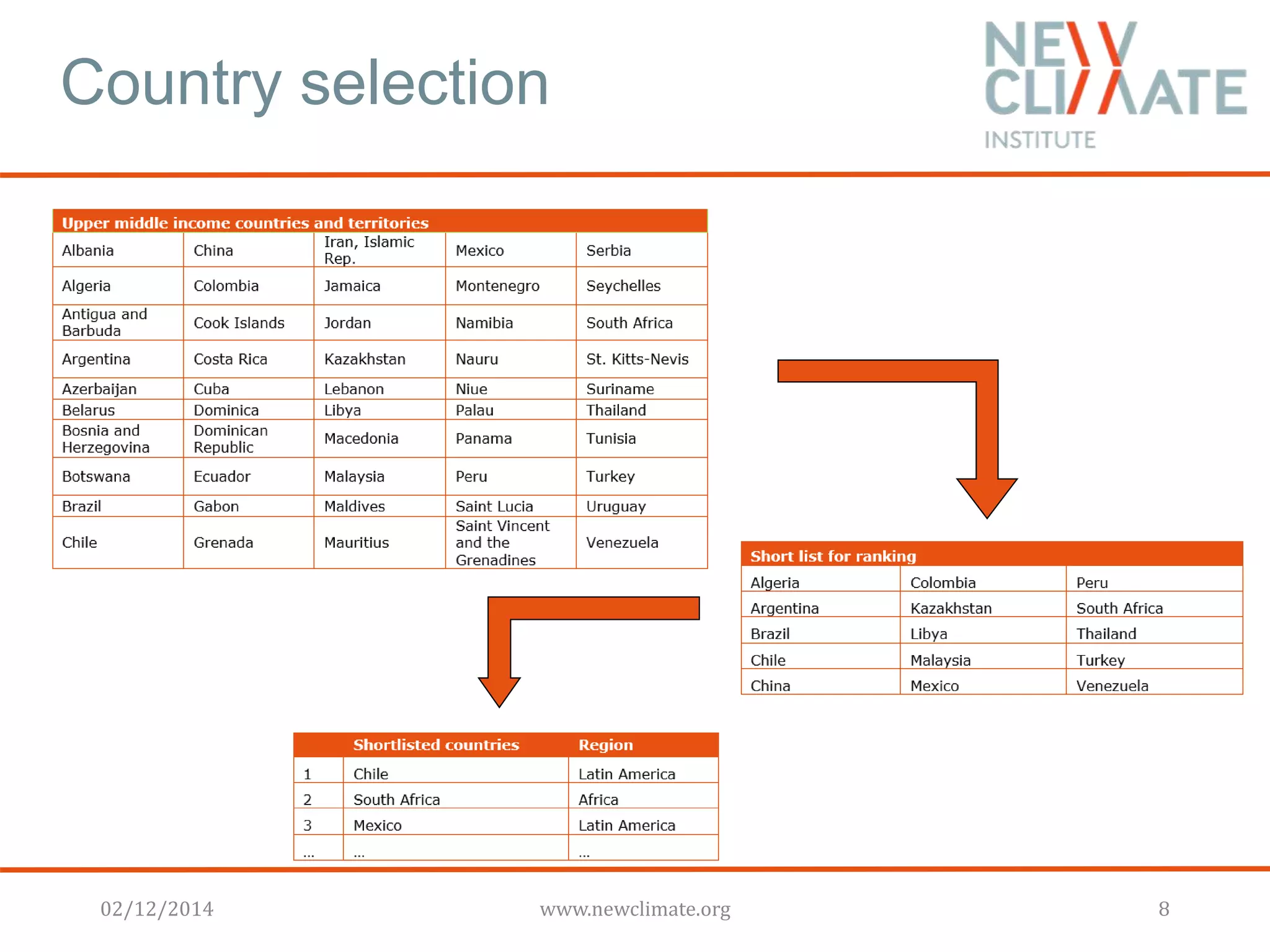
Country selection 
02/12/2014 www.newclimate.org 8
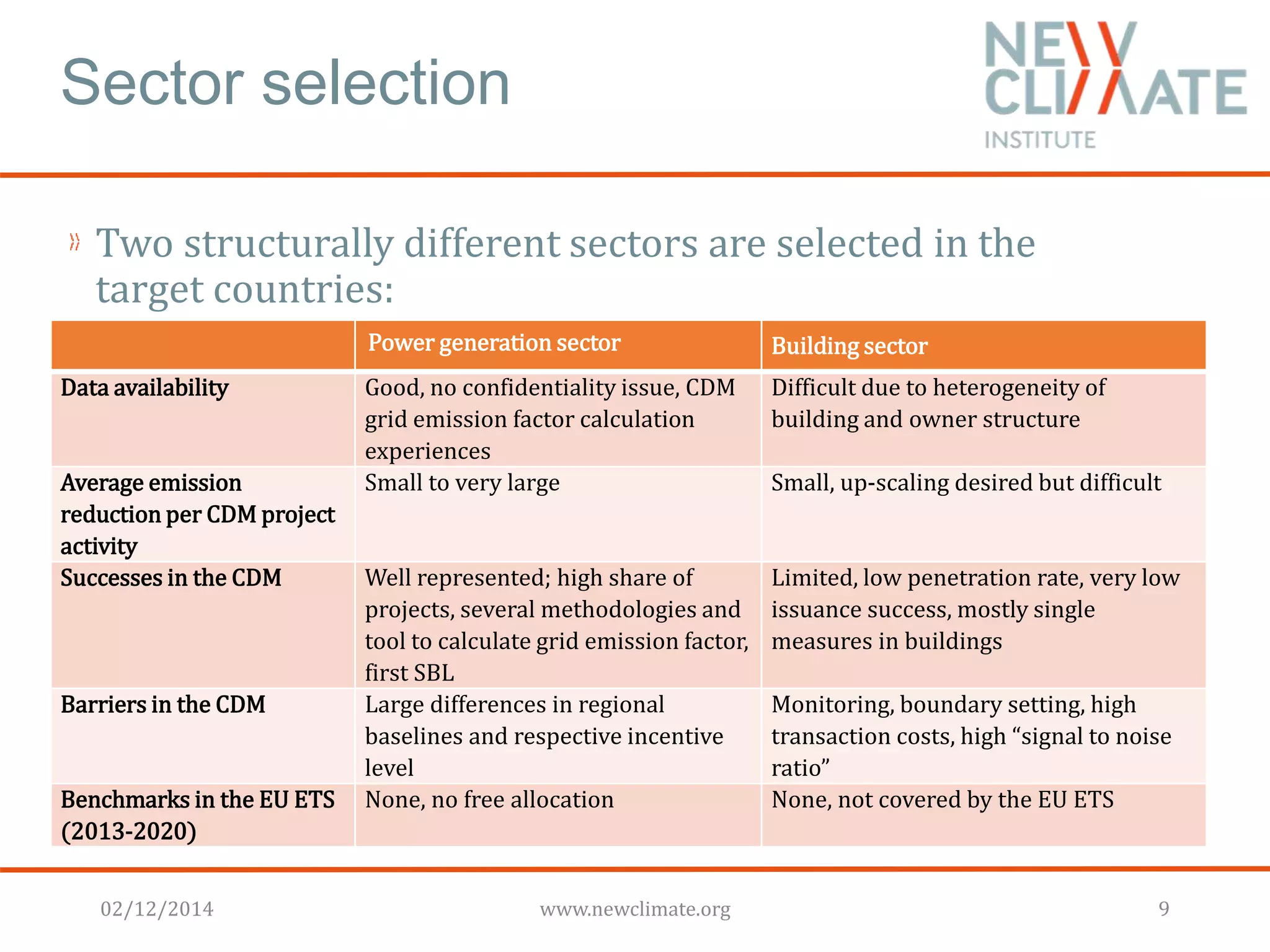
Sector selection 
Two structurally different sectors are selected in the 
target countries: 
Power generation sector Building sector 
Data availability Good, no confidentiality issue, CDM 
grid emission factor calculation 
experiences 
Difficult due to heterogeneity of 
building and owner structure 
Average emission 
reduction per CDM project 
activity 
Small to very large Small, up-scaling desired but difficult 
Successes in the CDM Well represented; high share of 
projects, several methodologies and 
tool to calculate grid emission factor, 
first SBL 
Limited, low penetration rate, very low 
issuance success, mostly single 
measures in buildings 
Barriers in the CDM Large differences in regional 
baselines and respective incentive 
level 
Monitoring, boundary setting, high 
transaction costs, high “signal to noise 
ratio” 
Benchmarks in the EU ETS 
(2013-2020) 
None, no free allocation None, not covered by the EU ETS 
02/12/2014 www.newclimate.org 9
Concepts for credited reference levels 
based on benchmarks 
Second part 
02/12/2014 www.newclimate.org 10
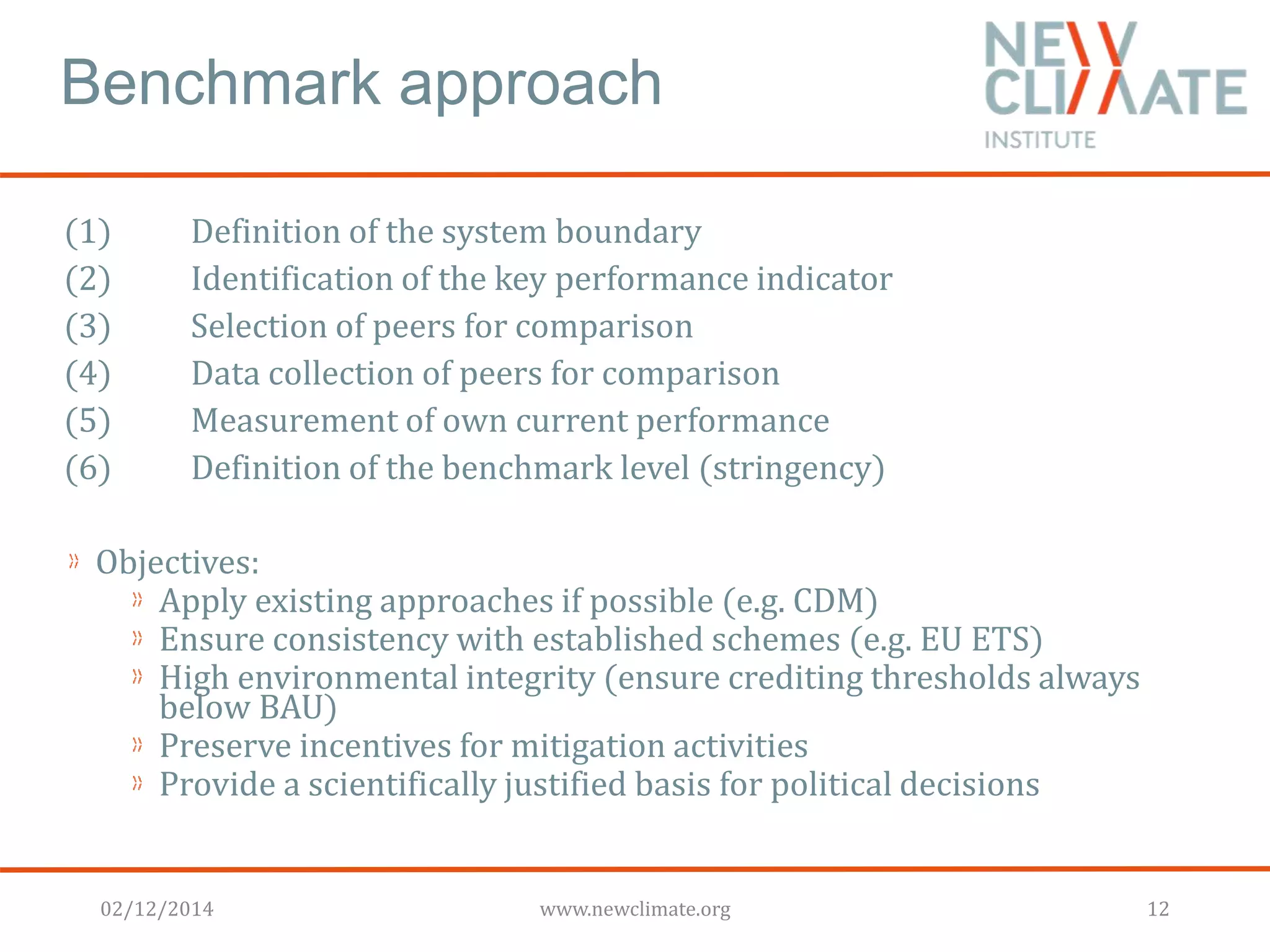
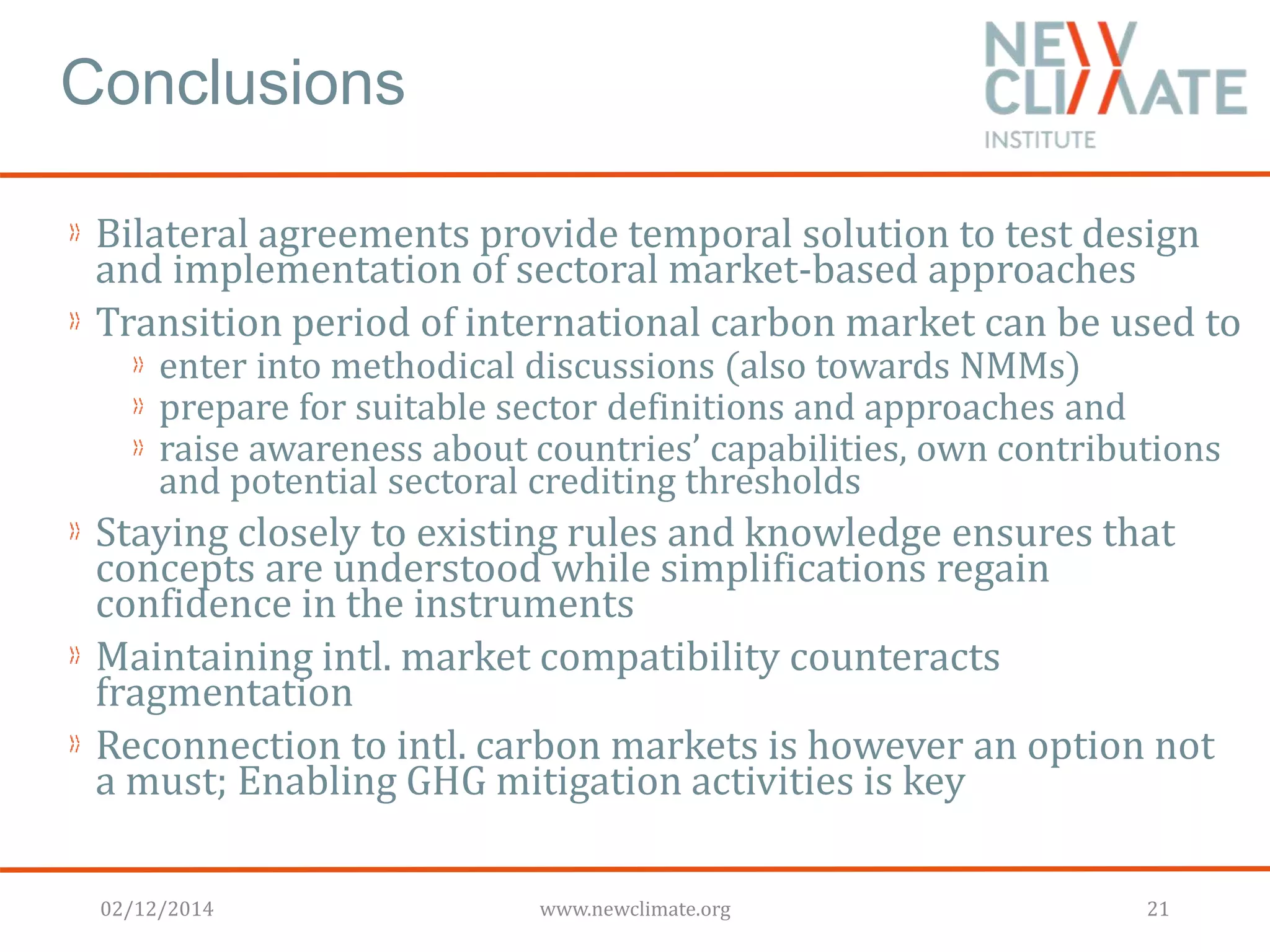
Why benchmarks? 
Benchmarks as (simplified) means to politically agree on 
crediting thresholds for piloting approaches 
GHG intensity 
time 
Historical 
Reduction units issued 
(bilaterally supported reductions) 
Currently implemented 
national policies & measures 
Current external support 
and CDM projects 
(2) Reference (BAU) 
Own contribution 
(3) Benchmark stringency 
(crediting baseline) 
(4) Emission level achieved 
02/12/2014 www.newclimate.org 11
Benchmark approach 
(1) Definition of the system boundary 
(2) Identification of the key performance indicator 
(3) Selection of peers for comparison 
(4) Data collection of peers for comparison 
(5) Measurement of own current performance 
(6) Definition of the benchmark level (stringency) 
Objectives: 
Apply existing approaches if possible (e.g. CDM) 
Ensure consistency with established schemes (e.g. EU ETS) 
High environmental integrity (ensure crediting thresholds always 
below BAU) 
Preserve incentives for mitigation activities 
Provide a scientifically justified basis for political decisions 
02/12/2014 www.newclimate.org 12
Chile‘s power generation sector 
Almost 1/3 of the GHG emissions stem 
from electricity and heat generation 
Electricity generation dominated by 
gas and hydro power plants 
Future capacity additions likely based on 
coal 
Vast potential for renewable energy 
Chile requires large electricity companies 
to have a share of at least 5% of 
renewable energy; increasing by 0.5ppts 
annually 
Chile is developing plans for a domestic 
ETS under the PMR 
Chile’s renewable energy NAMA is one of 
the first NAMAs to receive international 
finance 
02/12/2014 www.newclimate.org 13
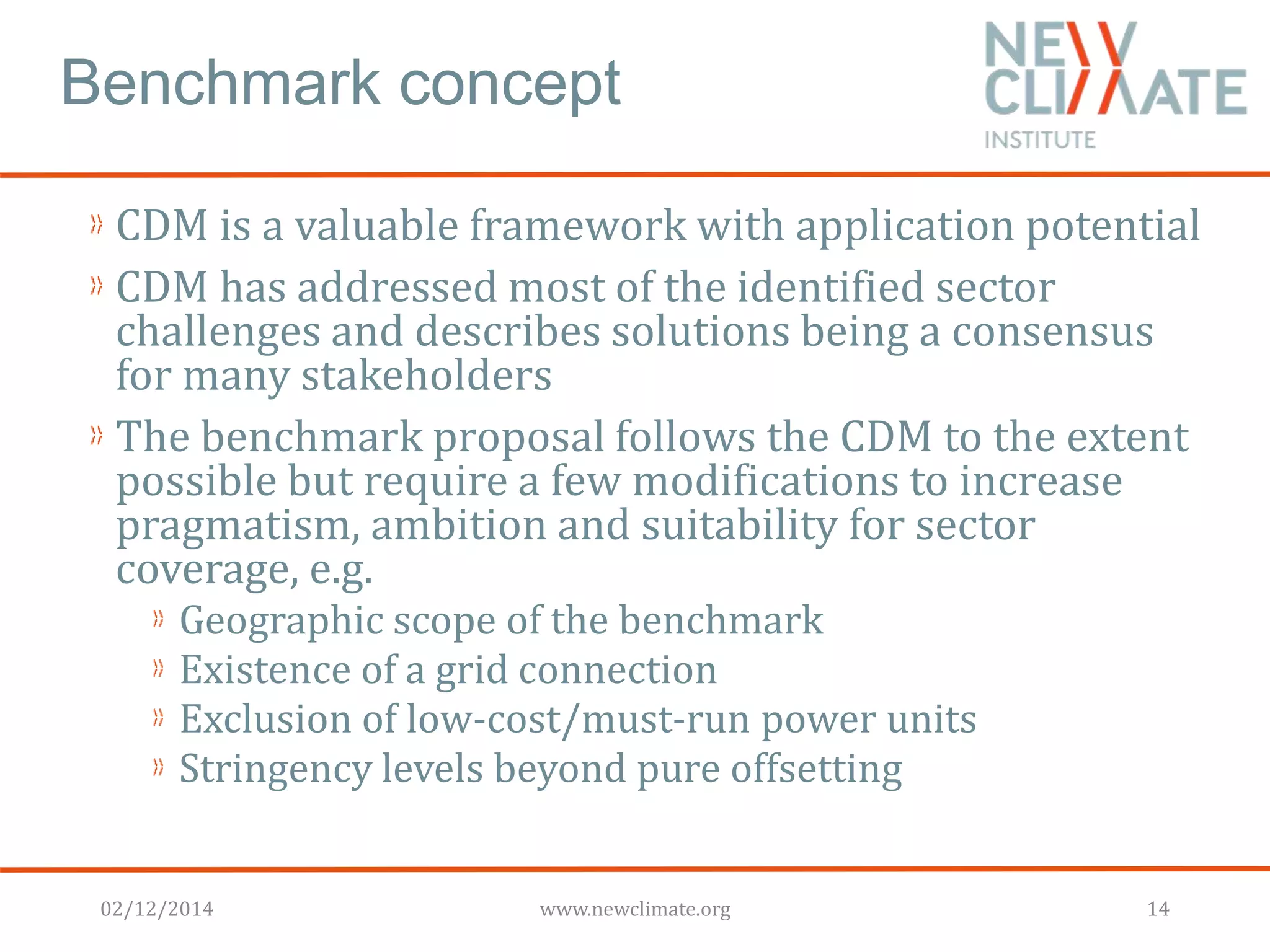
Benchmark concept 
CDM is a valuable framework with application potential 
CDM has addressed most of the identified sector 
challenges and describes solutions being a consensus 
for many stakeholders 
The benchmark proposal follows the CDM to the extent 
possible but require a few modifications to increase 
pragmatism, ambition and suitability for sector 
coverage, e.g. 
Geographic scope of the benchmark 
Existence of a grid connection 
Exclusion of low-cost/must-run power units 
Stringency levels beyond pure offsetting 
02/12/2014 www.newclimate.org 14
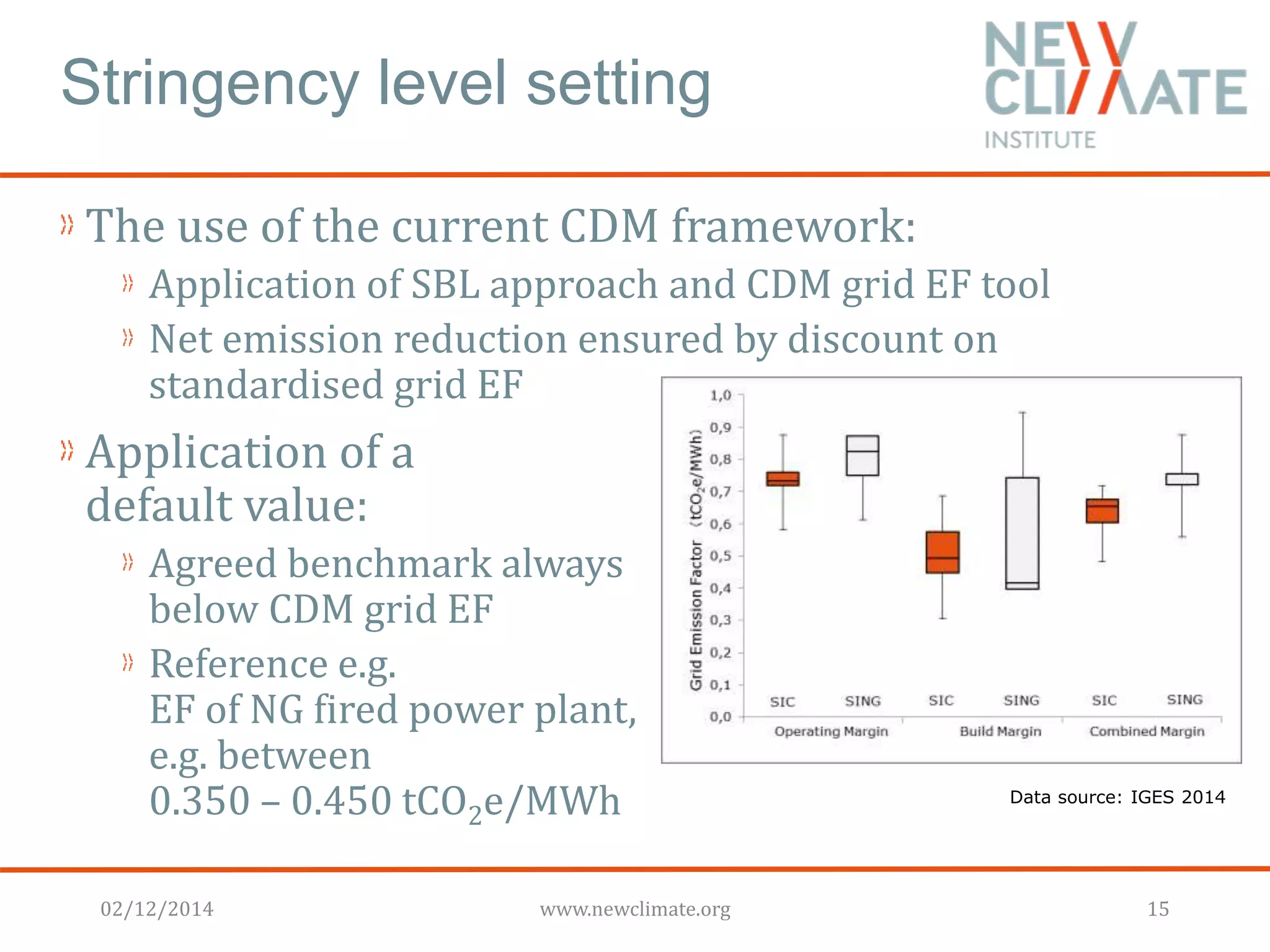
Stringency level setting 
The use of the current CDM framework: 
Application of SBL approach and CDM grid EF tool 
Net emission reduction ensured by discount on 
standardised grid EF 
Application of a 
default value: 
Agreed benchmark always 
below CDM grid EF 
Reference e.g. 
EF of NG fired power plant, 
e.g. between 
0.350 – 0.450 tCO2e/MWh Data source: IGES 2014 
02/12/2014 www.newclimate.org 15
Stringency level setting 
Hybrid approach: 
Combination of approaches 
RE by default get reduction units according to default 
BM value while fossil fuel based activities apply for 
BM based on the (adapted) CDM approach 
Incentives also for new NG fired power plants and for 
efficiency increase in existing fossil fuel fired power 
plants 
02/12/2014 www.newclimate.org 16
CDM in the building sector 
CDM projects mostly refer to single measures in 
buildings 
CDM application in its current form to entire 
buildings lags behind its enormous potential 
Low “signal to noise” ratio, high complexity 
Most available methodologies are either too specific 
or do not provide practicable solutions to sector 
challenges 
CDM experiences show the need for 
Pragmatic MRV approaches 
Valuation of indirect and long term effects 
Bundling of less homogeneous single activities to 
facilitate reaching a large coverage 
02/12/2014 www.newclimate.org 17
South Africa‘s building sector 
Large demand for low cost buildings to supply the 
growing population with adequate housing facilities 
Government targets for new buildings 
Low income housing segment provides free housing to 
poorest parts of the population 
Low income houses usually constructed in a standard 
way, resulting in a large number of similar homes 
Focus on sector sub-segment: „low income housing“ 
Lessons learned with the use of the CDM and upscaling 
approaches exist 
02/12/2014 www.newclimate.org 18
Benchmark concept 
Suggestion: Overcome existing barriers by using 
pragmatic approaches, deviating from exact GHG 
quantification 
GHG emissions per standard housing unit 
Ex-ante modeling (default/unit) 
Simplified ex-post MRV 
The increase in uncertainty is levelled out by 
ambitious crediting thresholds or conservative BAU 
definitions 
Transaction costs are reduced 
02/12/2014 www.newclimate.org 19
Stringency level setting 
BAU: 
incomplete building code implementation 
Reference level: 
assumption of full implementation 
of segment specific building codes 
Mitigation aim: 
beyond building code 
However, in this sector … 
The required support exceeds offset prices 
Potentially low own contribution expected 
Disincentives for ambitious activities to be avoided 
Credited approach requires significantly higher prices 
Uncertainty whether reconnection to future carbon markets is 
realistic 
02/12/2014 www.newclimate.org 20
Conclusions 
Bilateral agreements provide temporal solution to test design 
and implementation of sectoral market-based approaches 
Transition period of international carbon market can be used to 
enter into methodical discussions (also towards NMMs) 
prepare for suitable sector definitions and approaches and 
raise awareness about countries’ capabilities, own contributions 
and potential sectoral crediting thresholds 
Staying closely to existing rules and knowledge ensures that 
concepts are understood while simplifications regain 
confidence in the instruments 
Maintaining intl. market compatibility counteracts 
fragmentation 
Reconnection to intl. carbon markets is however an option not 
a must; Enabling GHG mitigation activities is key 
02/12/2014 www.newclimate.org 21
Outlook 
Deeper investigation of aspects such as 
Integration into the national and international 
policy landscape 
Requirements and next steps towards 
implementation 
Alternative pathways for immediate 
implementation action in a situation with no carbon 
market recovery 
02/12/2014 www.newclimate.org 22
Thank you for your attention! 
Carsten Warnecke 
c.warnecke@newclimate.org 
Hanna Fekete 
h.fekete@newclimate.org 
www.newclimate.org 
02/12/2014 www.newclimate.org 23

Approaches to lift sectoral mitigation potential with markets in transition

  • 1.
    Approaches to liftsectoral mitigation potential with markets in transition DEHSt Side Event 2nd of December 2014, Lima, Peru Carsten Warnecke Hanna Fekete c.warnecke@newclimate.org h.Fekete@newclimate.org
  • 2.
    About NewClimate Institute Non-profit research institute founded Nov. 2014 by 7 former Ecofys colleagues Offices in Berlin and Cologne (Germany) Areas of expertise Climate negotiations Tracking climate action Climate and development Climate financing Carbon market mechanisms 02/12/2014 www.newclimate.org 2
  • 3.
    Background Insights fromDEHSt research project Bilateral Agreements as Basis Towards Piloting Sectoral Market Mechanisms Duration: Sept 2012 – Aug 2015 Activity gap in market-based mechanisms challenges maintaining the expertise of stakeholders and testing of new approaches in practice Demand for „reduction units“ could be created based on bilateral agreements between Parties Theoretically, the EU ETS with article 11a (5),(6) considers bilateral agreements 02/12/2014 www.newclimate.org 3
  • 4.
    Objectives Theoretic researchto develop approaches based on a bilateral crediting system that allows pilot activities Pilot activities shall have a sectoral coverage based on benchmarks high level of environmental integrity generate net emission reductions Open to further ETS and regional markets to join the initiative Research shall Identify suitable countries and sectors for piloting Develop initial sector approaches including proposals for benchmark concepts Elaborate recommendations for the design of such bilateral agreements 02/12/2014 www.newclimate.org 4
  • 5.
    Country Selection methodology First part 02/12/2014 www.newclimate.org 5
  • 6.
    Country selection approach Upper Middle Income Countries 1. Global importance 2. Regional importance 3. Activity level 4. Ambition level Selected countries for individual assessment rating exclusion Shortlisted countries -> Absolute GHG emission level -> Good integration in the region, role model potential -> Development of detailed and objective ranking methodology -> Focus on carbon market and greenhouse gas mitigation related activities and ambition 02/12/2014 www.newclimate.org 6
  • 7.
    Criteria for ranking Indicators for criterion “level of activity”:  Participation in the Clean Development Mechanisms  Activities under the Partnership for Market Readiness (PMR) of the World Bank  Activities around Nationally Appropriate Mitigation Actions (NAMAs)  Activities around Monitoring, Reporting and Verification (MRV) of greenhouse gases; further described with the following sub-indicators: o Submission of National Communications to the UNFCCC; existence of greenhouse gas inventories o Activities under the Global Environment Facility (GEF) and the MRV partnership Indicators for criterion “level of ambition”:  Emission reduction pledges on an international level  Further targets: National energy efficiency or renewable targets  Engagement in Low Emission Development Strategies (LEDS)  Participation in regional or global networks 02/12/2014 www.newclimate.org 7
  • 8.
    Country selection 02/12/2014www.newclimate.org 8
  • 9.
    Sector selection Twostructurally different sectors are selected in the target countries: Power generation sector Building sector Data availability Good, no confidentiality issue, CDM grid emission factor calculation experiences Difficult due to heterogeneity of building and owner structure Average emission reduction per CDM project activity Small to very large Small, up-scaling desired but difficult Successes in the CDM Well represented; high share of projects, several methodologies and tool to calculate grid emission factor, first SBL Limited, low penetration rate, very low issuance success, mostly single measures in buildings Barriers in the CDM Large differences in regional baselines and respective incentive level Monitoring, boundary setting, high transaction costs, high “signal to noise ratio” Benchmarks in the EU ETS (2013-2020) None, no free allocation None, not covered by the EU ETS 02/12/2014 www.newclimate.org 9
  • 10.
    Concepts for creditedreference levels based on benchmarks Second part 02/12/2014 www.newclimate.org 10
  • 11.
    Why benchmarks? Benchmarksas (simplified) means to politically agree on crediting thresholds for piloting approaches GHG intensity time Historical Reduction units issued (bilaterally supported reductions) Currently implemented national policies & measures Current external support and CDM projects (2) Reference (BAU) Own contribution (3) Benchmark stringency (crediting baseline) (4) Emission level achieved 02/12/2014 www.newclimate.org 11
  • 12.
    Benchmark approach (1)Definition of the system boundary (2) Identification of the key performance indicator (3) Selection of peers for comparison (4) Data collection of peers for comparison (5) Measurement of own current performance (6) Definition of the benchmark level (stringency) Objectives: Apply existing approaches if possible (e.g. CDM) Ensure consistency with established schemes (e.g. EU ETS) High environmental integrity (ensure crediting thresholds always below BAU) Preserve incentives for mitigation activities Provide a scientifically justified basis for political decisions 02/12/2014 www.newclimate.org 12
  • 13.
    Chile‘s power generationsector Almost 1/3 of the GHG emissions stem from electricity and heat generation Electricity generation dominated by gas and hydro power plants Future capacity additions likely based on coal Vast potential for renewable energy Chile requires large electricity companies to have a share of at least 5% of renewable energy; increasing by 0.5ppts annually Chile is developing plans for a domestic ETS under the PMR Chile’s renewable energy NAMA is one of the first NAMAs to receive international finance 02/12/2014 www.newclimate.org 13
  • 14.
    Benchmark concept CDMis a valuable framework with application potential CDM has addressed most of the identified sector challenges and describes solutions being a consensus for many stakeholders The benchmark proposal follows the CDM to the extent possible but require a few modifications to increase pragmatism, ambition and suitability for sector coverage, e.g. Geographic scope of the benchmark Existence of a grid connection Exclusion of low-cost/must-run power units Stringency levels beyond pure offsetting 02/12/2014 www.newclimate.org 14
  • 15.
    Stringency level setting The use of the current CDM framework: Application of SBL approach and CDM grid EF tool Net emission reduction ensured by discount on standardised grid EF Application of a default value: Agreed benchmark always below CDM grid EF Reference e.g. EF of NG fired power plant, e.g. between 0.350 – 0.450 tCO2e/MWh Data source: IGES 2014 02/12/2014 www.newclimate.org 15
  • 16.
    Stringency level setting Hybrid approach: Combination of approaches RE by default get reduction units according to default BM value while fossil fuel based activities apply for BM based on the (adapted) CDM approach Incentives also for new NG fired power plants and for efficiency increase in existing fossil fuel fired power plants 02/12/2014 www.newclimate.org 16
  • 17.
    CDM in thebuilding sector CDM projects mostly refer to single measures in buildings CDM application in its current form to entire buildings lags behind its enormous potential Low “signal to noise” ratio, high complexity Most available methodologies are either too specific or do not provide practicable solutions to sector challenges CDM experiences show the need for Pragmatic MRV approaches Valuation of indirect and long term effects Bundling of less homogeneous single activities to facilitate reaching a large coverage 02/12/2014 www.newclimate.org 17
  • 18.
    South Africa‘s buildingsector Large demand for low cost buildings to supply the growing population with adequate housing facilities Government targets for new buildings Low income housing segment provides free housing to poorest parts of the population Low income houses usually constructed in a standard way, resulting in a large number of similar homes Focus on sector sub-segment: „low income housing“ Lessons learned with the use of the CDM and upscaling approaches exist 02/12/2014 www.newclimate.org 18
  • 19.
    Benchmark concept Suggestion:Overcome existing barriers by using pragmatic approaches, deviating from exact GHG quantification GHG emissions per standard housing unit Ex-ante modeling (default/unit) Simplified ex-post MRV The increase in uncertainty is levelled out by ambitious crediting thresholds or conservative BAU definitions Transaction costs are reduced 02/12/2014 www.newclimate.org 19
  • 20.
    Stringency level setting BAU: incomplete building code implementation Reference level: assumption of full implementation of segment specific building codes Mitigation aim: beyond building code However, in this sector … The required support exceeds offset prices Potentially low own contribution expected Disincentives for ambitious activities to be avoided Credited approach requires significantly higher prices Uncertainty whether reconnection to future carbon markets is realistic 02/12/2014 www.newclimate.org 20
  • 21.
    Conclusions Bilateral agreementsprovide temporal solution to test design and implementation of sectoral market-based approaches Transition period of international carbon market can be used to enter into methodical discussions (also towards NMMs) prepare for suitable sector definitions and approaches and raise awareness about countries’ capabilities, own contributions and potential sectoral crediting thresholds Staying closely to existing rules and knowledge ensures that concepts are understood while simplifications regain confidence in the instruments Maintaining intl. market compatibility counteracts fragmentation Reconnection to intl. carbon markets is however an option not a must; Enabling GHG mitigation activities is key 02/12/2014 www.newclimate.org 21
  • 22.
    Outlook Deeper investigationof aspects such as Integration into the national and international policy landscape Requirements and next steps towards implementation Alternative pathways for immediate implementation action in a situation with no carbon market recovery 02/12/2014 www.newclimate.org 22
  • 23.
    Thank you foryour attention! Carsten Warnecke c.warnecke@newclimate.org Hanna Fekete h.fekete@newclimate.org www.newclimate.org 02/12/2014 www.newclimate.org 23