the consulting company of DIW Berlin
TIMES-CGE-SD model coupling and data exchange
mechanism for the LEDS development for Kazakhstan*
November 30, 2021
WINTER 2021 SEMI-ANNUAL ETSAP MEETING
Lars Handrich, Nadiya Mankovska, Maria Polugodina** (DIW ECON GmbH, Germany)
Oleksandr Diachuk, Roman Podolets, Andrii Semeniuk (IEF NASU, Ukraine)
Andrea Bassi, Georg Pallaske (KnowlEdge Srl, Italy)
* Project “Supporting Green Economy in Kazakhstan and Central Asia for low-carbon economic
development” carried out in the framework of the International Climate Initiative of the Federal Ministry
for Environment, Natural Conservation and Nuclear Safety of Germany, operated by the GIZ
** presenter & corresponding author
the consulting company of DIW Berlin
TIMES-CGE-SD model coupling and data exchange mechanism 2
Outline
 Introduction
 Overall approach to iterative model integration
 Deep dive: Automated TIMES-CGE data exchange
 Quick overview of modelling results
the consulting company of DIW Berlin
TIMES-CGE-SD model coupling and data exchange mechanism
Introduction: The context
 Modelling decarbonization pathways to support development of the long-term low-emission
development strategy (LEDS) / carbon neutrality by 2060 for Kazakhstan
 Combining “top-down” (macroeconomic), “bottom-up” (energy technology) and system
dynamics non-energy sectoral approaches:
 This model set allows comprehensive analysis of economy-wide & sectoral transformations and
of socio-economic effects of decarbonization
3
computable general equilibrium (CGE)
(DIW ECON GmbH)
TIMES
(IEF NASU)
system dynamics (SD)
(KnowlEdge Srl)
 Small open economy (KAZ + RoW)
 34 activities + households +
government + capital account
 Calibrated with 2017 National accounts
 Module on industrial process emissions
added
 Recursive dynamics: 44 yearly periods,
2017-2060
 Single-region model
 Full energy system (all energy processes) covered
 Calibrated with 2017 Energy balance
 RSD and COM (TER) demands split by climatic zones
 24 timeslices
 New technology database compiled considering JRC
and Danish Energy Agency technology databases
 Five sectors: agriculture, buildings, coal,
transport, waste
 Calibrated with 2000-2017 data
 Agriculture, buildings and transport
split by climatic zones
 Energy technologies aligned with TIMES
 12 time steps (monthly) per year, to
capture seasonality
the consulting company of DIW Berlin
TIMES-CGE-SD model coupling and data exchange mechanism 4
Why (soft-)link the three models?
 Why link the models?
◼ Each model is focused on its area and makes a number of exogenous assumptions
◼ Replacing exogenous assumptions with endogenous results of other models increases breadth
and depth of modelling
◼ This improves data quality and provides more insightful results
 Why soft-link? – Operability & project sustainability
◼ Each of the models remains fully intact and independently operable
◼ The linking process is significantly simpler, methodologically less demanding and has higher
level of detail
◼ Keeping each model separate provides higher transparency and does not require knowledge
on all three
the consulting company of DIW Berlin
TIMES-CGE-SD model coupling and data exchange mechanism
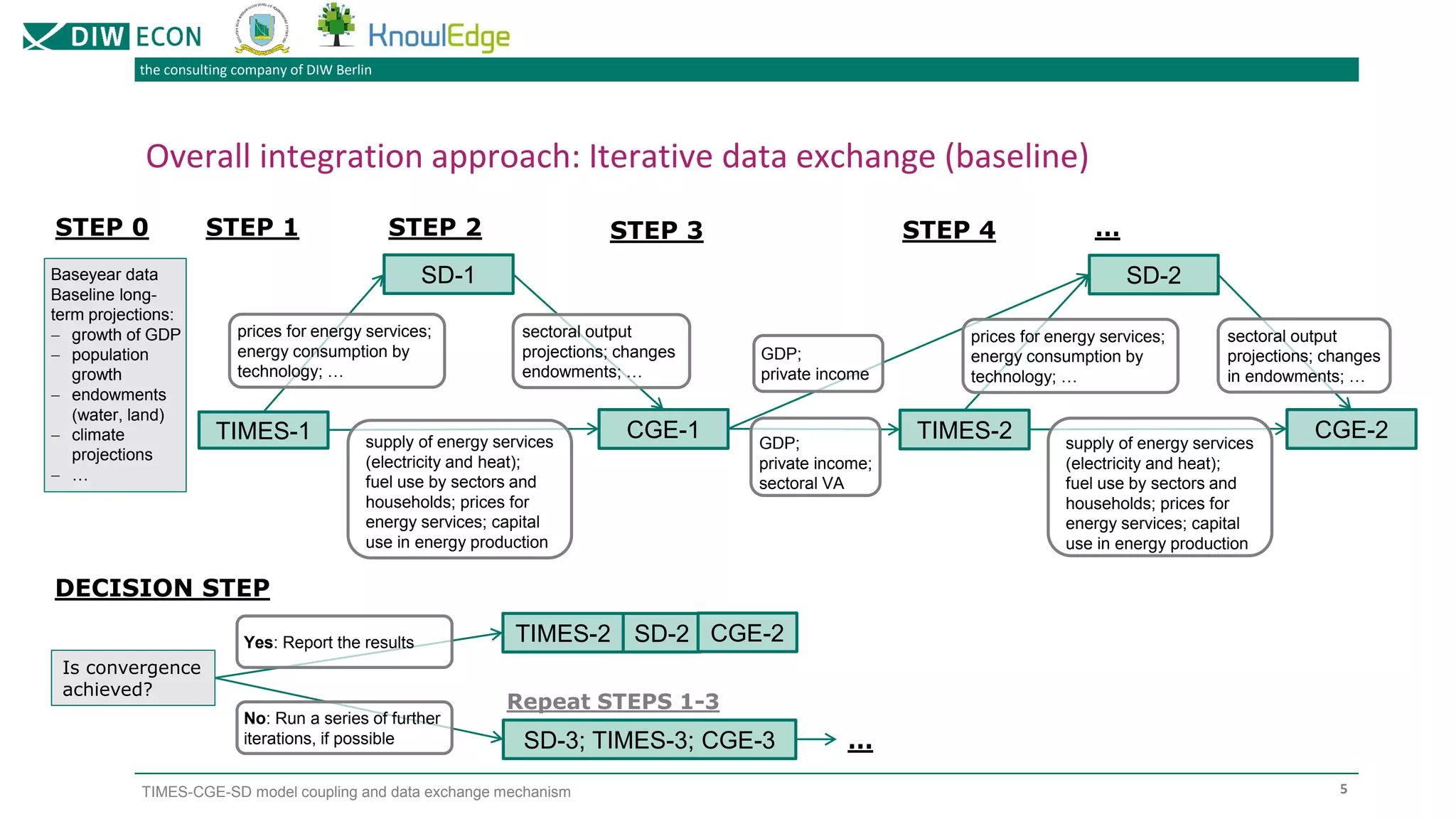
Overall integration approach: Iterative data exchange (baseline)
5
STEP 0
TIMES-1
Baseyear data
Baseline long-
term projections:
− growth of GDP
− population
growth
− endowments
(water, land)
− climate
projections
− …
STEP 1
SD-1
CGE-1
prices for energy services;
energy consumption by
technology; …
sectoral output
projections; changes
endowments; …
supply of energy services
(electricity and heat);
fuel use by sectors and
households; prices for
energy services; capital
use in energy production
STEP 2 STEP 3
TIMES-2
SD-2
CGE-2
prices for energy services;
energy consumption by
technology; …
sectoral output
projections; changes
in endowments; …
GDP;
private income
GDP;
private income;
sectoral VA
supply of energy services
(electricity and heat);
fuel use by sectors and
households; prices for
energy services; capital
use in energy production
STEP 4
TIMES-2 SD-2 CGE-2
Is convergence
achieved?
SD-3; TIMES-3; CGE-3
Repeat STEPS 1-3
…
No: Run a series of further
iterations, if possible
Yes: Report the results
DECISION STEP
…
the consulting company of DIW Berlin
TIMES-CGE-SD model coupling and data exchange mechanism
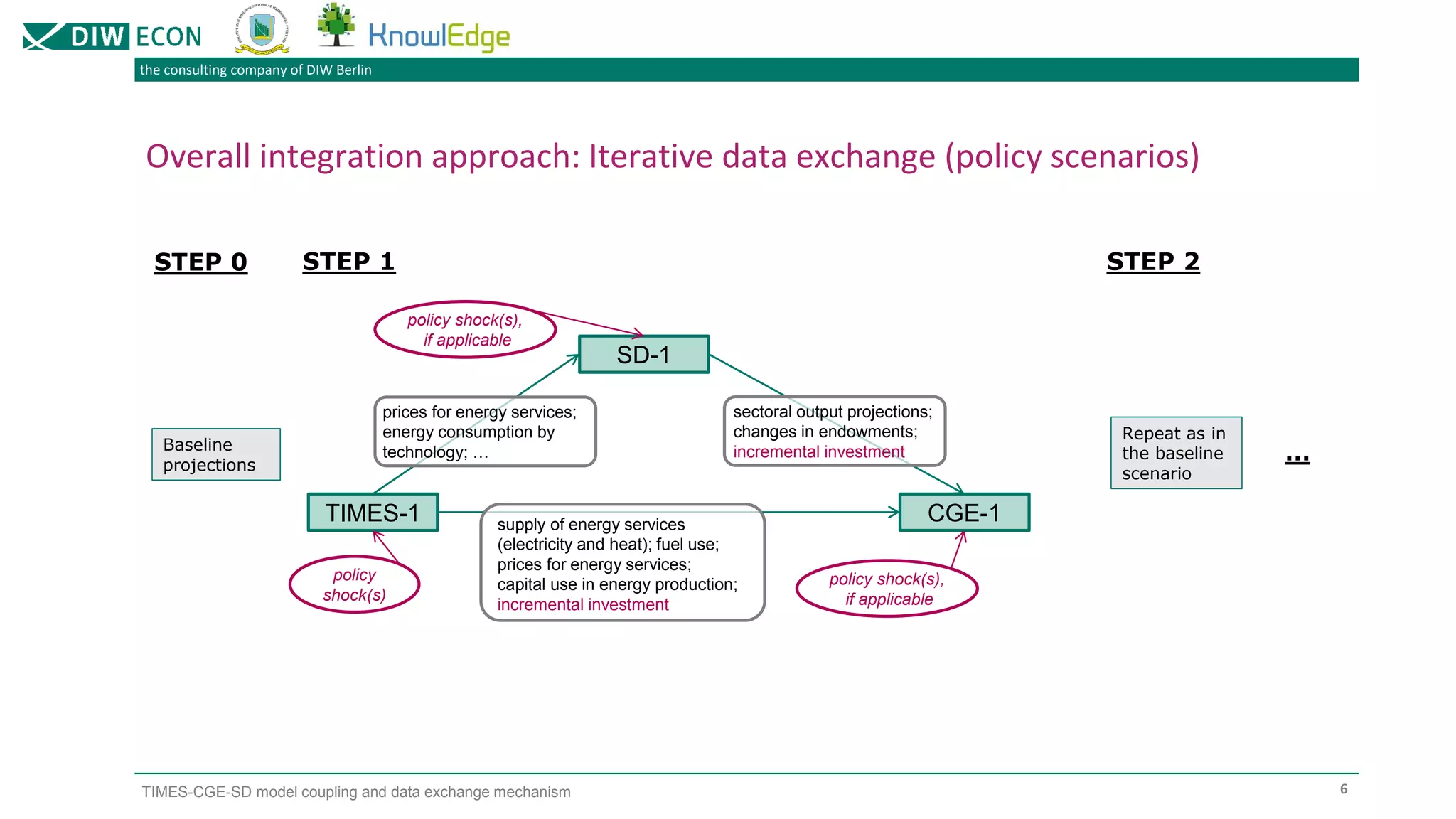
Overall integration approach: Iterative data exchange (policy scenarios)
6
STEP 0
TIMES-1
Baseline
projections
STEP 1
SD-1
CGE-1
policy
shock(s)
policy shock(s),
if applicable
policy shock(s),
if applicable
supply of energy services
(electricity and heat); fuel use;
prices for energy services;
capital use in energy production;
incremental investment
prices for energy services;
energy consumption by
technology; …
sectoral output projections;
changes in endowments;
incremental investment
STEP 2
Repeat as in
the baseline
scenario
…
the consulting company of DIW Berlin
TIMES-CGE-SD model coupling and data exchange mechanism
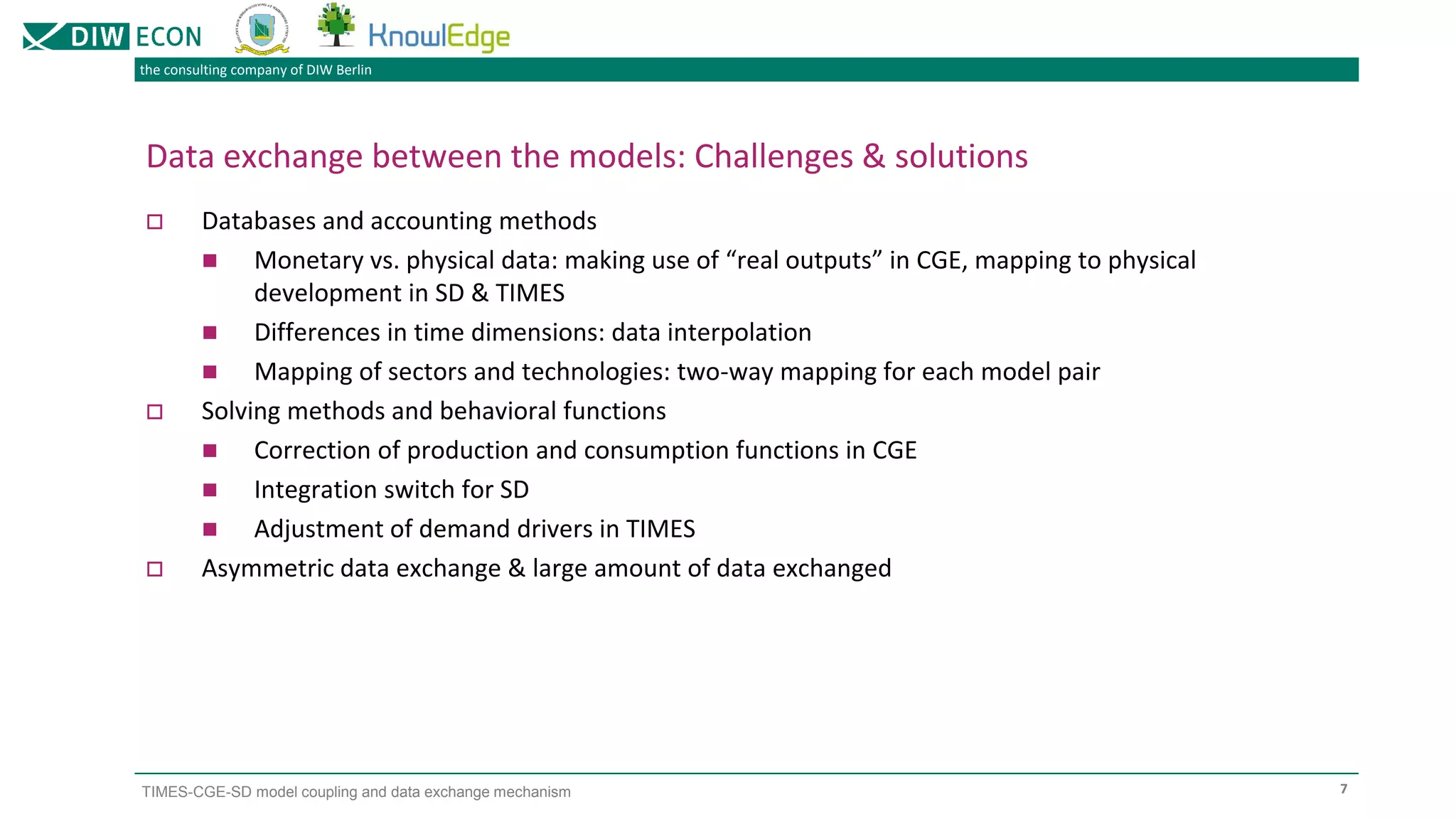
Data exchange between the models: Challenges & solutions
 Databases and accounting methods
◼ Monetary vs. physical data: making use of “real outputs” in CGE, mapping to physical
development in SD & TIMES
◼ Differences in time dimensions: data interpolation
◼ Mapping of sectors and technologies: two-way mapping for each model pair
 Solving methods and behavioral functions
◼ Correction of production and consumption functions in CGE
◼ Integration switch for SD
◼ Adjustment of demand drivers in TIMES
 Asymmetric data exchange & large amount of data exchanged
7
the consulting company of DIW Berlin
TIMES-CGE-SD model coupling and data exchange mechanism
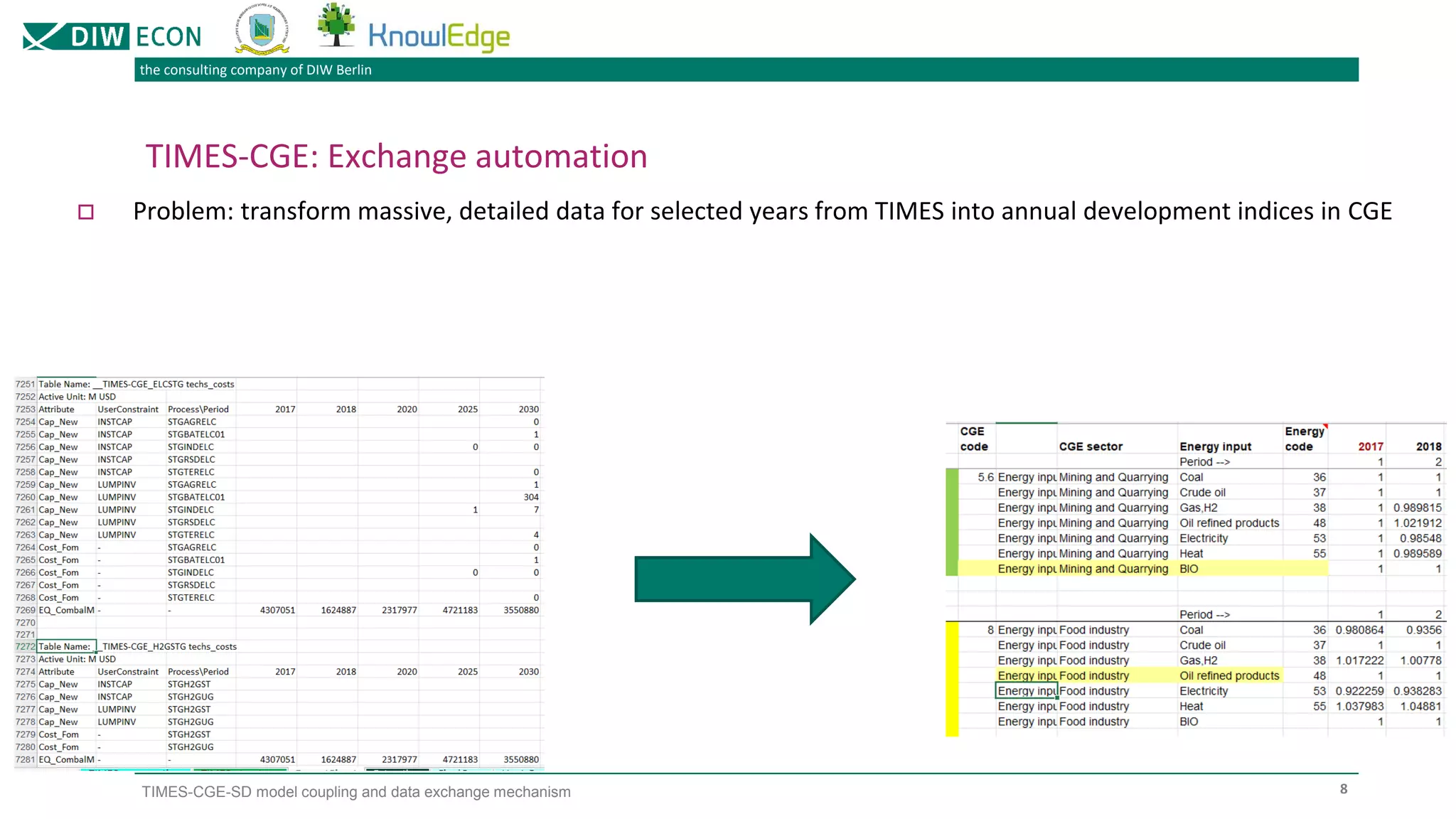
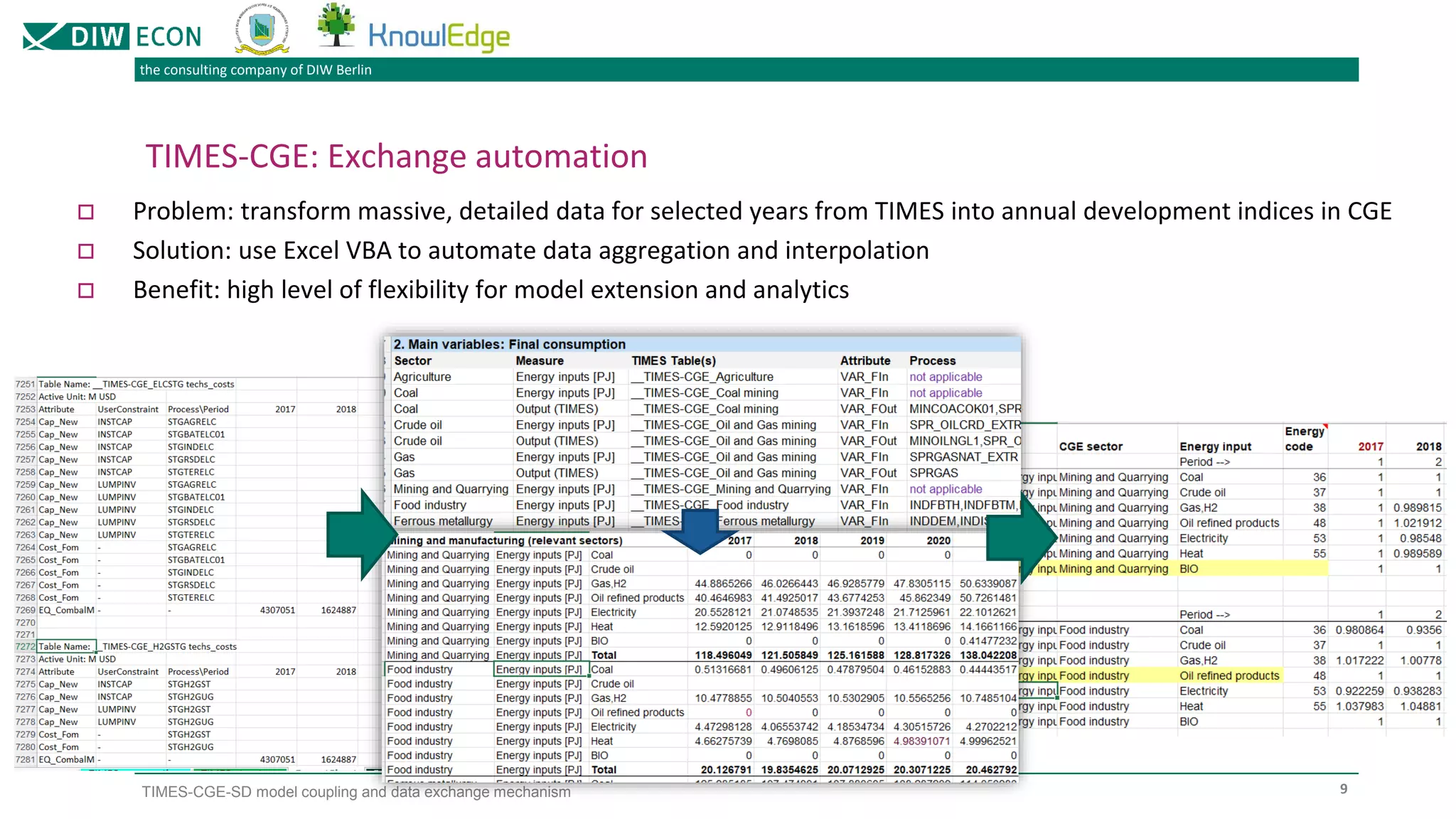
TIMES-CGE: Exchange automation
 Problem: transform massive, detailed data for selected years from TIMES into annual development indices in CGE
8
the consulting company of DIW Berlin
TIMES-CGE-SD model coupling and data exchange mechanism
TIMES-CGE: Exchange automation
 Problem: transform massive, detailed data for selected years from TIMES into annual development indices in CGE
 Solution: use Excel VBA to automate data aggregation and interpolation
 Benefit: high level of flexibility for model extension and analytics
9
the consulting company of DIW Berlin
TIMES-CGE-SD model coupling and data exchange mechanism
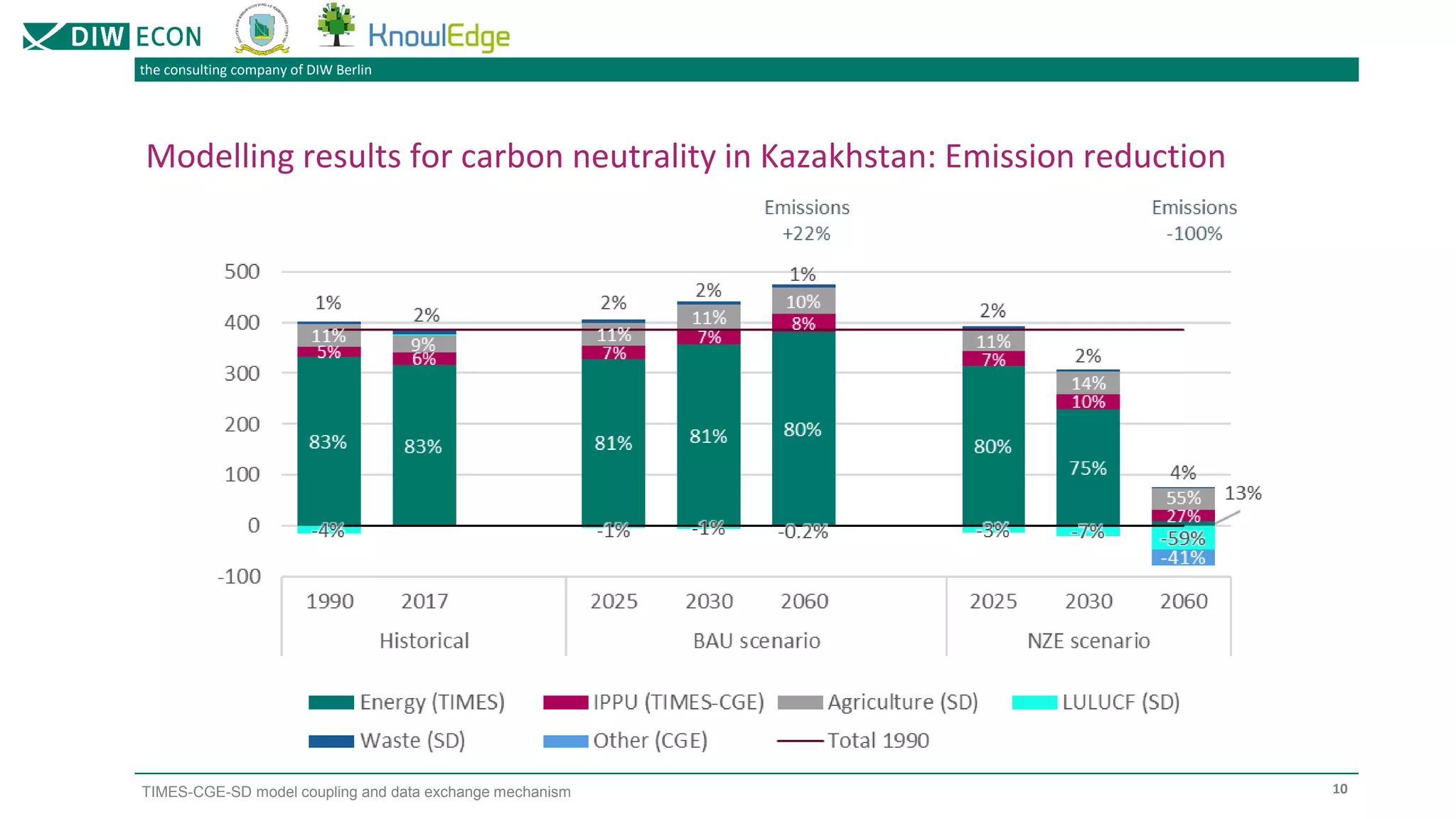
Modelling results for carbon neutrality in Kazakhstan: Emission reduction
10
the consulting company of DIW Berlin
TIMES-CGE-SD model coupling and data exchange mechanism
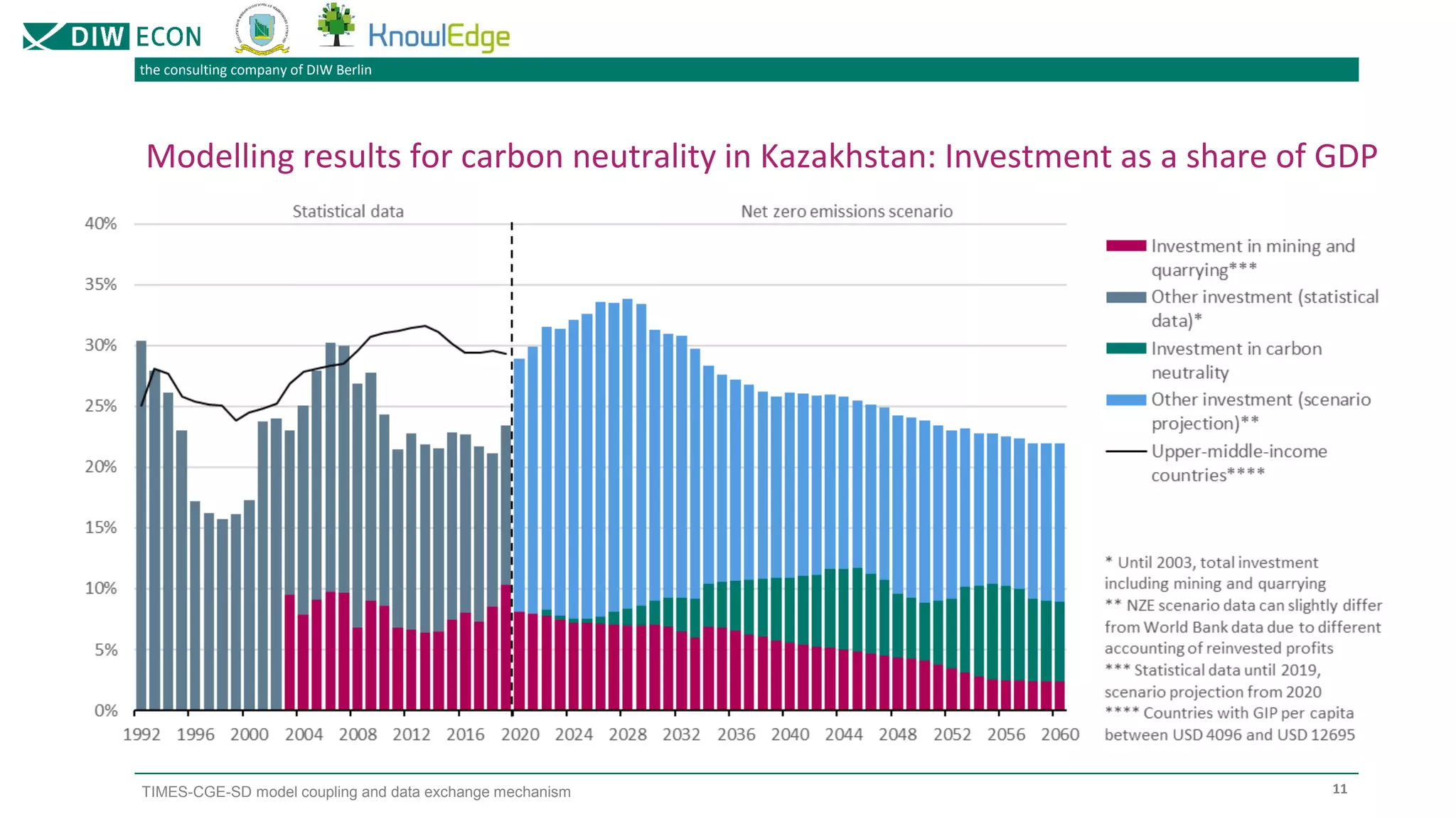
Modelling results for carbon neutrality in Kazakhstan: Investment as a share of GDP
11
the consulting company of DIW Berlin
TIMES-CGE-SD model coupling and data exchange mechanism
12
Contact
Dr. Lars Handrich
Managing Director
DIW Econ GmbH  Mohrenstraße 58
10117 Berlin  Germany
Phone +49.30.20 60 972 0
Fax +49.30.20 60 972 99
E-mail: lhandrich@diw-econ.de
URL: www.diw-econ.com
Head office: Berlin, Germany, Reg.-No.: HRB 108699 B, Local court: Charlottenburg
the consulting company of DIW Berlin
TIMES-CGE-SD model coupling and data exchange mechanism
Thank you for your attention!
13
the consulting company of DIW Berlin
TIMES-CGE-SD model coupling and data exchange mechanism
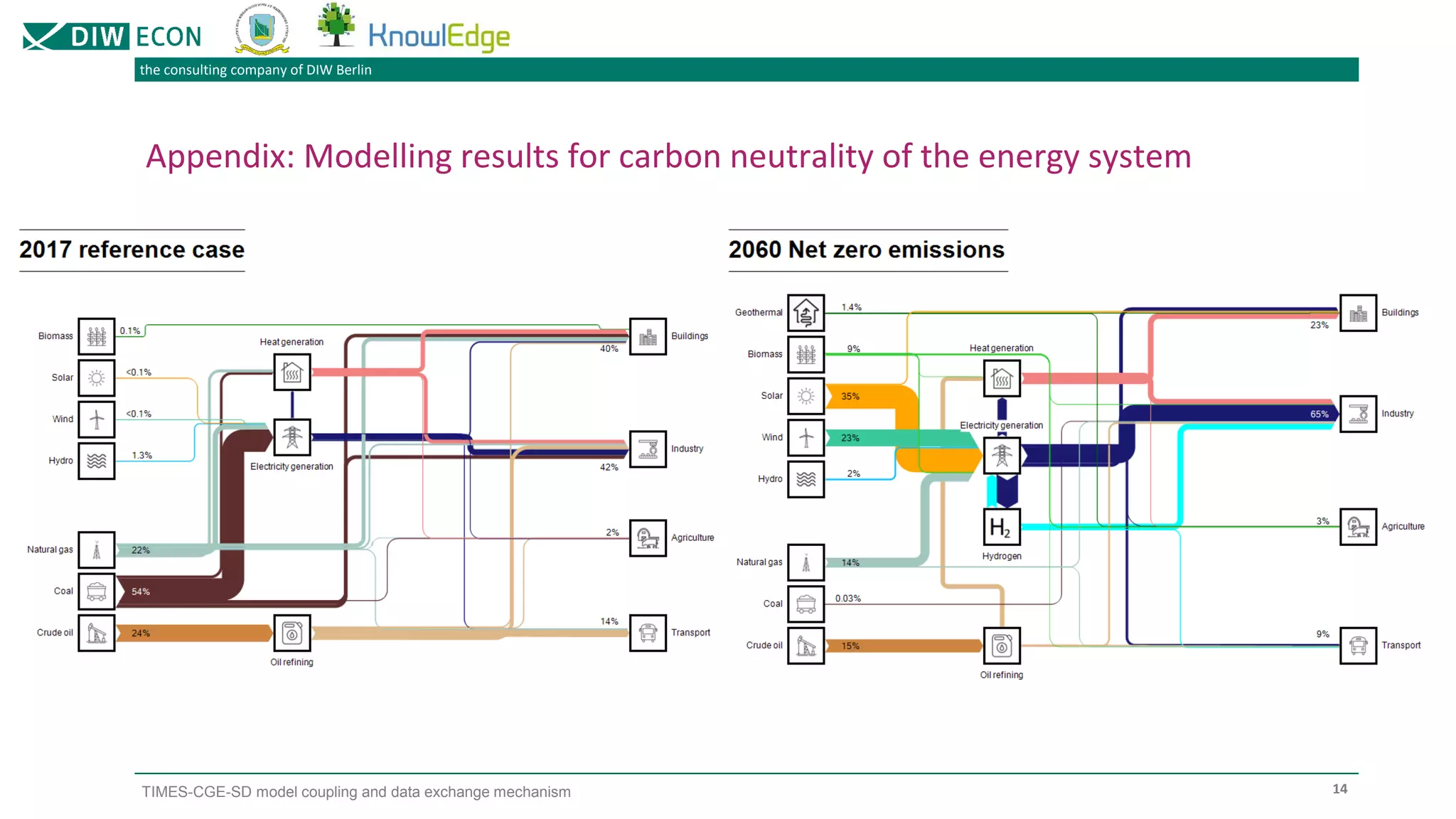
Appendix: Modelling results for carbon neutrality of the energy system
14

TIMES-CGE-SD model coupling and data exchange mechanism for the LEDS development for Kazakhstan

  • 1.
    the consulting companyof DIW Berlin TIMES-CGE-SD model coupling and data exchange mechanism for the LEDS development for Kazakhstan* November 30, 2021 WINTER 2021 SEMI-ANNUAL ETSAP MEETING Lars Handrich, Nadiya Mankovska, Maria Polugodina** (DIW ECON GmbH, Germany) Oleksandr Diachuk, Roman Podolets, Andrii Semeniuk (IEF NASU, Ukraine) Andrea Bassi, Georg Pallaske (KnowlEdge Srl, Italy) * Project “Supporting Green Economy in Kazakhstan and Central Asia for low-carbon economic development” carried out in the framework of the International Climate Initiative of the Federal Ministry for Environment, Natural Conservation and Nuclear Safety of Germany, operated by the GIZ ** presenter & corresponding author
  • 2.
    the consulting companyof DIW Berlin TIMES-CGE-SD model coupling and data exchange mechanism 2 Outline  Introduction  Overall approach to iterative model integration  Deep dive: Automated TIMES-CGE data exchange  Quick overview of modelling results
  • 3.
    the consulting companyof DIW Berlin TIMES-CGE-SD model coupling and data exchange mechanism Introduction: The context  Modelling decarbonization pathways to support development of the long-term low-emission development strategy (LEDS) / carbon neutrality by 2060 for Kazakhstan  Combining “top-down” (macroeconomic), “bottom-up” (energy technology) and system dynamics non-energy sectoral approaches:  This model set allows comprehensive analysis of economy-wide & sectoral transformations and of socio-economic effects of decarbonization 3 computable general equilibrium (CGE) (DIW ECON GmbH) TIMES (IEF NASU) system dynamics (SD) (KnowlEdge Srl)  Small open economy (KAZ + RoW)  34 activities + households + government + capital account  Calibrated with 2017 National accounts  Module on industrial process emissions added  Recursive dynamics: 44 yearly periods, 2017-2060  Single-region model  Full energy system (all energy processes) covered  Calibrated with 2017 Energy balance  RSD and COM (TER) demands split by climatic zones  24 timeslices  New technology database compiled considering JRC and Danish Energy Agency technology databases  Five sectors: agriculture, buildings, coal, transport, waste  Calibrated with 2000-2017 data  Agriculture, buildings and transport split by climatic zones  Energy technologies aligned with TIMES  12 time steps (monthly) per year, to capture seasonality
  • 4.
    the consulting companyof DIW Berlin TIMES-CGE-SD model coupling and data exchange mechanism 4 Why (soft-)link the three models?  Why link the models? ◼ Each model is focused on its area and makes a number of exogenous assumptions ◼ Replacing exogenous assumptions with endogenous results of other models increases breadth and depth of modelling ◼ This improves data quality and provides more insightful results  Why soft-link? – Operability & project sustainability ◼ Each of the models remains fully intact and independently operable ◼ The linking process is significantly simpler, methodologically less demanding and has higher level of detail ◼ Keeping each model separate provides higher transparency and does not require knowledge on all three
  • 5.
    the consulting companyof DIW Berlin TIMES-CGE-SD model coupling and data exchange mechanism Overall integration approach: Iterative data exchange (baseline) 5 STEP 0 TIMES-1 Baseyear data Baseline long- term projections: − growth of GDP − population growth − endowments (water, land) − climate projections − … STEP 1 SD-1 CGE-1 prices for energy services; energy consumption by technology; … sectoral output projections; changes endowments; … supply of energy services (electricity and heat); fuel use by sectors and households; prices for energy services; capital use in energy production STEP 2 STEP 3 TIMES-2 SD-2 CGE-2 prices for energy services; energy consumption by technology; … sectoral output projections; changes in endowments; … GDP; private income GDP; private income; sectoral VA supply of energy services (electricity and heat); fuel use by sectors and households; prices for energy services; capital use in energy production STEP 4 TIMES-2 SD-2 CGE-2 Is convergence achieved? SD-3; TIMES-3; CGE-3 Repeat STEPS 1-3 … No: Run a series of further iterations, if possible Yes: Report the results DECISION STEP …
  • 6.
    the consulting companyof DIW Berlin TIMES-CGE-SD model coupling and data exchange mechanism Overall integration approach: Iterative data exchange (policy scenarios) 6 STEP 0 TIMES-1 Baseline projections STEP 1 SD-1 CGE-1 policy shock(s) policy shock(s), if applicable policy shock(s), if applicable supply of energy services (electricity and heat); fuel use; prices for energy services; capital use in energy production; incremental investment prices for energy services; energy consumption by technology; … sectoral output projections; changes in endowments; incremental investment STEP 2 Repeat as in the baseline scenario …
  • 7.
    the consulting companyof DIW Berlin TIMES-CGE-SD model coupling and data exchange mechanism Data exchange between the models: Challenges & solutions  Databases and accounting methods ◼ Monetary vs. physical data: making use of “real outputs” in CGE, mapping to physical development in SD & TIMES ◼ Differences in time dimensions: data interpolation ◼ Mapping of sectors and technologies: two-way mapping for each model pair  Solving methods and behavioral functions ◼ Correction of production and consumption functions in CGE ◼ Integration switch for SD ◼ Adjustment of demand drivers in TIMES  Asymmetric data exchange & large amount of data exchanged 7
  • 8.
    the consulting companyof DIW Berlin TIMES-CGE-SD model coupling and data exchange mechanism TIMES-CGE: Exchange automation  Problem: transform massive, detailed data for selected years from TIMES into annual development indices in CGE 8
  • 9.
    the consulting companyof DIW Berlin TIMES-CGE-SD model coupling and data exchange mechanism TIMES-CGE: Exchange automation  Problem: transform massive, detailed data for selected years from TIMES into annual development indices in CGE  Solution: use Excel VBA to automate data aggregation and interpolation  Benefit: high level of flexibility for model extension and analytics 9
  • 10.
    the consulting companyof DIW Berlin TIMES-CGE-SD model coupling and data exchange mechanism Modelling results for carbon neutrality in Kazakhstan: Emission reduction 10
  • 11.
    the consulting companyof DIW Berlin TIMES-CGE-SD model coupling and data exchange mechanism Modelling results for carbon neutrality in Kazakhstan: Investment as a share of GDP 11
  • 12.
    the consulting companyof DIW Berlin TIMES-CGE-SD model coupling and data exchange mechanism 12 Contact Dr. Lars Handrich Managing Director DIW Econ GmbH  Mohrenstraße 58 10117 Berlin  Germany Phone +49.30.20 60 972 0 Fax +49.30.20 60 972 99 E-mail: lhandrich@diw-econ.de URL: www.diw-econ.com Head office: Berlin, Germany, Reg.-No.: HRB 108699 B, Local court: Charlottenburg
  • 13.
    the consulting companyof DIW Berlin TIMES-CGE-SD model coupling and data exchange mechanism Thank you for your attention! 13
  • 14.
    the consulting companyof DIW Berlin TIMES-CGE-SD model coupling and data exchange mechanism Appendix: Modelling results for carbon neutrality of the energy system 14