2011. 10. 17


      Sung-Wook Shin(KERIS)
Jon Mason(Queensland Univ. of Tech.)
Background
Purpose
Drafting the Report
Technical Components
Conclusions


                        2
During 2009 there was consensus to
 initiate work on a Technical Report
 representing a reference model and
 informing technical implementation
 of e-portfolio systems within learning
 context
During 2010 use cases were
 collected and an initial draft was
 prepared

                                      3
ISO/IEC 20013 has been in progress
 since 2010.
The challenge of developing
 international consensus is never easy.
This study presents a case-study
 within the formal standards context
 of Information Technology for
 Learning, Education, and
 Traning(ITLET)

                                      4
It is focused on developing an
 informative, as opposed to a
 normative, Technical Report by 2012
The intention is to provide guidance
 concerning interoperability issues
 rather than detail a set of
 prescriptive specifications


                                        5
Definition terms and scope
  e-Portfolio aims to show aspects of a
   student’s learning process, using Web-
   based communication tools and various
   methods of expression, such as
   audio, video, and graphics
   (Barrett, 1998)
  learners build and manage their
   artefacts in a digital format which
   reveals their capabilities in handling
   digital media while enabling self-
   reflection about their learning.
   (Tosh and Werdmuller, 2004)
                                            6
Definition terms and scope(cont.)
  an e-Portfolio in LET contexts can be
   examined from two perspectives:
   learners and assessors.
  a learner will typically use an e-portfolio
   for storage of learning artefacts, self-
   directed learning and reflection, career
   planning and social activities.
  An assessor perspective is likely to
   extend beyond educational institutions
   to include potential employers and
   workplaces.                                 7
Definition terms and scope(cont.)
   An e-Portfolio is a collection of data and
   electronic information aggregated within an
   IT system to support LET and professional
   development activities through automated
   and manual means, and used for a
   diversity of purposes, such as: storage of
   personal electronic artifacts; personal
   journalism for reflective learning; collated
   evidence of learning, experience, and
   achievements; and presentation of selected
   views of this content to prospective and
   existing employers(from ISO/IEC 20013).
                                                 8
e-Portfolio types
  According to the purpose of use,
    Developmental
    Assessment
    Showcase
    Hybrid: A blended all of the above
    (Choi Ae-kyung, 2005)


                                          9
Call for use-cases to SC36 NBLOs
  In order to initiate ISO/IEC 20013, co-
   editors called for use cases of e-portfolio
   in e-Learning to all SC36 NBLOs.
  As results, 8 cases contributed from 5
   NBs(AU, CA, CH, FR, KR) and 2 study
   cases including IMS
  Based on these cases, ISO/IEC 20013
   was initiated.

                                             10
Delphi survey for composing
  three to four rounds of questionnaire
   surveys are generally carried out with
   the same respondents to collect opinions
   from expert groups.
  The study involved Korean researchers
   to compose e-Portfolios after
   complementing and revising the e-
   Portfolio elements to fit the Korean
   situation.
                                           11
Standards for Composing e-Portfolio
 Categories and Elements
  Based on ISO/IEC 20013, the model
   gathered together common elements to
   form a hierarchical structure for broad
   (category), middle (element), and
   specific (item) classifications.
  To overcome any shortcomings, this
   study defined only essential categories
   and the essential elements that belong
   to each category.
                                         12
e-Portfolio Categories
  To set the criteria for a broad
   classification of e-Portfolios, an
   individual’s educational activities need to
   be considered from the viewpoint of
   lifecycle.
  One of the key ideas of constructivism is
   that knowledge is constructed through a
   learner’s experiences and self-directed
   learning.
                                            13
e-Portfolio Categories
  According to Wolf and Dietz(1998),
   there are three definitions for portfolio
   functions from learner perspectives
    to show the learning process of learners
    to assess learners
    to showcase professional development of
     learners to others
  However, it is not only for a learner, but
   also……
                                               14
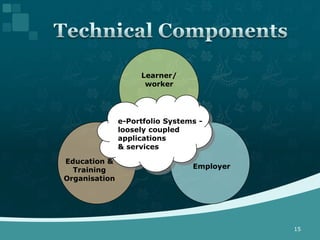
Learner/
                           worker


               e-Portfolio Systems - loosely coupled
                            applications
               e-Portfolio Systems -
                             & services
               loosely coupled
               applications
               & services

Education &
                                                       Employer
  Training
Organisation


                                                                  15
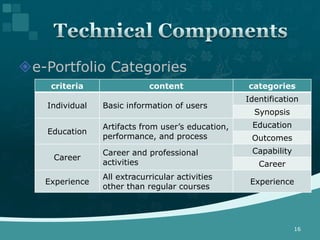
e-Portfolio Categories
    criteria                content                categories
                                                   Identification
   Individual   Basic information of users
                                                     Synopsis
                Artifacts from user’s education,    Education
    Education
                performance, and process            Outcomes
                Career and professional             Capability
     Career
                activities                            Career
                All extracurricular activities
   Experience                                       Experience
                other than regular courses


                                                                 16
e-Portfolio Elements
  Berrett(2001) and others pointed out
   “goal”, “data”, and “reflection” as
   elements that must be included
  This means that the concept and activity
   of “self-reflection” must be included, in
   acquiring and nurturing the qualification
   of “practical knowledge” and “reflective
   thinking ability”, as essential activities of
   the e-Portfolio
                                              17
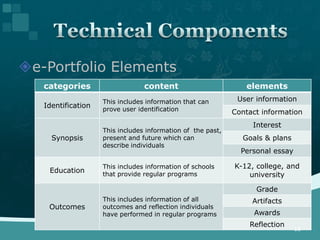
e-Portfolio Elements
   categories                    content                        elements
                    This includes information that can        User information
   Identification   prove user identification                Contact information
                                                                  Interest
                    This includes information of the past,
     Synopsis       present and future which can               Goals & plans
                    describe individuals
                                                               Personal essay

                    This includes information of schools     K-12, college, and
    Education       that provide regular programs                university

                                                                   Grade
                    This includes information of all              Artifacts
    Outcomes        outcomes and reflection individuals
                    have performed in regular programs             Awards
                                                                 Reflection
                                                                                18
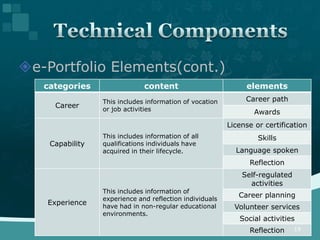
e-Portfolio Elements(cont.)
   categories                 content                         elements
                 This includes information of vocation        Career path
     Career      or job activities                               Awards
                                                         License or certification
                 This includes information of all                 Skills
    Capability   qualifications individuals have
                 acquired in their lifecycle.              Language spoken
                                                               Reflection
                                                             Self-regulated
                                                               activities
                 This includes information of
                 experience and reflection individuals
                                                            Career planning
   Experience    have had in non-regular educational       Volunteer services
                 environments.
                                                            Social activities
                                                               Reflection     19
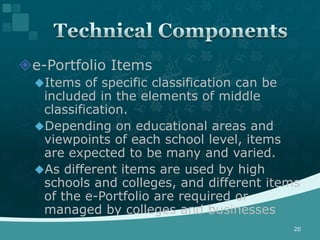
e-Portfolio Items
  Items of specific classification can be
   included in the elements of middle
   classification.
  Depending on educational areas and
   viewpoints of each school level, items
   are expected to be many and varied.
  As different items are used by high
   schools and colleges, and different items
   of the e-Portfolio are required or
   managed by colleges and businesses
                                             20
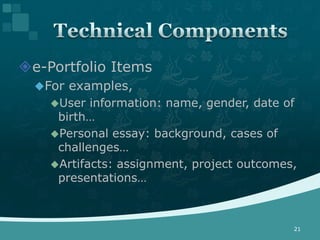
e-Portfolio Items
  For examples,
    User  information: name, gender, date of
     birth…
    Personal essay: background, cases of
     challenges…
    Artifacts: assignment, project outcomes,
     presentations…


                                            21
[Figure]

                               Structure of the e-portfolio
                               reference model


<7 categories & 25 elements>

                                                       22
This draft of e-portfolio categories
 has been developed from a lifecycle
 perspective.
It also proposed standardized
 elements by category and presented
 examples of the many and varied
 items that can be included in each
 element.

                                        23
A key difficulty lies in ensuring a
 systemic connection of information
 between different levels of schools,
 educational institutions, and
 jurisdictions, as well as between
 educational institutions and businesses.
However, without solving this, the
 consequence will be discontinuities in
 information management and little
 portability of data.
                                        24
An e-portfolio reference model for e-learning

An e-portfolio reference model for e-learning

  • 1.
    2011. 10. 17 Sung-Wook Shin(KERIS) Jon Mason(Queensland Univ. of Tech.)
  • 2.
  • 3.
    During 2009 therewas consensus to initiate work on a Technical Report representing a reference model and informing technical implementation of e-portfolio systems within learning context During 2010 use cases were collected and an initial draft was prepared 3
  • 4.
    ISO/IEC 20013 hasbeen in progress since 2010. The challenge of developing international consensus is never easy. This study presents a case-study within the formal standards context of Information Technology for Learning, Education, and Traning(ITLET) 4
  • 5.
    It is focusedon developing an informative, as opposed to a normative, Technical Report by 2012 The intention is to provide guidance concerning interoperability issues rather than detail a set of prescriptive specifications 5
  • 6.
    Definition terms andscope e-Portfolio aims to show aspects of a student’s learning process, using Web- based communication tools and various methods of expression, such as audio, video, and graphics (Barrett, 1998) learners build and manage their artefacts in a digital format which reveals their capabilities in handling digital media while enabling self- reflection about their learning. (Tosh and Werdmuller, 2004) 6
  • 7.
    Definition terms andscope(cont.) an e-Portfolio in LET contexts can be examined from two perspectives: learners and assessors. a learner will typically use an e-portfolio for storage of learning artefacts, self- directed learning and reflection, career planning and social activities. An assessor perspective is likely to extend beyond educational institutions to include potential employers and workplaces. 7
  • 8.
    Definition terms andscope(cont.)  An e-Portfolio is a collection of data and electronic information aggregated within an IT system to support LET and professional development activities through automated and manual means, and used for a diversity of purposes, such as: storage of personal electronic artifacts; personal journalism for reflective learning; collated evidence of learning, experience, and achievements; and presentation of selected views of this content to prospective and existing employers(from ISO/IEC 20013). 8
  • 9.
    e-Portfolio types According to the purpose of use, Developmental Assessment Showcase Hybrid: A blended all of the above (Choi Ae-kyung, 2005) 9
  • 10.
    Call for use-casesto SC36 NBLOs In order to initiate ISO/IEC 20013, co- editors called for use cases of e-portfolio in e-Learning to all SC36 NBLOs. As results, 8 cases contributed from 5 NBs(AU, CA, CH, FR, KR) and 2 study cases including IMS Based on these cases, ISO/IEC 20013 was initiated. 10
  • 11.
    Delphi survey forcomposing three to four rounds of questionnaire surveys are generally carried out with the same respondents to collect opinions from expert groups. The study involved Korean researchers to compose e-Portfolios after complementing and revising the e- Portfolio elements to fit the Korean situation. 11
  • 12.
    Standards for Composinge-Portfolio Categories and Elements Based on ISO/IEC 20013, the model gathered together common elements to form a hierarchical structure for broad (category), middle (element), and specific (item) classifications. To overcome any shortcomings, this study defined only essential categories and the essential elements that belong to each category. 12
  • 13.
    e-Portfolio Categories To set the criteria for a broad classification of e-Portfolios, an individual’s educational activities need to be considered from the viewpoint of lifecycle. One of the key ideas of constructivism is that knowledge is constructed through a learner’s experiences and self-directed learning. 13
  • 14.
    e-Portfolio Categories According to Wolf and Dietz(1998), there are three definitions for portfolio functions from learner perspectives to show the learning process of learners to assess learners to showcase professional development of learners to others However, it is not only for a learner, but also…… 14
  • 15.
    Learner/ worker e-Portfolio Systems - loosely coupled applications e-Portfolio Systems - & services loosely coupled applications & services Education & Employer Training Organisation 15
  • 16.
    e-Portfolio Categories criteria content categories Identification Individual Basic information of users Synopsis Artifacts from user’s education, Education Education performance, and process Outcomes Career and professional Capability Career activities Career All extracurricular activities Experience Experience other than regular courses 16
  • 17.
    e-Portfolio Elements Berrett(2001) and others pointed out “goal”, “data”, and “reflection” as elements that must be included This means that the concept and activity of “self-reflection” must be included, in acquiring and nurturing the qualification of “practical knowledge” and “reflective thinking ability”, as essential activities of the e-Portfolio 17
  • 18.
    e-Portfolio Elements categories content elements This includes information that can User information Identification prove user identification Contact information Interest This includes information of the past, Synopsis present and future which can Goals & plans describe individuals Personal essay This includes information of schools K-12, college, and Education that provide regular programs university Grade This includes information of all Artifacts Outcomes outcomes and reflection individuals have performed in regular programs Awards Reflection 18
  • 19.
    e-Portfolio Elements(cont.) categories content elements This includes information of vocation Career path Career or job activities Awards License or certification This includes information of all Skills Capability qualifications individuals have acquired in their lifecycle. Language spoken Reflection Self-regulated activities This includes information of experience and reflection individuals Career planning Experience have had in non-regular educational Volunteer services environments. Social activities Reflection 19
  • 20.
    e-Portfolio Items Items of specific classification can be included in the elements of middle classification. Depending on educational areas and viewpoints of each school level, items are expected to be many and varied. As different items are used by high schools and colleges, and different items of the e-Portfolio are required or managed by colleges and businesses 20
  • 21.
    e-Portfolio Items For examples, User information: name, gender, date of birth… Personal essay: background, cases of challenges… Artifacts: assignment, project outcomes, presentations… 21
  • 22.
    [Figure] Structure of the e-portfolio reference model <7 categories & 25 elements> 22
  • 23.
    This draft ofe-portfolio categories has been developed from a lifecycle perspective. It also proposed standardized elements by category and presented examples of the many and varied items that can be included in each element. 23
  • 24.
    A key difficultylies in ensuring a systemic connection of information between different levels of schools, educational institutions, and jurisdictions, as well as between educational institutions and businesses. However, without solving this, the consequence will be discontinuities in information management and little portability of data. 24