VARIOUS ELEMENTS, TECHNIQUES
AND, AND LITERARY DEVICES IN
VARIOUS MODES OF FICTION
WHAT IS LITERATURE?
-any written work; etymologically the term
derives from Latin literatura/litteratura "writing
formed with letters", although some definitions
include spoken or sung texts.
 FICTION: Short Stories, Novels, Fables, Fairy Tales
 NONFICTION: Biographies, autobiographies, essays, journalism
 POETRY: Sonnet, Haiku, Lyric Poetry, Free verse
 DRAMA
WHY LITERATURE IS
IMPORTANT
Serves as an art form used for expression
Preserves cultural ideals, customs, and morals
Give us a deeper context into the lives and
livelihood of people distinct from ourselves
"Literature adds to reality, it does not simply
describe it. It enriches the necessary competencies that
daily life requires and provides; and in this respect, it
irrigates the deserts that our lives have already
become."
- C.S. Lewis, a British scholar and novelist
What is genre zhän-rə
French word which means "kind" or "sort is
the term for any category of literature or other forms of art
or entertainment
-e.g. music, whether written or spoken, audial or visual,
based on some set of stylistic criteria.
•
What is Prose?
 form of language that possesses ordinary syntax and natural
speech rather than rhythmic structure
 in which regard, along with its measurement in sentences rather
than lines, it differs from poetry
 Prose comprises of full grammatical sentences, which consist of
paragraphs, and forgoes aesthetic appeal in favor of clear,
straightforward language. It can be said to be the most reflective
of conversational speech.
 Some works of prose do have versification, and a blend of the
two formats that is called “prose poetry.”
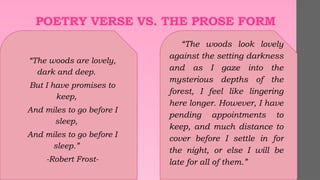
POETRY VERSE VS. THE PROSE FORM
“The woods are lovely,
dark and deep.
But I have promises to
keep,
And miles to go before I
sleep,
And miles to go before I
sleep.”
-Robert Frost-
“The woods look lovely
against the setting darkness
and as I gaze into the
mysterious depths of the
forest, I feel like lingering
here longer. However, I have
pending appointments to
keep, and much distance to
cover before I settle in for
the night, or else I will be
late for all of them.”
Common Types of Prose
1. Nonfictional Prose: A literary work like essays, biographies and
autobiographies that are mainly based on fact, though it may contain
fictional elements in certain cases.
2. Fictional Prose: Holistically or partially imagined stories like novels and
stories.
3. Heroic Prose: A literary work that might be recorded or recounted, and
which utilizes a significant number of the standard articulations found in
oral custom. Models are legends and stories. Epics and Legends may be
examples of this.
4. Prose Poetry: A literary work that shows poetic characteristics and nature
and utilizing passionate impacts and elevated symbolism. However these
are written in exposition rather than section.
WRAP-UP!
1. Define “literature” and explain its significance in
human culture.
2. What is genre in literature? Provide at least
three (3) examples of literary genres and briefly
describe their defining characteristics.
3. What is Prose? How does it differ from poetry?
4. What is the difference between fiction and non-
fiction prose? Give example of each.
A. Elements of Fictional Prose
I. SETTING - The time and location in which a story takes
place is called the setting. There are several aspects of a
story's setting to consider when examining how setting
contributes to a story (some, or all, may be present in a story):
a) place - geographical location.
b) time - When is the story taking place?
c) weather conditions - Is it rainy, sunny, stormy, etc?
d) social conditions - What is the daily life of the characters
like?
e) mood or atmosphere - What feeling is created at the
beginning of the story?
II. CHARACTER
People who take part in the story
Individuals that do the action in the story
The representation of a person in the story
Is revealed by the tone of voice
Occasionally, it could be an animal or object given human
qualities
There are two meanings for the word character:
The person in a work of fiction.
The characteristics of a person.
1. Protagonist – the chief figure who struggles against opposing
forces
2. Antagonist – the force, most often another character, that
opposes the protagonist
3. Dynamic Character – one whose attitudes and values are affected
by the events in the story
4. Flat Character – a character having only a single trait or quality
5. Round Character – a multi-dimensional or a complex character
6. Static Character – one whose personality, attitudes, and beliefs
remain fixed, no matter what kinds of situations he encounters

Creative Writing- Elements Techniques, and Literary Devices

  • 1.
    VARIOUS ELEMENTS, TECHNIQUES AND,AND LITERARY DEVICES IN VARIOUS MODES OF FICTION
  • 2.
    WHAT IS LITERATURE? -anywritten work; etymologically the term derives from Latin literatura/litteratura "writing formed with letters", although some definitions include spoken or sung texts.  FICTION: Short Stories, Novels, Fables, Fairy Tales  NONFICTION: Biographies, autobiographies, essays, journalism  POETRY: Sonnet, Haiku, Lyric Poetry, Free verse  DRAMA
  • 3.
    WHY LITERATURE IS IMPORTANT Servesas an art form used for expression Preserves cultural ideals, customs, and morals Give us a deeper context into the lives and livelihood of people distinct from ourselves
  • 4.
    "Literature adds toreality, it does not simply describe it. It enriches the necessary competencies that daily life requires and provides; and in this respect, it irrigates the deserts that our lives have already become." - C.S. Lewis, a British scholar and novelist
  • 5.
    What is genrezhän-rə French word which means "kind" or "sort is the term for any category of literature or other forms of art or entertainment -e.g. music, whether written or spoken, audial or visual, based on some set of stylistic criteria. •
  • 6.
    What is Prose? form of language that possesses ordinary syntax and natural speech rather than rhythmic structure  in which regard, along with its measurement in sentences rather than lines, it differs from poetry  Prose comprises of full grammatical sentences, which consist of paragraphs, and forgoes aesthetic appeal in favor of clear, straightforward language. It can be said to be the most reflective of conversational speech.  Some works of prose do have versification, and a blend of the two formats that is called “prose poetry.”
  • 7.
    POETRY VERSE VS.THE PROSE FORM “The woods are lovely, dark and deep. But I have promises to keep, And miles to go before I sleep, And miles to go before I sleep.” -Robert Frost- “The woods look lovely against the setting darkness and as I gaze into the mysterious depths of the forest, I feel like lingering here longer. However, I have pending appointments to keep, and much distance to cover before I settle in for the night, or else I will be late for all of them.”
  • 8.
    Common Types ofProse 1. Nonfictional Prose: A literary work like essays, biographies and autobiographies that are mainly based on fact, though it may contain fictional elements in certain cases. 2. Fictional Prose: Holistically or partially imagined stories like novels and stories. 3. Heroic Prose: A literary work that might be recorded or recounted, and which utilizes a significant number of the standard articulations found in oral custom. Models are legends and stories. Epics and Legends may be examples of this. 4. Prose Poetry: A literary work that shows poetic characteristics and nature and utilizing passionate impacts and elevated symbolism. However these are written in exposition rather than section.
  • 9.
    WRAP-UP! 1. Define “literature”and explain its significance in human culture. 2. What is genre in literature? Provide at least three (3) examples of literary genres and briefly describe their defining characteristics. 3. What is Prose? How does it differ from poetry? 4. What is the difference between fiction and non- fiction prose? Give example of each.
  • 10.
    A. Elements ofFictional Prose I. SETTING - The time and location in which a story takes place is called the setting. There are several aspects of a story's setting to consider when examining how setting contributes to a story (some, or all, may be present in a story): a) place - geographical location. b) time - When is the story taking place? c) weather conditions - Is it rainy, sunny, stormy, etc? d) social conditions - What is the daily life of the characters like? e) mood or atmosphere - What feeling is created at the beginning of the story?
  • 11.
    II. CHARACTER People whotake part in the story Individuals that do the action in the story The representation of a person in the story Is revealed by the tone of voice Occasionally, it could be an animal or object given human qualities There are two meanings for the word character: The person in a work of fiction. The characteristics of a person.
  • 12.
    1. Protagonist –the chief figure who struggles against opposing forces 2. Antagonist – the force, most often another character, that opposes the protagonist 3. Dynamic Character – one whose attitudes and values are affected by the events in the story 4. Flat Character – a character having only a single trait or quality 5. Round Character – a multi-dimensional or a complex character 6. Static Character – one whose personality, attitudes, and beliefs remain fixed, no matter what kinds of situations he encounters